Author: SLTMAKS Commercial Lighting Engineering Team
Target Audience: Commercial Cannabis Cultivators, Master Growers, Facility Managers, Agricultural Engineers
Reading Time: 15-20 Minutes
Table of Contents
Introduction: The High-Stakes Race of Commercial Cannabis Cultivation
In the highly competitive landscape of commercial cannabis cultivation, time is unequivocally tied to profitability. For master growers and facility managers operating large-scale indoor farms or sophisticated greenhouse environments, every single day shaved off a cultivation cycle without compromising yield or terpene profile represents a significant boost to the annual bottom line. The transition period between the vegetative stage and the flowering stage is one of the most critical bottlenecks in this process.
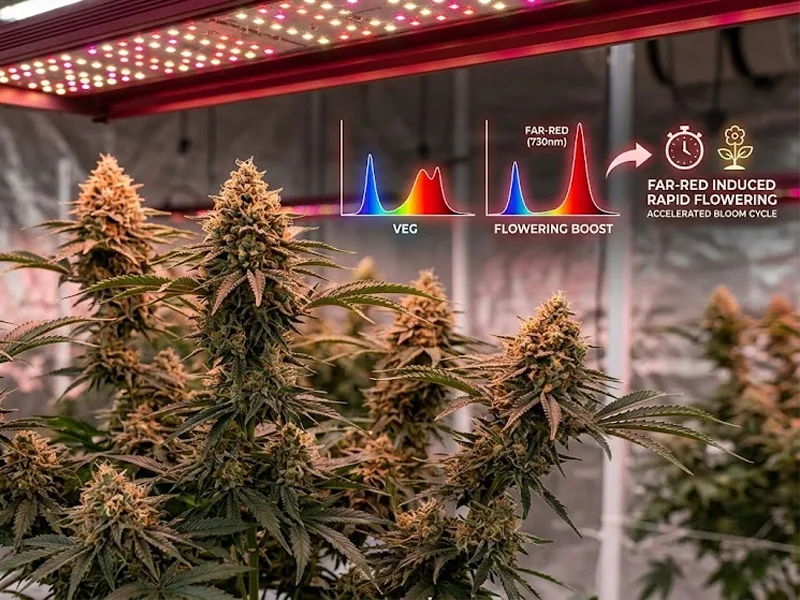
Traditionally, cultivators have relied on the standard 12/12 light cycle (12 hours of light, 12 hours of darkness) to signal the plant that autumn is approaching, thereby triggering the genetic command to produce flowers. However, modern photobiology has unlocked a more advanced, highly efficient tool: the strategic application of far-red light (typically peaking around 730nm).
Far-red light is no longer a fringe concept or a mere “supplement” in the world of commercial LED grow lights. It has emerged as a fundamental catalyst for photomorphogenesis—the light-mediated development of plants. Far-red light can be manipulated by manipulating the precise wavelengths of light that a cannabis plant receives, particularly at the beginning and end of the day. Cultivators can essentially “hack” the plant’s internal biological clock. This allows for faster transition times into the flowering stage, potentially shorter overall flowering periods, and optimized morphological development.
However, integrating far-red light into a commercial facility is not as simple as flipping a switch. Misunderstandings of the biological mechanisms, improper timing, and the use of subpar lighting equipment can lead to catastrophic crop failures, including severe etiolation (stretching), airy buds, and diminished yields.
As a premier B2B LED grow light manufacturer, SLTMAKS is dedicated to bridging the gap between cutting-edge photobiology and practical, industrial-scale agricultural engineering. Our mission is to provide commercial growers with not just hardware, but comprehensive cannabis cultivation lighting solutions. In this exhaustive guide, we will dissect the scientific mechanisms behind far-red light, detail its practical applications for rapid flowering, expose the most common operational mistakes, and guide you in selecting the optimal lighting systems to maximize your facility’s Return on Investment (ROI).
The Science Behind Far-Red Light and Cannabis Flowering
To truly leverage far-red light in a commercial setting, one must first understand the intricate biochemical language that plants use to interpret their environment. Plants do not have eyes; instead, they rely on highly sensitive photoreceptors to detect the presence, intensity, duration, and quality (spectrum) of light. For flowering, the most important of these photoreceptors are the phytochromes.
The Phytochrome System: The Pr vs. Pfr Dynamic Equilibrium
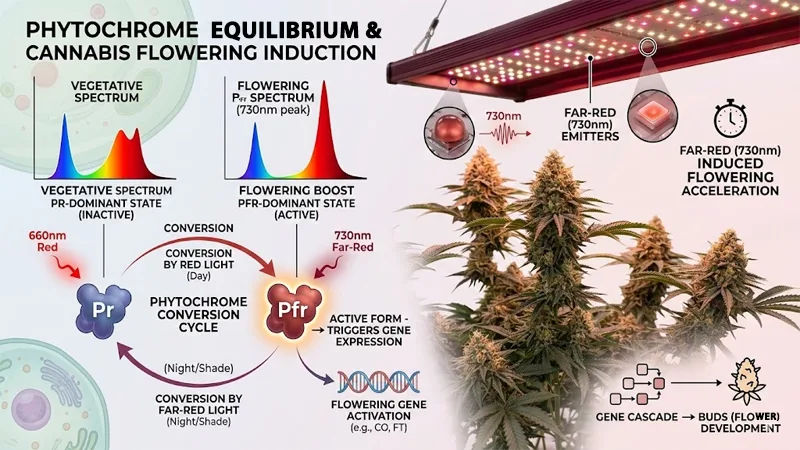
Phytochromes are a class of photoreceptor proteins found in the leaves of plants that act as biological light switches. They exist in two distinct, mutually reversible isoforms (states):
- Pr (Phytochrome Red): This form strongly absorbs red light, primarily around the 660nm wavelength. It is considered the biologically inactive form of the protein.
- Pfr (Phytochrome Far-Red): This form strongly absorbs far-red light, primarily around the 730nm wavelength. It is the biologically active form that triggers various physiological responses, including seed germination, stem elongation, and most importantly for our purposes, the regulation of flowering.
During the day, under the full spectrum of the sun (or highly engineered commercial LED grow lights), the plant is bombarded with both red and far-red light. However, natural daylight contains a significantly higher proportion of red light compared to far-red light (a high R: FR ratio). When the inactive Pr absorbs red light (660nm), it rapidly converts into the active Pfr form. Conversely, when the active Pfr absorbs far-red light (730nm), it converts back into the inactive Pr form.
Because daylight is rich in red light, the phytochrome equilibrium during the day is heavily skewed towards the active Pfr state.
Cannabis is classified as a short-day plant (more accurately, a long-night plant). This means that for the plant to initiate and sustain the flowering phase, it requires an uninterrupted period of extended darkness. The physiological trigger for flowering in short-day plants is not actually the absence of light, but rather the drop in the concentration of the active Pfr phytochrome below a specific critical threshold.
In a natural environment, or under standard lighting without far-red manipulation, when the sun goes down, or the lights turn off, the accumulated Pfr slowly undergoes a process called “dark reversion.” It gradually converts back into the inactive Pr state without the need for light absorption. This natural dark reversion is a slow metabolic process, often taking upwards of two hours. Only after these two hours does the plant “realize” it is nighttime and begin counting the dark hours required to trigger flowering hormones (like florigen).
The “Wake-to-Sleep” Transition: Accelerating the Biological Clock
This is where the magic of far-red light comes into play for commercial cultivators. By utilizing a technique known as End-of-Day (EOD) far-red treatment, growers can bypass the slow natural dark reversion process.
If a commercial grower exposes their cannabis plants to a short burst (typically 10 to 15 minutes) of pure far-red light (730nm) immediately after the primary vegetative or flowering lights are turned off, a rapid photo-conversion occurs. The active Pfr absorbs the massive influx of 730nm photons and is forcibly and instantaneously converted back into the inactive Pr state.
Instead of waiting two hours for the plant to chemically transition into its “night mode,” the EOD far-red treatment forces the plant to “go to sleep” within minutes. This means that out of a standard 12-hour dark cycle, the plant is experiencing a full 12 hours of deep physiological darkness, rather than just 10 hours. This rapid clearance of Pfr signals a stronger, more immediate short-day message to the plant, inducing the flowering stage days—and sometimes up to a week—faster than natural light cycles.
The Emerson Enhancement Effect: Synergizing Photosynthesis
Beyond photomorphogenesis and flowering triggers, far-red light plays a crucial role in the raw engine of plant growth: photosynthesis. For decades, it was believed that Photosynthetically Active Radiation (PAR) ended strictly at 700nm. Wavelengths beyond this were considered essentially useless for driving photosynthesis.
However, in the late 1950s, scientist Robert Emerson discovered a phenomenon that would change photobiology forever. He observed that exposing plants to red light (around 680nm) and far-red light (greater than 700nm) simultaneously produced a rate of photosynthesis that was significantly higher than the sum of the rates produced by each wavelength independently. This synergistic phenomenon is known as the Emerson Enhancement Effect.
Modern science explains this by the presence of two distinct photosystems in the chloroplasts: Photosystem II (PSII), which is optimally driven by red light (680nm), and Photosystem I (PSI), which is optimally driven by longer wavelengths, including far-red light (up to about 730nm). When both photosystems are excited simultaneously by a balanced spectrum of red and far-red light, the electron transport chain operates at peak efficiency.
For the modern commercial cultivator using advanced wholesale plant grow lights, this means that including a carefully calibrated percentage of far-red light in the main daytime spectrum (not just at the end of the day) can significantly boost overall carbon assimilation, leading to thicker stems, broader leaves, and ultimately, heavier biomass and yield.
Practical Application for Commercial Cultivators
Understanding the science is only the first step. The true test of a master grower is translating that science into scalable, repeatable Standard Operating Procedures (SOPs) within a commercial facility. Here is how top-tier operations utilize far-red light via professional cannabis cultivation lighting solutions.
Inducing Rapid Flowering via EOD Treatments
The most direct application of far-red technology is the End-of-Day (EOD) treatment.
- The SOP: Facilities install dedicated far-red light bars or utilize commercial LED grow lights with independently controllable spectral channels (a hallmark of SLTMAKS engineering).
- Execution: Exactly when the primary full-spectrum lights power down for the day, the 730nm far-red channels are activated for exactly 10 to 15 minutes.
- The result: The plants transition into the dark phase immediately. This strong biological signal reduces the transition time from the vegetative stage to the appearance of the first pistils (pre-flowers) by several days. Over hundreds of tables or thousands of square feet, shaving 3 to 5 days off a cycle is a massive commercial advantage.
Manipulating the Photoperiod to Increase DLI
Daily Light Integral (DLI) is the total amount of photosynthetically active photons delivered to a specific area over 24 hours. Higher DLI generally correlates with higher yields, provided other environmental factors (VPD, CO2, nutrients) are optimized.
In a standard flowering cycle, growers are restricted to a 12/12 light schedule to keep Pfr levels low enough to maintain flowering. This limits the total DLI they can push into the room. However, because EOD far-red treatments put the plant to sleep instantly, some advanced cultivators experiment with extending the daylight hours.
By using EOD far-red, some commercial growers successfully run a 13/11 or even a 13.5/10.5 photoperiod during the flowering stage. The extra 1 to 1.5 hours of high-intensity light per day drastically increases the cumulative DLI over a 60-day flowering cycle. Because the far-red treatment ensures the plant still perceives a “long night” (by accelerating the start of the dark period), the cannabis plants remain firmly in the generative (flowering) phase while absorbing significantly more energy for bud swelling.
Enhancing Canopy Penetration and Lower Bud Development
Cannabis is a notoriously light-hungry plant, and one of the biggest challenges in commercial indoor cultivation is light penetration. Full-spectrum white light and blue light are heavily absorbed by the upper canopy leaves. By the time the light reaches the lower third of the plant, the intensity is drastically reduced, leading to undeveloped “larf” (airy, low-quality buds) that are financially worthless in the premium market.
Far-red light (730nm) has a longer wavelength and lower energy than blue or red light. Physics dictates that longer wavelengths possess greater penetrative power through plant tissue. Far-red photons can transmit through the dense upper canopy leaves, reaching the lower bud sites.
When the lower canopy receives this far-red light, combined with scattered ambient light, the Emerson Enhancement Effect is triggered in the lower leaves. This allows the lower portions of the plant to maintain active photosynthesis, supporting the development of denser, heavier, and more marketable buds lower on the stalk, thereby increasing the total sellable yield per square meter.
Managing the Shade Avoidance Syndrome (SAS)
When plants are crowded together—as they always are in profitable commercial setups—they compete for light. Because leaves absorb red light but transmit and reflect far-red light, the light environment beneath a dense canopy becomes incredibly rich in far-red light and poor in red light (a low R: FR ratio).
Plants detect this low R: FR ratio via their phytochromes and interpret it as being shaded by competitors. This triggers the Shade Avoidance Syndrome (SAS). The plant’s immediate response is to stretch upward rapidly (internodal elongation) to outcompete its neighbors for sunlight.
In commercial cultivation, excessive stretching is undesirable. It leads to weak stems that cannot support heavy colas, pushes plants too close to the light fixtures (causing light burn), and creates an uneven canopy that is difficult to manage. However, controlled stretching during the first two weeks of flower (the “stretch phase”) is necessary to create internodal spacing for massive cola development.
Master growers use precise commercial LED grow lights to manipulate this. By slightly increasing the far-red ratio during the first 10 days of the flowering cycle, they can encourage a healthy, open plant structure. Once the stretch phase is complete, they reduce the far-red output to suppress further elongation, focusing the plant’s energy entirely on dense floral biomass production.
Common Practical Mistakes in Commercial Facilities
While the benefits of far-red light are undeniable, the margin for error in large-scale agriculture is razor-thin. At SLTMAKS, our agronomy support team frequently consults with facilities that have attempted to implement far-red technology but failed due to critical operational misunderstandings. Here are the most costly mistakes commercial cultivators make.
Mistake 1: Excessive Use Resulting in Catastrophic Etiolation (Stretching)
The most common and devastating mistake is throwing arbitrary amounts of far-red light at a crop without understanding the Red to Far-Red (R: FR) ratio. Some growers purchase cheap supplemental far-red bars and run them constantly throughout the day cycle alongside their main lights.
The consequence: If the R: FR ratio drops too low during the vegetative or mid-flowering stages, the Shade Avoidance Syndrome goes into overdrive. The plants experience severe etiolation. The internodal spacing becomes massively stretched, resulting in tall, spindly plants with weak cellular walls. These plants inevitably collapse under the weight of their own buds later in the cycle, requiring immense labor costs for trellising and support. Furthermore, energy that should have been directed toward root development and lateral branching is wasted on useless vertical stem growth. Yields drop, and the canopy becomes an unmanageable jungle.
Mistake 2: Incorrect Timing Across Growth Stages
Far-red light is a powerful morphogenic tool, but it is not a “one size fits all” application across the plant’s life cycle.
- Cloning/propagation: Exposing fragile clones to high levels of far-red light is a severe error. Clones need to focus strictly on root development. A low R: FR ratio (too much far-red) will signal the cutting to stretch its stem instead of pushing out roots, leading to high mortality rates in the nursery.
- Seedling stage: Similarly, young seedlings exposed to excessive far-red will stretch wildly, becoming “leggy” and prone to damping-off diseases. They lack the structural integrity to survive.
- Late flower ripening: While far-red is excellent for initiating flower and boosting photosynthesis, excessive use in the final two weeks of the flushing/ripening phase can sometimes cause foxtailing (abnormal, airy floral growth protruding from the main bud) in sensitive cultivars.
Mistake 3: Chasing Far-Red While Ignoring Total DLI and PPFD
Photobiology is holistic. A common trap for facility managers is obsessing over spectral tuning (like adding far-red) while neglecting the foundational metrics of light intensity: Photosynthetic Photon Flux Density (PPFD) and DLI.
The consequence: You can have the most scientifically perfect, Emerson-Effect-inducing spectrum in the world, but if your overall PPFD is only 500 µmol/m²/s during peak flower (when the plants can handle 1000+ µmol/m²/s with elevated CO2), your yields will be abysmal. Far-red light is an enhancer of a high-performance system; it is not a replacement for raw photonic horsepower. Growers must ensure their commercial LED grow lights deliver massive, uniform PPFD first, and treat the far-red spectrum as the fine-tuning mechanism to push the crop past its standard genetic limits.
Mistake 4: Utilizing Substandard “Wholesale Plant Grow Lights” with Uneven Distribution
The commercial lighting market is flooded with low-cost, low-quality imports masquerading as professional fixtures. A major issue with cheap LED fixtures that claim to include far-red diodes is poor engineering and optical design.
The Consequence: In a poorly engineered fixture, the 730nm diodes are often clustered in the center or spaced too far apart without proper secondary optics. Because far-red light is invisible to the human eye, the grower cannot see that the light distribution is wildly uneven. Plant A, sitting directly under a far-red diode cluster, gets forced into rapid flowering, while Plant B, sitting 18 inches away under the same fixture, receives almost no far-red photons and transitions slowly.
This results in an uneven canopy, staggered harvest times, and inconsistent bud quality across the same table. In a commercial facility where uniformity and predictable harvest dates are the bedrock of operational efficiency, uneven spectral distribution is an absolute operational nightmare. This is why partnering with a reputable B2B LED grow light manufacturer that guarantees uniform PPFD and spectral mapping is non-negotiable.
Choosing the Right Commercial LED Grow Lights with Far-Red Integration
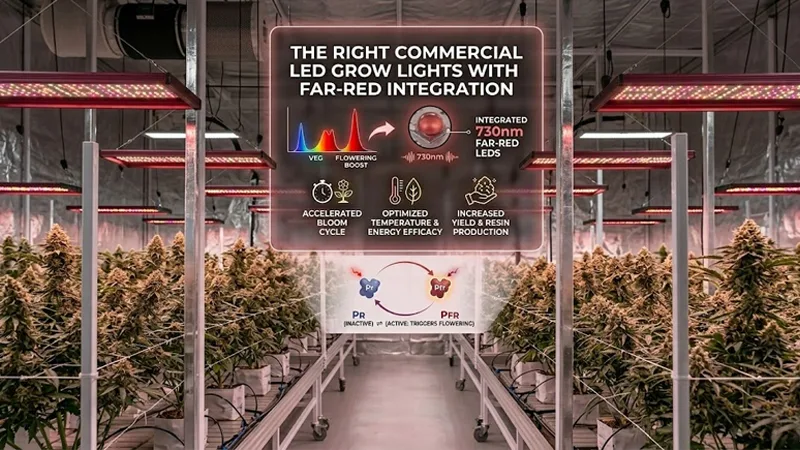
To successfully harness the power of far-red photomorphogenesis without falling victim to the mistakes outlined above, facility managers must be incredibly discerning when procuring hardware. The specifications of your lighting infrastructure will dictate your cultivation limits for the next 5 to 7 years. When evaluating cannabis cultivation lighting solutions, here is what commercial buyers must demand from their manufacturers.
Customizable and Independent Spectral Channels
The era of fixed-spectrum “blurple” or static white LEDs is over for top-tier commercial facilities. Because the plant’s requirements for far-red light change drastically from propagation to the stretch phase to late flower, your lighting system must be adaptable.
When sourcing wholesale cannabis grow lights, look for fixtures that offer independent channel control. Specifically, the main full-spectrum (white/red) array should be on one dimmable channel, while the UV and Far-Red (730nm) diodes should be on entirely separate, programmable channels.
This is a core engineering philosophy at SLTMAKS. By offering independent control, the grower can:
- Keep far-red entirely off during cloning and early veg.
- Blend in 5-10% far-red during mid-veg to increase leaf size and Emerson Effect photosynthesis.
- Blast pure 730nm for 15 minutes at the end of the day to trigger rapid flowering.
- Automate these light recipes via a master centralized control system.
Diode Quality, Efficacy (PPE), and Thermal Management
Adding far-red diodes to a fixture generates additional heat and alters the overall electrical efficiency of the unit. Commercial growers must look at the Photosynthetic Photon Efficacy (PPE), measured in µmol/J.
Cheap wholesale plant grow lights often use generic, low-bin far-red diodes that degrade rapidly and produce excessive heat. This not only lowers the lifespan of the fixture but drastically increases the HVAC load in the grow room, destroying profit margins through electricity costs.
A professional B2B LED grow light manufacturer like SLTMAKS utilizes only top-bin diodes (from trusted brands like Osram or Samsung) specifically engineered for horticultural longevity. Furthermore, robust passive thermal management (heavy-duty extruded aluminum heat sinks) ensures that the diodes operate well below their maximum junction temperatures. This guarantees that the far-red spectral output remains consistent year after year, cycle after cycle.
The SLTMAKS Advantage: Engineering for the B2B Market
SLTMAKS does not build lights for hobbyists in grow tents; we engineer industrial equipment for commercial facilities. When you invest in SLTMAKS lighting solutions, you are securing:
- Precision optical engineering: Our fixtures are designed with advanced secondary optics to ensure that the far-red spectrum is distributed perfectly evenly across the entire 4×4 or 5×5 canopy footprint. No hot spots, no cold spots—just total uniformity.
- Commercial certifications: Our fixtures carry UL, cUL, DLC, and CE certifications. This ensures compliance with local commercial building codes and makes your facility eligible for massive state and utility energy rebates, significantly lowering upfront CapEx.
- Custom light recipes: We don’t just sell hardware; our photobiology team works with your master growers to develop custom lighting schedules and DLI targets tailored to your specific cannabis cultivars.
ROI Analysis for B2B Clients: The Financial Impact of Far-Red
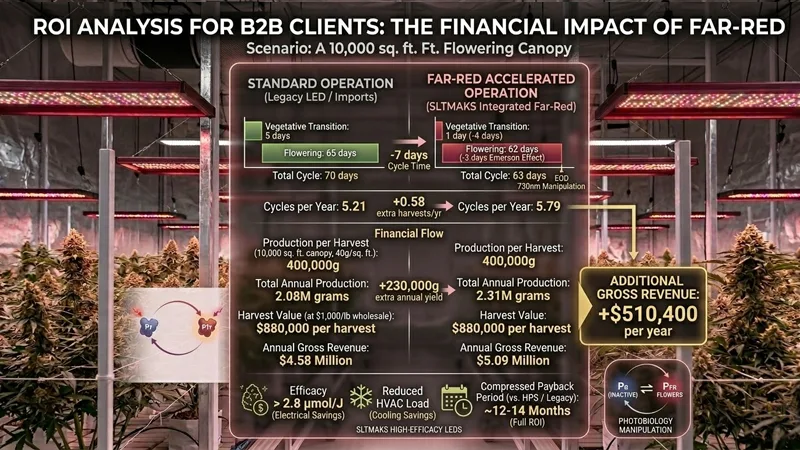
In B2B agriculture, every equipment purchase must be justified by a rigorous Return on Investment (ROI) model. Let’s examine how the correct application of far-red light directly impacts a commercial facility’s profitability.
Scenario: A 10,000 sq. ft. Ft. Flowering Canopy
- Standard operation: Without far-red manipulation, a typical flowering cycle for a commercial strain takes 65 days. Add 5 days for the transition/ramp-up period. Total time in the flowering room: 70 days.
- Cycles per year: 365 days / 70 days = 5.21 harvests per year.
The Far-red accelerated operation:
- By implementing EOD 730nm treatments using SLTMAKS controllable fixtures, the plant transitions to flower instantly. The facility shaves 4 days off the transition period. Furthermore, the enhanced photosynthesis (Emerson Effect) slightly accelerates maturation, shaving another 3 days off the backend of the cycle.
- New cycle time: 70 days – 7 days = 63 days.
- New cycles per year: 365 days / 63 days = 5.79 harvests per year.
The financial translation: That is an increase of 0.58 extra harvests per year. If the 10,000 sq. ft. canopy produces 40 grams per square foot per harvest, that is 400,000 grams (approx. 880 lbs) per harvest. At a wholesale price of $1,000 per pound, one harvest is worth $880,000. An extra 0.58 of a harvest equates to an additional $510,400 in gross revenue per year, from the same square footage, simply by manipulating the photobiology with the correct light spectrum.
Furthermore, because modern LED systems from SLTMAKS run highly efficiently (often exceeding 2.8 µmol/J), the electrical and HVAC cooling savings compared to legacy HPS lighting or cheap LED imports further compress the payback period of the lighting equipment, often resulting in full ROI in under 12 to 14 months.
Conclusion
The integration of far-red light (730nm) is no longer an experimental luxury; it is a fundamental requirement for any commercial cannabis facility striving for maximum operational efficiency. By understanding the phytochrome dynamics, leveraging the Emerson Enhancement Effect, and executing precise End-of-Day treatments, cultivators can seize absolute control over their plants’ biological clocks.
However, as we have explored, the line between maximizing yield and inducing catastrophic crop failure is incredibly thin. Avoiding common mistakes—like improper R: FR ratios, incorrect timing, and reliance on poorly engineered fixtures—is paramount. Success requires not just a fundamental understanding of photobiology, but the implementation of industrial-grade, precision-engineered commercial LED grow lights.
Are you ready to optimize your facility’s photobiology and maximize your annual yield?
Do not leave your facility’s revenue to chance with generic lighting. SLTMAKS is your dedicated B2B LED grow light manufacturer and partner in horticultural excellence. Our team of lighting engineers and agronomists is ready to assist you.
- Need a customized lighting layout design for your new greenhouse or indoor tier system?
- Want a free spectral consultation for your specific cannabis genetics?
- Looking for competitive wholesale pricing and rebate-eligible fixtures?
Contact the experts at SLTMAKS today. Let us help you engineer the perfect light recipe for your commercial success.
[Contact SLTMAKS Sales & Engineering Team Here]
How does far-red light accelerate the cannabis flowering stage?
Far-red light (730nm) manipulates the plant’s phytochromes. By using End-of-Day (EOD) treatments with professional commercial LED grow lights, growers can instantly put plants to “sleep,” bypassing the slow natural dark transition. This can speed up the flowering cycle by up to a week, significantly boosting your annual ROI.
Can far-red light improve lower canopy bud development and overall yield?
Yes. Far-red wavelengths have superior penetrative power through the upper canopy. When integrated into advanced cannabis cultivation lighting solutions, it triggers the Emerson Enhancement Effect in lower leaves, boosting photosynthesis and transforming airy lower buds (larf) into dense, marketable yields.
What is the most common mistake when using far-red light in commercial facilities?
The biggest mistake is running uncontrolled far-red light constantly, which causes severe stem stretching (etiolation) and weak plants. As a premier LED grow light manufacturer, we engineer fixtures with independent, programmable far-red channels so you can apply specific light recipes precisely without ruining your canopy structure.
How does far-red light allow growers to increase Daily Light Integral (DLI)?
Because EOD far-red treatments force plants into the night phase immediately, cultivators can safely extend their daytime light cycle (e.g., a 13.5/10.5 schedule) during flowering. High-quality wholesale plant grow lights can then deliver a higher total DLI per day, resulting in heavier biomass and massive bud swelling.
Why is a uniform far-red distribution critical when choosing a lighting supplier?
Cheap fixtures often cluster far-red diodes poorly, leading to uneven canopies and staggered harvest times. Working with an expert in the plant grow light manufacturing industry guarantees precision optical engineering, ensuring every plant receives the exact same uniform spectrum for predictable, commercial-scale results.