Introduction
High-wire cucumber crops have become an exercise in vertical resource management. The canopy is tall, the fruiting zone sits in a band that’s easy to shade, and energy costs make “just add more top light” an expensive habit.
Inter-lighting matters now because it changes where the photons land. Instead of forcing the top leaves to absorb (and waste) most of the supplemental light, inter-lighting pushes usable light into the mid and fruiting zones—where leaf area is still photosynthetically capable but often underserved by overhead fixtures.
A hybrid strategy (top + inter) is fundamentally about uniformity: top light drives the upper canopy; inter-lighting helps keep the fruiting zone productive and can reduce the “top-heavy” PPFD distribution that often shows up in tall crops. Philips summarizes the core mechanism well: placing light inside the canopy helps lower leaves become productive rather than net consumers in high-wire crops (“3 reasons why intercanopy lighting is effective for high-wire vegetables”).
In this article, you’ll learn the practical design decisions that determine whether cucumber inter-lighting pays off: spectrum options, PPFD and DLI setpoints, placement geometry, controls, energy KPIs, and compliance and safety checks.
Table of Contents
When Cucumber Inter-Lighting Pays
Production scenarios that benefit
Inter-lighting tends to pay in scenarios where canopy geometry creates a predictable shadow problem:
- High-wire cucumbers with dense mid-canopy leaf layers. If your PPFD maps or in-canopy sensors show a steep drop from top to fruiting zone, you’re the typical “hybrid-fit” operation.
- Facilities that already run meaningful top light. Inter-lighting is often an optimization and redistribution tool—improving where photons go, not only how many you buy.
- Operations are chasing tighter grade consistency. When the fruiting zone sees more stable light, size and class distribution often become easier to manage (especially when paired with climate discipline).
A practical tell: if you’re routinely pruning or defoliating to “open light paths” yet still see lower-canopy underperformance, inter-lighting can reduce how much canopy management is purely compensating for light distribution.
Seasonal and climate considerations
Inter-lighting shows its value most clearly when natural light is the constraint:
- Winter and shoulder seasons are when daily light integral (DLI) drops, and you’re trying to keep production predictable.
- Dark-day supplementation, where you want a controllable photon boost without overheating the headspace.
Cucumbers are commonly framed as high-light crops, with many commercial references citing DLI targets around 20–35 mol·m⁻²·day⁻¹ depending on cultivar, season, and strategy (see Heliospectra’s “Greenhouse cucumbers: high light vegetable series”). The practical point isn’t one magic DLI number—it’s running a system that can fill the DLI gap efficiently when the sun falls short.
Yield and quality outcomes to expect
Expectations should be calibrated to what you’re actually changing:
- If you increase total photons (higher total PPFD/DLI), yield can rise substantially.
- If you redistribute photons without increasing total light, gains are typically more about uniformity, fruiting-zone performance, and stability.
Research summaries report meaningful yield and fruit-number improvements when intercanopy lighting is added in cucumber systems, but you should read comparisons carefully because some trials change both intensity and distribution. For example, Hortidaily summarizes a study where combined top + intercanopy strategies were tested at different total PPFD levels, with the combined strategy described as roughly a 2/3 top and 1/3 inter split (“Higher yields with combined intercanopy and top light high-intensity strategy, research shows”).
On the practical side, AAFC Harrow mini-cucumber trials discussed by ONGreenhouseVegetables found that adding LED inter-lighting improved early yield and fruit visual quality, with outcomes depending on intensity and plant density.
Spectrum and Intensity Design
Red/blue/far-red mixes that work
For cucumbers, spectrum decisions should be framed as “what do we need to control?” rather than chasing a single recipe.
- Red-dominant with some blue is a common base for inter-lighting because it’s photosynthetically efficient and supports normal morphology. Industry guidance commonly describes intercanopy spectra built around red with a small amount of blue for development.
- Far-red can be useful seasonally or by cultivar, but it’s also where “spectrum claims” can get sloppy. Treat far-red as a controlled variable: trial it, measure morphology and fruit response, and avoid assuming the same ratio fits every cultivar and climate.
Blue has a role beyond morphology; peer-reviewed work also discusses how blue supplemental light can influence stomatal behavior and photoprotection responses in cucumbers (see “Acclimating Cucumber Plants to Blue Supplemental Light…” (2021)). That doesn’t mean “more blue is always better”—it means spectrum should be managed with clear intent.
PPFD targets by canopy layer
The most useful way to think about setpoints in a hybrid system is by canopy layer:
- Upper canopy (top lighting plane): supplies baseline photon flux and sets the overall DLI trajectory.
- Fruiting zone / mid-canopy (inter-lighting plane): adds PPFD where top light attenuates fastest and where fruiting performance is often constrained.
Many operations start by using inter-lighting to fix a vertical “PPFD cliff” rather than to chase the highest possible number. In practice, you’ll set a target band for the fruiting zone PPFD (measured at representative leaf planes) and then tune top lighting so total DLI goals are met without over-driving the head.
If you’re trying to standardize measurements across facilities, explicitly label your readings as intercanopy lighting PPFD (where and how it was measured), not only a generic “PPFD,” so teams don’t accidentally compare different planes or canopy states.
Pro Tip: Don’t argue about PPFD in isolation. Start with a DLI target, then decide what portion should be delivered from the top vs inside the canopy based on vertical uniformity and heat risk.
If you want a simple way to translate daily targets into setpoints, SLTMAKS lays out a quick conversion and examples in SLTMAKS “Most Efficient LED Grow Lights”:
- DLI (mol·m⁻²·day⁻¹) ≈ PPFD (µmol·m⁻²·s⁻¹) × photoperiod (hours) × 3600 / 1,000,000
Use that to convert a DLI gap (what you’re short after sunlight) into an average PPFD requirement for your lighting window. Document the resulting cucumber DLI target and the lighting hours used in the calculation so your setpoints stay auditable.
Avoiding over-lighting and heat load
Over-lighting is rarely a single-threshold event in a greenhouse. It shows up as a cluster of symptoms and operational signals:
- Leaf stress responses (bleaching-like symptoms, curling, reduced vigor)
- Higher transpiration demand without matching CO₂ / irrigation capacity
- Localized canopy warming near fixtures (even with LEDs)
The most reliable prevention approach is operational:
- Ramp inter-lighting after canopy fill. Early in crop development, inter-lighting can be less effective because there isn’t enough leaf area in the target zone to capture the photons efficiently.
- Use dimming to manage bright days. If sunlight is high, keep inter-lighting from stacking excessive PPFD in already-saturated tissue.
- Measure at the fruiting zone, not only at the top. Hybrid systems can look “fine” at the head while the fruiting zone swings.
Fixture Placement and Uniformity for Cucumber Inter-Lighting
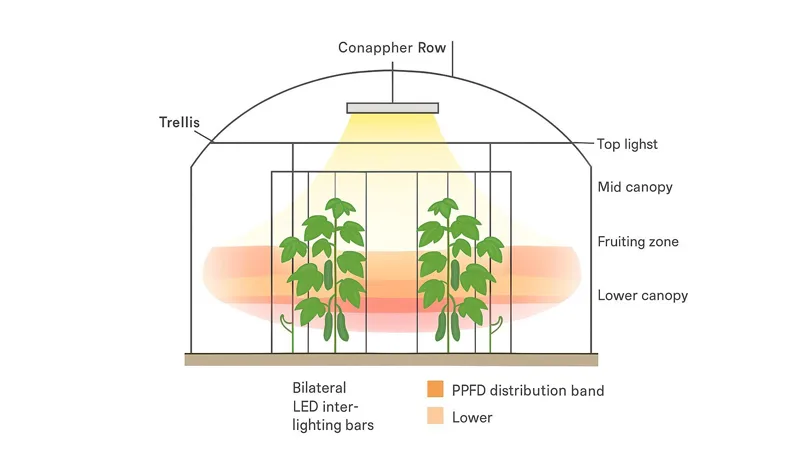
Bilateral mounting and spacing
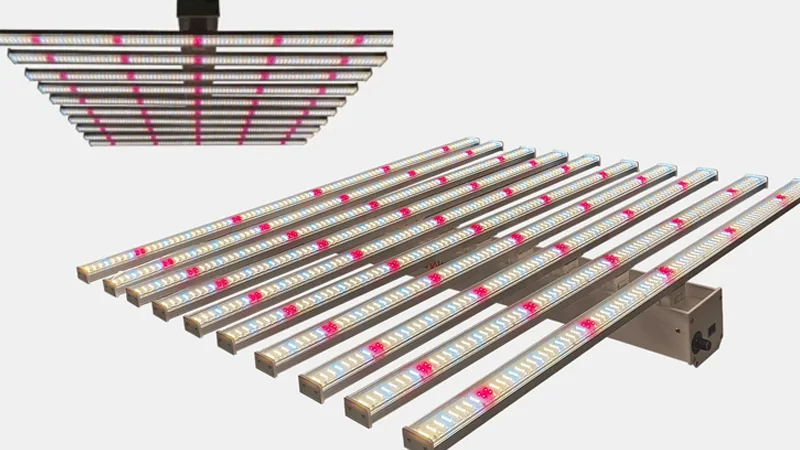
Bilateral mounting (one bar on each side of the row) is common because it reduces “one-sided” growth bias and evens out the fruiting-zone PPFD field.
This is where LED interlighting bar placement becomes a measurable engineering decision, not an aesthetic one: define the target zone (fruiting leaves), pick a bar height band that follows that zone through the season, then verify continuity with a PPFD sweep.
A simple spacing logic that holds up in real greenhouses:
- Start with symmetry: same bar count, height, and offset on both sides of the row.
- Space bars so adjacent segments overlap enough to avoid dark seams in the harvest zone.
- Validate spacing using measurements: a PPFD map or in-canopy sensor sweep is more reliable than a rule-of-thumb distance.
OnGreenhouseVegetables describes AAFC Harrow mini-cucumber trials where inter-lighting modules were placed at mid-canopy height and, in one setup, two modules were spaced 40 cm apart to create a combined in-canopy intensity band (“Finding the Right Light Recipe”). Treat that as an example of how researchers operationalize the idea: define the target zone, then position fixtures to create a continuous band of useful PPFD.
Height, angle, and cable management
Placement should be designed around the fruiting zone as it moves:
- Height: mount bars so the emitting surfaces align with the active fruiting leaf layers—then plan for how that zone shifts with pruning and vine lowering.
- Angle: most inter-light bars are designed to emit laterally; avoid tilting in ways that create hotspots on a single leaf plane.
- Cable management: assume humidity, washdown, and labor contact. Route cables away from pinch points, provide strain relief, and keep connectors positioned so they’re not sitting in drip lines.
⚠️ Warning: “Uniform PPFD” isn’t only a crop-quality goal. It’s also energy control. Hotspots force you to dim or raise fixtures, which can leave the rest of the canopy underlit.
If you need a concise refresher on how distribution drives efficiency and how to compare layouts fairly, SLTMAKS summarizes practical PPFD-map interpretation (including why height and footprint must match) in their “Most Efficient LED Grow Lights” guide.
Integration with trellising and labor flow
Inter-lighting succeeds when it doesn’t fight the workflow:
- Keep harvest paths clear and avoid mounting that forces repeated detours.
- Protect bars from cart impacts and routine canopy tasks.
- Coordinate bar height with trellis clips, pruning routes, and vine-lowering operations.
As a contextual example (not a vendor pitch): teams like SLTMAKS that do spectrum and placement work for commercial facilities typically treat installation geometry as an engineering deliverable—PPFD maps, mounting heights, cable routing drawings, and “how-to-measure” notes—because those documents make it easier for cultivation, facilities, and EHS to agree on a layout before hardware hits the greenhouse.
Controls, Energy, and ROI
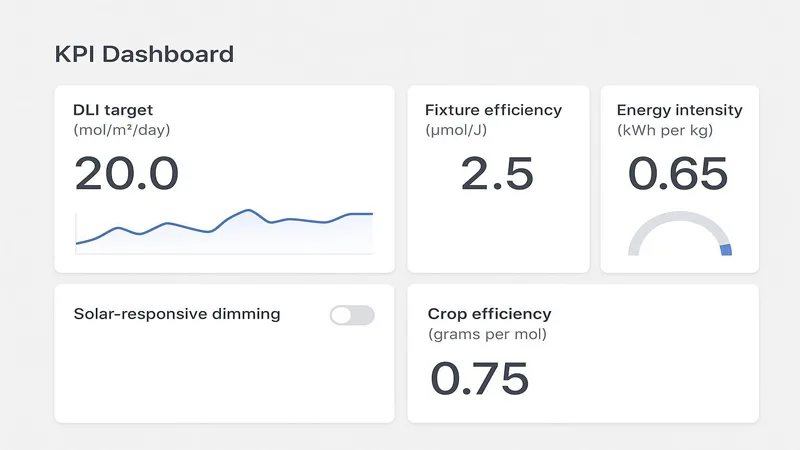
Solar-responsive dimming and day-parting
The control goal is simple: hit a consistent DLI without stacking light wastefully on bright days.
Operationally:
- Use sunlight sensors (or PAR sensors) to modulate output so greenhouse cucumber supplemental lighting fills the DLI gap.
- Consider day-parting: run more inter-lighting during the darkest windows (morning/evening, storm fronts) and taper when solar contribution rises.
This approach aligns with a DLI-first mindset: in greenhouses, sunlight provides a variable baseline, so supplemental light is often most efficient when it fills the DLI gap rather than pushing maximum PPFD regardless of conditions.
Energy benchmarks and payback drivers
A credible ROI discussion in greenhouse cucumber inter-lighting should use drivers you can actually measure:
- Fixture efficacy (µmol/J): how efficiently electricity becomes photons
- Delivered photon efficiency: how many photons actually land in the target canopy zone (distribution)
- Crop response (grams per mol): how effectively the crop turns photons into marketable product
- Energy intensity (kWh/kg): what operations ultimately pay for
Payback is usually pulled by some combination of:
- Improved marketable yield and class distribution (fewer “weak zones”)
- Reduced the need to overdrive top lighting to compensate for shading
- Better controllability (dimming reduces waste and heat risk)
Keep the model honest: if you change CO₂ setpoints, temperature, or cultivar at the same time, you’ve changed the baseline. Your trial design should isolate what the lighting change actually did.
Data logging and sensor placement
You can’t manage what you don’t measure.
Minimum viable measurement for a hybrid system:
- One sensor plane in the fruiting zone (where inter-lighting should move the needle)
- One sensor plane near the top (to keep the total DLI trajectory in check)
- Power logging at the lighting circuits (for kWh tracking)
Log at a frequency that captures solar variability (minutes, not hours) and keep notes on canopy state (pruning, lowering cycles). These are often the hidden variables when growers claim “the lights didn’t work.”
Risk Management and Compliance
Humidity pockets and disease prevention
Inter-lighting changes the air movement inside the canopy. Even if LEDs run cooler than legacy sources, fixtures and cables can still create micro-obstructions that encourage humidity pockets.
Practical risk controls:
- Validate airflow through the fruiting zone (smoke tests or anemometer checks during typical operation)
- Keep sanitation-compatible mounting: smooth surfaces, accessible wipe-down points, no connector “nests.”
- Coordinate lighting schedules with irrigation and dehumidification strategy so you don’t stack transpiration demand and high RH at the same time
Safety standards: IP, UL/ETL, NEC/OSHA
For commercial greenhouses, “works for plants” isn’t the finish line. You need inspection-ready electrical safety.
Define the acronyms on first use:
- IP (Ingress Protection): describes dust/water ingress resistance; choose for your wet/humid and cleaning realities.
- NRTL (Nationally Recognized Testing Laboratory): the U.S. framework for third-party safety certification.
- UL/ETL: common NRTL listing marks; in horticulture, standards such as UL 8800 are widely referenced for horticultural lighting environments.
- NEC (National Electrical Code) and OSHA (Occupational Safety and Health Administration): govern electrical installation practices and workplace safety.
If you want an operator-friendly overview of what documentation and certifications to demand, SLTMAKS summarizes key gates (including UL 8800 and DLC context) in SLTMAKS “Best LED Grow Lights 2026”. Final acceptance always depends on your Authority Having Jurisdiction (AHJ) and a qualified electrician.
Sanitation and maintenance intervals
Treat inter-lighting like greenhouse equipment, not like a “set and forget” electronics install.
A simple, workable cadence:
- Visual inspection weekly (cable strain relief, connector seals, mounting integrity)
- Cleaning at intervals that match your spray/condensation reality (and immediately after any disease event)
- Photometric spot-checks after major canopy workflow changes (new cultivar, density shift, trellis method change)
KPIs and Continuous Improvement
Yield, Class 1%, and uniformity indices
To judge success, track both outcome and distribution:
- Yield per m² and per lighting hour
- Class 1 percentage (your top-grade definition)
- Within-row and between-row uniformity (PPFD variability across the fruiting zone)
Uniformity isn’t a “nice-to-have” metric. If the fruiting zone has weak pockets, you’ll often see it first in grade drift and labor inefficiency (more sorting, more inconsistent picking).
Electrical efficiency and kWh/kg tracking
Bring lighting metrics back to the language of operations:
- µmol/J for fixture efficiency
- grams per mol for crop photon conversion
- kWh/kg for true energy intensity
The most useful dashboard is the one that ties these together: if grams per mol improves but kWh/kg doesn’t, something in controls or climate is offsetting the gain.
Trialing and scaling playbook
A disciplined scale-up beats a full-house retrofit based on one good week.
- Start with a pilot zone that includes the known “hard areas” (end rows, near doors, colder bays)
- Hold constant what you can: cultivar, CO₂ policy, and major climate targets
- Ramp inter-lighting in steps, and document the canopy condition at each step
- When results are stable, standardize the layout as an installation spec (mounting height, offsets, cable routes, sensor points)
Conclusion
Inter-lighting isn’t magic; it’s geometry and control discipline applied to a tall, self-shading crop. When you combine top lighting (to drive total DLI) with well-placed inter-lighting (to stabilize the fruiting zone), you’re typically buying three things: more uniform canopy productivity, tighter quality outcomes, and a clearer path to energy optimization.
Next steps to validate your plan on-site:
- Confirm your current DLI gap and convert it into a realistic PPFD setpoint using the DLI formula (and keep it solar-responsive)
- Measure PPFD in the fruiting zone before and after inter-lighting, not only at the canopy top
- Build an inspection-ready design checklist (IP rating choice, NRTL listing, cable routing, cleaning access)
- Run a structured pilot and judge it by KPIs that operations cares about: grams per mol and kWh/kg, alongside yield and grade
FAQ
Why is inter-lighting necessary if I already have high-intensity top lighting?
In high-wire cucumber crops, the dense upper canopy acts as an umbrella, creating a “PPFD cliff” where light levels drop drastically in the middle and lower zones. Even powerful top lights cannot efficiently penetrate these layers. Inter-lighting changes where the photons land, delivering usable light directly to the fruiting zone. This keeps mid-canopy leaves photosynthetically productive rather than allowing them to become net energy consumers.
What is the ideal balance between top lighting and inter-lighting?
While specific needs vary by cultivar and climate, a common commercial benchmark is a 2/3 top and 1/3 inter-lighting split. The top lights drive the overall growth trajectory and Daily Light Integral (DLI), while the inter-lighting bars stabilize the fruiting zone. The goal is to create vertical uniformity, preventing the crop from becoming “top-heavy” in terms of light distribution.
How should inter-lighting fixtures be positioned for maximum efficiency?
Positioning should be treated as an engineering decision based on the fruiting zone:
Bilateral Mounting: Place light bars on both sides of the row to prevent one-sided growth bias.
Target Alignment: Mount bars so the light-emitting surfaces align with active fruiting leaves.
Workflow Integration: Ensure placement accounts for vine-lowering cycles, pruning, and harvest paths to avoid interfering with labor or damaging equipment.
How do I manage the risk of over-lighting or heat stress?
Over-lighting is managed through operational discipline rather than a single fixed setting:
DLI-First Mindset: Use the formula
DLI ≈ PPFD×photoperiod×3600 / 1,000,000
to calculate the gap needed after sunlight.
Solar-Responsive Dimming: Use sensors to dim or taper inter-lighting on bright days to avoid stacking excessive photons on already saturated tissue.
Monitoring: Measure PPFD at the fruiting zone specifically, not just at the canopy head, to detect localized hotspots.
What are the most important KPIs to track when trialing inter-lighting?
To move beyond simple yield counts, operations should track:
Grams per mol: How effectively the plant converts delivered photons into marketable fruit.
kWh/kg: The true energy intensity of the production.
Class 1%: The percentage of top-grade fruit, as inter-lighting often improves quality and size consistency rather than just raw volume.
Uniformity Index: Variability of PPFD across the fruiting zone to ensure there are no “weak pockets” in the greenhouse.