Engineer the perfect light spectrum for optimal plant growth. Boost your yields and cultivate year-round with our energy-efficient LED solutions. Tell us your needs for a customized lighting strategy and quote.
Cheap LED grow lights can be a smart entry point for indoor gardening, a seed-starting rack, or even a small hobby tent. But “cheap” often means corners were cut somewhere—sometimes in ways you won’t notice until plants stretch, leaves pale, breakers trip, or the fixture fails right when your crop needs it most.
This guide is built around one idea: total cost of ownership. The sticker price matters, but the hidden costs—electricity, lost yield, replacement frequency, safety risk, and wasted time—are what usually separate a “good deal” from a frustrating purchase.
Table of Contents
What “cheap” really means (and when it’s fine)
Cheap can be “low cost,” or it can be “low standard.”
A low price can happen for good reasons: efficient manufacturing, fewer features, simpler housing, or a smaller footprint. A low price can also happen for bad reasons: inflated performance claims, weak thermal design, low-grade drivers, or nonexistent quality control.
The goal isn’t to shame budget shopping. The goal is to avoid false economy—where saving $40 today quietly costs you $200 later.
The best way to judge cheap LED grow lights: total cost, not price
If two fixtures both claim similar coverage but one fails in a year, pulls more watts than advertised, or delivers uneven PPFD, it wasn’t “cheap.” It was expensive in disguise.
A simple total-cost thinking model looks like this:
The only lighting terms you need to avoid being tricked
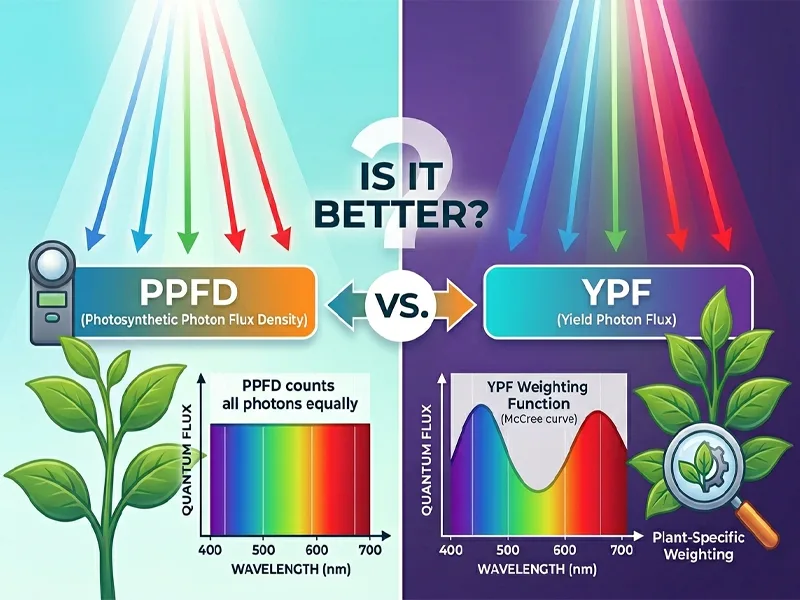
PAR, PPF, PPFD, and DLI—what they mean in plain English
A lot of cheap listings throw around “PAR value” without meaningful context. For plants, you want plant-relevant measurements, and standards are defining those quantities. ANSI/ASABE S640 is one of the key references for horticultural lighting terms and units.
PAR (400–700 nm): the waveband historically used for photosynthesis metrics. DLC’s horticultural measurement resources explicitly reference this range (as defined by ANSI/ASABE S640).
PPF (µmol/s): total plant-usable photons emitted by the fixture (within that defined band).
PPFD (µmol/m²/s): plant-usable photons arriving at the canopy (this is what plants “feel”).
DLI (mol/m²/day): the total photons your plant receives in a full day (PPFD integrated over time). DLI is widely used by universities and extension programs to match light to plant needs.
Why DLI matters more than “watts” for indoor success
Indoors, you control the light hours, so DLI becomes a practical way to set expectations. Virginia Tech Extension explains DLI as the amount of photosynthetic light received over 24 hours and connects it to growth outcomes and lighting schedule decisions.
If a cheap fixture forces you to run longer hours just to hit a basic DLI, your “deal” can evaporate on your power bill (and you still may not get great results if spectrum and distribution are poor).
The first hidden cost: fake wattage and inflated performance claims
“1000W” on the listing doesn’t mean 1000W at the wall
One of the most common pitfalls with cheap LED grow lights is equivalent wattage marketing. Sellers may label a unit “1000W” because it replaces a 1000W HID in their marketing story, while the actual wall draw might be 90–180W.
That can still be okay—if the listing is honest about real power and real PPFD. The problem is that many budget listings are not.
How to protect yourself in 60 seconds
You don’t need a lab to avoid the worst traps. Here’s the buyer’s checklist:
Look for actual power draw (watts at the wall) and a real test condition.
Look for PPFD maps with distance and grid size shown.
Be suspicious if the product claims huge coverage with tiny wattage.
Use a plug-in meter to verify draw after purchase, especially for multi-light setups.
For grow lights, the key idea is not “LM-79 solves everything,” but that credible measurement methods and reporting discipline are what separate real data from marketing numbers.
“Full spectrum” can mean anything unless it’s defined
Many cheap LED grow lights claim “full spectrum” because they include white LEDs, a few reds, and maybe some blue. But plants respond to the spectrum differently depending on crop type, growth stage, intensity, and photoperiod.
Also, remember: the classic PAR band is defined (400–700 nm) in the standards discussion around horticultural quantities. That doesn’t mean wavelengths outside 400–700 are useless—it means you should know what the seller is counting, and what they’re not.
Avoid spectrum theater; focus on outcomes
Instead of getting pulled into purple vs. white debates, ask these questions:
Does the fixture provide enough PPFD at your hanging height to reach the DLI your plants need?
Is the distribution even, or does it create hot spots and shaded corners?
Is there a credible spectrum chart from testing, not just an artistic graphic?
If a listing offers no PPFD data, no spectrum curve, and no meaningful test notes, you’re basically buying blind.
Hidden cost #2: poor thermal design that quietly kills output and lifespan
Heat doesn’t just “reduce life”—it reduces value
LEDs and drivers are sensitive to temperature. When thermal management is weak (thin metal, poor airflow design, no proper heat path, cheap thermal interface), output can droop and components age faster.
This is why longevity claims are often where cheap products get most unrealistic. If you see “100,000 hours” on a bargain fixture with minimal heatsinking, treat it as marketing unless proven otherwise.
LM-80 and TM-21: what they are—and what they are not
The industry uses LM-80 testing for LED package/array/module flux maintenance and TM-21 as a method to project long-term maintenance based on LM-80 data. The U.S. DOE has explained the role of LM-80 and TM-21 in standardizing lumen maintenance testing and extrapolations for LED components. IES also describes TM-21 as projecting long-term luminous/photon/radiant flux maintenance of LED light sources using LM-80 data.
The key buyer takeaway: LM-80/TM-21 relates to LED sources, not the entire grow light as a complete system with drivers, thermal design, wiring, connectors, humidity exposure, and real-world cycling. A cheap fixture can use decent diodes, but still fail early due to driver and build quality.
Hidden cost #3: driver quality (flicker, efficiency loss, early failure)
The driver is the heart of the fixture
A lot of cheap LED grow lights fail because the driver fails, not because the LEDs “burn out.” Low-quality drivers can run hot, hum, flicker, and degrade faster—especially in warm grow tents with high humidity.
From a standards perspective, UL 8750 covers LED equipment used in lighting products and includes LED drivers among the equipment scope. You don’t need to memorize standards to buy a light, but you should recognize that real safety and reliability frameworks exist, and reputable manufacturers align with them.
What driver shortcuts look like in real life
The dimmer (if present) jumps unevenly or causes flicker.
The light output changes noticeably as the fixture warms up.
A “silent” light becomes a buzzing light after a few weeks.
The driver dies before the LEDs, and you replace the whole unit.
Hidden cost #4: safety and compliance risks (this is the non-negotiable one)
Grow environments are harsher than normal rooms
Grow tents and indoor racks often have humidity, misting, nutrient reservoirs, reflective surfaces, and frequent height adjustments. That combination makes wiring integrity, strain relief, grounding, and connector quality more important than in typical household lighting.
UL created UL 8800 as a safety standard specifically addressing horticultural lighting equipment and grow systems, including considerations like repositioning flexibility and specialized wiring/connection methods in grow facilities.
Cheap lights can create hidden risks
The worst-case outcome isn’t “my basil grew slowly.” It’s overheating, arcing, shock risk, or a fire hazard. If a product has vague safety markings, no credible certification references, or inconsistent labeling, it’s not worth gambling—especially in multi-fixture setups.
How to shop smart—and still stay on budget
A practical comparison framework for cheap LED grow lights
Step 1: Ignore “equivalent watts,” compare PPE and PPFD maps
For plant lighting, you want efficiency expressed in plant terms: photon efficacy (often shown as µmol/J). DLC publishes horticultural lighting measurement resources and terminology to help users compare plant-focused metrics like PPF and PPFD.
A good listing (even a budget one) will show:
Wall draw (W)
PPF (µmol/s) or at least credible PPFD maps
Recommended hanging heights by growth stage
A real coverage footprint with numbers, not just icons
Step 2: Convert PPFD + photoperiod into DLI (so you know what you’re actually delivering)
University extension resources emphasize DLI as cumulative daily light and show how it’s used to manage plant growth decisions. If your light gives modest PPFD, you can sometimes compensate by running longer—but that increases operating cost and can stress some plants if photoperiod becomes excessive.
Step 3: Estimate operating cost so “cheap” stays cheap
Even without exact electricity prices, the math is straightforward:
kWh/day = (Watts ÷ 1000) × hours/day
Cost/day = kWh/day × your rate
This is where honest wattage matters. A “cheap” light that secretly pulls 30–50% more power than advertised can erase your savings quickly, especially if you run 16–18 hours/day for leafy growth.
(And as the U.S. DOE notes, “efficacy” is fundamentally about light output per power input—simple concept, big practical impact.
Pitfall patterns you can spot before you buy
Red flags on product pages
No real power draw listed (or listed in tiny text only)
PPFD maps without distance, grid size, or units
Unrealistic coverage claims (“4×4 flowering” from low draw)
No mention of testing method or any credible measurement reference
Overblown lifespan claims with zero context
Green flags even on a budget product
Clear wall drawing and tolerance range
PPFD heat map at multiple heights
Replaceable driver or serviceable parts
Sensible warranty terms and a support channel that looks real
Consistent labeling and safety documentation
How to avoid buyer’s remorse: match the light to your use case
For seedlings and clones
Seedlings usually don’t need extreme PPFD, but they do need uniformity to prevent stretching. A smaller, efficient light with good distribution can outperform a “stronger” cheap unit that creates hot spots.
If your seedlings are leggy, it’s often not “bad genetics.” It’s insufficient intensity at the canopy level or the light being too far away for the fixture’s optics.
For leafy greens and herbs
Greens respond well to stable DLI and good uniformity. Missouri Extension explains PPFD is used to calculate DLI and frames DLI as the total daily PAR light needed by a plant. A cheap light that forces you to place plants only under the center “sweet spot” wastes shelf space and reduces your real productivity.
For fruiting crops indoors
Tomatoes, peppers, and flowering plants punish weak lighting. If you’re choosing cheap LED grow lights for fruiting, prioritize real PPFD data and thermal/driver quality, because you’ll run long cycles and high hours.
Buying strategies that keep costs low without falling into traps
Strategy 1: Buy the right size, not the biggest number
A modest light that matches your shelf footprint is often a better buy than a “high-watt equivalent” unit with vague claims. Overshooting power with a low-quality fixture can increase heat load and shorten life.
Strategy 2: Spend for reliability where it matters most
If you’re truly budget-limited, prioritize spending on:
safer construction and credible compliance alignment (especially in humid setups)
better driver quality (stability over months)
honest performance data
Then compromise on extras like app control, fancy design, or “blurple aesthetics.”
Strategy 3: Think in “upgrade paths.”
Many growers start with a budget light for seedlings, then step up once they understand their plant targets and DLI needs. That’s reasonable—as long as the first purchase is safe and honest.
Where SLTMAKS fits (and what to ask any supplier)
Whether you buy from SLTMAKS or compare multiple suppliers, these are the questions that protect you:
What is the real wall draw and tolerance?
Do you have PPFD maps at multiple heights with units and grid spacing?
What components determine reliability, especially the driver and thermal design?
What safety framework is the product designed to meet for horticultural environments?
What warranty coverage actually applies, and what support process exists?
Cheap LED grow lights don’t have to be junk. The best “cheap” lights are simply efficient, honestly specified, and built to survive real growing conditions.
FAQ: quick answers buyers search for
Are cheap LED grow lights worth it?
They can be, if the product provides real power draw, credible PPFD information, stable drivers, and safe construction. The worst cheap lights become expensive due to replacement, higher operating costs, and poor plant results.
Is the “PAR value” on Amazon listings reliable?
Often not, because “PAR” is frequently used loosely in marketing. Trust measurements aligned to defined horticultural quantities (PPF/PPFD/DLI) and credible reporting sources instead.
Can I just run cheap lights longer to compensate?
Sometimes, because DLI depends on both intensity and time, extension resources emphasize managing DLI via schedules. But longer hours increase operating cost and don’t fix poor uniformity or spectrum/thermal issues.
The “cheap” choice that stays cheap
If you remember only one thing, make it this: Buy photons and safety, not marketing numbers. When you evaluate cheap LED grow lights using PPFD/DLI thinking, credible measurement concepts, and basic safety reality, you avoid the common traps that turn “budget-friendly” into “wasteful.”
Cheap can be a smart decision—when it’s backed by honest data and solid engineering, not just a low price tag.