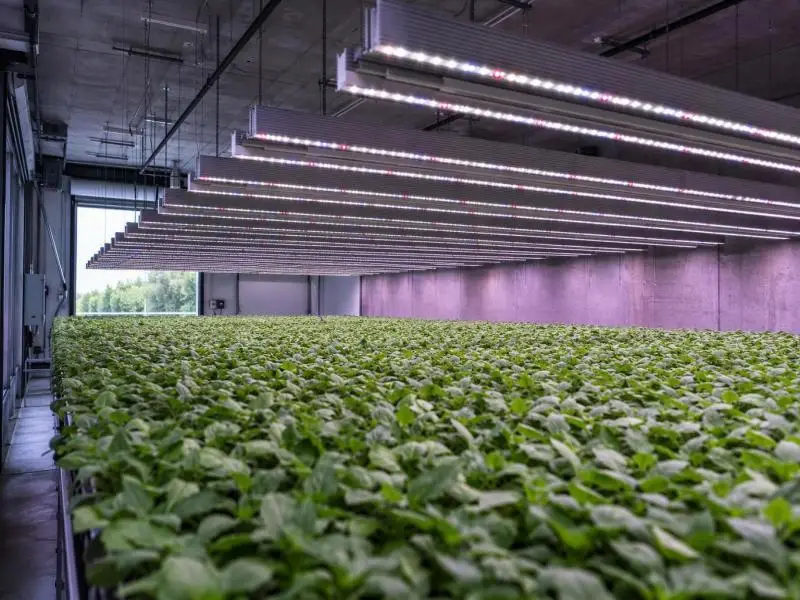
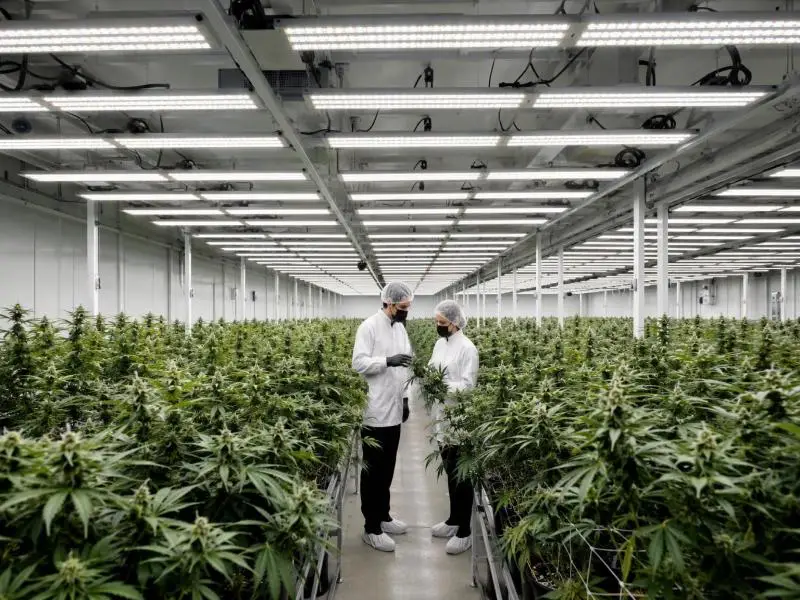
Broad spectrum cannabis lights are now the default specification for new commercial builds, and the reason is measurable, not aesthetic. The DLC’s Horticultural Technical Requirements V4.0 sets a minimum photosynthetic photon efficacy (PPE, the micromoles of PAR photons a fixture delivers per joule of electricity) of 2.5 µmol/J, an 8.7% increase over V3.0 (DesignLights Consortium, effective 18 April 2025). A narrow-band magenta fixture and a white multi-bar fixture can both clear that bar, but only one of them lets you dim to the same PPFD with fewer watts and inspect the canopy without a color cast.
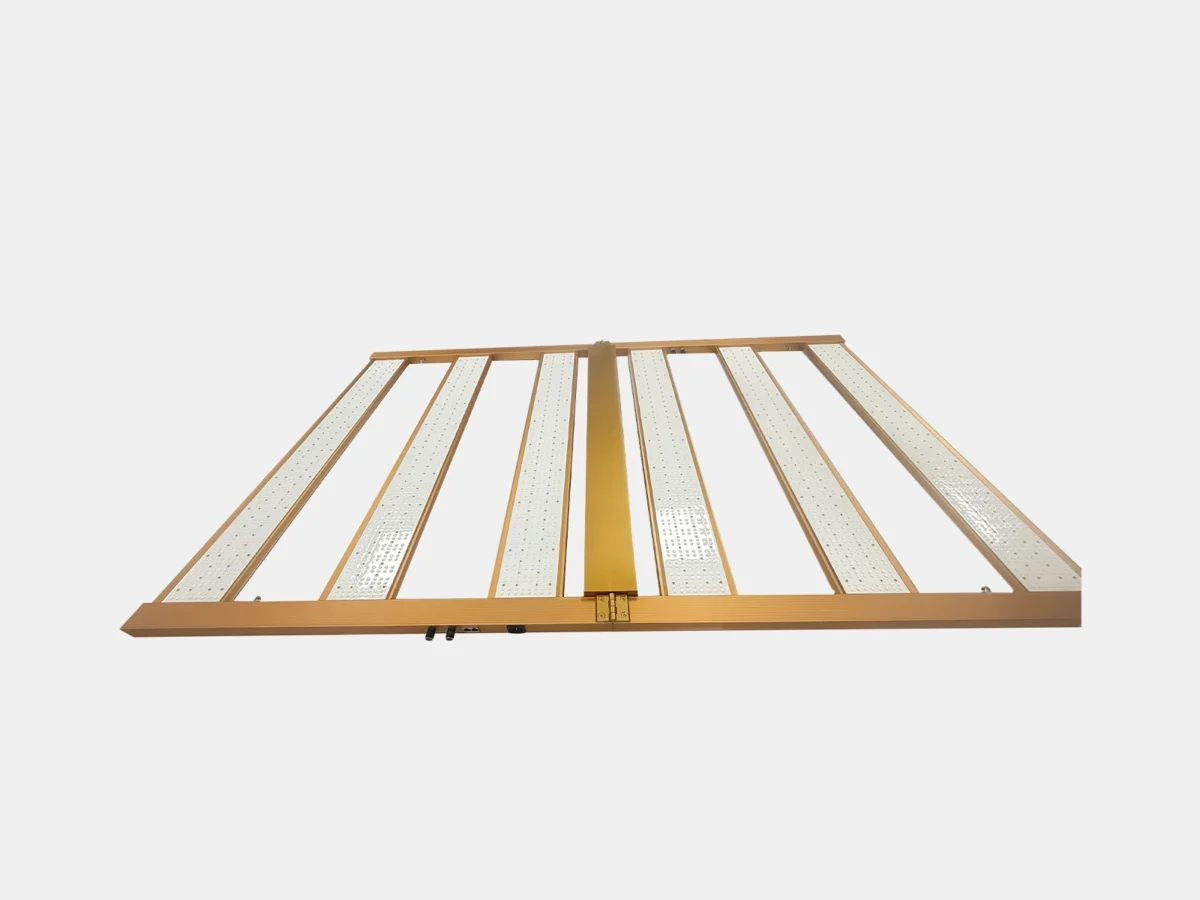
Blurple grow lights worked like a narrow-band spotlight aimed at two chlorophyll absorption peaks; broad-spectrum fixtures work more like daylight through a skylight, spreading output across the visible range. The first approach optimized the fixture’s spectrum diagram. The second optimizes what the plant actually receives across a three-dimensional canopy, which both your photometric report and your HVAC load calculation depend on.
That shift changes three numbers an operator signs off on: delivered PPFD uniformity, lighting kWh, and the sensible heat it dumps into the room, and the documentation an inspector or rebate reviewer will ask for. This article works through each in turn, with the arithmetic and the caveats.
Table of Contents
Performance and Uniformity
Blurple fixtures were a rational response to a real measurement. Chlorophyll a peaks at 430 and 663 nm and chlorophyll b at 453 and 642 nm, so early designers concentrated output there, and peak absorbance in vivo can shift up to 38 nm from those extract values (Frontiers in Plant Science, 2019). The problem is that a leaf is not a cuvette. Once you move from a pigment extract to a canopy, the spectrum that maximizes absorbed photons per emitted photon is not the spectrum that maximizes grams per square meter.
PPE and PPFD Targets
PPE tells you how efficiently a fixture turns electricity into light; PPFD (photosynthetic photon flux density, in µmol/m²/s) tells you how much of that light lands on a square meter of canopy; DLI (daily light integral, mol/m²/day) is PPFD integrated over the photoperiod. For PPFD and PPE for cannabis, the evidence says intensity does most of the work.
A 2021 PPFD gradient trial in cannabis raised dry inflorescence yield linearly from 116 to 519 g/m² as canopy PPFD climbed from 120 to 1,800 µmol/m²/s, with no saturation and no cannabinoid potency effect (Rodriguez-Morrison et al., 2021). The 600-to-1,000 µmol comparison in a separate trial lifted dry weight 1.6×, from 27.6 to 44.7 g per plant, a slope of about 4.6 g per plant for every extra 100 µmol (Frontiers in Plant Science, 2022).
Spectrum matters at the margin, and the margin is smaller than blurple marketing implied. A 2021 blue-fraction trial found that raising blue from 4% to 20% of photons cut flower yield 12.3%, roughly 0.77% per percentage point of blue removed, again with no effect on CBD or THC concentration (Westmoreland, Kusuma & Bugbee, 2021). Bugbee’s group measured 2.5 to 2.8 µmol/J for white-plus-red fixtures and 3.0 µmol/J for blue-plus-red, with practical ceilings of 3.4 and 4.1 µmol/J, respectively (Kusuma, Pattison & Bugbee, 2020). Planning ranges of roughly 100–300 µmol/m²/s for propagation, 250–600 for vegetative, and 500–1,050 for flowering are cultivar-dependent starting points, not standards.
Multi-Bar Layouts and Umin/Uavg
LED grow light uniformity is conventionally expressed as Umin/Uavg, the ratio of minimum to average PPFD over a defined measurement plane, taken from a calibrated cosine-corrected quantum sensor grid at final canopy height under steady-state operating conditions (IES recommended practice RP-45-21). The number is meaningless without the formula, the boundary, the grid spacing, the dimming level, and the point count, which is why two vendors can both claim “90% uniformity” and describe different rooms.
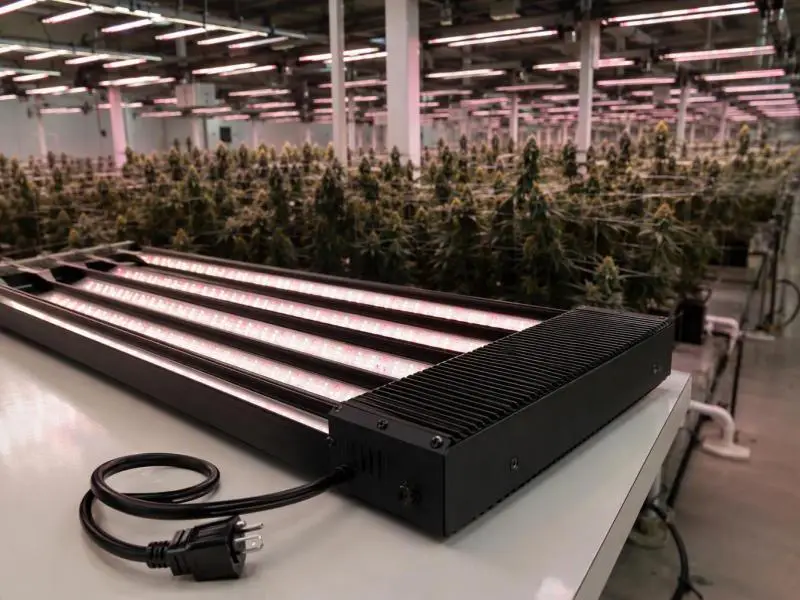
Multi-bar layouts help because they distribute sources across the canopy plane instead of concentrating output at a few high points, which flattens the center-to-edge gradient that single-point HPS and older blurple bars produced. A center-to-edge variation above 15–20% is the range where operators typically see visible growth and quality differences between the middle and perimeter of a table, so it functions as a practical retrofit trigger rather than a code limit. No primary source sets a cannabis-specific Umin/Uavg acceptance value; treat the target as a project specification you write into the design, not an industry standard you can point to.
Visibility and Quality Control
Leaf optical measurements under blue, green, and red light show why broad spectrum also improves the room as a workplace. Blue and red are strongly absorbed near the upper leaf surface (93.2% and 91.6% absorptance in lettuce), while green is absorbed less (81.1%) and peaks deeper in the tissue, distributing energy more evenly (Frontiers in Plant Science, 2021). Under 600 µmol, green light retained 58% of whole-leaf assimilation in the top half of the leaf, while blue fell from 87% to 73%, evidence that the “green is wasted” claim misreads a low-light action spectrum.
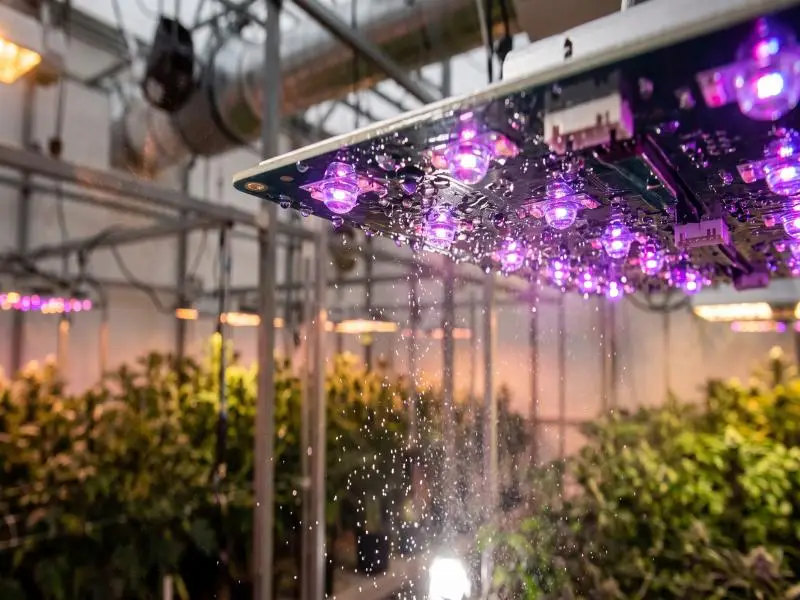
The operational payoff is mundane and real. Under magenta light, powdery mildew, spider mite webbing, leaf chlorosis, and nutrient burn all read through a heavy color cast, and technicians compensate with filtered glasses or white flashlights. Under white plus deep red, scouting, photography, and harvest grading happen under something close to normal color vision, which shortens inspection time and reduces misreads.
Energy and ROI Implications
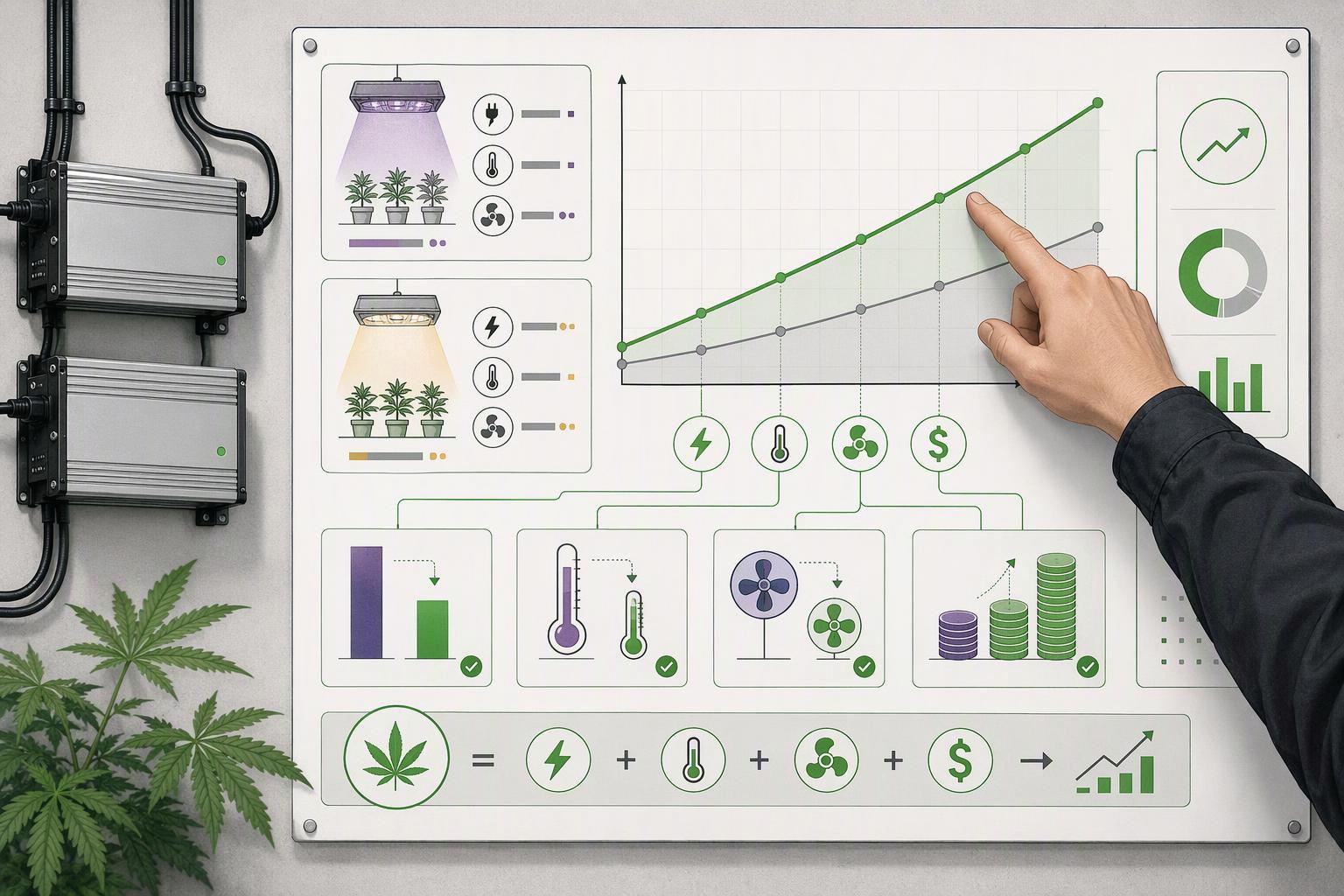
Grow light payback and HVAC load are the same calculation viewed from two ends, because nearly all fixture input electricity ends up as heat inside a sealed room. Denver’s cannabis energy guide puts lighting at 38% and HVAC plus dehumidification at 51% of an indoor grow’s electricity (Denver Department of Public Health & Environment, 2019). A Northwest Power and Conservation Council survey of licensed canopy in Oregon and Washington found a different split, lighting at 66% and HVAC-plus-other near 33%, with lighting power density of 99.6 kWh/ft² against 27.8 kWh/ft² for HVAC (NWPCC, 2017 data). The divergence is the point: HVAC share depends on climate, envelope, and dehumidification strategy, so model your own facility rather than importing a benchmark.
Key Takeaway Every watt you remove from lighting removes a watt of cooling load too, so efficacy gains compound across two line items on the utility bill.
Lighting kWh and Sensible Heat
Convert fixture wattage to energy with kWh = W × h ÷ 1000, then convert the same watts to heat at 1 W = 3.412 BTU/h. The efficacy table in Denver’s cannabis energy guide lists LED fixtures at 1.70–2.7 µmol/J against 0.94–1.34 µmol/J for single-ended HPS and 1.70–2.2 for double-ended HPS, with rated life of 50,000 hours for LED versus 5,000–20,000 for HPS (Denver guide, 2019). A documented HPS-to-LED conversion case study in the same guide replaced 72 × 1,000 W single-ended HPS (72,000 W) with 72 LED fixtures (35,640 W), saving 36,360 W, cutting 10 tons of air conditioning, and reducing consumption by 19,000 kWh and $1,400 per month.
Run the arithmetic on your own room before accepting a vendor’s payback claim. At 50 kW of lighting, the peak sensible load is about 170,600 BTU/h, or roughly 14.2 tons, and that figure scales with watts, not with spectrum. LEDs lower watts per photon; they do not change the conversion ratio.
HVAC Interactions and Latent Loads
Sensible load is heat you can measure with a thermometer; latent load is water vapor the plants transpire, which the dehumidification system must remove. Spectrum does not change transpiration much, but intensity and vapor pressure deficit do, which means a retrofit that raises PPFD to hit a higher DLI will raise latent load even as it lowers sensible load. The LBNL controlled-environment agriculture technology catalog defines photosynthetic photon efficacy as the efficiency with which a fixture converts electricity into PPF, reports 40–75% energy cost savings from HPS-to-LED switching, and notes that LED lifespan varies by wavelength band, roughly 50,000 hours for blue and far-red against 5,000–10,000 for UV-C and UV-B (LBNL CEA Technology Catalog, 2026).
The catalog also warns that not all LEDs are created equal and that marketing claims must be verified, which is the practical reason to commission a room after a retrofit rather than trusting the submittal.
Payback Levers and Incentives
Xcel Energy’s Colorado grow-lighting rebate pays per installed watt: $0.25/W for DLC-listed indoor horticultural LED and $0.19/W for non-DLC equipment, capped at 60% of project cost, with greenhouse applications and LED-to-LED upgrades excluded (Xcel Energy, application last updated 2022). On the 36,360 W saved in the case study above, the DLC-listed rate alone would be worth roughly $9,090 before the cap is tested, which is the kind of number a finance team can put in a model.
Capital cost is the counterweight. White-plus-red LED fixtures run 3–18× higher per unit photon flux than HPS, at $1,000–3,000/kW against $200–350/kW (Kusuma, Pattison & Bugbee, 2020), and the DLC threshold now sits more than 45% above the best double-ended HPS luminaire (DLC Hort V4.0, 2025). No verified utility evaluation of commercial HPS-to-LED horticultural payback was available for this article, so build the payback from your own tariff, your measured wattage reduction, and your confirmed rebate rather than quoting a range.
Deployment and Compliance
The compliance question is narrower than vendors sometimes imply. The 2020 NEC Article 410 Part XVI, Section 410.172, requires horticultural lighting equipment to be Listed but names no listing standard (UL Solutions Code Authorities, 2024). Your authority having jurisdiction (AHJ, the local official who interprets and enforces the code) decides which listing it will accept, and your nationally recognized testing laboratory (NRTL, an organization accredited to certify products to a standard) issues that listing.
⚠️ Warning NEC 410.172 requires Listing; it does not name UL 8800. Confirm the AHJ’s accepted standard in writing before you specify fixtures, because a submittal rejected at inspection is a schedule problem, not a paperwork problem.
Controls Integration and Safety
UL 8800 is the product-safety standard written specifically for horticultural luminaires, components, and grow systems, adding requirements over ANSI/UL 1598 for environmental resistance and photobiological safety aligned with IEC 62471 (UL, 2024). UL lists horticultural luminaires under the UL product category IFAU and complete grow systems under HRTI, and inspectors verify those listings in UL Product iQ (UL Code Authorities, 2024). Ask for the listing category on the cut sheet, not just the word “listed.”
Controls compatibility is where retrofits quietly fail. Confirm whether the fixture accepts 0–10 V or DALI dimming, whether your existing controller speaks the same protocol, and whether zone scheduling can shift intensity within the photoperiod to manage time-of-use rates. Then check breaker and panel capacity against the new connected load, because a lower-wattage fixture with a different inrush profile can still trip a panel that fed the old HPS circuits.
Photometrics and Commissioning
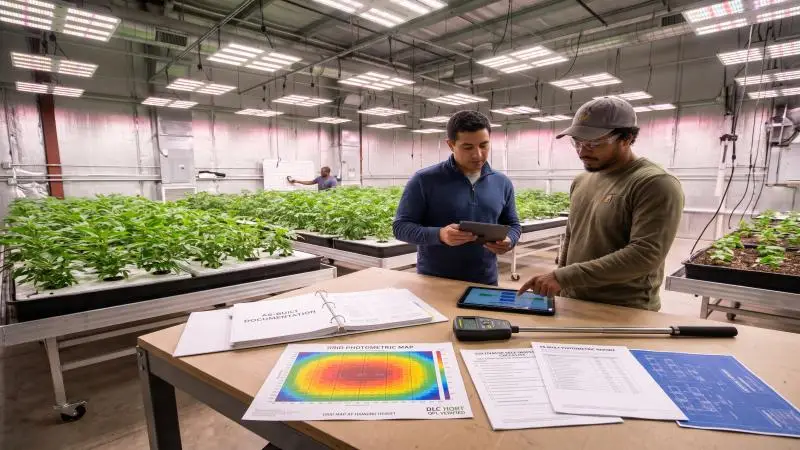
The DLC Hort QPL held more than 1,200 listed products by early 2025, from over 130 manufacturers (DLC, 2025), so product selection is not the constraint; verifying what the layout actually delivers is. Layout verification and commissioning support, including a grid photometric map at intended hanging height, a dimming protocol, and as-built documentation, is the kind of service an application engineer can scope alongside the fixture schedule.
Pro Tip Commission with a grid map at final hanging height under operating dimming, not datasheet center-point values. The datasheet describes a fixture in a test sphere; the map describes your room.
California’s cultivator self-inspection checklist is a useful template for what inspectors ask: for indoor and mixed-light licenses, the lighting diagram must reflect the location and wattage of all lights and stay within limits, and cultivation lights must be shielded to reduce glare (California Department of Cannabis Control). Keep the as-built photometric report next to that diagram.
Procurement Checklist
- PPE at or above the current DLC floor, quoted with the tested qualifying state for spectrally tunable products.
- A stated Umin/Uavg target with the formula, measurement plane, grid spacing and dimming level written into the specification.
- Dimming protocol (0–10 V or DALI) matched to the existing controller, plus a zone-scheduling plan.
- UL listing category (IFAU for luminaires, HRTI for systems) confirmed on the cut sheet.
- Written AHJ confirmation of the accepted listing standard before the order is placed.
- Rebate pre-approval against the utility’s current tariff, including exclusions for greenhouse and LED-to-LED upgrades.
- Lead time, warranty term, and spare-parts availability across every site in the portfolio.
Conclusion
Broad spectrum cannabis lights are replacing blurple because the decision now rests on numbers that procurement can audit: PPE above 2.5 µmol/J, a documented Umin/Uavg at canopy height, a wattage reduction that flows straight into the cooling load, and a listing an inspector can look up. The spectrum itself is the smaller part of the story. Intensity drives yield, and the 2021 and 2022 cannabis trials both show a linear response well past normal production PPFD, with no potency penalty.
Correct one misconception before it hardens: blurple is not useless. Narrow-band red and blue fixtures grew plants, and the underlying chlorophyll absorption peaks are real. What changed is that white plus deep red now delivers comparable or better efficacy with better canopy penetration and a room technicians can actually see in. A 2024 cannabis trial with dual red peaks at 640 and 660 nm raised inflorescence weight over a single 660 nm peak at both 600 and 1,200 µmol/m²/s, with no cannabinoid effect, which supports specifying white plus 660 nm rather than chasing a single peak (Frontiers in Plant Science, 2024).
The next step is a layout review against your actual room: hanging heights, racking, panel capacity and the AHJ’s accepted listing standard. Bring the fixture schedule and the utility tariff, and an application engineer can turn them into a photometric map and a wattage-reduction estimate your finance team can defend.
FAQ
Are blurple grow lights still effective?
Yes. Narrow-band red and blue fixtures grow healthy plants, and the chlorophyll absorption peaks they target are real. What changed is economics: white plus deep red now matches or beats their efficiency while giving better canopy penetration and a room you can actually see in.
Is broad spectrum or blurple better for flowering?
Intensity matters more than either spectrum. Cannabis yield rises nearly linearly as canopy PPFD climbs, so a well-dimensioned broad-spectrum layout usually wins because it spreads output evenly across the canopy. A 2024 trial also found dual red peaks at 640 and 660 nm outperformed a single 660 nm peak, which is why white plus 660 nm is the safer specification.
Do full spectrum LEDs increase yield compared with blurple?
They can, but mostly through the watts-per-photon and uniformity gains, not the color mix alone. Expect the bigger wins from hitting a higher DLI with fewer watts and a flatter Umin/Uavg across the table. Raising blue from 4% to 20% of photons cut flower yield 12.3% in a 2021 trial, so don’t overdo the blue end either.
What PPFD and DLI should I target in flower?
Roughly 500–1,050 µmol/m²/s at canopy height, which on a 12-hour photoperiod works out to about 22–45 mol/m²/day. Measure a grid across the canopy rather than a single center point, and step intensity up gradually while watching for bleaching or curled leaves.
Why are blurple grow lights purple?
Because they emit almost only red (roughly 600–700 nm) and blue (400–500 nm) light, usually at about a 4:1 ratio. Mixing those bands leaves little green or yellow, so everything in the room reads magenta. Broad-spectrum fixtures add white diodes, which restore normal color vision for scouting, photography and harvest grading.