Introduction
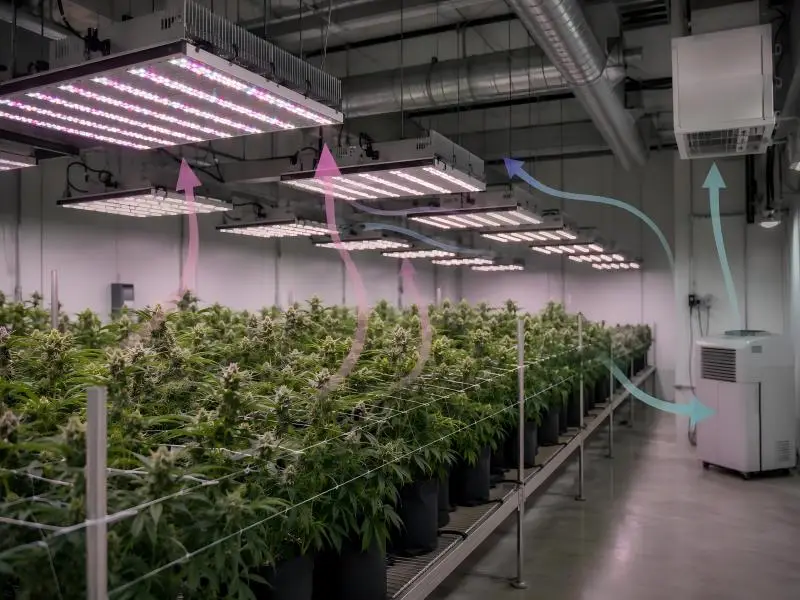
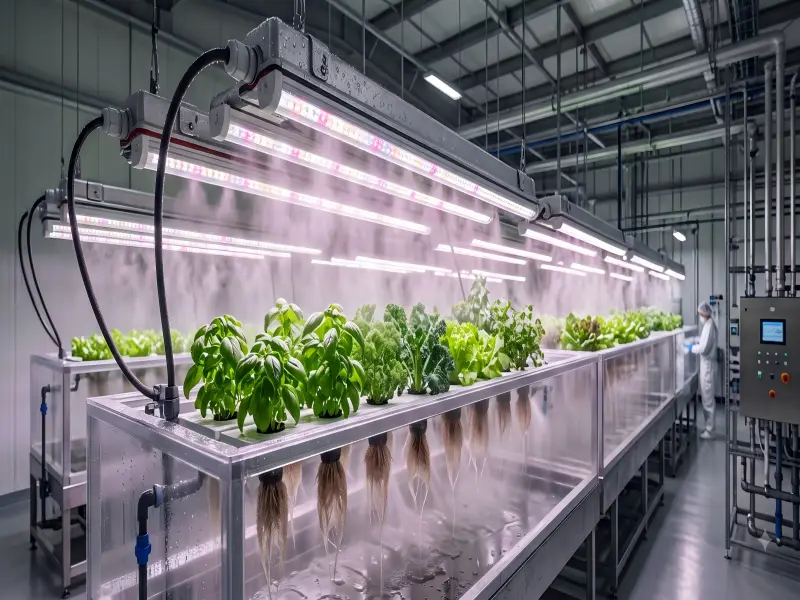
Aeroponic cultivation represents the frontier of controlled environment agriculture (CEA), delivering unmatched oxygenation and nutrient delivery to crop root zones. However, this high-performance growing method creates a uniquely challenging physical environment. High-frequency atomized nutrient misting, elevated ambient humidity, continuous condensation cycles, and rigorous washdown sanitation routines subject equipment to severe environmental stress, making waterproof LED lighting a critical requirement for success.
In a commercial aeroponic facility, waterproofing is not an optional accessory or a secondary marketing feature; it is a functional necessity for daily operational reliability, electrical safety, and regulatory compliance. Operating unsealed or inadequately protected fixtures in these saturated microclimates leads to premature LED degradation, driver failure, short circuits, and costly crop cycle disruptions.
This guide provides facility directors, heads of cultivation, and agricultural engineers with complete technical clarity on Ingress Protection (IP) ratings, the thermal engineering required for sealed luminaires, safety compliance standards, and commercial evaluation frameworks to optimize long-term return on investment (ROI).
Table of Contents
Why Aeroponic Systems Demand Waterproof Lighting
Commercial aeroponics relies on suspending plant roots in air chambers while spraying them with atomized nutrient solutions at precise intervals. While this maximises root respiration and crop growth rates, it creates an aggressive atmosphere that rapidly destroys standard indoor lighting fixtures.
The Moisture Challenge in Aeroponic Environments
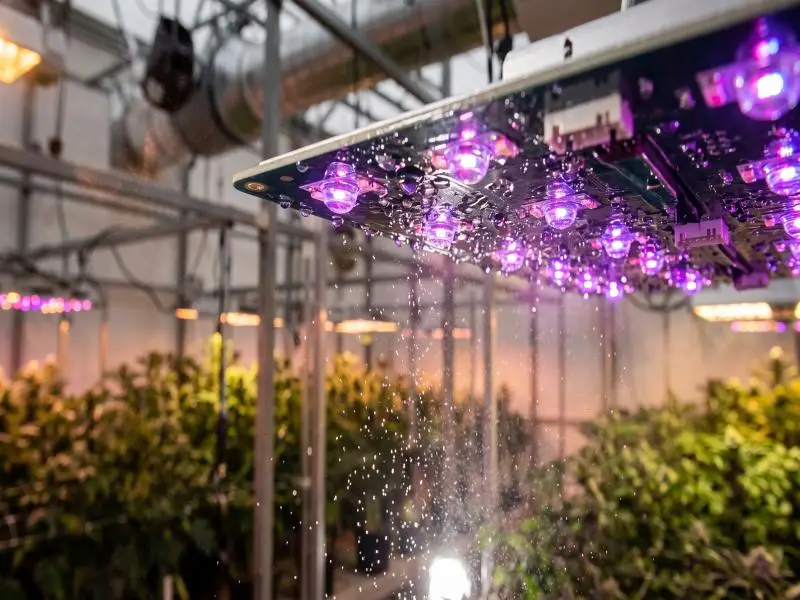
Unlike traditional soil or substrate setups, aeroponic systems continuously generate an aerosolized atmosphere. High-pressure mist nozzles produce micro-droplets (ranging from 10 to 100 microns) containing dissolved mineral salts, nitrates, and trace minerals. These fine droplets stay airborne, drifting throughout the grow room and settling on every exposed surface—including overhead light bars, drivers, and mounting hardware.
Furthermore, day-to-night temperature transitions trigger rapid condensation cycles. As ambient room temperatures drop during dark periods, air moisture condenses directly onto luminaire housings and optical lenses. Combined with routine sanitation protocols—where cultivation teams use hoses or pressure sprayers to sanitize vertical racks and walls—moisture exposure is constant, intense, and inescapable.
Consequences of Inadequate Protection
Deploying standard IP20 or inadequately sealed grow lights in an aeroponic facility invites catastrophic operational risks:
- Corrosion and short circuits: Moisture laden with nutrient salts penetrates unsealed housings, corroding copper circuit tracks, solder joints, and LED bond wires. This causes electrical shorts, arcing, and localized component failure.
- Uneven PPFD and yield penalties: When individual LEDs or sub-bars short out, Photosynthetic Photon Flux Density (PPFD) uniformity collapses across the canopy. Uneven light levels lead to inconsistent crop growth, variable harvest quality, and unpredictable yield modeling.
- Premature fixture degradation: Humidity penetrating optical lenses causes internal fogging, which permanently impairs light transmission and degrades diode phosphors, causing rapid photon decay well before the rated lifespan.
- Safety hazards: Wet electrical equipment poses severe electrical shock and fire hazards, exposing facility personnel to danger and putting operations at risk of severe liability.
Compliance Requirements for Wet Locations
To operate legally and maintain commercial insurance coverage, lighting equipment in aeroponic facilities must meet stringent electrical safety and environmental safety standards:
Key regulatory standard: In North America, UL 8800 (Standard for Horticultural Lighting Equipment) specifically evaluates luminaires for damp and wet location operation, mechanical strength, UV resistance of polymeric parts, and enclosure sealing integrity.
In addition to UL 8800, commercial procurement across North American and European facilities requires verified accreditations:
- ETL / CE marks: Confirm independent laboratory compliance with national electrical safety codes.
- RoHS compliance: Ensures hazardous substances like lead and mercury are excluded from electronic assemblies.
- Photobiological safety (IEC 62471): Classifies optical radiance hazards to protect farm technicians working daily under high-intensity LED arrays.
Understanding IP Ratings for Your Grow Environment
Ingress Protection (IP) ratings defined by the IEC 60529 standard classify the degree of sealing effectiveness against solid objects and liquids. However, commercial buyers must recognize that higher IP ratings reflect distinct mechanical protection profiles rather than a simple linear hierarchy of product quality.
IP Rating Structure: IP [First Digit: Solids] [Second Digit: Liquids]
• First Digit (6) = totally dust-tight
• Second Digit (5) = protected against low-pressure water jets
• Second Digit (6) = protected against high-pressure water jets
• Second Digit (7) = protected against temporary immersion (1 meter for 30 min)
IP65 vs IP66 vs IP67: What Actually Matters
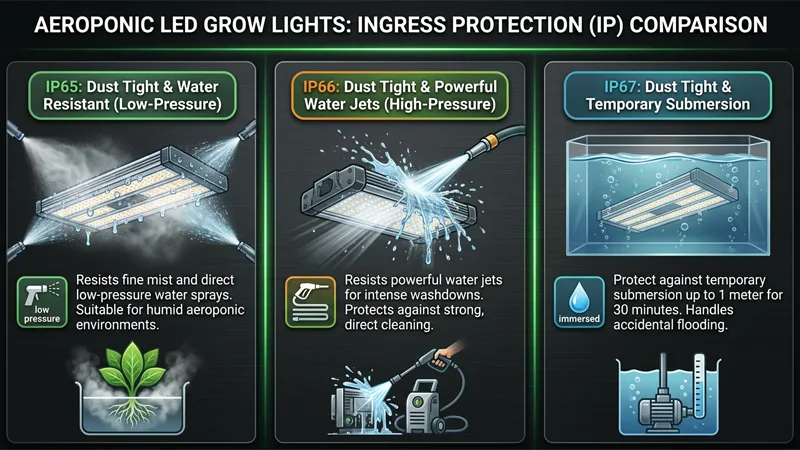
Selecting the appropriate ingress rating requires matching the fixture’s mechanical sealing against your facility’s daily sanitation SOPs and physical layout:
- IP65: Dust-tight and protected against low-pressure water jets (6.3 mm nozzle, 12.5 L/min at 30 kPa from 3 meters). IP65 serves as the practical baseline for standard humid grow rooms with indirect misting and light splash exposure.
- IP66: Dust-tight and protected against powerful, high-pressure water jets (12.5 mm nozzle, 100 L/min at 100 kPa from 3 meters). IP66 is essential when facility cleaning protocols involve routine high-pressure hose-downs or directional sanitizing sprays.
- IP67: Dust-tight and protected against the effects of temporary immersion in water (up to 1 meter depth for 30 minutes). IP67 is required for low-mounted canopy lights, lower rack levels near standing liquid, or flood-prone drainage zones.
Selecting the Right Rating for Your System
Evaluating your facility’s exact risk profile ensures you specify adequate protection without over-specifying hardware costs:
| Facility Application Zone | Primary Moisture Source | Recommended Rating | Operational Rationale |
|---|---|---|---|
| Top canopy lighting (high racks) | Transpiration mist, high RH | IP65 | Protects against rising humidity, condensation, and ambient spray drift. |
| Inter-canopy / lower tier lighting | Root chamber mist, direct splash | IP66 / IP67 | Resists localized liquid aerosol deposition and proximity to mist manifolds. |
| Routine hose-down washdown zones | High-pressure chemical sanitation | IP66 | Withstands direct directional hose spray during room sterilization between cycles. |
| Flood-risk / low drainage racks | Standing water, drain overflow | IP67 | Guarantees survival during temporary liquid accumulation or drainage pump failures. |
The Critical Role of Connectors and Cable Entry Points
The luminaire housing is only as waterproof as its weakest connection point. Statistically, electrical cable glands, daisy-chain pass-throughs, and quick-connect plug interfaces account for over 70% of moisture ingress failures in commercial grow rooms.
High-quality waterproof luminaires utilize IP67-rated threaded push-lock connectors with heavy-duty silicone O-rings. Precision cable entry glands with molded strain relief prevent cable bending from opening micro-gaps around the jacket, stopping capillary action from pulling water into the main driver compartment. For comprehensive specifications on luminaire ingress protection, review the commercial grow light IP rating breakdown.
Thermal Management in Sealed Lighting Fixtures
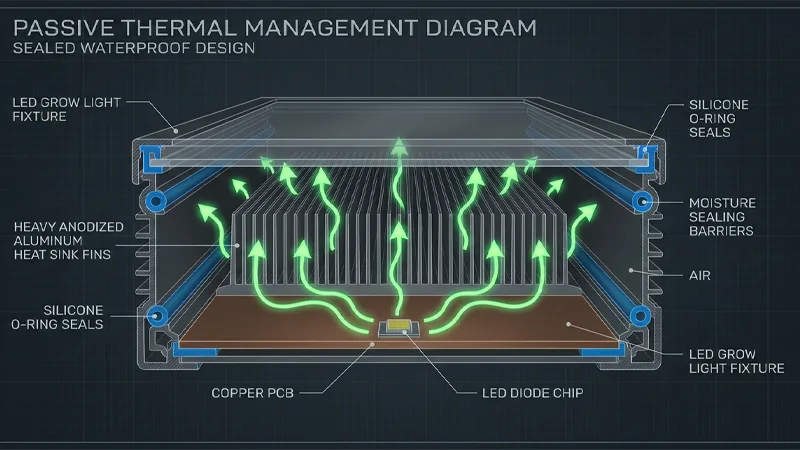
Waterproof sealing introduces a fundamental thermal engineering challenge: completely enclosing a luminaire to block liquid ingress traps internal heat. Because excess heat is the primary cause of LED efficiency degradation and premature component death, thermal architecture is just as vital as moisture sealing.
The Engineering Balance: Sealing vs. Heat Escape
High-efficacy LEDs convert approximately 30% to 40% of input electrical wattage into Photosynthetically Active Radiation (PAR) photons; the remaining 60% to 70% is converted directly into thermal heat. In an open fixture, air moves freely across circuit boards to dissipate this energy. In a sealed IP65+ luminaire, heat must transfer through solid conductive materials to exterior surfaces before radiating into ambient room air.
Failure to dissipate junction heat causes diode thermal runaway, shifting the light spectrum, reducing photon output (µmol/J drop), and cutting driver lifespan in half for every 10°C rise above operating limits.
Passive Cooling and Design Strategies
To maintain absolute sealing without motorized fans—which rapidly clog and fail in humid environments—commercial fixtures utilize advanced passive cooling engineering:
- Multi-bar aluminum architectures: Spreading LEDs across broad multi-bar arrays increases the total surface area, allowing heat to dissipate evenly via natural convection rather than at high thermal concentration.
- Under-driven high-efficacy diodes: Operating industry-leading diodes (such as Samsung full-spectrum chips) below their maximum rated drive current minimizes thermal output while maximizing photon efficacy (µmol/J).
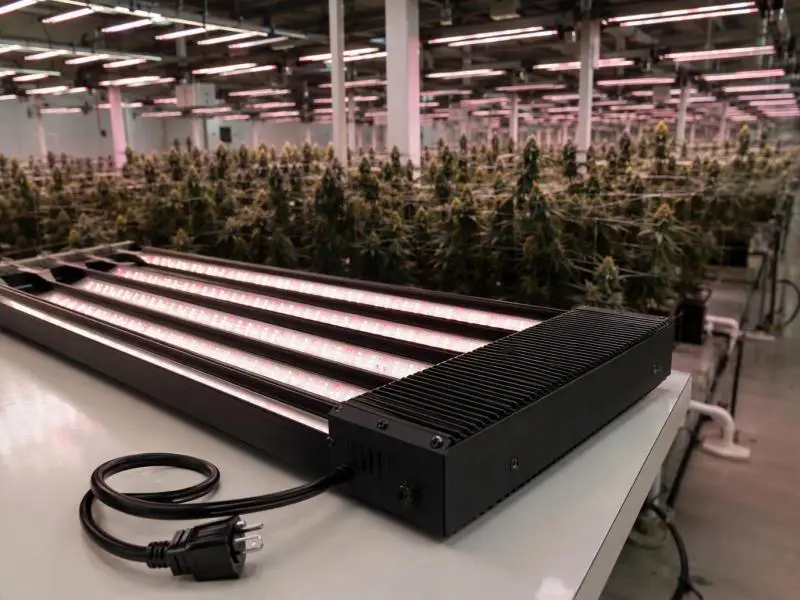
- Heavy-gauge anodized heat sinks: Structural aluminum extrusions serve as both the waterproof outer chassis and the primary conductive thermal path.
- Remote driver mounting: Detaching the power-supply driver from the LED bar array reduces the fixture’s heat load on the plant canopy by up to 20%, reducing HVAC loads.
Anti-Corrosion Protection for Longevity
Heat sinks and printed circuit boards (PCBs) must resist chemical attack from corrosive nutrient aerosols:
- Anodized finishes: Anodized aluminum forms a durable aluminum oxide surface layer that prevents chemical oxidation from sulfur, chlorine, and acidic fogging agents.
- Conformal PCB coatings: Advanced silicone or polyurethane conformal coatings are robotically sprayed over internal circuit boards to shield sensitive electronics from trace vapor penetration.
- Sulfur-resistant LED packaging: Encapsulating LEDs in sulfur-resistant materials prevents silver-plated lead frames from tarnishing and dimming over extended operation.
Commercial Selection Criteria and ROI
Specifying lighting for a commercial aeroponic facility requires looking beyond basic IP labels to evaluate holistic photometric performance, electrical efficiency, and long-term financial payback.
Beyond the IP Rating: Performance Metrics That Matter
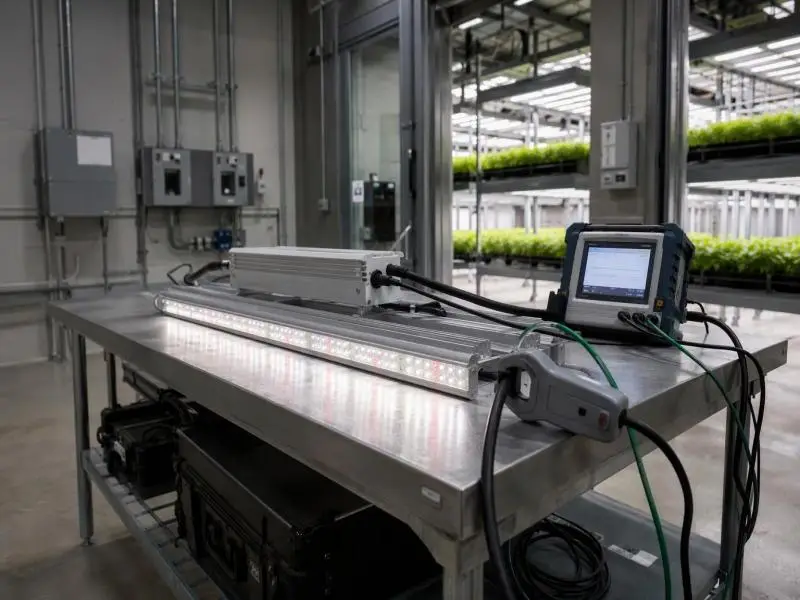
When evaluating commercial fixtures, require independent third-party photometrics (IES/LDT files) confirming the following benchmarks:
- Target photon efficacy (2.5 – 3.0 µmol/J): High photon conversion efficiency ensures minimal electricity is wasted as heat, lowering direct power costs and HVAC cooling overhead.
- PPFD uniformity (CV ≤ 10–15%): Coefficient of Variation (CV) measures light consistency across the canopy footprint. High uniformity eliminates hot spots and shadow zones, driving uniform crop development.
- Wide beam angles (100° – 150°): Broad optical beam angles overlap light beams between adjacent bars, improving canopy penetration across multi-tier racking configurations.
Modeling ROI for Commercial Deployment
Upgrading to premium waterproof LED fixtures requires upfront capital expenditure (CapEx), but delivers rapid return on investment (OpEx savings):
| Simple ROI Payback Period = Initial Capital Investment / Annual Operational Cost Savings | Detail |
|---|---|
| • Direct electricity reduction | 30% to 50% energy savings over HPS / low-efficiency LEDs |
| • HVAC load reduction | ~0.33 kW reduction in cooling demand per 1 kW lighting saved |
| • Maintenance & downtime savings | Elimination of bulb replacements, lower failure rework rates |
Commercial installations typically achieve complete CapEx payback within 12 to 24 months, depending on local utility electricity rates. Furthermore, utility rebate eligibility through DLC (DesignLights Consortium) qualification can cover 20% to 50% of initial fixture costs.
Driver Reliability and Control Integration
The LED driver is the operational heart of the lighting system. Industrial-grade installations require drivers built to exact power quality and control standards:
- Sealed IP67 power enclosures: Fully potted driver electronics housed in aluminum casings prevent internal moisture accumulation.
- Power factor (PF) > 0.95: Ensures maximum electrical efficiency and minimizes reactive power draw on facility transformers.
- Total harmonic distortion (THD) < 10%: Protects facility electrical infrastructure from harmonic noise and power quality degradation.
- Protocol control compatibility: Seamless 0–10V, PWM, or DALI dimming integration enables automated lighting schedules and dynamic spectrum tuning through central building management systems.
Commercial solution highlight: Professional manufacturers like SLTMAKS commercial LED grow lights combine industry-leading Samsung diodes, heavy-duty IP67 passive aluminum heat sinks, and certified ETL/CE safety compliance to deliver 3-year guaranteed reliability in high-moisture commercial facilities.
Installation Best Practices and Industry Trends
Proper field installation and commissioning ensure that high-performance hardware delivers its rated specifications over years of continuous operation.
Field Installation and Commissioning Checklist
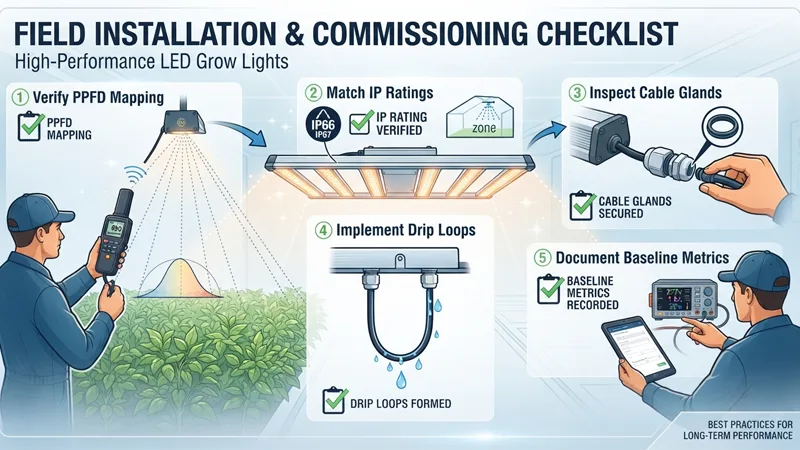
Follow this systematic engineering checklist during facility installation:
- Verify PPFD mapping: Measure baseline PPFD using a calibrated PAR meter at the exact canopy height to ensure daily light integral (DLI) targets are met.
- Match IP ratings to zone SOPs: Confirm that IP65, IP66, and IP67 fixtures are mounted in their designated moisture exposure zones.
- Inspect cable glands and O-rings: Verify that every quick-connect plug is fully seated, hand-tightened, and free of dust or debris on sealing gaskets.
- Implement drip loops: Form physical downward drip loops in power cables before entry into cable glands so gravity pulls water droplets away from connection points.
- Document baseline metrics: Record initial voltage, current draw, ambient temperature, and PAR values during commissioning to establish maintenance tracking baselines.
Emerging Trends in Waterproof Grow Light Design
Waterproof grow light engineering continues to advance rapidly to meet commercial demand:
- Widespread adoption of IP67 standards: Advanced manufacturing techniques are making full IP67 immersion-level protection the standard across premium commercial lines.
- Multi-channel spectrum tuning: Modern fixtures incorporate independent deep-red (660nm), far-red (730nm), and UVA channels to steer plant morphology, enhance secondary metabolite production, and accelerate flowering.
- Higher efficacy diodes: Next-generation semiconductor packaging pushes photon efficacy beyond 3.0 µmol/J, setting new standards for sustainable indoor agriculture.
Conclusion
Waterproof LED lighting solutions for commercial aeroponic systems are a critical technical investment rather than a basic accessory. The intense combination of continuous nutrient mist, high humidity, condensation cycles, and pressure-washdown sanitation makes ingress protection non-negotiable.
By carefully matching IP ratings to facility sanitation SOPs, prioritizing robust passive thermal management, enforcing safety compliance (UL 8800 / ETL), and specifying high-efficiency components, facility operators protect their crops, eliminate catastrophic downtime, and secure a rapid, defensible return on investment.
Why are standard IP20 grow lights unsuitable for commercial aeroponic facilities?
Aeroponic environments continuously produce aerosolized nutrient mist containing dissolved mineral salts, alongside daily condensation cycles. Standard IP20 fixtures lack ingress sealing, which allows moisture and salts to corrode circuit tracks, cause electrical shorts, accelerate photon decay, and trigger severe safety hazards.
What is the difference between IP65, IP66, and IP67 grow lights in aeroponic setups?
IP65 protects against low-pressure water spray and indirect misting; IP66 withstands powerful high-pressure water jets used during routine room sanitation washdowns; and IP67 guarantees protection against temporary liquid immersion, making it ideal for lower canopy tiers or flood-risk zones.
How do fully sealed waterproof LED grow lights dissipate heat without cooling fans?
Industrial waterproof fixtures rely on advanced passive thermal management—such as multi-bar aluminum extrusion architectures, high-efficacy diodes driven below maximum capacity, anodized anti-corrosion finishes, and detachable remote drivers—to dissipate thermal energy efficiently without mechanical fans that fail in high humidity.
What safety compliance standards should commercial aeroponic lighting fixtures meet?
Luminaires operating in wet aeroponic environments should be certified under UL 8800 (Standard for Horticultural Lighting Equipment), hold ETL/CE electrical safety marks, comply with RoHS hazardous substance standards, and adhere to IEC 62471 for photobiological safety.