Introduction
Far-red light is the band just beyond what most growers think of as “red,” roughly 700–750 nm. In a cannabis room, it matters less because it adds huge photosynthetic horsepower, and more. After all, it changes what the plant thinks its light environment looks like. That perception shows up in morphology, especially internodal spacing (stretch).
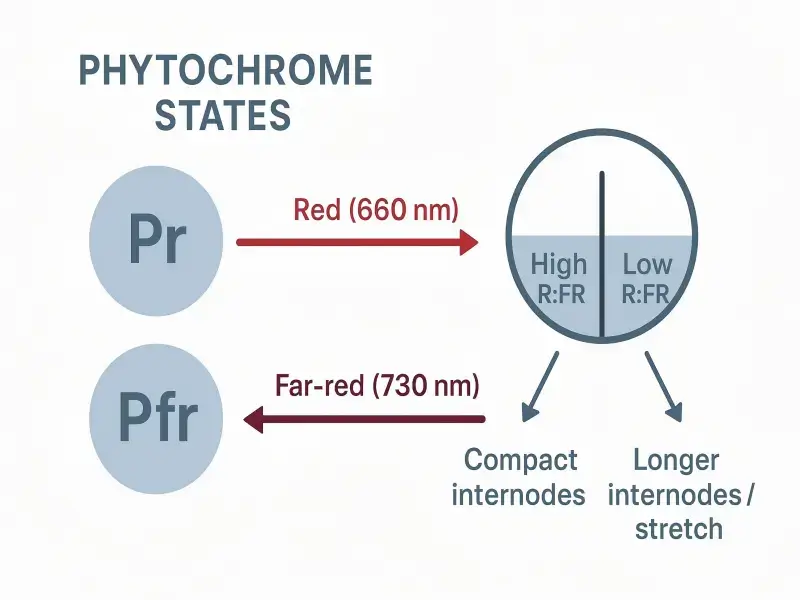
At the center of it is phytochrome, a light-sensing system that uses the balance between red and far-red wavelengths as a proxy for “open sun” vs. “shade from neighbors.” When the red:far-red ratio (R: FR) drops, plants tend to express shade-avoidance traits, including longer internodes and taller canopies. That basic biology is well established across species and summarized clearly in academic overviews such as “Phytochromes and Shade-avoidance Responses in Plants” (2014).
This article explores the effects of far-red grow light on cannabis cultivation, and focuses on decision-stage choices: practical R: FR ranges, how blue light can tighten structure, when end-of-day far-red (EOD-FR) is useful, and how to test changes without accidentally confounding results with PPFD, DLI, or environment.
Table of Contents
Mechanisms that Drive Stretch
Phytochrome Pr/Pfr and Photoequilibrium
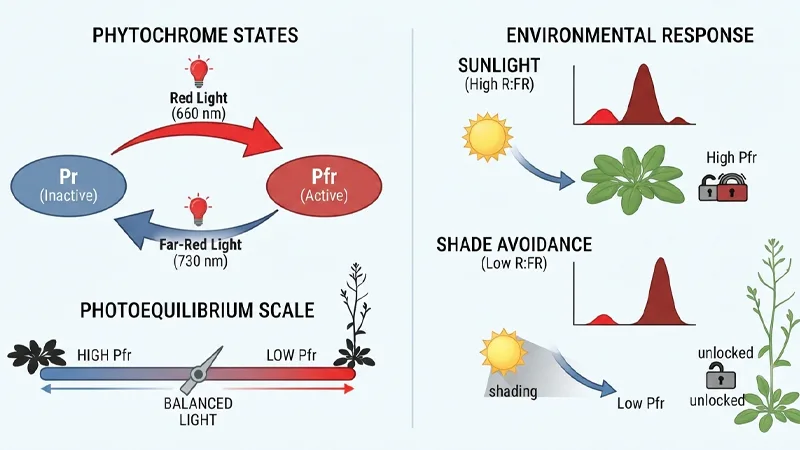
Phytochrome exists in two interconvertible forms (often simplified as Pr and Pfr). Red photons tend to push phytochrome toward the “active” state, while far-red photons tend to push it toward the “inactive” state. Under a steady spectrum, the plant reaches a photostationary balance (photoequilibrium) that effectively encodes spectral quality into a growth signal.
In practical terms, you can think of that balance as a brake on elongation. Higher active phytochrome generally suppresses shade-avoidance elongation; lower active phytochrome releases it. In research papers, this balance is often expressed as phytochrome photoequilibrium (also described as a phytochrome photostationary state). For a technical but readable overview of how this maps to neighbor detection and shade responses, see “Shade Avoidance” (2012).
R: FR Balance, Shade Avoidance, and Internodal Elongation
A low R: FR ratio is what a plant experiences under canopy shade in nature. Leaves absorb red strongly and transmit/reflect more far-red, so the light filtered through foliage is far-red enriched. Phycotocrome reads that change and triggers a set of responses collectively called shade-avoidance syndrome: elongation of stems and internodes, changes in leaf expansion, and altered resource allocation.
Cannabis responds to this same signaling logic. When you add far-red or otherwise reduce R: FR, you are usually asking the plant to stretch. That can be helpful in small doses (opening a dense canopy early), but it can also create weak stems, longer internodes than you want, and harder-to-manage plant architecture.
Blue Light Interplay That Compacts Plants
Far-red does not act alone. Shade is also a “low blue” environment, and plants integrate that cue through blue-light photoreceptors (cryptochromes and phototropins). In many crops, raising the blue fraction tends to promote more compact morphology: shorter internodes, thicker leaves, and sturdier structure.
For cannabis rooms where height control is a constraint, this is the key operational point: you can often counterbalance stretch pressure (from low R: FR, warm CCT, high density, or high temperature) by maintaining an adequate blue fraction, especially in veg and during the first weeks of flower.
What Cannabis Studies Show
Morphology Outcomes: Taller Plants and Longer Internodes with More Far-red Light
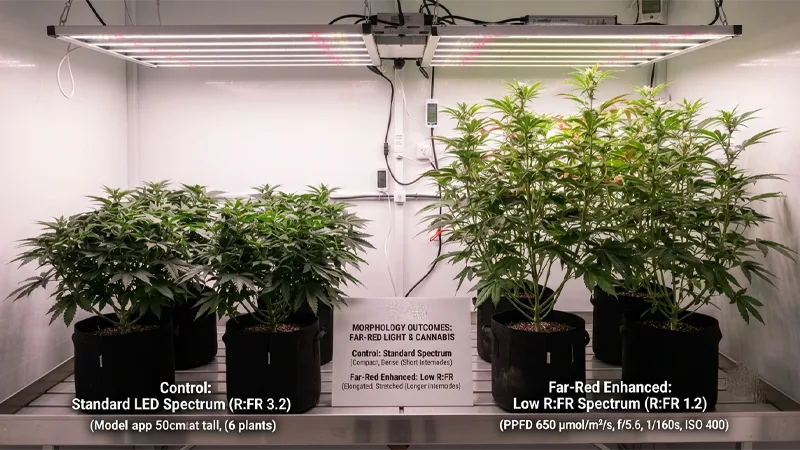
Across plant science, the most repeatable far-red outcome is elongation. Cannabis research and cannabis-focused reviews report the same directional response: as far-red increases and R: FR decreases, plants tend to grow taller with longer internodes, consistent with shade-avoidance signaling. The effects of far-red light on medicinal Cannabis (2025)
The operational translation is simple: if your room is already fighting height, adding far-red (or pushing R: FR too low) is rarely a neutral change. You should expect some amount of stretch unless you counter it with other levers.
Yield and Chemistry: Mixed Results and Genotype-specific Responses
Where the evidence is less consistent is on “does far-red pay you back” in dry flower yield, bud morphology, or cannabinoids. Published results vary by genotype and by the rest of the spectrum and environment. The most defensible position for a decision-stage operator is:
- Treat far-red primarily as a morphology and canopy-management lever
- Do not assume it will improve THC, terpenes, or yield without cultivar-specific validation
That caution is consistent with how the cannabis literature frames far-red: strong morphogenic effect, less reliable downstream impact on final quality metrics.
End-of-day Far-red (EOD-FR): Strong Elongation, Inconsistent Flowering/Yield Effects
EOD-FR means delivering far-red at the end of the photoperiod to shift phytochrome signaling quickly into the “night” state. The elongation effect can be strong.
In controlled cannabis work, extended EOD-FR exposures increased elongation and internode length, while flowering timing did not materially change under the tested conditions. Perotti et al. (2026)
For decision-making, this is the takeaway: EOD-FR is a reliable tool for stretch, but you should be skeptical of broad claims that it will shorten flower time or increase yield in cannabis. Use it only when you have a clear morphological reason, and treat yield/quality effects as “prove it in your room.”
Practical Spectrum Controls
Target R: FR Ranges to Tighten or Open nodes
If your goal is tighter nodes and less stretch, you generally want a higher R: FR ratio (less far-red relative to red). If your goal is to open up internodes (for airflow, canopy access, or early light penetration), you can lower R: FR by adding far-red.
Two practical ways to approach this without overcomplicating it:
- Set a target R: FR window, then verify at canopy with a meter that reports R: FR or supports spectral capture.
- Treat R: FR as a “morphology setpoint,” not a marketing spec. You care about what reaches the canopy, not the diode list.
For a deeper walkthrough of how spectrum choices are typically built into fixtures and recipes, see the SLTMAKS explainer on full-spectrum LED grow lights.
Set Blue Fraction by Stage to Manage Height
Blue is one of the cleanest spectrum levers for compactness.
- In veg, a higher blue fraction usually helps build shorter internodes and sturdier stems.
- In early flower, maintaining enough blue can reduce runaway stretch without having to heavily modify intensity or temperature.
A simple operational rule: if you’re introducing far-red or running a warm spectrum that tends to stretch the crop, make sure your blue fraction is not drifting down at the same time.
Managing Far-red Fraction and Channel Intensity
If you have independent channels, treat far-red like you’d treat PGRs: dose carefully, then measure. The more tightly you control far-red output (and the more consistently you measure it), the more likely you are to get the morphological effect you want without surprises.
For teams that want spectrum flexibility across cultivars and rooms, adjustable-spectrum fixtures with independent channels (blue/red/far-red) make it easier to lock recipes to a spec and reproduce them. SLTMAKS notes this kind of channel-based spectrum design in its custom LED spectrum process, and pairs it with strong thermal management to reduce heat-related confounds when you’re validating recipes.
Timing Playbook by Growth Stage
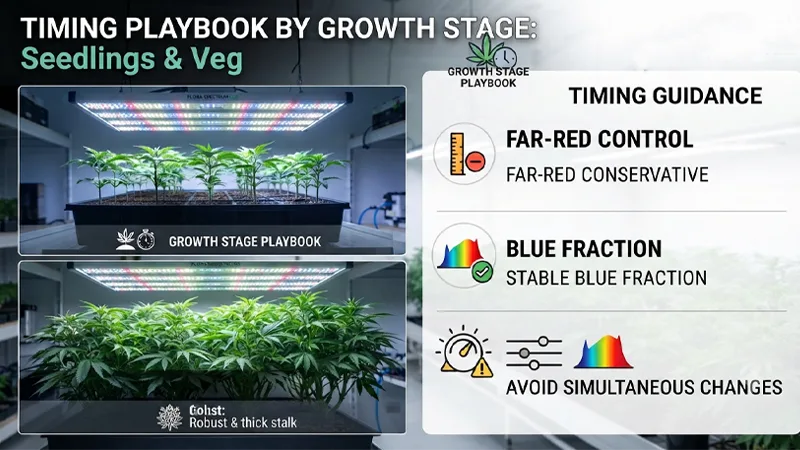
Seedlings and Veg: Keep Compact Structure and Sturdy Stems
In seedlings and veg, most commercial operators want short, strong plants that can support a uniform flowering canopy later.
Practical timing guidance:
- Keep far-red conservative if height is already a constraint
- Prioritize a stable blue fraction to build structure
- Avoid making simultaneous changes to spectrum and intensity when you’re still dialing in morphology
Transition and Early Flower (weeks 1–3): Curb Stretch Without Hurting Set
Stretch management is usually a week 1–3 problem. If you wait until internodes are already long, spectrum changes won’t “undo” that architecture.
Use a hierarchy of controls:
- Verify PPFD and DLI are where you think they are.
- Stabilize environment (VPD, temperature, day/night delta).
- Then adjust spectrum: keep R: FR from dropping too low and keep enough blue to limit elongation pressure.
If you do trial EOD-FR, treat it as a deliberate choice with a specific goal, not as a default addition.
Mid-to-late Flower: When, If Ever, to Add far-red Light Deliberately
Mid-to-late flower is rarely the place to chase height changes. If far-red is introduced here, it should be for a clearly defined reason (for example, testing canopy light distribution strategies) and only with a tight hold on confounding variables.
If your objective is yield or quality, keep expectations conservative. Cannabis evidence does not support assuming far-red will reliably increase yield or cannabinoids across cultivars.
Trialing and Risk Control
Small-block Tests (RCBD) to Validate by Cultivar
Treat spectrum as a cultivar-specific input. A simple way to reduce false wins:
- Run small-block tests using a randomized complete block design (RCBD)
- Replicate each treatment across multiple benches/racks/positions
- Keep the trial narrow: one spectrum change at a time
Keep PPFD/DLI and Environment Constant Across Spectrum Tests
Spectrum trials fail when PPFD or temperature drifts between treatments.
Control these first:
- PPFD at canopy (map it, not just a single point)
- DLI (same photoperiod, same intensity schedule)
- Canopy temperature and air temperature
- VPD and CO₂ setpoints
If you don’t lock these down, you can easily attribute stretch to far-red when it was driven by heat, intensity, or uniformity.
What to Measure: Node Length, Height, Biomass, Cannabinoids
Keep measurements simple and operational:
- Internode length on marked stems (same nodes each time)
- Plant height over time (growth curves matter)
- Fresh and dry biomass
- Cannabinoid and terpene results from your standard sampling protocol
If you use EOD-FR, record the exact dose window and the far-red intensity at canopy; duration and intensity both matter for how hard the shade signal hits.
Fixture and Spectrum Selection Tips
Independent Channels for Red, Blue, and Far-red Light
If you are serious about controlling internodal spacing, you want spectrum controls that are explicit and repeatable.
Independent red/blue/far-red channels allow you to:
- Hold PPFD constant while changing spectral ratios
- Adjust only one lever at a time during trials
- Lock a recipe to a documented configuration for multi-room deployment
If readers want to compare fixture classes and control options, the SLTMAKS products hub is a practical starting point.
Verifying Spectrum at Canopy: R:FR and Blue Fraction Tracking
Decision-stage recommendation: do not rely on “spectrum charts” alone.
- Verify R: FR and blue fraction at canopy height
- Measure at multiple points to account for uniformity and distance effects
- Treat spectrum setpoints like any other commissioning spec you’d verify (alongside PPFD, DLI, and temperature)
Thermal Management and Uniformity to Avoid Confounding Stretch
Stretch is easy to misattribute because temperature and light distribution push morphology hard.
When selecting fixtures, prioritize:
- Uniform PPFD distribution across the target footprint
- Thermal design that keeps canopy microclimate stable
- Controls that let you reproduce settings across rooms
You can cross-check commissioning basics like coverage and hanging height against SLTMAKS guidance on indoor LED plant grow light coverage.
(Brief brand note, kept neutral: SLTMAKS positions some adjustable-spectrum fixtures around independent channel control and strong cooling/heat-sink design, which aligns with the commissioning mindset above when you’re trying to validate spectrum effects without heat confounds.)
Conclusion
Lower R: FR and added far-red light generally push cannabis toward longer internodes and more stretch, while keeping a meaningful blue fraction helps compact structure. The biology is straightforward; the hard part is applying it without accidentally changing intensity or environment at the same time.
If you trial EOD-FR, start conservative, document the dose precisely, and judge success by canopy outcomes and final quality metrics, not plant height alone. Cannabis responses can be cultivar-specific, and the best published evidence supports treating far-red primarily as a morphology tool rather than a guaranteed yield or chemistry lever.
FAQ
Does far-red light increase internodal spacing in cannabis?
Yes—adding far-red (roughly 700–750 nm) or lowering the red:far-red ratio commonly triggers a shade-avoidance response, which tends to produce taller plants with longer internodes (more “stretch”).
What red-to-far-red ratio helps reduce stretch in early flower?
In general, keeping red dominant and avoiding a strongly far-red-enriched canopy spectrum helps maintain a more compact structure. The key is consistency at canopy height: verify what the plant receives (not just fixture marketing charts), and make only one change at a time so you don’t confuse spectrum effects with PPFD/DLI or temperature. For background on how far-red shifts shade signaling, see NCBI: “Phytochromes and Shade-avoidance Responses in Plants” (2014).
Does end-of-day far-red shorten cannabis flowering time?
Sometimes it’s reported to, but results are inconsistent. What’s consistent is that end-of-day far-red (EOD-FR) is a strong signal to phytochrome and often increases elongation; flowering-time and yield effects depend heavily on cultivar and protocol, and some cannabis studies show little to no flowering-time change under tested conditions.
How much blue light do I need to keep cannabis internodes tight?
Blue light is one of the cleanest spectrum levers for compactness: increasing the blue fraction generally reduces elongation pressure and tightens internodal spacing, especially in veg and the first weeks of flower. Rather than chasing a single “perfect %,” aim for “enough blue” to prevent runaway stretch in your specific cultivar and environment.
How can I test far-red changes without accidentally changing PPFD or DLI?
Treat it like a controlled trial: lock photoperiod (so DLI doesn’t drift), map PPFD at canopy for both treatments, keep canopy temperature/VPD stable, and change only one spectrum variable (for example, adding far-red) at a time. If you can, replicate the comparison across multiple positions to reduce “hot spot” bias.