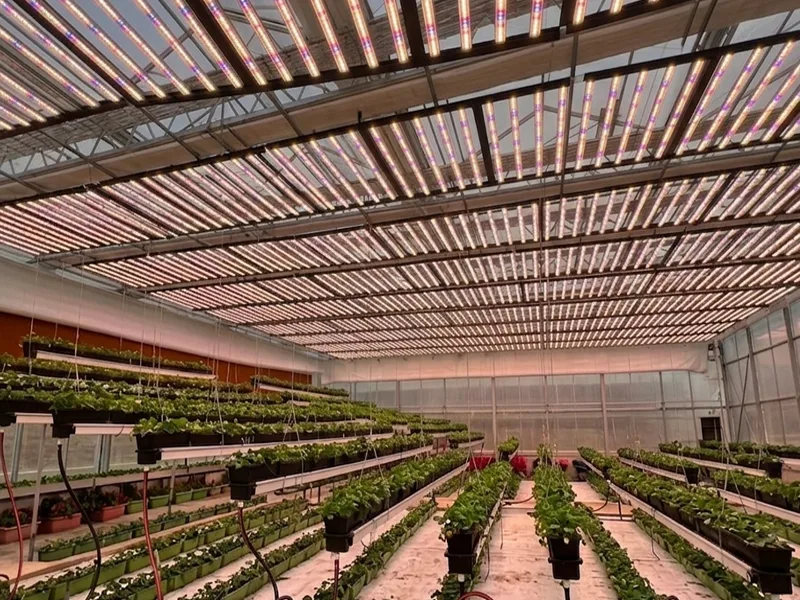
In one sentence: glazing determines the starting DLI you can bank on, and that starting point determines how much LED PPFD you must buy (and operate) to hit crop targets.
Introduction
Glazing is the first “filter” between outdoor sunlight and the photons your crop actually receives. Change the glazing, and you change both (1) how much PAR (photosynthetically active radiation, 400–700 nm) enters the structure and (2) how it’s distributed at canopy level. That’s why greenhouse glazing LED requirements aren’t just a fixture question—they’re a building-envelope question.
If you’ve ever tried to hold a DLI target through winter while keeping capex and kWh in check, you’ve seen the consequence: the same crop plan can demand very different supplemental PPFD once the glazing and screens change.
This guide is for commercial cultivation operators, facilities teams, and procurement stakeholders who need to size supplemental LEDs in a way that can survive internal review and, when relevant, an inspection conversation—without turning your glazing choice into an untracked variable.
The Impact of Greenhouse Glazing on Natural Light and Greenhouse Glazing LED Requirements guide is for commercial cultivation operators, facilities teams, and procurement stakeholders who need to size supplemental LEDs in a way that can survive internal review and, when relevant, an inspection conversation. The outputs you can quantify are straightforward: indoor natural-light DLI, DLI deficit, required supplemental PPFD, expected power density, and a defensible path to energy and ROI modeling.
The stepwise path is: measure DLI at crop height → calculate the deficit against your target → convert deficit to supplemental PPFD over a defined lighting window → translate PPFD into energy, controls, and payback assumptions. This is the same logic behind any rigorous supplemental lighting PPFD calculation—the difference is whether you quantify transmission or guess it.
Spectrum, diffusion, and compliance fit into this workflow as guardrails. Spectrum choices affect morphology and quality, diffusion affects uniformity (and therefore minimum vs. average outcomes), and compliance determines whether a design can be installed, inspected, and maintained without surprises.
Table of Contents
Glazing Materials and Light
In practice, your greenhouse light transmission factor is the operational number that matters: how much outdoor light actually reaches the crop plane after glazing, structure, screens, and soiling. The subsections below explain why that factor changes by material—and why diffusion changes uniformity even when total transmission looks similar.
Low-Iron Glass and Diffuse Coatings
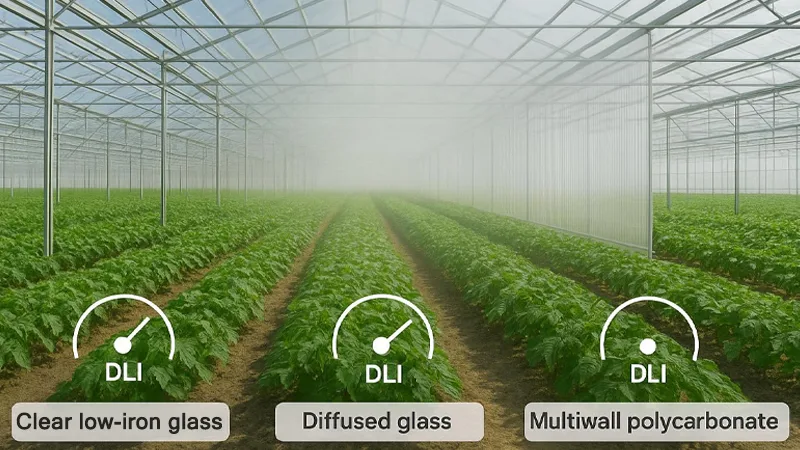
Low-iron glass is often selected when winter production makes “total photons” the binding constraint. Clear low-iron glass tends to preserve high PAR transmission at the material level, while diffuse glass or diffuse coatings trade a portion of direct-beam transmission for haze that improves uniformity.
The practical point isn’t that one is universally better. It’s that haze changes how light lands on the crop: less shadowing from structure, more canopy penetration, and often more stable plant-to-plant development. If you’re doing any PPFD-based guarantee or target minimums, diffusion can reduce the gap between average and minimum.
Diffuse coatings add a planning wrinkle: they can be seasonal or adjustable, so your “glazing performance” may not be constant year-round. In practice, this is part of diffuse greenhouse glazing haze management—how much scatter you run, when you apply it, and how consistently it’s maintained. When you size LEDs, that variability matters because the deficit you’re filling can shift with coating choice and application quality.
Multiwall Polycarbonate Performance
Multiwall polycarbonate earns its place through insulation and inherent diffusion. The multiwall structure scatters light in a way that can improve uniformity in many canopy geometries, especially where direct sun would otherwise create hotspots.
The tradeoff is that transmission tends to be lower than that of clear glass in many configurations. In practice, growers sometimes accept a lower indoor natural DLI to gain a more stable distribution and better thermal performance. Whether that’s a net win depends on your climate, screen strategy, and crop economics.
If you operate with shade curtains or thermal screens, treat polycarbonate as one part of a chain. Total transmission is the product of glazing, structure, screens, and cleanliness—not the glazing datasheet alone.
PE/EVA Films and Aging Effects
PE/EVA films can be cost-effective and can be specified with diffusion and IR/condensation additives, but their performance is time-dependent. Films age: dust loading, UV exposure, condensation behavior, and mechanical wear can all reduce transmission and shift diffusion characteristics.
For sizing LEDs, aging matters because it introduces a slow drift in indoor DLI. If you sized to “new film performance,” you may end up under-delivering light late in the replacement cycle, exactly when your crop plan assumes consistency.
A practical control is to treat film greenhouses as measurement-driven systems: set a baseline transmittance when the film is new, then verify at defined intervals (and after cleaning or storms) so your DLI deficit model stays aligned with reality.
Light Metrics and Targets
PPFD and DLI Definitions and Targets
PPFD (photosynthetic photon flux density) is an instantaneous measurement: µmol/m²/s at a point in space. DLI (daily light integral) is the time-integrated dose: mol/m²/day.
The conversion is deterministic:
- DLI = PPFD × hours × 0.0036
- PPFD = (DLI × 1,000,000) / (hours × 3600)
Virginia Tech Extension’s PDF guide, “Calculating and Using Daily Light Integral (DLI)” (SPES-720), provides a clear walk-through of how DLI relates to PPFD and photoperiod.
Targets are crop- and strategy-dependent. For this article’s purpose, the important operational discipline is to define a single target setpoint (or a range with a chosen setpoint) that your team agrees on, then keep the rest of the math consistent.
Outdoor-to-Indoor Transmission Factors
The numbers you can’t defend are the ones that will break your sizing model later. When teams argue about whether a greenhouse “really gets enough sun,” they’re usually arguing about this: the effective transmission to the crop plane, not the outside weather.
Outdoor DLI is not what the crop receives. Your indoor natural DLI is reduced by a total transmission factor that includes glazing, structure, screens, and soiling. A useful mental model is:
- T_total ≈ T_glazing × T_structure × T_screens × T_cleanliness
Extension literature emphasizes that measurements at the glazing level differ from measurements at the canopy because structure and operational factors accumulate. A helpful technical reference is the University of Wisconsin Extension note on factors affecting greenhouse light transmission.
Pro Tip: Treat “glazing transmission” as a component spec. Treat “crop-plane transmission” as an operational measurement you own.
Measurement and Verification Practices
If you want LED sizing to hold up over a season, measure like you’re going to be questioned about it later.
Start with three practices:
- Inside/outside ratio tests: measure PPFD outside and at crop height inside at the same time, then compute the indoor/outdoor ratio as a working transmission estimate.
- Grid mapping: take readings across representative bays. Average alone is not enough—track uniformity because diffusion and fixture layout both affect minimums.
- Logging and integration: if you can, log PPFD and integrate to DLI over a day. Apogee Instruments’ notes on instantaneous PPFD to integrated conversion are a good sanity check for the constants and the logic.
The goal isn’t academic precision. It’s reproducible inputs that keep your deficit model honest.
Sizing LEDs from DLI Deficit (Greenhouse Glazing LED Requirements)
Step-by-Step Calculation Workflow
This workflow is the backbone of greenhouse glazing LED requirements (and it’s what turns glazing choices into a quantified lighting spec). It makes glazing impacts explicit rather than implicit, and it keeps your DLI deficit to PPFD conversion traceable from first principles.
Step 1 — Choose the design month and outdoor DLI. Pick the month or period you’re designing for (often the lowest-light window that constrains production) and record outdoor DLI for your site.
Step 2 — Determine crop-plane total transmission (T_total). Use measured inside/outside ratios when possible. If you must estimate, document the assumption and plan a verification pass.
Step 3 — Compute indoor natural DLI. Indoor natural DLI = outdoor DLI × T_total.
Step 4 — Define the target DLI setpoint. Choose a single setpoint so the deficit is unambiguous.
Step 5 — Compute DLI deficit DLI_deficit = max(0, target DLI − indoor natural DLI).
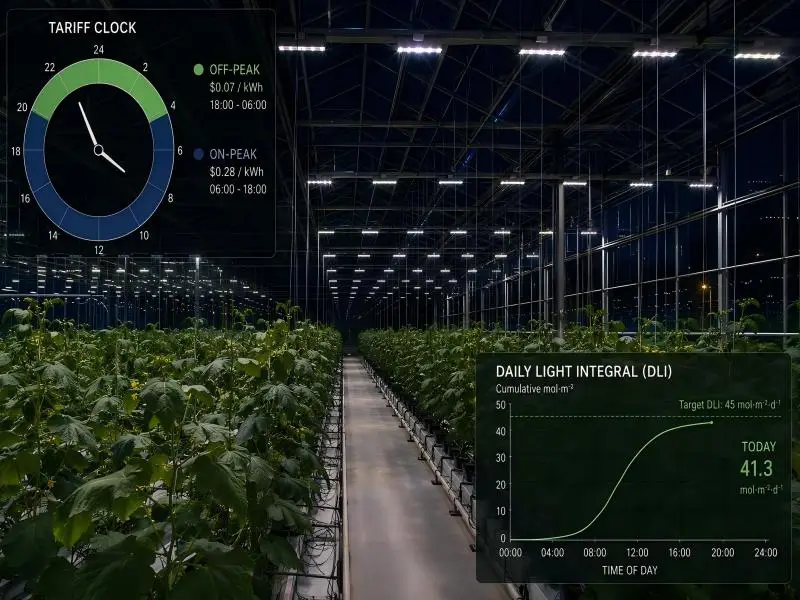
Step 6 — Choose your lighting window (hours_on). Your photoperiod constraints, TOU tariffs, and demand charges influence this as much as crop biology does.
Step 7 — Convert DLI deficit to required supplemental PPFD: PPFD_avg = (DLI_deficit × 1,000,000) / (hours_on × 3600).
If you use the compact constant form, confirm the units. Apogee’s conversion notes (linked above) help validate the math.
That conversion step is the part most teams mean when they say “we did a DLI calculation.” The difference between a rough estimate and a usable spec is whether the inputs (transmission, lighting hours, uniformity assumption) are documented.
Step 8 — Apply a distribution/uniformity factor. The conversion gives a dose average. Layout and diffusion determine how much average PPFD you need to keep minimums acceptable.
⚠️ Warning: If you size from a single center-bay PPFD reading, you will almost always under-estimate the required installed photons.
Seasonal and Latitude Scenarios
Glazing decisions are seasonal decisions. Two greenhouses can share the same crop target DLI and still have different deficits because outdoor DLI and solar angle differ by latitude and season.
In winter at higher latitudes, the practical priority is often maximizing usable photons: clear, high-transmission glazing (plus a disciplined cleaning plan) can reduce the electrical deficit meaningfully. In sunnier periods or lower latitudes, higher diffusion can improve uniformity and reduce stress from hotspots, even if it trades a small portion of direct-beam transmission. That’s where a quantified diffusion spec (haze) becomes more than marketing—it’s an input to your uniformity expectations (and how conservative you need to be in fixture count).
A good practice is to run the sizing worksheet for at least two scenarios:
- A conservative low-light month (what you’ll guarantee)
- A shoulder season month (where controls and dimming strategy prevent over-lighting)
That’s also where DLI-based dimming earns its keep. Without it, you’re forced into fixed schedules that waste kWh on brighter days.
Fixture Selection and Controls
Fixture selection is where the math meets constraints: mounting height, bay geometry, wiring, controls compatibility, and documentation.
At a minimum, use a documentation-first checklist:
- Photometrics (IES/LDT) suitable for greenhouse mounting heights
- Verified system efficacy (µmol/J), not just diode claims
- Dimming interface details (for example, 0–10V) and how the fixture behaves at low output
- Environmental suitability (ingress protection rating; define IP on first use if you reference it)
- Serviceability (driver replacement, lead times, spares)
When you integrate dimming with sensors, you convert glazing variability into a control problem instead of a surprise. In that context, SLTMAKS is relevant as a neutral example of the spec conversation you should be having: certified, high-efficacy horticultural LEDs paired with sensor-driven dimming compatibility (e.g., 0–10V control) so your system can track a daily DLI target instead of running a fixed worst-case schedule. If you want a controls-focused reference point, see Commercial Greenhouse Supplemental LED Lighting & Smart Controls. For an energy comparison framing that often shows up in procurement discussions, LED vs HPS for Commercial Greenhouse Lighting can help you align lighting choices with ROI assumptions.
Spectrum and Glazing Interactions
UV Transmission and Quality Outcomes
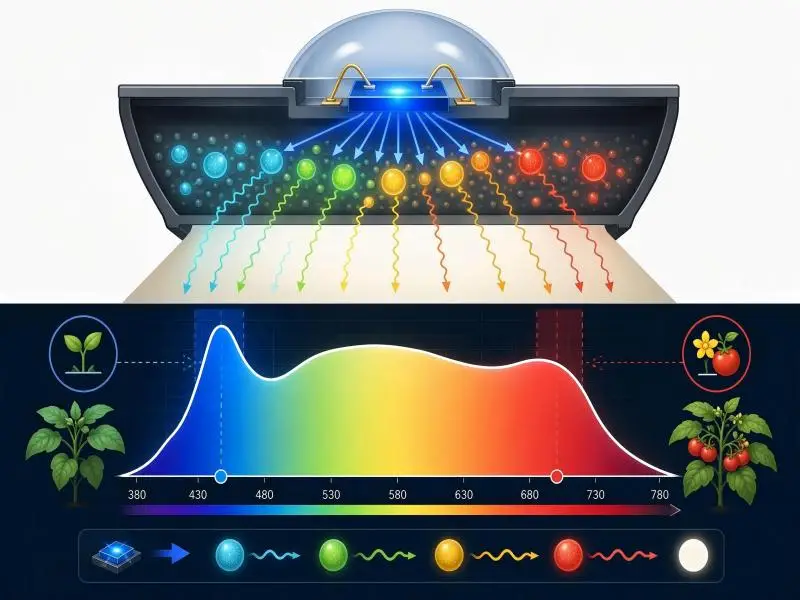
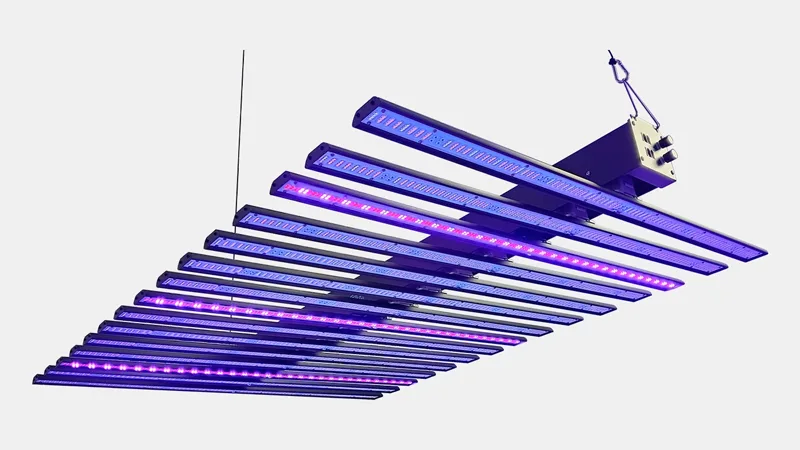
Glazing changes the spectrum, not just quantity. Many glazing materials attenuate UV differently, and that can affect crop quality attributes and pest/pathogen dynamics depending on your crop and management strategy.
The practical approach is to treat UV transmission as a controlled variable. If your glazing blocks most UV, you may decide that quality targets require a specific spectral strategy under LEDs or a different cultural approach. If your glazing is UV-open, you may see different secondary metabolite expression and should verify with your own measurements rather than assuming.
Far-Red, R: FR, and Morphology Control
Far-red affects phytochrome signaling and morphology, and its value is context-specific. Glazing can shift the ratio of red to far-red (R: FR) reaching the canopy by preferentially transmitting, or attenuating parts of the spectrum, and screens can add another layer.
If you use far-red intentionally, treat it like any other spec: define the outcome you want (stretch control, flowering responses, canopy architecture), then verify plant response and measure at the canopy. Avoid “more far-red is better” thinking; it’s a control knob, not a virtue.
Diffusion, Uniformity, and Yield Stability
Diffusion is often where glazing and LEDs interact most visibly. Diffuse glazing can raise the floor (minimum PPFD) by reducing hard shadows, while LED layout determines overlap patterns. Together, they shape uniformity, which is frequently the hidden driver of yield stability and labor predictability.
If your KPIs include consistent bench-to-bench outcomes, evaluate glazing and LEDs as a coupled system: a diffusion upgrade can sometimes let you run a lower average PPFD for the same minimum target, or hit the same average with less variability.
Energy, Controls, and Compliance
Fixture Efficacy and kWh per Mol
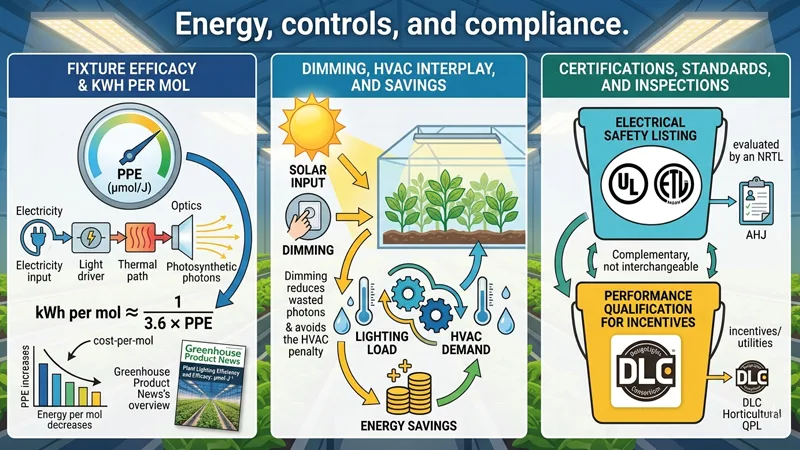
Efficacy (µmol/J) tells you how many photosynthetic photons you get per unit of electrical energy. It’s the cleanest single metric for comparing photon economics, but it only works when it’s measured at the system level (driver, thermal conditions, optics).
For planning, it’s useful to translate efficacy into energy per delivered photon dose:
- kWh per mol ≈ 1 / (3.6 × PPE)
Where PPE is in µmol/J. This turns fixture efficacy into a cost-per-mol metric that maps directly to your DLI deficit model.
For a practical explanation of why µmol/J matters and what to ask vendors, Greenhouse Product News has a readable overview: “Plant Lighting Efficiency and Efficacy: µmol·J⁻¹”.
Dimming, HVAC Interplay, and Savings
Lighting power becomes heat in the greenhouse. Even efficient LEDs add thermal load, which affects canopy temperature, VPD, dehumidification, and sometimes heating demand, depending on the climate.
Dimming is a practical tool for preventing over-lighting and over-heating when solar conditions improve. If you track delivered DLI and dim to a target, you reduce wasted photons and usually reduce the “HVAC penalty” that comes from running maximum output during brighter periods.
The greenhouse-specific lesson is simple: don’t model lighting OPEX without modeling its interaction with climate control. Even a rough coupling assumption is better than pretending the systems are independent.
Certifications, Standards, and Inspections
In the US, compliance conversations often split into two buckets:
- Electrical safety listing: Many jurisdictions and customers expect fixtures to be evaluated by a Nationally Recognized Testing Laboratory (NRTL). UL and ETL are common examples of NRTL marks. Your Authority Having Jurisdiction (AHJ) ultimately decides what’s acceptable for installation.
- Performance qualification for incentives: Programs and utilities may reference the DesignLights Consortium’s horticultural requirements and product lists. DLC documents its approach in the DLC horticultural technical requirements and maintains the lookup list at the DLC Horticultural QPL.
Treat these as complementary, not interchangeable. Safety listing is about acceptance and risk control. QPL listing is about performance comparability and, often, rebate pathways.
Conclusion
Glazing decisions show up later as electrical decisions. The clean way to manage that is to keep the workflow explicit:
- Treat glazing as a measurable input to crop-plane DLI, not a spec-sheet assumption
- Convert the resulting DLI deficit into PPFD using a documented lighting window
- Apply a uniformity factor so “average PPFD” doesn’t hide weak zones
- Translate PPFD into energy using verified fixture efficacy and a control plan
- Keep compliance (NRTL listing, AHJ expectations, and incentive requirements) on the checklist from day one
Pitfalls that repeatedly cause overspend or under-delivery:
- sizing from glazing transmission specs instead of crop-plane transmission
- ignoring film aging, dirt, and screen schedules
- relying on a single PPFD point without a grid map
- selecting fixtures without photometrics, dimming behavior details, and inspection-ready documentation
Action checklist for the next season plan:
- Pick your design month and document outdoor DLI inputs
- Measure inside/outside transmission and repeat after cleaning or glazing changes
- Run the DLI deficit to PPFD conversion and validate with a canopy-level PPFD grid
- Define a DLI-based dimming strategy so you aren’t stuck in worst-case runtime
Verification and continuous improvement steps:
- Log delivered DLI and compare to targets across weather patterns
- Re-check transmission quarterly (or on your film replacement/cleaning cycle)
- Pilot one bay before scaling to a full-house retrofit
If you want a practical next step to standardize the math and controls assumptions across stakeholders, use SLTMAKS’s Greenhouse Supplemental Lighting: PPFD/DLI Calculations as a worksheet reference, then adapt it to your own glazing + screen schedules so the deficit model matches how your greenhouse actually operates.
FAQ
Why shouldn’t I rely solely on the glazing material’s datasheet for light transmission?
The manufacturer’s datasheet only lists the transmission of the material itself, but the actual light reaching your crop is the product of a “chain” of filters. You must account for the greenhouse structure, internal screens, and even surface soiling (dust/dirt). It is more accurate to treat “crop-plane transmission” as an operational measurement you perform on-site rather than a static component specification.
What are the practical benefits of diffuse glazing over clear glass?
While clear glass maximizes total photon entry, diffuse glass or coatings improve how that light is distributed. Diffusion reduces hard shadows from the greenhouse structure and increases light penetration deeper into the plant canopy. This results in more stable plant-to-plant development and helps reduce the gap between your average and minimum PPFD targets.
How do I calculate the specific LED “DLI Deficit” for my facility?
The calculation follows a logical stepwise path:
Step 1: Determine your indoor natural DLI (Outdoor DLI × Total Transmission Factor).
Step 2: Define your crop’s target DLI setpoint.
Step 3: Subtract the natural DLI from your target to find the DLI Deficit.
Step 4: Convert that deficit into the required supplemental PPFD based on your planned lighting hours (photoperiod).
How does dimming impact the relationship between lighting and HVAC?
Lighting power is eventually converted into heat, adding to the greenhouse’s thermal load and affecting canopy temperature and dehumidification needs. Dimming is a tool used to prevent over-lighting when solar conditions improve. By tracking delivered DLI and dimming to a target, you reduce wasted electricity and minimize the “HVAC penalty”—the extra energy spent cooling or dehumidifying due to unnecessary light output.
What is the difference between an NRTL listing (UL/ETL) and a DLC listing?
These should be viewed as complementary but separate standards:
Electrical Safety Listing (NRTL): Marks like UL or ETL are required by many jurisdictions for safety compliance and risk control; they determine if a fixture is acceptable for installation.
Performance Qualification (DLC): Listing on the DesignLights Consortium (DLC) QPL is focused on performance comparability and is often a mandatory requirement to qualify for utility energy rebates.