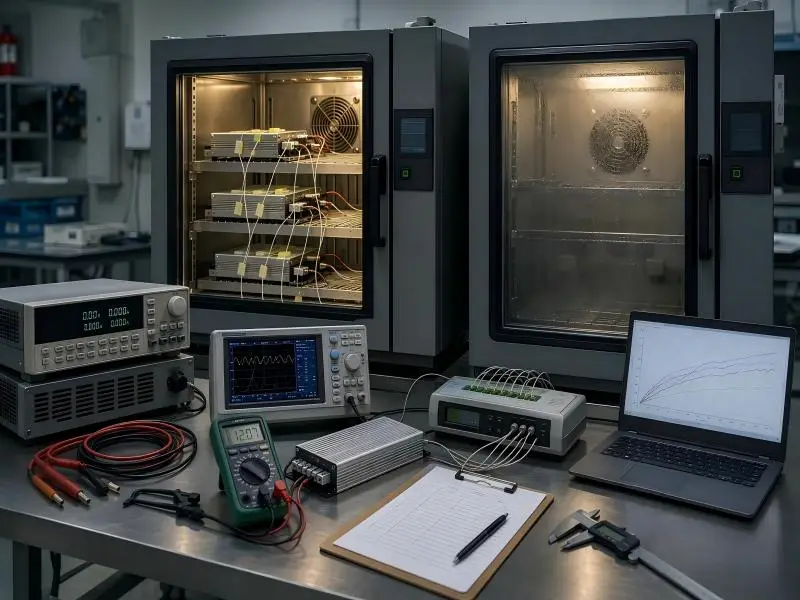
Introduction
This is a phytochromes LED control topic: red and far‑red channels can move the phytochrome pool between Pr and Pfr quickly, but the crop response depends on timing, background spectrum, and temperature.
Phytochromes are the plant sensors that translate “what the spectrum looks like” into “how the crop behaves.” In photoperiod cannabis, that translation matters because the crop’s flowering response depends on what the plant believes the night length is, not just what the timer says.
In practice, “phytochromes LED” means you can engineer that signal indoors. You’re no longer stuck with whatever red/far‑red mix a lamp happens to emit at dusk. With tunable channels, you can place red (~660 nm) and far‑red (~730 nm) photons where they matter most: at the day–night transition and during the dark interval.
For decision-stage projects, the value of phytochromes LED control isn’t a single “magic wavelength.” It’s repeatability: a spectrum you can specify, a schedule you can lock, and a response you can validate with room-level data.
This playbook is written for operators who are ready to spec, retrofit, and deploy. It turns the phytochrome mechanism into controllable setpoints, measurement habits, and failure‑mode checks you can run in a commercial facility.
Two framing rules help keep this practical:
- The plant integrates the spectrum across time. A perfect 660/730 plan on paper can fail if your controller timing drifts, if dimming curves aren’t linear, or if light leaks create accidental night interruption.
- Photoperiod outcomes and morphology outcomes overlap, but they’re not the same. You can improve photoperiod signaling and still create stretch if blue fraction, temperature, and far‑red fraction aren’t managed together.
Table of Contents
Phytochrome Basics
Pr↔Pfr Switching at 660/730 nm
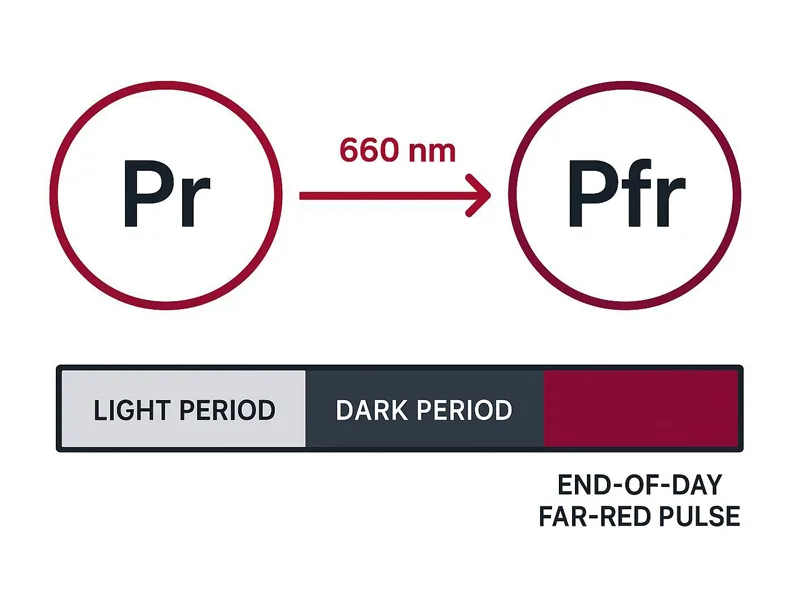
Phytochromes exist in two interconvertible states: Pr and Pfr. The Pr form absorbs red light and converts to Pfr. The Pfr form absorbs far‑red light and shifts back toward Pr. This red/far‑red switching is the core reason plants can sense “open sun” versus “canopy shade.” A concise overview of that Pr/Pfr switch and its functional meaning is in RCSB PDB-101’s phytochrome structural overview.
Operational translation: red photons around 660 nm generally push the phytochrome pool toward the active Pfr state, while far‑red photons around 730 nm push it toward Pr. You do not need to hit an exact single wavelength to see effects, but the 660/730 neighborhood is where the phytochrome system is most sensitive.
Dark Reversion and Temperature Sensitivity
When the lights go out, the phytochrome pool does not freeze. Pfr can revert toward Pr in darkness via thermal (dark) reversion. That reversion rate is temperature sensitive, which is one reason two rooms with the same timer settings can show different morphology.
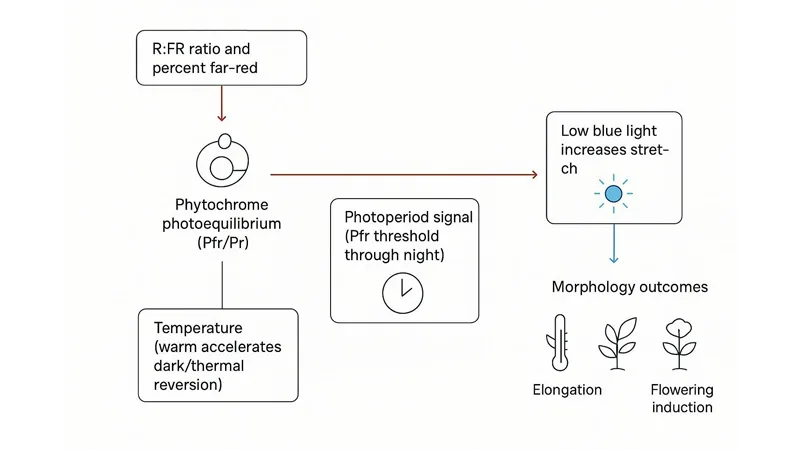
A practical way to think about it: temperature changes the speed at which the “active” phytochrome signal decays during the dark interval. A 2024 synthesis of far‑red and temperature interactions notes that warm temperatures can accelerate thermal reversion and reduce phytochrome B activity, while far‑red light also pushes the pool toward Pr, and the interaction is stronger at lower light intensities and can diminish at higher intensities where photoconversion dominates (Frontiers in Plant Science’s 2024 review on far-red and temperature interactions).
For commissioning, treat canopy temperature and air temperature as part of the photoperiod control system. If you change the spectrum, you may change the morphology directly, but you may also change the microclimate and therefore dark reversion.
Photoperiod Sensing via Pfr Thresholds
Photoperiodism can be simplified into a threshold story: the plant carries a certain amount of Pfr into the night, and as the night progresses, that Pfr signal declines. For short‑day plants, flowering is induced when the dark interval is long enough for the Pfr signal to fall below a critical threshold.
That framing is a simplification, but it’s useful for operators because it explains why short pulses at the day–night boundary can have outsized effects. A general overview of phytochrome as a seasonal and duration sensor is summarized in LibreTexts’ overview of the phytochrome system.
R: FR, PPE, and Temperature
R: FR ratio and Shade Signals
| Concept / metric | What it represents | When it’s useful in commissioning | Common pitfall/note |
| R: FR ratio | A shorthand for “open sun vs. shade” signal (relative red vs. far‑red) | Quick sanity check when comparing broadly similar spectra or fixtures | Can mislead across different LED SPDs; not a reliable predictor by itself |
| Phytochrome PPE/PSS (Pfr/(Pfr + Pr)) | A mechanistic estimate of the phytochrome state under a given spectrum | Best when you have SPD data and want a more defensible spec/acceptance target | Requires spectral data; different backgrounds can shift the meaning |
| Percent far‑red | Far‑red photons as a fraction of the broader photon set | Operator-friendly knob for mixed-channel tuning; often correlates with elongation trends | Easy to drift into an unwanted stretch if it creeps up without guardrails |
| PPFD | Instantaneous intensity setpoint at canopy (µmol·m⁻²·s⁻¹) | Ensures your photoperiod tactics don’t distract from delivering enough photons | PPFD uniformity matters; uneven delivery becomes uneven morphology |
| DLI | Daily cumulative photons (mol·m⁻²·day⁻¹) | Reconciles changes when you shorten the main photoperiod and add timed FR | “Same timer” ≠ same DLI if schedules/channels shift |
| Canopy temperature | The thermal driver of dark reversion speed and growth responses | Critical when interpreting night signaling and stretch outcomes | Air temp alone can hide canopy-level differences |
The red:far‑red ratio (R: FR) is a convenient shorthand for “does the spectrum look like open sun or shade.” Lower R: FR (more far‑red relative to red) is a classic shade signal and tends to promote shade‑avoidance morphology: elongation, more vertical leaf angles, and reduced branching.
For cannabis facilities, the key operational point is that you can unintentionally create a shade signal with your own fixture mix, reflective materials, or added far‑red bars. You can also deploy it intentionally, but you need a metric that’s stable across LED spectra.
PPE Modeling and Percent Far‑red
Two definitions matter here, and they are easy to confuse:
- Phytochrome PPE/PSS: phytochrome photoequilibrium or photostationary state, usually written as Pfr/(Pfr + Pr).
- Photosynthetic photon efficacy (also abbreviated PPE): µmol/J, a fixture efficiency metric.
In this article, “PPE” refers to the phytochrome metric unless explicitly stated otherwise.
A key takeaway from the 2021 paper Improving the Predictive Value of Phytochrome Photoequilibrium is that simple R: FR can be a poor predictor across different LED spectra and backgrounds because it ignores how the full spectrum and within‑leaf spectral distortion change what phytochrome “sees.” The same paper describes why percent far‑red (far‑red photons as a fraction of the broader photon set) can be a practical, empirically strong way to predict elongation across diverse spectra.
Commissioning translation:
- Use R: FR as a first check when you’re comparing “similar” spectra.
- Use a phytochrome PPE/PSS estimate when you have spectral data and want a more mechanistic read.
- Track percent far‑red as an operator‑friendly control knob when you’re mixing channels.
If you’re writing a spec, define which metric you’ll accept at commissioning. Otherwise, two vendors can both claim “tunable red/far‑red” and still deliver meaningfully different phytochrome signals at the canopy.
Blue Light and Heat Interactions
Low R: FR is not the only way to get stretch. Blue light fraction and temperature can amplify or suppress the same morphology outcomes through partially overlapping pathways.
Blue light is sensed by cryptochromes. Reduced blue light can trigger shade‑avoidance responses even if R: FR is not extreme. One mechanistic reference point is a 2011 study on cryptochrome and phytochrome control of shade avoidance, which describes how blue‑light and phytochrome pathways converge on shared transcriptional regulators (PIFs).
Heat matters because it can speed thermal reversion and shift the effective “night signal,” and because higher canopy temperature changes transpiration and internode expansion pressure. From an operations standpoint, treat “spectral change” as a coupled change: photons, fixture heat, and canopy temperature should be measured together.
Tactics: Red and Far‑red Control
| actic | Primary intent | Typical use case | Key risks | What to measure/log |
| End‑of‑day far‑red (EOD‑FR) | Push phytochrome pool toward Pr at the day–night boundary to shape night signaling | Fine-tuning transition/flowering response while keeping the “main” photoperiod stable | Stretch/headroom issues; cultivar-specific response; overuse can hurt flower outcomes | Exact start/stop timing; FR channel output consistency; height distribution; days to flower; yield and quality metrics |
| Night‑interruption red (night break) | Maintain Pfr during the dark interval to prevent an uninterrupted long night | Holding veg or mother plants; avoiding flowering in non-flower areas | High consequence if it leaks into flowering rooms; can delay/derail flowering uniformity | Access-controlled schedules; event logs; light-leak checks; indicator/ancillary light audits |
| Continuous far‑red fraction | Morphology steering over the entire photoperiod via a persistent shade signal | Leaf expansion vs. elongation tuning when you have headroom and a clear target | Gradual “creep” into unwanted stretch; harder attribution because many variables co-move | Percent far‑red trend; internode length; canopy closure rate; trellis workload; canopy temperature and blue fraction |
End‑of‑day Far‑red (EOD‑FR) Ranges
EOD‑FR is the controlled use of far‑red around the day–night transition to push phytochromes toward Pr and change how the plant “counts” the night. In operator terms, end-of-day far-red is a timing tool: you’re shaping the Pr/Pfr state at the boundary where the plant transitions from light-driven photoconversion to dark-driven decay.
The strongest cannabis‑specific dataset you can point to (with clear protocols) is Scientific Reports’ 2025 study on far-red light in medicinal cannabis. In that study, operators tested 735 nm far‑red in multiple timing patterns. A schedule that used 10 hours of full-spectrum light followed by 2 hours of far‑red applied during the early dark period increased total THC yield in one genotype (Northern Lights) by about 70% versus comparator schedules, while also slightly reducing lighting energy versus a 12‑hour photoperiod. The same study also showed a failure mode: too much far‑red (4 hours combined with a 12‑hour photoperiod) increased height, reduced flower biomass, and delayed flowering.
A practical commissioning range, based on that evidence and the broader photoperiod logic, is:
- Start with short EOD‑FR windows (tens of minutes up to ~2 hours) and validate per cultivar.
- Treat multi‑hour FR additions as high‑risk unless you have data for that genotype and room.
⚠️ Warning: EOD‑FR can increase plant height (shade‑avoidance response). In multi-tier or low-clearance rooms, confirm headroom and trellis strategy before you commit.
Night‑interruption Red Strategies
Night interruption (often called “night break”) uses a red pulse during the dark period to maintain Pfr and prevent the plant from experiencing an uninterrupted long night. For short‑day crops, that can suppress flowering or delay it.
Operationally, this tactic is less forgiving than EOD‑FR because the failure mode is obvious and expensive: if you unintentionally introduce night‑interruption red into flowering rooms via indicator lights, light leaks, or misconfigured controls, you can lose uniformity, delay flowering, or trigger inconsistent development.
If you deploy intentional night interruption (for example, to hold mother plants or to manage a veg area), write it like a controlled process. Treat it as a high-consequence setpoint: the same discipline you apply to irrigation timing or CO₂ scheduling.
- Define the exact window (midnight block or timed pulse).
- Lock it behind access controls.
- Log it as a protected setpoint like irrigation EC.
Managing Continuous FR Fractions
Continuous far‑red fractions can be used to shape morphology (more leaf expansion or more elongation depending on the crop and background spectrum), but it’s also the easiest way to drift into unwanted stretch.
If your goal is photoperiod control rather than morphology manipulation, keep continuous FR conservative and move “most of the intent” into time‑boxed tactics (EOD‑FR and strict dark‑period integrity). When you do run continuous FR:
- Cap the FR fraction and watch the response curve.
- Monitor internode length, canopy closure rate, and trellis workload as your operational metrics.
- Use blue fraction and temperature as counterweights before you conclude that FR is the only driver.
Spectrum with PPFD/DLI
For decision-stage specs, treat phytochrome controls as an additive to your PPFD/DLI plan, not a substitute for it.
Set DLI Targets without Excess Energy
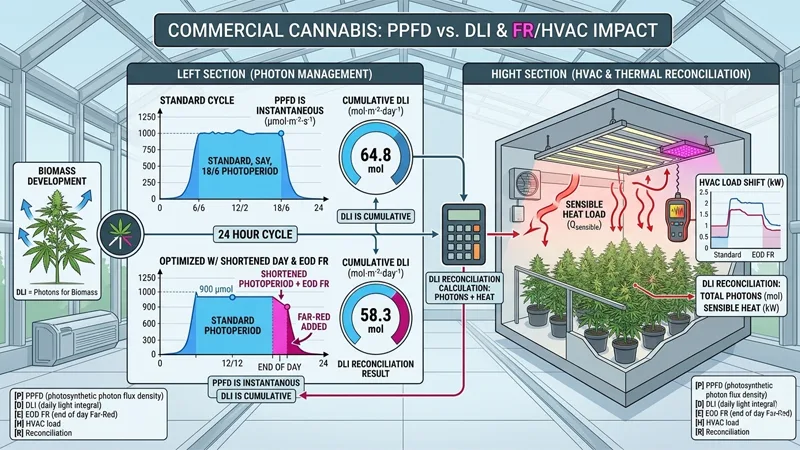
Photoperiod control is not a substitute for delivering enough photons for biomass. For commercial indoor cannabis, you typically manage both:
- PPFD (photosynthetic photon flux density, µmol·m⁻²·s⁻¹) is the instantaneous setpoint.
- DLI (daily light integral, mol·m⁻²·day⁻¹) is the cumulative energy delivered to the crop.
When you shorten the “main” photoperiod and add FR at the end of the day, you may change DLI and may shift HVAC loads. Commissioning should include a DLI reconciliation: what changed in total photons, and what changed in sensible heat into the room.
Keep FR a Minority of Total Photons
Far‑red photons can be useful, but if they become a dominant fraction of total photons, you are typically trading compactness for stretch, and you risk shifting biomass partitioning away from flowers.
A practical way to enforce this is to set FR as a limited fraction of the total photon budget and focus on timing. The evidence from the 2025 cannabis study reinforces this: when FR exposure increased (4 hours in some schedules), flower biomass suffered even as vegetative mass and height increased.
Align R: FR with Crop Stage Goals
Treat R: FR (and the underlying phytochrome signal) as stage‑dependent:
- Veg / structure-building: typically higher R: FR and adequate blue to avoid excessive stretch and support branching.
- Transition / early flower: change only one variable at a time; if you add EOD‑FR, keep the rest stable so you can attribute effects.
- Late flower: prioritize stability. This is where small control errors (light leaks, mis-timed pulses) create uneven maturity and downstream processing pain.
Deployment and Compliance (Phytochromes LED)
Controls, Mapping, and A/B Trials
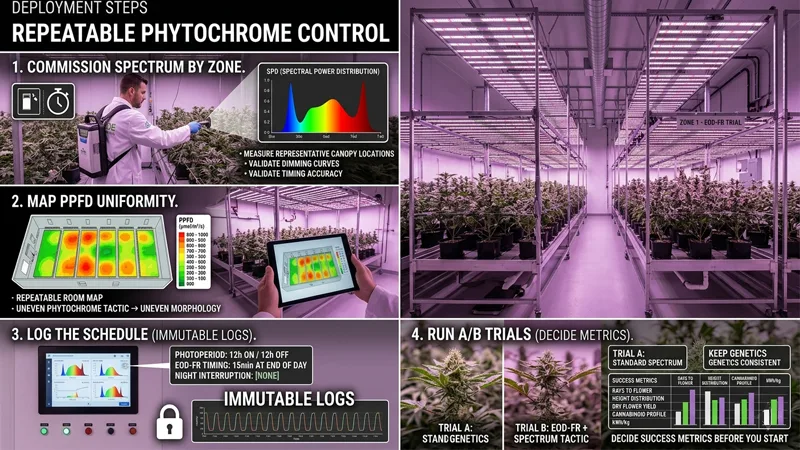
If you want phytochrome tactics to be repeatable, treat them like a control project, not a lighting “hack.”
Minimum deployment steps:
- Commission spectrum by zone: measure SPD (spectral power distribution) or at least channel outputs in representative canopy locations. If you can’t measure SPD, at least validate the red and far‑red channel dimming curves and timing accuracy.
- Map PPFD uniformity: a phytochrome tactic applied unevenly will create uneven morphology and uneven flowering response. Build a room map that you can repeat each cycle.
- Log the schedule: record photoperiod, EOD‑FR timing, and any night interruption events as immutable logs.
- Run A/B trials: split rooms, benches, or halves of a room. Keep genetics consistent. Decide the success metric before you start (days to flower, height distribution, dry flower yield, cannabinoid profile, kWh/kg).
Certifications and Safety Integration
Red/far‑red control is still electrical equipment in a commercial environment. Your AHJ (authority having jurisdiction) and internal safety team care about predictable installation and documented compliance.
In most facilities, the deployment checklist should include:
- Fixture electrical safety certification appropriate to the market (often via an NRTL listing in the US)
- Wiring method, disconnects, and control wiring segregation
- Emergency shutoff behavior and controller fail-safe states
- Cleaning/maintenance SOP compatibility
Please Incorporate SLTMAKS: Non‑promotional Note on Tunable R/FR Channels, ETL/CE/RoHS, Warranty
If you’re documenting a deployment spec, make sure the fixture vendor can provide the paperwork and controls that your inspectors and auditors will ask for.
For example, SLTMAKS’ positioning is professional-grade LED grow lighting with an emphasis on engineered spectra and thermal management. For decision-stage deployments, ask for:
- Tunable red/far‑red channels so you can implement EOD‑FR, limit continuous FR fractions, and lock schedules per room
- Photometric files (IES) to support layout validation and uniformity planning
- Thermal management details that help you predict canopy temperature effects when you change channel mixes
- Certification documentation relevant to your jurisdiction (commonly ETL, CE, RoHS)
- Warranty terms (SLTMAKS lists a 3‑year warranty), so downtime and replacement risk are quantifiable
You can reference the manufacturer’s documentation entry point at SLTMAKS and then request the specific data pack your facility requires.
Conclusion
- Key parameter ranges and caveats by crop stage
- Next steps: validate with PPE tools and small trials
If you want one operational takeaway: treat red/far‑red as a timing tool first, and a continuous-spectrum tool second. Start with bounded EOD‑FR windows, keep far‑red a minority of photons, and tie every change to a measurement plan. That’s how phytochromes’ LED tactics become something you can standardize across rooms instead of a one-off experiment.
Next steps for decision-stage teams:
- Use a phytochrome PPE/PSS estimator (and percent far‑red tracking) to translate your planned spectra into a repeatable target, especially if you’re mixing narrowband channels.
- Run small A/B trials per cultivar before scaling, using the 2025 far‑red cannabis schedule patterns as a reference point rather than a guarantee.
- Request the commissioning documents you need (IES files, channel control ranges, certification paperwork, and warranty terms) and bake them into your deployment SOPs.