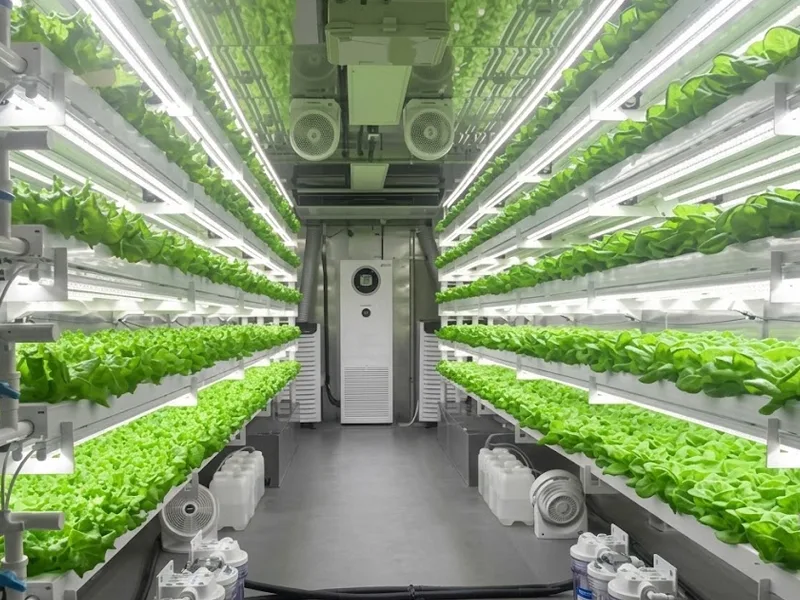
The transition from traditional greenhouse agriculture to high-density, controlled-environment agriculture (CEA) represents a monumental shift in how we produce food and medicinal crops. At the heart of this revolution is the multi-tier architecture, where implementing the right vertical farm lighting is often the deciding factor between a facility’s profitability and its failure. By stacking grow trays vertically, operators can exponentially increase their yield per square foot of real estate. However, this architectural triumph introduces severe biophysical and engineering bottlenecks. When you compress hundreds of multi-tier rack grow lights into a confined cubic space, two critical adversaries emerge: compounded heat accumulation and extreme light distribution disparities.
As a professional horticultural lighting manufacturer, SLTMAKS recognizes that solving these two challenges is not merely a matter of installing brighter diodes or larger fans. It requires a holistic, engineering-first approach to vertical farming lighting solutions. When microclimates destabilize and edges of the canopy suffer from photon starvation, the entire financial model of a commercial indoor farm collapses under the weight of excessive operational expenditures (OPEX) and degraded crop yields.
This comprehensive guide delves deep into the thermodynamics and optical physics of multi-tier cultivation. We will explore how advanced commercial LED grow lights wholesale buyers, facility engineers, and farm operators can systematically eradicate heat dissipation bottlenecks and achieve pristine PPFD uniformity in indoor farming environments. By aligning cutting-edge fixture design with rigorous agronomic requirements, we aim to elevate your cultivation strategy to meet the highest standards of energy efficiency and premium crop production.
Table of Contents
Deep Dive: The Thermodynamics and “Microclimate Traps” of Multi-Tier Racks
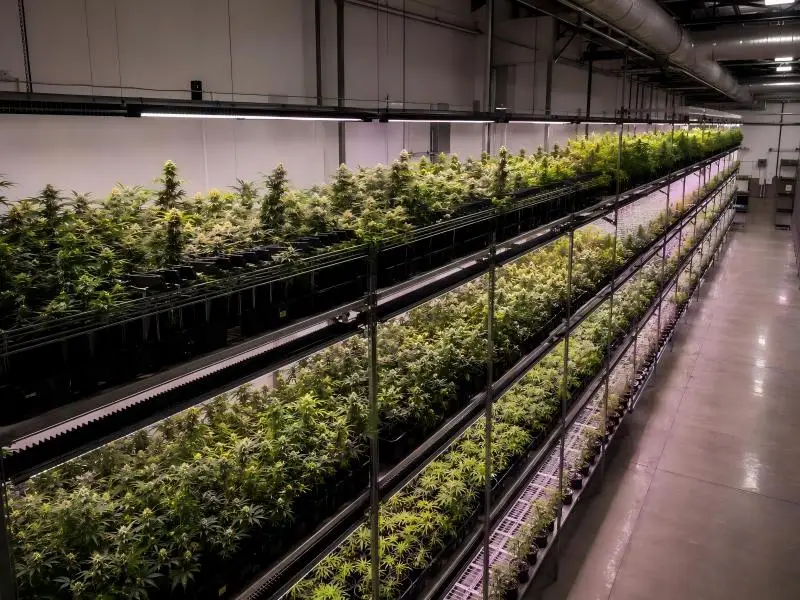
To engineer a solution, we must first profoundly understand the problem. The core issue in multi-tier vertical farming is the creation of unintended, highly localized microclimates.
The Physics of Confined Heat Accumulation
Even the most advanced high-efficacy horticultural lighting on the market today does not convert 100% of electrical energy into photosynthetically active radiation (PAR). Approximately 40% to 50% of the consumed power is inevitably emitted as heat. In a standard single-level greenhouse, this thermal energy naturally dissipates into the expansive air volume above the canopy.
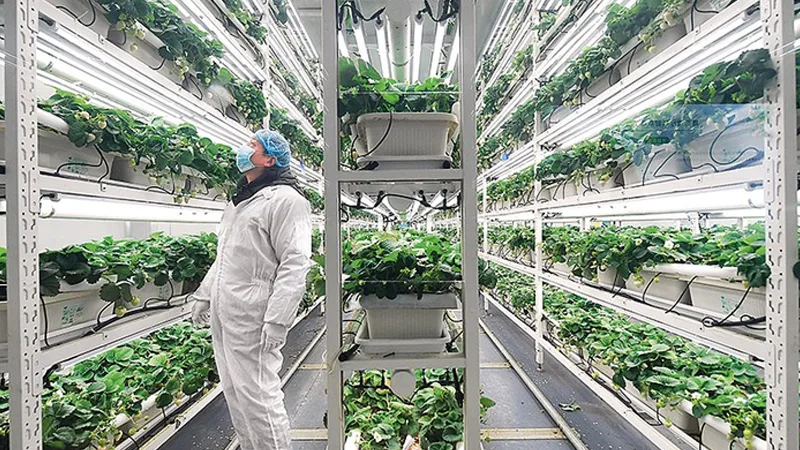
In a multi-tier system, however, the architecture works against the physics of cooling. The grow tray immediately above a light fixture acts as an impermeable ceiling. Heat generated by the LEDs on Tier 1 rises, warming the root zone and underside of the grow tray of Tier 2. This convective heat transfer compounds as you move higher up the rack. Without precise intervention, the top tier of a vertical rack can operate at temperatures significantly higher than the bottom tier.
The Impact on Vapor Pressure Deficit (VPD) and Plant Physiology
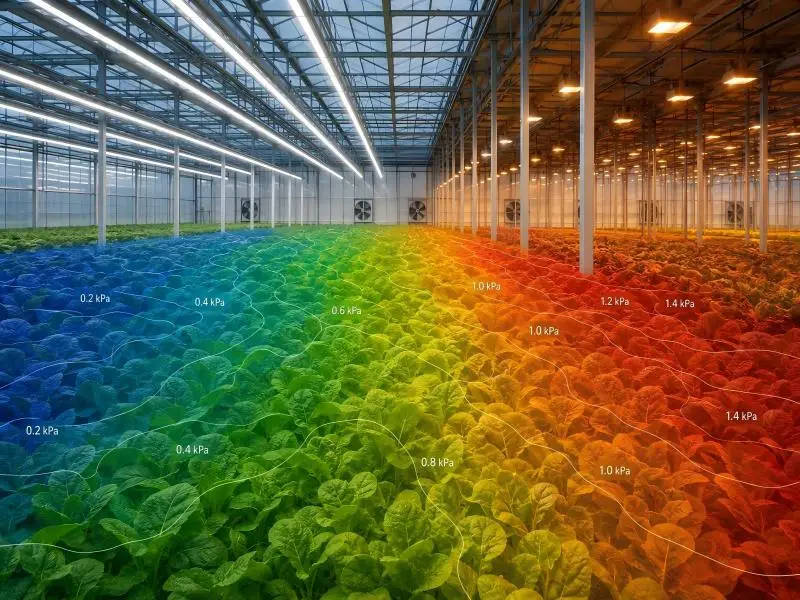
This thermal stratification wreaks havoc on a critical agronomic metric: Vapor Pressure Deficit (VPD). VPD is the difference between the amount of moisture in the air and how much moisture the air can hold when it is saturated. It is the primary driving force behind plant transpiration.
When trapped heat drastically raises the localized ambient temperature within a specific tier, the air’s capacity to hold water increases, resulting in a sudden spike in VPD.
- High VPD stress: If the VPD becomes too high (the air is too hot and dry), plants will close their stomata to prevent excessive water loss. When stomata close, CO2 intake halts, instantly stalling photosynthesis and vegetative growth.
- Root zone complications: Furthermore, excessive heat radiating into the grow trays warms the hydroponic or aeroponic nutrient solutions. Elevated water temperatures decrease dissolved oxygen (DO) levels, paving the way for anaerobic pathogens like Pythium (root rot).
The Limits of Conventional HVAC Integration
A common misconception among early-stage vertical farm investors is that HVAC integration for vertical farms can simply be scaled up to brute-force the cooling process. This is a financially disastrous approach. Relying solely on massive HVAC tonnage to penetrate dense, multi-tier racks is highly inefficient.
The dense foliage and the solid shelves block horizontal and vertical airflow. Increasing HVAC velocity often results in wind burn on the outer plants while the center of the rack remains a stagnant, hot microclimate. Furthermore, over-engineering the HVAC system balloons the Capital Expenditure (CAPEX) and results in astronomical monthly electricity bills (OPEX), eroding the farm’s profit margins. The solution must begin at the source of the heat: the lighting fixture itself.
Vertical Farm Lighting Innovations: Eradicating Heat Dissipation Bottlenecks
To conquer the thermal challenges of multi-tier environments, LED grow light heat dissipation must be addressed through sophisticated mechanical and structural engineering. At SLTMAKS, we approach thermal management through multiple concurrent strategies, ensuring that our fixtures run exceptionally cool, thereby preserving the integrity of your HVAC strategy and the health of your plants.
Passive Thermal Management: The Science of Heat Sinks
For commercial vertical farming, passive cooling (cooling without moving parts like integrated fans) is the gold standard. Fans introduce mechanical failure points, consume extra power, and are susceptible to breaking down in high-humidity indoor farm environments.
Effective passive cooling relies on maximizing the surface-area-to-volume ratio of the fixture’s housing.
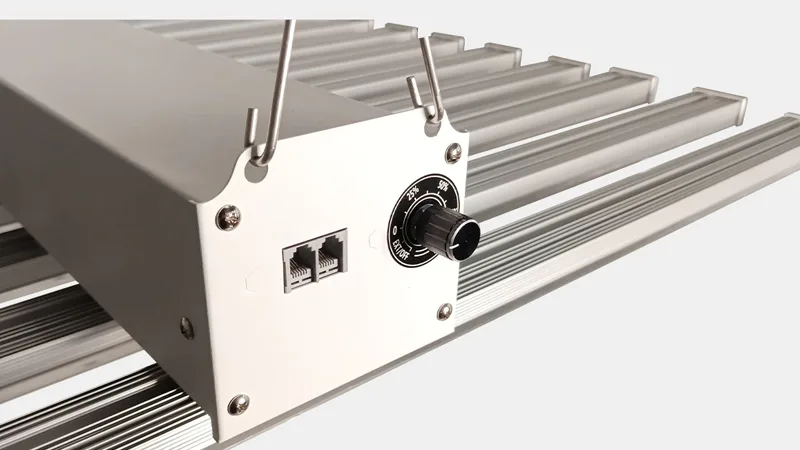
- Material selection: Utilizing high-grade, cold-forged or extruded 6063 aerospace aluminum is paramount. This specific alloy offers superior thermal conductivity compared to standard die-cast alternatives.
- Fin geometry: The design of the heat-dissipating fins is critical. Deep, strategically spaced fins create micro-channels that leverage natural convection. As air between the fins warms, it rises, drawing cooler air in from the bottom—a continuous, passive thermal siphon that pulls heat away from the sensitive LED junctions (Tj). Lower junction temperatures directly correlate with longer diode lifespans and sustained photon output over years of continuous operation.
Remote Driver Architecture: Decoupling the Heat Source
One of the most effective breakthroughs in vertical farming lighting solutions is the implementation of remote LED driver architectures. In traditional grow lights, the LED driver (the power supply unit) is mounted directly onto the back of the light fixture. The driver is responsible for converting AC line voltage to the DC voltage required by the LEDs, a process that inherently generates significant heat—often accounting for 15% to 20% of the fixture’s total thermal output.
By engineering fixtures that allow the drivers to be detached and mounted outside of the cultivation racks (e.g., on adjacent walls or entirely outside the grow room in dedicated electrical corridors), we instantly remove a massive thermal load from the immediate microclimate of the plants. This remote driver strategy allows the HVAC system to handle the driver heat more efficiently in open space, rather than struggling to pull it out from between tight shelving layers.
Aerodynamic Fixture Morphology: The Slim Bar Advantage
The physical footprint of the light fixture dictates how well conditioned air can move through the rack. Solid “quantum board” style lights act as physical baffles, completely blocking vertical airflow.
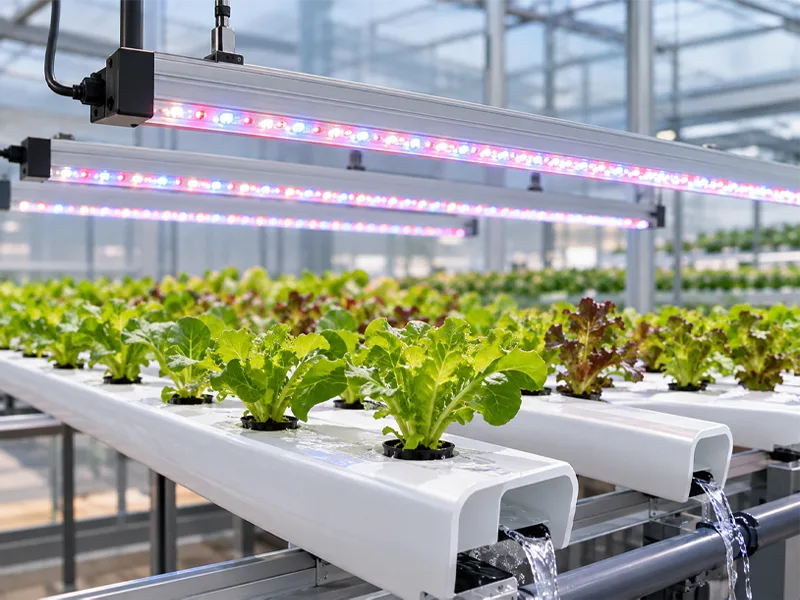
The industry standard for multi-tier racks has evolved into the “Slim Bar” or “Strip Light” morphology. By spreading the LEDs across narrow, spaced-apart aluminum bars, the fixture becomes highly permeable. This open-bar design allows the downward draft from overhead HVAC ducts or canopy airflow systems to seamlessly pass through the light fixture, breaking up stagnant air pockets and ensuring a uniform temperature and humidity profile across the entire plant canopy.
Conquering Light Uniformity: Eradicating “Edge Yield Loss”
Solving the heat problem is only half the battle. The second, and arguably more complex challenge in multi-tier racks, is delivering perfectly uniform light to every single plant, regardless of its position on the shelf.
The Physics of Proximity and The Inverse Square Law
In a multi-tier setup, vertical space is money. To maximize the number of tiers, the distance between the grow light and the plant canopy is compressed to extreme limits—often as close as 6 to 12 inches (15 to 30 cm). This proximity heavily exacerbates the physical behavior of light, specifically governed by the Inverse Square Law: , where illuminance (E) is inversely proportional to the square of the distance (d) from the source.
When a standard light fixture is placed inches from the canopy, it creates a severe “hotspot” directly in the center, delivering massive amounts of Photosynthetic Photon Flux Density (PPFD). However, just a few inches towards the perimeter of the tray, the PPFD drops off a cliff.
Defining True PPFD Uniformity
In B2B commercial horticulture, “average PPFD” is a deceptive metric. A fixture might advertise an average of 800 µmol/m²/s across a 4×4 ft footprint. But if the center is receiving 1200 µmol/m²/s (causing light stress and photobleaching) and the edges are receiving 400 µmol/m²/s (causing stretching and stunted growth), that average is useless.
True PPFD uniformity indoor farming demands a high uniformity coefficient—ideally above 0.85 (where the minimum PPFD is at least 85% of the maximum PPFD). Without this, a commercial farm faces staggered harvesting times, inconsistent crop quality, and massive yield loss on the periphery of every single tray.
Optical Engineering: Secondary Lenses and Beam Angles
To achieve this level of uniformity at extreme close quarters, advanced optical engineering is required. SLTMAKS utilizes precise secondary optical lenses placed over the individual LEDs.
Standard bare LEDs typically emit light at a 120° angle. By applying custom-molded, high-transmittance polycarbonate lenses, we can manipulate the light distribution curve. We utilize wide-beam optics (e.g., batwing distribution patterns) that intentionally refract light outwards, drastically reducing the central hotspot and pushing those valuable photons out towards the edges of the cultivation area. This ensures that a plant in the very corner of the rack receives the same vital energy as a plant in the dead center.
Edge-Dense LED Layout Engineering
Beyond lenses, the physical distribution of the diodes on the Printed Circuit Board (PCB) is paramount. Traditional fixtures space diodes evenly across the board. However, light in the center of a fixture benefits from the overlapping beams of surrounding diodes. Light at the edge simply spills out into the aisles and is lost.
To counteract this, SLTMAKS employs an “Edge-Dense” diode layout. We mathematically calculate the photon drop-off rate and physically cluster a higher concentration of LEDs towards the outer perimeters of the light bars. This intentional over-saturation of the edges perfectly compensates for the lack of overlapping light and the spillover effect. The result is a flawlessly flat, uniform blanket of PAR across the entire canopy, guaranteeing synchronized growth rates and consistent, high-quality yields across 100% of your canopy space.
The Economics of Energy Efficiency and Premium Cultivation
For the B2B operator, the ultimate metric is Return on Investment (ROI). Every photon must be accounted for, and every watt must be utilized with maximum efficiency. Lighting represents one of the largest ongoing operational expenses in a vertical farm; therefore, optimizing efficacy is non-negotiable.
Photosynthetic Photon Efficacy (PPE) and OPEX
When selecting multi-tier rack grow lights, the PPE rating (measured in µmol/J) is your financial compass. This metric tells you exactly how many photons of plant-usable light are generated for every joule of electrical energy consumed.
The leap from legacy fixtures offering 2.0 µmol/J to modern high-efficacy horticultural lighting offering 2.8 µmol/J or higher represents a paradigm shift in profitability. In a commercial facility running thousands of lights for 12 to 18 hours a day, an increase of even 0.5 µmol/J translates to tens, if not hundreds, of thousands of dollars saved annually in direct electricity costs—not to mention the secondary savings from reduced HVAC cooling loads.
Dynamic Spectrum Control for Targeted Cultivation
Energy efficiency isn’t just about using less power; it’s about using power intelligently. Different crops—and different growth stages of the same crop—require specific spectral recipes.
- Vegetative stage: A spectrum richer in the blue wavelengths (400-500nm) promotes compact, sturdy structural growth, preventing the internodal stretching that is disastrous in space-limited vertical racks.
- Flowering/fruiting stage: A shift towards heavier red and hyper-red wavelengths (600-700nm, including 660nm deep red) drives massive biomass production and floral development.
By utilizing multi-channel fixtures with tunable spectra, cultivators can manipulate the morphology and chemical profiles of their plants. Strategic application of specific wavelengths (like UV or Far-Red) can act as abiotic stressors, triggering the plant to produce higher concentrations of desirable secondary metabolites, such as anthocyanins, terpenes, and cannabinoids, thereby increasing the market value of the final crop.
Precision Management via DLI and Smart Controls
Maximizing efficiency requires treating light as a precise daily dosage rather than an on/off switch. This is known as managing the Daily Light Integral (DLI)—the total number of photosynthetically active photons delivered to a specific area over 24 hours.
Integrating our lighting solutions with advanced environmental control systems via 0-10V or DALI dimming protocols allows for algorithmic lighting management. As plants grow and the canopy moves closer to the light source, the fixtures can be seamlessly dimmed down to maintain a constant, optimal DLI without wasting a single watt of excess power.
The SLTMAKS Ecosystem: Your Partner in Vertical Integration
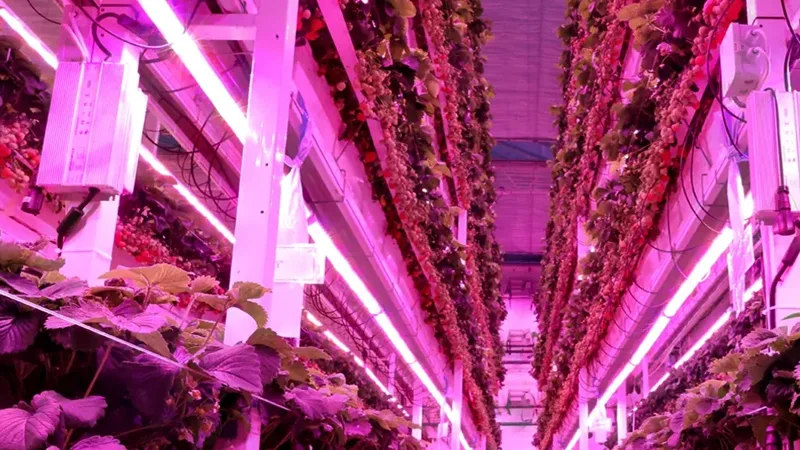
Transitioning to or upgrading a commercial vertical farm requires more than simply purchasing hardware off a shelf; it requires a strategic partnership with a manufacturer who understands the intricate realities of controlled environment agriculture.
As a premier provider of commercial LED grow lights wholesale, SLTMAKS brings decades of optoelectronic engineering and horticultural science to the table. Our dedicated multi-tier lighting solutions are not generic adaptations; they are purpose-built systems engineered from the ground up to eliminate the thermal and optical constraints of dense vertical farming.
When you partner with SLTMAKS, you gain access to our comprehensive engineering support:
- Custom microclimate planning: We assist in calculating thermal loads to ensure our fixtures synergize perfectly with your facility’s HVAC capabilities.
- Precision optical simulation: Before a single light is installed, our engineering team utilizes industry-leading DIALux software to generate precise 3D light-mapping simulations of your specific rack geometry. We guarantee our uniform PPFD commitments on paper before you commit your capital.
- Tailored spectral recipes: We work with your agronomists to fine-tune the spectral output of our multi-channel fixtures to exactly match the biological demands of your specific cultivars, ensuring maximum yield, premium quality, and optimal energy utilization.
Conclusion: Securing Your Farm’s Future Profitability
In the highly competitive landscape of commercial indoor agriculture, the margin for error is razor-thin. The structural challenges of multi-tier vertical farming—specifically heat accumulation and light degradation—can silently erode your profitability if left unaddressed. By investing in scientifically engineered lighting design that prioritizes sophisticated thermal management, remote driver architectures, and precise optical layouts, you transform these challenges into a competitive advantage.
A perfectly uniform, thermally stable canopy is the foundation of predictable, high-yield, and low-cost cultivation. We invite commercial growers, facility engineers, and farm investors to explore how SLTMAKS can revolutionize your multi-tier operations.
How do vertical farm lighting solutions manage heat dissipation in multi-tier racks?
Professional vertical farm lighting solutions utilize passive thermal management with aerospace-grade aluminum heat sinks and an aerodynamic “Slim Bar” design. This allows vertical HVAC airflow to pass through seamlessly, preventing heat accumulation and ensuring a stable microclimate for optimal plant growth without relying on failure-prone cooling fans.
Why is PPFD uniformity crucial when choosing LED grow lights for indoor farming?
In dense multi-tier setups, standard lights often create intense center hotspots while starving plants at the edges (Edge Yield Loss). Premium LED grow lights are optically engineered to over-saturate the edges, providing a flawlessly uniform Photosynthetic Photon Flux Density (PPFD). This guarantees synchronized growth rates and consistent, high-quality yields across 100% of your canopy.
What are the advantages of remote driver architecture in commercial LED grow lights wholesale?
LED drivers can generate up to 20% of a fixture’s heat. When sourcing commercial LED grow lights wholesale, choosing a remote driver architecture allows you to decouple the power supply and mount it outside the cultivation rack. This instantly removes massive thermal loads from the plants, prevents Vapor Pressure Deficit (VPD) spikes, and reduces HVAC cooling costs.
How do high-efficacy plant growth lights improve a vertical farm’s ROI?
Upgrading to high-efficacy plant growth lights (e.g., 2.8 µmol/J or higher) means more plant-usable photons are generated per joule of electricity. This maximizes energy efficiency, significantly reducing your monthly electricity bills (OPEX) and lowering secondary HVAC expenses, ultimately driving a faster and more sustainable Return on Investment.
As a professional plant growth light manufacturer, do you offer custom light spectrums for different crops?
Yes. A reliable plant growth light manufacturer like SLTMAKS provides dynamic, multi-channel spectrum control. We tailor spectral recipes—such as blue-rich wavelengths for compact vegetative growth or hyper-red (660nm) for massive flowering—to match the exact biological demands of your specific cultivars, maximizing both biomass and premium crop quality.