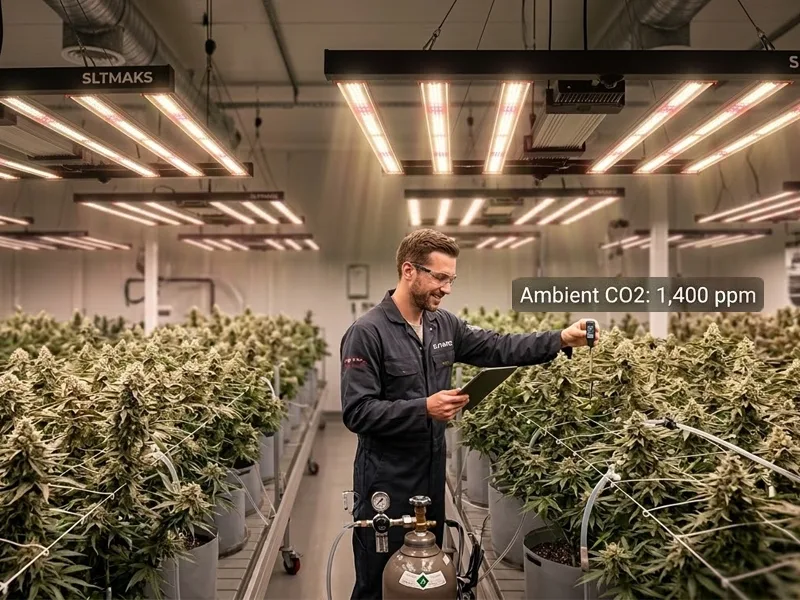
In the hyper-competitive landscape of commercial cannabis cultivation, pushing the boundaries of yield and secondary metabolite production is the ultimate goal. To achieve this, master growers and facility directors routinely invest heavily in environmental controls, frequently elevating atmospheric carbon dioxide (CO2) levels to 1,000–1,500 ppm. However, a widespread and costly phenomenon continues to plague commercial indoor agriculture: growers pump in premium CO2, yet their canopy yields remain frustratingly stagnant, or worse, plant health deteriorates.
Why does this happen? The answer lies in Liebig’s Law of the Minimum, applied to modern photobiology. In a high-CO2 cultivation room, carbon is no longer the limiting factor—light is. If you elevate CO2 without simultaneously upgrading your commercial LED grow lights to deliver matched, extreme-intensity PPFD (Photosynthetic Photon Flux Density), the extra CO2 is not just wasted capital; it becomes a metabolic bottleneck.
This comprehensive guide explores the advanced science of light matching in high CO2 environments. We will break down the physiological shift in cannabis light saturation points, analyze how to calculate the perfect Daily Light Integral (DLI), and demonstrate how partnering with a professional LED grow light manufacturer like SLTMAKS can transform your commercial facility’s profitability through precision high PPFD LED fixtures.
Table of Contents
The Science of Synergy: Why CO2 and PPFD Must Scale Together
To truly optimize a commercial cannabis canopy, facility operators must move beyond basic light metrics and understand the profound biochemical synergy between photon absorption and carbon assimilation.
Understanding the Shift in the Light Saturation Point
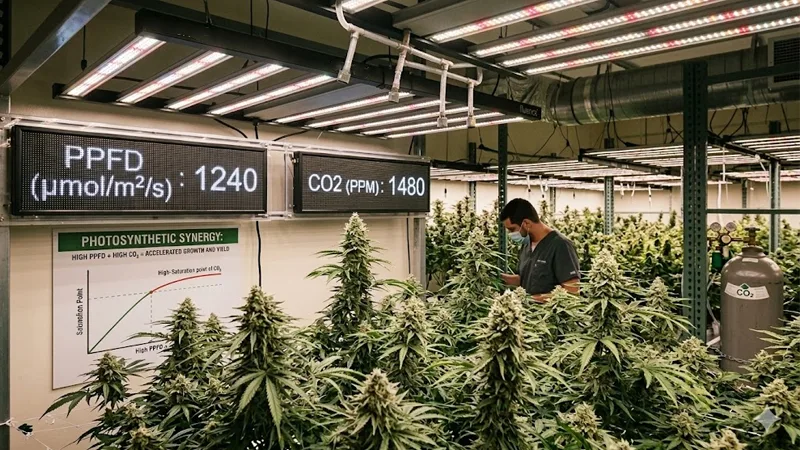
Under ambient atmospheric conditions (approximately 400-450 ppm CO2), the cannabis plant is exceptionally efficient at utilizing light. However, at this baseline, the enzyme RuBisCO—which is responsible for fixing carbon during the Calvin cycle—often binds with oxygen instead of CO2, leading to a wasteful process called photorespiration. At ambient CO2, the light saturation point for cannabis (the point where adding more light no longer increases the rate of photosynthesis) typically hovers between 800 and 1,000 µmol/m²/s of PPFD. Beyond this, plants experience photoinhibition, leading to light stress and bleached colas.
When you elevate the environment to 1,200–1,500 ppm CO2, the biochemical rules change entirely. The abundance of CO2 outcompetes oxygen at the RuBisCO binding sites, virtually eliminating photorespiration. This supercharges the Calvin cycle, allowing the plant to process photons at a radically accelerated rate. Consequently, the light saturation point shifts dramatically upward. In these hyper-enriched environments, cannabis can actively utilize PPFD levels of 1,500 to 1,800+ µmol/m²/s without suffering from photoinhibition—provided that other environmental factors like Vapor Pressure Deficit (VPD) and fertigation are dialed in.
The Danger of “Unmatched” Environments
Operating a high-CO2 room with standard wholesale grow lights that cap out at 900 µmol/m²/s is a recipe for physiological disaster. When plants are bathed in 1,500 ppm CO2 but starved of the matched photons required to drive the electron transport chain, several detrimental things occur:
- Stomatal closure: Elevated CO2 naturally signals stomata to partially close. Without intense, high-quality light (specifically in the blue spectrum) to signal them to remain open, transpiration rates plummet.
- Nutrient lockout: Decreased transpiration means the plant stops pulling water and mobile nutrients (like Calcium and Magnesium) up through the xylem. This leads to localized deficiencies, necrotic spotting, and weak cellular walls.
- Stretching and poor morphology: The canopy senses the excess carbon but lacks the light energy to build dense tissue. Plants will stretch rapidly (etiolation), resulting in long internodal spacing, weak stalks, and ultimately, fluffy, non-commercial “popcorn” buds.
Identifying Your Current Lighting Bottlenecks in Commercial Facilities
Before investing in facility upgrades, commercial operators must audit their current canopy performance. Recognizing the symptoms of a lighting bottleneck is the first step toward commercial cannabis yield optimization.
Signs Your Canopy is Starving for Light
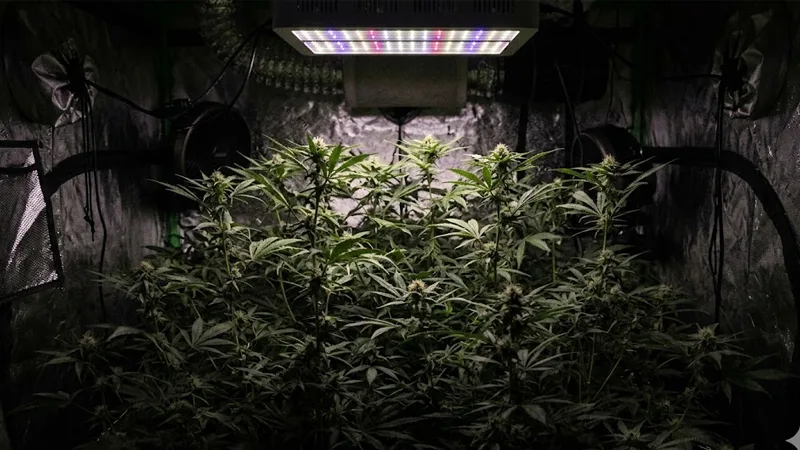
If your facility is supplementing CO2 but your grams-per-square-foot metric is stagnating, look for these telltale signs of light starvation:
- Low Leaf area ratio (LAR) to biomass: The plants produce excessively large fan leaves attempting to capture sparse photons, but floral biomass remains low.
- Poor canopy penetration: While the top 6 inches of the canopy may look acceptable, the mid-to-lower branches produce loose, lacy flowers that are essentially unsellable on the premium market, forcing them into lower-margin extraction biomass.
- Delayed ripening: Trichome maturation is a highly energy-intensive process. Unmatched lighting prolongs the flowering cycle, reducing the total number of crop turns a facility can execute annually.
Legacy High-Pressure Sodium (HPS) fixtures and early-generation “blurple” LEDs simply cannot deliver the localized, high-intensity PPFD required for modern CO2-enriched environments without causing severe heat stress to the upper canopy.
The DLI Factor: Beyond Just Instantaneous PPFD
While instantaneous PPFD (measured in µmol/m²/s) is crucial, commercial growers must focus heavily on the Daily Light Integral (DLI)—the total accumulation of photosynthetically active photons delivered over 24 hours (measured in mol/m²/d).
For ambient CO2 cultivation, a DLI of 35-40 mol/m²/d is generally sufficient for the flowering stage. However, in a 1,200+ ppm CO2 environment, target DLIs must be pushed aggressively to 45-65 mol/m²/d to maximize the plant’s elevated metabolic potential. Achieving a DLI of 60 over a 12-hour flowering cycle mathematically requires a sustained average PPFD of roughly 1,388 µmol/m²/s across the canopy. Standard lighting layouts will fail this requirement. Upgrading to specialized commercial LED grow lights designed for high-density, high-intensity outputs is the only viable path to hitting these DLI targets.
Advanced Light Matching Strategies for Extreme Yields
Breaking through the photosynthesis bottleneck requires more than just hanging brighter lights; it demands a strategic, horticultural approach to photon delivery.
Pushing the Limits: PPFD Requirements for 1200-1500 ppm CO2
Transitioning to high PPFD LED fixtures requires careful canopy management. You cannot subject plants to 1,500 µmol/m²/s immediately; they must be acclimated to prevent shock.
- Vegetative stage: Start at 400-600 µmol/m²/s and gradually ramp up to 800-1,000 µmol/m²/s by the final week of veg, pairing this with 800-1,000 ppm CO2.
- Early flowering (weeks 1-3): As the stretch phase occurs, systematically increase light intensity to 1,200 µmol/m²/s and elevate CO2 to 1,200 ppm.
- Peak flowering (weeks 4-7): This is where extreme yields are built. Push PPFD to 1,500+ µmol/m²/s and CO2 to 1,400-1,500 ppm. Ensure fertigation EC (Electrical Conductivity) and irrigation drybacks are increased proportionally to fuel this massive metabolic spike.
- Late Flowering/Flush: Reduce CO2 and slightly dim the lights to simulate autumnal conditions, which encourages final trichome swelling and anthocyanin production (coloration).
Spectral Tuning: Feeding the High-Metabolism Plant
Intensity drives yield, but spectrum drives quality. In a high CO2 environment, the spectral output of your commercial agricultural lighting hardware becomes deeply influential.
- The power of red (660nm): Deep red light is the most efficient driver of photosynthesis. When CO2 is abundant, a high proportion of 660nm photons rapidly accelerates biomass accumulation and floral bulking.
- Blue light (400-500nm) for structure: Elevated CO2 can cause stretching. Maintaining an adequate ratio of blue light (typically 10-20% of the spectrum) keeps internodes tight and prevents the canopy from growing into the light fixtures. Furthermore, blue photons are essential for triggering stomatal opening, ensuring transpiration keeps pace with the high CO2 absorption.
- Far-red and the emerson effect: Advanced cannabis light recipes now incorporate Far-Red (730nm). When combined with deep red, it triggers the Emerson Enhancement Effect, a phenomenon where the rate of photosynthesis is greater than the sum of the two individual wavelengths. Far-red also penetrates deeper into the canopy, signaling lower sites to develop.
Canopy Penetration and Uniformity
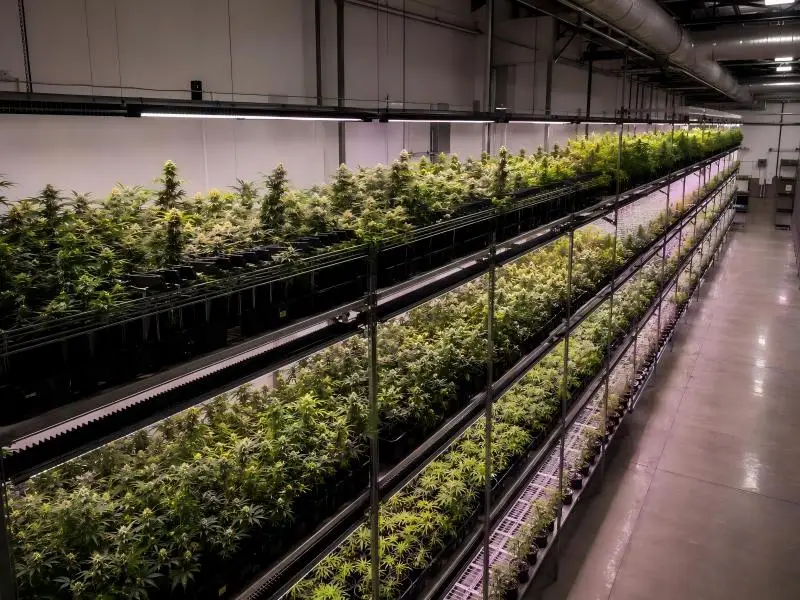
A peak PPFD reading directly under the center of a fixture is a vanity metric if the edges of the canopy are starved. For maximum commercial yield, uniformity is king. Multi-bar LED designs (spider style) are vastly superior to older integrated “quantum board” or single-reflector styles. By distributing the diodes across a wider physical footprint, high-quality fixtures ensure that the angles of incidence vary, allowing light to bypass the upper fan leaves and penetrate deep into the lower canopy. This uniformity guarantees that every square foot of the bench is contributing to the final harvest weight.
Selecting the Right Hardware: A Commercial Buyer’s Guide
For agricultural tech buyers and facility designers, selecting wholesale grow lights for cannabis is a multi-million dollar CapEx (Capital Expenditure) decision that will dictate the facility’s OpEx (Operational Expenditure) for the next 5 to 10 years.
Thermal Management at High Outputs
Pushing 1,500+ PPFD inherently generates heat. While LEDs are vastly more efficient than HPS, physics dictates that a 1,000 W LED fixture will still introduce thermal load into the room. The hallmark of premium commercial LED grow lights is their thermal management system. High-quality extruded aluminum heatsinks and advanced diode spacing dissipate heat passively, keeping the ambient temperature near the plant canopy stable. This dramatically reduces the localized heat stress on the apical meristems (top buds) and significantly lowers the load on your facility’s HVAC and dehumidification (HVACD) systems, saving thousands in monthly cooling costs.
Efficacy (µmol/J) and ROI for Large-Scale Operations
When purchasing wholesale B2B grow lights, the metric that dictates your ROI is Photosynthetic Photon Efficacy (PPE), measured in micromoles per Joule (µmol/J). Standard fixtures might offer 2.3 µmol/J, while state-of-the-art fixtures push 2.8 to 3.0+ µmol/J.
The commercial math: If a 100-light facility upgrades from a 2.0 µmol/J system to a 2.8 µmol/J system, they can deliver the same amount of light to the canopy while consuming approximately 28% less electricity. In a high-CO2 room where you are pushing lights to their maximum intensity for 12 hours a day, this efficacy difference can translate to tens of thousands of dollars saved annually per flower room, fast-tracking the ROI of the hardware upgrade. Furthermore, fixtures with high efficacy ratings are often eligible for substantial utility rebates (like those certified by DLC – DesignLights Consortium), subsidizing the initial purchase price.
Integration with Facility Control Systems
In a modern commercial greenhouse or indoor facility, lighting does not operate in a vacuum. Your high PPFD LED fixtures must seamlessly integrate with centralized environmental control systems (e.g., TrolMaster, Argus, Priva). Look for fixtures featuring standard 0-10V or RJ14 daisy-chain dimming capabilities. This allows the master controller to automatically dim the lights if the HVAC system fails and room temperatures spike, or to execute precise sunrise/sunset simulations to reduce humidity spikes during the day/night transition.
The SLTMAKS Solution: Engineered for High-Yield Commercial Growers
Overcoming the photosynthesis bottleneck requires hardware built specifically for the extreme demands of modern cultivation. As a professional LED grow light manufacturer, SLTMAKS bridges the gap between agronomic science and commercial-grade engineering.
Why Partner with a Professional Manufacturer?
Sourcing your cannabis grow lighting solutions directly from a specialized manufacturer like SLTMAKS provides immense B2B advantages. We offer a highly stable supply chain, stringent quality control, and direct-to-facility wholesale pricing that eliminates distribution markups. More importantly, our engineering team works directly with commercial growers to develop custom grow light solutions, tailoring the spectrum and form factor to the specific dimensions of your rolling benches or vertical racking systems.
Highlight Featured Capabilities
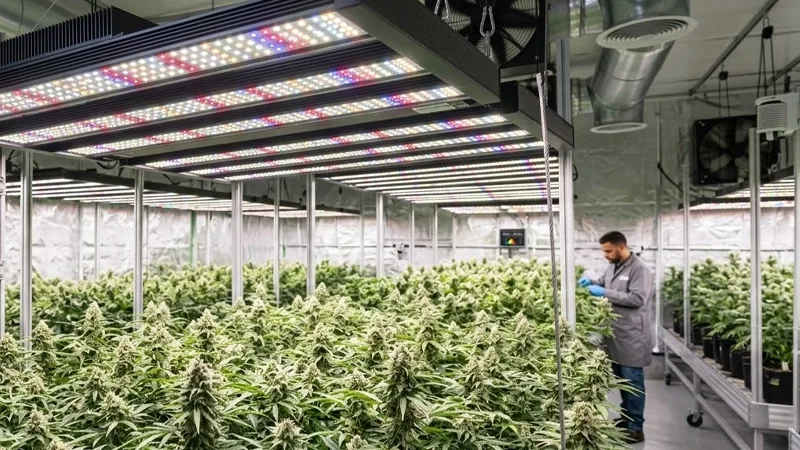
SLTMAKS commercial fixtures are engineered explicitly for high-CO2 environments. Our flagship models can deliver sustained, uniform PPFDs exceeding 1,500 µmol/m²/s without canopy burn. Utilizing top-tier, high-efficacy diodes, our fixtures regularly achieve efficacies of 2.8+ µmol/J. We utilize an optimized, full-spectrum light recipe rich in both 660nm deep red for explosive floral growth and adequate blue wavelengths to maintain compact, structurally sound canopies capable of supporting heavy yields.
Case Study: Scaling Success
(Representative Commercial Data) A recent commercial partner operating a 10,000 sq. ft. indoor facility was supplementing CO2 to 1,200 ppm but yielding only 2.2 lbs per light using outdated 600W LEDs. After partnering with SLTMAKS and upgrading to our high-output commercial bar fixtures, they were able to push their canopy PPFD to 1,400 µmol/m²/s. By matching their lighting to their CO2 levels, they saw a dramatic physiological response: yields increased by 35% (averaging 3.1 lbs per light), and independent lab testing showed a 12% increase in total terpene concentration due to improved spectral quality and deeper canopy penetration.
Conclusion
Elevating CO2 without upgrading your lighting infrastructure is a compromised strategy that leaves massive potential yields on the table. To truly unlock the genetic potential of your cultivars and maximize the ROI of your facility, light matching is non-negotiable. It is time to break through your canopy’s photosynthesis bottlenecks.
We can develop the most suitable LED plant grow light configuration solution for you.
FAQ
What is the optimal PPFD for cannabis during the flowering stage with 1200 ppm CO2?
With CO2 elevated to 1,200 ppm and environmental factors like VPD correctly managed, the optimal PPFD for peak flowering is generally between 1,200 and 1,500 µmol/m²/s. Pushing beyond this is possible but requires master-level control over fertigation and crop steering.
Can SLTMAKS customize the light spectrum or fixture dimensions for specific cannabis strains or vertical racks?
Yes. As a primary manufacturer, SLTMAKS offers high degrees of customization for large-scale commercial rollouts. We can tailor diode ratios to target specific photomorphogenic responses or adjust fixture physical dimensions to perfectly illuminate specific multi-tier vertical farming setups without light spill.
What are the warranty and bulk ordering terms for SLTMAKS commercial fixtures?
We stand behind our engineering. SLTMAKS commercial fixtures come with an industry-leading multi-year warranty. We offer tiered wholesale pricing for commercial build-outs, dedicated B2B account management, and reliable lead times for large container-volume orders.