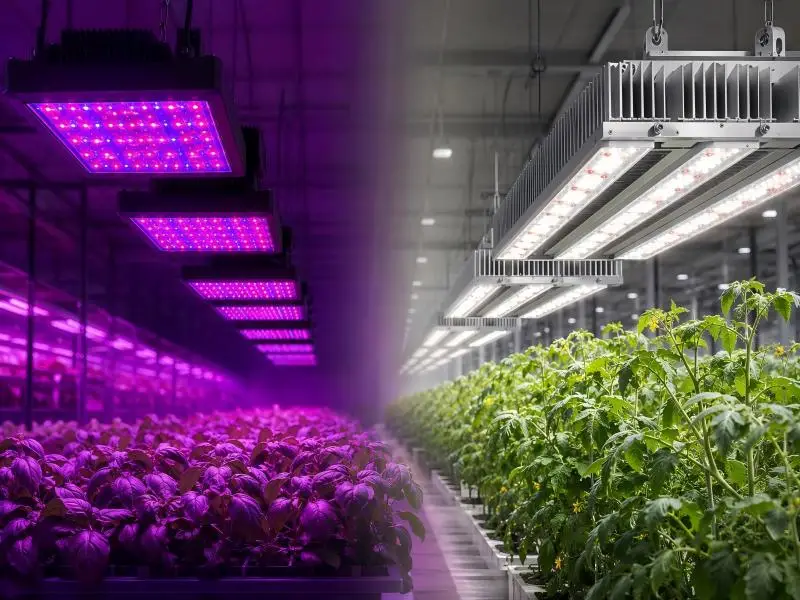
Walk into a facility built in the early 2010s, and you will still find them: magenta-lit racks, the unmistakable pinkish-purple wash that growers came to call “blurple.” Walk into a facility commissioned last year, and the light is more likely to look like an overcast afternoon, sometimes with a red component that is invisible until you photograph it. To fully understand this transition, examining the blurple vs. white LED history reveals how rapidly commercial horticulture transformed. The fixtures changed, and the change was large enough that it reshaped how spectra are specified, how fixtures are tested, and how a cultivation team evaluates a purchase.
The question worth asking is not which spectrum looks better. It is whether the shift reflected a reversal in plant science — a discovery that plants needed something the early fixtures withheld — or a shift in what the technology could deliver at a price. The answer is mostly the second, with an important qualification about the first.
This article approaches that history from the manufacturing side: spectrum design, emitter binning, thermal engineering, and cost. It separates what the photobiology literature supports from what the measurement and standards literature supports, because those are different bodies of evidence with different failure modes. By the end, you should be able to compare a narrowband fixture and a white fixture on photosynthetic photon efficacy (PPE) under matched conditions, recognize why your quantum sensor gives different readings on each, and judge which architecture fits a given production room rather than which one is fashionable.
Table of Contents
Why Early LED Grow Lights Were Red and Blue: The Blurple vs White LED History
The first commercial horticultural LED fixtures were blue-plus-red combinations, and they produced the magenta spectrum that gave the era its nickname. In the broader blurple vs white LED history, Kusuma, Pattison, and Bugbee, writing in Horticulture Research in 2020, record both facts plainly: these fixtures came first, and they had higher efficacy than white or white-plus-red alternatives available at the time.
The rationale early manufacturers advanced was spectral matching. Chlorophyll absorbs strongly in the blue and red regions of photosynthetically active radiation (PAR, 400–700 nm), so a fixture built from blue and red emitters would, in that telling, deliver photons where photosynthesis happens and skip the rest. The same 2020 review notes that this thinking was advanced by early LED manufacturers even though green photons had long been known to be effective for photosynthesis. The absorption-peak argument was therefore an incomplete justification, not a fabricated one: it described where chlorophyll absorbs most strongly and then treated that as a description of where photosynthesis is most efficient, which it is not.
The blue component had a separate and more solid basis. A 1996 NASA-supported review by Bula, Tennessen, Morrow and Tibbitts (NASA technical report) describes early trials in which lettuce and other dicotyledonous plants grown under red LEDs as the sole irradiation source developed excessive hypocotyl elongation, stem elongation, leaf extension and reduced chlorophyll. Normal development returned when the red light was supplemented with blue light from fluorescent lamps. The same review cites work showing stomatal opening is most responsive to blue light, with a peak response around 450–460 nm, although red photons alone provide sufficient signal for stomata to open — the practical problem under red-only light being low stomatal conductance that had to be overcome with elevated CO₂.
So the red/blue pairing had a real photomorphogenic basis. What it did not have was a complete photosynthetic one. Conflating those two distinct claims is the origin of much of the technical confusion throughout blurple vs white LED history.
The Engineering Constraints That Kept Fixtures Blurple
If the chlorophyll-peak story was oversimplified, why did blurple persist for years? Because the engineering constraint behind it was genuine, and it operated on the emitter level rather than the plant level.
The central constraint is the “green gap.” Green LEDs are inefficient at converting electricity into photons, which made direct green emission impractical for a production fixture. Park and Runkle, in their 2018 comparison of white versus blue-plus-red radiation in PLOS ONE, state the consequence directly: adding green radiation from green LEDs was not practical at the time. Designers who wanted a high-efficacy fixture were pushed toward narrowband red and blue emitters, which were the most electrically efficient colors available. Nelson and Bugbee make the same point in their 2014 fixture survey in PLOS ONE: photosynthesis is driven by moles of photons, and the most electrically efficient LED colors sit in the deep red and blue wavelengths.
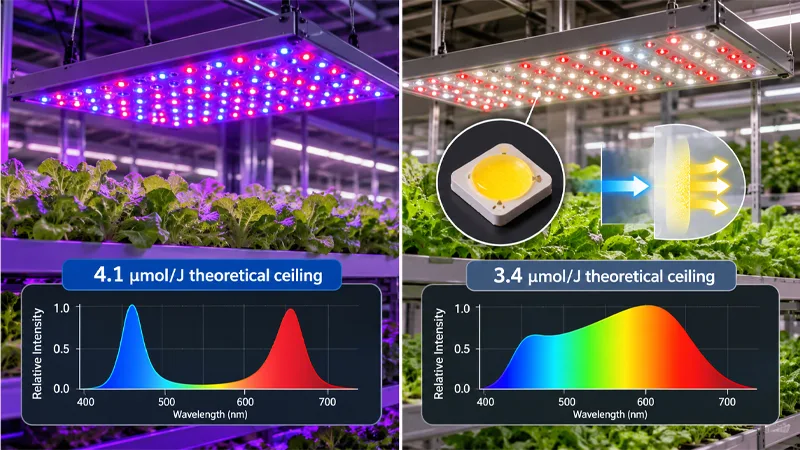
Phosphor-converted white was the workaround. As the 2020 review describes, a white LED consists of a blue die coated with a luminescent material — typically a Y₃Al₅O₁₂:Ce phosphor — that absorbs some blue photons and re-emits them at longer wavelengths. The design deliberately transmits some blue while converting the remainder. That conversion is not free: phosphor conversion introduces losses that a directly emitting red or blue die does not incur. White light therefore bought a broad spectrum at the cost of some efficacy.
The trade-off had a quantified ceiling. The same review calculates upper efficacy limits, with current LED technology, of 3.4 µmol J⁻¹ for white-plus-red fixtures and 4.1 µmol J⁻¹ for blue-plus-red fixtures, with both figures reduced by roughly 10% when optical protection against water and humidity is added. That gap is the honest core of the blurple era. A designer choosing blue-plus-red was not being sentimental; they were choosing the architecture with the higher theoretical ceiling. The question that eventually decided the market was how much of that ceiling each architecture actually reached in a shipped fixture, and at what cost.
What Actually Changed: White LED Economics and Performance
The underlying technology dates to the early 1990s. The Royal Swedish Academy of Sciences awarded the 2014 Nobel Prize in Physics to Isamu Akasaki, Hiroshi Amano and Shuji Nakamura “for the invention of efficient blue light-emitting diodes which has enabled bright and energy-saving white light sources” (NobelPrize.org press release). The press release notes that red and green diodes had existed for a long time, but without blue light white lamps could not be created, and that the blue LED had resisted both science and industry for three decades.
The commercial origin of phosphor-converted white is dated precisely in Nichia’s own corporate history: in 1996 the company developed the world’s first white LED by combining a blue LED with yellow phosphor, drawing on phosphor manufacturing experience that reached back to 1966 (Nichia, “Nichia’s History”).
None of that was horticulture-specific. The horticultural inflection came from volume economics. Kusuma and co-authors report that, because of widespread use in lighting for human vision, white LED packages became roughly 20% of the cost of red LEDs, and that this contributed to white LEDs rising above 60% of the emitter mix in some horticultural fixtures. That is a cost statement, and it is the single most important line in this history: the architecture that won did so substantially because another industry had already paid to scale it.
Manufacturers then began positioning white explicitly for plant use. On May 15, 2018, Luminus announced an expansion of its horticulture portfolio with SST-20 series white LEDs, describing “horticulture white” as a complement to its discrete wavelengths from UVA (365 nm) to far red (730 nm) (Luminus press release). The stated rationale was twofold: white light in a greenhouse makes it easier to observe crops for signs of disease, and in many cases white LEDs can replace blue LEDs because they provide similar PPF, potentially reducing production costs. The release also notes a 2700K–7000K offering range.
That release is a useful dated marker of a manufacturer making the argument in public. It is not evidence that the industry turned on that date, and it should not be read as one. It is one company’s product positioning, consistent with a cost trend already visible in the literature.
Is White Light Better for Plants, or Just for People?
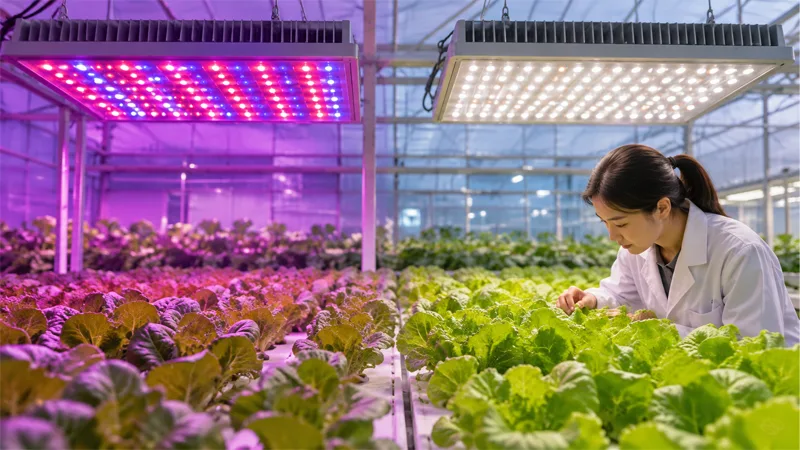
Two questions get merged in sales conversations and should be separated. Does white light grow plants better? And is white light better for the people working under it? They have different answers and different evidence.
On the plant side, the 2020 review states that spectral effects on photosynthesis are remarkably similar across species — a broad statement about photosynthesis specifically, not about morphology, quality or secondary metabolism. Green photons are effective for photosynthesis; the review notes they are up to 10% less photosynthetically efficient than photons from the most common red LED (660 nm) but penetrate deeper into plant canopies than blue or red photons.
Park and Runkle tested the practical version of this question directly. They compared mint-white LED treatments, alone and blended with increasing proportions of red, against a blue-plus-red mixture at equal PPFD, across begonia, geranium, petunia and snapdragon seedlings. At the transplant stage, total leaf area and fresh and dry weight were similar across all treatments in all species.
The blue-plus-red treatment had the highest PPE at 2.25 µmol J⁻¹, against 1.51–2.13 µmol J⁻¹ for the white treatments, but dry weight gain per unit of electricity consumed was similar between the blue-plus-red treatment and the mixed white-plus-red treatments in three species. Color rendering was better under the white blends: the mint-white 75/red 25 and mint-white 45/red 55 treatments scored 72 and 77 on the color rendering index, against 64 or below for the others.
The authors also recorded a result that resists generalization: when petunia was grown beyond the transplant stage, the primary stem elongated and flower buds appeared earlier under the all-mint-white and 75/25 treatments than under blue-plus-red. That is one species, under sole-source lighting, past a specific developmental stage. It is a reason to test petunia specifically, not a reason to expect the same response in lettuce or tomato.
Morphology is where species and condition dependence dominate. The 2020 review notes that replacing green photons with red has minimal effects on plant shape, but plants grown under sole-source blue LEDs with no red or green can rapidly elongate. Far-red photons can powerfully affect plant shape: in some species, especially lettuce, they beneficially increase leaf expansion, while in many other species they significantly increase stem elongation, which may not be beneficial.
A 2024 lettuce study in PLOS ONE found that substituting red with far-red increased leaf area in both cultivars tested, with shoot fresh mass greatest at a far-red fraction of about 0.25 and similar to the no-far-red control at the highest far-red level — and that green light had less effect on leaf expansion and fresh mass than far-red. Those are lettuce results at a stated intensity and blue fraction, not a universal prescription.
On the human side, the case is more straightforward. Park and Runkle note that one limitation of blue-plus-red LEDs is that plants appear purplish to the human eye, causing difficulties in detecting nutritional deficiencies, disease symptoms, and physiological disorders. Luminus makes the same observation about crop observation and disease signs. Neither source claims white light improves the crop; both claim it improves the grower’s ability to see the crop.
“Better for plants” and “better for people” are separate questions. The honest answer to the first is spectrum- and crop-dependent, with photosynthesis broadly similar across species and morphology decidedly not. The answer to the second is that white light is generally easier to work under and to inspect crops under.
Comparing PPE and PPF Claims Across Architectures
Comparing a blurple fixture to a white fixture requires photon-based metrics, not lumen-based ones. Lumens are a weighting function applied to a spectral distribution for human visual response; photosynthesis is driven by the number of photons, not by lumens or radiant energy. The 2020 review puts it directly: photons excite electrons, and photobiology is driven by photon count.
Fixture-level photosynthetic photon efficacy (PPE, µmol/J, 400–700 nm) by spectrum architecture. Measured values are fixture/system-level tests: the best LED fixture in the 2014 Nelson & Bugbee survey (1.7), and 2020 measured values of about 3.0 for blue+red and 2.5–2.8 for white+red. The 2.7 (all-white), 3.4 (white+red), and 4.1 (blue+red) figures are calculated upper limits under near-maximum assumptions for current LED technology, not products on a shelf; adding optical protection from water and humidity reduces the calculated limits by roughly 10%. The 1000 W double-ended HPS reference (1.72) is a measured fixture from the same 2014 survey. Values are not a product ranking.
Two quantities do most of the work. PPF (photosynthetic photon flux) is the total photon output in the 400–700 nm range, in µmol/s. PPE (photosynthetic photon efficacy) is that output divided by electrical input power, in µmol/J. PPE is the number to compare when electricity is the dominant operating cost, and it is the number the market now regulates against.
The standards context matters. ANSI/ASABE S640, “Quantities and Units of Electromagnetic Radiation for Plants (Photosynthetic Organisms),” published July 2017, provides definitions and descriptions of the metrics used for plant radiation measurement; its stated scope explicitly excludes display aspects and human visualization (ASABE abstract). That exclusion is the point: plant metrics and human-vision metrics are different systems.
The DesignLights Consortium’s Horticultural Technical Requirements are a listing program, not a test method, and the current version sets a market floor. Hort V4.0 took effect April 18, 2025, with V3.0 delisting on January 5, 2026. V4.0 raises the minimum PPE threshold to 2.5 µmol J⁻¹, an 8.7% increase over V3.0, and the DLC states this places the LED threshold more than 45% above the most efficacious non-LED option, the 1000W double-ended high pressure sodium luminaire. The DLC also reports that the increase will delist the least efficacious V3-listed products, about 11% of the qualified products list (DLC Hort V4.0).
A listed PPE figure is a fixture-level figure, and that distinction is where most comparisons fail. The 2020 review identifies four factors that sit between package efficacy and fixture efficacy: current droop (radiative efficiency falls as drive current rises), thermal droop (efficiency falls as junction temperature rises), driver inefficiency, and optical losses. Optical losses alone can be substantial: protective glass covers transmit up to 92% of photons, an 8% reduction, though that protection can significantly extend fixture life in humid environments, while unprotected fixtures can reach 99% optical efficiency with potentially shorter lifetimes.
Before two PPE numbers are comparable, the conditions behind them must match: junction temperature, drive current, and the test standard used. The review notes that published photon efficacy figures are typically presented at a junction temperature of 25°C and 150 mA, and that values shift if those inputs change. It also notes that chip area is often confidential and that manufacturers report specifications at total drive current rather than current density, which limits what an outside evaluator can infer.
The practical rule: compare fixture-level tested PPE to fixture-level tested PPE, at matched conditions, from a recognized test method. A datasheet package figure placed next to a fixture-level tested figure is not a comparison; it is two different measurements sharing a unit.
Why Your Light Meter Disagrees Between Blurple and White
A grower who measures a blurple fixture and a white fixture at the same true PPFD with the same quantum sensor will often get different numbers. That is expected behavior, and it has a documented cause.
Apogee Instruments explains spectral error: a quantum sensor is designed to count photons from 400 to 700 nm, but no quantum sensor perfectly matches the defined quantum response, so it does not respond equally to all wavelengths in that range. Apogee’s meters are sensitive from approximately 370 nm to 665 nm, with a relatively flat response between 450 and 650 nm, and their electric-lighting units are calibrated in a chamber filled with T5 cool-white fluorescent lamps. LEDs have very different spectral output from T5 lamps, so some spectral error follows (Apogee, LED light measurements).
The direction of the error is systematic. Apogee’s sensors are less sensitive to blue wavelengths near 400 nm and read low under blue LEDs; more sensitive to green and red above 500 nm and read high under green and red LEDs; and read low under broadband white because white output includes a small proportion of radiation beyond the sensor’s roughly 665 nm upper sensitivity.
Apogee publishes electric calibration errors for specific LED types:
| LED type | Calibration error |
|---|---|
| Blue (448 nm peak, 10 nm FWHM) | −10.7% |
| Green (524 nm peak, 15 nm FWHM) | +5.8% |
| Red (635 nm peak, 10 nm FWHM) | +4.7% |
| Cool white | −4.2% |
| Neutral white | −6.1% |
| Warm white | −9.9% |
| Red/blue mixture | +2.7% |
| RGB mixture | +3.5% |
These are the manufacturer’s figures for specific LED types measured with specific Apogee sensor models, and they should be read that way. They are not a correction table for every sensor on the market, and the sign and magnitude will differ for other manufacturers’ meters.
Apogee adds an important boundary condition: LEDs that output a large proportion of radiation above approximately 660 nm will read very low and should not be measured with the original quantum sensors (SQ-100, 200, 300 and 400 series) but will work with the full-spectrum SQ-500 sensor. That matters for any fixture with meaningful far-red content, and it matters for warm-white spectra, which carry more long-wavelength output than cool white — consistent with the larger negative error listed for warm white.
The implication for procurement is direct. A blurple fixture and a white fixture delivering the same true PPFD can read differently on the same meter, so raw meter readings are not a valid cross-architecture comparison unless the spectral response is corrected. If a specification or a sales claim rests on an uncorrected handheld reading, it is not a PPE comparison.
Thermal Design, Binning and Cost Trade-offs
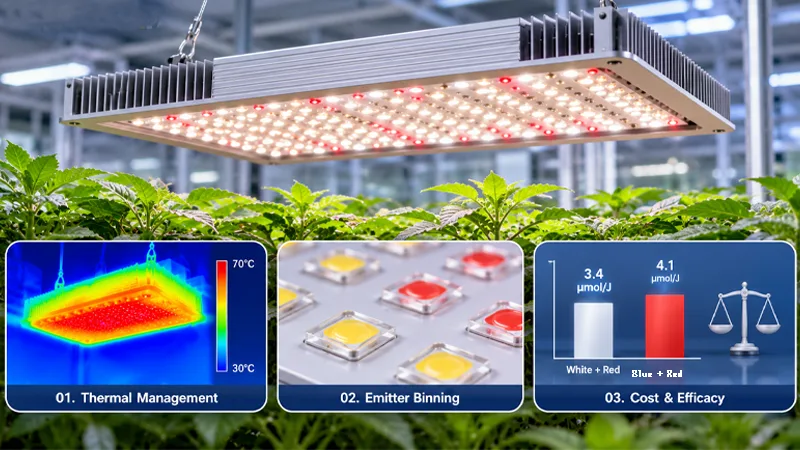
Spectrum choices carry thermal, binning and cost consequences that do not appear on a spectrum chart.
Thermal. LED output and lifetime depend on junction temperature. The 2020 review describes L70 — sometimes Q70 for horticultural products — as the time at which fixture output reaches 70% of initial, with a typical L70 of 50,000 hours for LED fixtures, and notes that efficacy declines as LEDs and fixtures age, a problem exacerbated by high junction temperatures. Lifetime claims rest on IES LM-80 package testing, and projections of luminaire lumen maintenance cannot exceed six times the tested duration: a 60,000-hour depreciation claim requires 10,000 hours of LED test data.
Nelson and Bugbee add that LED life is reduced if emitters are driven at higher amperage to achieve higher output or exposed to high temperatures, and that power supplies, fans and other components can fail well before the LEDs themselves. A spectrum that concentrates output in fewer emitter types, or drives them harder to reach a target PPF, therefore carries different thermal consequences than one spread across a broader emitter mix. That is a design condition to check, not a rule that one architecture runs hotter.
Binning. Narrowband red and blue emitters are binned primarily on wavelength and flux. Phosphor-converted white is binned on flux plus color metrics — correlated color temperature (CCT), color rendering index (CRI) and TM-30. The 2020 review notes that phosphor types and amounts are varied to create multiple hues and color qualities, and that higher-CCT white LEDs carry a higher percentage of blue photons, following the general relationship described by Wien’s Displacement Law. For a manufacturer, that changes the matching and inventory problem: a white build has to hold color consistency across production lots in addition to flux, and a mixed white-plus-red build has to hold both regimes at once.
Cost. White’s cost advantage comes from general-lighting volume, as the roughly 20%-of-red-LED-cost figure indicates. Part of that advantage is given back to phosphor conversion losses, which is one reason the calculated efficacy ceiling for white-plus-red (3.4 µmol J⁻¹) sits below blue-plus-red (4.1 µmol J⁻¹). The trade-off is real in both directions, and the balance shifts with the price of red emitters and the price of white packages at the time of purchase. Specific cost and thermal figures beyond those in the cited literature are not asserted here; they should come from current supplier quotes and your own test data.
When Blurple or Mixed-Spectrum Still Makes Sense
The synthesis is conditional, and it should be stated as such: the following are defensible cases grounded in the efficacy-limit and cost material above, not measured outcomes for every crop.
Narrowband or blue-plus-red remains defensible where peak photon efficacy per joule dominates, and human visibility is irrelevant. Enclosed multi-tier production with no workers present during the photoperiod is the clearest case. The 4.1 versus 3.4 µmol J⁻¹ ceiling gap is the relevant number, and it favors blue-plus-red on paper. Whether a given fixture realizes that gap is a separate question answered by fixture-level test data.
Narrowband remains defensible where a specific photomorphogenic response is being targeted and narrowband control is an advantage. Far-red is the obvious example: the 2020 review notes far-red photons are efficiently generated by LEDs and are a promising addition, with species-dependent effects on leaf expansion and stem elongation, and cautions that far-red must be used carefully in sole-source environments because it can induce shade-avoidance stem elongation. A narrowband channel lets a grower add far-red deliberately rather than as a byproduct of a broad spectrum.
Mixed white-plus-red captures most of white’s human-factors benefit while recovering efficacy. Park and Runkle’s data support this shape of answer: as more mint white was substituted with red, PPE rose from 1.52 to 2.13 µmol J⁻¹, and dry weight gain per unit electricity was similar between blue-plus-red and the mixed white-plus-red treatments in three species. The 75/25 and 45/55 blends also had the best color rendering in that study.
What the evidence does not settle should be said plainly. Photosynthetic responses are broadly similar across species, but morphological and developmental responses are not, and a result in petunia, lettuce, or four bedding-plant species does not transfer automatically to cannabis, tomato, or cucumber. There is no single universal best spectrum, and any claim otherwise is a claim about a specific crop, stage, and environment that should be backed by data from that crop, stage, and environment.
A Manufacturer’s Takeaway
The historical lesson is not that blurple was wrong. It is that the blurple-to-white shift was driven less by a reversal in plant science than by the economics and performance of white LED packages, and by the recognition that green light was never the problem the chlorophyll-peak story implied. The early manufacturers were working inside a real constraint — the green gap, the efficacy advantage of deep red and blue emitters, and a higher calculated ceiling for blue-plus-red. What changed was that general lighting scaled white packages to roughly a fifth of the cost of red LEDs, and the architecture with the better cost curve displaced the architecture with the better theoretical ceiling in many fixtures.
Four checks carry that lesson into a purchasing decision:
- Compare fixture-level PPE under matched test conditions — junction temperature, drive current, and test standard — and never set a datasheet package figure against a fixture-level tested figure.
- Correct meter readings for spectral response before treating them as a cross-architecture comparison, and use a full-spectrum sensor where substantial output sits above roughly 660 nm.
- Weigh thermal and binning consequences alongside spectrum: L70 claims backed by adequate LM-80 duration, drive current relative to the thermal design, and color consistency across lots for white builds.
- Match the architecture to the application — enclosed tiers with no workers present, targeted photomorphogenic control, or a mixed white-plus-red build where inspection and working conditions matter.
For buyers evaluating full-spectrum fixtures, the useful questions are about documentation rather than marketing: which test standard produced the PPE figure, at what conditions, and whether the spectrum can be verified independently. Manufacturers with in-house spectrum customization and thermal engineering programs, including SLTMAKS, can supply that documentation as part of a technical evaluation; the numbers should still be checked against your own measurements and your own crop.
FAQ
Was blurple based on a false premise?
Partly. In the broader context of blurple vs. white LED history, the chlorophyll-absorption rationale was incomplete, because green photons were already known to be effective for photosynthesis. But the efficacy constraint behind blue-plus-red was real: green LEDs were inefficient, deep red and blue emitters were the most electrically efficient colors, and the calculated efficacy ceiling for blue-plus-red (4.1 µmol J⁻¹) exceeds white-plus-red (3.4 μmol/J) with current technology.
When did white become viable for horticulture?
Tracing the history of blurple vs. white LEDs, the enabling technology dates to efficient blue LEDs in the early 1990s, recognized with the 2014 Nobel Prize in Physics, and to Nichia’s 1996 white LED, which combined a blue die with yellow phosphor. The horticultural inflection is a cost story — white packages at roughly 20% of the cost of red LEDs, contributing to white exceeding 60% of the emitter mix in some fixtures — with Luminus’s May 2018 “horticulture white” announcement as one dated example of manufacturers positioning white for plant use.
Is white light better for plants?
Spectrum- and crop-dependent. As professional growers evaluate the history of blurple vs. white LED, spectral effects on photosynthesis are broadly similar across species, and green light is effective for photosynthesis. Morphology and development are where species and conditions matter: far-red effects on leaf expansion and stem elongation vary by species, and a petunia developmental result does not transfer to other crops.
How do I compare PPE across architectures?
Use photon-based metrics — PPF in μmol/s and PPE in μmol/J — at the fixture level, under matched junction temperature, drive current, and test standard. When reviewing fixture data through the lens of blurple vs white LED history, do not compare a package datasheet figure to a fixture-level tested figure. The DLC Hort V4.0 threshold of 2.5 μmol·J⁻¹, effective April 18, 2025, is a useful market floor for listed products.
Why do meter readings differ between blue and white?
Spectral error. Quantum sensors are calibrated under T5 cool-white fluorescent lamps and do not respond equally across 400–700 nm. Apogee’s published electric calibration errors run from -10.7% for a 448 nm blue LED to +5.8% for a 524 nm green LED, with white LEDs reading low (-4.2% cool white to -9.9% warm white). Documenting blurple vs. white LED history helps explain why these are manufacturer figures for specific LED types and sensor models: Apogee notes that LEDs with a large proportion of output above roughly 660 nm will read very low on its original quantum sensors (SQ-100, 200, 300 and 400 series) and should be measured with the full-spectrum SQ-500 instead.