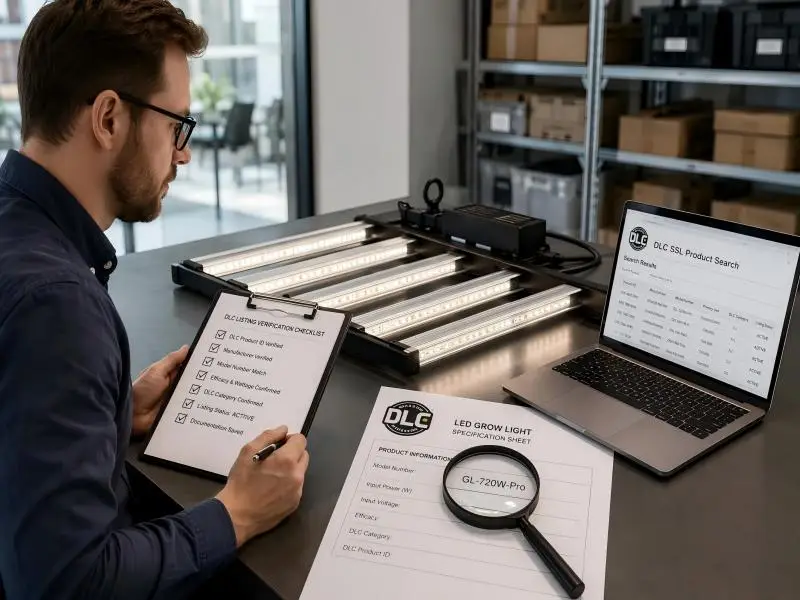
When you need to verify DLC listed grow lights from a Chinese supplier, a simple logo on a spec sheet proves nothing about that fixture’s listing status. The listing is a record in the DesignLights Consortium’s public Horticultural Qualified Products List (Hort QPL), and the DLC states plainly that the QPLs themselves — not logos, not certificates, not a factory’s assurance — are the one true source for validating a product listing. Everything below is built around that record.
The stakes are concrete. If the fixture is not on the QPL under the exact manufacturer, brand, and model you are buying, it is not qualified, and the rebate application, the procurement sign-off, and the safety documentation review that depend on that qualification will not survive scrutiny. This guide walks through the verification in the order a buyer or specifier should perform it: gather the right inputs, search the QPL, match identifiers exactly, resolve the private-label question, read listing status and version, reconcile performance data, confirm safety certification separately, and check rebate eligibility with the program administrator rather than the supplier.
Table of Contents
Prerequisites: What You Need Before You Start to Verify DLC Listed Grow Lights
The verification fails most often because the buyer starts searching with the wrong string. Assemble these inputs before opening the QPL.
- The exact full model number as it will appear on the purchase order. Not a series name, not a marketing name, not an internal factory code. The DLC requires manufacturers to list full model numbers that clearly demonstrate all qualified product options offered, and reviewers may check web listings and marketing materials and request additional information to demonstrate the full model number.
- The manufacturer name and the brand name the supplier claims. These are two separate fields on the QPL record, and they frequently differ.
- The DLC Product ID, if the supplier cites one. This is the unique identifier for a specific model listing and is the fastest lookup path.
- The supplier’s spec sheet and any test reports they have offered, so the QPL record can be compared against them later.
- A free MyDLC account. The QPLs are publicly available by creating and logging into a MyDLC account, and searches can be filtered and saved when logged in.
A quotation alone is often insufficient. Quotations from trading companies and factories routinely carry truncated codes, internal SKUs, or a series designation that maps to several distinct listings. If the model string on the quote does not look like a complete model number, request the full model string in writing before you search — otherwise a failed search tells you nothing about the product.
Step 1: Search the Horticultural QPL for the Exact Model
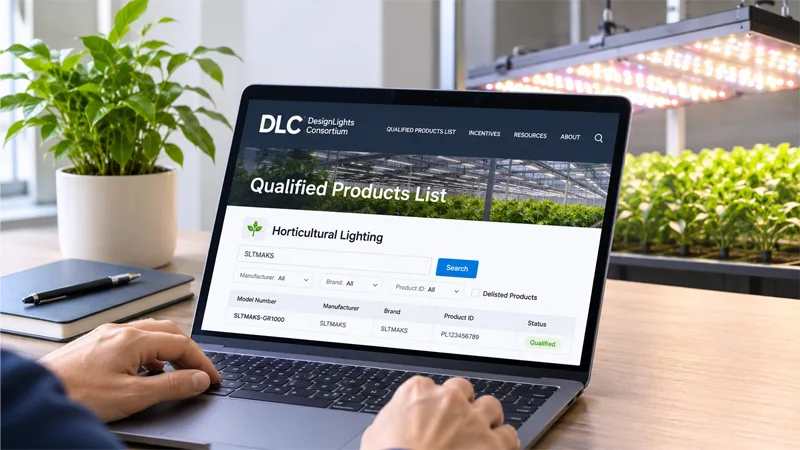
Go to the DLC QPL portal and select the horticultural lighting list. From there, you can search by model number, manufacturer, brand, or Product ID, and filter the results.
The QPL is the authoritative source, and the DLC has been explicit about this: while DLC logos can be the first step in identifying products that may qualify for energy efficiency rebates, the one true source to validate product listing is the actual Qualified Products List itself. Treat any other document — a PDF certificate, a logo on a catalogue page, a letter from the factory — as a claim to be tested against the QPL, not as evidence of listing.
One search behavior matters for later steps: delisted products remain searchable. The DLC’s QPL filters include a “Delisted Products” option, so a model that no longer qualifies can still be found — which is exactly what you want when a supplier insists a product is listed and you need to determine whether it ever was, or whether it has since been removed.
Verify checkpoint: the model appears as a current listing under the manufacturer and brand you were quoted.
Step 2: Match Model Number, Manufacturer, and Brand Exactly
Finding a similar-looking record is not the same as finding your product. The DLC’s technical requirements impose matching discipline that the buyer should mirror.
Each model number may represent the product under only a single brand. If a product can be sold under multiple brands, the model numbers must be listed separately for each brand. If the brand name is not provided, the manufacturer name is used to represent the brand on the QPL. That single-brand rule is why a record showing the right fixture family under a different brand name is not your listing.
Three failure modes account for most mismatches:
- Series name versus model number. The quote says the supplier’s “X-Series 720” while the QPL lists individual model numbers within that series. Only the specific listed model numbers are qualified.
- Brand versus manufacturer. The QPL record carries both a manufacturer and a brand field. A Chinese factory may be the manufacturer while the brand on the record belongs to a distributor or a private label.
- Family qualification. A spec sheet may show a product family in which only some variations are qualified. The DLC’s logo compliance guidance notes that if not all variations are qualified, materials must clearly indicate that only some products are qualified — and that a product not appearing on the QPL under the exact manufacturer or brand, with a model number that aligns with the listing, is not qualified.
Misrepresentation carries consequences on the supplier’s side too: the DLC reserves the right to check web listings and marketing materials, and misrepresentation of model numbers discovered outside the application process is generally considered a violation of DLC program and trademark rules and may result in delisting.
Verify checkpoint: manufacturer, brand, and full model number align across the quotation, the product label, and the QPL record.
Step 3: Confirm Whether a Private-Label Brand Can Rely on the Factory’s Listing
This is the question that most often decides whether a Chinese-sourced fixture is usable under your own brand, so it deserves a direct answer.
The DLC’s rule: private label applications may only be submitted if the original equipment manufacturer’s (OEM) product is already DLC qualified, and private label products must be identical to the originally qualified versions. The private label listing is dependent on the OEM listing — if the OEM product is delisted for any reason, all associated private labeled products are also delisted. Delisting can follow a voluntary manufacturer request, non-compliance with program requirements, a logo use violation, or other misrepresentation.
The distinction that matters commercially:
- A reseller selling DLC qualified products under the exact manufacturer name and model number explicitly listed on the QPL under the OEM information does not need to use the private label application process.
- A brand selling under its own name and its own model number does need a private label listing. The DLC’s logo compliance guidance calls the assumption that an OEM qualification automatically extends to a differently labeled product a common misconception: without a separate DLC qualification, there is no way to verify that the private labeler has a business relationship with the OEM and that the private labeler’s products have undergone required testing and review.
On the safety side, private label applications require more than the OEM’s paperwork. The applicant submits the OEM’s compliance certificate, the private labeler’s own compliance certificate bearing the private labeler’s name and unique file number, and a multiple listing correlation sheet issued by the safety organization that cross-references OEM model numbers with private label model numbers.
Verify checkpoint: if the brand you are buying differs from the manufacturer on the QPL record, ask for the private label listing itself or the multiple listing correlation sheet. An OEM listing alone does not transfer.
Step 4: Check Whether the Listing Is Current, Superseded, or Delisted
A record that exists is not necessarily a record that qualifies today. Listing status changes with version cycles and with enforcement.
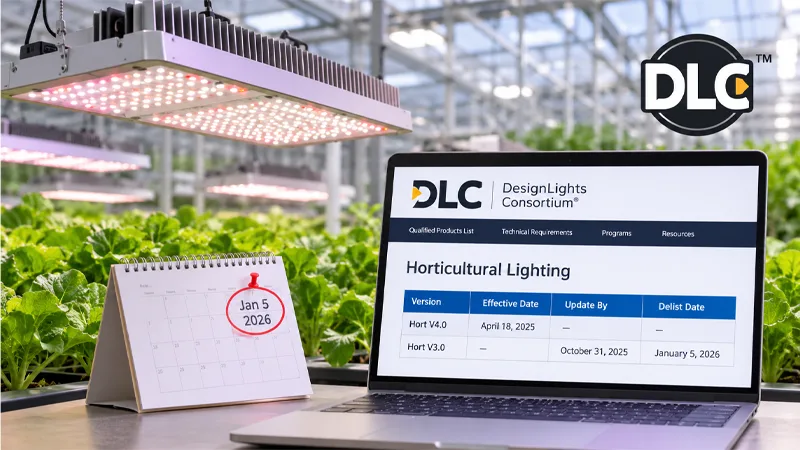
Under the current schedule, Hort V4.0 is active effective April 18, 2025. Hort V3.0 remains active with an update-by date of October 31, 2025, and a delist date of January 5, 2026. Note a discrepancy in the DLC’s own published material: the V4.0 technical requirements page shows the V3.0 delist date as January 5, 2026, while the horticultural lighting program page shows January 6, 2026. Confirm the date against the current schedule table on the DLC site rather than relying on a screenshot or a secondhand summary.
The practical consequence: a product qualified only to a superseded version will be delisted when that version’s delist date passes. Hort V4.0 also raised the PPE threshold to a minimum of 2.5 µmol/J, an 8.7% increase over V3.0, and the DLC stated that this increase would delist the least efficacious V3 listed products — roughly 11% of the QPL. A fixture that was legitimately listed in 2024 may therefore be gone from the current list without any misconduct by the supplier.
Status can also change outside the version cycle. The DLC’s logo compliance guidance lists the outcomes of surveillance testing, product misrepresentation, logo violations, updated technical requirements, and voluntary manufacturer removal as reasons a product’s qualification status may change. The DLC’s draft QPL Integrity Policy describes a routine quality monitoring program that periodically re-evaluates listed products after qualification, and notes that products which qualified using tolerances to meet the technical requirements may carry a higher risk of not meeting them during monitoring.
Verify checkpoint: the record shows an active status under the current version, and you have noted the next version deadline that applies to it.
Step 5: Reconcile QPL Performance Values Against the Datasheet and Test Reports
The QPL record carries performance data, and that data — not the datasheet — is the listing value. Comparing the two is where buyers catch both honest scaling and inflated claims.
The fields to compare are photosynthetic photon efficacy (PPE, in µmol/J), photosynthetic photon flux (PPF), and input power. The QPL product detail page holds identifying information including model number, Product ID, manufacturer, brand, and DLC family code, alongside tested and reported performance data.
Understanding the parent/child distinction explains why datasheet and QPL values legitimately differ. Products tested for photometric performance are parent products, tested to produce a full LM-79 report and typically chosen as worst-case models within a family. Products not tested for photometric performance, bracketed by testing of the parent products, are child products. Parent records show both tested performance and reported (nominal) performance; child records rest on reported data. The DLC sets no strict prescriptive method for calculating reported performance, but all reported values must meet the technical requirements and the method must be understood and based in engineering logic, and it must be fully described in the application.
Test-method scope matters when you read the reports the supplier sends. LM-79 covers electrical and photometric measurement of a complete fixture. LM-80 is a lumen maintenance test method for LED packages, arrays, or modules driven by an auxiliary driver, with case temperature controlled during testing — it does not by itself establish fixture performance, and it does not specify pass/fail criteria or extrapolation methods. TM-21 projections are calculated from LM-80 data. A supplier who sends an LM-80 report as evidence of fixture efficacy has sent the wrong document.
One caution on interpretation: a datasheet PPE higher than the QPL value is not proof of superior performance. It is a discrepancy to raise with the supplier in writing, and the QPL value governs what the listing represents. The DLC’s own guidance acknowledges that tested performance data may deviate from reported data substantially enough that the scaling method is called into question.
Verify checkpoint: QPL PPE, PPF, and input power are consistent with the datasheet within the supplier’s stated tolerances, and any gap is explained in writing.
Step 6: Confirm the Safety Certification Separately
DLC listing is not a safety certification, and the DLC does not act as a safety certification body. The qualification process requires manufacturers to provide documentation demonstrating that each listed product has obtained appropriate safety certification from an accredited body, and DLC staff review that documentation — a product cannot be listed without it — but the listing itself is a performance qualification, not a safety mark.
The underlying requirement: products must be certified by an OSHA Nationally Recognized Testing Laboratory (NRTL) in the United States, or by a Standards Council of Canada (SCC)-recognized body in Canada, to ANSI/UL 8800 (ANSI/CAN/UL 8800), the standard applicable to horticultural lighting products.
What to request is the compliance certificate itself. The document name varies by organization: Intertek issues an Authorization to Mark, UL a Certificate of Compliance or Notice of Authorization, CSA a Certificate of Compliance, and DEKRA a Certificate. The document must bear the manufacturer’s name and cover the exact model you are buying. During application, manufacturers digitally sign an agreement confirming the safety documentation covers all models they wish to list and that products sold will bear the proper markings.
Coverage can lapse. If, after qualification, the safety documentation is updated so that a listed model number is no longer covered by the original certificate, the manufacturer must submit the revised documentation to the DLC; failure to do so may result in the product and any associated family members or private labels being delisted. The DLC’s draft QPL Integrity Policy adds that where safety verification finds a non-compliant product, all products sharing the family ID are delisted, subject to review where multiple safety documents were submitted within one family.
Verify checkpoint: the safety certificate names the exact model, and the certifying body appears on the OSHA NRTL list or the SCC directory of accredited clients.
Step 7: Confirm Rebate Eligibility With the Utility, Not the Listing Alone
A listing is a common eligibility input; it is not a rebate. Approximately 75% of efficiency programs across Canada and the United States use the QPLs to determine incentive eligibility, according to the DLC’s logo compliance white paper. That figure describes how programs source eligibility information — it does not mean every program accepts every listed product on the same terms.
Program rules vary in ways that matter to a specific purchase. Confirm with the program administrator, in writing:
- Which QPL version qualifies. A program may still be operating on a version whose delist date has passed, or may have moved to V4.0 ahead of a supplier’s paperwork.
- Any minimum PPE above the DLC threshold. A program can set a higher efficacy bar than 2.5 µmol/J.
- The required Product ID on the application. The DLC advises efficiency programs to request the DLC Product ID when reviewing incentive submissions, and advises distributors to request it when in doubt.
- Whether private-label models are accepted, and under what documentation.
Utility paperwork reflects this variability in practice. Connecticut’s C&I express lighting rebate form, for example, requires detailed invoices itemizing make, model, and quantity, and reserves pre-approval and post-inspection for rebates above a stated threshold — the kind of administrative condition that has nothing to do with the QPL and everything to do with whether your application is paid.
Verify checkpoint: the program administrator confirms in writing that the exact model and Product ID qualify under the program’s current rules.
Common Mistakes That Sink a Verification
- Accepting a DLC logo on a spec sheet as proof. The QPL is the one true source; a logo is a claim. Search the model.
- Matching a series name instead of the full model number. Only the specific listed model numbers are qualified. Get the full string on the purchase order.
- Assuming an OEM listing covers your private-label brand. It does not. A brand selling under its own name and model number needs a private label listing and a multiple listing correlation sheet.
- Checking only the current QPL and missing a pending delist date. A V3.0-only listing has a delist date attached. Note it before you commit volume.
- Treating a datasheet PPE as the listed value. The QPL value governs. A higher datasheet figure is a discrepancy to raise, not a performance claim to accept.
- Conflating DLC listing with UL 8800 safety certification. They are separate. Request the compliance certificate naming the exact model from an OSHA NRTL or SCC-recognized body.
- Assuming a listing guarantees a rebate. Roughly 75% of programs use the QPLs, but each sets its own rules. Confirm with the administrator.
Verify Your Result: The Sign-Off Checklist
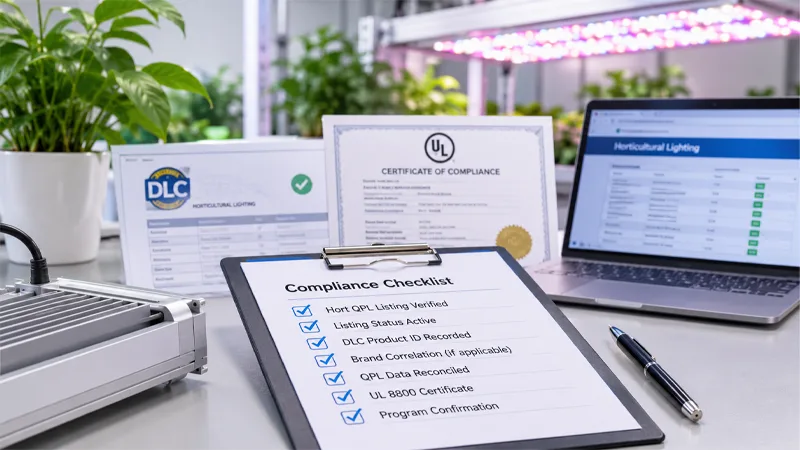
Attach this to the procurement file. It is the evidence set that answers an auditor or a program reviewer.
- Exact full model number found on the Hort QPL under the claimed manufacturer and brand.
- Listing status active under the current technical requirements version; next delist date noted.
- DLC Product ID recorded on the purchase documentation.
- Private-label listing or multiple listing correlation sheet obtained if the brand differs from the QPL manufacturer.
- QPL PPE, PPF, and input power reconciled with the datasheet, with any gap explained in writing.
- ANSI/UL 8800 compliance certificate naming the exact model, issued by an OSHA NRTL or SCC-recognized body.
- Utility or program administrator confirmation on file for the exact model and Product ID.
If any line cannot be completed, the qualification claim is not yet verified — regardless of what the supplier’s marketing materials show.
Frequently Asked Questions
Can a Chinese factory’s DLC listing be used by my brand to verify DLC listed grow lights?
Only through a private label application, and only if the OEM product is already DLC qualified and the private label product is identical to the originally qualified version. The private label listing depends on the OEM listing and is delisted with it. Your brand also needs its own safety compliance certificate and a multiple listing correlation sheet.
Does a DLC listing mean the fixture is UL certified?
No. When you verify DLC listed grow lights, remember that DLC qualification is a performance listing; the DLC does not act as a safety certification body. Products must separately be certified to ANSI/UL 8800 by an OSHA NRTL or an SCC-recognized body, and the DLC reviews that certificate during qualification.
What if the model isn’t on the QPL but the supplier shows a certificate?
A certificate is not a listing. If you need to verify DLC listed grow lights, the DLC states the QPLs are the one true source to validate product listing, and its guidance is that if a product cannot be found on the QPL under Listed Products and no valid DLC Product ID can be provided, the product is not qualified.
How long does a listing last?
Until the applicable version’s delist date passes or the product’s status changes. When you verify DLC listed grow lights, note that status can change through surveillance and routine quality monitoring, misrepresentation findings, logo violations, updated technical requirements, or voluntary removal by the manufacturer.
Where do I find the Product ID?
On the QPL product detail page, which is reached by clicking the listing on the QPL search page. When distributors need to verify DLC listed grow lights, the DLC advises requesting the Product ID from the supplier when in doubt.