
Introduction
Two fixtures can carry the same model number, the same nominal CCT, and the same diode part number, and still read differently on a PAR meter or look different side by side over a canopy. The difference is rarely a defect. It is usually a binning decision — made by the LED supplier, then again by the fixture manufacturer — that was never written down anywhere the buyer could see it.
LED binning consistency is the discipline that closes that gap. It has two halves. The first is mechanical: understanding why bins exist, what a bin split is, and how a bin selection propagates through a reel, a fixture, and a production run. The second is commercial: knowing which documents prove what, how to judge a proposed bin split, and how to write requirements into an order so that “same model” stops being the only control you have.
This article works through both halves in that order. The technical sections explain the mechanism; the procurement sections give you a framework you can apply before a retrofit, a multi-site rollout, or a reorder.
Table of Contents
Why “Same CCT” and “Same LED Model” Do Not Guarantee Fixture-to-Fixture Consistency
Binning exists because LED production cannot deliver identical parts. Lumileds states the reason plainly in its LUXEON 2835 Color Line datasheet: “In the manufacturing of semiconductor products, there are variations in performance around the average values given in the technical datasheet. For this reason, Lumileds bins LED components for luminous flux or radiometric power, color point, peak or dominant wavelength and forward voltage.” The datasheet average is a description of a distribution, not a promise about the part in your hand.
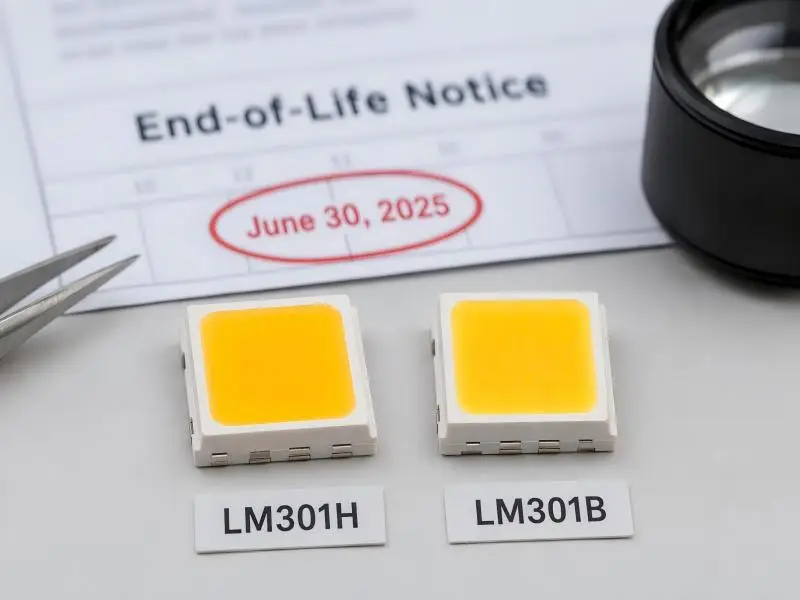
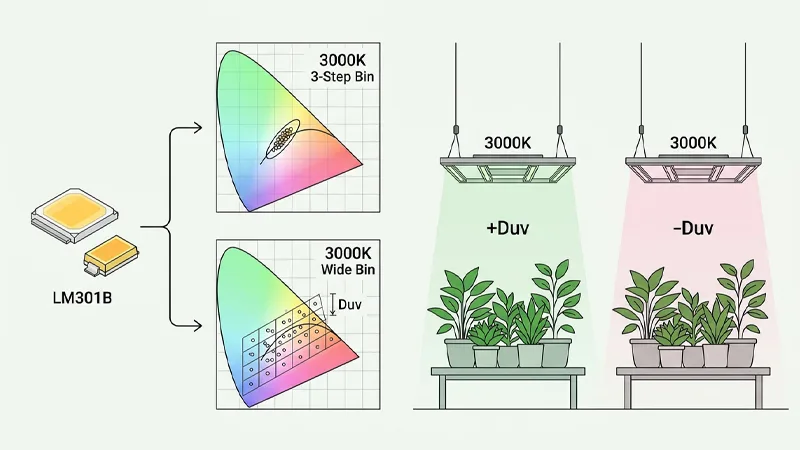
Samsung LM301B, CRI 80, 3000 K: the same part family is orderable as a whole bin spanning twelve color ranks (VA–VM), as a MacAdam 3-step ellipse bin limited to four ranks (VA–VD), and as S and K kitting options covering intermediate subsets. Counts are of color ranks listed in the ordering table; they are not a measure of color variation or of performance quality. Single product family only — not typical of other manufacturers.
A Holophane white paper on LED binning describes the same constraint from the luminaire maker’s side. A single wafer is coated, diced, bonded, phosphor-coated and encapsulated, and despite heavy investment in process control the result is “a process that is not capable of producing highly consistent and tightly controlled production of LEDs.” The paper also names the trade-off that governs every binning conversation: if a luminaire manufacturer accepts a very wide range of LEDs in any binned criterion, “price and lead-time are substantially improved,” while “the variability of luminaire performance is substantially increased.”
That trade-off is why two fixtures can share a label and diverge in the room. Two mechanisms do the work.
A nominal CCT is a range, not a point. The DOE’s LED Color Characteristics fact sheet is direct about this: nominal designations such as 2700 K, 3500 K or 5000 K “each cover a range of actual CCT and Duv values, as defined by ANSI in C78.377-2015.” The same fact sheet concludes that “two sources with the same nominal CCT can appear very different, and just specifying a nominal CCT will do little to ensure that multiple products emit light that appears similar.” Duv matters as much as CCT here, because it describes where the color point sits relative to the blackbody locus — a positive Duv reads slightly greenish, a negative Duv slightly pinkish.
A model number fixes the part family, not the bin. When a fixture specification says “Samsung LM301B” or names any other diode family, it identifies which product line was designed in. It says nothing about which color rank, flux rank or voltage rank was populated on the reel that fed a given production lot.
The LM301B ordering table makes the gap visible: for 3000 K alone, the same part family is offered as a whole bin spanning twelve color ranks (VA through VM), as a 3-step MacAdam ellipse bin limited to four ranks (VA through VD), and as two different kitting options that each cover a different subset. All of those are legitimate LM301B 3000 K products. They are not interchangeable in a consistency-critical installation.
The practical consequence: consistency is a property of the bin selection and mixing policy behind a fixture, not of the model name printed on the spec sheet. A buyer who specifies only the model has specified the menu, not the meal.
What Binning Actually Sorts — and Where Consistency Breaks Down
Binning sorts production output along three axes, and each one fails differently.
Schematic, not a measured curve. LED packages are binned for flux and color under a short pulse at Tj = 25 °C (DOE/PNNL, 2007), while typical constant-current operation with engineered heat mitigation runs at Tj ≈ 60 °C or higher; the DOE fact sheet states white LEDs will then provide at least 10% less light than the manufacturer’s rating, with larger reductions where thermal design is inadequate. No slope is drawn and no intermediate values are implied.
Luminous flux (or radiometric power). Output is measured and sorted into prescribed ranges. The Lighting Africa technical note on reading LED datasheets lists the bin categories as luminous flux (or intensity), forward voltage, and color, with color usually given as x,y coordinates on the 1931 CIE chromaticity chart. Flux binning is the most linear of the three: a wider accepted flux range means a wider spread in delivered output across a fleet.
Color point. Color bins are regions on the chromaticity diagram grouped around a nominal CCT. The Holophane paper describes the geometry: bins are grouped as quadrants around the standard chromaticity curve, and “the larger the bin size, the more variation around the standard color temperature is accepted. Conversely, smaller bin sizes maintain a tighter control of color variation.” MacAdam-step designations are the tighter version of the same idea — an ellipse drawn around a target color point rather than a full ANSI quadrant.
Forward voltage. Voltage bins matter less for what the canopy sees and more for how the fixture behaves. Where drivers are matched to strings, a wide voltage spread can shift operating points between units. The DOE SSL Manufacturing Roadmap records the industry view that color consistency is the most important binning issue, with forward voltage and lumen output variations considered much less significant — a useful ranking when you have to decide where to spend tolerance.
The LM301B table shows how these axes combine into orderable codes. A whole-bin code accepts the full set of color ranks for a nominal CCT. A 3-step code narrows acceptance to four ranks inside a MacAdam 3-step ellipse. The S and K kitting codes cover intermediate subsets — wider than 3-step, narrower than whole bin, and different from each other. Separately, the flux rank is carried in a different character of the part number, and the forward-voltage bin in another. Reading a full ordering code tells you which combination you are actually buying; reading only the family name tells you nothing.
Two failure modes. The first is inside a single fixture: a build that draws from a wide bin spread produces a luminaire whose own output and color sit somewhere in a range, and two units off the same line can differ. The second is across a fleet: each production run is internally consistent but built from a different bin, so fixtures installed in phase one and phase two do not match. The first is a tolerance problem; the second is a traceability problem. They need different controls.
The thermal dimension. Binning conditions are not operating conditions. The DOE’s Thermal Management of White LEDs fact sheet states that manufacturers “test and sort (or ‘bin’) their products for luminous flux and color based on a 25 millisecond power pulse, at a fixed Tj of 25°C (77°F).” Under constant current at room temperature with engineered heat mitigation, Tj is typically 60°C or greater — and the fact sheet concludes that white LEDs “will provide at least 10% less light than the manufacturer’s rating,” with the reduction significantly higher for products with inadequate thermal design.
The same document notes that different colored LEDs respond differently to temperature, with amber and red the most sensitive and blue the least. That matters for full-spectrum horticultural fixtures, which mix phosphor-converted white with narrow-band red and far-red emitters: the emitters do not drift equally, so a thermal design that lets junction temperature climb changes the delivered spectrum, not just the delivered flux.
This is why bin selection and heat-sink design cannot be evaluated separately. A tight bin commitment on a fixture with a weak thermal path delivers a tightly specified part operating far from its specified condition. The grower’s exposure is the combination: spectral and flux consistency across a canopy depends on the bin policy and the thermal path together.
The Documents That Make Consistency Verifiable
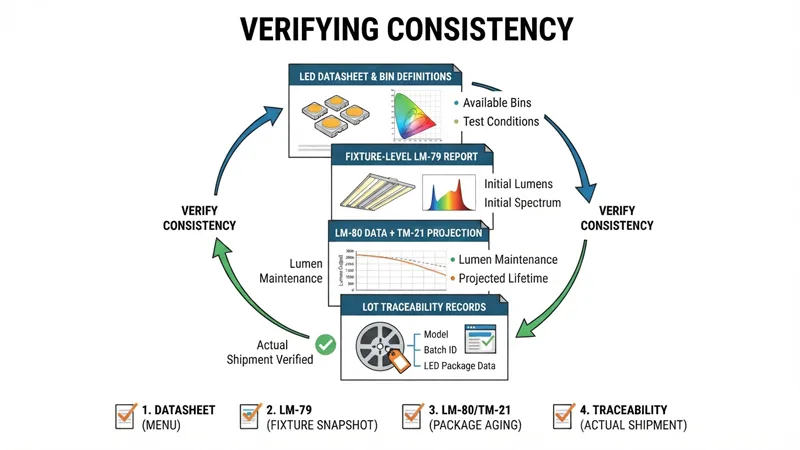
Consistency claims are only as good as the documents behind them, and each document type answers a narrower question than buyers usually assume. Request them as a set and read each one against its own limit.
Scope of each document type, as defined by the cited sources. LM-79 covers integrated SSL products (luminaires, lamps, light engines) and is an initial snapshot; it excludes LED packages and arrays and does not address lumen maintenance or case temperature. LM-80 covers LED packages, arrays and modules only and does not itself provide extrapolation guidance. IEC 63403-2:2024 specifies a binning method for horticultural LED packages. None of these documents states which bin a given shipment contains — that is what lot traceability records are for.
LED supplier datasheet and bin definitions. Answers: what bins exist for this part, and under what test conditions were they measured? Does not answer: which bin was shipped. The datasheet defines the available menu and the binning conditions — for example, Lumileds specifies its 3000 K 3-step and 5-step MacAdam ellipses around a center point of (0.4338, 0.4030) at a binning temperature of Tj = 25°C, and notes a tolerance of ±0.007 on x and y coordinates. Those are useful reference points; they are not a statement about your order.
Fixture-level LM-79 report. Answers: how did this integrated luminaire perform under specified conditions at the time of test? The DOE’s Understanding LM-79 Reports describes the method as providing “a snapshot of performance under specified operating conditions at some point in the life of a product, usually at the beginning of operation,” and states explicitly that it “does not address lifetime ratings, changing performance over time (e.g., lumen maintenance), or LED case temperature.”
Two practical cautions follow. First, LM-79 applies to integrated products, not to LED packages, modules or arrays. Second, the report describes the tested configuration and version, so it must be matched to the exact model and revision you are buying — the DOE advises comparing reports against specification sheets to confirm the results are being used accurately.
LM-80 data plus a TM-21 projection. Answers: how did the LED package’s lumen and color output hold up over time at the case temperatures tested? Does not answer: how the finished fixture behaves in situ. The DOE LM-80 webcast materials set out the scope — measurement of lumen maintenance for LED packages, arrays and modules — and note that the method itself does not provide guidance on extrapolation beyond the tested hours; that is what TM-21 does, under its own limits.
The DOE/LSRC chromaticity shift report adds the caution that once LEDs are installed in a luminaire, many additional factors affect depreciation and color shift, including temperature extremes, humidity, chemical exposure, driver behavior, encapsulant degradation and phosphor degradation. Package-level data is a starting point, not a fixture prediction.
Batch or reel traceability records. Answers: which bin populated which production lot, and when. This is the only document on the list that can close the loop between a specification and a shipment. A traceability record worth having links the finished product identity (model, batch, production date) to the LED package data — supplier, bin, CCT, CRI, forward-voltage bin, flux bin, lot number — and to the test and inspection records for that batch. The level of detail should scale with risk: a single small installation may be adequately controlled at batch level, while a multi-site rollout or a project with visible adjacencies justifies deeper records.
A short version to keep at hand: ask for the datasheet to see the menu, the LM-79 to see the tested fixture, the LM-80/TM-21 set to see package-level maintenance, and the lot traceability record to see what actually shipped. If a supplier offers only the first, you have verified nothing about your order.
Accepting or Rejecting a Bin Split Before a Retrofit or Multi-Site Rollout
A bin split is what happens when a supplier proposes to fill one order from more than one bin. It is not inherently dishonest — the Holophane paper’s point about price and lead time cuts both ways, and a supplier facing a large order may genuinely need to draw on several bins to ship on schedule. The question is whether the split is bounded, disclosed and traceable, or whether it is invisible.
Low-risk split. Three conditions hold at once. The bins proposed fall inside a tolerance the buyer specified before the order was placed. The split is disclosed in writing, with the specific bins named. And lot traceability lets the buyer confirm after delivery which bin went into which unit or batch. Under those conditions a split is a managed commercial decision, and the buyer has retained the ability to decide whether the resulting variation is acceptable for the application.
High-risk split. Any one of those conditions fails. The most common failure is the third one inverted: the tolerance was never written down, so “same model” became the only control, and the buyer discovers the split only when fixtures look different in the room. An undisclosed split is worse still, because it removes the buyer’s chance to reject before installation.
The multi-site case. When fixtures at different sites come from different bins, cross-site comparisons lose their baseline. Differences in yield, spectral response or energy use that appear between sites can no longer be attributed cleanly to lighting versus other variables, because the lighting itself was not the same input. Standardization therefore requires one of two commitments: a single-bin commitment for the whole rollout, or a documented, bounded split applied consistently — for example, the same bin or bin set assigned to every site in a phase, so that site-to-site comparison remains valid within the phase.
The cost trade-off, stated honestly. Tighter bin acceptance generally costs price and lead time, for the reason the Holophane paper gives: wide acceptance is what makes supply cheap and fast. The productive response is not to tighten everything. It is to decide which parameters actually need tightening for your crop, your layout and your comparison plan. Color point usually earns tight tolerance because it is visible and because spectral consistency underpins any cross-site comparison. Flux tolerance matters where PPFD uniformity across a canopy is a design goal. Forward-voltage tolerance matters where driver matching affects fixture-to-fixture behavior. Parameters outside those priorities can often be left wide in exchange for better price and availability.
A test to apply before signing. Four questions, answered in writing:
- Which specific bins will fill this order, named by code rather than by family?
- Do all of them fall inside the tolerance we specified in advance?
- Will the split be disclosed per shipment, and what record will identify which bin went into which lot?
- If delivered lots fall outside the stated tolerance, what is the remedy?
A supplier who can answer all four has given you a controllable order. A supplier who cannot answer the first has not yet told you what you are buying.
Writing Bin and Tolerance Requirements Into a Purchase Order
The purchase order is where a binning framework either becomes enforceable or evaporates. Referencing a datasheet is weaker than naming a bin code, because the datasheet defines the menu while the order must select from it. A well-built order states the selection explicitly.
Elements to state.
- Color: the specific bin code or MacAdam step, not just the nominal CCT. If the application is sensitive to tint, state the acceptable Duv direction as well.
- Flux: the flux bin or a stated minimum, referenced to the test current and condition under which it was measured.
- Forward voltage: the voltage bin, where driver matching or string design makes fixture-to-fixture behavior sensitive to it.
- Reference test conditions: the current, temperature and binning condition the specified values refer to, so that a later measurement can be compared on equal terms.
- Split policy and disclosure: whether a split is permitted at all, and if so, the requirement to disclose the specific bins before shipment.
- Traceability: the record to be supplied per lot, and what it must connect — finished product identity to LED bin, lot number and test records.
- Remedy: what happens if delivered lots fall outside the stated tolerance. Without this clause the tolerance is an aspiration.
A common vocabulary for horticultural binning. Horticultural LED binning now has a dedicated international reference. IEC 63403-2:2024, published 8 February 2024, is titled “Horticultural lighting – LED packages for horticultural lighting – Part 2: Binning” and, in the standard’s own scope statement, “specifies the binning method for LED packages for horticultural lighting.” It is useful as a shared vocabulary when negotiating with a supplier or comparing quotations, because it gives both sides the same terms for the same concepts.
What it does not do is decide your order. A binning method standard defines how bins are constructed and labeled; it does not mandate which bins a buyer must accept, and it does not set a tolerance for your crop or your layout. The buyer still has to state which bins and tolerances are acceptable. Treat the standard as the grammar of the conversation, not the content of the contract.
One further note on scope: no standard cited in this article mandates a specific numeric tolerance for a horticultural fixture. Any figure in your purchase order should come from your own application requirements, not from an assumption about what a standard requires.
Why Reorder Consistency Matters for Multi-Site Standardization
A first order and a reorder can each be internally consistent and still differ from each other. That is the scenario binning is meant to manage, and it is the one most often left unmanaged.
Between production runs, the bins a supplier has available can shift. Wafer output varies, demand for particular bins is uneven, and a bin that was readily available at commissioning may be scarce eighteen months later. If the reorder is filled from whatever bins are on hand, and the order language never named a bin, then the reorder is compliant with the specification while being different from the installation it is meant to extend. The DOE SSL Manufacturing Roadmap notes that binning affects LED selling price “because of potential limited availability of specific codes” — availability of a specific bin is a real constraint, not a hypothetical one.
For a multi-site operator, the operational consequence is a drifting baseline. The lighting installed at commissioning defines the reference against which later crop performance, spectral response and energy use are judged. If expansion fixtures come from a different bin, the reference has moved, and differences observed between the original site and the expansion can no longer be attributed cleanly to lighting versus other variables. The comparison that the standardization program was built to support quietly stops working.
The control is straightforward, though it requires discipline: treat bin commitment as a recurring requirement rather than a one-time specification. Carry the same bin language into every reorder. Require lot traceability on every shipment so that a shift is detected at receiving rather than in the canopy. Where a supplier cannot hold the original bin, require the proposed substitute to be disclosed and checked against the agreed tolerance before it ships — the same accept/reject test from the previous section, applied again.
This is a risk-control argument, not a measured effect. The claim is not that a bin shift will reduce yield by a specific amount; it is that a bin shift removes the ability to attribute a change to its cause, and that loss of attribution is expensive precisely when a multi-site operator is trying to compare sites.
How SLTMAKS Approaches Binning Consistency
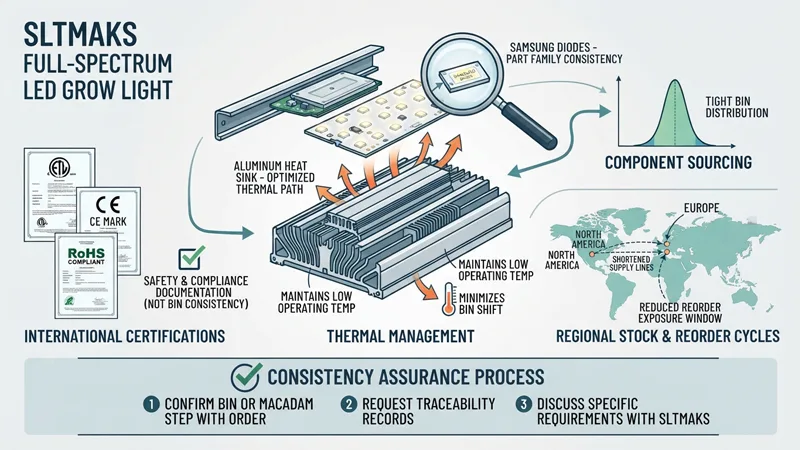
SLTMAKS builds full-spectrum LED grow lights on Samsung diodes, with thermal management built around aluminum heat sinks, and ships under international safety certifications including ETL, CE and RoHS, backed by a 3-year product warranty. Finished fixtures are stocked in warehouses in North America and Europe.
Those are manufacturer-side controls, and they map onto the framework above at specific points — but only at specific points.
Component sourcing. Naming Samsung diodes establishes the part family. It does not, by itself, establish which bin was populated on a given lot. The questions that remain are the ones from the documents section: which bin or MacAdam step applies to the model you are ordering, and what traceability record accompanies the shipment. Those are order-specific and should be confirmed for the model and version under consideration.
Thermal path. The aluminum heat-sink design is the manufacturer-side answer to the thermal dimension described earlier — the gap between the 25°C pulsed binning condition and real operating junction temperature. Thermal design determines how far delivered performance drifts from the binned rating, and it is the reason bin policy and heat-sink design have to be evaluated together rather than as separate line items.
Compliance documentation. ETL, CE and RoHS certification supports the safety and documentation side of a procurement review. It does not speak to binning consistency, and it should not be read as doing so; the two belong to different parts of the evaluation.
Regional stock. Warehouses in North America and Europe shorten reorder cycles, which is directly relevant to the reorder-consistency problem: shorter supply lines reduce the window in which available bins can shift between an original order and a reorder. It does not eliminate the need to carry bin language into every order, but it reduces the exposure.
What the brand profile does not supply — and what this article will not invent — is a specific bin code, a numeric tolerance, or a measured consistency figure. Those belong in the order-specific documentation described above. Buyers who want to discuss bin and documentation requirements for a particular model should raise them directly with SLTMAKS as part of the quotation process, alongside the four accept/reject questions and the purchase-order elements set out earlier.
Conclusion
Consistency in full-spectrum LED grow lights is a bin-and-thermal policy, not a model name. A nominal CCT covers a range of chromaticity coordinates and Duv values; a diode family covers a set of bins; and the binning condition sits at 25°C while the fixture runs hotter. Two fixtures that share a label can therefore differ in the room, and the difference is a decision someone made — or failed to make — about which bins to accept and how to mix them.
That decision becomes verifiable through specific documents with known limits: the datasheet shows the menu, the LM-79 report shows the tested fixture, LM-80 and TM-21 show package-level maintenance, and lot traceability shows what actually shipped. It becomes enforceable when bin and tolerance requirements are written into the purchase order — color bin or MacAdam step, flux bin, voltage bin where it matters, reference conditions, split policy, traceability record and remedy — and when the same language is carried into every reorder.
Before the next retrofit or multi-site order, assemble the document set for the models under consideration and draft the bin language while there is still time to negotiate it. Buyers who want to work through order-specific bin and documentation requirements can raise them with SLTMAKS as part of the quotation.
Frequently Asked Questions
Does specifying the same LED model guarantee the same spectrum across fixtures?
No. A model number defines the part family; bins define the performance range within that family. The LM301B ordering table, for example, offers the same 3000 K product as a whole bin spanning twelve color ranks or as a 3-step MacAdam ellipse limited to four. Consistency requires naming the bin or MacAdam step and controlling how bins are mixed across a production run.
What is the difference between a whole bin and a MacAdam-step bin?
A whole bin accepts the full set of color ranks defined for a nominal CCT. A 3-step or 5-step MacAdam designation narrows acceptance to a smaller ellipse around the target color point. In the LM301B table, the 3000 K whole bin covers ranks VA through VM, while the 3-step version covers only VA through VD. The narrower the step, the tighter the color consistency — generally at higher cost and longer lead time, for the reason the Holophane paper gives about wide acceptance improving price and availability.
Can a fixture be consistent on color but inconsistent on output?
Yes. Flux and color are separate bin axes, so a supplier can hold color tightly while accepting a wide flux range. Buyers who care about both should specify both, and should also consider forward-voltage binning where driver matching affects fixture-to-fixture behavior. The DOE manufacturing roadmap records the industry view that color consistency is the most important binning issue and that flux and voltage variations are considered less significant — a useful ranking, but one that should be checked against your own application.
Why does a datasheet’s lumen rating not match what the fixture delivers?
LED manufacturers test and bin at a fixed junction temperature under a short pulse — the DOE thermal fact sheet cites a 25 ms pulse at Tj = 25°C — while real operation typically runs at Tj of 60°C or higher. The same fact sheet concludes that white LEDs will provide at least 10% less light than the manufacturer’s rating, with significantly higher reductions where thermal design is inadequate. Delivered output therefore depends heavily on the fixture’s thermal path.
Is there a standard for horticultural LED binning?
Yes. IEC 63403-2:2024, published 8 February 2024, is titled “Horticultural lighting – LED packages for horticultural lighting – Part 2: Binning” and specifies a binning method for LED packages for horticultural lighting. It provides a common reference for negotiation, but it does not decide which bins or tolerances are acceptable for your installation — the buyer still has to state that in the order.
How should a multi-site operator handle a supplier who cannot commit to a single bin?
Use a bounded alternative. Require disclosure of the proposed split, confirm the bins fall within a tolerance agreed in advance, and require lot traceability so any drift is caught at receiving rather than in the canopy. Apply the same bin set consistently across sites within a phase so that cross-site comparison remains valid. If the tolerance cannot be met, treat it as a rejection before the rollout rather than after.