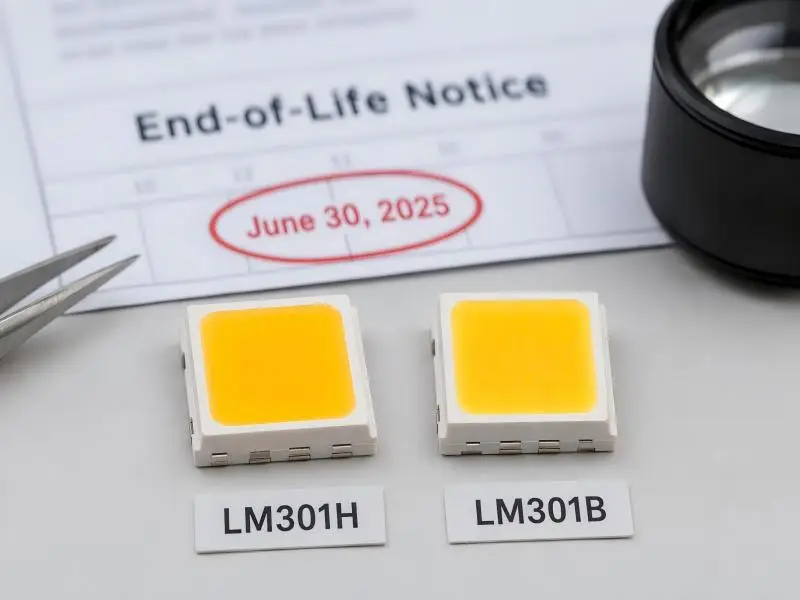
When it comes to sourcing Samsung LM301H and LM301B LEDs, buyers realize they are no longer dealing with a simple either-or choice. Samsung’s End-of-Life notice, dated December 31, 2024, lists the LM301B/301H part-number family among the general-lighting LED products being discontinued, with a non-cancelable last-time-buy order date of June 30, 2025 and non-returnable last-time shipment of December 31, 2025. As of this writing both deadlines have passed, so what remains in the channel is stock already ordered. Buyers comparing the two diodes are therefore weighing three things at once: what the datasheets actually specify, what a supplier can document about the specific reels they hold, and how long that supply will last.
The marketing story is familiar: the LM301H is the horticulture part, the LM301B the general-lighting part, and the H carries a premium on that basis. The datasheets narrow that gap considerably. Samsung’s own horticulture brochure lists the LM301H at 3.08 µmol/J in its SL rank at 65 mA, 25 °C, 5000K, CRI80+, and an independent comparison found that a measured ~5% gap between the two models matched the difference between an unbinned LM301B and the higher SL bin rather than any die-level change. That does not make the two parts identical in every order — it makes the bin the variable that decides the outcome.
This guide serves as a practical reference for sourcing Samsung LM301H components, providing research-based insights rather than a bench test. It covers how to read a full part number and check it against a quotation, what the die-versus-bin evidence supports, why a fixture’s µmol/J cannot be taken from a diode datasheet, which documents to request before a purchase order, how to inspect incoming stock, what the discontinuation does and does not establish, and when a verified high-bin LM301B is the better commercial choice.
Table of Contents
Quick Comparison: LM301H vs. LM301B at A Glance
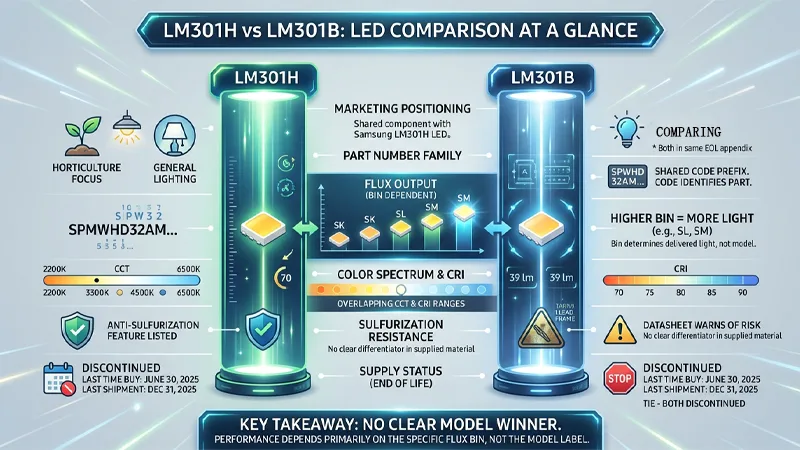
| Attribute | LM301H | LM301B | Reading |
|---|---|---|---|
| Intended positioning | Horticulture | General lighting | Marketing distinction; both appear in the same EOL appendix |
| Part-number family | SPMWHD32AMH... (CRI80/CRI90 ordering codes) | Same SPMWHD32AM... family per the EOL notice | Shared prefix; the code, not the name, identifies the part |
| Rated efficacy (65 mA, 25 °C) | 3.08 µmol/J (SL rank, 5000K, CRI80+) | Not stated in the supplied LM301B excerpt at this condition | Not comparable from supplied material |
| Flux bins | S0, SF, SG, SH, SJ, SK, SL, SM depending on CCT; SL and SM at the top for 4000–6500K | SK, SL, SM appear in the kitting rule; SL bin averages 39 lm at 65 mA per the independent comparison | Bin, not model, sets delivered flux |
| CRI / CCT options | CRI 70–90; 2200K–6500K | CRI 70 datasheet supplied; CRI 70–90 range reported | Overlapping ranges |
| Anti-sulfurization | Listed as a feature of the LM301H line in Samsung’s horticulture brochure | Datasheet warns of sulfurization risk on the silver-plated lead frame | Not established as a differentiator from supplied material |
| Supply status | In the EOL appendix; last-time buy June 30, 2025; last shipment December 31, 2025 | Same appendix and same dates | Tie — both discontinued |
No row above supports declaring one model the winner. The one place the supplied material supports a clear ordering is bin: within either model, a higher flux bin delivers more light at the same test current. Diode-level values here are quoted at 65 mA and 25 °C solder-point temperature; they do not transfer to a fixture, for reasons covered below.
How to Master Sourcing Samsung LM301H and Match It to A Supplier Quotation?
Samsung’s LM301H CRI80 datasheet publishes a product-code table that maps each CCT and flux bin to a complete ordering string. The structure runs: the SPMWHD32AMH prefix, a CCT segment, a separator, and a flux-bin suffix. For 5000 K, the CCT segment is 5XAR; a 5000K part in the SL bin readsSPMWHD32AMH5XAR●SL, where the bullet is a placeholder character in the table, and the trailing SL is the flux bin. The same table shows the flux range that bin covers — 38.0 to 40.0 lm at 65 mA, 25 °C for SL at 5000K — and shows that 5000K is also available in SK (36.0–38.0 lm) and SM (40.0–42.0 lm).
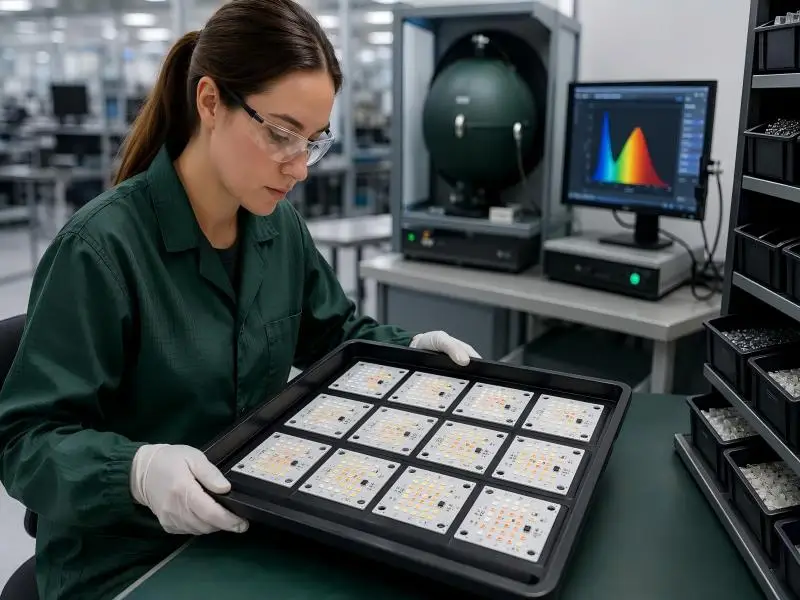
That string is not decorative. Under Samsung’s standardized label format, effective for manufacturing dates from March 1, 2021, the reel and aluminum-bag labels carry a 2D barcode whose fields include the Samsung Part Number (data identifier 1P) and the Bin Code (33P), alongside quantity, date code, lot code, and country of origin. The inner box label repeats the same fields, and the packing list carries them as required entries. So the part number on a quotation should be checkable against three physical documents at goods-in.
A quotation that says only “LM301H 5000K” omits the bin and therefore cannot be verified against a datasheet row. Two reels matching that description could sit at opposite ends of the flux table. The same problem applies to a quotation that lists “LM301H” with no CCT at all, since the CCT segment changes the ordering code and the available bins.
The practical rule: a quotable part number should be complete enough to match one row of the datasheet’s product-code table. If a supplier abbreviates, get the abbreviation resolved in writing before the PO is issued — not on the packing list after delivery.
What Actually Differs Between LM301H and LM301B — the Die or the Bin?
Start with what the datasheets state. The LM301H CRI80 datasheet lists forward-voltage bins AY (2.6–2.7 V), AZ (2.7–2.8 V) and A1 (2.8–2.9 V), thermal resistance of 7.5 °C/W junction-to-solder-point, a 120° beam angle, a 200 mA maximum forward current and a 110 °C junction temperature limit. The LM301B CRI70 datasheet lists the same forward-voltage bins, the same 7.5 °C/W thermal resistance, the same 120° beam angle, the same 200 mA forward current, and the same 110 °C junction limit. The independent comparison at cre. reaches the same conclusion from the datasheets: the LM301H has the same electrical and optical properties as the LM301B, available across 2200K–6500K and CRI 70–90.
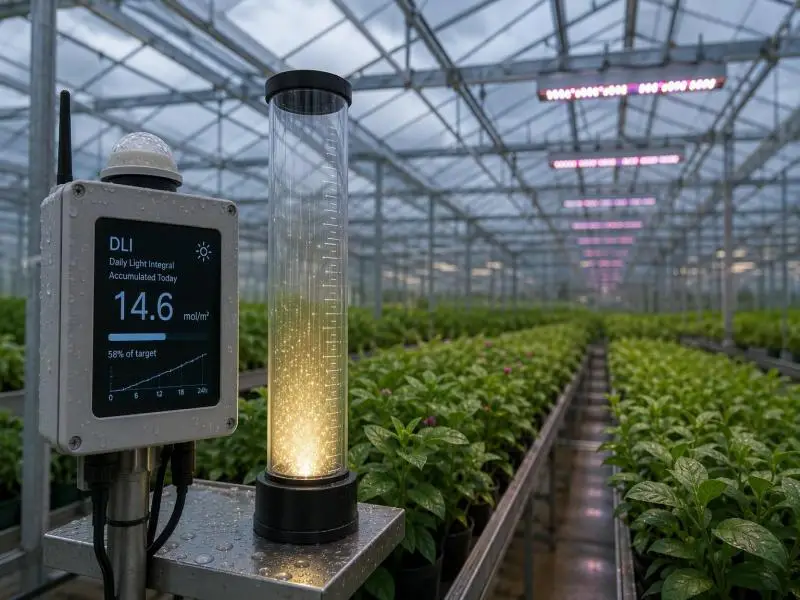
Published PPF/W by rank for the LM301H family, from Samsung’s Greenhouse Lighting Solutions brochure (2021 H2). Values are per rank at 65 mA, 25 °C; the LM301H (SL) figure is at 5000K, CRI80+, while the LM301H ONE (S0) figure is at 3500K, CRI70+, so the ONE bar is not directly comparable on spectrum. These are rank-specific figures, not family-wide ratings.
The competing account comes from measurement. Crescience built two comparable arrays — 140 LM301B versus 140 LM301H — and measured with an Apogee SQ-520 quantum sensor in a small box. They found roughly a 5% difference. But the first-generation array used unbinned LM301B, while the successor used the higher SL bin, and the authors note the difference matches the bin gap almost exactly: the average SK bin delivers 37 lm at 65 mA while SL averages 39 lm. They also state their own limitation plainly — simple test equipment, results subject to various uncertainties — and conclude that the LM301H’s advantage over their LM301B cannot be confirmed as a die-level improvement.
Marketing runs ahead of both. Samsung’s horticulture brochure positions the LM301H line as plant-centric with anti-sulfurization, and third-party grow-light content repeats claims of a 3.2% efficacy advantage plus epitaxial and phosphor changes. Those claims are not corroborated by the datasheets supplied here, and the specific figures in that content conflict with Samsung’s own published values — it lists the LM301H at 3.20 µmol/J where Samsung’s brochure states 3.08 µmol/J for the SL rank at 65 mA, 25 °C, 5000K, CRI80+. Treat such numbers as unverified.
What a buyer can conclude: bin selection is documented in the datasheet, printed on the label, and checkable at goods-in. A die-level difference between the two model names is not established by the supplied material. The sourcing implication follows directly — specify the bin, not just the model name.
Why Is A Fixture’s µmol/J Lower than the Diode’s Datasheet Efficacy?
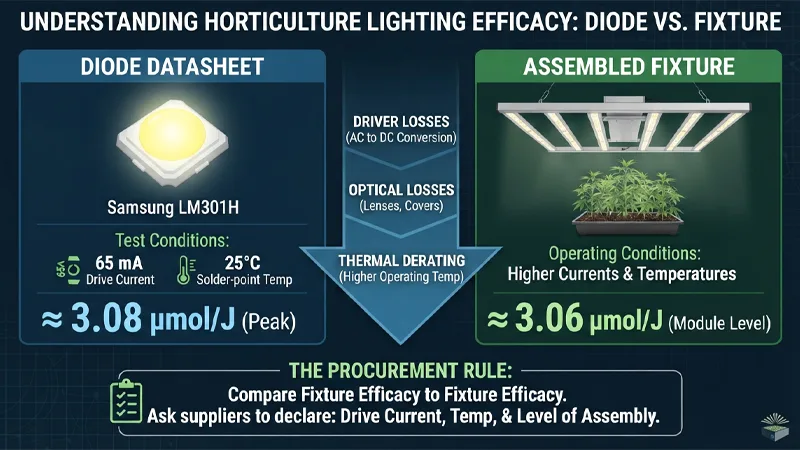
A diode datasheet figure and a fixture datasheet figure describe different objects, and the gap between them is where most procurement errors start.
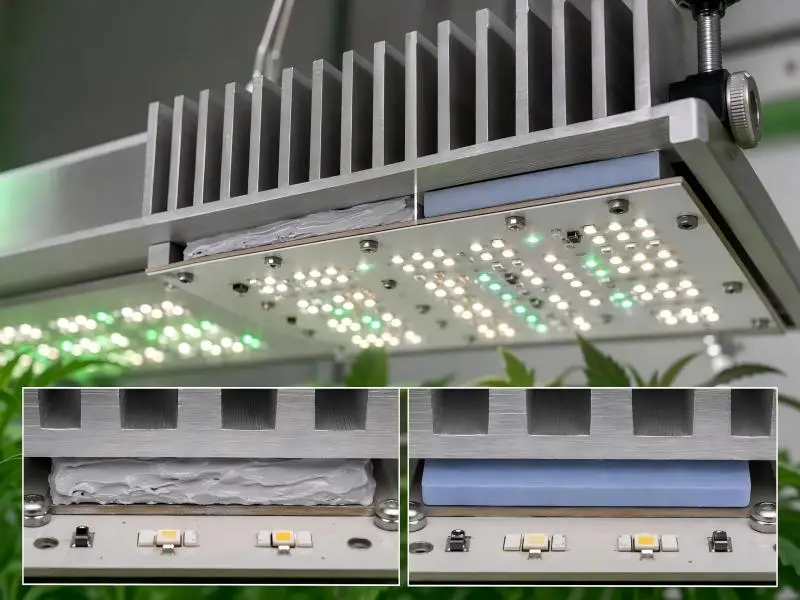
Samsung’s LM301H values are quoted at 65 mA drive current and 25 °C solder-point temperature. Those are test conditions, not operating conditions. A fixture typically runs its mid-power diodes at higher currents and at solder-point temperatures well above 25 °C, and both moves reduce conversion efficiency. On top of the diode, the fixture adds driver conversion losses between wall power and the LED string, optical losses through lenses, covers or reflectors, and thermal derating as the heatsink reaches equilibrium in a warm room. Each stage subtracts from the diode-level number.
Samsung’s own product line illustrates the level-of-assembly point. The Horticulture LED Module Gen2 in the same brochure is rated 3.06 µmol/J at module level — a figure for an assembled module, not a bare diode, and lower than the 3.08 µmol/J the brochure lists for the LM301H SL rank at 65 mA. The same manufacturer publishes different numbers at different levels of assembly, and the module number is the one closer to what a buyer installs.
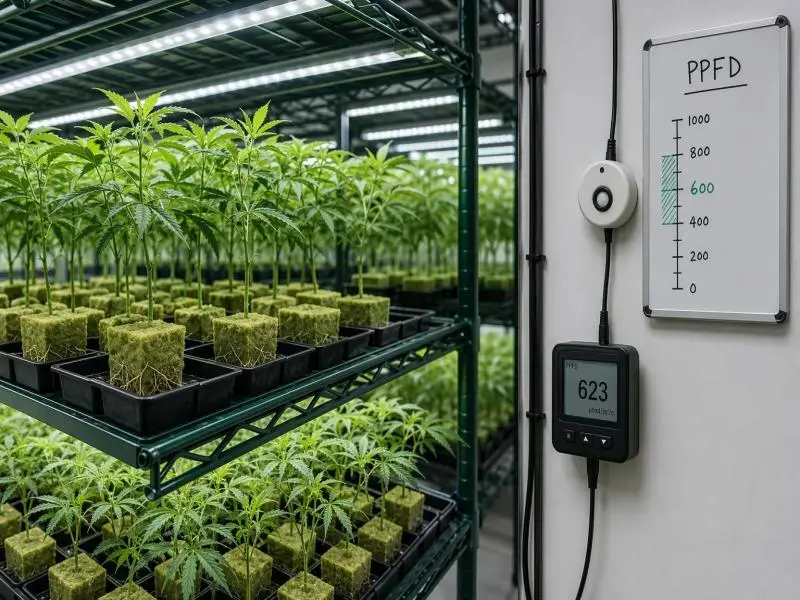
The procurement rule: compare fixture efficacy to fixture efficacy, under stated test conditions. Ask any supplier to declare the measurement basis — drive current, solder-point or ambient temperature, whether the figure is diode-level or fixture-level, and whether driver and optical losses are included. A quotation that cites a diode datasheet number as a fixture specification has not answered the question you asked.
What Documents Should You Request Before Placing A Diode or Fixture Order?
Each item below lets you check something specific. The absence of an item leaves that check unperformed, not necessarily a defect — but it should be resolved before the PO.
- Full Samsung part number matching a datasheet row. Lets you confirm the CCT segment and flux-bin suffix against the product-code table. Without it, the bin is unknown.
- Bin code. Lets you compare the ordered flux range to the alternative you are evaluating. Without it, two quotations are not comparable.
- Date code and lot code. Lets you trace the reel to a manufacturing batch and check age against the EOL timeline. Without them, you cannot tell last-time-buy stock from older inventory.
- Country of origin. A required field on the standardized packing list; lets you check the shipment against the declared supply chain.
- Applicable datasheet revision. Lets you confirm the specification you are relying on is the one that governs the part. Datasheets are revised; a quotation citing an old revision may describe a different bin table.
- Fixture-level efficacy test report with measurement conditions. For fixtures, lets you compare delivered performance rather than diode-level claims. Without stated conditions, the number cannot be benchmarked.
Samsung’s label standard defines where several of these live. The 2D barcode on reel, aluminum bag and inner box carries the Samsung Part Number (1P), quantity (Q), date code (9D, 10D), lot code (1T), country of origin (4L) and bin code (33P). The packing list carries the same fields as required entries, plus packing list number and ship date. Requesting the packing list alongside the quotation lets you check the same identifiers before shipment that you will check again at goods-in.
How Do You Verify Genuine Samsung Diodes on Incoming Stock?
Label checks raise or lower confidence. They do not, by themselves, authenticate a diode. Work the sequence in order and record what you find.
- Match the three documents. Compare the reel label, the inner-box label, and the packing list on the 2D barcode fields: Samsung Part Number (1P), quantity (Q), date code (9D/10D), lot code (1T), country of origin (4L), and bin code (33P). Any disagreement between the three is a stop signal.
- Check the label format. The standardized format applies to manufacturing dates from March 1, 2021, and adds product name, CRI and CCT information, and a reorganized logo layout to the reel and bag labels, with a separate detail label on the inner box. A label that does not follow the current format on a recent date code warrants a question.
- Check the part number against the datasheet. Confirm the received string matches the row for the bin you ordered — not merely that it begins with the right prefix.
- Escalate disputes through Samsung’s channels. Samsung publishes a counterfeit-product disclaimer covering forged logos and unauthorized distributors falsely presenting as authorized, and directs inquiries about suspected counterfeit product to its own support channels. A disputed shipment should go there rather than being settled by inspection alone.
What this sequence cannot do is confirm the die inside the package. It confirms that the documentation is internally consistent and matches the order. That is a meaningful screen — inconsistent labels are a strong negative signal — but it is not a substitute for buying through a traceable channel.
Is LM301H Supply Being Discontinued, and What Does That Mean for Warranty and Continuity?
Separate what the notice establishes from what it leaves open.
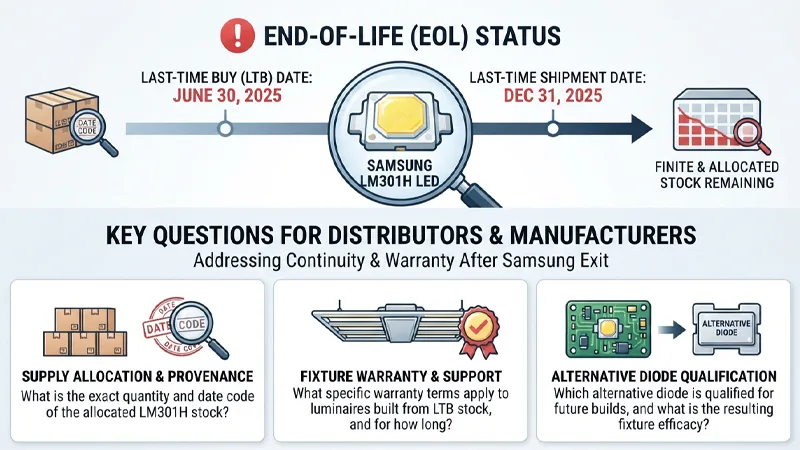
Established. Samsung’s EOL notice, dated December 31, 2024, initiates end-of-life for all product families of general-lighting LED products, including packaged LEDs, filament LEDs, CSP LEDs, COB LEDs, and LED modules. Appendix A lists “LM301B/301H” with part number pattern SPMWHD32AM********, alongside LM301B EVO and LM301H EVO entries. The notice sets a non-cancelable last-time-buy order date of June 30, 2025, and a non-returnable last-time shipment of December 31, 2025. Trade reporting from October 2024 describes Samsung’s exit from the LED business, and a grow-light supplier’s September 2025 article states that the LM301 series is no longer produced and that remaining stock will be used for some time.
Not established from the supplied material. How any specific fixture maker’s warranty, spare-parts commitment, or replacement policy is affected. Samsung’s datasheets state that Samsung provides a limited warranty for its LED products, with the full text published separately — but that is a component-level warranty, and it does not tell you what a fixture builder promises on a finished luminaire assembled from last-time-buy reels.
Both dates in the notice have now passed. That does not mean the channel is empty; it means the remaining supply is finite and already allocated to someone. Put these questions to the distributor in writing and keep the answers:
- How much of the specific part number and bin is allocated to this order, and from which date code?
- What warranty covers fixtures built from last-time-buy stock, and for how long?
- Which qualified alternative diode is designed into future builds, and what fixture-level efficacy does it deliver under stated conditions?
A verbal assurance that “stock is fine” is not an answer to any of the three.
When Is A Verified High-Bin LM301B the Better Commercial Choice?
The case rests on where the documented difference actually lives. If the checkable variable between these two models is binning, then a verified high-bin LM301B and a low-bin LM301H are not ordered by model name at all — they are ordered by the flux range printed on the label. A high-bin LM301B can match or beat a low-bin LM301H on delivered flux at the same test current, and the datasheet bin tables are the place to confirm it for the specific CCT you need.
The second argument is commercial. The LM301B was positioned as a general-lighting part, which in practice meant wider distribution and more price competition across the channel. That matters more now that both models sit in the same EOL appendix with the same passed deadlines: the question is no longer which part is better in the abstract but which part you can still source, in a documented bin, at a defensible price.
Conditions favoring a verified high-bin LM301B:
- The bin is documented on the quotation and matches a datasheet row at least equal to the alternative you are comparing.
- The fixture-level efficacy is verified under stated test conditions, not quoted from a diode datasheet.
- Continuity of supply for the build is confirmed in writing — quantity, date code range, and delivery window.
Conditions favoring LM301H:
- An existing qualified design already specifies it, and re-qualifying would cost more than the supply risk.
- A documented horticulture-specific requirement in your specification points to it.
- Remaining verified stock is available at an acceptable price with paperwork that survives inspection.
Neither model should be selected on name alone once supply is constrained. The name tells you less than the bin code does.
FAQ
Is the LM301H simply a better diode than the LM301B?
The datasheets do not support that framing. The LM301H CRI80 and LM301B CRI70 datasheets list the same forward-voltage bins, thermal resistance, beam angle, and current limits, and the independent comparison found the measured gap tracked bin selection rather than the model suffix. Compare bins at the CCT you need, then compare fixture-level efficacy. The model name is the least informative field on the quotation.
Can the two be mixed in one fixture build?
The practical constraint is matching, not the model name. Forward voltage is binned (AY, AZ, A1), and Samsung’s kitting rule combines a forward-voltage rank only with the same rank — AY with AY, AZ with AZ, A1 with A1 — while flux kitting pairs adjacent bins such as SK+SL or SL+SM. If you mix reels, match the forward-voltage rank across strings and keep the flux bins close enough that the strings share current predictably. Document what went into each build so a later service replacement can be matched.
Is remaining LM301 stock still worth buying?
It can be, with conditions. Check the date code against the EOL timeline and against the storage guidance in the datasheet: sealed bags have a 12-month shelf life at 0–40 °C and 0–90% RH, devices stored three months or more after shipment should be in nitrogen-filled containers, and baking is required if the humidity card reads above 60% at 23 ± 5 °C. Old stock with a documented date code and intact packaging is a different proposition from old stock with neither.
What should we specify if LM301 supply runs out?
Specify fixture-level efficacy under stated measurement conditions, plus the documentation package described above — part number, bin, date code, lot code, and test report. That specification is diode-agnostic and lets you evaluate any candidate on the same basis. Naming a replacement diode brand is a separate qualification exercise; the specification should not presuppose the answer.
Verdict: Which Diode Should Your Next Order Specify?
| Decision area | What the supplied material supports |
|---|---|
| Part-number clarity | Full ordering code with CCT segment and bin suffix is checkable against the datasheet table and the label’s 1P and 33P fields |
| Die versus bin | Datasheets list matching electrical and optical ratings; the measured gap tracked bin selection |
| Fixture versus diode efficacy | Diode figures are at 65 mA, 25 °C; fixture figures require their own stated test conditions |
| Documentation | Part number, bin, date code, lot code, country of origin, datasheet revision, fixture test report |
| Verification | Label and packing-list cross-check raises or lowers confidence; disputes go to Samsung’s channels |
| Supply continuity | Both models in the EOL appendix; last-time buy June 30, 2025; last shipment December 31, 2025 |
| Commercial choice | Verified high-bin LM301B where documented and available; LM301H where the design is qualified or verified stock justifies it |
The decision rule is short. Specify the complete part number and bin. Verify at fixture level under stated conditions. Confirm supply continuity in writing before committing. Then choose between the LM301H and a verified high-bin LM301B on documented performance and availability rather than on the model name.
Buyers evaluating fixtures should ask any supplier — SLTMAKS included — for the same part-number, bin, and fixture-efficacy documentation described in this guide, and should treat an incomplete answer as an open item rather than a settled one.