Decisions regarding commercial DWC lighting often go wrong when they start with a fixture catalogue instead of a target. The workable sequence for a commercial DWC lighting layout runs from daily light integral (DLI, the total photosynthetic light a canopy receives in a day) to a measured uniformity acceptance, then to fixture spacing and mounting height, and only then to power, controls, compliance, and return on investment. This guide is reviewed against the standards and studies cited below as of February 2026.
It is written for multi-site operators and retrofit teams who have to defend a specification to an engineer, an operations manager, a procurement lead, and an executive in the same meeting. Each section states its point first, then the evidence behind it, so a section can be lifted into a procurement pack without rewriting.
Table of Contents
Set Targets and Validate Mapping for Commercial DWC Lighting
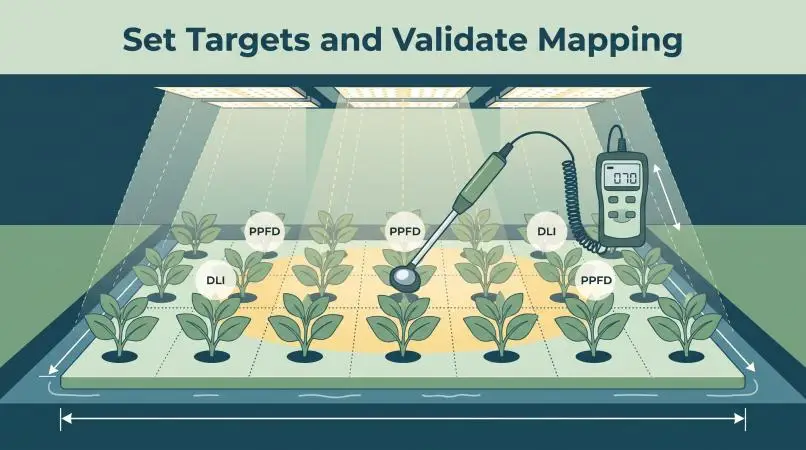
Targets come before fixtures. A DWC layout is only as good as the acceptance criteria written before the first luminaire is hung, and those criteria have two parts: a DLI band by crop stage and a uniformity metric with a stated measurement grid.
PPFD/DLI by Crop Stage
DLI is the product of PPFD and photoperiod, and it is the number that predicts biomass. RII’s lighting best-practice guide puts leafy greens at a DLI of 12 to 17 mol/m²/day at PPFD 180 to 270 µmol/m²/s, and shows the arithmetic directly: 16 mol/m²/day equals 270 µmol/m²/s over 16 hours, or 180 µmol/m²/s over a longer photoperiod (RII’s lighting best-practice guide, 2022 edition).
The band is a range, not a target, because genotype moves the optimum. A 2026 Frontiers in Plant Science study reports lettuce optima of 12 to 16 mol/m²/day depending on genotype and an ideal PPFD of 150 to 300 µmol/m²/s under sole-source lighting (a 2026 Frontiers in Plant Science study, 2026). The iceberg lettuce DLI trial found shoot fresh weight peaked at 11.5 mol/m²/day, rising 42% from 8.64 to 11.5 mol/m²/day (275.5 g to 393 g), then falling 10% at 14.4 mol/m²/day with root fresh weight down 21% and shoot dry weight down 23% (the iceberg lettuce DLI trial, 2023). The upper end of a published band can already be supra-optimal for a specific cultivar.
Basil shows how far the ceiling moves between species. The basil intensity trial ran 100, 200, 400 and 600 µmol/m²/s over 16 hours, which is a DLI of 6, 12, 23 and 35 mol/m²/day, and fresh mass at harvest was 80% higher at the top of that range than the bottom (the basil intensity trial, 2022). A basil ceiling is not a lettuce ceiling.
| Crop stage | DLI (mol/m²/day) | PPFD (µmol/m²/s) | Photoperiod arithmetic | Source |
|---|---|---|---|---|
| Leafy greens, general | 12 to 17 | 180 to 270 | 16 mol = 270 × 16 h, or 180 × 24 h | RII, 2022 |
| Lettuce, genotype-dependent | 12 to 16 | 150 to 300 | 14.4 mol = 250 × 16 h, 340 × 12 h, 170 × 24 h | Frontiers, 2026 |
| Iceberg lettuce, measured optimum | 11.5 | 200 constant | 11.5 mol = 200 × 16 h | Scientific Reports, 2023 |
| Basil, seedling to finish | 6 to 35 | 100 to 600 | 35 mol = 600 × 16 h | Frontiers, 2022 |
Uniformity Metrics and Acceptance
No standard sets a canopy PPFD uniformity pass/fail, so the acceptance criterion has to be written by the operator. The DLC’s V4.0 horticultural technical requirements require photosynthetic photon intensity distribution (PPID) reporting per ANSI/IES TM-33 but set no canopy uniformity threshold (the DLC’s V4.0 horticultural technical requirements, revised 1 October 2025).
The peer-reviewed critique of PPFD uniformity metrics measured two indoor settings and reported Uo (minimum divided by average) of 0.87 and 0.60, Ud (minimum divided by maximum) of 0.80 and 0.48, and 1−CV of 0.95 and 0.82. The same paper states that minimum/average “is not appropriate” as a figure of merit and that setting specification limits on minimum-based ratios without the crop’s light-response curve is “a source of confusion and decision error” (the peer-reviewed critique of PPFD uniformity metrics, 2022). The spread between those two settings came from mounting height and colour mixing, not from the luminaires’ quality.
The practical consequence is that a uniformity number quoted in a vendor guide is commercial practice, not code. Write the acceptance criterion as a measured canopy average with a named grid and a named statistic, and record which statistic was used, because Uo, Ud and 1−CV rank the same layout differently.
Key Takeaway Set targets by crop stage, then accept the installation on a measured canopy average over a stated grid. A datasheet centre-point PPFD figure is not an acceptance criterion.
Sensor Placement and Mapping Protocol
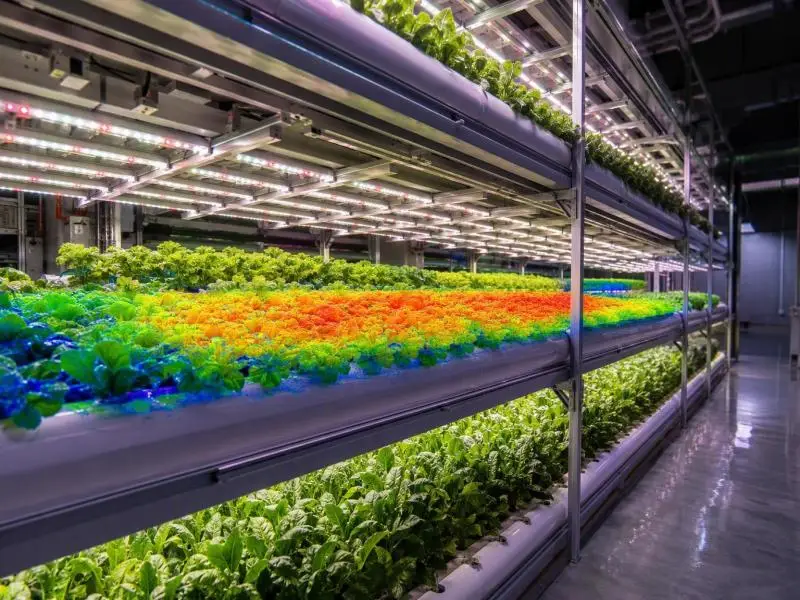
PPFD has to be measured at multiple canopy locations because not all fixture output reaches the canopy; PPF is fixture output, and PPFD is received light (LBNL’s CEA Technology Catalog, 14 May 2026). No IES-documented room-mapping protocol exists in LM-79 or LM-80, which are luminaire and flux-maintenance standards, so the grid density is a project decision that should be written into the commissioning scope.
Modelled light is a planning estimate, not a substitute for measurement. The agrivoltaic lettuce study’s simulated versus observed PPFD had an R² of 0.76 for calibration and 0.82 for validation, with RMSE of 158 and 268 µmol/m²/s respectively, and observed values ran higher and fluctuated more than simulated (the agrivoltaic lettuce light study, 13 November 2025). A layout that is only modelled has not been validated.
Operations should own the mapping routine: same sensor, same warm-up, same grid, same statistic, repeated at the same crop stage. That is what makes a second site comparable to the first.
Engineer the DWC Layout
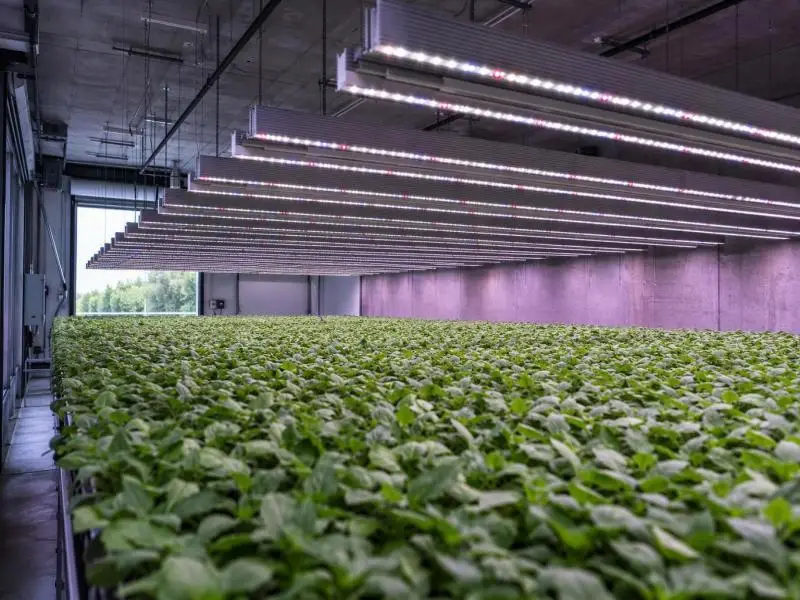
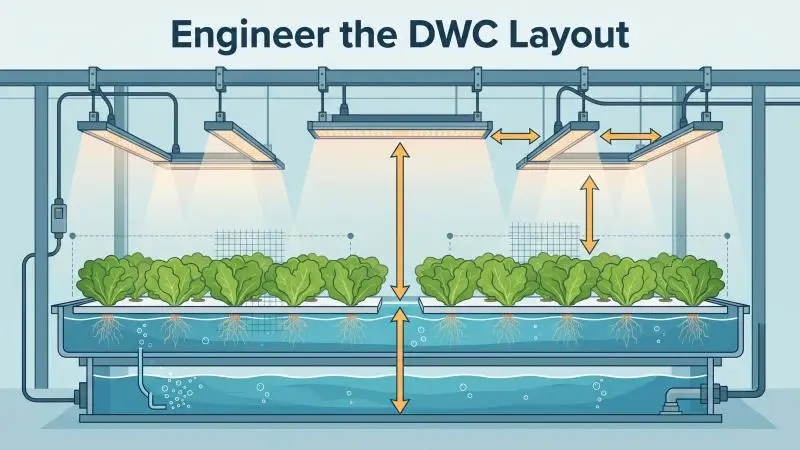
Geometry decides whether the target survives contact with the canopy. In a commercial lighting layout for deep water culture, fixture form factor, spacing, mounting height, and spectrum are the four variables that move measured PPFD distribution, and the first three are fixed at installation.
Fixture Form Factor, Spacing, and Mounting Height
Linear runs improve uniformity, and mounting height is the single largest lever. RII’s lighting best-practice guide recommends linear fixture runs over point sources for even coverage (RII’s lighting best-practice guide, 2022). The uniformity study measured the same luminaire type at 1,612 mm mounting height and at 200 mm: the high mount produced Uo of 0.87 and the low mount 0.60, with the low mount losing significantly more PPFD at the boundaries of the target area (the peer-reviewed critique of PPFD uniformity metrics, 2022).
LED bar spacing and mounting height therefore have to be set against the channel geometry, not against a room average. When rack-level PPFD varies more than ±10% across a 1.2 m channel, the fix is usually spacing or height, not a higher-output fixture.
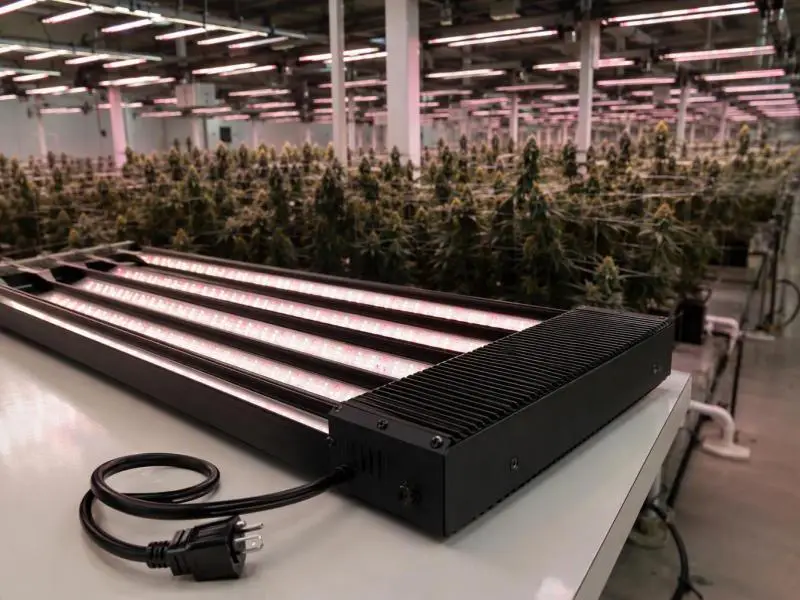
Fixture comparisons rest on LM-79 data, not nominal wattage. ANSI/IES LM-79 defines how PPF, efficacy, and photometric distributions on a datasheet are produced, and the DLC requires PPF reported per LM-79 in 400 to 500, 500 to 600 and 600 to 700 nm bins plus total, with PPID per ANSI/IES TM-33 (ANSI/IES LM-79, revised 1 October 2025).
Pro Tip Verify spacing against a measured grid at canopy height, not against the datasheet’s centre-point PPFD.
Spectrum, Dimming, and Repeatable Recipes
Above a DLI of 7 mol/m²/day, PPFD matters more than spectrum, so spectrum is a secondary specification once the intensity target is met (RII’s lighting best-practice guide, 2022). That ordering is what makes a recipe repeatable: fix DLI, then tune spectrum within it.
Photoperiod and PPFD can be traded against each other at constant DLI, and the energy case depends on doing both. A 2026 Bari study holding DLI constant at 14.4 mol/m²/day reached it three ways, 16 hours at 250 µmol/m²/s, 12 hours at 340 and 24 hours continuous at 170, and continuous light cut LED energy cost 16.5% while raising energy use efficiency to 11.4 g/kWh against 9.8 and 9.0 (a 2026 Bari study holding DLI constant, 2026). The same trial measured light use efficiency of 3.4 g/mol at 16 and 12 hours against 3.8 g/mol at 24 hours (the same Bari trial, 2026). Extending hours while holding PPFD raises DLI and is a different experiment.
Dimming is a DLC requirement above a threshold, not an option. The DLC requires dimming for AC luminaires with PPF of 350 µmol/s or more, and knob-only manual dimming is not acceptable (DLC V4.0, revised 1 October 2025). Dimming floor and driver behaviour at high ambient are the honest limits on how far a recipe can be turned down.
End-of-warranty PPFD is the number a recipe has to hold. ANSI/IES LM-80 measures flux maintenance and TM-21 projects long-term maintenance from that data, which is the defensible basis for sizing a target that must still be met at end of warranty (IES’s position on LED lifetime claims, current position). A datasheet L70 figure is not a design basis.
Airflow, Condensation, and Microclimate
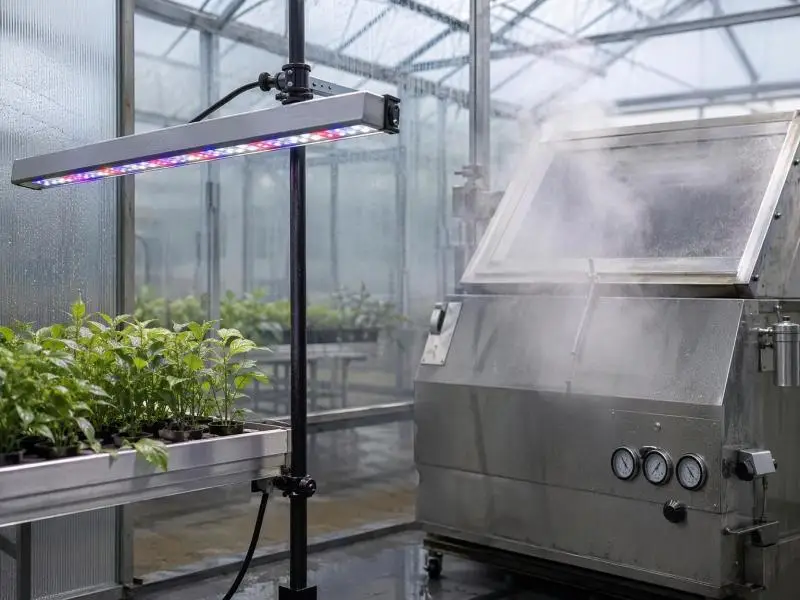
An open DWC surface is an evaporative reservoir, and the DWC lighting layout has to keep fixture surfaces above dew point. Plants retain under 5% of the water they absorb; the other roughly 95% enters the air around the plant, mostly as transpiration, and any water added to the grow area that the plant does not take up adds to humidity (LBNL’s CEA Technology Catalog, 14 May 2026). An open channel adds free-water evaporation on top of that.
The design target is fixture surface temperature above dew point, not a relative humidity setpoint. RII’s lighting best-practice guide describes condensation on fixtures, drivers, cable glands and connectors at or below dew point, externally and internally during heat and cool cycles, and warns against aiming supply air, circulation fans or exhaust paths so humid air is driven onto cool luminaires (RII’s lighting best-practice guide, 2022). No source in this review quantifies free-water evaporation from an open DWC raft surface, so the load has to be handled mechanistically rather than from a published figure.
Power, Controls, Compliance, and ROI
The electrical and compliance case is where a layout becomes a project. Efficacy, heat load, controls sequences, listing, and incentives each have a documented threshold, and each one can invalidate a design that looked correct on the lighting plan.
Efficacy, Heat Load, and HVAC Coordination
Efficacy floors have moved twice in three years, so a specification written against an older threshold is already out of date. The DLC’s V4.0 horticultural technical requirements set a minimum photosynthetic photon efficacy of 2.5 µmol/J over 400 to 700 nm, an 8.7% increase over V3.0, with a −5% test tolerance meaning reports showing 2.38 µmol/J or more are accepted (the DLC’s V4.0 horticultural technical requirements, revised 1 October 2025).
The V4.0 threshold sits more than 45% above the most efficacious non-LED option, the 1000 W double-ended high pressure sodium luminaire, and the increase delisted roughly 11% of the V3 qualified products list (DLC’s V4.0 transition schedule, 2025).
Heat load follows directly from input wattage. One watt equals 3.413 Btu/h, and all electrical input to an air-cooled fixture remains in the conditioned space, so heat load is approximately 3.413 Btu/h per input watt, about 100% sensible and 0% latent from the fixture itself (ANSI/ASABE/ASHRAE EP653, 2021).
| Connected lighting load | Heat to the conditioned space | Basis |
|---|---|---|
| 1,000 W | 3,413 Btu/h | 3.413 Btu/h per input watt |
| 10,000 W | 34,130 Btu/h | 3.413 Btu/h per input watt |
| 30 W/ft² | 102.4 Btu/h/ft² | 3.413 Btu/h per input watt |
| 50 W/ft² | 170.7 Btu/h/ft² | 3.413 Btu/h per input watt |
Sizing the air side is not a straight sensible-load calculation. Grow-room sensible heat ratio typically runs 0.30 to 0.75 against 0.80 to 0.90 for commercial buildings, latent load drives equipment sizing, and latent load is high enough to remove sensible heat, so reheat capacity must be sized (ASHRAE grow-room design guidance, 2019).
Driver waste heat is a small but real line item. RII’s lighting best-practice guide gives drivers at 92 to 95% efficient, so a 630 W fixture’s power supply may emit about 40 W, or 140 Btu/h, and notes that LED retrofits can allow HVAC downsizing worth up to 33% lower capital cost, with setpoints raised 7 to 8 °F to hold leaf temperature and VPD (RII’s lighting best-practice guide, 2022). The 33% figure is indicative, not an engineering guarantee.
Control Sequences and Staged Startup
The control protocol has to be chosen before the fixtures are ordered, because it determines the driver and the wiring. DALI-2 is the addressable, certifiable choice for grouped fixture control with fade and status feedback, 0–10 V is one-way and adequate for grouped intensity, and DMX512 suits multichannel or tunable research rigs (federal lighting-controls guidance, 8 February 2024). The same guidance notes that all equipment on the same wiring must use the same dimming method, and that dimming is separate from the communication protocol.
Staged startup ramps avoid simultaneous inrush and an abrupt change in crop illumination. A workable sequence for a multi-tier DWC room runs: bring up one rack zone at a time on the ramp, verify measured PPFD at canopy height against the target, confirm the dimming floor, then release the next zone. Record the ramp profile with the recipe so a second site can reproduce it.
Codes, Commissioning, and Incentives
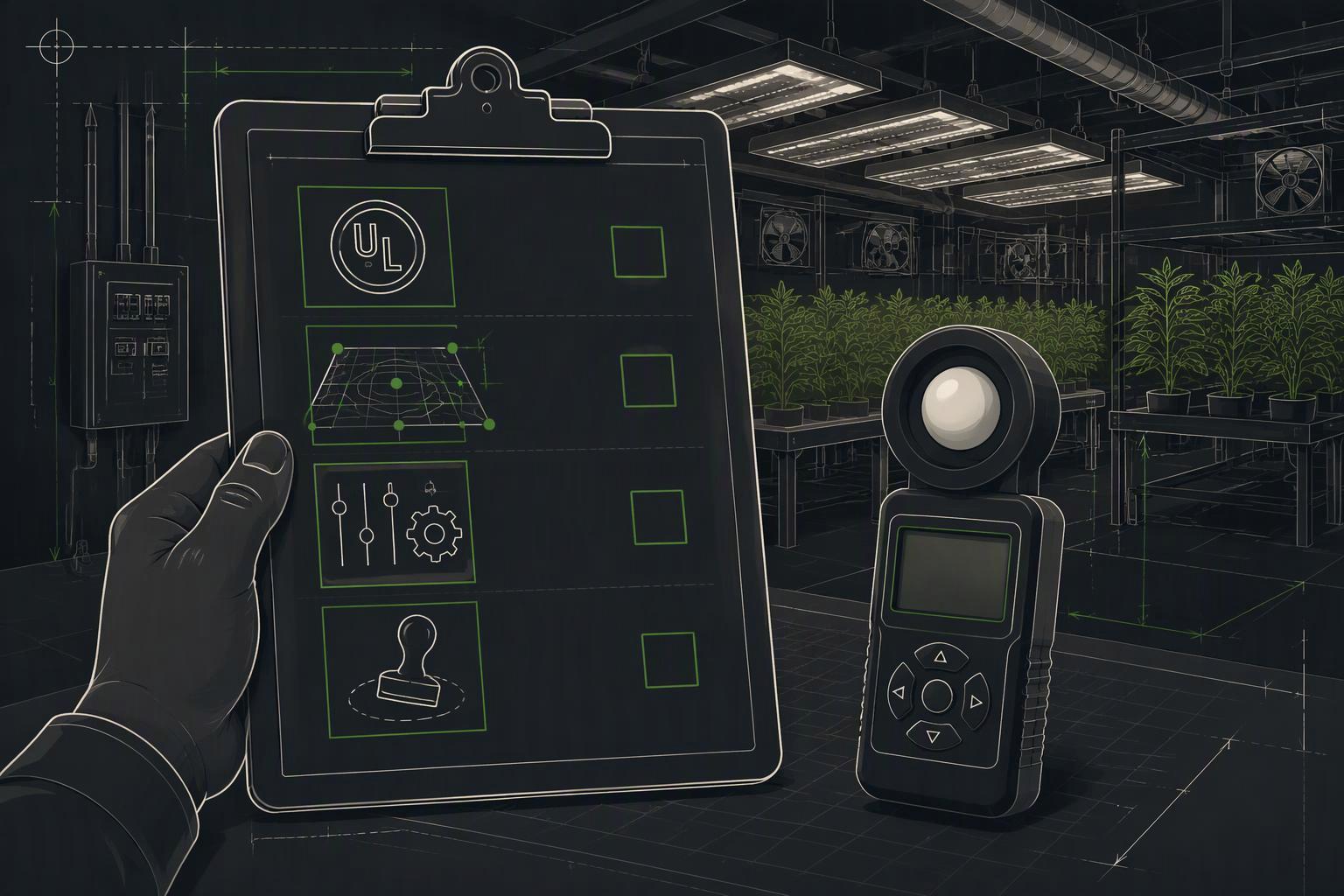
Listing and code compliance are two separate requirements, and passing one does not satisfy the other. UL 8800 is the first standard written specifically for horticultural luminaires, components, and grow systems, covering damp and wet-location suitability, ingress protection testing and classification, photobiological safety consistent with IEC 62471, UV resistance of polymeric parts, and system-level safety (UL 8800, the horticultural lighting safety standard, October 2024).
UL 8800 is distinct from UL 1598, which addresses general luminaires, and it evaluates a single luminaire’s optical output, so the facility must still manage cumulative exposure, access control, and personnel safeguards (UL’s guidance for code authorities).
The installation rules come from the electrical code. NEC 410.10(A) requires luminaires in wet or damp locations to be installed so water cannot enter or collect in wiring compartments, lampholders or other electrical parts, wet-location luminaires must be marked suitable for wet locations, a damp-listed fixture may never be used in a wet location, and NEC 314.15 requires wet-location boxes and fittings to be listed for wet locations with field drainage openings only between 3 mm and 6 mm (NEC 410.10(A), 2023 edition).
The 2023 NEC quick reference confirms the marking logic: wet-rated installations are also acceptable in damp locations, but not the reverse (the 2023 NEC quick reference, 2023 edition).
⚠️ Warning A damp-listed fixture may never be used in a wet location, and DLC listing alone does not satisfy the authority having jurisdiction. UL 8800 listing plus NEC compliance are both required.
Commissioning follows a fixed sequence:
- Confirm UL 8800 listing and the wet marking against the installed location.
- Map PPFD at canopy height on the agreed grid and compare with the acceptance criterion.
- Test the controls sequence, including the dimming floor and the staged startup ramp.
- Verify utility pre-approval before purchase, since several programmes require it.
Incentives reward the listing and penalise the retrofit shortcut. Xcel Energy’s Colorado grow-lighting rebate pays $0.25/W installed for DLC-listed lighting and $0.19/W for non-DLC, capped at 60% of project cost, LED only, with no LED-to-LED upgrades and purchase-and-install before application (Xcel Energy’s Colorado grow-lighting rebate, current form, verify programme year).
A flat per-fixture horticultural schedule pays $10 for 8 to 14 W fixtures, $15 for 15 to 49 W, $25 for 50 to 99 W and $40 for 100 W and above, requiring ENERGY STAR or DLC horticultural QPL listing (a flat per-fixture horticultural schedule, Form A4 rev. 12/20).
Efficiency Maine’s technical reference manual requires DLC Hort QPL listing and assigns a measure life of 10 years for flowering and 8 years for vegetative, based on 50,000 hours of LED life, against a new-construction baseline of 1,000 W double-ended HPS or MH for flowering and 600 W for vegetative (Efficiency Maine’s technical reference manual, v2025.1).
Payback is therefore a function of the local schedule, not a national rate. No verified payback range for HPS-to-LED retrofits was found on a primary page in this review, so the return on investment case should be built from the site’s own capex, the metered lighting load and the confirmed incentive, with the DLC efficacy floor and the heat-load arithmetic above as the fixed inputs.
Conclusion
A commercial lighting layout for deep water culture is a chain of decisions, and each link has a documented basis. Set the DLI band by crop stage from RII’s 12 to 17 mol/m²/day for leafy greens and the genotype-dependent 12 to 16 mol/m²/day for lettuce, then accept the installation on a measured canopy average over a stated grid rather than a datasheet centre point.
Engineer the geometry next: linear runs, mounting height set against the channel, and spacing verified on a measured grid. Then close the electrical case with the DLC V4.0 efficacy floor, the 3.413 Btu/h per input watt heat load, the controls protocol chosen before the order, and the listing and code requirements that the authority having jurisdiction will actually inspect.
The next step is documentation. Compare fixture specifications before you commit, using LM-79 and TM-33 datasheets and a layout review against your own measured grid, and request a layout review before the purchase order goes out.
About the publisher. SLTMAKS is a global provider of professional-grade LED grow lights, including full-spectrum fixtures with Samsung diodes, aluminum heat sinks, and ETL, CE, and RoHS certifications. It sells lighting products, so it has a commercial interest in how lighting layouts are specified, and readers should weigh its perspective accordingly. The guidance above does not depend on its products.
FAQ
What DLI should a commercial DWC leafy-green room target?
Aim for 12 to 17 mol/m²/day at 180 to 270 µmol/m²/s, per RII’s 2022 lighting best-practice guide. Lettuce optima shift by genotype between 12 and 16 mol/m²/day, so treat the band as a starting point and confirm it with a measured trial on your own cultivar.
What uniformity should I accept for a DWC lighting layout?
No standard sets a canopy pass/fail, so write your own criterion: a measured canopy average over a named grid, using a named statistic. Record whether you used minimum/average, minimum/maximum or 1−CV, because those three rank the same layout differently.
Why does mounting height matter more than fixture output?
Because it spreads light across the whole channel instead of concentrating it under each fixture. In a peer-reviewed comparison, the same luminaire at 1,612 mm reached a minimum/average of 0.87, while at 200 mm it fell to 0.60 — with far more PPFD lost at the edges of the target area.