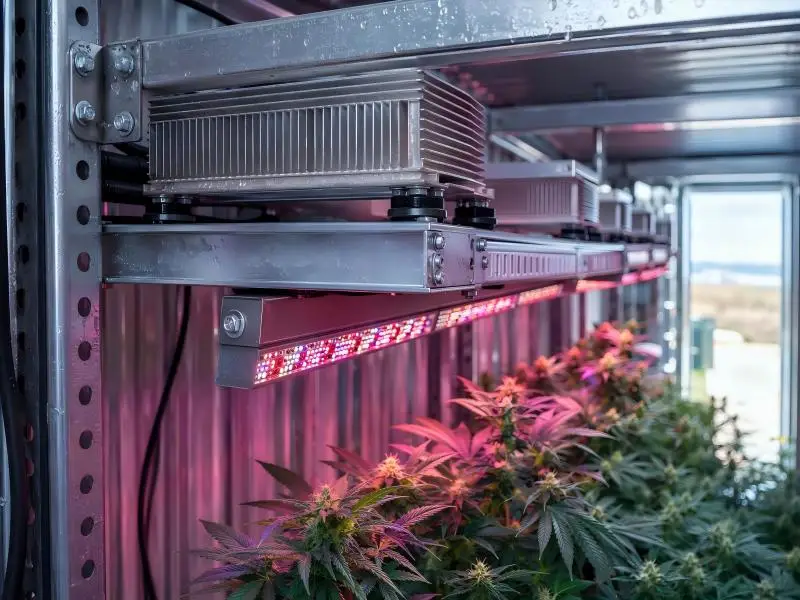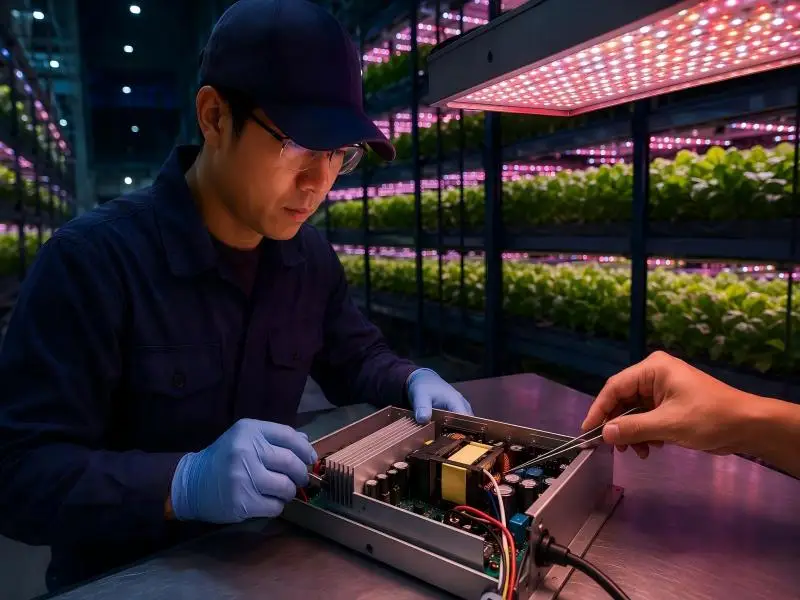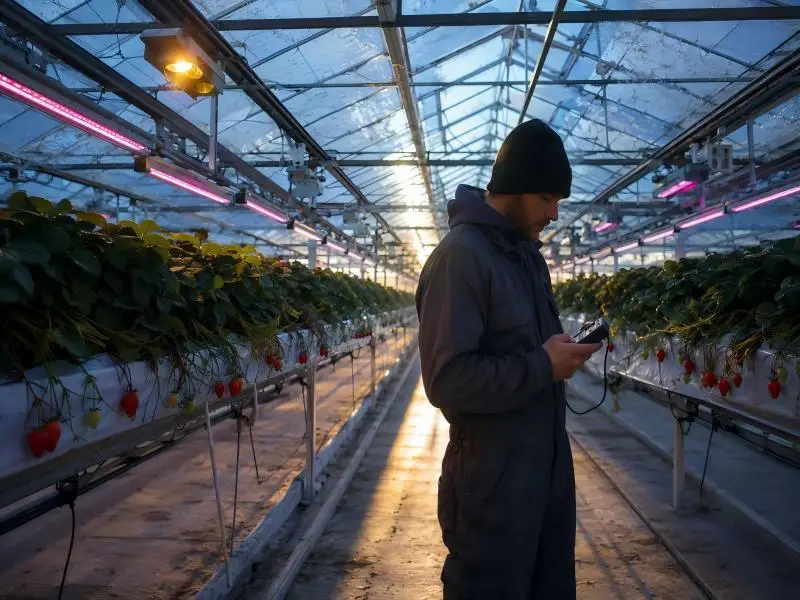
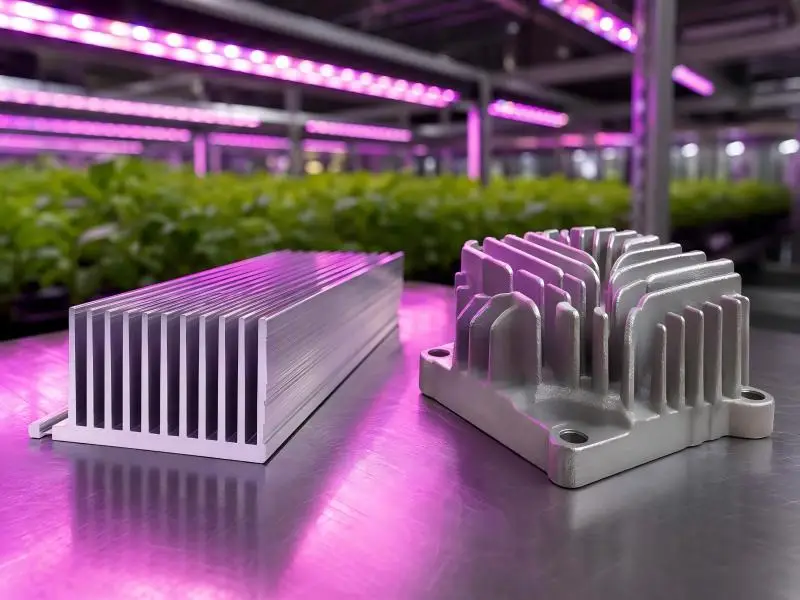
This comparison covers extruded aluminum vs die-cast aluminum grow light heat sink options across five criteria: how each moves heat from the LED junction, how fin geometry and airflow behave in a canopy, what tooling and volume economics look like, how each survives a humid room and the standards that apply, and what the total cost of ownership works out to over a fixture’s life.
The stakes are measurable rather than theoretical. Thermal resistance is the path by which a heat load raises junction temperature above ambient, so a design that lowers that resistance preserves both output and lifespan (Nature, Horticulture Research, 2020).
The peer-reviewed horticulture review that documents about a 10% efficacy drop between the 25 °C and 85 °C reporting points also notes that LM-80 projections cannot exceed six times the tested duration, which is why a fixture’s real junction temperature still has to be derated in practice. One supplier comparison puts L70 at over 60,000 hours at 25 °C and under 25,000 hours at 85 °C, an illustrative spread rather than a lab result (Unibox).
Both processes can reach a workable design. They differ in where they spend money and where they impose constraints, and the sections below work through each criterion in turn.
SLTMAKS is a global provider of professional-grade LED grow lights, and its lighting designs rely on advanced cooling technology with robust aluminum heat sinks. Because thermal management is central to how the company builds its fixtures, this comparison of extruded and die-cast aluminum heat sinks draws on the same area of work.
Introduction
Heat sink design decides how much of an LED’s rated efficacy a grow light actually delivers. As noted above, the peer-reviewed horticulture review documents about a 10% efficacy drop between the 25 °C and 85 °C reporting points and notes that LM-80 projections cannot exceed six times the tested duration (Nature, Horticulture Research 7:114, 2020).
Thermal resistance is the path by which a heat load raises junction temperature above ambient, so the fixture’s real Tj must be derated even when LM-80 or TM-21 data exists. One supplier comparison puts L70 at over 60,000 hours at 25 °C and under 25,000 hours at 85 °C, an illustrative figure rather than a lab result (Unibox).
This comparison covers extruded aluminum vs die-cast aluminum heat sinks for grow lights across five criteria: thermal performance, geometry and airflow, manufacturability and cost, reliability and compliance, and total cost of ownership. Each one carries a direct line to canopy temperature, HVAC load, and certification.
Table of Contents
Thermal Fundamentals
Conductivity and Heat Spread
The choice between extruded and die-cast aluminum starts with one number: how fast heat moves away from the LED package. Extruded 6063-T5, the workhorse alloy for linear grow light bars, is listed at roughly 209 W/m·K by Gabrian International’s 6063 aluminum properties reference, and an independent materials database puts 6063-T5 at about 210 W/m·K (MakeItFrom). That figure is the benchmark for aluminum heat sink thermal conductivity 6063 and A380 comparisons, and the gap is structural rather than cosmetic.
Die casting changes the material, not just the shape. Because air conducts heat far worse than aluminum, even a modest pore fraction lowers effective conductivity, and the die-cast skin forms a denser outer layer over a more porous core, so the part behaves as a two-zone material with non-uniform heat flow. A cast heat sink’s effective k can therefore fall well below the nominal conductivity of its alloy, which is why nominal A380 datasheet values overstate real spread performance in a finished part.
Junction Temp and Efficacy
Conductivity only matters because of what it does to junction temperature. Higher Tj shifts peak wavelength and color temperature, moving output away from the intended photosynthetic spectrum, and LM-80/TM-21 ratings are controlled-condition lumen-maintenance data that do not remove the need to derate for actual in-fixture operating temperature (PatSnap horticulture LED challenge review).
Pro Tip: Derate against the junction temperature your fixture actually reaches at full load in its installed orientation, not against the LM-80 case temperature. A heat sink that holds Tj stable at rated drive current protects spectrum and efficacy together.
Material Choices and Grades
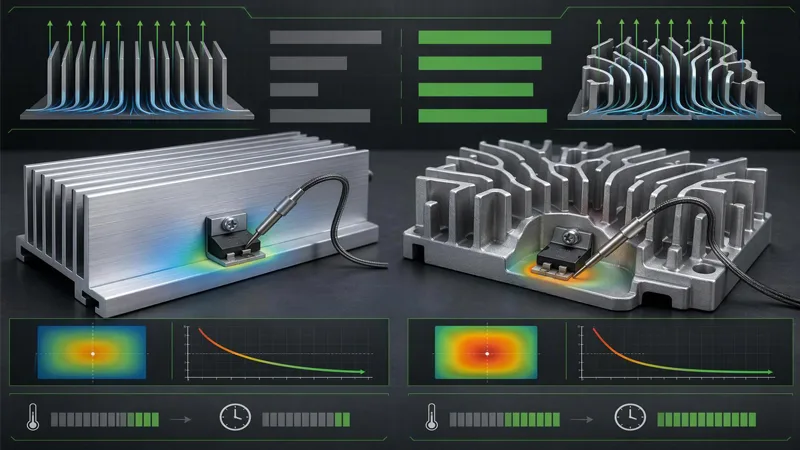
Extrusion favors 6063 in T5, T6, or T832 tempers, all clustered near 200 to 210 W/m·K. Die casting favors A380, A360, or A413 for castability and thin-wall fidelity, accepting lower effective conductivity in exchange for geometry that extrusion cannot produce. Neither is universally better; the grade follows the geometry the design requires.
Geometry and Airflow
Geometry decides how much of the heat a grow light’s LEDs generate actually reaches the air. Fin spacing, fin height, and the convection mode you design for set the ceiling on thermal performance long before alloy choice matters.
Fin Limits and Aspect Ratio
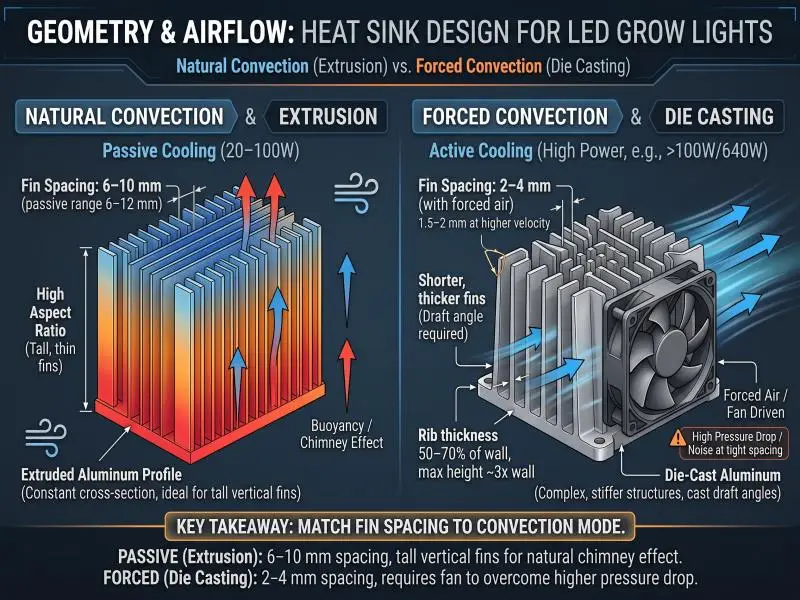
Extrusion and die casting face different geometric ceilings. Published heat-sink design guidance puts natural-convection fin spacing at 6–10 mm, with a broader passive range of 6–12 mm, and forced-convection spacing at 2–4 mm, tightening to 1.5–2 mm at higher air velocity (Lumileds, Practical Heat Sink Design for Illumination).
Extruded profiles handle tall, thin fins and high aspect ratios because the die pushes metal through a constant cross-section. Die casting resists that shape: published DFM tables cap rib height at about three times the nominal wall and set rib spacing at no less than twice the wall, with rib thickness at 50–70% of wall (Alumcasting die-casting DFM guidelines). Cast fins are therefore shorter and thicker, and they trade surface area for stiffness.
Natural vs Forced Convection
Passive cooling LED grow light heat sink design works only inside a narrow power band. The same design guidance notes that passive cooling typically carries LEDs in the 20–100 W range, and only with sufficient surface area plus vertical airflow through the fins. A 640 W bar running passive in a 30 °C room sits far outside that band; it needs forced air or a much larger sink. Extrusion suits passive designs because it produces the tall, closely spaced vertical fins that drive a chimney effect. Die casting suits forced-convection designs, where 2–4 mm spacing and a fan do the work.
Pressure Drop and Spacing
Tighter fins raise surface area and pressure drop together. At 1.5–2 mm spacing, a fan must overcome more resistance to move the same air volume, which raises noise and fan power. Wider spacing at 6–10 mm lowers pressure drop and lets buoyancy alone move air, which is why passive sinks favor it. Die casting’s wall-thickness floor compounds this: published DFM tables put aluminum walls at 1.2–4.0 mm depending on projected area, so a cast sink cannot reach the thin, dense fin field an extrusion can (Alumcasting).
Key Takeaway: Match fin spacing to convection mode. Passive designs need 6–10 mm spacing and vertical fins; forced designs can use 2–4 mm. Extrusion reaches passive geometry more easily; die casting fits forced designs and thicker, stiffer structures.
Manufacturability and Cost
Extrusion and die casting sit at opposite ends of the tooling-cost curve, and the crossover point is the single most useful number in this comparison. Extrusion wins on upfront capital and speed to first article; die casting wins on per-part cost once volume is high enough to amortize a much more expensive tool.
Tooling and Lead Times
Extrusion dies typically run from about $1,250 for a solid profile to roughly $5,000 for a complex multi-hollow die, with a typical build lead time of 3 to 5 weeks and samples arriving about 2 weeks after die completion (Profile Precision Extrusions, 2025). A die-cast tool costs multiples of that, and the part design itself adds constraints: die-casting draft angles run 1.5 to 3° on external walls and 2 to 5° on internal walls, narrowing as wall depth increases (Alumcasting DFM guide, 2026). Those angles have to be designed in before the tool is cut.
Volume Break-even Points
Sourcing analyses place the die-casting break-even anywhere from about 500 to 1,500 units to more than 5,000, depending on part complexity and tooling assumptions (DFMA extrusion cost resource, 2026). Below roughly 1,000 parts, extrusion is usually cheaper overall; between 1,000 and 5,000 parts is the gray zone where either route can win. The grow light heat sink tooling cost and volume break-even calculation should also include secondary machining: critical features typically add about $2 to $15 per part, and extrusion plus secondary CNC, drilling, bending, or complex cutting adds 15 to 40% to per-unit cost (Sunon Mould, 2026).
⚠️ Warning: Die-casting economics only pay off above the break-even volume. Below it, the tooling premium never amortizes, and secondary machining is the line item most often underestimated in early cost models.
Part Consolidation Options
The strongest argument for casting is not unit cost but part count. A cast housing can form bosses, mounting ears, driver pockets, and sealing lands near-net-shape, while an extruded housing usually needs CNC finishing for tight-tolerance features (Sunon Mould, 2026). Formed bosses still typically need drilling, reaming, or tapping for precision, so casting reduces operations rather than eliminating them.
Reliability, Sealing, and Compliance
Reliability in a grow room is a sealing problem before it is a thermal one. High humidity, condensate, and frequent washdown turn any internal void into a potential leak path, and that risk differs sharply between the two processes.
Porosity, Coatings, Corrosion
Die casting’s structural weakness is internal porosity. The NADCA-derived porosity classification that casting engineers use separates continuous porosity, which produces leak paths ranging from slow single-point leaks to outright failure, from blind porosity, which weeps machining fluid at the surface (Kinetic Die Casting, 2013). The mechanism matters: gas porosity is smooth and regular, shrink porosity irregular and rough, and porosity that survives or is opened by machining becomes a leak path (Kinetic Die Casting, 2013). Extruded profiles have no equivalent cast-void risk along their length, though cut ends and joints still need sealing.
On corrosion and materials compliance, the die-casting industry’s own RoHS guidance is worth reading before you assume a restriction: lead is not a purposeful alloying element in common aluminum die casting alloys, and the 0.1% homogeneous-material limit carries an alloying-element exemption for aluminum up to 0.4% (NADCA Design, undated). Copper-alloy hardware deserves a separate check.
IP65–IP67 Sealing Tactics
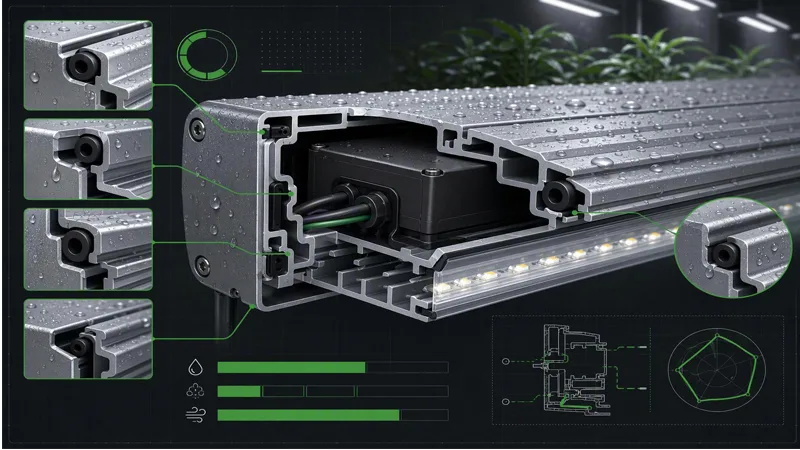
The dust-tight digit that IP65, IP66 and IP67 all share is the first 6; the water digit is the differentiator between IP65, IP66 and IP67, covering jets, powerful jets, and temporary immersion respectively (SLTMAKS, 2026). For IP65 IP67 grow light enclosure sealing, the practical rules are continuous compression gaskets at every opening, with low-compression-set silicone because stress relaxation opens leak paths under thermal cycling, plus smooth flat sealing lands, endcaps that clamp the gasket around the whole perimeter, correct fastener torque, and IP-rated cable glands (SLTMAKS, 2026). Numeric IEC 60529 test parameters are commonly repeated, but the standard is paywalled; this research did not obtain them from a primary source.
UL 8800 and DLC Linkage
UL 8800 is the safety standard that DLC horticultural listing is built on. It covers luminaires plus drivers, connectors, and integrated structures, and addresses photobiological exposure, wiring methods, damp/wet and hot grow environments, ingress protection, and UV effects on materials (UL Solutions, 2024). It is a safety standard, not a performance standard, and UL states certification is a requirement to be added to or remain on the DLC horticultural QPL. For an authority having jurisdiction (AHJ) inspection, an NRTL listing such as ETL plus a QPL entry is what closes the loop.
Selection Framework
Choosing between extruded aluminum vs die-cast aluminum heat sinks for grow lights comes down to three variables: production volume, convection mode, and enclosure requirements. Each one narrows the field before you compare anything else.
When to Choose Extrusion
Extrusion suits low-to-mid volume builds, linear bar formats, and passively cooled fixtures. Because the die is a simple profile cut to length, tooling is cheap and lead times are short, and you can change fixture length without new tooling. The trade-off is geometry: a constant cross-section limits fin height and aspect ratio, so passive cooling typically carries LEDs in the 20–100 W range only with sufficient area and vertical airflow. Above that, extrusion alone runs out of surface.
When to Choose Die Casting
Die casting suits higher volumes and complex, non-linear housings where fins, mounting bosses, and driver pockets must coexist in one part. A cast housing can form bosses, mounting ears, driver pockets, and sealing lands near-net-shape, which cuts assembly steps and part count. The costs are front-loaded: tooling is expensive and lead times are long, and the 1,000–5,000-part gray zone is where neither process clearly wins on unit economics. Secondary machining for critical features typically adds about $2–$15 per part.
Hybrid Design Playbook
The strongest answer is often neither process alone. A common pattern pairs an extruded thermal spine, which carries the fins and the primary heat path, with cast endcaps and a cast driver housing that provide the mounting interfaces and sealed compartments. This keeps the expensive casting small and the cheap extrusion long. For example, SLTMAKS builds grow light heat sinks this way, and the approach supports passive and forced-convection designs while keeping tooling spend concentrated where geometry actually demands it.
TCO and Deployment tips
Energy, HVAC, and Lifetime
Lifetime is where the heat sink decision lands on the operating budget. Typical L70 for horticultural LEDs is about 50,000 hours, and LM-80 projections cannot exceed six times the tested duration (Nature, retrieved 2026-06-04). One supplier comparison puts L70 at over 60,000 hours at 25 °C and under 25,000 hours at 85 °C, so a fixture running its junctions hot can retire roughly half its rated life (Unibox, retrieved 2026-06-04).
That gap changes the replacement schedule, not just the spec sheet. The fixture’s real junction temperature must be derated even when LM-80/TM-21 data exists, because the reported figure describes the test condition, not your rack (Design Lights Consortium, retrieved 2026-06-04). Higher junction temperature also shifts peak wavelength and color temperature, so a hot-running fixture drifts away from the spectrum you specified (LEDs Magazine, retrieved 2026-06-04).
For HVAC, the heat a fixture fails to conduct away stays in the room. Better thermal paths move watts into the air handler instead of into the diode, so model cooling load against actual dissipation rather than nameplate wattage.
Layout, Controls, and Mounting
Rack geometry constrains the heat sink before the thermal calculation does. Extruded profiles run in one direction, so fin channels must align with the airflow your rack actually produces; a passive bar mounted across a convection path loses most of its rated area. Forced-convection designs need clearance on both sides of the fin stack, and dense multi-tier racks usually need airflow direction fixed at design time rather than adjusted on site.
Controls compatibility is the second constraint. Dimming, driver placement, and sensor integration all sit on or near the heat sink, and cast housings give more freedom to mold mounting bosses, driver cavities, and sensor ports into the part than an extrusion can. Where a rack uses a shared driver architecture, confirm the thermal path covers the driver housing too, not only the LED bar.
Procurement and Scale Ops
Tooling economics decide which process you can actually buy at volume. Extrusion dies are cheaper and faster to cut, but any feature the profile cannot form, such as tapped holes, flat sealing faces, or machined mounting pads, becomes a secondary operation: secondary machining for critical features typically adds about $2–$15 per part (Xometry, retrieved 2026-06-04). At low volumes, that adder is tolerable; at high volumes it can erase the extrusion’s tooling advantage.
For multi-site rollouts, standardize on one heat sink family per fixture class so spare parts, mounting hardware, and driver interfaces stay interchangeable across facilities. Ask suppliers for die or tool ownership terms up front, since a tool held by the vendor limits your ability to requalify a second source later.
Conclusion
Neither process wins outright. Extrusion leads on thermal conductivity, passive performance, and low-volume economics; die casting leads on geometric freedom, part consolidation, and unit cost at high volume. The decision rule is straightforward: choose extrusion when your design is a linear bar or spine, your volumes are modest, and you need the highest conductivity per dollar. Choose die casting when your heat sink must wrap a driver, integrate mounting bosses, or ship in volumes that amortize tooling.
Applying the framework to your facility means working the criteria in order. Start with the thermal load and ambient you must hold, then check whether a constant cross-section can carry that load passively. If it can, extrusion is usually the faster and cheaper path. If it cannot, and you need fins, housing, and mounting in one part, die casting earns its tooling cost back at scale.
For buyers weighing extruded aluminum vs die-cast aluminum heat sinks for grow lights, the honest answer is that the right choice follows your geometry and volume, not a blanket preference. Request a spec pack or talk to a technical expert before you commit tooling spend.
FAQ
Is extruded aluminum better than die-cast aluminum for a grow light heat sink?
Not universally, but extrusion wins whenever cooling is the only job. Extruded 6063-T5 conducts heat at roughly 209 W/m·K, while a common die-cast alloy like A380 lands near 96 W/m·K — a gap that widens further in a finished part once cast porosity is factored in (Gabrian International’s 6063 aluminum properties reference; Kinetic Die Casting on heat sink comparisons). Die casting pulls ahead in a different scenario: when the heat sink must double as a housing with bosses, driver pockets, and sealing lands molded near-net-shape. So the answer follows the part, not the material — straight fins that only dissipate favor extrusion, complex integrated housings favor casting.
How much does a custom aluminum extrusion heat sink die cost?
Budget roughly $1,250 for a simple solid profile and up to about $5,000 for a complex multi-hollow die, with die-cast tooling costing multiples of that (Profile Precision Extrusions, 2025). Across the industry, simple extrusion dies often quote between $800 and $2,500, while large or intricate dies can run from $5,000 well past $15,000 (Aluminum heat sink extrusion buyer’s guide, 2026). Remember to price the die alongside per-part secondary machining, since critical features typically add $2 to $15 per unit.
What IP rating do LED grow lights need in a humid grow room?
IP65 is the practical minimum for humid grow spaces, IP66 suits rooms with frequent washdown or strong spray, and IP67 is only necessary if a fixture could sit briefly in standing water. All three share the first digit 6, meaning dust-tight; the second digit is the differentiator — 5 covers low-pressure jets, 6 covers powerful jets, and 7 covers temporary immersion (SLTMAKS on IP ratings for commercial grow lights, 2026). Keep in mind that humidity alone isn’t submersion, so a light rated for jets isn’t automatically safe under a pressure washer.