
The UL8800 horticultural lighting standard is the safety benchmark for luminaires and lighting systems used to grow plants indoors. ANSI/CAN/UL 8800 was published in September 2023 and most recently revised in March 2025 (UL Standards & Engagement). Think of it as the rulebook that sits between your grow lights and the electrical code your inspector enforces.
Its scope covers lighting equipment intended for use in a horticultural environment and installed in accordance with the NEC and CEC (UL Standards & Engagement, Scope 1.1). That single sentence answers the question procurement teams ask most often: the standard does not replace the National Electrical Code or the Canadian Electrical Code, and it does not replace your authority having jurisdiction (AHJ), the local official who interprets and enforces those codes.
Instead, UL 8800 gives an NRTL (a nationally recognized testing laboratory such as UL or Intertek) a defined set of requirements to test against, so the AHJ has documented evidence that a horticultural luminaire is safe for its intended environment. This guide walks through what the standard covers, how it differs from UL 1598, what the DLC Horticultural QPL requires, and how to build a compliance and inspection workflow that holds up at submittal, commissioning, and beyond.
Introduction
The UL 8800 horticultural lighting standard is the safety benchmark for luminaires used in commercial cultivation, and it was first published in September 2023 as ANSI/CAN/UL 8800 Ed. 1, then most recently revised in March 2025 (UL Standards & Engagement, retrieved 2026-06-11). Think of it as the horticultural counterpart to the general luminaire standard: same safety logic, different growing conditions. Its scope covers lighting equipment intended for use in a horticultural environment and installed in accordance with the NEC and CEC (UL Standards, Scope 1.1).
That placement matters because the Authority Having Jurisdiction (AHJ), the official who enforces your local electrical code, and the Nationally Recognized Testing Laboratory (NRTL) that lists the product are looking at two different things. The AHJ verifies code compliance and the listing mark on site; the NRTL verifies the product against the standard. Understanding where UL 8800 sits relative to the National Electrical Code (NEC) and Canadian Electrical Code (CEC) is what keeps an inspection from stalling.
This guide walks through scope and applicability, the core electrical, environmental, and mechanical requirements, photobiological safety under IEC 62471, how UL 8800 differs from UL 1598, the safety prerequisites in the DLC Horticultural QPL, and the procurement, commissioning, and recordkeeping checklists that hold up under review.
Table of Contents
UL8800 Horticultural Lighting Standard Scope and Applicability
UL 8800 is the ANSI-approved safety standard for horticultural lighting, and its scope is written narrowly enough that the first question a specifier should ask is also the most basic one: does the fixture in front of me actually fall under it? Getting that answer wrong in either direction costs money, either in unnecessary testing or in a rejected submittal. The standard’s own scope language settles most of it.
Products and systems covered
Scope 1.2 defines the covered equipment as “horticultural luminaires, hardware and horticultural systems intended for use in a plant growth environment” (UL Standards product page, Scope 1.2, retrieved 2025-03-18). Three categories sit inside that sentence, and they carry different obligations. A bare luminaire is evaluated as a luminaire. Hardware, which includes mounting and interconnection components sold separately, is evaluated as part of the assembly it supports.
A horticultural system, meaning a coordinated set of luminaires, drivers, and controls, is evaluated as a system rather than as a stack of independent parts.
What this means for your facility: if you buy fixtures and controls from different vendors and assemble them on site, the system-level evaluation may not exist for your configuration, and the AHJ can ask you to demonstrate it. Confirm with each vendor which category their listing covers before you specify.
Environments and use conditions
Scope 1.3 draws the exclusion line: “Lighting equipment that provides broadband white light such as light for general illumination, or whose primary purpose when applied to plantings is aesthetic and/or sustaining plant life is not considered horticultural lighting” (UL Standards product page, Scope 1.3, retrieved 2025-03-18). That single sentence separates a grow light from a decorative plant lamp and from ordinary white-light fixtures installed in a greenhouse for worker visibility. Intent of application, not spectrum alone, drives the classification.
The practical consequence is that the same physical fixture can be in scope in one installation and out of scope in another, depending on what it is doing. Document the intended function in the submittal, because that is what the reviewer will read.
Listing categories and markings
Edition status matters when you cite the standard in a specification. Edition 1 remains the active edition, while Editions 2 and 1 are archived (UL Standards & Engagement product page, 2023-09-14). The standard is published in both English and French, with the French-language counterpart carrying the same publication and revision dates (UL Standards product page, Équipement et systèmes d’éclairage d’horticulture, retrieved 2025-03-18), which matters for Canadian submittals where the French text may be the governing reference.
Markings are where scope becomes checkable. A listed horticultural luminaire carries the NRTL mark, the standard reference, and the environmental and risk-group ratings discussed below. If a fixture carries only a general-illumination listing, treat the horticultural claim as unverified until the manufacturer produces the certificate.
Core requirements and tests
UL 8800 does not invent a new safety philosophy for grow lights. It assembles the requirements that already govern luminaires, power supplies, and polymeric materials, then applies them to the conditions a cultivation space creates.
The standards UL 8800 cross-references include UL 1598 for luminaires, UL 496 for lampholders, UL 498 for attachment plugs and receptacles, UL 817 for cord sets and power-supply cords, UL 1310 for Class 2 power units, UL 507 for electric fans, UL 1951 for electric plumbing accessories, UL 746B, 746C and 746E for polymeric materials, UL 73 for motor-operated appliances, UL 962, and UL 1977 (UL Standards product page, revision record dated 2025-03-18). That list is the practical answer to “what is actually tested”: the luminaire, its wiring method, its supply, and the plastics holding it together are each evaluated against the standard that already covers them.
Electrical and fire safety
The electrical evaluation asks whether a fault inside the fixture stays inside it. Input wiring, connectors, and any remote supply are checked against the cord-set, plug, receptacle, and Class 2 requirements above, which is why a low-voltage remote driver arrangement is assessed as a system rather than as a bare fixture. Fire safety follows the luminaire requirements in UL 1598, including temperature limits on surfaces and components. For a facility, the consequence is direct: a listing that covers the supply method you actually intend to install removes an inspection argument later.
Environmental suitability (damp/wet, IP, materials)
Ingress protection (IP) is a two-digit rating for dust and water entry; the first digit covers solids, the second covers liquids. UL 8800 addresses damp locations and adds material requirements drawn from the UL 746B, 746C, and 746E polymer standards, because irrigation, humidity, and nutrient solutions degrade plastics that would be fine in a dry ceiling plenum. The March 2025 revision topics include changes to 5.5, Section 15A, and 19.4.4 (UL Standards product page, 2025-03-18). What this means for your facility: match the marked IP rating and location rating to the wettest condition the fixture will realistically see, not the average.
Mechanical integrity and installation
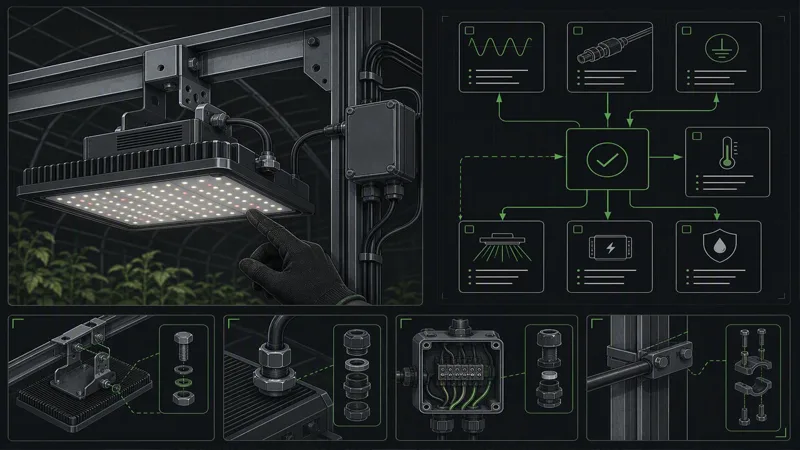
Mechanical requirements cover mounting, strain relief, and the enclosure’s ability to hold together under vibration, movement, and the weight of the fixture itself. Fans and motor-operated components inside actively cooled fixtures are evaluated under UL 507 and UL 73 respectively, which matters because a failed fan is both a thermal event and a mechanical one. The practical takeaway is that installation instructions are part of the listing, not a suggestion: mounting method, clearance, and support are conditions the listing depends on.
Photobiological safety (IEC 62471 alignment)
Photobiological safety asks a narrower question than most growers expect: how much light can a person’s eyes and skin tolerate from this fixture? UL 8800 answers it by aligning with IEC 62471, the international framework for evaluating broadband optical radiation from lamps and lamp systems. The standard sorts a luminaire into a risk group based on measured irradiance at defined distances, then requires markings and instructions that match that classification.
Risk groups and labeling outcomes
IEC 62471 places products into exempt, Risk Group 1, Risk Group 2, or Risk Group 3 categories, from no measurable hazard up to hazards that persist even at brief exposure. Horticultural luminaires rarely land in the exempt band, because the whole point of the product is to deliver high photon flux. What matters for procurement is the labeling consequence: the higher the risk group, the more explicit the required cautionary markings on the product and the more detailed the installation and operating instructions.
Risk Group 3 is not permitted for listing. A luminaire that cannot be classified at or below Risk Group 2 does not receive the certification, so a compliant label on a horticultural fixture already tells you the product cleared that ceiling. What the label does not tell you is how several of those fixtures behave together in one room.
Worker exposure controls and instructions
The standard’s single-luminaire photobiological assessment is the key limitation to understand before you write a safety procedure. UL 8800 evaluates the light output characteristic of one horticultural luminaire and requires the matching cautionary or warning markings on the product and in the installation and operating instructions, as set out in the standard’s scope (UL Standards product page, Scope 1.4, retrieved 2026-06-11). The same scope language notes that increased exposure risk to facility personnel may be present depending on how many luminaires are installed and where they are positioned.
That is why the standard places residual exposure responsibility on the plant growth facility itself (UL Standards product page, Scope 1.5, retrieved 2026-06-11). In practice, worker protection is a facility design and procedure question: fixture density, mounting height, task locations, and how long staff spend directly under the canopy. Personal protective equipment, meaning the eyewear and skin coverage specified for the installation, belongs in your written procedure, not in the luminaire’s certification.
⚠️ Warning: Risk Group 3 is not permitted for listing. Cumulative multi-fixture exposure remains the facility’s responsibility.
Documentation expectations for AHJs
An authority having jurisdiction reviewing a submittal will typically look for the risk group classification, the cautionary markings as they appear on the product, and the installation and operating instructions that carry the same warnings. Keep the manufacturer’s photobiological test documentation with the submittal package rather than filing it separately, and make sure the instructions you hand to the installing contractor are the revision that matches the listed product. If your facility adds fixtures after commissioning, the single-luminaire assessment behind the original label no longer describes the room, and your exposure controls should be revisited on that basis.
UL 8800 vs UL 1598 and DLC signals
UL 8800 is not a replacement for the general luminaire standard UL 8800 builds on. It layers horticulture-specific requirements on top of it, and DLC’s safety-certification prerequisite then asks for a mark issued against the horticultural standard specifically. Treating the two as competing options is the most common procurement error in this category.
Scope differences and practical implications
The relationship is additive, not either/or. UL 1598 covers general luminaires: construction, wiring, and electrical safety for lighting equipment in ordinary installations. UL 8800 keeps that foundation and adds what a grow environment demands, including photobiological safety assessment and suitability for the damp, wet, and high-ambient conditions found in cultivation spaces.
That distinction has a practical consequence. A fixture carrying only a general luminaire listing has not been evaluated against the horticultural additions, so its photobiological output and environmental ratings may be undocumented for your application. When an AHJ or a utility program asks for horticultural safety evidence, a general listing does not answer the question.
DLC Horticultural QPL safety prerequisites
DLC’s safety-certification prerequisite is explicit: a product must be certified by an OSHA NRTL or SCC-recognized body to ANSI/UL 8800 (ANSI/CAN/UL 8800) before it can appear on the Horticultural Qualified Products List (DesignLights Consortium safety certification requirements). Performance data alone does not qualify a fixture.
The recognized-body requirement is broader than many specifiers assume. OSHA’s list of recognized testing laboratories currently names 21 organizations holding NRTL recognition, including UL LLC, Intertek, CSA Group, TÜV SÜD America, TUV Rheinland of North America, DEKRA, Eurofins, SGS, and Nemko (OSHA, Current List of NRTLs). A mark from any of them satisfies the recognition condition, provided the certification is issued to the horticultural standard.
One documentation rule catches retrofit and legacy projects. Under the March 2018 ETL documentation cutoff, multiple listings processed before 26 March 2018 are not required to supply the supporting documentation, while those processed on or after that date are (DesignLights Consortium safety certification requirements). Older listings can therefore pass a QPL check while carrying a thinner paper trail than a recent one.
Pro Tip: Track Standards Update Notices (SUNs) and their effective dates rather than the listing date on the label. A certificate issued to an earlier edition can remain valid while the edition it cites is superseded.
Staying current on revisions and listings
UL 8800 is actively maintained, and the published revision history shows how often the text moves. The record lists revisions dated 2025-03-18, 2023-09-14, 2023-03-13, 2022-02-14, and 2021-11-12, each with a redline (UL Standards & Engagement product page). Five dated revisions across roughly four years means a certificate’s edition reference deserves a second look at every project submittal, not just at first purchase.
The verification habit that follows is simple: confirm the standard edition on the certificate, confirm the certifying body holds current NRTL or SCC recognition, and confirm the product still appears on the DLC Horticultural QPL. Those three checks take minutes and prevent the most expensive late-stage surprise, a fixture that is installed, inspected, and rejected on documentation.
Compliance and inspection workflow
Compliance is not a single event. It is a chain of documents and physical checks that starts before you issue a purchase order and continues for as long as the luminaires stay in service. The three checklists below organize that chain by stage, so each role knows what to hold and what to verify.
Procurement and submittals checklist
Before a purchase order goes out, confirm the paperwork exists and matches the exact model you are buying.
- Certification to ANSI/CAN/UL 8800 from an OSHA-recognized NRTL in the U.S. or an SCC-recognized body in Canada. OSHA maintains a public list of 21 NRTLs, so “UL listed” is one of several acceptable certification marks; ETL/Intertek, CSA, and TÜV SÜD all appear on it. The DLC safety certification requirements describe this route in full.
- The certificate or listing report naming the specific model and catalog number, not just the product family.
- The installation instructions and any photobiological safety labeling that ships with the unit.
- The IP rating and ambient temperature rating, written into the specification so the submittal can be checked against it.
Installation and commissioning checklist
Once fixtures arrive, the installation record becomes your first line of defense in an inspection.
- Verify the nameplate on each unit matches the submitted model and carries the certification mark.
- Confirm wiring methods, connector types, and any remote power supply placement follow the manufacturer’s instructions and the local electrical code.
- Check that risk group labeling and any required exposure warnings are present and legible after mounting.
- Record commissioning measurements, including mounting heights and any controls settings, so the as-built condition is documented.
Maintenance and recordkeeping checklist
Standards compliance fades if the records do not survive staff turnover.
- Keep certificates, submittals, and the commissioning record together in one accessible file.
- Log every lamp, driver, or power supply replacement, noting whether the replacement part preserves the original listing.
- Re-check labeling and instructions after any modification, since field changes can affect how an AHJ reads the installation.
- Review the file against the current standard edition before each major inspection cycle.
Key Takeaway: Procurement confirms the certification and paperwork match the exact model; installation confirms the physical unit matches the submittal; maintenance keeps that evidence current. An inspector can ask for any of the three, so treat them as one continuous record rather than three separate tasks.
Note on brand integration
Some manufacturers now design and test their horticultural fixtures against UL 8800 from the outset, which simplifies the submittal stage because the certification documentation is prepared alongside the product. SLTMAKS is one example of a supplier that supports this approach, aligning its design and testing work with the standard so buyers can verify compliance through the same certificate-and-labeling route described above. The verification steps themselves do not change: whatever the supplier, confirm the mark, the model number, and the documentation before the fixtures go up.
Conclusion
UL 8800 horticultural lighting standard compliance is a documentation exercise as much as an engineering one. The standard’s scope, electrical and environmental tests, and IEC 62471-aligned photobiological risk classification all resolve into a single question at handover: can you show an inspector, in writing, that each luminaire in the space is listed to the correct standard for its mounting location and use condition?
De-risk the project by treating that question as a procurement gate rather than a commissioning problem. Confirm the listing category and marking on the label, match the IP and ambient ratings to the actual grow-room conditions, and keep the risk-group label and installation instructions on file with the submittal package. Where a fixture sits outside UL 8800’s scope, say so explicitly instead of assuming the listing covers it.
Your immediate next step is to verify certificates, markings, and documentation for your specific models against the edition of the standard your authority having jurisdiction enforces, before the fixtures ship.
FAQ
Is UL 8800 the same as UL 1598?
Is UL 8800 the same as UL 1598?
No. UL 8800 builds on UL 1598 rather than replacing it. UL 1598 covers construction, wiring, and electrical safety for general luminaires, while UL 8800 keeps that foundation and adds what a grow environment demands, including photobiological safety assessment and suitability for damp, wet, and high-ambient conditions. A fixture carrying only a general luminaire listing hasn’t been evaluated against the horticultural additions, so its photobiological output and environmental ratings may be undocumented for cultivation use.
What risk group do horticultural luminaires fall under?
What risk group do horticultural luminaires fall under?
UL 8800 aligns with IEC 62471, which sorts a luminaire into exempt, Risk Group 1, Risk Group 2, or Risk Group 3 based on measured irradiance. Horticultural luminaires rarely land in the exempt band because delivering high photon flux is the point of the product. Risk Group 3 is not permitted for listing, so a certified horticultural fixture has already cleared that ceiling. Keep in mind that UL 8800 assesses a single luminaire, which means worker exposure from multiple fixtures in one room remains the facility’s responsibility.
Do I need UL 8800 certification to get on the DLC Horticultural QPL?
Do I need UL 8800 certification to get on the DLC Horticultural QPL?
Yes. DLC’s safety-certification prerequisite requires a product to be certified by an OSHA NRTL or SCC-recognized body to ANSI/CAN/UL 8800 before it can appear on the Horticultural Qualified Products List. Performance data alone does not qualify a fixture. OSHA’s public list names 21 recognized testing laboratories, so UL LLC, Intertek, CSA Group, and TÜV SÜD all satisfy the recognition condition, provided the certification is issued to the horticultural standard.