Introduction
If you are a commercial cultivator seriously considering launching your own lighting line, private label grow lights are almost certainly your fastest route from concept to installed fixtures under your own name. Compared with reselling someone else’s brand — which gives the manufacturer the repeat business — private label lets every unit you sell build equity in your brand while you stay out of the R&D and tooling burden of a fully custom design.
That speed matters in a category where the design and testing cycle is long, and the certification stack is non-negotiable. In the U.S. market, hydroponic buyers increasingly screen on two signals before they commit: does the fixture clear a recognized performance threshold, and can the brand show safety and regulatory compliance without friction? That means the DesignLights Consortium (DLC) performance listing for horticultural lighting and an OSHA-recognized safety mark such as UL or ETL are no longer nice-to-haves — they are the price of entry for DLC-certified grow lights that utilities and inspectors will accept.
This guide walks you through the decisions that separate a private-label line that looks professional from one that stalls in procurement. You will get a framework for modeling return on investment (ROI), a clear picture of the compliance work in front of you, and a practical set of supply-chain guardrails to de-risk certification, repeatability, and cost.
Table of Contents
The Business Case
Speed-to-market Advantages
Private label is built on a proven, already-manufacturable product base. Instead of engineering a fixture from scratch, you select from an existing design, put your brand on it, and in many cases go from order to shelf-ready units in as little as a few weeks. That dramatically shortens your time-to-market compared with a fully custom build, which can take many months once tooling, prototyping, and testing are included. For a new or expanding brand, compressing that window means you reach customers and capture the sales cycle before slower competitors do.
Brand Control Without Full OEM Burden
Putting your own name, packaging, spec sheet, and support materials on the light means the equity accumulates with you. Every installed unit, every invoice, and every support interaction reinforces your brand rather than the manufacturer’s. You also keep control over pricing and margin, which matters because private label typically yields better unit economics than reselling someone else’s branded product. The tradeoff is less product differentiation than a full original equipment manufacturer (OEM) build: your distinctiveness lives in branding, spectrum selection within a menu, and the service experience around the fixture, not in a one-of-a-kind optical design.
Where Private Label Fits in Your Portfolio
Private label is not the answer to every portfolio need. It is the ideal entry point for testing a market, launching a catalogue quickly, or serving a crop- or region-specific segment with a proven platform. When you need genuinely proprietary performance — a signature spectrum, a novel housing, or deeply integrated controls — that is where a full OEM project earns its higher cost and longer lead time. Most well-architected lines start narrow with private label, validate demand, and later graduate specific SKUs to custom development once the volume justifies it. Understanding the difference is exactly what the OEM vs ODM vs private label sourcing model discussion helps you pin down.
Compliance Foundations
DLC Hort V4.0 Essentials
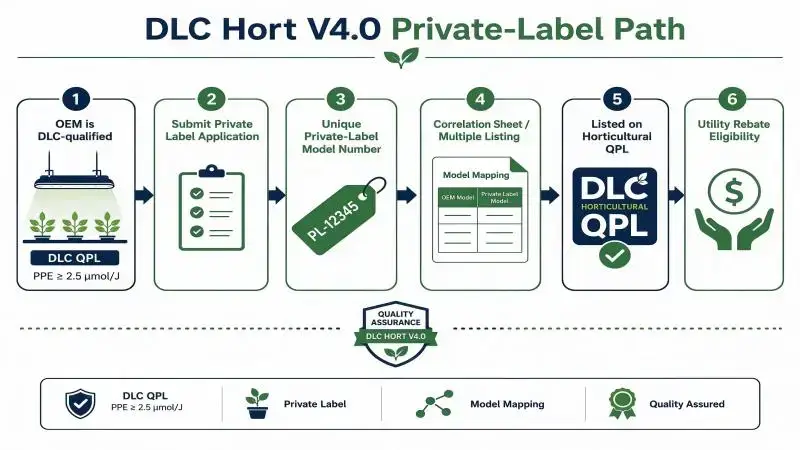
The DLC Horticultural Qualified Products List (QPL) is the reference most U.S. utilities use to decide whether a fixture can earn energy-efficiency rebates, and since the transition to Hort V4.0 it has gotten stricter. The current threshold requires a minimum photosynthetic photon efficacy (PPE) of 2.5 μmol/J, an 8.7% increase over the previous V3.0 level, which pushes the DLC’s LED benchmark well above the most efficient non-LED alternatives. DLC published the Hort V4.0 technical requirements with applications opening in 2025 and older-version products delisted in January 2026 — so a listing is not a permanent asset, and it is tied to a specific product and model identifier, not a broad family claim.
For a private-label brand, the encouraging news is that you do not necessarily have to repeat the full test program. DLC allows a private label application only when the original equipment manufacturer’s product is already qualified on the QPL and your private-label product is identical to that qualified version. That lets the same fixture appear under multiple brands without duplicate testing — provided each brand gets its own unique model number and the required correlation paperwork. The flowchart below shows the clean path to read:
UL/ETL and Safety Mapping
On the safety side, the standard that governs horticultural lighting in North America is UL 8800, developed specifically for lighting equipment installed in a growing environment and deployed under the National Electrical Code. It evaluates electrical shock, fire risk, insulation and spacing, and environmental suitability, and it typically requires at least a damp rating with consideration for photobiological safety, ingress protection, and polymer UV degradation.
An ETL Listed mark from Intertek — itself an OSHA-recognized Nationally Recognized Testing Laboratory (NRTL) — indicates the same class of independent safety validation, so inspectors and authorities having jurisdiction (AHJs) treat UL-listed and ETL-listed fixtures as equivalent evidence of compliance. For the details behind these marks, the UL 8800 standard for horticultural lighting is the baseline to quote in your spec.
Documentation That Passes Inspection
Certification follows the tested configuration, not a marketing claim. A private-label brand needs a complete technical file for the exact model being sold: circuit schematics, electrical parameters, a bill of materials with evidence for safety-critical components, PCB and layout drawings, product labels and nameplates, and a declaration of any model differences between your variants.
Critically, the documentation must include your own private-label compliance certificate and the multiple-listing correlation sheet that cross-references OEM model numbers to your private-label model numbers. If you change the driver, LED board, enclosure, or rating after certification, you may no longer match the file — which is why change control sits at the heart of staying inspection-ready.
Performance That Scales
PPFD Uniformity and Spectrum Efficacy
A listing proves a fixture clears a floor, but plant outcome depends on how photons land on the canopy. Photosynthetic photon flux density (PPFD) uniformity across the rack affects whether every plant gets the same daily light integral (DLI), which in turn drives consistency in yield and quality.
Spectrum efficacy — how efficiently the fixture converts input power into photosynthetically active radiation, expressed in μmol/J — determines how much of your energy bill becomes growth rather than heat. Private-label programs that anchor on a proven platform with published photometrics and uniform distribution give you defensible numbers to put on your spec sheet from day one.
Thermal Management and Reliability
Heat is the silent driver of both plant microclimate and component longevity. Fixtures with robust thermal management keep canopy temperature more predictable and protect the LED modules and drivers from premature failure. Because drivers are the most common failure point on an LED luminaire, understanding how the fixture is cooled and how the driver is covered matters as much as the diode count. A line built on a thermally sound base is easier to warrant, easier to maintain across multi-site rollouts, and less likely to cause the downtime events that quietly erode your ROI calculation.
Controls Integration and DLI Alignment
Commercial operations increasingly run lighting on schedules tied to DLI targets rather than fixed timers. Fixtures that integrate with standard dimming and control systems let your customers (and you, if you also operate facilities) match photon delivery to the crop’s developmental stage and the local environment. This controls integration is not just a convenience — DLC’s newer quality and controllability expectations nudge the market toward fixtures that can be dimmed or scheduled, and utilities increasingly ask about the controls narrative on custom rebate applications.
ROI You Can Defend
Baseline-to-LED Savings Model
The core of any lighting ROI case is an honest comparison from your current baseline to the LED solution. The standard model works like this:
- Compute annual lighting energy for both the baseline (typically HPS) and the proposed LED fixture under your real photoperiod, fixture count, and electricity rate.
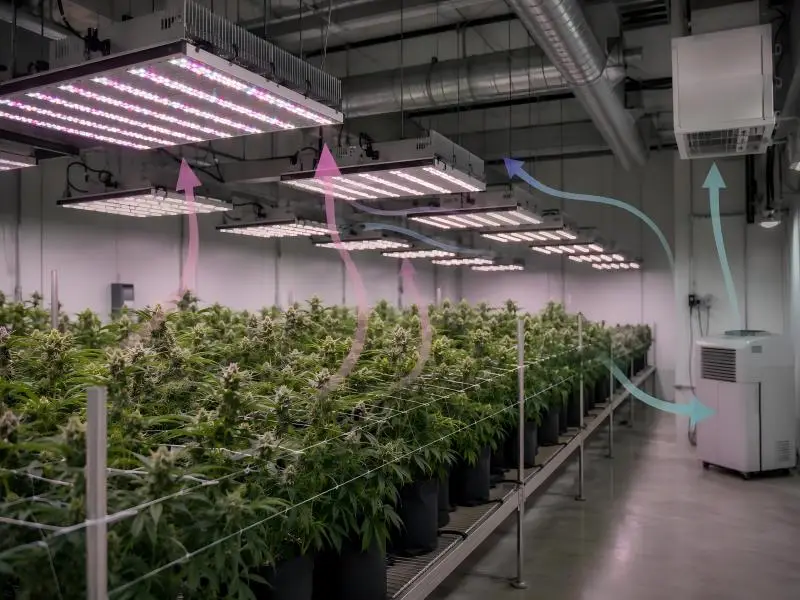
- Add HVAC savings that LED lighting delivers by putting less radiant heat into the space — while being honest about any added heating demand in a greenhouse context.
- Add maintenance savings — avoided lamp changes, reduced relamping labor, fewer outages — that compound over a season.
- Subtract any added costs, then divide the net installed cost (after rebates) by the annual net benefit to get simple payback.
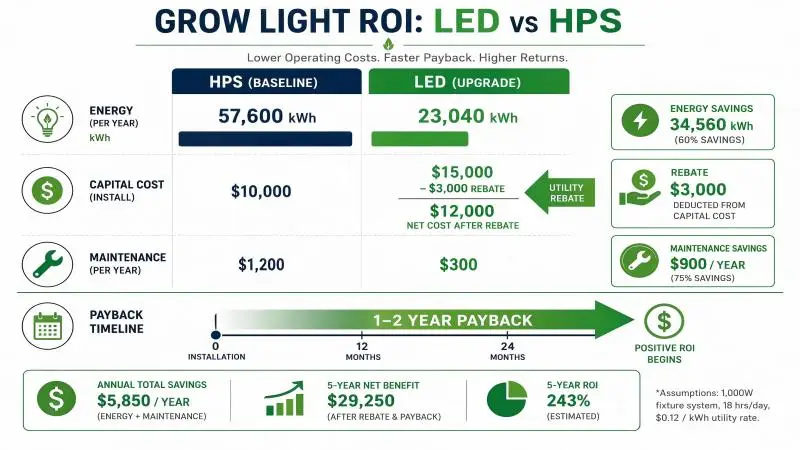
Across commercial horticulture, LED lighting typically uses 30–60% less energy than HPS for the same plant-usable light, and most retrofit payback periods land in the range of one to three years depending on electricity price, operating hours, and incentives. The infographic below lays out the deltas that drive that math:
Utility Incentives and DLC Listings
For most U.S. utilities, appearing on the DLC Qualified Products List is the gatekeeper for lighting rebates. That means your private-label fixtures must carry their own listing — a private-label model number is not automatically covered by the OEM’s listing. Each brand and model must be listed separately.
And the exact model identifier on the QPL must match what appears on your quote, purchase order, packing list, and invoice, because a mismatch is one of the most common reasons an otherwise excellent fixture loses a rebate. Utilities also require pre-approval before purchase and, for custom or calculated-savings applications, a documented controls and baseline-vs-proposed narrative.
Warranty, Downtime, and TCO Impacts
Simple payback can flatter a fixture that fails early. Extending your analysis to total cost of ownership (TCO) over a five-to-ten-year horizon forces you to weigh warranty term, driver coverage, rated photon maintenance, and the cost of downtime. A fixture with a strong warranty and a solid thermal design protects you from the expense and reputation damage of field failures, and it makes your-brand’s reliability claim credible to procurement. On a private-label line, your warranty policy and your ability to supply spare parts across lots are part of what you “sell” to multi-site customers exploring you as a supplier.
Supply-Chain Guardrails
Master Model Mapping and BOM Control
The single most important discipline in private label is making sure the fixture you quote is the fixture you ship. A master model mapping ties each of your SKUs to the exact approved record — model name, internal SKU, purchase order, packing list, invoice, and certification file — so the identifier matches end to end.
Next, lock down the bill of materials (BOM) and define which component substitutions are allowed, using a controlled change process so a driver, connector, or coating swap cannot silently invalidate your certification. High-risk parts like diodes, drivers, and thermal materials are the ones to verify directly.
This rigor is exactly why growers vet factory quality control before choosing a grow light manufacturer — the discipline lives at the factory level, not just your paperwork.
Pre-shipment Inspection and Traceability
Before any container leaves the factory, conduct a pre-shipment inspection (PSI) using an AQL-based sampling plan: verify packaging, labels, barcode and SKU accuracy, carton marks, and functional performance including burn-in and photometric checks. Pair that with lot/batch traceability that follows parts from goods-in through finished goods, so any defect can be traced back to a specific production run, component lot, and inspection record.
Sample retention and batch records give you the evidence base for dispute resolution, failure analysis, and reorder consistency — the same record-keeping that lets you prove a shipped unit is the exact certified version. For a fuller picture of these risks across the value chain, the LED grow light supply chain is worth a close read.
Governance, SLAs, and Document Retention
None of this holds together without governance. Put your quality obligations into supplier service-level agreements (SLAs) that cover defect thresholds, response time, rework authority, inspection pass criteria, and — critically — change-notification timing, with written approval required before any component or process change. Then retain the documents in a controlled archive tied to batch or lot numbers: master model files, BOM revisions, test and inspection reports, certifications, and packing records. Retain them long enough to support warranty claims, regulatory questions, and future reorders.
A well-run private-label program references the exact baseline from the first order when it writes the second — that is what makes the line predictable rather than a one-off. A partner like SLTMAKS illustrates how compliance-aligned private-label deployments are built: OEM-capable documentation, certification coordination, and change-controlled rollout planning that keep a qualified configuration standard without repeated re-testing.
Decision Guide
Private Label vs OEM/ODM vs Resale
| Model | Speed to market | Brand equity | Cost profile | Best fit |
|---|---|---|---|---|
| Private label | Fastest (proven base) | Builds for you | Lowest upfront among branded | Test a market fast, launch a catalogue, build a brand |
| ODM | Faster than OEM | Moderate | Medium | Some differentiation, no full custom development |
| OEM | Slowest | Highest uniqueness | Highest (tooling, testing) | Distinct performance or proprietary design |
| Resale | Fast to start | Weakest (builds supplier’s brand) | Lowest setup | Short-term catalogue fill, not brand building |
As the table shows, no single model wins everywhere. The right choice depends on your timeline, budget, and how much differentiation your strategy demands.
Fit-by-scenario Recommendations
- Launching a line fast, or testing a new crop segment: private label is the strongest fit — you get a certified platform and your own brand without the R&D cycle.
- You need a point of difference but not full custom optics: an ODM adaptation lets you tune a base design within a bounded menu.
- Your brand depends on unique spectral performance, housing, or controls: invest in a full OEM build despite the longer lead time and higher cost.
- You are filling a short-term gap, not building a brand: simple resale keeps setup minimal, but expect the manufacturer to capture the repeat business.
Next Steps and Due Diligence Checklist
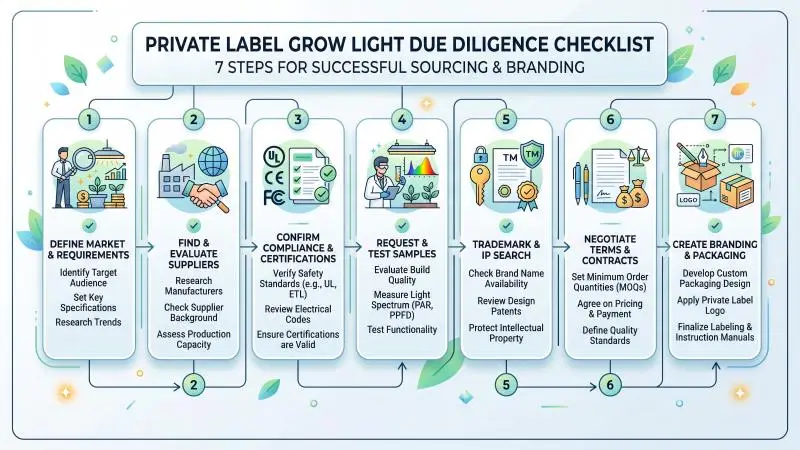
Before you commit to a private-label partner, work through this checklist so your launch carries predictable performance, rebates, and controlled risk:
- Confirm the OEM platform is already listed on the DLC Horticultural QPL under Hort V4.0, and get a certification file that matches the exact product.
- Verify an NRTL safety listing (UL or ETL to an applicable standard such as UL 8800) exists for your model and is valid for your target market.
- Establish a unique private-label model number and complete the private-label correlation / multiple-listing paperwork before you order.
- Freeze the BOM and define the change-control and substitution-approval process in the supplier agreement.
- Model your payback on real baseline-vs-proposed energy, HVAC, maintenance, and rebate numbers — not the supplier’s optimistic datasheet.
- Confirm utility rebate eligibility and obtain written pre-approval before purchasing; match the model identifier across every procurement document.
- Build in AQL-based pre-shipment inspection, lot/batch traceability, and a document-retention policy tied to batches.
FAQ
What is the difference between private label and OEM grow lights?
Private label means you take a proven, already-manufacturable design from an existing factory and put your own name, packaging, and spec sheet on it — you keep the brand equity and margin without funding tooling or R&D. A full OEM build, by contrast, is a custom product engineered to your own optical design, housing, and controls, which is why it carries a much higher cost and a longer lead time. For most growers who want to launch a hydroponic lighting line quickly, private label offers the fastest certified route; you graduate specific SKUs to custom OEM development only once volume justifies the expense.
Do I need my own DLC and UL or ETL certification for a private label grow light?
For safety, yes — your brand typically needs its own UL 8800 or ETL Equivalent listing for the U.S. market. For DLC performance, the path is easier: if your OEM supplier’s product is already on the DesignLights Consortium’s Horticultural Qualified Products List under Hort V4.0 and your private-label unit is identical, DLC allows a private label application without duplicate testing. Two rules matter here: your version needs its own unique model number, and the identifier on the QPL must match what appears on your quote, purchase order, packing list, and invoice, or utility rebates can be rejected over a simple mismatch.
What is the minimum order quantity for private label grow lights?
There is no single industry-wide MOQ; it varies by supplier and by how much customization you ask for. An off-the-shelf platform with a logo-and-label change typically starts in the low hundreds of units, while custom spectrum, housings, or packaging will push the MOQ higher. Before negotiating, ask how the MOQ changes with each level of customization and whether your target volume stays cost-effective once certification correlation and packaging tooling are factored in. That way you avoid signing up for a quantity the retail side of your plan can’t absorb.
How much does it cost to start a private label grow light brand?
How much does it cost to start a private label grow light brand?
Costs split into product, compliance, and go-to-market buckets. The fixture cost depends on MOQ and the platform you select, while compliance adds your private-label DLC-correlation paperwork and UL or ETL listing fees. Budget also for branding and packaging tooling, samples and pre-shipment inspection, and warehousing. A focused launch can be done on a modest budget, but the realistic guardrail is to model payback on real energy, HVAC, and rebate assumptions rather than a supplier datasheet — that discipline is what turns a private-label line into a defensible ROI instead of a margin guess.
Conclusion
Private label grow lights give you the fastest, lowest-risk path to a branded lighting line without surrendering the compliance confidence your customers and inspectors expect. The model works because you stand on a proven, DLC-listed, UL- or ETL-listed platform while keeping your own name, margin, and service experience — the combination that actually builds a hydroponic brand over time.
The action items are clear: choose a DLC Hort V4.0-qualified platform, lock your safety certifications and model mapping, model your ROI on real site assumptions, and put supply-chain guardrails in place before the first container ships. Do that, and you can launch with predictable performance, credible utility rebates, and risk you can defend — instead of a brand story with no documented foundation behind it.