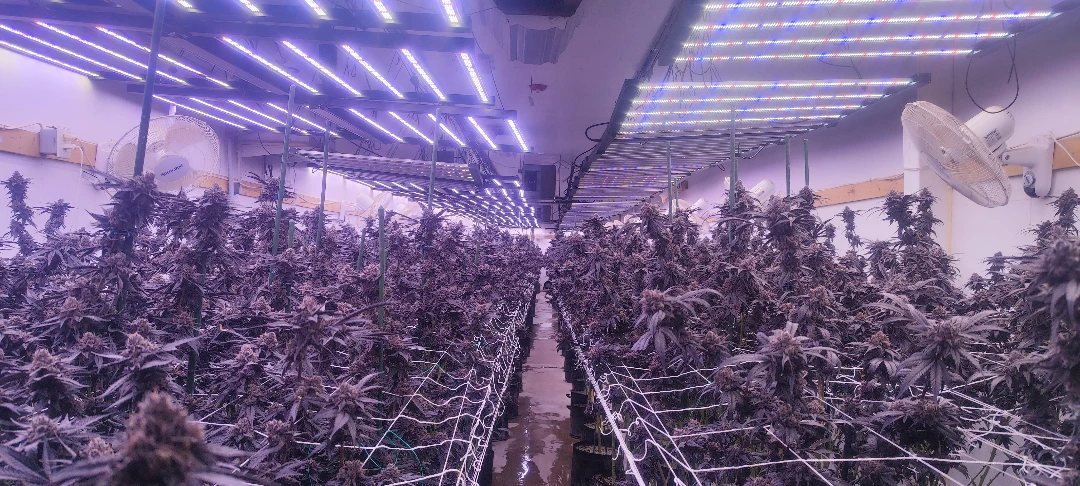
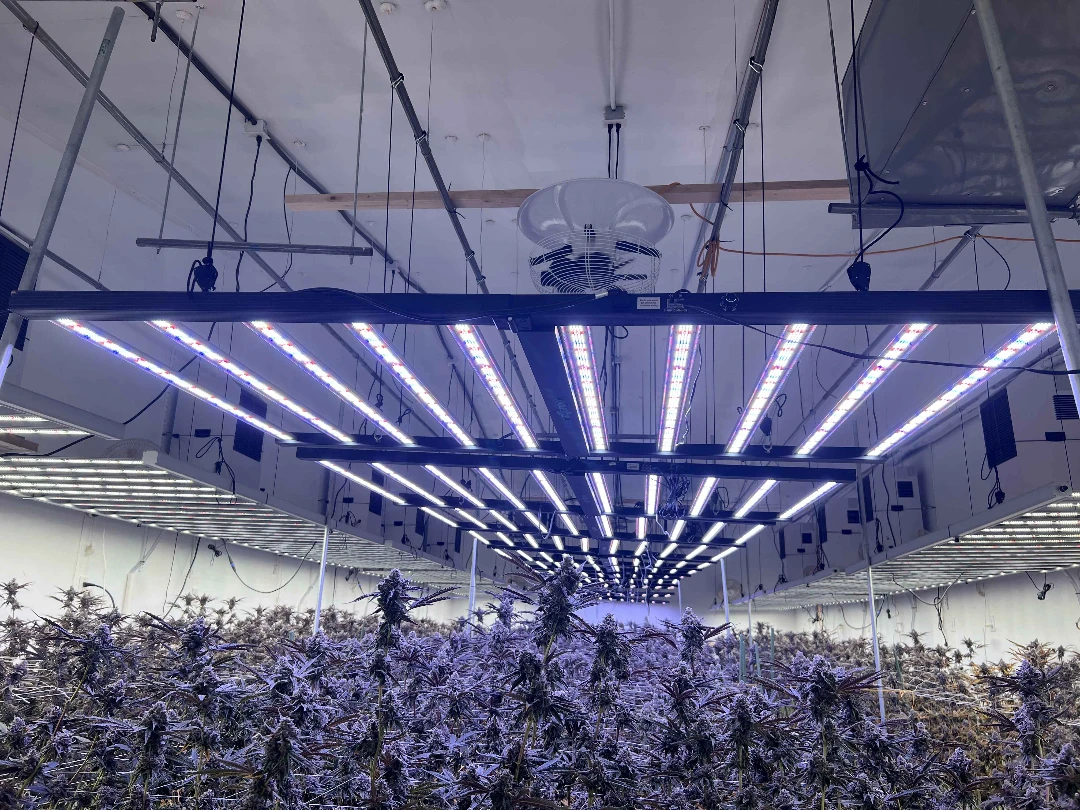
Red LED grow lights have moved from “niche supplemental lamps” to a core tool in modern greenhouses and controlled-environment agriculture. When you use deep red correctly—especially the common ~660 nm peak—you can steer flowering responses, improve canopy efficiency, and support fruiting performance in many crops. When you use it incorrectly (or use only red), you can end up with weak structure, delayed quality targets, or confusing results that look “bright” to the eye but don’t match plant outcomes.
This guide explains—plainly and practically—what deep red does inside the plant, how it affects flowering and fruiting, and how to design a spectrum that performs reliably for commercial production using red LED grow lights.
Table of Contents
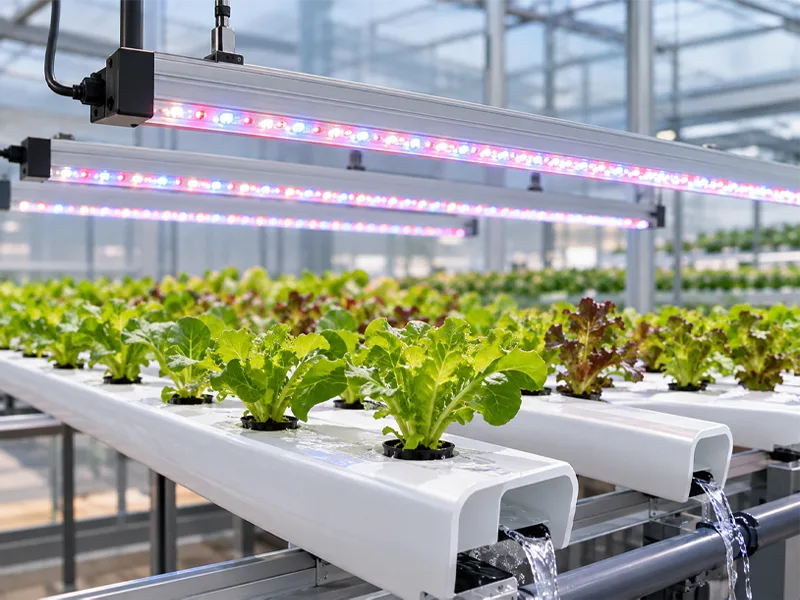
What “red LED grow lights” actually means
Red, deep red, and far-red are not the same thing
In horticultural lighting, “red” often refers to wavelengths roughly within 600–700 nm, while deep red usually means a peak around ~660 nm (a very common LED peak). Far-red is typically 700–800 nm, and although it sits just outside the traditional PAR definition, it can strongly influence plant form and flowering signaling. Ag and Natural Resources College
If you’re comparing fixtures, treat “red,” “deep red,” and “far-red” as three separate design levers. They may be sold together in marketing copy, but plants perceive them through different receptor dynamics and ratios (especially the red-to-far-red balance).
Why 660 nm is everywhere in LED fixtures
A common deep-red diode peak is around 660 nm, largely because it aligns well with chlorophyll absorption and delivers strong photosynthetic usefulness per watt in many applications. In practice, deep red is one of the most “efficient” photons you can buy in terms of converting electricity into plant-usable light—but efficiency is not the same as best results.
That distinction matters because plants are not just photosynthesis machines. They also run development programs—flower initiation, internode spacing, leaf expansion, and fruiting allocation—based on light quality and timing, not only photon totals.
PAR, PPFD, and why “brightness” is a trap
Plants primarily use photons between 400–700 nm to drive photosynthesis, which is why PAR is defined in that band. Ag and Natural Resources College However, many people still judge lights using lux or foot-candles (human-vision units), which can be misleading for plants and especially misleading for spectra heavy in red. Purdue Extension explicitly notes that foot-candles are photometric (human-eye weighted) and not appropriate for indicating plant photosynthesis. Purdue University – Extension
If you want red LED grow lights to perform consistently, measure (or request) PPFD maps and work with DLI targets, not “it looks bright.”
The plant science behind deep red
Deep red supports photosynthesis—but not in isolation
Deep red photons are highly effective at driving photosynthesis, but photosynthesis and productivity are also limited by canopy architecture, stomatal behavior, nutrient balance, and photoprotective responses. Even if red photons are “powerful,” a plant that is too elongated or has poor leaf development may intercept less light overall, reducing real yield.
A useful example appears in a strawberry LED study hosted on PubMed Central: it reports that the photosynthetic rate under red light (660 nm) was higher than under blue light (450 nm) in their measurements. PMC Yet the same paper also describes complex tradeoffs in flowering response and plant form under different single-peak wavelengths. PMC
Takeaway: deep red can be an excellent “engine,” but you still need a good “chassis” (plant structure) to convert that engine power into harvested fruit.
Phytochrome: the main reason red affects flowering timing
Plants use a pigment system called phytochrome to sense red and far-red light and convert those signals into development decisions. Michigan State University notes that phytochrome mediates flowering of plants with photoperiodic flowering responses and that plants can be very sensitive to low intensities of red light at night. Ag and Natural Resources College
This is why red is so powerful for flowering control: you can influence “day length perception” with relatively little energy compared to full daytime production lighting, as long as you deliver the right wavelength at the right time.
Red-to-far-red ratio (R:FR) shapes plant form and flowering responses
In many crops, the R:FR ratio is a major cue for “open sun” vs “competition/shade.” MSU describes that as far-red is added to red light, R:FR decreases and extension growth increases; conversely, absence of far-red (common in many LED-only spectra) can produce more compact growth indoors. Ag and Natural Resources College
This is central to using red LED grow lights correctly: you’re not only adding red photons—you are also changing the balance that plants use to decide whether to stretch, branch, expand leaves, or accelerate flowering.
How deep red influences flowering
Short-day crops: red at night can prevent flowering
For short-day crops, the key control variable is usually the uninterrupted dark period. MSU reports that very low red light at night can inhibit flowering of short-day plants. Ag and Natural Resources College
In commercial terms, this means stray red light leakage (from indicator LEDs, hallway lights, or adjacent rooms) can unintentionally disrupt flowering schedules. If you run multi-room operations, this is not theoretical—this is a common cause of “mystery delays.”
Long-day crops: red (often with far-red) can promote flowering
Long-day plants often flower faster when they perceive a long-day photoperiod. The same MSU resource indicates low-intensity red at night can promote flowering of some long-day plants, and notes that adding far-red in roughly similar quantities can stimulate flowering of a wide range of long-day plants. Ag and Natural Resources College
This is why many professional flowering-control lamps emit red and sometimes far-red. If your goal is to control flowering timing (not necessarily to maximize daily biomass), photoperiodic strategies can be extremely energy efficient.
Photoperiodic lighting requires low intensity, not “full power”
A practical piece many growers miss is intensity. A Michigan State University article on photoperiodic vs supplemental lighting notes photoperiodic lighting typically requires only low-intensity light (e.g., a few µmol·m⁻²·s⁻¹), because the goal is signaling, not photosynthesis. Ag and Natural Resources College
If you’re using red LED grow lights to manage flowering, it’s often smarter to separate:
- Photoperiodic (signal) lighting and
- Photosynthetic (growth) lighting
…rather than trying to do everything with one “blast it” schedule.
How deep red supports fruiting and yield

Fruiting depends on carbon economy—and DLI is the foundation
Fruiting is expensive for a plant. It needs sufficient daily photosynthesis to support flower development, fruit set, and filling. That is why DLI (Daily Light Integral) is one of the most important predictors of yield and quality in controlled environments.
MSU defines DLI as the number of photosynthetic photons received per day (400–700 nm). Ag and Natural Resources College Purdue Extension similarly defines DLI as the amount of PAR received each day as a function of light intensity and duration, expressed as mol·m⁻²·d⁻¹. Purdue University – Extension
If you want better fruit set and fruit size, you typically need to hit a crop-appropriate DLI first. Spectral tuning helps you spend photons more effectively, but it does not replace insufficient photon totals.
Deep red can improve canopy-level capture when structure is right
Deep red often improves photosynthetic “throughput,” especially when paired with a spectrum that maintains healthy leaf anatomy and stomatal function. However, if a spectrum causes excessive elongation or poor leaf expansion, your canopy intercept can decline—so your effective DLI at the leaf surface can be lower even if your sensors read the same PPFD above the canopy.
This is one reason far-red sometimes increases yield indirectly: MSU notes far-red photons are weakly effective at instantaneous photosynthesis, but far-red can increase leaf size, enabling plants to capture more light over time and potentially increase growth. Ag and Natural Resources College
Evidence example: strawberry under narrow-band LEDs
The strawberry LED study on PubMed Central provides a useful demonstration of tradeoffs. It reports red 660 nm can deliver higher photosynthetic rate than blue 450 nm in their measurements. PMC Yet it also describes that blue light promoted more flowering than red (630 and 660 nm, except a longer red peak in their setup). PMC
The business lesson is straightforward: use deep red to support carbon gain, but don’t ignore the wavelengths that steer flowering and plant form. Commercial fruiting systems almost always win with mixed spectra.
Red light alone vs mixed spectra
Why “all red” can backfire
Red-only lighting can create problems that look like nutrition or genetics issues but are actually spectral. Common symptoms include:
- Excessive stretch or weak stems in some cultivars (especially when R:FR dynamics are unbalanced).
- Poor leaf thickness and less robust morphology in some species.
- Flowering timing that doesn’t match expectations (because signaling pathways are being driven without supporting cues).
In the strawberry LED paper, the authors even suggest photosynthetic ability decreased when plants were grown only under red light and that photosynthetic rate can be improved by combining red with blue or alternating exposures. PMC
The role of blue and “white” in real-world production
Blue light is often important for morphology control and “normal-looking” growth, but the exact effect depends on species and ratios. A tomato study in the Journal of the Japanese Society for Horticultural Science reports tomato seedlings under red LED were significantly longer than those under blue LEDs or mixed spectra, and that increasing blue relative to red reduced stem length in their conditions. J-STAGE
White light isn’t “magic,” but it usually includes a balanced spread that supports both canopy management and worker visibility. In most commercial facilities, deep red is best used as a targeted component within a broader spectrum strategy.
Practical spectral recipes (conceptual, not “one-size-fits-all”)
A high-performing approach for fruiting crops typically looks like this:
- A strong base spectrum (often white + red + some blue) to maintain healthy structure and leaf function.
- Deep red supplementation to increase photosynthetic efficiency and support reproductive load.
- Optional far-red strategy if you need leaf expansion, flowering acceleration in long-day crops, or canopy penetration effects—managed carefully because it can also increase extension growth. Ag and Natural Resources College+1
If you want a deeper technical overview of spectrum engineering in controlled environments, this ACS review is a good reference: Shaping and Tuning Lighting Conditions in Controlled Environment Agriculture. ACS Publications
Choosing red LED grow lights for commercial flowering and fruiting
Check the spectrum spec, not just “red included”
When you compare fixtures, request:
- Peak wavelength (e.g., 660 nm deep red).
- Relative output fraction in red (and whether far-red is included).
- A spectral power distribution chart, not only a marketing label.
If a vendor cannot provide a spectrum chart, you’re buying blind. Serious flowering and fruiting programs deserve serious data.
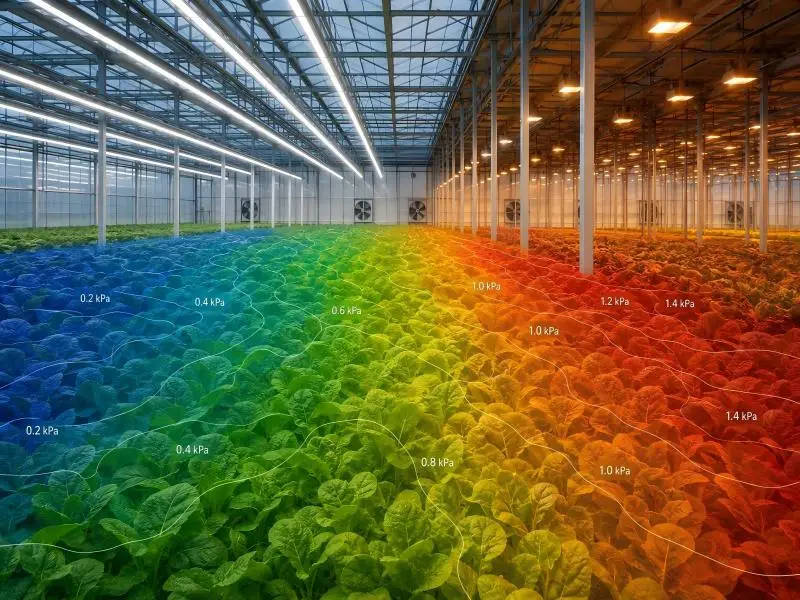
Demand PPFD maps and uniformity data
Uniformity impacts fruiting consistency. Hot spots can cause localized stress and uneven development, while weak edges reduce yield per square meter.
Also, remember the warning from Purdue Extension: photometric units like foot-candles are designed for human vision and are not appropriate for photosynthesis measurement. Purdue University – Extension Ask for PPFD and DLI planning support instead.
DLI planning is where ROI usually lives
Here is a simple way to estimate DLI from PPFD and hours:
- DLI (mol·m⁻²·d⁻¹) ≈ PPFD (µmol·m⁻²·s⁻¹) × hours × 0.0036
For example, if your canopy receives 600 µmol·m⁻²·s⁻¹ for 12 hours, the DLI is about 25.9 mol·m⁻²·d⁻¹. That number is often more predictive of yield than debating tiny spectral differences—unless you are using red LED grow lights specifically for flowering control, in which case timing and R:FR can matter more.
For a solid primer, see:
- MSU: Daily Light Integral Defined Ag and Natural Resources College
- Purdue Extension: Measuring Daily Light Integral in a Greenhouse (PDF) Purdue University – Extension
Setup guidelines: distance, dimming, and photoperiod

Separate “flowering signal” from “fruiting horsepower”
If flowering timing is the priority, consider a low-intensity photoperiodic strategy rather than overdriving production fixtures at night. MSU’s photoperiodic lighting guidance highlights that photoperiodic lighting uses low intensity compared with supplemental production lighting. Ag and Natural Resources College
If yield and fruit size are the priority, focus first on hitting DLI targets and ensuring uniform canopy PPFD. Once DLI is stable, then optimize spectrum ratios and deep red supplementation.
Use dimming to tune plant response, not just to save power
Dimming is often treated as an energy feature, but it’s also a crop steering tool. With red LED grow lights, small changes in red fraction (or the addition/removal of far-red) can shift morphology and flowering responses, especially in sensitive cultivars.
A disciplined operational approach is:
- Stabilize environment (temp/VPD/CO₂) first.
- Lock your DLI target next.
- Then adjust deep red fraction in controlled steps while recording outcomes (flower timing, internode length, leaf area, fruit load).
Measure at canopy height, and re-measure as the crop grows
As the crop grows, canopy height changes, leaf angle changes, and the light interception pattern changes. PPFD at “day 1” is not PPFD at “day 35.”
This matters more for red-heavy spectra because visual brightness is deceptive. Always measure at canopy height, and if possible, measure at multiple points to verify uniformity.
Common mistakes, risks, and how to avoid them
Mistake 1: assuming red = flowering for every plant
Red strongly influences phytochrome signaling, but flowering responses vary by species and photoperiod class. MSU notes phytochrome mediates flowering in photoperiodic plants and that low intensities of red light at night can shift flowering responses, but that does not mean “more red always equals faster flowering.” Ag and Natural Resources College
Treat flowering as a crop-specific program, not a universal rule. If you grow multiple crops, avoid copying one crop’s lighting recipe onto another without trials.
Mistake 2: adding far-red without managing elongation risk
Far-red can be beneficial for flowering acceleration in some long-day plants and can enlarge leaves, but it can also promote extension growth. MSU explicitly notes the industry challenge: they had not identified a way to promote flowering without accompanied promotion of extension growth in the far-red discussion. Ag and Natural Resources College
If you use far-red, use it intentionally and monitor internode length and mechanical strength. Do not “set it and forget it.”
Mistake 3: using lux/foot-candles as a control metric
This is one of the most expensive mistakes in commercial LED deployments. Purdue Extension emphasizes that foot-candles are based on human vision and are not appropriate for indicating plant photosynthesis. Purdue University – Extension
If your SOPs still reference lux targets, consider updating them to PPFD/DLI language. This change alone often improves consistency and reduces energy waste.
Why SLTMAKS for red LED grow lights
Deep red done right requires engineering discipline
Deep red impacts flowering and fruiting most reliably when the fixture design is stable: consistent diode bins, good thermal pathways, and high-quality drivers. In real operations, spectrum drift and uneven PPFD do more damage than most people expect, because they create different “micro-light climates” inside one crop block.
SLTMAKS designs lighting around commercial realities: heat management, serviceability, scalable layouts, and data you can use (PPFD maps, recommended mounting strategies, and spectrum options).
Spectrum customization for flowering and fruiting goals
A production team might want:
- A base spectrum optimized for vegetative structure and leaf health.
- A controllable deep red channel to push reproductive productivity during flowering and fruit set.
- Optional far-red strategy depending on crop type and facility design.
If your goal is measurable improvement (not just a “redder” light), SLTMAKS can support a spectrum and control plan aligned with your crop schedule and facility constraints.
Support that matches how growers actually work
Lighting is a system, not a bulb. SLTMAKS supports:
- Layout planning and uniformity targets.
- DLI-based operating strategies.
- Practical commissioning guidance so outcomes match what the spreadsheet promised.
If you want to evaluate a project, start with your crop targets, area, and available mounting height. From there, it’s straightforward to propose a red LED grow lights configuration that hits the numbers without creating avoidable morphology problems.
Quick FAQ about deep red, flowering, and fruiting
Does deep red automatically trigger flowering?
Not automatically. Deep red influences phytochrome signaling and can strongly affect flowering in photoperiodic plants, but the outcome depends on the crop’s photoperiod class and timing of light exposure. Ag and Natural Resources College
Is 660 nm better than 630 nm?
Often, 660 nm is a strong choice for photosynthetic usefulness, and many fixtures use it as a standard deep red peak. Some studies show nuanced differences across red peaks and interactions with blue and other wavelengths, so the “best” option is crop- and strategy-dependent. PMC
Do I need far-red for fruiting crops?
Not always. Far-red can help with leaf expansion and can accelerate flowering in some long-day plants, but it can also increase extension growth, so it should be used intentionally and monitored. Ag and Natural Resources College+1
What’s the single most important metric for yield?
In many fruiting programs, DLI is one of the most important controllable variables because it determines the daily carbon budget for flowering and fruit filling. Ag and Natural Resources College+1
Make deep red a controlled advantage, not a guessing game
Deep red is one of the most valuable tools in modern horticultural lighting. Used correctly, red LED grow lights can strengthen your flowering control strategy, support the carbon economy needed for fruiting, and improve consistency across production cycles. Used carelessly, red-heavy lighting can create avoidable morphology and timing issues that look like “crop randomness” but are actually design and measurement problems.
If you want deep red to be an advantage, build your plan around DLI and uniformity first, then tune spectrum and photoperiod signaling based on crop response. That approach is repeatable, scalable, and financially defensible.