Introduction
Commercial greenhouse operators invest millions of dollars in glass or double-poly glazing designed to maximize natural solar radiation. Yet, during peak daylight hours, a significant portion of that ambient solar energy never reaches the crop canopy. It is intercepted before arrival by the very equipment installed to supplement it: bulky supplemental light fixtures mounted directly overhead.
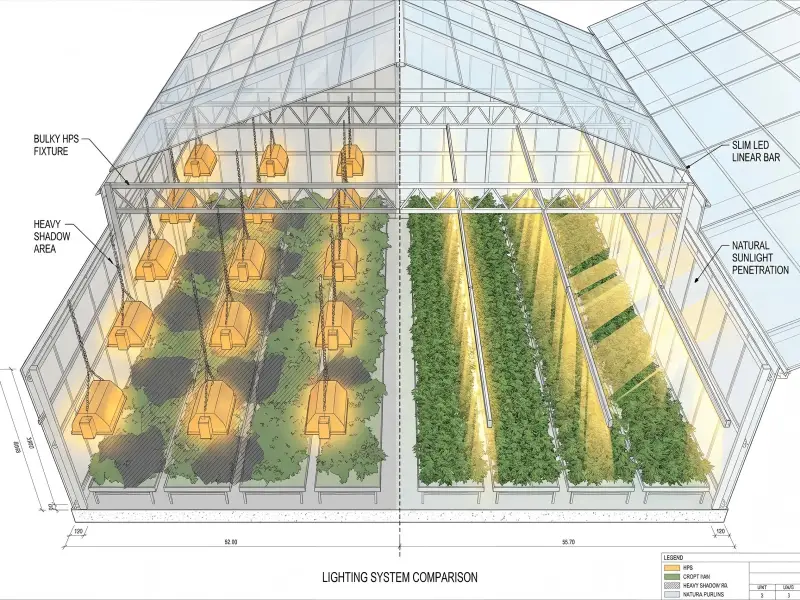
Every square inch of aluminum housing, reflector hood, and driver box positioned beneath the roof structure acts as a permanent barrier to sunlight. These physical obstructions cast sharp, persistent shadow footprints across the upper leaves. In effect, commercial growers inadvertently pay twice: first to construct a high-transmittance greenhouse envelope, and second by paying for electric photons to replace the “free photons” blocked by broad lighting equipment.
To reclaim lost solar capacity and optimize daily light integrals (DLI), facility managers must evaluate fixture geometry with the same rigor applied to structural purlins and glazing transmissivity. This technical guide outlines how to quantify fixture shading loss, implement low-profile fixture design and mounting layout optimizations, validate canopy PAR delivery, and build a multi-site financial case for eliminating equipment shading.
Table of Contents
How Much Light Do Bulky Fixtures Really Block
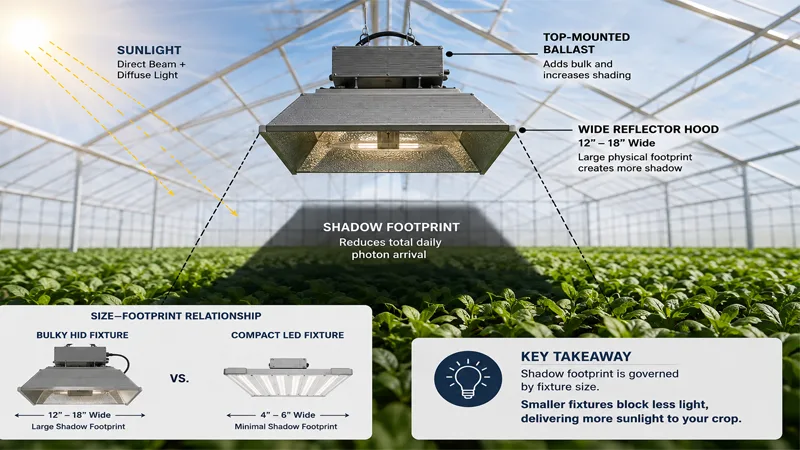
Understanding the impact of overhead equipment begins with basic optical geometry: shadow area is directly proportional to the physical footprint of the luminaire positioned between the sun and the canopy.
The Physics of Fixture Shading and Size–Footprint Relationship
When sunlight hits a greenhouse roof, it arrives as a combination of direct beam radiation and diffuse skylight. Direct sunlight casts a dark, sharp shadow directly beneath any opaque object. Diffuse light scatters around the edges, creating a softer penumbra.
Legacy high-intensity discharge (HID) luminaires—specifically 1000W High-Pressure Sodium (HPS) units—were designed with wide, deep aluminum reflector hoods (often 12 to 18 inches wide) to spread light from a single intense arc tube. Coupled with top-mounted magnetic or electronic ballast enclosures, these broad physical structures create a large shadow footprint over the canopy. As the sun moves across the sky from east to west, these bulky housings sweep a continuous band of shadow across the crop, reducing total daily photon arrival.
Key takeaway: Shadow footprint is governed by luminaire surface area and housing profile. Bulky reflector hoods block direct solar beam radiation during peak morning and afternoon hours, creating moving shadows that lower regional DLI across the canopy.
Comparing Shading Loss Across Fixture Types: HPS versus LED
The physical contrast between traditional HPS luminaires and modern commercial LEDs highlights a fundamental shift in optical design.
| Lighting Attribute | Legacy 1000W DE HPS Fixture | Slim Linear LED Bar Fixture | Operational Impact |
|---|---|---|---|
| Housing geometry | Deep reflector hood + ballast box | Low-profile narrow linear bar | Reduces physical surface area in the solar path |
| Housing width | 12 to 18 inches (30–45 cm) | 2 to 3 inches (5–8 cm) | Shrinks direct shadow footprint by up to 75% |
| Open air / light space | Solid sheet-metal enclosure | Open-frame lattice layout | Allows direct and diffuse sunlight to pass through |
| Structural alignment | Hangs below trusses, creating new shadow zones | Mounts parallel/beneath trusses | Hides fixture shadow inside existing truss shadow |
According to peer-reviewed research on horticultural luminaire shadow footprints, luminaire shadow loss is directly dictated by housing dimensions. Traditional HPS reflectors create broad, unbroken obstruction blocks, whereas linear LED bars distribute light-emitting diodes across thin aluminum extrusion channels, allowing ambient sunlight to pass cleanly between adjacent bars.
The “One-Percent Rule” Tying Light Loss to Measurable Yield Reduction
In commercial greenhouse horticulture, the connection between photosynthetically active radiation (PAR) and harvest weight is well established. Agronomists apply a fundamental rule of thumb verified by research from Wageningen University & Research (WUR) and horticultural extension programs: a 1% change in cumulative light (DLI) yields approximately a 0.5% to 1.0% change in crop yield.
For high-wire fruiting crops (such as tomatoes, cucumbers, and bell peppers) as well as commercial medical cannabis, the response sits near a 1:1 ratio during low-light autumn, winter, and spring cycles:
- 5% overhead light obstruction ≈ 3.75% to 5.0% lower annual harvest yield
- 10% overhead light obstruction ≈ 7.5% to 10.0% lower annual harvest yield
When a facility operates under 10% equipment-induced shading, every bench loses pounds of biomass annually simply because ambient sunlight cannot reach the palisade mesophyll cells in upper canopy leaves.
Greenhouse Light Shading Fixtures: Design Features That Minimize Blockage
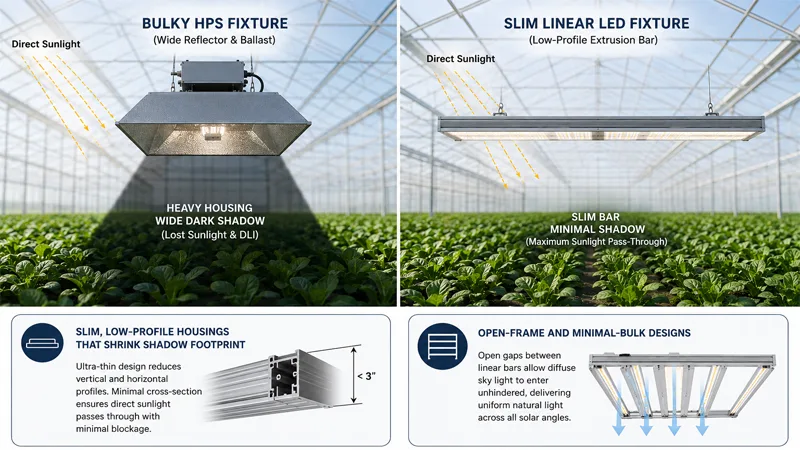
To eliminate equipment-induced light loss, commercial growers must select fixtures specifically engineered for high-transmittance greenhouse environments rather than sole-source indoor cultivation rooms.
BULKY HPS FIXTURE SLIM LINEAR LED FIXTURE
(Wide Reflector & Ballast) (Low-Profile Extrusion Bar)
Direct Sunlight Direct Sunlight
HEAVY HOUSING WIDE DARK SHADOW (Lost Sunlight & DLI)
SLIM BAR MINIMAL SHADOW (Maximum Sunlight Pass-Through)
Slim, Low-Profile Housings That Shrink Shadow Footprint
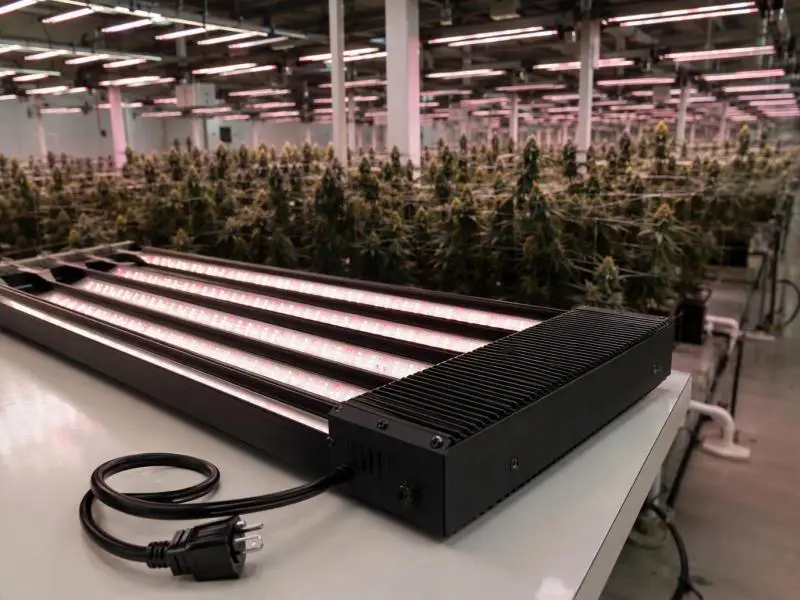
Low-profile greenhouse luminaires reduce vertical and horizontal cross-sectional profiles. By housing driver electronics remotely or using ultra-thin aluminum heatsink channels under 3 inches in width, these fixtures present a minimal cross-section to incoming solar rays. Shrinking the physical cross-section ensures that direct solar beam radiation passes through the upper structure with minimal refraction or blockage.
Open-Frame and Minimal-Bulk Designs
Unlike indoor multi-bar LED racks that use a solid rectangular frame, greenhouse-optimized fixtures feature open-frame, modular, or single-linear bar geometries. The open gaps between parallel light bars allow diffuse sky radiation to enter unhindered. This enables the upper canopy to receive uniform natural light across variable solar angles.
Higher Efficacy Means Fewer Fixtures and Less Aggregate Obstruction
Fixture efficacy—measured in micromoles per joule (µmol/J)—directly dictates the total physical equipment count required to meet target PPFD levels:
Required Fixture Count = Target Supplemental PPFD (µmol/m²/s) × Canopy Area (m²)/Fixture Photon Flux Output (µmol/s)
Upgrading to high-efficacy commercial LED grow light fixtures featuring advanced Samsung diodes delivering 2.8 to 3.2+ µmol/J allows facility engineers to deliver target photon counts using significantly fewer total luminaires. Reducing total fixture count naturally reduces total overhead physical mass, minimizing aggregate shadow footprint across the facility.
Why Efficient LED Designs Keep Uniform PPFD While Reducing Shading
Modern optical distribution lenses spread supplemental light across wide, batwing beam angles. Rather than concentrating photons directly beneath a broad reflector hood, slim linear LEDs project photons at angled trajectories. This overlap ensures uniform canopy PPFD without requiring bulky, continuous luminaire enclosures overhead. Deploying high-efficiency slim greenhouse LED lighting solutions allows facilities to achieve high light uniformity while maintaining maximum sunlight penetration.
Optimizing Fixture Layout and Mounting to Reduce Shading
Equipment selection is only half the equation; strategic placement within the structural bay determines whether overhead fixtures create new shadows or hide within existing structural lines.
Balancing Fixture Spacing and Mounting Height for Overlap Without Dark Gaps
Mounting luminaires higher in the greenhouse truss structure increases beam overlap, smoothing out light distribution across the canopy. However, mounting height must be balanced against structural geometry:
- High mounting (truss-level): Maximizes beam overlap and dilutes shadow sharpness, but requires wide optical beam angles to avoid wall losses.
- Low mounting (gutter-level): Increases supplemental PPFD intensity directly beneath the fixture, but creates sharp shadow lines and hotspots if spacing is too wide.
A recommended ratio for linear LED top-lights is maintaining a 1:1.2 to 1:1.5 height-to-spacing distance above the mature crop wire to ensure smooth PPFD blending.
Coordinating Placement with Trusses, Purlins, and Overhead Infrastructure
Every greenhouse roof includes structural shadow sources: steel trusses, purlins, heating pipes, shade-screen gutters, and irrigation lines.
Pro tip: Always align linear LED fixtures directly beneath or parallel to major structural trusses and purlins. Positioning the luminaire within the shadow cone already cast by a structural steel beam prevents the fixture from creating an additional, independent shadow path on the canopy below.
Using Interlighting and Under-Canopy Bars to Reach Shaded Lower Leaves
In tall high-wire crops (such as tomatoes, cucumbers, and tall indoor medical crops), upper canopy leaves naturally shade lower foliage, regardless of overhead fixture profile. Adding slim interlighting bars directly within the crop foliage delivers targeted photons to middle and lower leaves without adding any overhead roof obstruction. Inter-canopy lighting converts shaded, parasitic leaves into active photosynthetic contributors without increasing daylight blockage at the roof line.
ROOF GLAZING / NATURAL SUN SLIM TOP-LIGHT ← Hidden under truss TOP CANOPY (High Solar Light) SLIM INTERLIGHT BAR ← Placed inside crop LOWER CANOPY (Targeted PAR)
Leveraging Reflective Surfaces to Bounce Light into Shadowed Zones
To mitigate unavoidable structural and equipment shadows, install high-albedo reflective floor coverings (such as white UV-stabilized ground film) across greenhouse walkways and soil beds. White floor coverings reflect up to 85%–90% of unabsorbed downwelling light back up into the lower leaf undersides, diffusing shadows created by overhead infrastructure and boosting total canopy light absorption.
Measuring and Validating Shading Improvements
To verify that fixture design changes successfully reclaim lost solar capacity, commercial managers should execute a rigorous PAR and DLI measurement protocol.
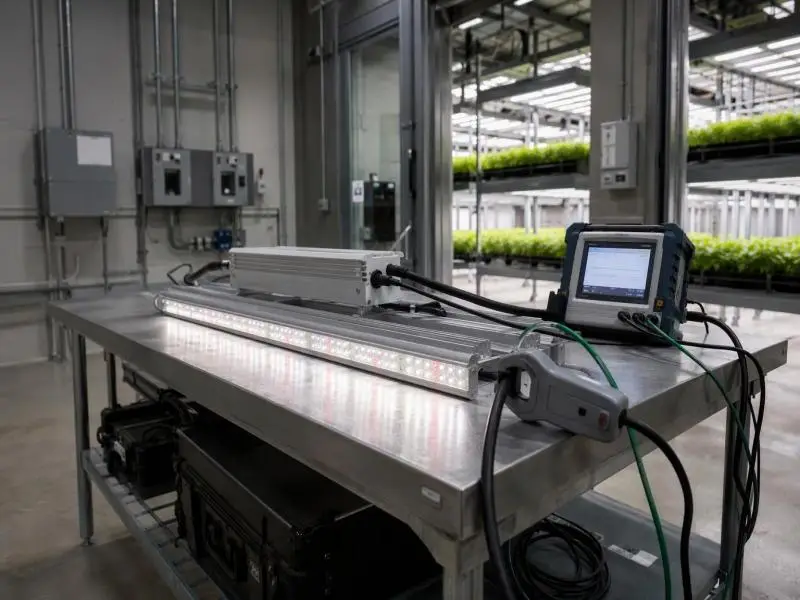
Running a PPFD and DLI Mapping Protocol Across Your Canopy
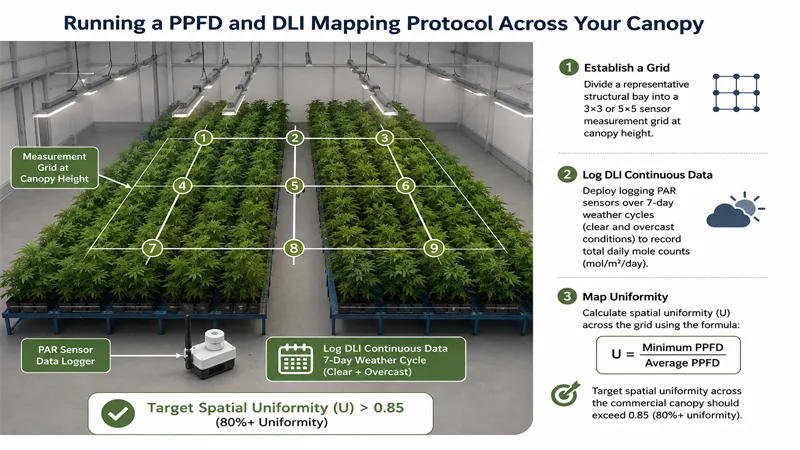
Relying on a single handheld quantum sensor reading at center-bench can yield misleading results. Facilities should execute a multi-point grid mapping protocol:
- Establish a grid: Divide a representative structural bay into a 3×3 or 5×5 sensor measurement grid at canopy height.
- Log DLI continuous data: Deploy logging PAR sensors over 7-day weather cycles (capturing both clear and overcast conditions) to record total daily mole counts (mol/m²/day).
- Map uniformity: Calculate spatial uniformity (U) across the grid using the formula:
U = Minimum PPFD/Average PPFD
Target spatial uniformity across the commercial canopy should exceed 0.85 (80%+ uniformity).
Comparing Indoor and Outdoor Transmission to Expose Combined Losses
To isolate equipment shading from structural glazing losses, install a reference quantum sensor on an unshaded exterior weather station rooftop alongside interior canopy sensors.
Total Transmission Loss (%) = ( 1 – Interior Unsupplemented PAR/Exterior Ambient PAR ) × 100
- Baseline glazing transmission: Typically 65%–70% for clean double-poly or glass without lights.
- Glazing + bulky HPS fixtures: Often drops to 52%–58% total transmission.
- Glazing + slim linear LED fixtures: Recovers transmission to 62%–66% total transmission.
A 6% to 8% gain in daylight transmission directly restores 3 to 5 additional moles of natural DLI per day during spring and summer shoulder months.
Isolating Supplemental Contribution with Nighttime Fixture-Only Measurements
To confirm artificial light delivery without solar interference, run spatial PPFD mapping sweeps at night with the supplemental fixtures powered to 100% capacity. This confirms whether fixture optical distribution meets engineering layout designs, ensuring that dark gaps or hot spots do not exist independently of daylight shading.
The Financial Case for Reducing Fixture Shading
Reclaiming natural daylight is not merely an optical exercise; it represents a major driver of operational profitability and capital payback.
Turning Recaptured Light into Measurable Yield and Revenue
Applying the 1% rule to commercial production demonstrates immediate top-line impacts. Consider a 50,000 sq. ft. commercial tomato or high-value crop facility generating 20 lbs per sq. ft. annually:
- Baseline annual yield: 1,000,000 lbs
- Recaptured solar light from slim LED retrofit: +6% net DLI increase
- Yield expansion (+0.75% per 1% light): +4.5% net yield increase (+45,000 lbs/year)
- At $2.50/lb wholesale: +$112,500 additional annual top-line revenue from reclaimed “free” solar photons alone—without drawing an extra kilowatt-hour from the electrical grid.
Weighing the HPS-to-LED Retrofit Economics and Payback Timeline
When replacing legacy 1000W HPS fixtures with slim, high-efficacy LED bars, financial savings accrue from three distinct streams:
⚠️ Warning: Failing to factor HVAC and chiller load reductions into your lighting ROI calculation will underestimate financial payback. Every watt of electrical heat avoided at the luminaire reduces air conditioning and exhaust fan operating costs.
- Direct electrical energy reduction: Upgrading from 1050W total HPS system draw to a 600W slim LED offering equivalent PPFD cuts fixture energy consumption by 42%.
- HVAC and cooling relief: Lower thermal radiation from LED heat sinks reduces mechanical chiller and pad-and-fan electricity loads during warm season operations.
- Recaptured solar photons: Increased daylight transmission boosts baseline crop production year-round.
In typical North American and European energy markets ($0.12–$0.18 per kWh), the combined financial return yields complete capital expenditure (CAPEX) payback in 1.8 to 2.8 years, even before applying local utility energy-efficiency rebates.
Accounting for Total Cost of Ownership Across a Multi-Site Operation
For corporate multi-site operators, standardized deployment of slim-profile greenhouse luminaires lowers total cost of ownership (TCO) across facility lifecycles:
- Reduced structural load: Slim aluminum profiles weigh less per linear foot, reducing steel truss engineering costs in new builds.
- Longer maintenance intervals: Eliminating annual HPS bulb replacements and reflector cleaning cycles lowers labor overhead.
- Compliance and safety: Selecting luminaires certified under ETL, CE, and RoHS standards ensures smooth building inspections and utility incentive approvals across different municipalities.
Conclusion
Overhead equipment shading represents a controllable operational variable rather than a fixed cost of greenhouse cultivation. Every broad reflector hood and bulky ballast hanging beneath your glass roof intercepts free solar radiation, driving down crop DLI and reducing total harvest weight.
By selecting greenhouse light shading fixtures designed with low-profile housings, high efficacy, and open-frame structures, operators can align lighting infrastructure directly with roof trusses to minimize daylight blockage. Paired with accurate DLI canopy mapping and strategic mounting height, facilities restore natural light transmission while delivering precise supplemental PPFD.
The path to higher canopy efficiency begins with a clear audit: measure your current interior-to-exterior light transmission ratio, map your overhead shadow footprints, and calculate the financial return of reclaiming your daylight.
FAQ
How much sunlight do overhead supplemental light fixtures actually block in a commercial greenhouse?
How much sunlight do overhead supplemental light fixtures actually block in a commercial greenhouse?
Bulky supplemental fixtures can block between 5% and 15% of ambient natural sunlight, depending on their housing dimensions and placement. Traditional 1000W HPS luminaires with wide reflector hoods create the most significant obstruction, whereas modern slim linear LED bars reduce daylight obstruction by up to 75%.
How does fixture shading impact overall crop yield and daily light integral (DLI)?
Horticultural research shows a direct correlation: a 1% loss in cumulative daily light (DLI) results in approximately a 0.5% to 1.0% reduction in crop yield. In high-wire fruiting crops and medical cannabis, operating under 10% equipment shading can cause an annual harvest loss of 7.5% to 10%.
Why are slim linear LED fixtures better than traditional HPS for greenhouse shading management?
Legacy HPS fixtures feature deep 12-to-18-inch reflector hoods and bulky ballast boxes that sweep wide shadow bands across the canopy. Slim linear LED fixtures feature 2-to-3-inch narrow aluminum channels and open-frame lattice structures that allow direct and diffuse skylight to pass through freely.
What is the best way to align LED grow lights with greenhouse structural trusses to eliminate shadow loss?
To minimize new shadows, mount linear LED luminaires directly beneath or parallel to major structural roof trusses and purlins. Positioning the fixture within the shadow cone already created by the steel truss hides the fixture’s physical shadow footprint from the crop below.
Can inter-canopy lighting help offset overhead light blockage in tall crops?
Yes. In high-wire crops like tomatoes and cucumbers, upper leaves naturally shade lower foliage. Slim inter-canopy LED bars deliver targeted photons directly into middle and lower leaf zones without creating any overhead daylight obstruction at the roof line.
What is the financial ROI of retrofitting from bulky fixtures to low-profile LEDs?
Upgrading to low-profile, high-efficacy LEDs generates financial returns through three sources: increased crop yield from recaptured natural daylight (+4% to +6% DLI), reduced direct electrical consumption (up to 42% energy savings), and lower cooling/HVAC costs. Facilities typically achieve full CAPEX payback within 1.8 to 2.8 years.