When upgrading a commercial indoor cultivation facility or retrofitting legacy HPS fixtures, equipment hardware represents only part of your capital expenditure. Logistics and international freight frequently account for 15% to 45% of total landed cost. For commercial cultivation managers and operations directors, choosing the wrong shipping mode for grow lights from China can lead to severe budget overruns, delayed crop cycles, or unexpected dimensional weight penalties.
Commercial LED fixtures are physically unique cargo. Unlike compact consumer electronics, commercial bar-style lights utilize heavy extruded aluminum heat sinks, industrial CC power drivers, and large flat packaging footprints. Choosing between sea freight and air freight requires balancing lead times against volumetric freight calculations and customs duties.
Table of Contents
At-a-Glance Comparison: Sea Freight vs. Air Freight
The table below summarizes the key operational differences between ocean freight and air cargo when importing commercial LED grow lights from Chinese manufacturers to North American or European facilities.
| Evaluation Metric | Sea Freight (Ocean Cargo) | Air Freight (Standard / Express) |
|---|---|---|
| Typical cost per unit | $2.00 – $5.00 / fixture (FCL) / $6.00 – $12.00 (LCL) | $25.00 – $55.00+ / fixture (Volumetric Rate) |
| Door-to-door transit time | 25 – 45 Days (US West Coast 25–35d, East Coast 35–45d) | 3 – 8 Days (Air Express 3–5d, Standard Air 6–8d) |
| Volumetric weight risk | Low (Billed by volume in CBM) | Extremely High (Billed by 1:167 kg/CBM dimensional ratio) |
| Optimal order scale | Bulk commercial orders (100+ fixtures / 5+ CBM) | Emergency restocks, pilot samples (<10 fixtures) |
| Customs & tariff handling | Managed via DDP / FOB ocean bill of lading | Fast clearance via air waybill (AWB) |
| Carbon footprint | Low emissions per kilogram shipped | High emissions per kilogram shipped |
The Hidden Penalty: Volumetric Dimensional Weight for LED Bar Lights
Many commercial cultivation managers calculate freight estimates by multiplying total fixture weight in kilograms by an air freight rate per kilogram. This calculation often results in major cost surprises because airlines charge based on Volumetric Weight (Dimensional Weight) whenever package volume exceeds physical weight.
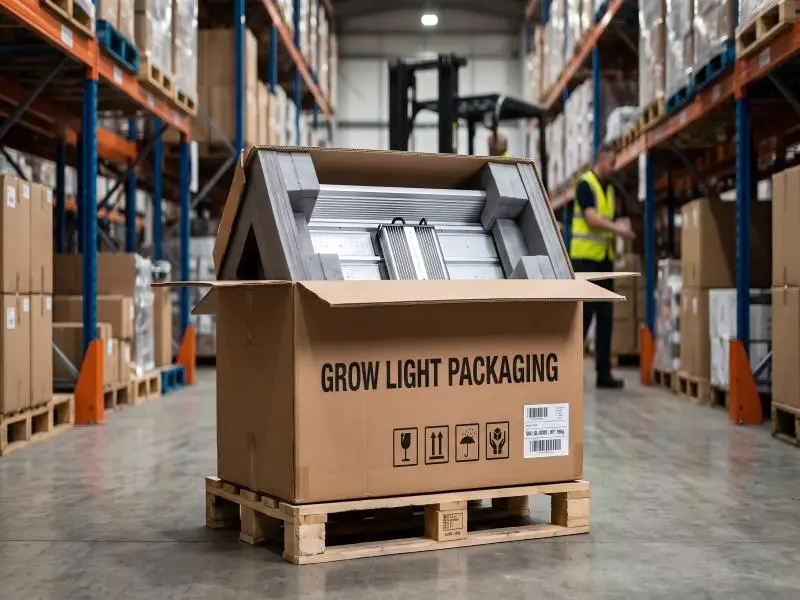
High-output fixtures—such as 8-bar or 10-bar 720W to 1000W LED systems—are packaged flat to protect diodes and folding hinges. A standard master carton for a 720W commercial LED grow light measures approximately 115 cm × 115 cm × 12 cm (0.1587 CBM).
The Volumetric Calculation Formula
International air freight applies a volumetric divisor of 5000 for standard air cargo (and 6000 for certain express couriers):
Volumetric Weight (kg) = (Length (cm) × Width (cm) × Height (cm)) / 5000
Applying this formula to a typical commercial fixture packaging:
Volumetric Weight = (115 × 115 × 12) / 5000 = 31.74 kg
Even if the physical fixture weighs only 13.5 kg, the air carrier bills the shipment at 31.74 kg.
At a standard air freight rate of $6.00 per kilogram, shipping a single 13.5 kg fixture costs $190.44 by air freight, compared to approximately $4.50 per unit via ocean FCL. B2B market benchmarks from Compare2Best LED Freight Analysis (2026) show that ocean freight cuts per-unit shipping fees by up to 85% on commercial lighting orders exceeding 100 units.
Pro tip: Always request both the actual gross weight and the packaged carton dimensions (L × W × H) from your manufacturer before requesting an air freight quote. Billed weight will always equal whichever number is higher.
Sea Freight Deep Dive: Ocean Cargo (FCL & LCL)
For commercial farm expansions, ocean shipping is the primary freight method for importing lighting equipment from China to North America and Europe.
Full Container Load (FCL)
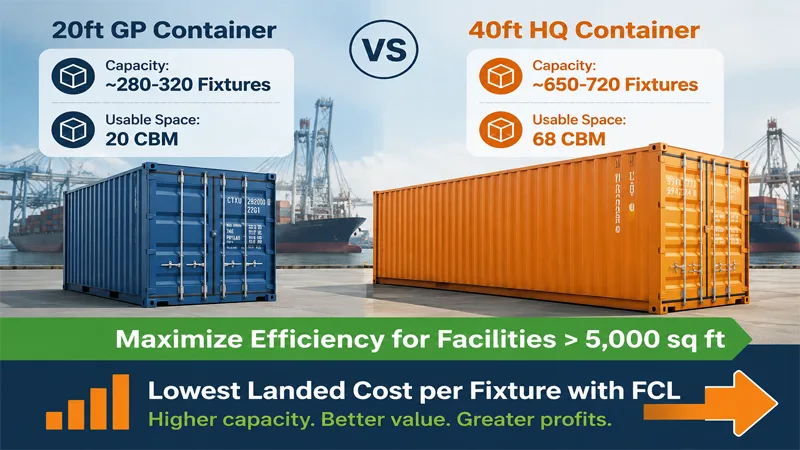
When procuring lighting for facilities exceeding 5,000 square feet, Full Container Load (FCL) offers the lowest landed cost per fixture.
- 20ft GP container: Holds approximately 280–320 folded commercial bar fixtures (20CBM usable space). Ocean freight costs range between $1,800 and $3,200 depending on destination port.
- 40ft HQ container: Holds approximately 650–720 fixtures (68CBM usable space). Ocean freight costs range between $2,500 and $4,500.
FCL cargo travels directly from the port of loading (e.g., Shenzhen, Ningbo, or Shanghai) to the destination port (e.g., Los Angeles, Long Beach, Savannah, or Rotterdam) without intermediate deconsolidations, minimizing handling damage.
Less than Container Load (LCL)
For mid-sized orders ranging from 20 to 100 fixtures (2CBM to 12CBM), LCL allows buyers to share container space with other cargo.
LCL ocean freight rates typically range from $80 to $150 per CBM. However, buyers should account for origin consolidation fees and destination port handling charges (THC), which add roughly $200–$400 to the total shipment invoice.
Port-to-Port vs. Door-to-Door Transit Timelines
Sea freight timelines require structured planning into your facility buildout schedule:
- Factory dispatch to China ocean port: 2–4 days
- Port handling & customs export clearance: 3–5 days
- Ocean transit time:
- China to US West Coast (LAX/LGB): 14–18 days
- China to US East Coast (SAV/NYC): 28–34 days
- China to Northern Europe (Rotterdam/Hamburg): 28–35 days
- US customs clearance & port deconsolidations: 4–7 days
- Final inland trucking to farm facility: 2–5 days
Total Door-to-Door lead time: Allow 30 to 45 days total transit time for ocean shipments.
Air Freight Deep Dive: Standard Air Cargo vs. Air Express
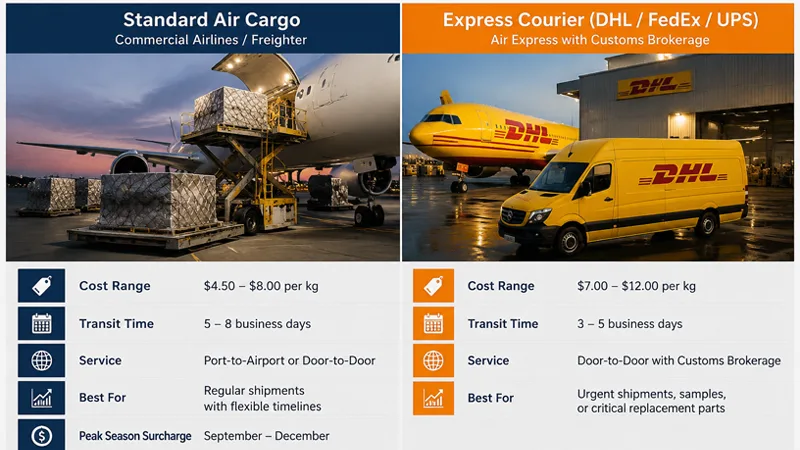
Air freight is reserved for time-critical scenarios where project delays cost more than freight surcharges.
Standard Air Cargo
Standard air cargo moves via commercial or freighter airlines (port-to-airport or door-to-door). According to Vantage Forwarding Air Freight Guidelines (2026), general cargo air rates from Asian manufacturing hubs to North America range between $4.50 and $8.00 per kilogram, with peak-season surcharges applying between September and December. Total transit time averages 5 to 8 business days.
Express Courier (DHL / FedEx / UPS)
Air express provides door-to-door courier service with built-in customs brokerage. Rates range from $7.00 to $12.00 per kilogram. Express transit delivers in 3 to 5 business days, making it ideal for shipping engineering evaluation samples or urgent driver replacements.
When Air Freight Makes Sense
Air freight is economically justified in specific operational situations:
- Pre-procurement pilot samples: Verifying PPFD spectrum uniformity, thermal management performance, and build quality on 2–3 test units before issuing a 500-unit purchase order.
- Emergency crop cycle protection: Replacing power supplies or fixtures during an active flowering cycle where light loss directly impacts harvest yields.
- Contractual expansion deadlines: Meeting fixed licensing or lease deadlines where missing an operational start date incurs heavy financial penalties.
Navigating US Customs and Tariffs When Shipping Grow Lights from China
Importing commercial grow lights into the United States requires navigating trade regulations and electrical safety standards.
Shipping & Compliance Workflow
When importing commercial grow lights from Chinese manufacturers to your US facility, your cargo typically follows a structured compliance and logistics pathway:
- Factory dispatch (FOB / DDP): Goods are packed and released from the Chinese manufacturing facility.
- Customs export clearance: Origin customs clearance and departure preparation.
- Transit mode selection:
- Sea freight: 30–45 Days door-to-door transit for bulk commercial orders.
- Air freight: 3–8 Days transit for emergency replacements or pilot samples.
- US customs & border protection (CBP) entry:
- HTS code classification: Declared under HTS 9405.42.8400 or 9405.49.0000.
- Section 301 tariff: 25% duty applied to FOB hardware value.
- Electrical safety compliance: Verification of ETL/UL 8800 and FCC certification.
- Final inland delivery: Trucking dispatch directly to your commercial cultivation facility.
Section 301 Tariffs & HTS Codes
Commercial LED lighting fixtures manufactured in China fall under Harmonized Tariff Schedule (HTS) codes 9405.42.8400 or 9405.49.0000. Under Section 301 trade actions, imports of Chinese LED lighting into the US carry a 25% tariff on top of the base import duty rate (typically 6%).
Tariffs are calculated on the FOB customs value of the goods, not on the freight cost.
Electrical Safety Certification Verification
US Customs and Border Protection (CBP) and local electrical inspectors require horticultural lighting to hold recognized North American safety marks. Fixtures must carry ETL or UL 8800 (the standard for horticultural lighting equipment) and FCC Class A/B compliance for electromagnetic interference.
If a shipment lacks proper ETL/UL labeling or documentation, customs authorities may detain the cargo at the port of entry, resulting in daily demurrage fees.
Incoterms: FOB vs. CIF vs. DDP
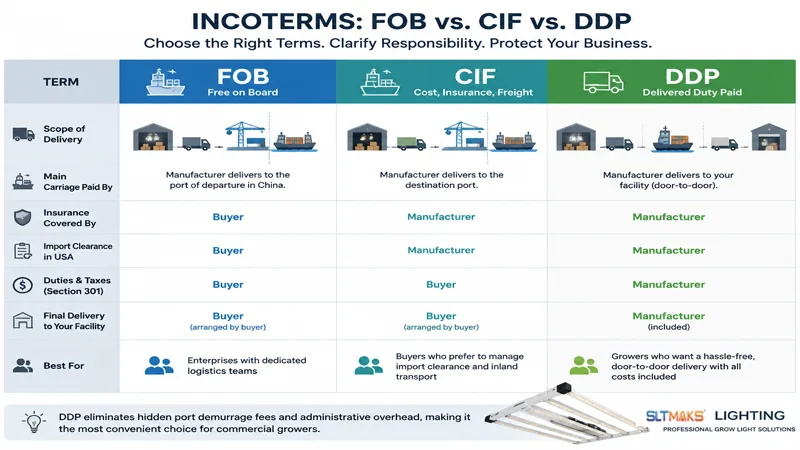
Understanding Incoterms ensures clear division of responsibility between the grower and the manufacturer:
- FOB (Free on Board): The manufacturer delivers cargo to the departure port in China. The buyer selects the freight forwarder, pays ocean/air freight, manages US customs clearance, and pays tariffs. Recommended for enterprise operators with dedicated logistics teams.
- CIF (Cost, Insurance, Freight): The manufacturer pays freight to the destination port. The buyer handles import clearance, port charges, and final trucking.
- DDP (Delivered Duty Paid): The manufacturer or their logistics partner handles everything door-to-door—ocean/air transport, US customs clearance, Section 301 duty payment, and final truck delivery to your farm facility. As noted in DFH Logistics US Import Protocol (2026), DDP eliminates hidden port demurrage fees and administrative overhead for commercial growers.
Real-World Landed Cost Example: 100 Commercial Fixtures
To illustrate the financial difference between shipping options, consider an order of 100 units of 1000W foldable LED grow light fixtures shipped from Shenzhen to a cultivation facility in Denver, Colorado.
- Order volume: 100 Fixtures
- FOB unit price: $380.00 / fixture ($38,000 total FOB)
- Individual packaging: $115\text{ cm} \times 115\text{ cm} \times 12\text{ cm}$
- Gross weight per carton: 14.0 kg (Total Net Cargo Weight: 1,400 kg)
- Volumetric weight per carton: 31.74 kg (Total Billed Air Weight: 3,174 kg)
- Total volume: 15.87CBM
| Cost Component | Option A: Air Freight (DDP) | Option B: Sea Freight LCL (DDP) | Option C: Sea Freight FCL 20ft (DDP) |
|---|---|---|---|
| FOB hardware cost | $38,000.00 | $38,000.00 | $38,000.00 |
| Billed freight weight/vol | 3,174 kg (Volumetric) | 15.87 CBM | 20ft Container (20CBM) |
| Total freight charge | $19,044.00 ($6.00/kg) | $1,904.40 ($120/CBM) | $2,800.00 (Flat 20ft Rate) |
| Section 301 duty (25% FOB) | $9,500.00 | $9,500.00 | $9,500.00 |
| Customs & terminal fees | Included in DDP | Included in DDP | Included in DDP |
| Total landed cost | $66,544.00 | $49,404.40 | $50,300.00 |
| Landed cost per unit | $665.44 / light | $494.04 / light | $503.00 / light |
| Door-to-door lead time | 5 – 7 Days | 35 – 40 Days | 30 – 35 Days |
Financial takeaway: Selecting DDP Sea Freight saves $17,139.60 on a 100-fixture order—reducing total equipment investment by 25.7%.
The Hybrid Supply Chain Strategy: Sea Freight Bulk + Local Warehouse Buffering
While ocean freight provides the lowest landed cost for facility construction, unexpected room expansions or fixture failures require rapid fulfillment that air freight pricing renders impractical.
Leading commercial manufacturers address this dilemma through a hybrid logistics model. For example, SLTMAKS ships primary commercial orders (such as 1300W high-power indoor grow lights) directly from Chinese manufacturing facilities via ocean FCL/LCL to maximize budget efficiency.
To support ongoing operations, manufacturers maintain local warehouse inventory in North America and Europe.
To balance cost efficiency and operational risk, commercial cultivation facilities typically utilize a dual-channel fulfillment model:
- Primary buildout orders (50+ units): Shipped directly via Direct Factory Sea Freight (30–40 Days lead time, $2–$5/unit cost) to achieve maximum capital savings on large equipment purchases.
- Emergency & replenishment (1–10 units): Fulfilled via Local US Warehouse Dispatch (2–5 Days lead time via ground freight) for rapid replacement of CC power drivers or fixture expansions without incurring costly air freight fees.
By stocking standardized fixtures and replacement CC power drivers in local US warehouses, growers receive emergency replacements within 2 to 5 business days via domestic ground freight—avoiding international air freight costs while maintaining continuous crop protection.
Making the Right Choice for Your Facility
To choose the optimal shipping strategy for your commercial grow light order:
- Use sea freight (FCL or LCL) when planning facility buildouts 60+ days in advance, ordering more than 30 fixtures, or seeking the lowest possible landed cost per micromole of light output.
- Use air freight strictly for sample evaluation, pilot testing, or emergency replacements where crop damage costs exceed freight surcharges.
- Leverage local warehousing for immediate fixture expansion or driver replacement needs without paying international air freight rates.
If you are planning an upcoming commercial buildout or need an accurate landed cost assessment including freight, tariffs, and customs spectrum configurations, explore our OEM/ODM custom LED spectrum manufacturing options or contact our logistics team for a complete DDP freight quote.
FAQ
How much does it cost to ship LED grow lights from China to the US?
Sea freight typically ranges from $2.00 to $5.00 per unit for Full Container Load (FCL) and $6.00 to $12.00 per unit for Less than Container Load (LCL). In contrast, air freight costs average $25.00 to $55.00+ per unit due to volumetric weight calculations for large LED bar fixtures.
What is the Section 301 tariff rate on commercial grow lights imported from China?
Commercial LED grow light fixtures imported into the United States under HTS codes 9405.42.8400 or 9405.49.0000 are subject to a 25% Section 301 tariff in addition to standard import duties (typically around 6%). Tariffs are calculated on the declared FOB hardware value of the goods.
How long does sea freight take compared to air freight for grow light shipments?
Door-to-door ocean freight from Chinese manufacturing hubs to US facilities takes 30 to 45 days (25–35 days to the US West Coast and 35–45 days to the East Coast). Air express delivers in 3 to 5 business days, while standard air cargo takes 6 to 8 business days.
What electrical safety certifications are required to import grow lights into the US?
US Customs and local electrical inspectors require horticultural lighting equipment to hold recognized safety certifications, specifically ETL or UL 8800 compliance, alongside FCC Class A/B certification for electromagnetic compatibility. Missing proper safety marks can result in shipment detention at entry ports.
What is the difference between FOB and DDP terms when buying grow lights from China?
Under FOB (Free on Board), the buyer handles and pays for international freight, US customs clearance, tariffs, and inland delivery. Under DDP (Delivered Duty Paid), the manufacturer handles all logistics end-to-end—including ocean transit, Section 301 tariff payments, and final delivery directly to your cultivation facility.