For commercial cultivation operators, vertical farm developers, and equipment distributors, sourcing horticultural lighting directly from Chinese manufacturers offers unbeatable unit economics. However, commercial buyers frequently hit a major roadblock early in supplier conversations: high Minimum Order Quantities (MOQ).
When requesting a custom spectrum, private-label housing, or proprietary dimming controls, Chinese suppliers often quote an LED grow light MOQ of 500 to 2,000 units. For a scaling indoor facility or regional distributor testing a new product line, tying up hundreds of thousands of dollars in unproven inventory presents severe cash flow and operational risks.
The common reaction is to demand discounts or repeatedly ask sales representatives to “make an exception.” In B2B manufacturing, simply asking harder rarely works. Chinese LED factories set high MOQs for specific structural and supply chain reasons—ranging from diode reel sizes to automated SMT line setup costs.
By understanding the true component economics behind factory minimums and applying targeted negotiation levers, procurement managers can successfully negotiate MOQs down by 50% to 80% while preserving factory margins and establishing a long-term manufacturing partnership.
Table of Contents
Understanding the Hardware Economics Behind Factory MOQs
Before entering negotiations, buyers must recognize that an LED grow light MOQ is not an arbitrary figure invented by a sales agent. It reflects the factory’s real break-even threshold for raw material purchasing and production line setup.
When a manufacturer builds an LED grow light fixture, they aggregate sub-components from specialized supply chains across Shenzhen, Dongguan, and Zhongshan. Each sub-component carries its own procurement or manufacturing minimum.
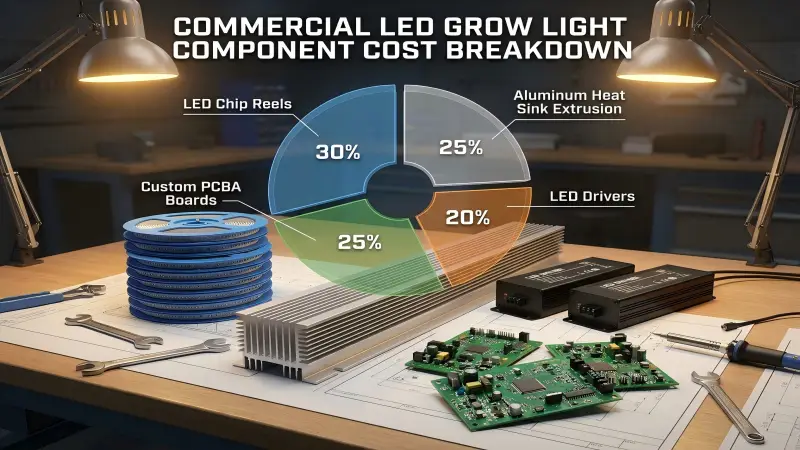
The 4 Main Component Drivers of LED Light MOQs
| Hardware Component | Supply Chain Constraint | Impact on Fixture MOQ |
|---|---|---|
| LED chips & diodes | Diodes (e.g. Samsung LM301H, Osram 660nm Deep Red) arrive in sealed factory reels of 4,000 to 10,000 chips. | Opening a partial diode reel for a custom spectrum forces the factory to hold unused chip inventory. |
| LED drivers/power supplies | Premium driver brands (Inventronics, Mean Well, Sosen) require batch minimums of 100 to 500 units for custom voltage or dimming leads. | Custom driver casing or non-standard wire lengths require sub-supplier batch commitments. |
| PCBA board SMT setup | High-speed Surface Mount Technology (SMT) wave soldering lines require $150–$300 in setup time, solder stencil creation, and feeder calibration. | Running fewer than 100 PCBA boards creates unrecovered downtime on automated SMT lines. |
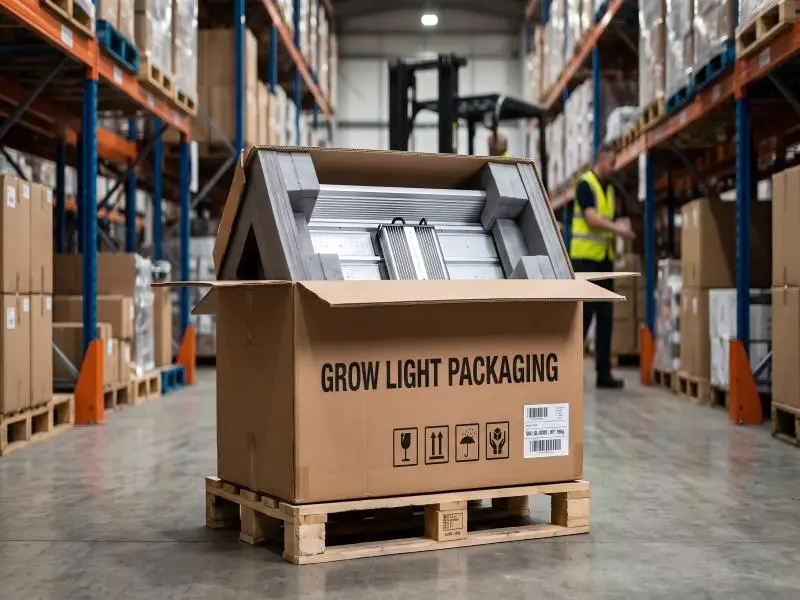
| Custom packaging & tooling | Offset carton printing suppliers enforce a 500–1,000 unit print run for full-color branded boxes. | Custom outer packaging is frequently the single largest driver of high private-label MOQs. |
As detailed in industry studies on diode reel minimums and SMT setup costs, understanding which specific component creates the MOQ bottleneck allows you to negotiate targeted compromises rather than arguing over total order volume.
Key takeaway: An LED factory’s MOQ is driven primarily by component sub-suppliers (diode reels, driver batches, packaging print runs) and line setup fees. Isolating these cost drivers gives you the leverage to propose realistic low-MOQ compromises.
7 Proven Levers to Negotiate Lower MOQs with Chinese Manufacturers
Rather than treating MOQ as a take-it-or-leave-it figure, use these seven field-tested B2B negotiation strategies to secure low trial orders and flexible OEM terms.
1. Separate Standard Housing from Custom Spectrum PCBA
Mechanical tooling for aluminum extrusion heat sinks and heavy steel mounting brackets carries significant manufacturing overhead. If you ask a factory for a custom aluminum mold alongside a custom spectral layout, they will insist on an OEM minimum of 1,000+ units.
The negotiation lever: Offer to use the factory’s standard, existing catalog housing and heat sink extrusion while customizing only the printed circuit board assembly (PCBA) diode spectrum.
By utilizing off-the-shelf mechanical frames, the factory eliminates custom extrusion setup costs. You get the exact photometrics, PPFD output, and spectral ratio your crops require while cutting the baseline LED grow light MOQ down to standard SMT assembly levels (typically 50 to 100 units).
2. Pay One-Time Setup and Printing Plate Fees Upfront
If a sales manager tells you, “We cannot customize the packaging or laser etch your logo for under 500 units,” the underlying constraint is usually a $150 to $250 packaging printing plate or laser setup charge from their sub-supplier.
The negotiation lever: Volunteer to pay the one-time tooling, laser calibration, or box printing plate fees directly as an itemized line item.
Example proposal:
“We understand your packaging sub-supplier requires a 500-box minimum. We will pay the $200 printing plate fee upfront today for our 100-unit pilot order, and you can hold the remaining 400 printed boxes in your warehouse for our follow-up orders this quarter.”
This removes the financial risk from the factory. They receive full coverage for setup expenses, while you maintain a lean inventory footprint.
3. Offer a Higher Upfront Deposit to Accelerate Cash Flow
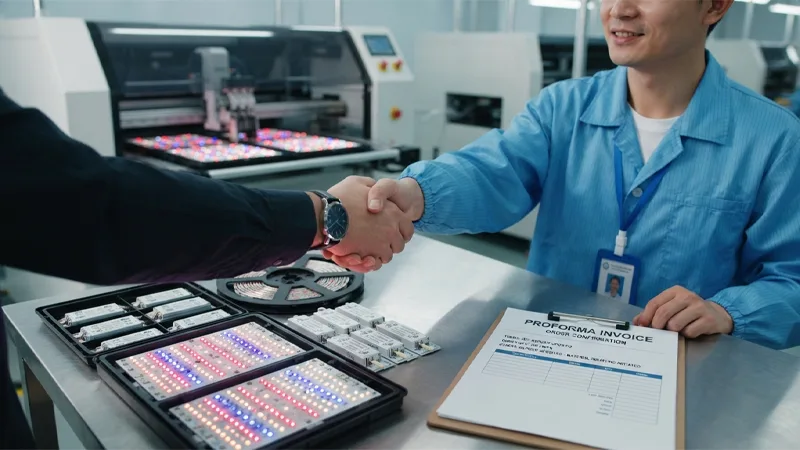
Standard B2B payment terms in China are typically 30% deposit upon PO placement and 70% balance payment before shipment (or against Bill of Lading copy). On small or non-standard production runs, factories worry about holding customized inventory if a new client defaults.
The negotiation lever: Propose a 50% upfront deposit in exchange for reducing the order quantity from 500 units to 100 units.
Increasing your deposit provides the manufacturer with immediate liquidity to purchase dedicated diode reels and driver batches. Demonstrating financial commitment builds immense trust with Chinese factory owners, who prioritize reliable cash flow over theoretical volume.
4. Bundle Orders Across SKUs and Wattages
If your cultivation facility or retail channel requires multiple fixture sizes—such as top-lighting bars, multi-tier rack fixtures, and side-lighting—placing separate low-volume orders for each SKU will trigger multiple high MOQs.
The Negotiation Lever: Consolidate your purchasing into a single Master Purchase Order that spans complementary fixture models.
For example, combine an order for a high-efficiency commercial 720W LED grow light for standard ceiling mounts with a heavy-duty 1000W foldable grow light fixture for high-DLI flowering rooms and a high-intensity 1300W high-output LED grow light for multi-tier commercial facilities.
Because these fixtures share common sub-components—such as identical LEDs, driver series, and mounting clips—the factory can aggregate raw material purchases across the entire PO to satisfy their sub-suppliers’ minimums.
| Order Approach | SKU Breakdown | Total Fixture Count | Factory MOQ Status |
|---|---|---|---|
| Unconsolidated POs | 30 x 720W Fixtures30 x 1000W Fixtures40 x 1300W Fixtures | 30 units/SKU30 units/SKU40 units/SKU | ❌ Rejected (Below 100-unit threshold per SKU) |
| Bundled master PO | 30 x 720W Fixtures30 x 1000W Fixtures40 x 1300W Fixtures | 100 Combined Units | ✅ Accepted (Shares diode reels & driver series) |
5. Accept Extended Lead Times and Off-Peak Production Slotting
Chinese manufacturing operates on tight scheduling windows. Forcing a low-volume custom order into a peak manufacturing window disrupts high-volume production lines.
The negotiation lever: Agree to a flexible 6-to-8-week lead time instead of demanding standard 3-week delivery.
Allowing the factory manager to slot your PCBA SMT run alongside another client’s production run using similar diode components dramatically reduces their setup downtime. In exchange for your scheduling patience, suppliers will readily accept lower unit thresholds.
6. Issue a Phased Purchase Order with Scheduled Pilot Deliveries
Factories prefer large orders because they guarantee predictable factory utilization. You can leverage this preference by structuring a single contractual Master PO with scheduled release batches.
The negotiation lever: Sign a Master PO for 500 units to lock in volume pricing, but contractually divide delivery into three phased batches:
- Batch 1 (Pilot Run): 100 units shipped immediately for facility installation and initial QA verification.
- Batch 2: 200 units scheduled for release 60 days post-installation.
- Batch 3: 200 units scheduled for release 120 days post-installation.
This structure satisfies the factory’s volume planning while allowing you to validate product performance in real-world canopy conditions before releasing capital for subsequent batches.
7. Agree to a Temporary Sample Surcharge with a Contractual Rebate
When a factory insists that an order below 200 units is unprofitable due to overhead, propose a temporary pricing adjustment backed by a rebate clause.
The negotiation lever: Pay a 5% to 10% unit price surcharge on an initial 50-unit pilot batch, with an explicit contract clause stating that the surcharge will be credited back against your first 500-unit reorder.
Rebate clause example:
“Buyer agrees to a unit price of $220 (standard volume price $200 + $20 pilot surcharge) for the initial 50-unit evaluation order. Upon placement of a follow-up order exceeding 300 units within 180 days, Seller agrees to credit $1,000 ($20 x 50 units) toward the final balance invoice.”
This guarantees that the factory covers its short-term setup costs while ensuring you do not permanently forfeit your margin once you scale.
Pro tip: Never negotiate MOQ in isolation. Always negotiate volume tiers, payment deposit percentages, lead times, and setup fees simultaneously so you can trade non-monetary concessions for lower unit minimums.
Contract Safeguards: Locking In Quality and Compliance
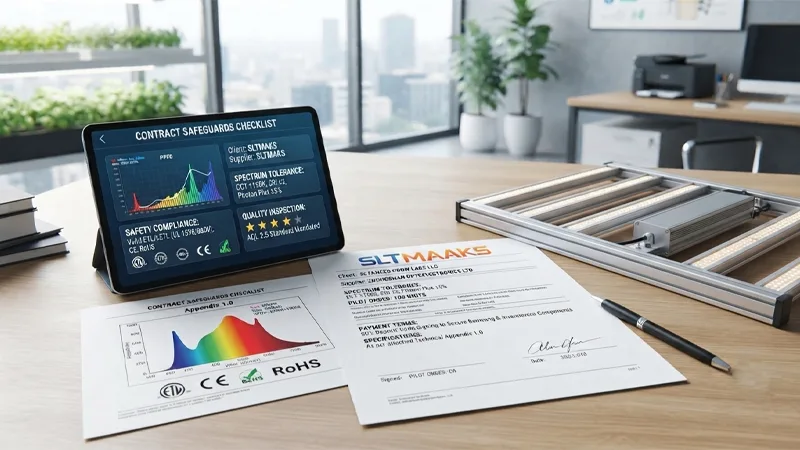
Securing a lower LED grow light MOQ is a major victory, but it must not come at the expense of product quality, electrical safety, or spectral accuracy. When factories agree to smaller production runs, procurement managers must ensure that quality control standards remain rigorous.
According to global supply chain standards referenced in research on standard factory MOQ thresholds, formalizing explicit technical specifications in your Proforma Invoice (PI) and Purchase Order (PO) prevents quality degradation on pilot runs.
B2B specification checklist:
- Photometric report: Require IES files & 3D PPFD distribution maps
- Spectrum tolerance: CCT ±150K, CRI ±2, Photon Flux ±5%
- Safety certification: Valid ETL / cETL (UL 1598/8800), CE, RoHS
- Quality inspection: Enforce AQL 2.5 defect inspection standard
- Component proof: Certified Samsung diode & Inventronics drivers
Key Technical Specs to Mandate in Writing
- Photometrics and spectral accuracy: Specify exact channel peak wavelengths (e.g. 660nm Deep Red, 730nm Far Red, 450nm Royal Blue) and photon efficacy metrics (μmol/J). Mandate CCT tolerances within ±150K and photon flux variance within ±5%.
- Electrical safety and regulatory compliance: Commercial indoor cultivation facilities in North America and Europe face strict building and electrical inspections. Ensure fixtures carry certified ETL / cETL (UL 1598 and UL 8800 horticultural standards), CE, and RoHS marks. Request valid certificate test report numbers directly from the laboratory (e.g., Intertek or SGS).
- Pre-shipment quality inspection (AQL 2.5): Stipulate that final payment is contingent upon passing a pre-shipment inspection based on ISO 2859-1 / ANSI/ASQ Z1.4 (AQL 2.5 Acceptable Quality Limit) conducted by an independent third-party auditor or factory QC team.
Copy-Paste B2B Negotiation Email Script
When opening negotiations for a lower MOQ with a Chinese LED grow light supplier, send a structured, professional proposal that addresses their cost concerns upfront.
Subject: RFQ & Pilot Order Proposal – Custom LED Grow Lights – [Your Company Name]
Dear [Factory Sales Manager Name / Supplier Name],
Thank you for providing the initial quotation and specifications for your commercial LED grow light fixtures. We are impressed by your manufacturing capabilities and quality control standards.
Regarding our initial project requirements, our engineering team has finalized the fixture specifications. However, as this represents our introductory deployment for a new commercial facility project, our initial pilot phase requires 100 units rather than your standard 500-unit MOQ.
To ensure this initial order is workable for your production team, we propose the following flexible terms:
- Standard mechanical frame: We will use your standard catalog aluminum housing and heat sink extrusion to avoid custom tooling costs.
- Setup fee coverage: We are happy to pay the one-time $200 packaging printing plate fee upfront for this pilot run.
- Payment terms: We will increase our initial deposit to 50% upfront upon PO signing to support your raw material procurement (Samsung diodes/drivers).
- Phased forecast: Upon successful installation and 60-day performance verification of this 100-unit pilot batch, our projected schedule calls for a follow-up order of 500 units in Q3.
Please confirm if you can update the Proforma Invoice to reflect these pilot terms so we can proceed with deposit remittance this week.
Best regards,
[Your Name]
[Your Title]
[Your Company Name & Website]
Partnering with Flexible, Factory-Direct Manufacturers
While learning to negotiate with traditional factories is invaluable, working directly with an agile, customer-centric manufacturer simplifies the entire procurement process.
At SLTMAKS, we specialize in professional-grade horticultural lighting designed specifically for commercial indoor cultivation operators, vertical farms, and equipment distributors. We combine advanced spectral engineering with flexible, low-MOQ manufacturing programs designed to help growing businesses scale safely.
Why Commercial Buyers Choose SLTMAKS
- Custom spectrum & OEM engineering: Access specialized spectral tuning, custom diode ratios, and white-label branding through our dedicated custom LED spectrum design and OEM manufacturing program.
- Low-MOQ trial programs: We support scaling commercial operators with flexible pilot orders starting as low as 50 to 100 units, allowing you to test spectra and build quality without locking up capital.
- Top-tier components & performance: Engineered with industry-leading Samsung LEDs and ultra-efficient drivers delivering up to 2.8+ μmol/J efficacy and superior PPFD canopy penetration.
- International certification & local warehousing: All fixtures are fully ETL, CE, and RoHS certified for seamless commercial compliance. With strategic local warehouse fulfillment across North America and Europe, we deliver fast local shipping, zero customs delays, and comprehensive 3-year warranty protection.
Whether you are retrofitting an existing facility, building out a multi-tier vertical farm, or expanding your distribution product line, our engineering team is ready to deliver tailored lighting solutions built around your operational budget.
Ready to discuss your custom LED grow light project with flexible factory-direct terms?
Contact the SLTMAKS Engineering Team Today to request a custom photometrics simulation, spectrum consultation, or low-MOQ quotation.
FAQ
What is the typical MOQ for custom LED grow light orders from Chinese manufacturers?
Standard Chinese LED grow light factories typically set minimum order quantities between 200 and 1,000 units for customized spectrums, private-label branding, or custom housing extrusions. However, by negotiating targeted concessions—such as using standard aluminum frames or paying upfront tooling fees—buyers can often reduce pilot order MOQs down to 50–100 units.
Can I order sample units before committing to a larger low-MOQ pilot order?
Yes, most manufacturers provide evaluation samples (typically 1 to 5 units) before mass production. While sample units carry a higher per-unit price and shipping fee, reputable suppliers will credit the sample cost back toward your first official Purchase Order upon contract signing.
How does changing the LED brand or spectrum affect factory MOQs?
Diode components are purchased in sealed factory reels of 4,000 to 10,000 chips. If your custom spectral ratio requires non-standard diodes or specific wavelengths (such as 730nm Far Red or UV), the factory must purchase full reels. To keep MOQs low, choose mainstream high-efficiency diodes (like Samsung LM301H or Osram 660nm) that the factory regularly uses in their high-volume production runs.
Does reducing the order quantity increase the shipping cost per fixture?
Yes, shipping smaller quantities via air freight or Less-than-Container Load (LCL) ocean freight results in higher per-unit transportation costs. To offset this, partner with manufacturers like SLTMAKS that maintain local fulfillment warehouses in North America and Europe, allowing you to leverage flexible local delivery without paying premium international freight rates on pilot batches.