For decades, horticultural lighting was dominated by a widespread misconception: because plants reflect green light, green wavelengths are useless for photosynthesis. This myth originated from early laboratory tests conducted on isolated chlorophyll extracts in test tubes, which showed sharp absorption peaks in the blue (400–500 nm) and red (600–700 nm) regions with a dramatic dip in the green region (500–600 nm).
However, an intact plant leaf in a commercial indoor facility is not a test tube filled with liquid chlorophyll. In a living crop canopy, optical biophysics operates under entirely different rules, making green light photosynthesis an indispensable driver of whole-plant biomass and crop yield.
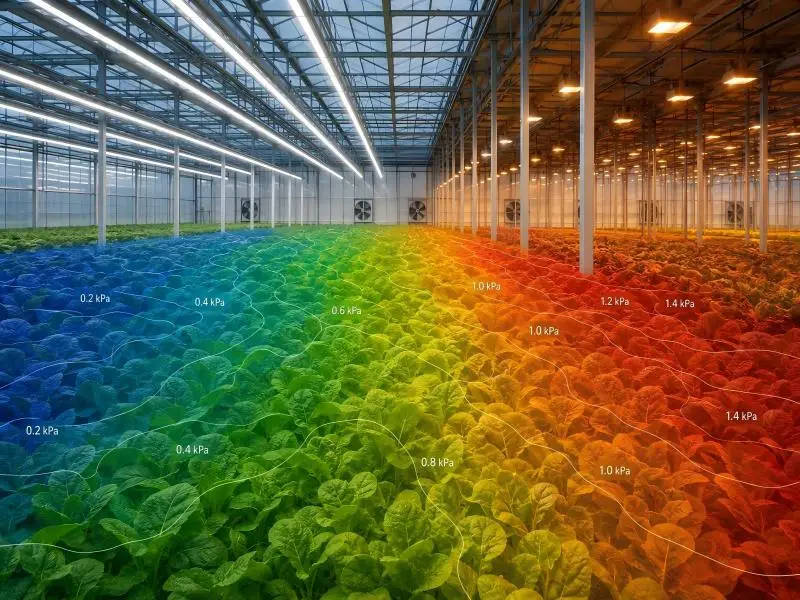
Modern plant photobiology demonstrates that green light plays a pivotal role in driving total crop photosynthesis. While red and blue photons are absorbed overwhelmingly by the upper surface of the top leaves, green photons penetrate deeper into individual leaf tissues and pass through upper leaf layers to illuminate lower canopy tiers. Understanding how green light penetrates crop canopies enables commercial operators to optimize broad spectrum LED grow lights, prevent lower-tier crop starvation, and maximize total yield per square meter.
Table of Contents
The Single-Leaf Optical Paradox: Absorption vs. Transmittance
To understand deep canopy photosynthesis, commercial growers must first distinguish between the spectral behavior of isolated chlorophyll and that of an intact plant leaf. In living leaves, chlorophyll molecules are densely packed inside specialized organelles called chloroplasts, which are arranged in distinct anatomical layers.
When light strikes a leaf, three optical events occur: absorption, reflection, and transmittance. While extracted chlorophyll absorbs almost no green light, an intact crop leaf absorbs approximately 75% to 85% of incoming PAR green wavelengths.
Key takeaway: Intact plant leaves absorb the vast majority of green light. According to leaf absorptance and transmittance research from Michigan State University, typical crop leaves absorb roughly 75–85% of green wavelengths, compared to 90–95% for red and over 95% for blue.
The critical difference lies in leaf transmittance of green light and surface saturation. Blue and red wavelengths are absorbed so strongly by the uppermost cell layers that almost none pass through the leaf. In contrast, an individual leaf transmits 5% to 15% of incident green light to the cell layers directly below it or to lower leaves in the canopy stack.
| Waveband Region | Wavelength Range | Single-Leaf Absorptance | Single-Leaf Transmittance | Primary Absorption Site |
|---|---|---|---|---|
| Blue | 400-500nm | ~ 95%+ | < 1-2% | Upper leaf cuticle & upper palisade layer |
| Green | 500-600 nm | 75-85% | 5-15% | Distributed across upper & lower mesophyll |
| Red | 600-700 nm | ~ 90-95% | 1-3% | Upper & mid palisade cells |
The Biophysical Mechanism: How Green Light Travels Through Leaf Tissue
Why does green light travel deeper through leaf tissue than red or blue light? The answer lies in internal leaf anatomy and fundamental optical physics, which together enable efficient green light photosynthesis throughout the mesophyll.
A typical dicot leaf consists of two primary photosynthetic tissue zones: the upper palisade parenchyma and the lower spongy mesophyll. The palisade layer contains tightly packed, column-like cells filled with chlorophyll. Because chlorophyll a and b possess high absorption coefficients for blue and red photons, these wavelengths are stripped out within the first few micrometers of the palisade tissue.
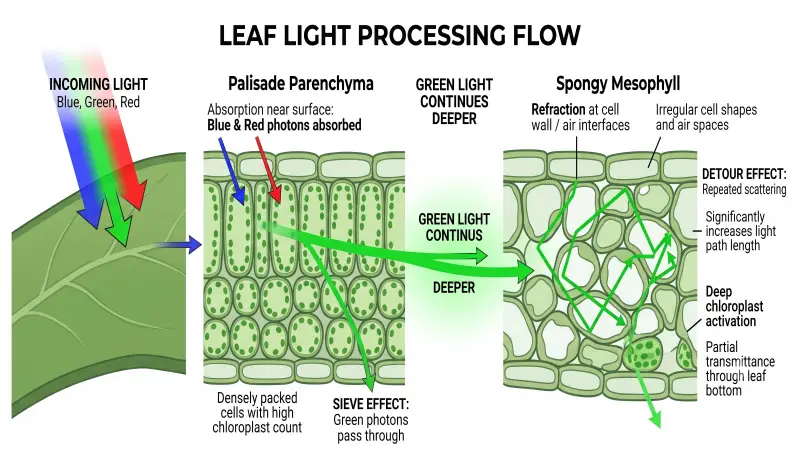
Green light, having a lower absorption coefficient per unit of chlorophyll, experiences two crucial optical phenomena:
- The sieve effect: Because chlorophyll is localized inside discrete chloroplasts rather than dissolved uniformly, some green photons pass through the gaps between chloroplasts without being intercepted. This allows green light to reach deeper cell layers.
- The detour effect: The spongy mesophyll contains irregularly shaped cells separated by microscopic air spaces. As green photons travel through these tissues, they repeatedly cross cell wall–air interfaces.
The refractive index mismatch between hydrated cell walls (≈1.38) and intercellular air spaces (≈ 1.00) causes diffuse scattering. This scattering bends the path of green light, bouncing photons back and forth within the spongy mesophyll. This “detour” dramatically lengthens the optical path length of green light inside the leaf, increasing the probability that green photons are eventually captured by deep-seated chloroplasts that red and blue light never reach.
Pro tip: A detailed photobiological analysis in the Journal of Experimental Botany highlights that internal light scattering extends the path length of green photons by up to several times the physical thickness of the leaf, transforming moderate absorption into high whole-leaf photosynthetic efficiency.
The Terashima Effect: Photosynthetic Efficiency Under High Light Intensity
In 2009, a research team led by Ichiro Terashima at the University of Tokyo published a study that fundamentally reshaped horticultural lighting science and our understanding of green light photosynthesis. The researchers investigated how different light wavebands drive CO2 fixation when applied as supplemental light on top of a high-intensity background light.
Under low light conditions (<100 μmol/m²/s), red light exhibits the highest quantum yield of photosynthesis. However, commercial cultivation facilities operate at much higher light intensities, frequently supplying 500 to 1,500+ μmol/m²/s of Photosynthetically Active Radiation (PAR).
Under high light intensity, the chloroplasts in the upper palisade layer become saturated with light. Once a chloroplast reaches its light saturation point (Ik), it cannot process additional photons into chemical energy any faster. Excess red or blue photons absorbed by these saturated upper chloroplasts cannot increase photosynthesis; instead, the energy is dissipated harmlessly as heat through Non-Photochemical Quenching (NPQ).
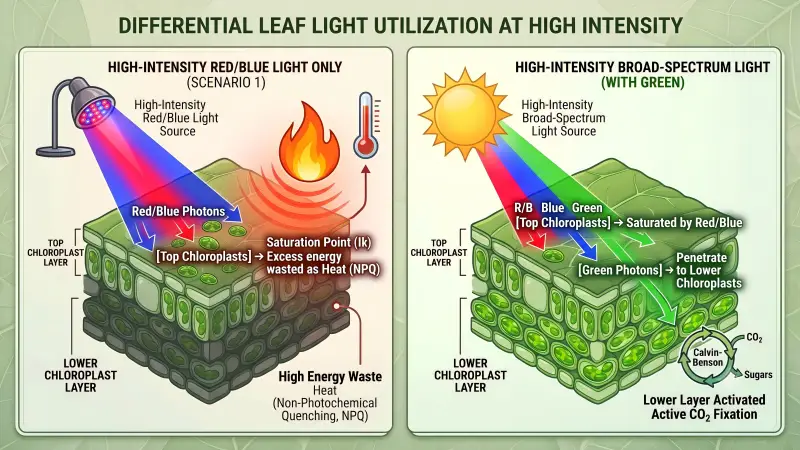
Because green light penetrates deeper into the leaf, green photons pass through the saturated upper chloroplasts and reach the unsaturated chloroplasts in the lower mesophyll.
The landmark 2009 photobiology study by Terashima et al. proved that under strong white background light, additional green photons drive leaf photosynthesis more efficiently than additional red or blue photons. The green photons activate lower-layer chloroplasts that still have available photosynthetic capacity, raising the net CO2 assimilation rate of the entire leaf.
Canopy-Scale Photobiology: Overcoming Light Starvation in Dense Crop Tiers
While leaf-level optical properties demonstrate how green light activates inner mesophyll tissue, the advantages of green light canopy penetration become even more pronounced when scaling up to a multi-layer crop canopy in a commercial indoor farm.
In high-density cultivation environments with a high Leaf Area Index (LAI), top leaves shade middle and lower leaves. Light attenuation through a crop canopy follows a mathematical relationship known as the Beer-Lambert Law:
Iz = I0 • e-k • LAI
Where:
- Iz is the light intensity at canopy depth z.
- I0 is the incident light intensity at the top of the canopy.
- k is the extinction coefficient of the specific wavelength.
- LAI is the cumulative Leaf Area Index above depth z.
Monochromatic red and blue wavebands have high extinction coefficients ($k \approx 0.8\text{–}1.0$). As a result, the top one or two leaf tiers absorb virtually all red and blue photons, creating a steep light gradient. Under pure red/blue “blurple” lighting, lower canopy tiers exist in near-total darkness, leading to lower leaf senescence, yellowing, and poor fruit or flower development on lower branches.
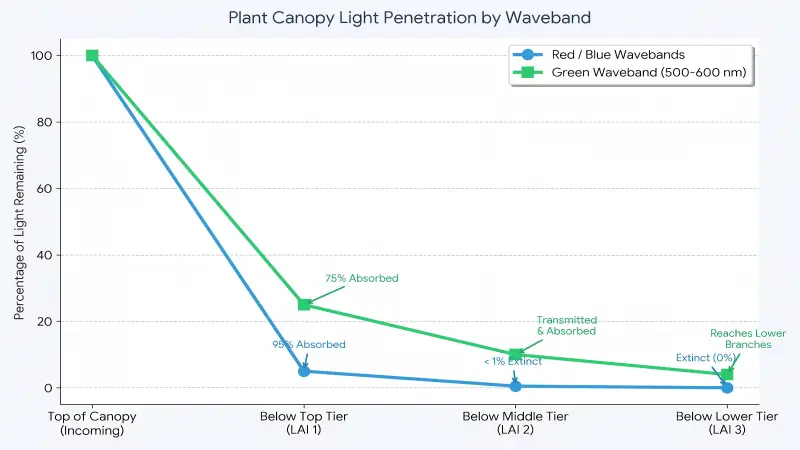
Green light has a lower extinction coefficient ($k \approx 0.4\text{–}0.6$). Because upper leaves transmit 5% to 15% of green photons, green light filters down through multiple canopy layers to support deep canopy photosynthesis.
This deep canopy penetration delivers vital photon flux to shaded leaves, maintaining active photosynthesis across the entire plant volume. As a result, commercial growers achieve more uniform bud and fruit distribution, higher overall dry weight yield, and improved crop consistency across all harvest tiers.
Commercial Spectrum Engineering: Why Broad Spectrum LED Grow Lights Outperform Monochromatic Lights
The scientific consensus on green light photosynthesis and canopy penetration has driven a major industry transition away from legacy red/blue LED fixtures toward broad spectrum LED grow lights.
Modern commercial LED grow lights engineered for commercial agriculture rely on high-efficacy phosphor-converted white LEDs (such as Samsung 3000K and 5000K diodes) supplemented with deep red (660 nm) and far-red (730 nm) diodes.
Broad-Spectrum LED Energy Distribution
| Spectrum (Wavelength) | Energy Distribution | Function / Effect |
| Blue (400–500 nm) | ~15–20% | Vegetative structure & stomatal regulation |
| Green (500–600 nm) | ~15–25% | Deep canopy penetration & worker ergonomics |
| Red (600–700 nm) | ~50–60% | Primary photosynthetic driver |
| Far-Red (700–750 nm) | ~5–10% | Emerson enhancement & shade response |
Incorporating PAR green wavelengths (15% to 25% green photon fraction) within a full-spectrum fixture provides key operational advantages for commercial indoor facilities:
- Balanced PAR distribution: Delivers uniform photon flux from top leaves down to middle branches, ensuring consistent crop density. Commercial growers targeting high PPFD levels can review recommended fixture setups and broad-spectrum PAR distribution and PPFD targets to calibrate hanging heights and coverage maps.
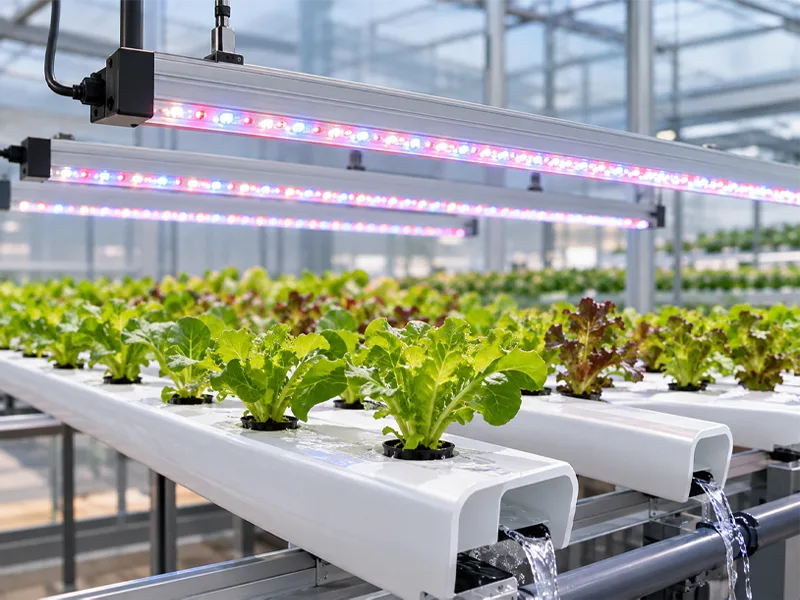
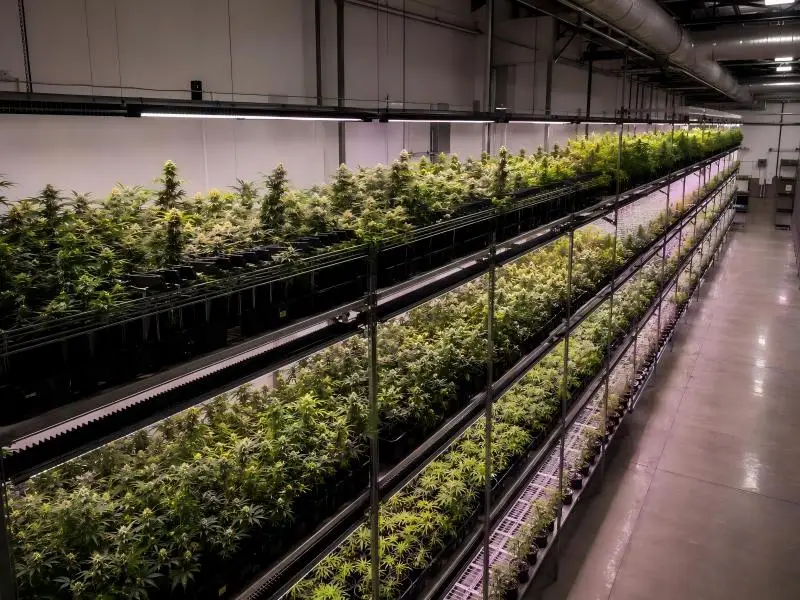
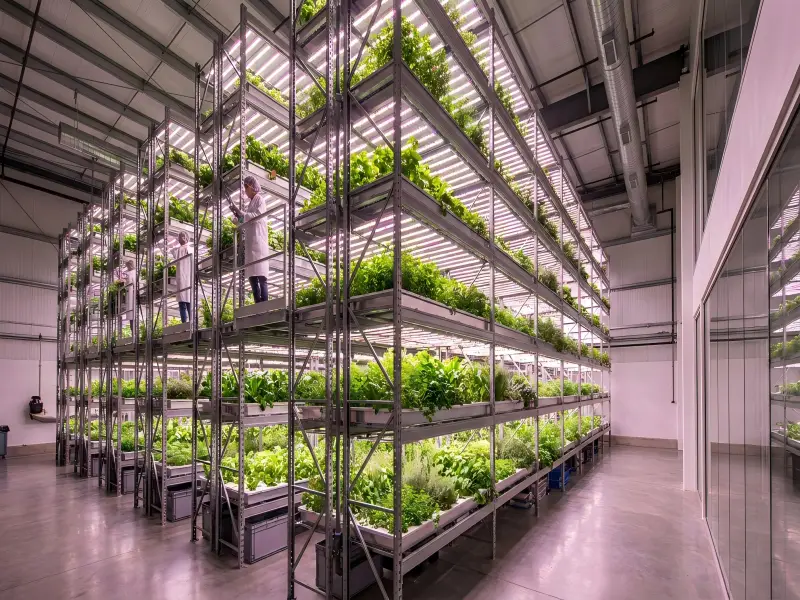
- Superior canopy penetration: High-power commercial indoor LED grow lights maintain active photosynthesis in dense multi-tier racking systems and vertical farm layouts.
- Visual inspection clarity: Monochromatic red/blue lighting makes plants appear dark purple, hiding early signs of nutrient deficiencies, spider mites, or fungal pathogens. Broad-spectrum white light containing green wavelengths renders plants in natural human-visible color, allowing crop scouts and operators to spot health issues immediately.
- Custom recipe flexibility: Advanced CEA facilities can deploy custom light recipes for commercial agriculture that adjust green and far-red ratios to manage internodal spacing without sacrificing lower-canopy photosynthetic output.
To maintain maximum yield and canopy uniformity across all growth cycles, growers replacing legacy HPS or outdated red/blue fixtures should opt for sun-like full-spectrum LED fixtures built with industrial-grade thermal management and verified photon efficacy.
FAQ
Do plants absorb green light for photosynthesis?
Yes. Intact crop leaves absorb between 75% and 85% of green light (500–600 nm). While extracted chlorophyll in liquid solution shows lower green absorption, living leaves process green photons highly efficiently through internal tissue scattering and deep chloroplast activation.
Why does green light penetrate crop canopies better than red or blue light?
Green light has a lower single-leaf absorption coefficient than red or blue light. Because upper leaves absorb roughly 95% of blue and 90% of red light, those wavelengths are depleted near the surface. Green light is transmitted at a rate of 5% to 15% per leaf layer, allowing green photons to pass through top leaves and achieve green light canopy penetration into lower canopy levels.
What is the Terashima effect in green light photosynthesis?
The Terashima effect refers to research led by Dr. Ichiro Terashima (2009) showing that under high background light intensity, adding green photons increases leaf photosynthesis more efficiently than adding more red or blue photons. This occurs because upper chloroplasts are saturated by red/blue light, while green light penetrates deeper to excite unsaturated chloroplasts in lower mesophyll layers.
What percentage of green light should an LED grow light have?
Most commercial broad spectrum LED grow lights incorporate a 15% to 25% green light fraction, typically provided by phosphor-converted white LEDs (3000K to 5000K). This proportion provides sufficient green photons for deep canopy photosynthesis and human visual inspection without compromising overall fixture photon efficacy (µmol/J)).
Planning a facility lighting upgrade or retrofitting multi-tier racks for higher canopy penetration? Explore SLTMAKS full-spectrum LED lighting solutions and request customized photometric layouts tailored to your crop’s target DLI.