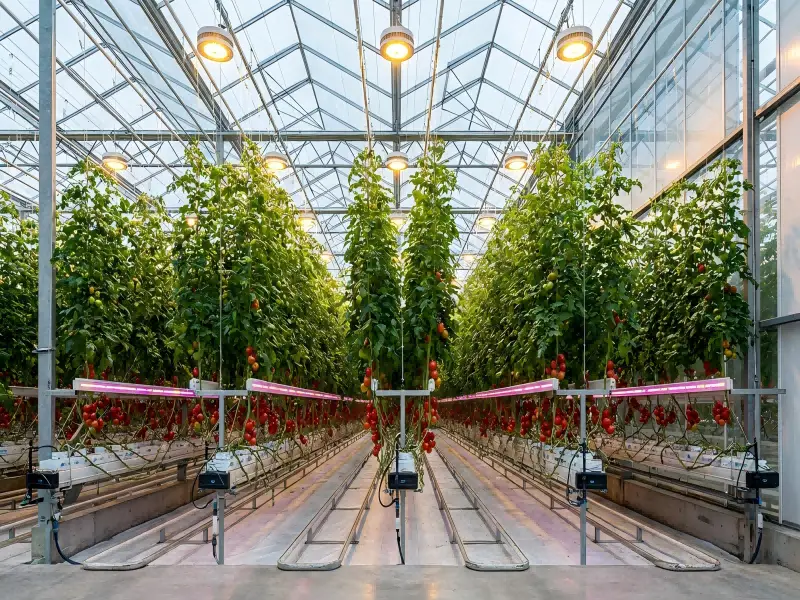
Commercial high-wire tomato production relies on maintaining an extensive, highly productive vertical vine structure. In modern greenhouse and indoor cultivation facilities, indeterminate tomato crops reach lengths of 10 to 12 meters (30 to 40 feet) over a typical 40 to 50 week growing cycle. While the vine is continually lowered along supporting overhead wires, the active green canopy forms a dense, vertical leaf mass extending 2.5 to 3.5 meters downward from the growing tip.
Managing light distribution across this tall, multi-layered canopy represents one of the most critical engineering challenges for commercial growers. Traditional lighting strategies rely exclusively on top-lighting LED fixtures suspended above the gutter line. However, as plant density increases and Leaf Area Index (LAI) climbs above 3.5 m²/m², upper leaves absorb the vast majority of photons, creating a steep light attenuation gradient. By the time natural sunlight or overhead LED light reaches the middle and lower leaf zones, Photosynthetic Photon Flux Density (PPFD) drops significantly—often falling below the light compensation point required to sustain positive net carbon assimilation.
To overcome this vertical light deficit, commercial growers increasingly deploy inter canopy lighting—installing linear LED fixtures directly within the plant rows at mid-canopy height. This guide provides a rigorous architectural comparison among top-lighting-only, inter-canopy-lighting-only, and hybrid lighting systems, evaluating photon optics, leaf physiology, energy efficiency, microclimate impact, and capital payback.
Architectural Comparison Matrix
The table below summarizes how the three primary lighting configurations perform across core agronomic, electrical, and operational metrics in high-wire tomato facilities:
| Engineering & Agronomic Metric | Top-Lighting Only | Inter-Canopy Lighting Only | Hybrid (Top + Inter-Canopy) |
|---|---|---|---|
| Primary canopy coverage zone | Apical (top 0.5–1.2 m) | Middle & Lower Canopy (1.2–2.8 m) | Full Vertical Canopy (0–3.5 m) |
| PPFD uniformity (vertical CV) | High variance (CV ~48%) | Moderate Variance (CV ~43%) | Lowest Variance (CV ~37%) |
| Canopy light interception | Baseline (I0) | +8% Photon Capture vs Top | Maximum Optical Efficiency |
| Lower leaf senescence rate | Accelerated (light starvation) | Significantly Delayed | Delayed; Active Assimilate Supply |
| Fruit brix & quality impact | Baseline | +0.5° to +1.2° Brix | +0.8° to +1.5° Brix |
| HVAC thermal distribution | Sensible heat concentrated at roof | Distributed mild micro-convection | Balanced roof & canopy heat load |
| Installation complexity | Low (fixed overhead mounting) | Moderate (In-row cabling & brackets) | Moderate-High (Dual power distribution) |
| Commercial yield delta | Baseline | +10% to +18% (Standalone) | +15% to +27% (Optimized DLI) |
Canopy Optics & Photon Penetration: The Physics of Light Attenuation
Understanding why overhead lighting struggles in high-wire tomato crops requires examining the physics of light extinction within dense plant populations. Light penetration through a crop canopy follows the Beer-Lambert extinction model:
Iz=I0 • e-k•LAI
Where Iz represents the PPFD at depth z, I0 is the incident PPFD at the top of the canopy, k is the extinction coefficient (typically 0.7 to 0.9 for high-wire tomatoes with horizontal leaf orientation), and LAI is the cumulative Leaf Area Index from the apical tip downward.
Lighting strategy comparison
| Feature / Canopy Level | Top-Lighting Only | Hybrid (top + inter-canopy) |
| Overhead top-light input | 1000 µmol/m²/s | 700 µmol/m²/s |
| Top leaves | 800 µmol/m²/s(saturated / heat quenching) | 600 µmol/m²/s(high quantum efficiency) |
| Mid leaves | 150 µmol/m²/s(light starved) | 150 + 200 = 350 µmol/m²/s(active photosynthesis) |
| Lower leaves | 0 µmol/m²/s (below compensation point) | 120 µmol/m²/s(sustained assimilates) |
In a commercial greenhouse with an LAI of 4.0, a top-lighting system delivering 1000 µmol/m²/s at the top of the crop leaves less than 50 µmol/m²/s at a depth of 2.0 meters. Pushing higher top-lighting intensities to force light deeper produces diminishing returns: top leaves reach light saturation (Isat ≈ 700-900µmol/m²/s), dissipating excess energy as heat through Non-Photochemical Quenching (NPQ). Meanwhile, lower leaves remain severely photon-deprived.
Key takeaway: Increasing top-lighting PPFD beyond upper leaf saturation wastes electrical energy through thermal dissipation. Inter-canopy placement bypasses top-leaf absorption barriers, delivering photons directly into photon-starved middle leaf layers.
Lower Canopy Photosynthesis: Delaying Senescence & Accelerating Fruit Fill
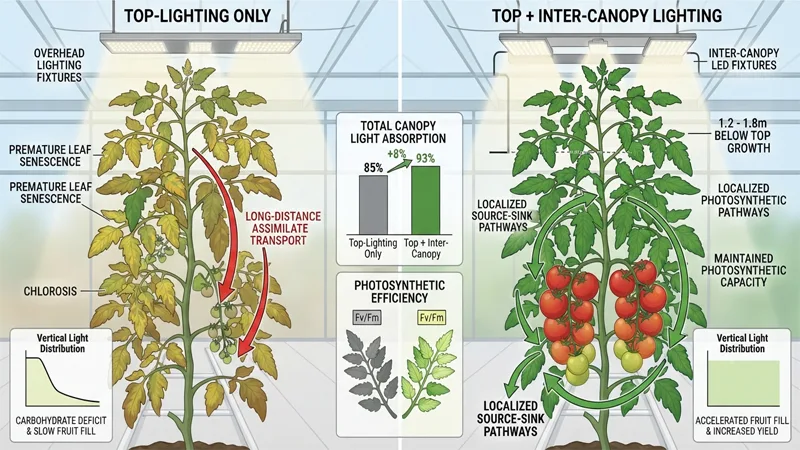
In high-wire tomato plants, photoassimilates (sugars produced during photosynthesis) are transported along localized source-to-sink pathways. Developing tomato fruit clusters (trusses) import the majority of their carbohydrates from the nearest adjacent leaves—typically the 3 to 4 leaves directly above and below the cluster.
When lower and middle leaves are shaded under top-lighting alone, two major physiological bottlenecks occur:
- Premature leaf senescence: Shaded leaves remobilize mobile nutrients (nitrogen, phosphorus) toward upper growth, resulting in rapid chlorosis, loss of chlorophyll, and early leaf removal (de-leafing).
- Carbohydrate deficits during fruit filling: Developing fruit trusses in the lower canopy must rely on long-distance assimilate transport from distant upper leaves. This leads to slower fruit expansion, lower average fruit weight, and reduced soluble solids (°Brix).
By positioning inter-canopy lighting fixtures in the mid-canopy zone (typically 1.2 to 1.8 meters below the top growth), growers supply 150 to 250 µmol/m²/s directly to leaves surrounding active fruit trusses. Scientific research published in Wageningen University canopy photon absorption research (2023) demonstrated that intra-canopy lighting increases total whole-canopy light absorption by 8% compared to top-lighting alone, while significantly homogenizing vertical light distribution.
Furthermore, a peer-reviewed lower-canopy photosynthetic capacity study revealed that supplemental inter-canopy illumination maintains higher photosynthetic quantum yield ($F_v/F_m$) in shaded foliage, extending functional leaf lifespan and driving direct carbohydrate flow into filling fruit.
Total DLI Contribution & System Energy Efficacy
Commercial tomato cultivation requires a target Daily Light Integral (DLI) of 30 to 35 µmol/m²/day to achieve maximum commercial yield potential (60-85kg/m2/year depending on region and facility type). During winter months in temperate zones, natural solar DLI often drops below 5 to 8 µmol/m²/day, requiring 22 to 28 µmol/m²/day of supplemental electric lighting.
When evaluating lighting architecture for DLI contribution, energy efficacy (µmol/J) must be combined with optical interception efficiency:
- Top-lighting Fixture Efficacy: High-power top-lighting fixtures achieve high photon efficacy (up to 3.5-3.8 µmol/J). However, up to 10–15% of overhead photons are lost to greenhouse structural walkways, walls, or reflected off upper leaves.
- Inter-canopy Fixture Efficacy: Modern double-sided inter-canopy fixtures deliver 3.0-3.3µmol/J with wide double-sided batwing optics (110°-130°). Because the light source is surrounded by leaf tissue on both sides, photon interception efficiency approaches 95–98%.
Top-Lighting Only:
[100% Overhead Energy Input] ──> 12–15% Loss (Walkways/Reflectance) + 55% Top Absorption + 30% Mid/Lower Penetration
Hybrid Strategy:
[70% Top + 30% Inter-Canopy] ──> 8% Loss + 50% Top Absorption + 42% Mid/Lower Direct Absorption
Deploying high-efficacy commercial indoor LED grow lights for top-lighting provides the baseline overhead DLI, while supplemental inter-canopy modules deliver precise secondary photon doses into the dense foliage below.
Yield & Fruit Quality Metrics: Brix, Uniformity, and Harvest Timing
The ultimate validation of any lighting architecture lies in harvest performance. Commercial greenhouse trials comparing top-lighting with hybrid top + inter-canopy setups consistently document improvements in both total biomass and fruit quality attributes:
1. Total Fruit Yield (kg/m²)
Data from commercial greenhouse yield trials (2026) showed that adding LED inter-canopy lighting to high-wire tomato crops increased overall yields by 20% to 24% under commercial production conditions. The yield increase stems primarily from larger individual fruit mass and higher fruit setting rates on middle and lower trusses during low-sunlight periods.
2. Sugar Content (°Brix) and Flavor Profile
Because inter-canopy light stimulates direct photosynthesis in leaves adjacent to fruit trusses, carbon conversion into fructose and glucose increases. Commercial growers report an average increase of 0.5° to 1.2° Brix in high-wire beefsteak and truss tomato cultivars, producing sweeter, higher-grade fruit that commands premium market pricing.
3. Harvest Uniformity and Ripening Speed
Under top-lighting alone, lower fruit trusses experience delayed color turn due to lower ambient temperatures and reduced local photon flux. Inter-canopy lighting provides mild radiant warming alongside targeted photon delivery, accelerating color development and narrowing the harvest window across the truss.
Pro tip: When adjusting inter-canopy light levels, monitor the distance between the fixture and active fruit trusses. Maintain a 15 to 20 cm clearance to avoid localized fruit skin heating while maximizing photon absorption on surrounding leaves.
Microclimate, HVAC, and Physical Facility Engineering
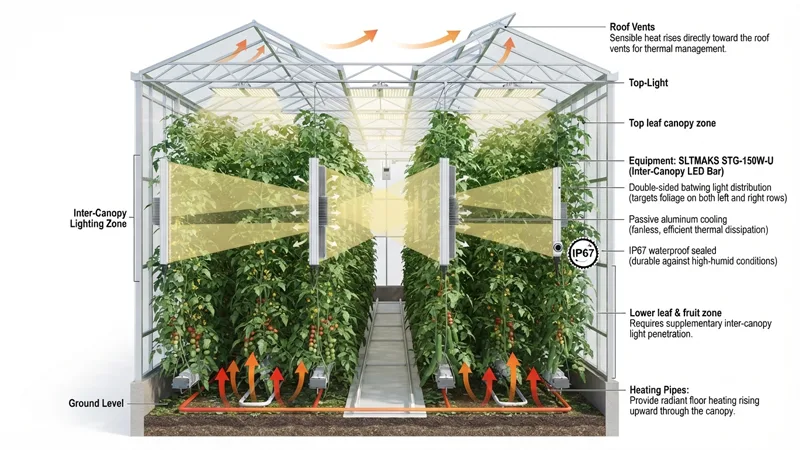
Integrating electrical fixtures inside a dense, humid plant canopy requires strict engineering controls for microclimate management, electrical safety, and mechanical durability.
High-wire greenhouse crop canopy system layout
Canopy Structure & Climate Control (Top to Bottom)
- Upper roof zone
Roof top-light: Sensible heat rises directly toward the roof vents for thermal management. - Top leaf canopy zone
Upper layer receiving overhead light. - Inter-canopy lighting zone
Positioned between Leaf Row 1 foliage and Leaf Row 2 foliage:
Equipment:SLTMAKS STG-150W-U(Inter-Canopy LED Bar)
Double-sided batwing light distribution (targets foliage on both left and right rows)
Passive aluminum cooling (fanless, efficient thermal dissipation)
IP67 waterproof sealed (durable against high-humidity conditions) - Lower leaf & fruit zone
Dense foliage and crop development region requiring supplementary inter-canopy light penetration. - Ground level
Heating Pipes: Provide radiant floor heating rising upward through the canopy.
1. Ingress Protection (IP Rating) and Washdown Durability
Greenhouse inter-canopy fixtures operate in a demanding environment subject to crop spraying, high relative humidity (80–90% RH), and high-pressure water washdowns during post-harvest sanitation. Fixtures must feature a minimum rating of IP65, with premium commercial fixtures built to IP67 standards using tempered glass lenses and anodized aluminum enclosures.
2. Thermal Management & Passive Cooling
Inter-canopy LED modules must operate without active cooling fans, which are prone to dust and moisture failure in greenhouse environments. Fixtures rely on slim, double-sided aluminum heat sinks to dissipate driver and diode heat passively. Surface temperatures should not exceed 50°C to 55°C, preventing leaf scorching when foliage contacts the fixture casing during vine movement.
3. Air Circulation & Humidity Micro-Pockets
Dense foliage can create stagnant humidity pockets surrounding lower leaves, increasing susceptibility to Botrytis cinerea (grey mold). The mild sensible heat generated by inter-canopy LED bars creates localized thermal micro-convection currents. Rising air movement helps break boundary layer resistance on leaf surfaces, promoting transpiration and reducing microclimate humidity stagnation.
4. Labor Operations & Mechanical Clearance
Commercial high-wire operations perform routine labor tasks including de-leafing, side-shoot pruning, truss taping, and vine lowering. Inter-canopy fixtures must be mounted using quick-release suspension cables or rigid row brackets that maintain vertical alignment without obstructing worker movement or vine lowering trolleys.
CapEx vs. OpEx Financial Framework: Calculating Payback in Commercial CEA
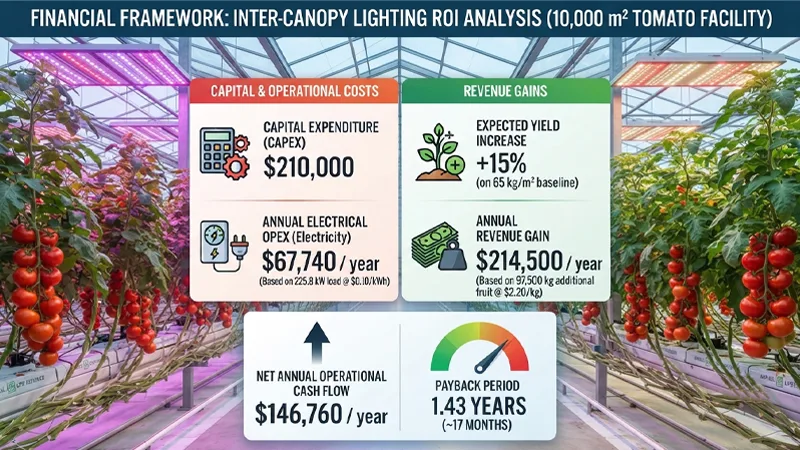
Evaluating whether to install inter-canopy lighting requires a complete Total Cost of Ownership (TCO) calculation comparing initial capital expenditure (CapEx) against operational energy costs (OpEx) and yield revenue gains.
Sample Financial Model (10,000 m² Commercial High-Wire Tomato Facility)
Assumptions:
- Baseline top lighting: 180 µmol/m²/s LED top-lighting
- Supplemental inter canopy addition: 70 µmol/m²/s LED inter-canopy lighting
- Supplemental operating hours: 3,000 hours/year (winter/spring operation)
- Electricity rate: $0.10 per kWh
- Wholesale tomato price: $2.20 per kg
Financial calculations:
- Added installed power (inter-canopy):
70 µmol/m²/s ÷ 3.1 µmol/J = 22.58 W/m²
10,000 m² × 22.58 W/m² = 225.8 kW total connected load - Annual electrical opEx:
225.8 kW × 3,000 hours × $0.10/kWh = $67,740 / year - Capital expenditure (fixtures, power distribution, installation brackets):
Approx. $18.00 to $24.00 per m² = $210,000 total CapEx - Expected yield increase (15% on 65 kg/m² baseline):
65 kg/m² × 15% = 9.75 kg/m² additional yield
10,000 m² × 9.75 kg/m² = 97,500 kg additional fruit / year - Annual revenue gain:
97,500 kg × $2.20/kg = $214,500 / year - Net annual operational cash flow:
$214,500 (Revenue) – $67,740 (Electricity) = $146,760 / year - Payback period:
$210,000 CapEx ÷ $146,760 Net Cash Flow = 1.43 Years (~17 Months)
In commercial high-wire tomato production, the combination of higher yield volume, improved °Brix quality grading, and rapid capital payback makes inter-canopy supplementation one of the highest-ROI investments available for greenhouse retrofits and new builds.
Architectural Recommendations: Choosing the Right Configuration
Select the lighting configuration that matches your facility type, crop variety, and operational goals:
Scenario A: Top Lighting Only
- Best for: Low-density crops, short-canopy greens, young vegetative propagation, or low-ceiling indoor facilities where mounting height is restricted (< 3.0 meters).
- Strategy: Deploy high-efficiency overhead fixtures to maximize top-surface DLI.
Scenario B: Inter Canopy Lighting Only
- Best for: Supplemental daylight greenhouses with high natural solar radiation where roof structure weight limits prevent adding heavy overhead top-lighting, but lower canopy shading remains an issue during peak growth.
Scenario C: Hybrid Top + Inter Canopy Lighting (Recommended Gold Standard)
- Best for: Commercial high-wire tomato, cucumber, and pepper operations seeking maximum yield (>75kg/m2/year), year-round consistency, and premium fruit quality.
- Strategy: Allocate 65% to 75% of total supplemental PPFD to overhead top lighting (e.g., commercial greenhouse supplemental lighting systems) and 25% to 35% to modular inter-canopy fixtures placed at mid-canopy height.
Next Steps for Commercial Cultivators
Optimizing lighting architecture for high-wire crops requires tailored optical modeling that accounts for your facility’s geographic latitude, greenhouse dimensions, natural light transmission, and target yield goals.
SLTMAKS engineers custom high-efficiency greenhouse lighting solutions, including high-power top lighting systems and IP67 double-sided inter canopy LED bars designed for commercial high-wire operations.
Request a custom light plan: Contact our engineering team today to receive a comprehensive photometric layout simulation (IES files), PPFD canopy distribution map, and custom ROI financial calculation for your facility.
FAQ
What is inter canopy lighting and how does it work?
Inter canopy lighting is an agricultural lighting strategy where LED light fixtures are placed within the dense crop foliage rather than above it. By positioning lights inside the plant canopy, it delivers essential light directly to lower leaves that are typically shaded, maximizing photosynthesis throughout the entire plant structure.
What are the main benefits of using inter-canopy lighting in greenhouses?
The key advantages include significantly higher crop yields, improved fruit or flower quality on lower branches, better energy efficiency, and reduced shading issues in high-density crops like tomatoes, cucumbers, and tall floriculture plants.
Which crops benefit the most from inter canopy lighting?
Inter canopy lighting is most effective for tall, dense, or vine crops grown in indoor farming or greenhouse environments. Common applications include vine tomatoes, cucumbers, bell peppers, cannabis, and high-density medicinal plants.
How does inter canopy lighting compare to traditional top lighting?
Traditional top lighting illuminates only the upper leaves, leaving lower foliage in the shade. Inter-canopy lighting supplements top lighting by targeting hidden leaves directly, resulting in more uniform plant growth, optimized light absorption, and lower overall energy waste.
What type of lights are best suited for inter canopy installation?
Slim, low-heat LED fixtures designed with wide light distribution angles are best suited for inter-canopy setup. LED technology is critical because it generates minimal heat, preventing burns on leaves that come into close contact with the light modules.