Introduction
Why Firmness Matters in Commercial CEA
In commercial Controlled Environment Agriculture (CEA), fresh biomass yield is only half of the profitability equation. While rapid vegetative expansion drives total harvest weight, buyers across retail and food-service channels evaluate produce based on structural integrity, crispness, and post-harvest shelf life. Soft or limp leaves bruise easily during automated packing, deteriorate rapidly in cold-chain transit, and suffer high shrinkage rates on retail displays. Achieving structural leaf firmness without sacrificing harvest weight determines whether a commercial indoor vertical farm achieves sustainable margins.
How the Red-blue Light ratios Leafy Greens Affect Texture and Yield
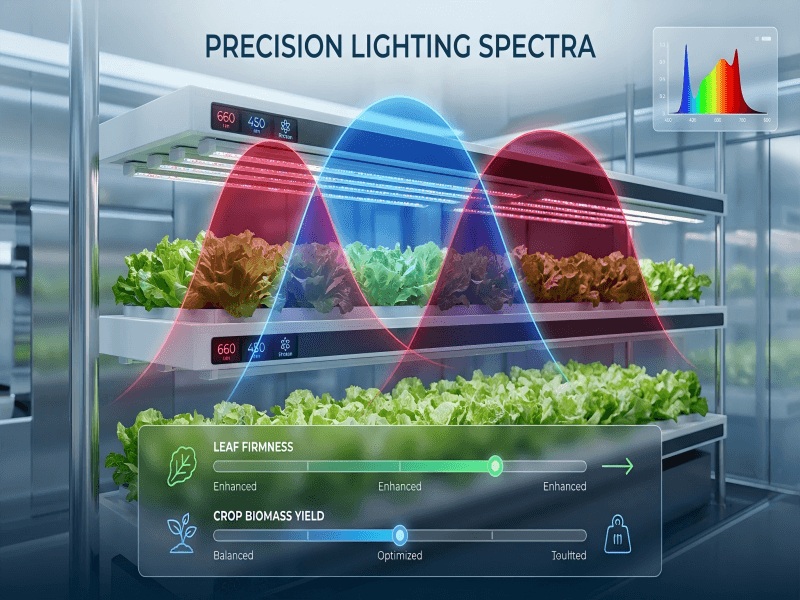
The spectral composition of artificial lighting directly controls plant morphology and cellular structure. Adjusting the red-blue ratio that leafy greens receive signals specific photoreceptors that govern cell division, leaf lamina expansion, and epidermal tissue density. Red wavelengths (660nm) stimulate chlorophyll absorption and rapid leaf expansion, driving fresh biomass yield. Conversely, blue wavelengths (450nm) activate cryptochromes and phototropins, promoting palisade cell elongation, thicker leaf cross-sections, and elevated accumulation of structural carbohydrates. Balancing these two wavebands allows facility operators to engineer targeted texture profiles—ranging from tender butterhead leaves to ultra-crisp romaine.
What You Will Gain: Actionable Ranges and Deployment Steps
This guide translates academic photobiology research into practical lighting protocols for commercial operators. You will gain:
- Evidence-backed red: blue ratio frameworks for head lettuce, butterhead, and romaine cultivars.
- Quantitative insights into how far-red (700-750nm) photons interact with photosynthetically active radiation (PAR) to boost yield without causing structural collapse.
- Specific spectral targets for spinach production, including mechanisms for nitrate reduction and mineral optimization.
- A step-by-step facility validation framework covering pilot design, electrical safety compliance, Light Use Efficiency (LUE) metrics, and multi-site ROI modeling.
Table of Contents
Photobiology Basics
Red vs Blue Effects
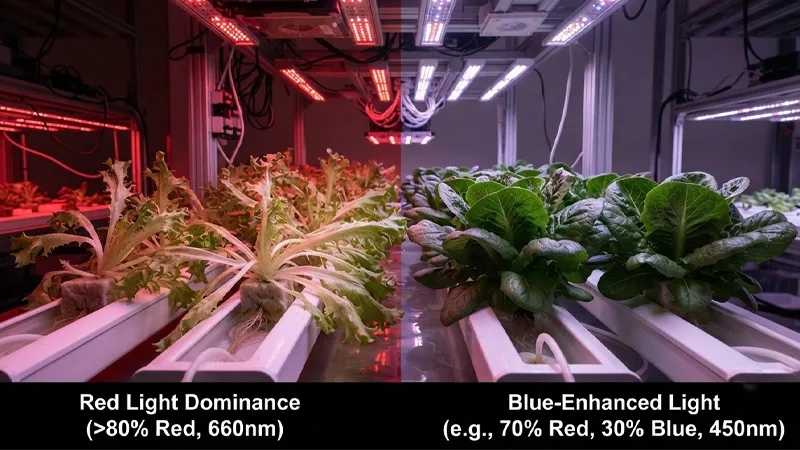
Red photons (660nm) match the peak absorption spectrum of chlorophylls a and b, driving high photosynthetic quantum yield per unit energy. In leafy greens, red light stimulates horizontal leaf expansion and cell division, maximizing photon interception across the canopy. However, growing crops under extreme red-dominant spectra (>80% red) leads to thinner mesophyll layers, increased Specific Leaf Area (SLA in cm2/g), and reduced structural rigidity. Research published in Nature Scientific Reports (2021) demonstrated that lettuce cultivated under red proportions exceeding 70% developed visible petiole distortion and epinasty, which compromised leaf structure and packability.
Blue light (450nm) acts as a morphogenetic control mechanism. Blue photons induce stomatal opening, increase chloroplast concentration per unit leaf area, and thicken the palisade parenchyma cell layer. Higher blue photon fractions yield darker green, more rigid leaves with superior crunch and transport resilience. The trade-off is a net reduction in canopy expansion: blue light restricts individual leaf area, which can reduce total fresh weight yield by 15% to 30% if red fractions are set too low.
Far-red as A Lever
Far-red photons (700-750nm}) fall just outside the traditional 400-700nm PAR waveband, yet they exert a profound influence on canopy development. Plants perceive the ratio of red to far-red light through phytochrome photoreceptors. A low red-to-far-red ratio signals shading from neighboring plants, triggering the Shade Avoidance Response (SAR).
Adding far-red photons 30-50 μmol·m-2·s-1 to a red-blue background spectrum lowers the phytochrome photo-equilibrium Pfr/Ptotal. This induces rapid leaf lamina elongation and canopy expansion, enabling young plants to capture available light more effectively. According to Michigan State University photobiology research (2024), supplementing a red-blue baseline with far-red radiation increased shoot fresh weight across multiple lettuce cultivars by up to 100%. Because far-red light increases leaf area while slightly thinning cell walls, operators must pair far-red treatments with sufficient blue photons or higher overall light intensity to prevent excessive leaf softening.
Intensity and DLI Coupling
Spectral ratios cannot be evaluated in isolation from total light quantity. Photosynthetic Photon Flux Density (PPFD, measured in μmol·m-2·s-1 and Daily Light Integral (DLI, measured in mol·m-2·d-1 dictate the energy available for carbon fixation.
At low PPFD levels (<120 μmol·m-2·s-1), plants prioritize survival over cell wall thickening, magnifying the leaf thinning effects of high-red or far-red spectra. When PPFD is elevated to commercial target ranges (200-280 μmol·m-2·s-1) to deliver a target DLI of 16-20 mol·m-2·d-1, elevated carbohydrate production counteracts leaf thinning. In high-DLI environments, commercial facilities can deploy higher red fractions (such as 80:20 or 90:10 R: B) to maximize fresh biomass while maintaining acceptable structural firmness.
Lettuce: Evidence-based Ranges
Quality vs Yield Trade-offs
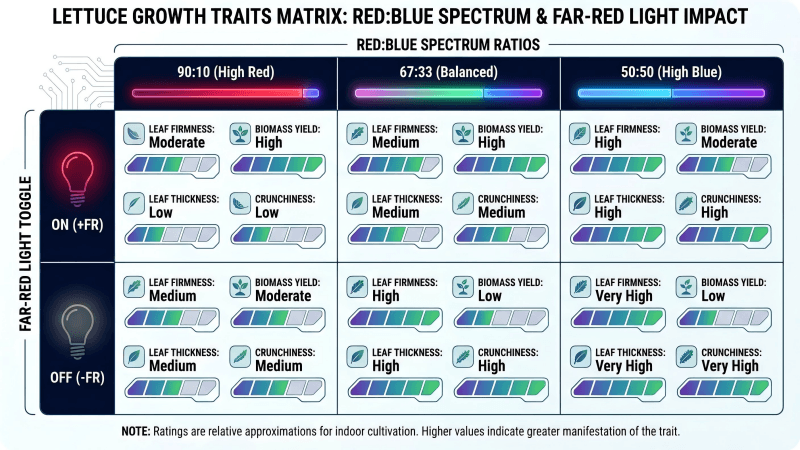
Commercial lettuce production requires continuous balancing between total biomass output and leaf quality parameters. Controlled trials across indoor vertical facilities highlight three benchmark red: blue ratio tiers:
- 90:10 Red: Blue ratio: Maximizes fresh weight yield and canopy growth speed. This ratio achieves rapid canopy closure and high Light Use Efficiency (LUE). However, leaves possess higher Specific Leaf Area (thinner cross-sections) and lower anthocyanin content, resulting in a softer texture suitable for tender baby-leaf mixes but less durable for long-distance shipping.
- 67:33 Red: Blue ratio: Represents the sweet spot for commercial romaine and butterhead production. The 33% blue photon fraction increases palisade cell density and cuticle thickness, providing crisp texture and extended shelf life while maintaining strong biomass accumulation.
- 50:50 Red: Blue ratio: Produces highly compact, dark green, or deep purple leaves with exceptional firmness and crunch. While post-harvest durability is maximized, fresh biomass yield drops by 20% to 28% compared to the 90:10 baseline due to restricted leaf blade expansion.
Key takeaway: High red ratios (90:10) drive maximum fresh weight but yield softer leaves. Intermediate ratios (67:33) deliver the optimal commercial compromise between harvest weight, crisp texture, and shipping durability.
Far-red and PPFD Interplay
Integrating far-red light into lettuce lighting recipes unlocks yield potential without sacrificing crop quality, provided PPFD is properly calibrated. When 30-40 μmol·m-2·s-1 of far-red photons are added to an 80:20 R: B base spectrum under an elevated PPFD of 220 μmol·m-2·s-1, the canopy expands rapidly in early vegetative growth. The higher PAR intensity ensures sufficient photosynthetic carbon fixation to thicken cell walls as leaves expand, offsetting the structural thinning typically caused by shade avoidance.
Timing Blue for Color
Red-leaf lettuce varieties (such as ‘Cherokee’ or ‘Red Oak leaf’) require specific light signals to synthesize anthocyanins—the pigments responsible for red coloration. Anthocyanin accumulation protects plant tissue against high-energy photons and is strongly driven by blue and UV-A light.
Running high blue light fractions throughout the entire 28-35 day crop cycle limits leaf expansion and reduces total biomass. A more effective commercial strategy is End-of-Production (EOP) spectral tuning. Operators maintain a yield-focused ratio (e.g., 85:15 R: B with far-red) during the main vegetative phase, then shift to a high-blue spectrum (50% to 100% blue at 50-100 μmol·m-2·s-1) for the final 3 to 5 days before harvest. Research from Frontiers in Plant Science (2022) confirms that dynamic spectral shifting triggers rapid pigment expression and leaf firming right before packaging, without compromising total yield during early growth.
Spinach: Current Insights
1:1 to 4:1 Pilots
Spinach (Spinacia oleracea) exhibits distinct photomorphogenic responses compared to lettuce, demanding tailored spectral strategies in indoor farms. Commercial pilot trials evaluating red: blue ratios between 1:1 (50:50) and 4:1 (80:20) reveal clear trade-offs between growth morphology and nutritional quality.
A 4:1 red: blue spectrum (80% red, 20% blue) combined with a moderate PPFD of 150-190 μmol·m-2·s-1 maximizes spinach fresh biomass, leaf number, and total leaf surface area. Agronomy research published in PMC Indoor Cultivation Studies (2020) demonstrated that a 4:1 R: B ratio generated superior fresh and dry shoot weights in indoor hydroponic spinach compared to equal red-blue mixes.
Conversely, a 1:1 red: blue spectrum (50% red, 50% blue) restricts petiole elongation, producing thicker, upright, rosette-type leaves with thick cuticles. While total fresh weight under a 1:1 ratio is 12% to 18% lower than under 4:1, the resulting leaves offer superior resistance to mechanical tearing during automated washing and packaging.
Minerals, Nitrate, Structure
Leafy greens, particularly spinach, can accumulate high concentrations of inorganic nitrate (NO3–) under indoor artificial lighting. High leaf nitrate is regulated in food safety markets, particularly across Europe and North America, as lower nitrate levels correlate with higher nutritional quality and longer post-harvest shelf life.
Blue light photons stimulate the activity of Nitrate Reductase (NR)—the key enzyme responsible for converting nitrate into amino acids and proteins within plant tissue. Studies documented in HortScience research on vegetable nitrate dynamics indicate that increasing blue light proportions or elevating overall PPFD before harvest reduces leaf nitrate content in spinach and lettuce by up to 47%. Furthermore, blue-rich spectra enhance ascorbic acid (Vitamin C) synthesis and regulate oxalic acid levels, improving mineral bioavailability (K+ and Mg2+) and bolstering cell wall structural firmness.
Deployment and Validation
Layouts and Controls
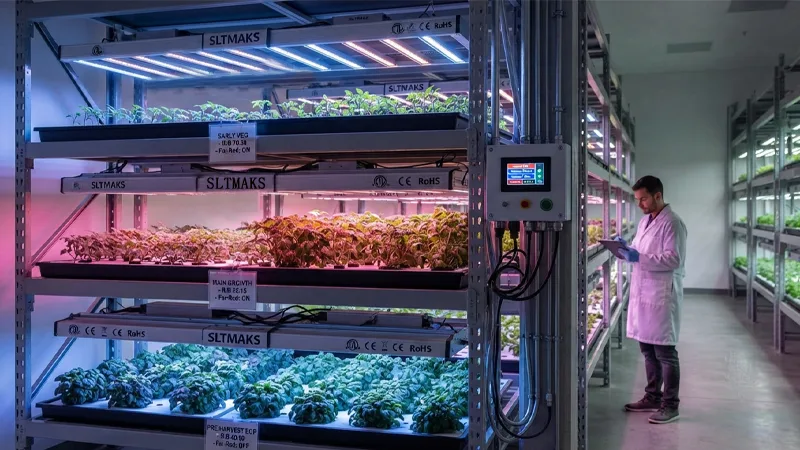
Translating photobiology principles into commercial indoor operations requires precise fixture selection and lighting control systems. Multi-channel LED grow lights featuring independently dimmable red, blue, and far-red spectrum channels allow growers to execute stage-specific recipes across multi-tier racking systems dynamically.
When deploying lighting infrastructure across commercial facilities, operators must evaluate electrical safety and thermal performance alongside spectral capabilities. Professional fixtures, such as those supplied by SLTMAKS Commercial Lighting, incorporate heavy-duty aluminum heat sinks for passive thermal management and carry international safety certifications including ETL, CE, and RoHS. Ensuring ETL/CE/RoHS compliance simplifies local electrical inspections, reduces fire risks in high-humidity cultivation rooms, and guarantees that fixture driver electronics maintain precise spectral output without thermal drift.
➔ Early Vegetative Phase
- R:B Ratio: 70:30
- Far-Red: On (30 μmol·m-2·s-1)
- Goal: Root & Leaf Establishment
➔ Main Growth Phase
- R:B Ratio: 85:15
- Far-Red: On (40 μmol·m-2·s-1)
- Goal: Maximum Biomass
➔ Pre-Harvest EOP Phase
- R:B Ratio: 40:60
- Far-Red: Off
- Goal: Firmness & Color
Pro tip: Select multi-channel LED fixtures certified under ETL/CE/RoHS standards to ensure electrical compliance during local municipal inspections, while using dynamic spectral dimming to automate pre-harvest firmed-leaf protocols.
Pilot Design and KPIs
Before rolling out new spectral recipes across an entire facility, operators should conduct a structured 3-phase pilot trial using isolated rack zones.
To rigorously evaluate the impact of a new red-blue ratio leafy greens recipe, track the following Key Performance Indicators (KPIs):
- Light Use Efficiency (LUE): Expressed as grams of fresh biomass harvested per mole of PAR photons delivered (g·mol-1). LUE quantifies energy conversion efficiency.
- Specific Leaf Area (SLA): Calculated as leaf blade surface area divided by dry leaf weight (cm2·g-1). Lower SLA values indicate thicker, firmer leaves with higher structural density.
- Texture & firmness rating: Measured using a digital penetrometer (force required to puncture leaf tissue in Newtons) or standardized sensory crunch panels.
- Post-harvest degradation rate: Tracking percentage fresh weight loss, chlorosis, and leaf breakdown over 14 days of cold storage (4°C).
ROI and Multi-site Rollout
Facility expansion and spectrum retrofits require clear Capital Expenditure (CapEx)- to-Operational Expenditure (OpEx) financial modeling. Higher blue light proportions require shorter-wavelength LEDs (such as 450 nm blue), which historically exhibit lower electrical-to-photon efficacy ($\mu\text{mol}\cdot\text{J}^{-1}$) compared to deep-red 660 nm LEDs.
Applying an unneeded 50:50 R: B ratio across a 100,000 sq. ft. vertical farm increases facility energy consumption and HVAC thermal cooling loads without delivering proportional financial return. Conversely, implementing an optimized 85:15 R: B recipe supplemented with far-red yields faster canopy turnover, increasing annual harvest cycles from 10 to 12 runs per year. The resulting 15% to 20% increase in marketable top-tier produce offsets fixture CapEx payback within 14 to 18 months of multi-site rollout.
Conclusion
- Start near 90:10 for lettuce; 1:1–4:1 for spinach: Establish an 85:15 to 90:10 red: blue baseline for maximum lettuce fresh weight, while utilizing 1:1 to 4:1 red: blue spectrums for spinach depending on target leaf thickness and nitrate standards.
- Tune blue with PPFD; treat far-red separately: Use blue light as a structural knob to control leaf thickness and crunch, ensuring PPFD (200-250 μmol·m-2·s-1) is sufficient to support cell wall density. Deploy far-red (30-50 μmol·m-2·s-1) independently during early growth to drive leaf expansion.
- Validate by cultivar; track LUE, shelf life, ROI: Conduct structured rack-level pilot trials measuring Specific Leaf Area, penetrometer firmness, and 14-day cold storage shelf life. Base multi-site facility rollouts on verified Light Use Efficiency
FAQ
What is the ideal red-to-blue ratio for leafy greens?
For most commercial lettuce production, an 85:15 to 90:10 red-to-blue ratio maximizes total biomass yield and canopy growth speed. However, intermediate ratios such as 67:33 deliver the best balance between harvest weight, leaf firmness, and post-harvest shelf life.
How does blue light affect leaf texture and firmness in indoor farming?
Blue light (450nm) activates phototropins and cryptochromes, which promote palisade parenchyma cell thickening and stomatal regulation. Higher blue light fractions produce darker, thicker, and crisper leaves that resist mechanical damage during processing and transport.
Why is far-red light added to red-blue LED light recipes?
Far-red light (700-750nm) triggers the Shade Avoidance Response (SAR), causing leaf blades to expand rapidly and capture more photons. When paired with sufficient photosynthetically active radiation (PAR), far-red photons significantly increase total shoot fresh weight without causing structural leaf collapse.
What is End-of-Production (EOP) lighting for red-leaf lettuce?
End-of-Production (EOP) lighting involves switching to a high-blue or UV-rich spectrum for the final 3 to 5 days before harvest. This dynamic shift stimulates anthocyanin pigment synthesis and firms up leaf tissue right before packaging without suppressing biomass growth during early developmental stages.
How does light spectrum influence nitrate levels in indoor spinach?
Higher proportions of blue light and elevated PPFD stimulate the activity of Nitrate Reductase (NR), an enzyme that converts inorganic nitrates into amino acids. Increasing blue light before harvest can reduce leaf nitrate concentrations in spinach by up to 47%, improving nutritional quality and regulatory compliance.
Does increasing blue light decrease energy efficiency in commercial LED grow lights?
Yes, short-wavelength blue LEDs (450nm) generally have lower photosynthetic photon efficacy (μmol/J) than deep-red LEDs (660nm). To optimize operational cost (OpEx), commercial facilities use high-red baselines for general growth and reserve high-blue treatments for targeted end-of-production finishing phases.
(g/mol) and total cost of ownership payback.