Introduction
For commercial indoor cultivation, custom LED spectrum isn’t a marketing checkbox. It’s a controllable input that influences morphology, crop timing, secondary metabolites, and—critically—how efficiently a facility converts kWh and HVAC capacity into saleable biomass.
Custom spectrum work tends to pay off in three situations:
- You’re operating at scale and small percentage gains in yield, uniformity, or cycle time have meaningful financial impact.
- You have a defined crop-stage playbook (or you’re building one) and want lighting to behave like an engineered system, not a fixed “one spectrum fits all” fixture.
- You need procurement-grade defensibility—standards compliance, rebate eligibility, data logs, acceptance criteria—because the buyer is a committee (cultivation + facilities + procurement + safety).
This guide is written for commercial grow light brands (OEM/ODM), enterprise growers, and integrators who need an audit-ready approach to spectrum development.
How to use it:
- Start with the standards and rebate reality so you don’t design yourself into an ineligible corner.
- Translate crop biology into PPFD/DLI targets and channel roles.
- Engineer the fixture and controls around uniformity, controllability, and reliability.
- Validate with a stepwise trial and change-control workflow.
- Convert the results into RFQ specs and acceptance tests procurement can enforce.
Table of Contents
Standards and Rebates 2025–2026
Decision-stage spectrum programs fail most often when compliance is treated as an afterthought. In the U.S., your lighting design has to survive three independent filters: electrical safety, DLC qualification (if you want broad rebate access), and utility program paperwork.
UL 8800 Scope and Impacts
UL 8800 is the safety standard focused on horticultural lighting equipment and systems, intended to address hazards and conditions common in grow environments (moisture, dust, elevated ambient temperatures, and installation realities that differ from general-purpose lighting). UL provides background in its brief, UL 8800, Published Standard for Horticultural Lighting Equipment.
From a practical procurement standpoint, UL 8800 affects custom spectrum projects in four ways:
- Fixture construction requirements (enclosure, wiring, connectors, materials) must match horticulture use conditions, not just dry-office assumptions.
- Documentation expectations increase: safety marks, installation instructions, environmental ratings, and system configuration details become part of the review.
- Design changes become expensive if made late. Spectrum tweaks can cascade into driver, wiring, thermal, and enclosure revisions.
- Scope clarifications matter for modern architectures (e.g., remote low-voltage power supplies and system configurations). UL notes scope expansions in Scope Expansion to the Horticultural Lighting Standard.
⚠️ Warning: If you’re planning field-adjustable spectrum or multi-channel controls, align the controllability and “qualifying state” definitions early—otherwise your test report and your sellable configuration can drift.
DLC V4.0 Thresholds and Timelines
If your go-to-market relies on rebates, the DLC Horticultural Qualified Products List (QPL) is often the gatekeeper.
For Horticultural Technical Requirements V4.0, DLC’s published policy sets a minimum Photosynthetic Photon Efficacy (PPE) threshold of 2.5 µmol/J and describes the transition timeline. See the official policy PDF DLC HORT Technical Requirements V4.0 (Final Policy, 2025).
Timelines are easy to miss, but procurement will ask:
- DLC indicates V4.0 applications open April 18, 2025, and V3.0 products are delisted January 5, 2026 (per DLC’s V4.0 page).
- DLC also publishes transition guidance in Transition to Horticultural Lighting V4.0.
What this means for custom spectrum development:
- Define the qualifying state (which channel mix and dimming state will be used for certification testing).
- Ensure your commercially shipped configuration can be locked, documented, and replicated for rebate and compliance audits.
Utility Rebate Prerequisites
Utility programs vary by territory, but decision-stage documentation requirements rhyme.
In general, expect utilities (or their program administrators) to require:
- DLC QPL listing for the exact model identifier being purchased (not a “similar family”).
- Model-number consistency across quote, PO, packing list, and invoice.
- A project workflow that often includes pre-approval before purchase/installation.
- A documentation packet: spec sheet, safety listing evidence, and sometimes controls/commissioning descriptions.
Treat rebate compliance as a procurement deliverable, not a marketing promise: design the fixture/configuration so the paperwork can’t get ambiguous.
Spectrum Fundamentals and Targets: Custom LED Spectrum
Custom spectrum work is easiest to mismanage when teams chase “best wavelengths” instead of defining what outcome they’re targeting and what constraints they must respect.
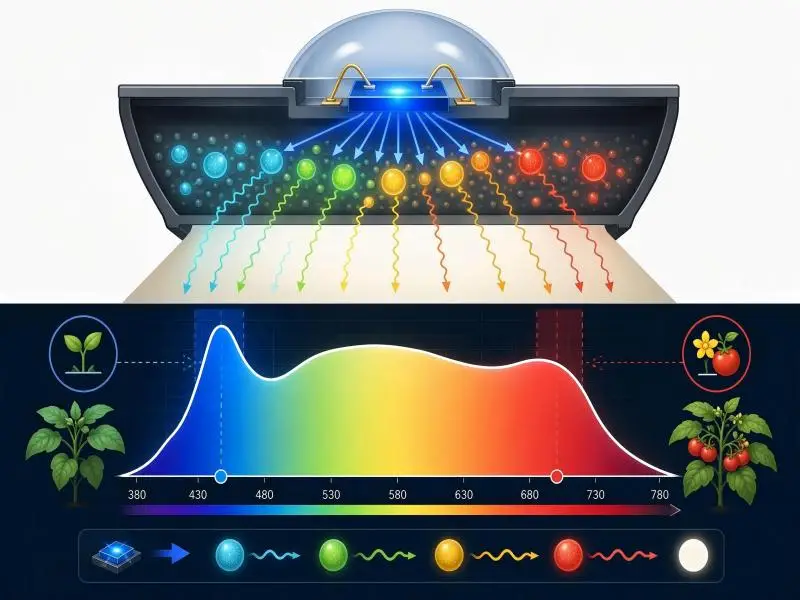
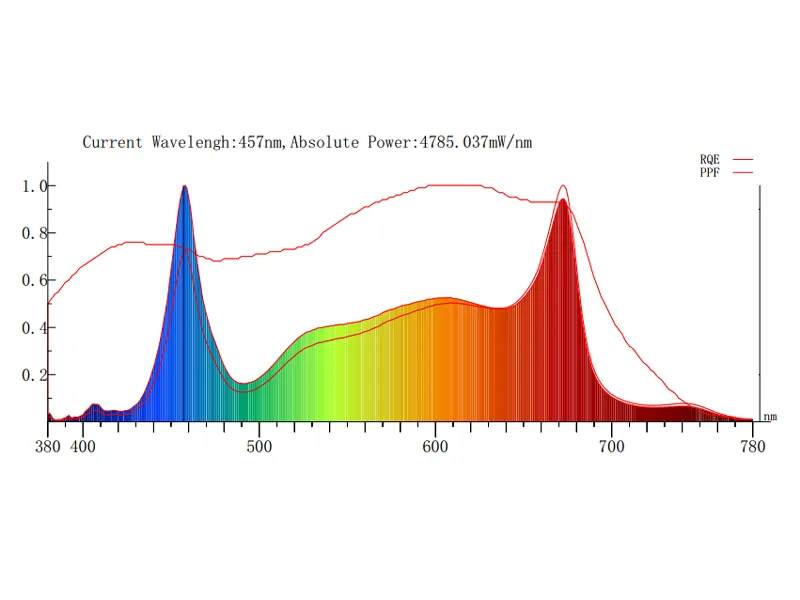
Roles of Blue, Green, Red, Far‑red
A decision-grade way to think about spectral channels:
- Blue (≈400–500 nm): morphology control (compactness, leaf thickness), reduced stretch. A higher relative share is commonly used earlier to manage structure.
- Green (≈500–600 nm): improves canopy penetration and makes visual scouting more reliable; it’s rarely “wasted” in dense canopies.
- Red (≈600–700 nm; especially ~660 nm): primary workhorse for photosynthesis and biomass; often emphasized as crops transition to flowering/fruiting.
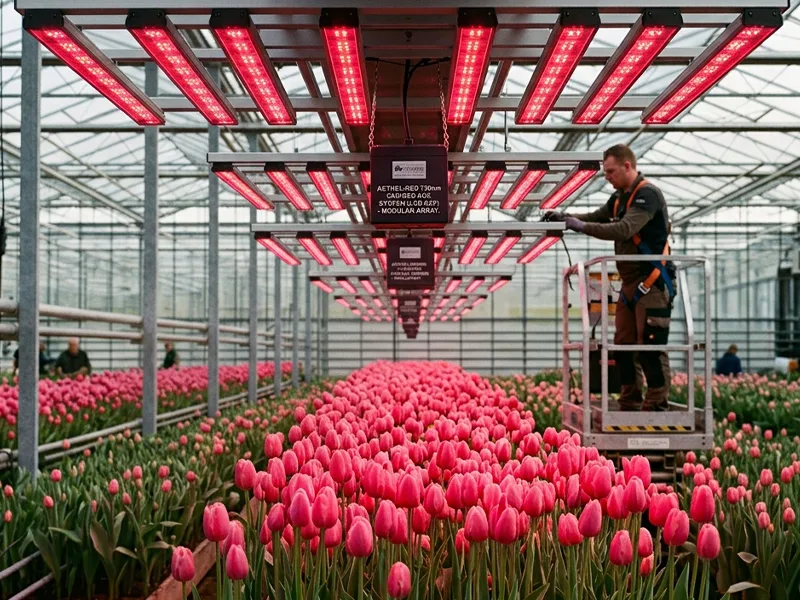
- Far‑red (≈700–750 nm; especially ~730 nm): a tool for morphology and flowering responses; useful in specific strategies, but can increase stretch if applied indiscriminately.
The key is not the presence of a channel—it’s how you specify when it’s used, at what fraction, under what controls, and with what acceptance metrics.
Stage‑specific PPFD/DLI Targets
Spectrum doesn’t operate in isolation. For most procurement conversations, start with PPFD and DLI targets and then tune spectral fractions within those setpoints.
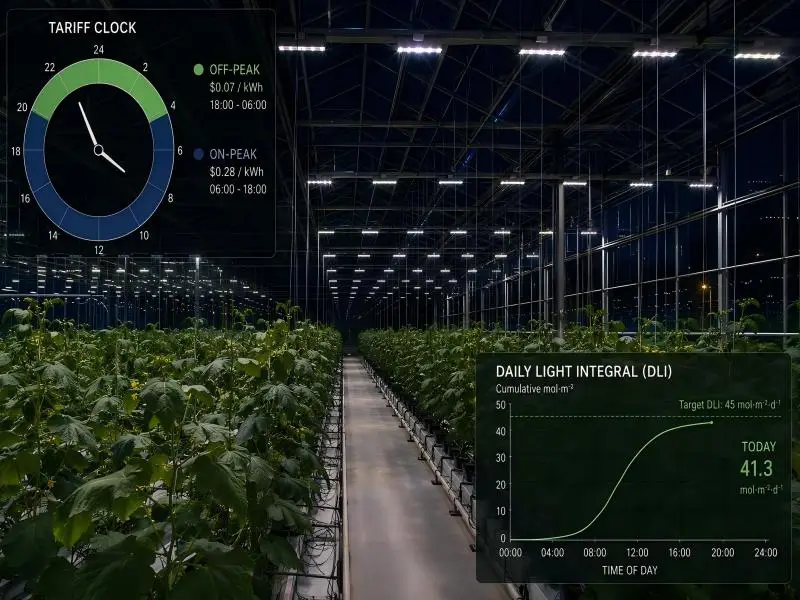
- PPFD (photosynthetic photon flux density) is the instantaneous canopy intensity.
- DLI (daily light integral) is the cumulative photons delivered per day, driven by PPFD × photoperiod.
A practical stage-based framing for commercial controlled environments:
- Seedling/clone: lower PPFD and conservative DLI; avoid stress and excessive stretch; tighter blue control tends to be more valuable than far-red.
- Vegetative / canopy build: balanced spectrum with targets defined by canopy closure speed and architecture.
- Flower/fruit: higher PPFD/DLI when environment (CO₂, temperature, VPD, nutrition) can support it; red fraction often increases; far-red may be added deliberately if morphology/cycle-time goals justify it.
Pro Tip: When you set PPFD targets, also set a uniformity target (e.g., minimum-to-average PPFD) so the lighting “recipe” isn’t masking layout problems.
From biology to Custom LED Spectrum
This is where custom spectrum becomes a specification exercise:
- Define crop-stage outcomes (compactness, cycle timing, yield, quality attributes).
- Convert those outcomes into setpoints: PPFD, photoperiod, DLI, and allowable canopy temperature shift.
- Choose spectral channels that can deliver those outcomes without compromising certification state.
- Write down the control intent (what changes, when, and why) so engineering and cultivation stay aligned.
Fixture Architecture and Engineering
Once you’ve defined targets, your decisions become less about “what spectrum is best” and more about whether the fixture can deliver the recipe reliably, uniformly, and compliantly.
Channel and WavelengthSelection
For commercial brands building custom spectra, the most defensible approach is typically:
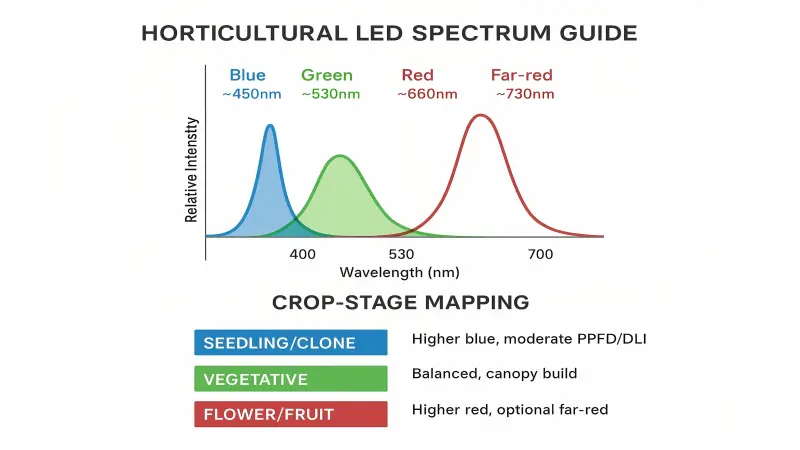
- A stable white/full-spectrum base for broad coverage and workability.
- Separate controllable channels for blue, deep red (~660 nm), and optional far-red (~730 nm).
Specify channels in terms procurement can enforce:
- Peak wavelength and bandwidth (binning tolerance)
- Channel max current and max photon output
- Allowed operating envelope (ambient temperature, dimming range)
- “Qualifying state” configuration used for DLC/third-party test reports
Drivers, Dimming, and Controls
Decision-stage failures frequently come from driver/controls ambiguity. For RFQs, define:
- Dimming interface (0–10 V, DALI, or networked controls)
- Minimum dimming level without flicker or instability
- Channel independence (which channels can be dimmed/tuned separately)
- What happens on control-signal loss (failsafe default state)
- Data outputs (if any): runtime hours, faults, current draw, temperature derates
Thermal, Optics, and Ingress Protection
Thermal, optics, and ingress protection determine whether your custom spectrum stays stable and whether the facility can keep it running.
- Thermal: specify junction-temperature management strategy and derating behavior; require documented thermal testing at realistic ambient conditions.
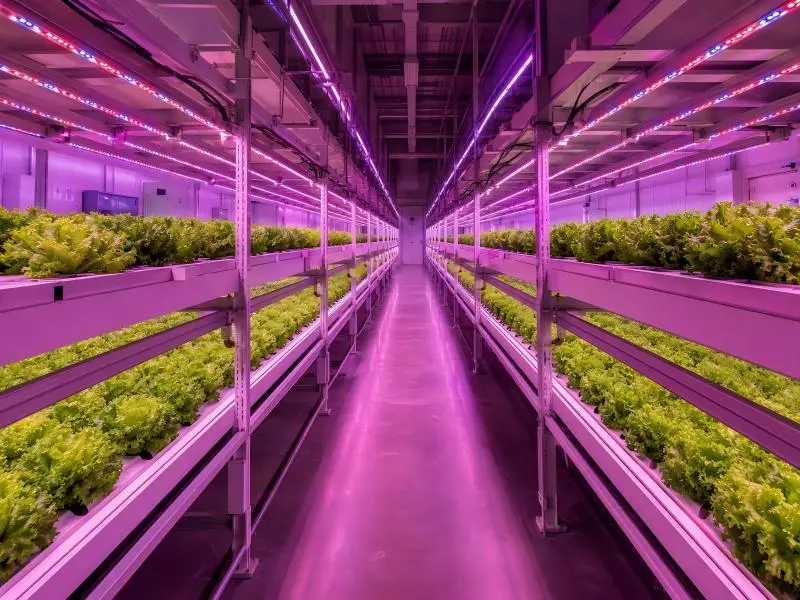
- Optics: choose distributions that match your geometry (single-tier rooms vs multi-tier racks) and support uniformity targets without excessive overlap losses.
- Ingress & cleaning: define IP requirements based on washdown/SOP reality, not best-case conditions.
SLTMAKS context (non-promotional): SLTMAKS enterprise deployments typically prioritize heat-sink margin, rack-friendly optics, and dimming stability with clear commissioning defaults to reduce multi-room variability.
Uniformity, Integration, and Controls
A custom spectrum that isn’t uniform becomes multiple unintended spectra across a room. That’s a validation and SOP problem, not just a “layout tweak.”
PPFD Mapping and Layout Metrics
For procurement-grade installations, require PPFD mapping that matches how the room is actually used:
- Measurement grid defined by aisle/rack geometry
- Canopy-height measurement (not just floor)
- Report average, minimum, and uniformity ratios (min/avg; min/max) per zone
- Document mounting height, spacing, and dimming state during measurement
Room‑to‑BMS Control Hierarchy
Enterprise facilities rarely operate lighting in isolation. Define a control hierarchy:
- Fixture/channel controls → zone controller → room controller → site controller → BMS (building management system)
- Time schedules and ramping behavior
- Who has authority to change recipes (cultivation vs facilities)
- Auditability: how changes are logged and rolled back
Commissioning and Fail‑safes
Commissioning should be a contractual deliverable:
- A standard commissioning checklist (signal verification, dimming curve validation, fault simulation)
- Failsafe defaults that keep crops safe during controller outage
- Surge protection and grounding checks
- “As-commissioned” configuration export (so multi-site rollouts stay consistent)
Validation, Trials, and SOPs
Decision-stage spectrum work isn’t complete when the fixture ships. It’s complete when the recipe and system meet acceptance criteria in production.
Small‑scale Recipe Trials
Keep trials defensible:
- Define a baseline control recipe and one variable change per test (channel ratio, PPFD, or photoperiod—not all at once).
- Replicate where possible (more valuable than a single large uncontrolled test).
- Lock down non-light variables (CO₂, temperature, VPD, irrigation) or at least log them.
PPFD Maps and Data Logging
A spectrum program without logging becomes un-auditable quickly.
Minimum logging set:
- PPFD maps per representative room/rack
- Photoperiod schedules and dimming profiles
- Energy use (kWh) at room/zone level
- Driver/fixture fault codes and downtime
Change Control and Acceptance
Treat spectrum as a controlled process change:
- Define acceptance thresholds (uniformity, yield/quality KPIs, energy per unit output, downtime).
- Require sign-off gates (cultivation + facilities + compliance).
- Maintain versioned “recipes” with rollback capability.
ROI and Procurement Framework
Decision-stage buyers don’t need a single ROI number—they need a model that survives scrutiny.
DLI‑based Sizing and Dimming
Start with the photon requirement, not fixture wattage:
- Define target DLI per crop stage.
- Convert to PPFD given photoperiod.
- Design the layout to meet PPFD and uniformity targets.
- Use dimming as an operational lever (early-stage lower DLI, ramp to peak) to reduce wasted photons and HVAC load.
CAPEX+OPEX and HVAC Coupling
Lighting ROI is coupled to HVAC in indoor facilities:
- Higher PPFD can increase sensible heat and dehumidification load.
- Dimming strategies can reduce peak HVAC demand and improve stability.
A procurement-ready ROI worksheet typically includes:
- Fixture CAPEX + installation labor
- Driver replacement assumptions and downtime cost
- kWh cost scenario(s)
- HVAC delta assumptions (explicit, with caveats)
- Rebate assumptions (program-specific, validated at time of application)
RFQ Specs and Compliance Checks
If you want procurement to enforce your spectrum intent, include the right asks in the RFQ:
- Photometrics: IES files, PPFD maps at defined mounting heights, uniformity metrics.
- Spectrum: channel peaks/bins; tunability ranges; qualifying state definition.
- Controls: interface type (0–10 V/DALI/NLC), minimum dim level, failsafe behavior, commissioning procedure.
- Reliability: thermal derating behavior, ambient rating, ingress rating.
- Compliance: safety certification to UL 8800 where required; DLC QPL status (if rebate-dependent); documentation packet contents.
Where internal product pages are helpful, use them as concrete spec references—not as performance claims. Examples:
- SLTMAKS high-power fixtures with different form factors and input-power classes: SLTMAKS 720W commercial LED grow light, SLTMAKS 1000W foldable plant grow light, and SLTMAKS 1300W indoor plant grow light.
Conclusion
Custom LED spectrum development is a decision-stage discipline: you’re not just choosing wavelengths—you’re specifying a controllable system that must pass compliance, qualify for incentives, and perform consistently across rooms and sites.
Action checklist (use as your next-step gate):
- Confirm UL 8800 and DLC requirements early; define the qualifying state.
- Convert crop goals into PPFD + photoperiod → DLI targets, with uniformity metrics.
- Specify channels + controls + failsafes in RFQ language procurement can enforce.
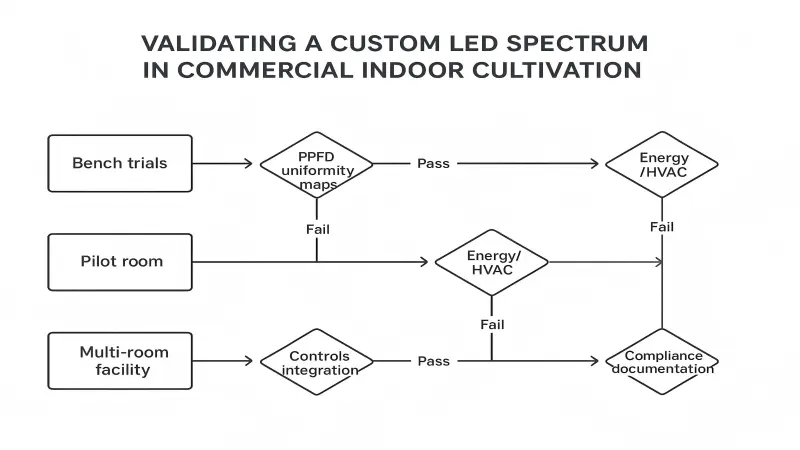
- Validate through bench → pilot → rollout with data logging and change control.
- Model ROI with HVAC coupling and rebate prerequisites as explicit assumptions.
Common pitfalls to avoid next:
- Treating tunable spectrum as “infinite flexibility” without a locked qualifying configuration.
- Skipping PPFD mapping and hoping spectrum can fix uniformity.
- Leaving controls behavior undefined (especially failsafes and commissioning defaults).
- Building a rebate strategy around assumptions instead of current DLC/QPL status and program rules.
Where to go for standards, tools, and updates:
- UL: See UL 8800, Published Standard for Horticultural Lighting Equipment (UL) and UL’s news on scope changes.
- DLC: See DLC HORT Technical Requirements V4.0 (Final Policy, 2025).
FAQ
What is a custom LED spectrum for commercial grow lights?
A custom LED spectrum is a fixture’s engineered spectral power distribution (SPD)—often implemented as a full-spectrum base plus separately dimmable channels (e.g., blue, deep red, far‑red)—that’s tuned to a specific crop, stage, and facility constraint. In commercial programs, “custom” also means the spectrum is repeatable and documentable (binning tolerances, control ranges, and a defined operating state).
How do I choose PPFD and DLI targets before tuning spectral channels?
Start by setting DLI targets per growth stage, then convert DLI to PPFD using the intended photoperiod. Only after PPFD/DLI are set should you tune channel fractions, because spectrum choices can’t compensate for under/over-lighting or poor uniformity. For procurement, pair intensity targets with a uniformity requirement (such as min/avg PPFD) so the “recipe” holds across the whole canopy.
What is the “qualifying state” for DLC testing, and why does it matter?
The qualifying state is the specific channel mix and dimming configuration that a tunable fixture uses for third‑party testing and DLC qualification. It matters because rebates and compliance audits typically require that the shipped, sellable configuration can be locked, documented, and reproduced. If your field-tunable settings drift from the qualifying state, you can end up with a product that’s hard to certify, hard to sell into rebate-driven projects, or hard to defend in procurement.
Does a custom spectrum affect DLC V4.0 eligibility or PPE performance?
Yes. Custom spectrum decisions can change photon efficacy (PPE, µmol/J) because different diodes, channel mixes, and drive currents have different efficiency and thermal behavior. If rebate access is important, design the spectrum program so the qualifying state can meet DLC HORT V4.0 technical requirements, including minimum PPE thresholds, while still supporting your agronomic goals through controlled tunability.
What should an OEM/ODM include in an RFQ for custom spectrum grow lights?
Include requirements procurement can verify:
Spectrum: channel peaks/bins, tunability ranges, and the defined qualifying state
Photometrics: IES files and PPFD maps at specified mounting heights with uniformity metrics
Controls: interface (0–10 V/DALI/NLC), minimum dim level, failsafe behavior, and commissioning deliverables
Reliability: thermal derating behavior, ambient and ingress ratings, and documentation pack contents
This turns “custom spectrum” into enforceable acceptance criteria instead of a vague feature claim.