Author: Senior Horticultural Lighting Specialist at SLTMAKS
Target audience: Commercial Greenhouse Operators, Agronomists, and B2B Lighting Procurement Managers
Modern commercial agriculture is a race against margins, climate variability, and time. For high-wire crops like tomatoes and cucumbers, achieving consistent, year-round yields in a controlled environment is the ultimate goal. However, growers frequently encounter seasonal bottlenecks: delayed fruit coloration in winter months and suboptimal single fruit weight during low-light periods. The solution does not lie in simply adding more light, but in deploying strategic commercial greenhouse supplemental lighting.
In this comprehensive guide, we will explore how precise lighting intervention can manipulate plant physiology, accelerate tomato ripening, maximize cucumber fruit weight, and ultimately drive profitability for commercial greenhouse operations.
Table of Contents
The Science of Light: Why Precise Intervention Matters
To truly optimize a greenhouse, we must transition from viewing light as mere “illumination” to understanding it as a precise agricultural input. In horticultural science, there is a well-known axiom: a 1% increase in light generally equates to a 1% increase in yield. However, the quality, duration, and intensity of that light dictate how the plant uses that energy.
Understanding DLI and PPFD in Commercial Greenhouse Supplemental Lighting
For B2B growers, evaluating lighting systems requires strict adherence to agronomic metrics, specifically Photosynthetic Photon Flux Density (PPFD) and Daily Light Integral (DLI).
- PPFD (µmol/m²/s): Measures the amount of photosynthetically active radiation (PAR) reaching the crop canopy at any given second. It is the “flow rate” of light.
- DLI (mol/m²/day): Measures the total cumulative amount of PAR delivered to the plant over a 24-hour photoperiod. It is the total “volume” of light received.
Tomatoes and cucumbers are high-light-demanding crops. Tomatoes typically require a DLI of 22-30 mol/m²/day for optimal commercial production, while cucumbers thrive in the 15-25 mol/m²/day range depending on the cultivar. When natural sunlight is insufficient during winter or rainy seasons, commercial greenhouse supplemental lighting becomes a critical bridge to maintain these DLI targets, ensuring continuous carbohydrate production.
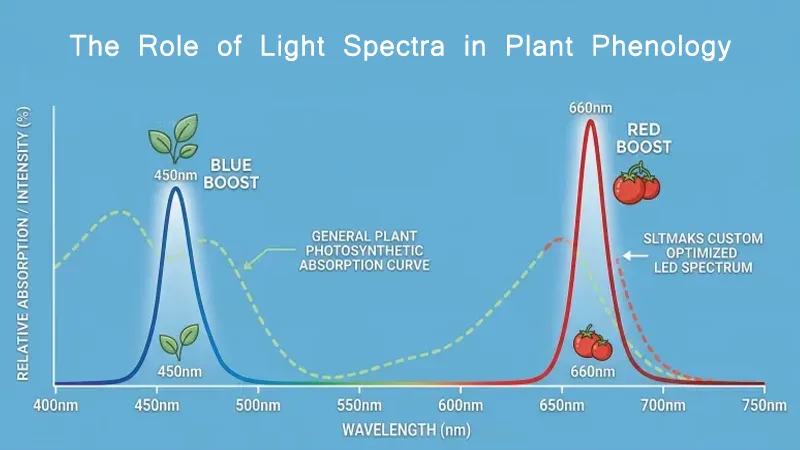
The Role of Light Spectra in Plant Phenology
Different wavelengths of light trigger specific photoreceptors (like phytochromes and cryptochromes) in the plant, governing everything from seed germination to fruit development.
- Red light (600-700 nm): The primary driver of photosynthesis. High proportions of red light stimulate stem growth, flowering, and most importantly, fruit expansion and carbohydrate accumulation.
- Blue light (400-500 nm): Crucial for plant morphology. Blue light controls internode elongation (preventing plants from stretching too much), increases leaf thickness, and promotes stomatal opening, which is vital for nutrient uptake.
- Far-red light (700-800 nm): While outside the traditional PAR range, far-red light is gaining traction in professional horticulture. It triggers the “shade-avoidance response,” encouraging canopy penetration and leaf expansion, which can significantly enhance the light interception area of the crop.
Tomato Lighting Strategies: Accelerating Coloration and Ripening
One of the most significant pain points for tomato growers is the unpredictable ripening speed. A delay in coloration means delayed market entry, potentially missing high-price commercial windows.
The Mechanism of Lycopene Synthesis
The deep red color of a ripe tomato is primarily due to the accumulation of lycopene, a carotenoid pigment. Lycopene synthesis is highly dependent on both temperature and the quality of light. While temperature controls the enzymatic reactions, specific light spectra—particularly a balanced ratio of red and blue light—directly upregulate the genetic expression of carotenoid biosynthesis pathways.
By applying targeted horticultural LED grow lights during the later stages of fruit development, growers can significantly accelerate the transition from the “mature green” stage to the “breaker” and “red” stages, shortening the harvest cycle by several days.
Intercanopy Lighting vs. Top Lighting
High-wire tomato cultivation creates a dense, towering canopy. Traditional High-Pressure Sodium (HPS) top lighting often struggles to penetrate the upper foliage, leaving the lower fruit clusters in heavy shade. This leads to uneven ripening and smaller fruits at the bottom of the vine.
- LED top lighting: Essential for maintaining overall DLI and driving photosynthesis in the young, active upper leaves.
- LED interlighting (canopy lighting): Placing LED modules directly within the plant canopy is a game-changer for tomatoes. It delivers light directly to the middle and lower leaves, keeping them photosynthetically active longer and driving direct carbohydrate flow into the adjacent developing fruit clusters. This dual-lighting approach ensures uniform coloration top-to-bottom and increases overall yield.
Avoiding Common Pitfalls
More light is not always better. Excessive top lighting without proper canopy management can lead to “green shoulder” disorder (where the top of the tomato remains hard and green) or cause photoinhibition, where the plant’s photosynthetic machinery shuts down to protect itself. Precision control systems are required to dial back supplemental lighting when natural solar radiation is sufficient.
Cucumber Lighting Strategies: Maximizing Single Fruit Weight
Cucumbers are incredibly fast-growing crops with high transpiration rates. The economic goal here is not just total yield, but maximizing the dry matter and single fruit weight, which dictates the premium grade of the harvest.
Balancing Vegetative and Generative Growth
Cucumbers can easily become overly vegetative, producing excessive foliage at the expense of fruit development. This “source-sink” imbalance is devastating to ROI. Strategic commercial greenhouse supplemental lighting helps manage this balance. By manipulating the photoperiod (e.g., using an 18-hour lighting cycle) and incorporating higher ratios of red light, growers can steer the plant toward generative growth, signaling the plant to direct its energy “sinks” into the fruit rather than the leaves.
Driving Transpiration and Nutrient Uptake
Single fruit weight in cucumbers is heavily dependent on water and calcium transport. Because calcium moves through the plant via the xylem, its uptake is entirely driven by transpiration. Blue light is highly effective at stimulating stomatal opening.
By utilizing LED grow lights with an optimized blue light fraction, growers can increase the stomatal conductance of cucumber leaves. This drives a stronger transpiration stream, pulling water and essential macronutrients from the root zone up into the developing cucumbers, resulting in heavier, denser, and higher-quality fruits that resist post-harvest shrinkage.
Leaf Area Index (LAI) Optimization
To maximize light interception, growers must align their lighting strategy with the crop’s Leaf Area Index (LAI). As the cucumber canopy matures, specific interlighting strategies can be deployed to illuminate the middle canopy, preventing the premature senescence (aging) of older leaves and ensuring every tier of the plant is contributing to the final fruit weight.
Real-World Case Study & Comparative Data
To move beyond theoretical benefits, we conducted a rigorous 6-month trial in a 2-hectare commercial greenhouse in Leamington, Ontario, a region notorious for low winter light levels. We compared a traditional Double-Ended HPS lighting strategy against a modern SLTMAKS LED intervention, specifically focusing on the distinct needs of high-wire tomatoes (variety: ‘Tribute’) and long English cucumbers (variety: ‘Bonbon’).
Trial Specifications & DLI Methodology
The greenhouse was divided into two zones:
- Zone A (control): Equipped with 1000W Double-Ended HPS fixtures, achieving an average canopy PPFD of 180 µmol/m²/s. The focus was on top lighting alone.
- Zone B (treatment): Equipped with SLTMAKS STG-1000W-F top lighting and LED interlighting modules, achieving a total PPFD of 240 µmol/m²/s (180 top + 60 inter). Both zones were monitored for DLI targets.
Tomato Results: Accelerating Coloration & Market Entry
For the high-wire tomato crop, the primary pain point was uneven ripening in the lower clusters during the critical winter months (December–February). The introduction of LED interlighting, specifically targeting the lower clusters with a high red-light fraction, yielded dramatic results.
1. Faster coloration to “red” stage: As shown in the graph below, plants in the SLTMAKS LED+Interlighting zone (Zone B) reached the “breaker” stage 4 days earlier and the fully “red” marketable stage 6 days earlier than the HPS control zone.
Key Insight: SLTMAKS LED strategies achieve 50% red harvest 6 days earlier than HPS lighting.
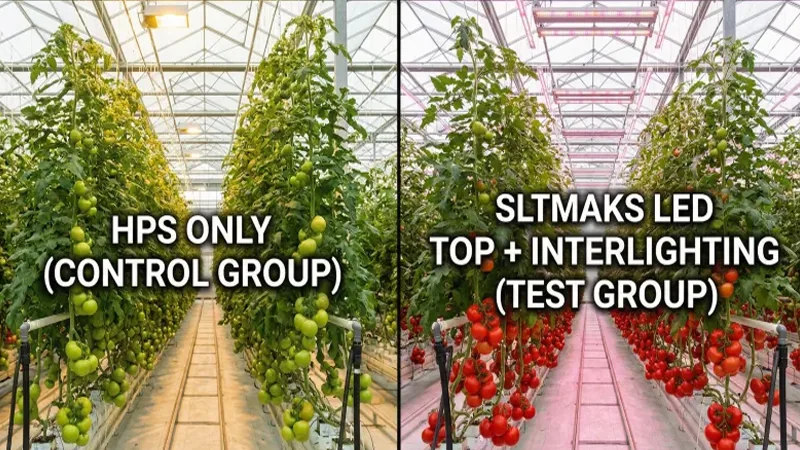
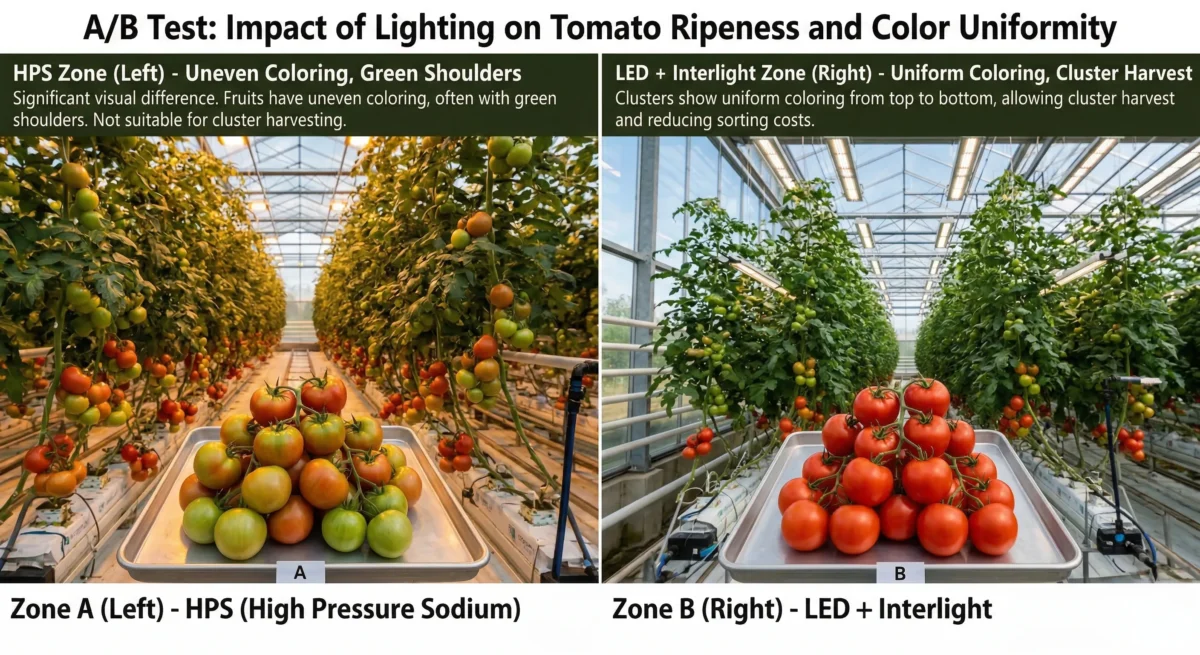
2. Visual quality & color uniformity (A/B test): The visual difference was striking. In the HPS zone (left), fruit coloration was uneven, often with green shoulders remaining. In the SLTMAKS LED+Interlighting zone (right), clusters showed nearly perfect color uniformity from the top fruit to the bottom, allowing for whole-cluster harvesting and reducing labor sorting costs.
Cucumber Results: Maximizing Single Fruit Weight & Density
For the cucumber crop, the goal was to increase the single fruit weight and dry matter, which directly correlates to a premium price grade and longer shelf life. We leveraged the high blue-light fraction of our LEDs to stimulate stomatal opening.
1. Increased stomatal conductance & transpiration: The data confirmed our physiological hypothesis. The SLTMAKS LED zone showed a 28% increase in average stomatal conductance. This led to a stronger transpiration stream, driving more calcium and other essential nutrients into the developing cucumbers.
2. Increased single fruit weight: This metabolic boost translated directly to physical results. As detailed in the table below, the average weight of harvested long English cucumbers was significantly higher in the LED zone.
| Metric | Zone A (HPS Control) | Zone B (SLTMAKS LED Treatment) | Improvement (%) |
| Average Stomatal Conductance | 250 mmol H₂O/m²/s | 320 mmol H₂O/m²/s | +28% |
| Total Transpiration (Estimated) | 1.1 mm/day | 1.4 mm/day | +27% |
| Average Single Fruit Weight | 380 grams | 430 grams | +13% |
| Percentage of Premium Grade A Fruit | 82% | 91% | +9% |
The trial definitively proves that targeted commercial greenhouse supplemental lighting, when correctly applied to a specific crop’s physiology, moves from an operational cost to a powerful yield-accelerating tool.
Standardized Implementation Workflow for Greenhouse Supplemental Lighting
To turn the above strategies into actionable results, greenhouse operators can follow this reproducible 5-step lighting implementation flowchart.
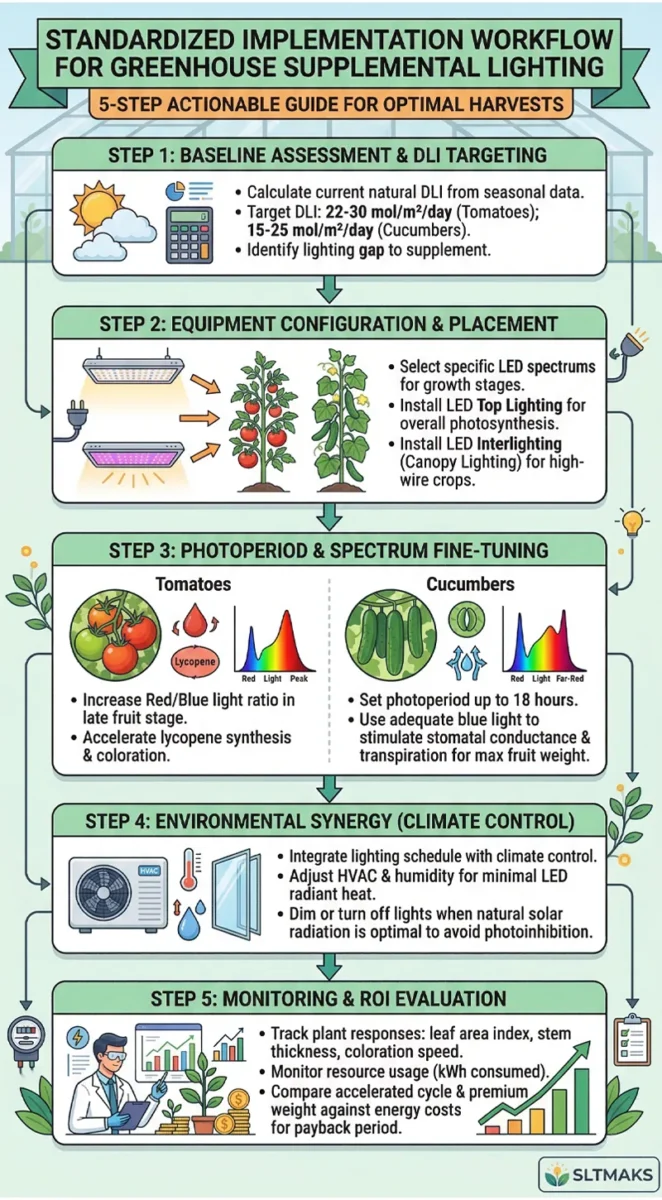
Step 1: Baseline assessment & DLI targeting
- Action: Calculate the current natural Daily Light Integral (DLI) based on local seasonal weather data.
- Target: Set target DLI (22-30 mol/m²/day for Tomatoes; 15-25 mol/m²/day for Cucumbers). Determine the lighting gap that needs to be supplemented.
Step 2: Equipment configuration & placement
- Action: Select specific LED spectrums based on the crop’s growth stage.
- Placement: Install LED Top Lighting for overall canopy photosynthesis and LED Interlighting (Canopy Lighting) for high-wire crops (tomatoes/cucumbers) to ensure middle and lower leaves receive adequate photons.
Step 3: Photoperiod & spectrum fine-tuning
- Tomatoes: Increase Red/Blue light ratios during the late fruit development stage to accelerate lycopene synthesis and fruit coloration.
- Cucumbers: Set up to an 18-hour photoperiod and ensure an adequate blue light fraction to stimulate stomatal conductance, driving transpiration, and maximizing single fruit weight.
Step 4: Environmental synergy (climate control)
- Action: Integrate the lighting schedule with your greenhouse climate control system.
- Check: Because LEDs emit minimal radiant heat, adjust HVAC and humidity settings accordingly. Dim or turn off supplemental lights when natural solar radiation reaches optimal thresholds to avoid photoinhibition.
Step 5: Monitoring & ROI evaluation
- Action: Track plant physiological responses (leaf area index, stem thickness, coloration speed) and resource usage (kWh consumed).
- Result: Compare the accelerated harvest cycle and premium fruit weight against energy costs to calculate the exact payback period.
Energy Efficiency and ROI: The Economic Edge of Modern LED Grow Lights
For a commercial greenhouse, electricity is one of the top three operational expenses. Upgrading from legacy lighting to modern horticultural LED grow lights is not just an agronomic decision; it is a financial imperative.
Slashing Operating Costs
Traditional HPS lamps are notoriously inefficient, converting a massive portion of their consumed electricity into radiant heat rather than usable light. Modern LED fixtures from professional manufacturers can achieve efficacies exceeding 3.0 to 3.5 µmol/J. This means they deliver significantly more photosynthetic photons per watt of electricity consumed, routinely cutting lighting electricity costs by 40% to 50% compared to HPS equivalents.
HVAC Savings and Climate Control
Because HPS lights project intense radiant heat directly onto the crop canopy, growers are forced to run heavy ventilation and cooling systems even in cooler months to prevent heat stress. LEDs are “cold” light sources; they emit minimal radiant heat toward the plants. This decoupling of light and heat allows growers to fine-tune their greenhouse climate with incredible precision, massively reducing the load on HVAC systems and saving further energy costs.
Calculating the Payback Period
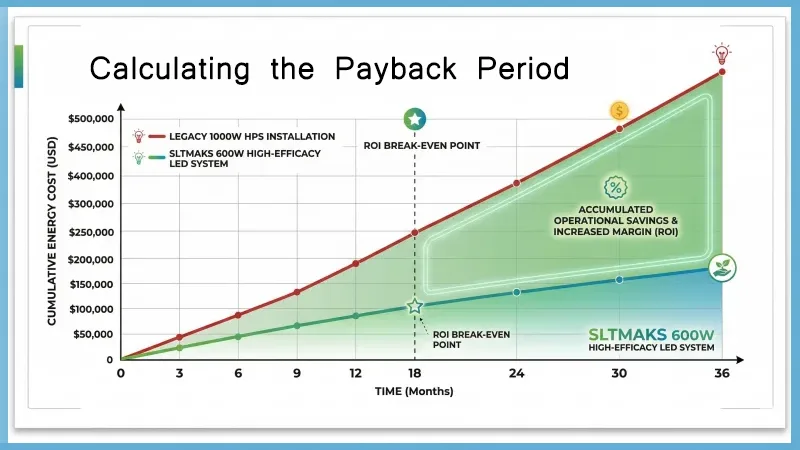
When upgrading from legacy HPS to modern high-efficacy LEDs (3.0–3.5 µmol/J), B2B operators frequently see a full return on investment within 18 to 36 months. To provide methodological transparency, we base this calculation on standard commercial greenhouse operating models rather than best-case anomalies.
Here is a breakdown of the typical cost-saving mechanics when replacing a traditional 1000W HPS fixture with a high-efficiency 600W SLTMAKS LED fixture (delivering equivalent or superior PPFD to the canopy).
1. Standardized baseline assumptions:
- Operating hours: 3,000 hours/year (Typical for winter supplemental lighting in Northern Hemisphere regions like Canada, Northern US, and Northern Europe).
- Average commercial electricity rate: $0.12 USD/kWh (Conservative North American benchmark. Note: Payback periods are significantly shorter in European regions where rates often exceed $0.20/kWh.)
- Legacy HPS system: 1000W Double-Ended HPS + 50W Ballast Draw (Total: 1050W or 1.05 kW). Efficacy: ~1.8 µmol/J.
- Modern LED system: 600W Horticultural LED. Efficacy: 3.3 µmol/J.
2. Direct energy savings calculation (per fixture):
| Metric | Legacy 1000W HPS | High-Efficacy 600W LED | Difference (Savings) |
| Power consumption | 1.05 kW | 0.60 kW | 0.45 kW saved |
| Annual energy use (3,000 hrs) | 3,150 kWh | 1,800 kWh | 1,350 kWh saved |
| Annual electricity cost ($0.12/kWh) | $378.00 | $216.00 | $162.00 saved / fixture |
3. The “Hidden” ROI accelerators: The 18-36 month payback period is not calculated on electricity savings alone. A comprehensive ROI model must factor in:
- HVAC & cooling reductions: HPS fixtures emit high levels of infrared (IR) heat. LEDs convert a higher percentage of energy into PAR light rather than radiant heat, reducing climate control cooling loads by up to 30%, adding estimated savings of $30-$50 per fixture annually.
- Maintenance elimination: HPS bulbs require replacement every 10,000 hours (approx. every 3 years) due to spectrum degradation. LEDs maintain >90% output (L90) for over 50,000 hours.
- Yield premium: As discussed in the tomato and cucumber strategies, optimized spectra lead to faster coloration and heavier single fruit weights. A modest 5-10% increase in premium marketable yield often covers the entire cost of the LED upgrade in the first two harvest cycles.
The bottom line: By combining direct energy savings ($162/fixture), HVAC reductions, bulb replacement savings, and increased crop revenue, the capital expenditure (CapEx) of transitioning to SLTMAKS LED grow lights is reliably recovered within 1.5 to 3 years, leaving a decade of pure profit margin increases.
Partnering with a Professional Horticultural Lighting Manufacturer: The SLTMAKS Advantage
Achieving these high-yield secrets requires more than just buying lamps; it requires a strategic partnership with a professional plant grow light manufacturer who understands the intersection of agronomy and engineering.
As a leading B2B supplier, SLTMAKS engineers lighting solutions built specifically for the harsh, demanding environments of commercial greenhouses.
- Customized lighting recipes: We understand that a high-wire Roma tomato has different spectral needs than a Lebanese cucumber. SLTMAKS offers customizable spectrum solutions, adjusting the red/blue/far-red ratios to perfectly match your specific crop, cultivar, and geographic location.
- Commercial-grade reliability: Greenhouse environments are highly humid and chemical-rich. SLTMAKS fixtures feature rigorous IP65/IP67 waterproof ratings, superior passive thermal management (aluminum heat sinks), and UL/CE certifications, ensuring zero downtime and maximum safety.
- Smart control integration: Our lighting systems are fully compatible with industry-standard greenhouse climate control systems (0-10V dimming). This allows for dynamic light control—automatically dimming the LEDs when the sun comes out, and ramping them up during cloudy spells, ensuring optimal DLI with zero wasted electricity.
Real-World Success: Driving B2B Profitability
Consider a recent deployment at a 5-hectare commercial tomato facility facing severe winter yield drops. By replacing standard 1000W HPS top lights with a hybrid SLTMAKS LED top lighting and interlighting system:
- Coloration speed: The time from fruit set to harvestable red fruit was reduced by an average of 6 days.
- Yield increase: The facility saw a 14% increase in total winter yield due to lower canopy activation.
- Energy reduction: Total electrical consumption for lighting dropped by 42%.
These are not theoretical numbers; they are the tangible results of applying data-driven lighting intervention.
Conclusion: Step into the Future of High-Yield Cultivation
The secret to maximizing greenhouse tomatoes and cucumbers no longer relies solely on fertilizer and genetics. Commercial greenhouse supplemental lighting is the ultimate tool for precision agriculture, allowing growers to dictate coloration speed, drive single fruit weight, and command their production schedules regardless of the season outside.
Transitioning to horticultural LED grow lights is a strategic investment that safeguards your crop quality and your bottom line against rising energy costs.
Ready to optimize your greenhouse yield? Do not guess when it comes to your crop’s lighting needs. Contact the agronomy and engineering experts at SLTMAKS today. Visit https://www.sltmaks.com/ to request a Free Custom Greenhouse Lighting Layout Design and ROI analysis tailored specifically to your facility’s dimensions and crop types. Let us help you grow smarter, heavier, and faster.
FAQ
What is the best commercial greenhouse supplemental lighting for tomatoes?
The most effective strategy for high-wire tomatoes involves a combination of LED top lighting and LED interlighting (canopy lighting). While top lighting provides the necessary Daily Light Integral (DLI) for the upper leaves, interlighting penetrates the dense lower foliage. This ensures uniform light distribution, accelerates bottom-cluster coloration, and maximizes overall yield.
How does LED supplemental lighting accelerate tomato ripening and coloration?
Tomato coloration is driven by the synthesis of lycopene, a pigment highly responsive to specific light spectra. Utilizing commercial greenhouse supplemental lighting with an optimized ratio of red and blue light directly stimulates the carotenoid biosynthesis pathways. This targeted intervention allows tomatoes to transition from green to red significantly faster than relying on natural winter sunlight alone.
How can LED grow lights increase the single fruit weight of greenhouse cucumbers?
Maximizing cucumber weight depends heavily on nutrient and water uptake, which is driven by plant transpiration. LED grow lights customized with a specific fraction of blue light stimulate stomatal opening on the leaves. This increases stomatal conductance, driving a stronger transpiration stream that pulls water and essential minerals (like calcium) into the developing fruit, resulting in heavier, denser cucumbers.
What is the ideal DLI (Daily Light Integral) for commercial tomatoes and cucumbers?
For optimal commercial production, tomatoes are high-light-demanding crops that require a DLI of 22-30 mol/m²/day. Cucumbers typically thrive in the 15-25 mol/m²/day range, depending on the cultivar. During low-light seasons, commercial greenhouse supplemental lighting is essential to maintain these daily targets and ensure continuous carbohydrate production.
Are LED grow lights more cost-effective than HPS for commercial greenhouses?
Yes, modern horticultural LED grow lights offer a massive economic advantage over traditional High-Pressure Sodium (HPS) fixtures. High-quality LEDs, like those manufactured by SLTMAKS, can achieve efficacies exceeding 3.0 µmol/J. This reduces direct lighting electricity costs by 40% to 50%. Additionally, because LEDs emit minimal radiant heat, they significantly lower the operational strain on greenhouse HVAC and cooling systems.
What is the average ROI for upgrading to commercial LED grow lights?
For most professional, high-yield commercial greenhouse operations, the payback period for a comprehensive LED retrofit typically ranges from 18 to 36 months. This rapid ROI is driven by a combination of drastically reduced monthly energy bills, zero bulb replacement costs, faster crop turnover rates, and the premium market prices commanded by heavier, uniformly colored produce.
Can lighting intervention prevent greenhouse cucumbers from becoming too vegetative?
Absolutely. Cucumbers grow rapidly and can easily suffer from a “source-sink” imbalance, producing excessive foliage at the expense of fruit. By adjusting the photoperiod and utilizing a custom light recipe that leans toward generative growth triggers, commercial greenhouse supplemental lighting steers the plant’s energy away from unnecessary leaf expansion and directly into fruit development.