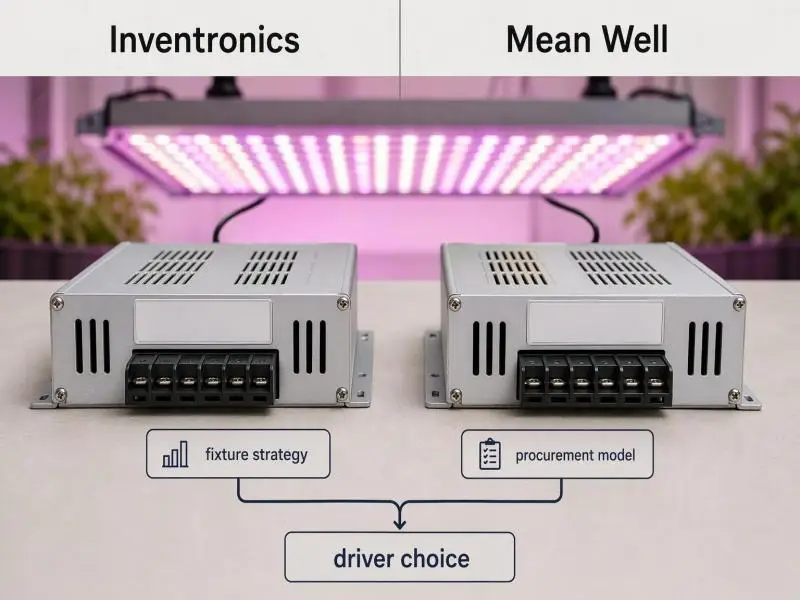
Selecting the proper LED drivers for grow lights dictates how much current reaches the diodes, how the fixture responds to environmental controllers, how hot it runs at canopy level, and how quickly it can be returned to service after a failure. Inventronics and Mean Well both build specialized LED drivers for grow lights that routinely end up in commercial horticultural fixtures, but they organize their catalogs around fundamentally different procurement models. Mean Well publishes broad standard families whose output is fixed by model number or trimmed with an internal potentiometer, while Inventronics builds programmable families where output current is set in software or over NFC, alongside DALI-2/D4i-certified models and a dedicated horticulture line.
That difference, more than any single specification, is what a buyer is actually choosing between when sourcing LED drivers for grow lights. This comparison is criteria-first and based on published datasheets, manufacturer design-in documentation, and standards material from the DALI Alliance — not on bench testing or teardown. It works through six criteria in order: output architecture, dimming and control, thermal derating, programmability, certification, and serviceability. In every case, the decision is carried by the model number on the label, not by the brand on the housing, so treat each section as a filter for narrowing a shortlist rather than a verdict on either manufacturer.
Table of Contents
Quick Comparison: How the Two Brands Differ on the Criteria That Matter
The table below orients the rest of the article. Each row names a criterion, then the documented positioning of each brand at the family level. It summarizes model families, not whole-brand rankings, and a specific model number must be checked against its own datasheet before it is specified into a fixture.
| Criterion | Inventronics (documented families) | Mean Well (documented families) |
|---|---|---|
| Output architecture | Constant-current and constant-voltage models; programmable families advertise full power across a wide output-current range (constant power) | HLG series offers dual constant-voltage/constant-current output; HLG-C is constant current; XLG is constant power with model-specific current and voltage windows |
| Dimming interfaces | 0-10V/PWM/timer dimming on programmable families; DALI-2 and D4i certification on models such as the EUM-075SxxxBx and EUM-100S105BB | 0-10V, 10V PWM, and resistance “3-in-1” dimming on B/AB types of HLG and XLG |
| Thermal data | Datasheets separate safety case temperature (Tc_s) from warranty case temperature (Tc_w) and publish lifetime-versus-Tc curves | Datasheets publish maximum case temperature and tie typical life expectancy to a stated Tcase |
| Programmability | Adjustable output current (AOC) via NFC or programming interface on programmable families | Output current defined by model number; A/AB types allow internal potentiometer adjustment |
| Certification | Model- and series-level listings (UL, ENEC, Type HL, IP ratings), with logo changes tracked in datasheet revisions | Model- and series-level listings (UL8750, ENEC, Type HL, IP ratings), with regional logo caveats stated in datasheet notes |
| Service model | Replacement driver must be reprogrammed to the original output settings | Replacement driver is matched by model number, with potentiometer trim where applicable |
Read the table as a map of where to look, not as a scorecard. Two families in the same row can differ more from each other than the two brands differ overall.
Output Architecture in LED Drivers for Grow Lights: Constant-Current, Constant-Voltage, or Constant-Power?
Start with the load, not the driver. For a constant-current design, the required electrical output is defined by two numbers: the maximum forward voltage of the assembled LED load (Vf max) and the drive current you intend to run through it (Io). Their product gives the maximum output power the driver must supply. Inventronics states this directly in its design-in guide for programmable drivers: Pout max = Vf max × Io, and the driver’s rated output power must meet or exceed it.
The guide’s worked example is worth internalizing because it shows how wiring topology changes the answer. Two LED boards with a 32 V maximum forward voltage, each optimized for 1400 mA, wired in parallel keep the 32 V figure but double the current to 2800 mA — 89.6 W, so a driver rated at least 90 W is required. Wire the same boards in series, and the current stays at 1400 mA while the voltage doubles, which points to a different model in the same family.
That arithmetic is what separates the three architectures. A constant-current (CC) driver regulates current through a series string and lets voltage float within its compliance window; it is the natural fit for a single string or a series-parallel array sized to one drive current. A constant-voltage (CV) driver holds output voltage steady and is used where the load expects a fixed rail, or where the driver offers both modes. Mean Well’s HLG-185H is documented as a constant-voltage plus constant-current driver, while the HLG-185H-C is constant current only, with model-specific current and voltage windows such as 700–1400 mA over 71–143 V.
Constant power is the third option, and it is the one that matters most for horticulture. A constant-power driver delivers its rated wattage across a wide output-current range, so the same model can drive different diode configurations at different currents without losing output.
Inventronics’ EUD-320S family is documented this way: each model in the series delivers 320 W across its current range, from the 105–1500 mA model up to the 469–6700 mA model, with the output voltage window narrowing as current rises. Mean Well’s XLG-320 is likewise described as a constant-power-mode driver, with full-power current ranges such as 1050–1400 mA on the L type and 5570–7420 mA on the H type.
Both brands therefore cover all three architectures, which is the point: the architecture question filters which models you shortlist; it does not crown a brand. Answer it by writing down Vf max, Io, and the wiring topology first, then confirm the candidate model’s constant-current region or full-power current range actually contains your operating point. A driver whose headline wattage matches but whose current window sits at the edge of your design will leave performance on the table.
Dimming and Control: Which Protocol Should the Room Standardize on?
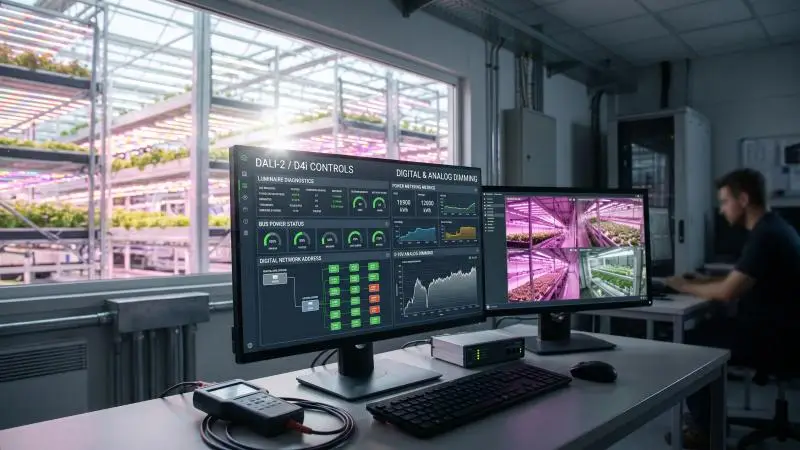
Dimming is where a grow room’s controls architecture gets decided, and the two brands’ documented interfaces map onto two different levels of ambition.
At the analog level, Mean Well’s B and AB types on the HLG and XLG series offer what the datasheets call 3-in-1 dimming: output current can be adjusted by applying 1–10 VDC, a 10 V PWM signal in the 100 Hz–3 kHz range, or a resistance between DIM+ and DIM−. The XLG-320 datasheet specifies 0–10 VDC for its AB type.
The same datasheet carries a wiring warning worth repeating to any installer: do not connect DIM− to −V. Inventronics’ programmable families document a comparable analog set — 0-10V, PWM, and timer dimming modes — with the EUD-320S listing 0-10V as the default mode and PWM selectable through the programming interface, plus three time-dimming modes including self-adapting midnight and self-adapting percentage curves.
At the digital level, the gap widens. Inventronics’ EUM-075SxxxBx is documented as DALI-2 and D4i certified, with an integrated 16 VDC DALI-2 bus power supply, integrated power metering to ±1%, an end-of-life indicator, and two-way communication over DALI-2. The DALI Alliance’s product listing for the EUM-100S105BB confirms certified DALI-2 and D4i status for that model. Mean Well’s HLG and XLG families, as documented in the supplied datasheets, are analog-dimming families; the company’s broader catalog and FAQ material covers DALI and KNX activity, but that should be confirmed model by model rather than assumed from the brand.
What D4i actually buys you is defined by the DALI Alliance. D4i certification is an extension of DALI-2 that makes three data sets mandatory — luminaire data (Part 251), energy data (Part 252), and diagnostics data (Part 253) — and requires an integrated bus power supply (Part 250), with an auxiliary power supply (Part 150) optional. In practical terms, a D4i driver can power sensors and control nodes on the intra-luminaire bus, report energy consumption, and expose diagnostic and inventory data to a building or greenhouse management system.
The controls decision follows from room scale and ambition. A single-tier room with a handful of circuits and a 0-10V controller is well served by analog dimming; it is simple, polarity-tolerant in practice, and every driver on the shortlist supports it. A multi-tier vertical farm or a multi-room facility that wants per-fixture energy accounting, sensor integration without separate power runs, or predictive maintenance signals is the case where standardizing on DALI-2/D4i earns its complexity.
The DALI Alliance’s comparison material notes that a DALI subnet supports 64+64 addresses over up to 300 m of cabling with up to 250 mA of bus power, and that DALI is polarity-insensitive on a standard two-core cable — useful facts when laying out a room before fixtures are chosen.
Thermal Derating: Reading the Curve for a Hot, Humid Grow Room
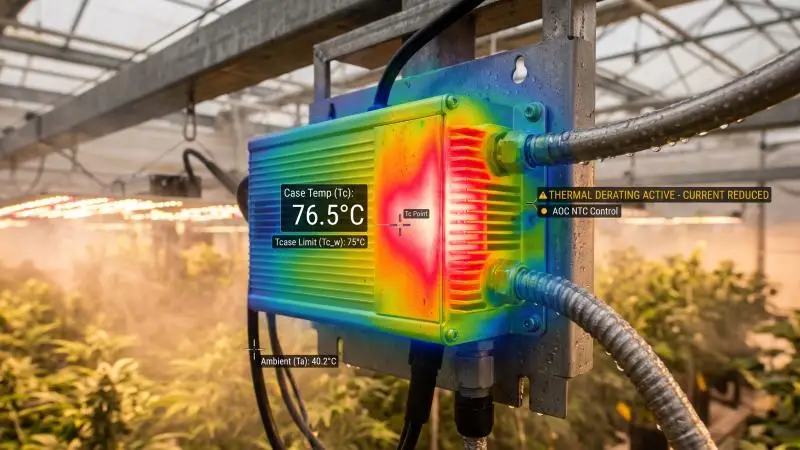
Headline wattage tells you almost nothing about how a driver will behave in a grow room. What matters is the derating curve and the case-temperature limits behind it, and the two brands document these differently enough that comparing them requires care.
Inventronics’ EUD-320S datasheet separates two case-temperature figures. The operating case temperature for safety, Tc_s, runs from −40 °C to +89 °C. The operating case temperature for warranty, Tc_w, tops out at +75 °C, and the datasheet ties the seven-year warranty to that figure. The same document publishes a lifetime figure of 97,000 hours measured at 220 Vac input, 80% load, and 70 °C case temperature, with a pointer to the lifetime-versus-Tc curve for other conditions. The distinction matters because a driver can be electrically safe at 89 °C while running outside the conditions that support its warranty.
Mean Well documents life expectancy against a stated case temperature instead. The HLG-185H datasheet states a typical life expectancy of more than 62,000 hours when Tcase, particularly the tc point, is about 75 °C or less, and gives a maximum case temperature of +90 °C with a working range of −40 to +90 °C. The XLG-320 datasheet states more than 50,000 hours at Tcase of 75 °C or less, with a maximum case temperature of +85 °C and automatic power derating above roughly 85 °C on the L/M/H types.
The XLG-150 adds a concrete ambient figure: operating in constant-current mode at rated current, the maximum workable ambient is 55 °C at 230 Vac or 40 °C at 100 Vac.
To compare the two brands on equal terms, build a small table for each candidate model with four rows: maximum case temperature for safety, the case temperature tied to warranty or life expectancy, the ambient temperature at which full load is still permitted, and the published lifetime figure with its test conditions. Then measure or estimate the actual tc-point temperature in your fixture under canopy conditions. A driver mounted on the fixture’s heat sink sees a different case temperature than one in a remote enclosure, and a humid room changes the convection assumptions behind any free-air rating.
Neither brand’s datasheet claims its driver runs cooler than the other’s; the curves tell you what each model will do at the temperature you actually achieve.
Two practical notes from the documentation. Mean Well’s datasheets specify ambient-temperature derating of 3.5 °C per 1000 m for fanless models above 2000 m altitude, which matters for high-elevation facilities. And Inventronics’ programmable families support external thermal protection through an NTC input — the EUM-075SxxxBx datasheet defines a start-derating resistance and a stop-derating resistance, letting the driver reduce current as the LED module heats up. That is a fixture-level thermal strategy, not a driver-cooling strategy, and it is worth specifying deliberately if your diodes run close to their limits.
Programmability: Factory-Set Current vVersus Field-Programmable Output
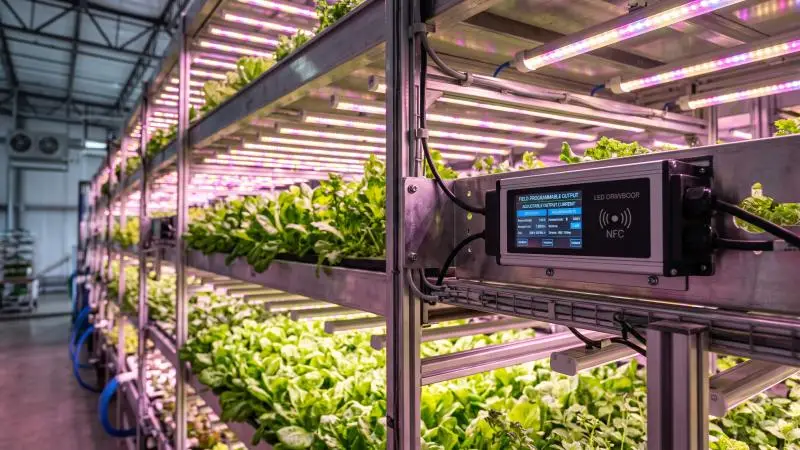
This is the criterion where the two brands represent genuinely different procurement models, and where the operational consequences are largest.
Mean Well’s standard approach fixes output current by model number. In the HLG-185H-C series, the model suffix sets the rated current — C500, C700, C1050, C1400 — each with its own constant-current voltage window. The A and AB types add an internal potentiometer that allows output current and voltage adjustment within a range, as the HLG-185H datasheet notes (“adjustable for A/AB-Type only, via built-in potentiometer”). The XLG-320 datasheet similarly describes output constant power adjustable via a built-in Io potentiometer on the A type. This is a well-understood model: you pick the model whose current matches your design, and the driver arrives set.
Inventronics’ programmable families invert that. The EUM-075SxxxBx is documented as NFC programmable with adjustable output current (AOC); the design-in guide describes a software interface — the Inventronics Multi Programmer — for reading a connected driver, changing output current, and configuring dimming modes and timer curves. The EUD-320S lists output current setting ranges per model and PWM mode selection through the PC interface. The practical effect is that one physical model can serve several fixture variants, with current set at the end of the line or in the field.
The operational consequences run in both directions. On the positive side, programmability reduces SKU count: a single driver part number can cover multiple diode configurations, which simplifies purchasing and inventory and shortens the path from a fixture redesign to a shippable product. On the cost side, it introduces a toolchain and a skill requirement. Someone on staff — or at the contract manufacturer — needs the programming software, the connection hardware, and the discipline to record what each unit was set to. A driver that leaves the line at the wrong current is a fixture that underperforms or overdrives its diodes, and the error is invisible on the label unless your process captures it.
Fixed-current models carry the opposite trade-off. They need no programming step and no software, and a replacement is a like-for-like part number. But every new drive current is a new SKU, and a mid-life change to a fixture’s operating point means a different driver model rather than a settings change.
The decision rule is about where you want the complexity. High-volume OEM development with several fixture variants and an engineering team that can own a programming process fits the programmable model. A retrofit- or replacement-driven operation that values part-number simplicity fits the fixed model. Neither is inherently better; they place the burden in different places.
Certifications and Compliance: What to Confirm at Model Level for an AHJ Inspection
Certification is a property of a model, sometimes of a model-and-region pair, and never of a brand. The datasheets make this concrete.
Mean Well’s HLG-185H-C lists UL8750, CSA C22.2 No. 250.13-12, BS EN/EN/AS/NZS 61347-1 and 61347-2-13, BS EN/EN62384, and IP65 or IP67 among its safety standards. The XLG-320 lists UL8750 (type “HL”), CSA C22.2 No. 250.13-12, ENEC to BS EN/EN61347-1 and 61347-2-13, and IP67. Its datasheet notes carry two regional caveats worth flagging to an AHJ: products sourced from the Americas may not have the ENEC/CCC/KC logo, and some products may not have the BIS logo — both to be confirmed with Mean Well sales. The XLG-150 datasheet adds that its IS15885 listing applies to the XLG-150I type only.
Inventronics’ EUD-320S lists IP67 and UL dry/damp/wet location rating, SELV output on certain models, and Type HL for use in a Class I, Division 2 hazardous location. Its revision history is instructive: revision F in 2022 updated the ENEC/CB/TUV logo, and revision G in 2024 deleted the ENEC/TUV logo from the datasheet. That is exactly the kind of change a submittal package must reflect — a logo on an older PDF is not evidence of a current listing. The EUM-075SxxxBx carries IP66/IP67, UL dry/damp/wet, and Type HL as well, plus its DALI-2 and D4i certification.
Type HL deserves a note because it appears on both brands’ datasheets and is often misunderstood. Mean Well’s FAQ explains that the Type HL requirement comes from UL8750 and provides an option for evaluating LED drivers intended for use in Class I, Division 2 hazardous-location luminaires. It is a driver-level qualification that supports a luminaire-level classification; it does not by itself classify the fixture.
For an AHJ submittal, confirm the following for each model number, not each brand:
- The exact model number and its current datasheet revision, with the revision date recorded.
- The safety standards listed for that model, matched against the standards your jurisdiction recognizes.
- The IP rating as it applies to the specific model and mounting orientation, not the series headline.
- Any regional logo caveats in the datasheet notes, confirmed in writing with the manufacturer or distributor.
- The Type HL listing if the installation is in a classified location, and the luminaire-level classification that depends on it.
- The SELV status of the output if the installation relies on it for separation.
Neither brand is “more certified” in the abstract. What differs is which models carry which listings, and how clearly the datasheets flag regional variation — and both brands’ documents show that variation is real.
Serviceability: Spare Drivers, Programming Expertise, and Replacement Channels
A driver failure in a commercial grow room is a production event. The service question is how quickly a replacement can be installed and returned to the fixture’s original operating point, and the two procurement models produce different service burdens.
With a fixed-current model, the spare-part strategy is straightforward: stock the exact model numbers used in your fixtures, and a replacement is a like-for-like swap. Mean Well’s FAQ directs end users to apply RMA service through the original purchased sales channel and to prepare the model name, serial number, defective quantity, and defect description when claiming warranty repair. That is a channel-based process, and the practical planning question is how many spares to hold given the lead time from that channel. The datasheets do not state distributor stock positions, so that number has to come from your distributor, not from this article.
With a programmable model, the spare itself is interchangeable but the settings are not. A replacement EUM-075SxxxBx or EUD-320S arrives at its default output current, which the datasheet defines as a common value chosen by the manufacturer — not necessarily your fixture’s value. Restoring the original settings requires the programming toolchain and a record of what those settings were. That makes configuration management part of the service plan: a per-fixture record of output current, dimming mode, timer curves if used, and any thermal-protection thresholds, stored where the maintenance technician can reach it. Without that record, a replacement driver is a guess.
The expertise question follows. A grow operation that runs programmable drivers needs at least one person who can operate the programming interface and verify the result, whether that is in-house staff or the fixture OEM. An operation running fixed-current drivers needs only the ability to match a part number. Neither is free; they are different costs.
Replacement lead time and channel are the third variable, and they are the least documented. Both brands publish warranty terms and RMA processes, but neither publishes stock positions or lead times in the datasheets supplied here. The practical approach is to establish, before the first fixture is installed, the authorized channel for each model, the typical lead time from that channel, and the spare quantity that covers your acceptable downtime. For operators who buy finished fixtures rather than bare drivers, that conversation belongs with the fixture supplier, since the supplier’s spare-parts policy — not the driver brand’s — determines what arrives and when.
Who Should Choose Which: Matching the Brand to the Fixture Strategy
The criteria converge on a small number of operator profiles. Match your profile to the documented family, then confirm the model.
High-power programmable OEM fixture development. If you are designing fixtures around high-wattage diodes and expect to iterate on drive current across variants, Inventronics’ programmable families are the documented fit. The EUD-320S delivers 320 W across current ranges from 105–1500 mA to 469–6700 mA, with NFC or interface-based current setting and timer dimming. The trade-off is the programming toolchain and the configuration discipline described above.
Multi-channel horticulture spectrum control. If your fixture tunes spectrum across two or three channels, Inventronics’ horticulture line is documented for it: the company’s horticulture drivers page describes multi-output models supporting 2 to 3 channels, power ranges from 220 W to 1200 W, and input voltage ranges spanning 90–305 Vac up to 342–457 Vac. The ESM-1K2SxxxMG series is a 1200 W constant-current programmable model with 0-10V dimming and UART-based digital dimming. This is a different architectural question from single-string design, and it should be answered before brand selection.
Standardized, replacement-driven retrofit. If you are retrofitting an existing room, standardizing on a small number of fixed-current models, and valuing part-number simplicity over field flexibility, Mean Well’s HLG and XLG families are the documented fit. The HLG-185H-C’s model-number-defined currents and the XLG-320’s constant-power ranges cover common horticultural drive points, and the 3-in-1 dimming on B/AB types integrates with existing 0-10V controls.
Analog-dimming simplicity. If the room runs a 0-10V controller and has no plan to add networked sensors or per-fixture energy reporting, both brands’ analog-dimming models serve equally well, and the decision should fall to thermal margin, certification fit, and service logistics rather than dimming capability.
Many operations will source both brands for different fixture roles — programmable drivers for new development, fixed-current drivers for replacement stock, or DALI-2/D4i models for a room that is being networked while older rooms stay analog. That is a legitimate outcome, not a failure to decide.
The edge case is worth naming. If your load requires a current or voltage window that neither brand’s documented families cover at the wattage you need, or if your controls architecture requires a protocol neither family supports at the model level, the right move is to reopen the architecture question — series versus parallel wiring, single versus multi-channel, analog versus digital control — rather than force a model that does not fit. Driver selection is downstream of fixture architecture, and no brand comparison can substitute for getting the architecture right.
Verdict: Criteria Winners and the Decision Rule
The per-criterion outcomes, summarized:
| Criterion | Where Inventronics is documented stronger | Where Mean Well is documented stronger | Where it is a tie or model-dependent |
|---|---|---|---|
| Output architecture | Constant power across wide current ranges; multi-channel horticulture models | Dual CV/CC and constant-power families covering common drive points | Both cover CC, CV, and constant power; the load decides |
| Dimming and control | DALI-2/D4i certification with integrated bus power and metering | Simple, well-documented 3-in-1 analog dimming on B/AB types | Analog dimming is comparable; digital addressability is the differentiator |
| Thermal derating | Separate Tc_s and Tc_w figures; NTC-based external thermal protection | Clear life-expectancy statements tied to Tcase; published ambient limits | Neither brand claims a cooler-running driver; compare curves at your actual tc temperature |
| Programmability | NFC and interface-based current setting; reduced SKU count | Model-number simplicity; no programming toolchain | Depends on whether you want the complexity in software or in part numbers |
| Certification | D4i and Type HL on documented models; revision history tracks logo changes | Broad standard listings across HLG and XLG; regional caveats stated | Model-level confirmation is required for both |
| Serviceability | Interchangeable spares with recorded settings | Like-for-like part-number replacement | Depends on your configuration-management capability and channel lead times |
The decision rule is short: choose by fixture strategy and controls architecture first, then confirm the model datasheet. Write down Vf max, Io, and wiring topology; decide whether the room needs analog dimming or digital addressability; decide whether you want programmability or part-number simplicity; then check the candidate model’s thermal limits, certifications, and service channel. The brand follows from those answers.
One last connection to the fixture-level evaluation you already run. Driver selection interacts with the criteria a grow-light buyer uses anyway: a driver with a wide constant-power range supports the PPFD and efficacy targets you set for the fixture; a driver with clear thermal limits supports the heat-load assumptions behind your HVAC sizing; and a driver with documented dimming and certification supports the controls and submittal work that precedes installation. Getting the driver right is not a separate procurement exercise from getting the fixture right — it is the part of the fixture decision that determines whether the rest of the specification holds up in the room.
FAQ
What is the main difference between Inventronics and Mean Well LED drivers?
Inventronics centers on programmable driver families with software- or NFC-adjustable output currents and DALI-2/D4i digital control. Mean Well relies primarily on standard fixed-current families determined by model numbers or built-in potentiometers, offering simple part-number replacement and 3-in-1 analog dimming.
Which driver brand is better for smart controls and energy monitoring in grow rooms?
Inventronics. Select Inventronics models feature certified DALI-2 and D4i integration with built-in bus power supplies, two-way communication, and accurate energy/diagnostic reporting for multi-tier or advanced commercial facilities.
How do replacement and maintenance requirements differ between the two brands?
Mean Well replacements are direct, plug-and-play swaps matched by exact part number without special software. Inventronics replacement drivers arrive at default factory settings and require the programming toolchain plus saved configuration records to match the fixture’s target current.
How should growers choose between Inventronics and Mean Well drivers?
Choose Inventronics if you develop multi-variant OEM fixtures, require spectrum tuning across multiple channels, or need digital DALI-2/D4i networking. Choose Mean Well if you prioritize analog 0–10V controls, simple drop-in retrofits, and inventory management based on fixed part numbers.