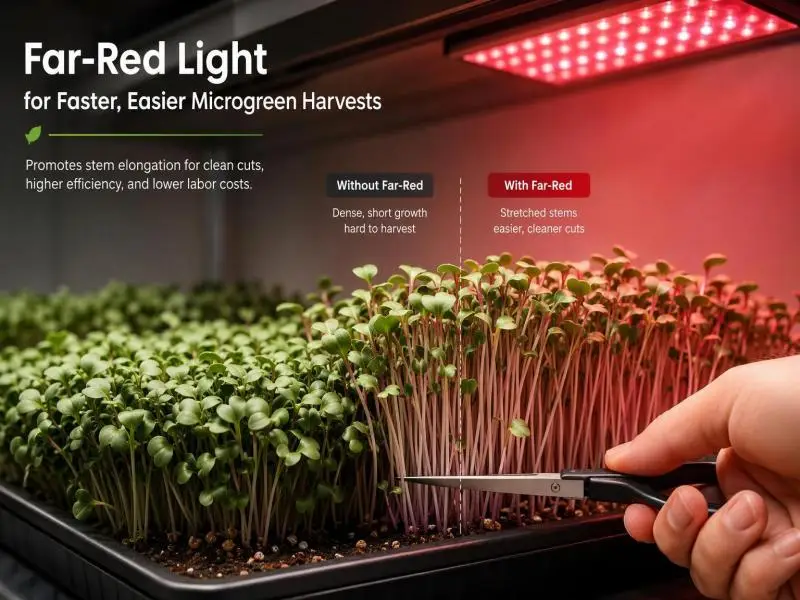
A tray of microgreens that finishes two centimeters short of a comfortable cutter height costs money in a way that never appears on a seed or substrate invoice. Harvesters slow down, blades drag through the growing medium, and the clean cut that keeps stems from bruising becomes a trimming step. Mastering microgreen stretching with far-red light provides the exact spectral lever needed to address this specific problem: it triggers hypocotyl and stem extension via phytochrome, and it can be scheduled, dosed, and measured like any other lighting input.
It is not a yield booster, and treating it as one is where most of the disappointment originates. The evidence base for FR in microgreens is real but uneven: some effects are measured directly in microgreen trials, others are inferred from lettuce, pepper, and seedling work, and several trade-offs remain genuinely unresolved.
This guide flags which is which. It covers the mechanism, the spectral parameters worth specifying, when in the crop cycle to apply FR, how species differ, what the documented costs are, how to measure FR at the canopy rather than trusting a fixture label, and how to run a small dose-response trial that answers the question for your own species and fixture.
Table of Contents
The Science of Microgreen Stretching: Far-Red, Phytochrome, and Shade Avoidance
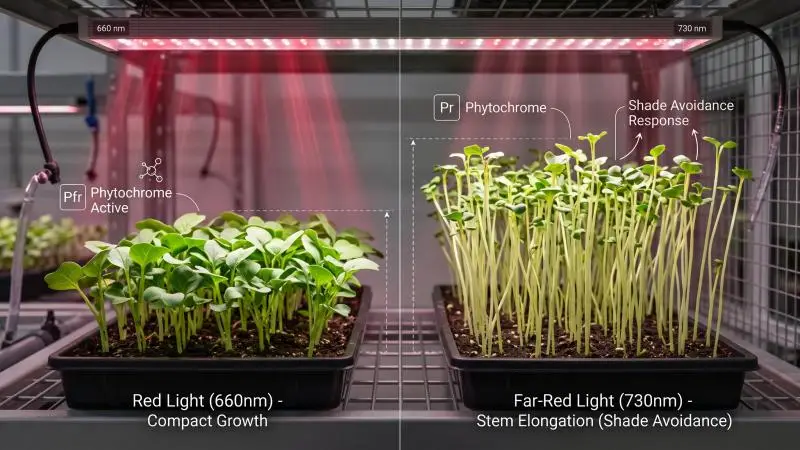
Phytochrome exists in two interconvertible forms. Red light around 660 nm converts the inactive Pr form to the active Pfr form; far-red light around 730 nm converts it back. Under a spectrum with plenty of red and little far-red, a large share of the phytochrome pool sits in the active Pfr form. Add far-red and the equilibrium shifts toward Pr, and the plant reads that shift as a signal that neighbors are close enough to shade it.
The response is shade avoidance: stem and petiole extension, leaf expansion, and in some species a reallocation of carbon toward structural tissue in the elongating stem.
Work in Arabidopsis seedlings found that a higher FR fraction reduced expression of photosynthesis and Calvin-cycle genes in the hypocotyl while increasing transport of radiolabeled carbon from cotyledons to hypocotyls, with cell wall and protein fractions in the hypocotyl increasing more than threefold between high and low red-to-far-red treatments (Frontiers in Plant Science, 2023). That is a mechanistic account of where the extra stem length comes from, and it also hints at why the carbon has to come from somewhere.
The conventional summary metric for a spectrum’s effect on phytochrome is the phytochrome photostationary state (PSS), the modeled ratio of active to total phytochrome under a given light source. PSS is useful for comparing fixtures, but it is not the best predictor of what a plant will actually do. A comparison of metrics found that the percentage of far-red photons relative to photosynthetically active photons predicted stem length and leaf area better than PSS or the red-to-far-red ratio, independent of the light source’s spectral output (Apogee Instruments, summarizing Kusuma and Bugbee 2019).
What the mechanism establishes is direction, not magnitude. It explains why adding FR can stretch a microgreen stem. It does not tell you how many millimeters you will get, and it does not tell you what the stretch will cost in biomass or pigment. Those are empirical questions answered per species, per spectrum, and per environment.
The Spectral Parameters That Actually Control the Response
The far-red waveband is usually defined as roughly 700–750 nm in the plant-physiology literature, and that is the definition used throughout this guide. Some fixtures and product sheets report a broader 700–800 nm band, which will produce a larger number for the same actual effect on phytochrome. When comparing two fixtures or two studies, confirm which band is being summed before treating the percentages as equivalent.
FR dose has two components that are not interchangeable. Instantaneous flux, in µmol·m⁻²·s⁻¹, sets the intensity at any moment. The daily integral, in mol·m⁻²·d⁻¹, is flux multiplied by duration. A short burst at high flux and a long window at low flux can deliver the same daily integral while producing different morphological results, because phytochrome dynamics include thermal reversion back to the inactive form, which matters more at low photon fluxes (Frontiers in Plant Science, 2023). Specify both, or specify one and state the duration.
Two ratio framings compete. FR: PAR expresses far-red photons, summed over a stated band, as a percentage of 400–700 nm photons. R:FR expresses red-to-far-red and is the older convention, still common in greenhouse literature. FR: PAR is the framing that best predicted stem length and leaf area in the comparison cited above, and it is the framing a lighting specifier should ask for. A fixture specification may instead report FR as a fraction of total or extended photon flux — FR divided by the sum of PAR and FR — which uses a different denominator.
The accounting consequence is easy to miss. Far-red photons above 700 nm sit outside the classical PAR definition, but when delivered alongside shorter wavelengths they drive photosynthesis, with canopy-level activity equal to PAR photons as long as far-red stays at or below about 30% of total photon flux (Zhen, van Iersel and Bugbee, Frontiers in Plant Science, 2021). Adding FR therefore raises extended DLI (400–750 nm) without raising PAR DLI (400–700 nm). A recipe that states only “DLI” is ambiguous; state which denominator applies.
The same source notes that far-red typically causes significant stem, leaf, and petiole elongation, which will likely limit the maximum useful FR fraction to below about 20% of total photon flux for most crops. That is a caution about morphology, not photosynthesis. The fraction that stretches stems can sit below the fraction that is photosynthetically useful, and the gap between those two numbers is where the trade-off lives: enough FR to move the stem, not so much that the plant pays for it in compactness, pigment, or biomass.
Choosing the Application Window: Finishing Versus Continuous Exposure
Four timing patterns appear in the literature, and they do not behave the same way.
FR throughout the photoperiod is the simplest to control and the most expensive in energy and accumulated morphological effect. FR during the day only is the pattern in most growth-chamber microgreen work. End-of-day FR is a short pulse, typically 15–60 minutes, applied after the main photoperiod ends; because it lands in a window without PAR, it produces a low PSS efficiently, and it has been described as more energy-efficient than daytime FR application (Lanoue, Little and Hao, Frontiers in Plant Science, 2022). Overnight FR runs for hours in darkness.
The pepper work is the most instructive on timing. In greenhouse peppers under continuous lighting, moving just 25% of the total FR daily integral from daytime into the night — at only 10–11 µmol·m⁻²·s⁻¹ — produced a significantly stronger photomorphogenic response than daytime FR at the same total FR dose, increasing internode length by 37.6–53.5% at the first destructive measurement and 55.6–75.8% at the second, depending on cultivar (Lanoue et al., 2022).
The same paper reports that the lack of further internode increase between two nighttime treatments with PSS of 0.315 and 0.135 suggests a threshold around PSS 0.315, comparable to a PSS threshold of 0.23 reported for arugula and mustard microgreens beyond which no further stem elongation occurred.
The microgreen greenhouse result runs the other way. In winter greenhouse production with overnight supplemental light at 14 µmol·m⁻²·s⁻¹, overnight FR did not promote stem elongation in arugula or mustard; it increased plant height by 7% in mustard only, possibly through petiole elongation, while overnight blue increased stem length by 12% and 20% in mustard and arugula, respectively (Ying, Kong and Zheng, HortScience, 2020).
The authors attribute the contrast with their earlier growth-chamber work partly to the phytochrome activity established by the daytime spectrum: a red-blue daytime source with high PSS leaves phytochrome active for hours into the dark period, whereas greenhouse daylight does not.
That is the practical lesson. Overnight FR is not a universal substitute for daytime FR; its effect depends on what the daytime spectrum left behind. For a microgreen operation, a short finishing window — FR added for the last portion of the photoperiod, or as an end-of-day pulse — concentrates the dose where it can still act on the tissue that will be cut, and limits the total exposure that accumulates biomass and pigment costs. This recommendation is practical reasoning from the timing evidence, not a result that any single study established for microgreens. Treat the window length as a trial variable.
Species and Cultivar Differences: What the Microgreen Studies Show
Three microgreen datasets are worth knowing in detail, because their treatment conditions determine how far each result travels.
Percent increase in plant height versus each study’s own no-far-red control. Bars are not directly comparable across studies: the Ying 2020 growth-chamber trial used a 15% blue / 85% red background at ~330 µmol·m⁻²·s⁻¹ PPFD over 17 h with 155 µmol·m⁻²·s⁻¹ added FR (R: FR 1.8); the Hooks 2022 trial used white LEDs with FR at 32% of total photon flux at constant total flux. Kale showed no significant height response in the white-LED trial and is therefore omitted rather than plotted as zero.
Blue-plus-red versus fluorescent, with two FR levels. Kale, cabbage, arugula, and mustard microgreens were grown under sole-source light at roughly 330 µmol·m⁻²·s⁻¹ PPFD over 17 hours at about 21 °C. Adding high-intensity FR at 155 µmol·m⁻²·s⁻¹ to a 15% blue / 85% red background increased plant height in all four species and cotyledon area in mustard, without affecting fresh or dry biomass in any species.
It also increased cotyledon greenness in the green-leafed species and reduced cotyledon redness in red-leafed mustard. Low FR at 15.5 µmol·m⁻²·s⁻¹ changed none of these traits relative to blue-red alone (Ying, Kong and Zheng, 2020). The authors note that the relatively high energy consumption of FR needs to be considered when optimizing spectral quality.
White LED plus FR at 32% of total photon flux. Basil, cabbage, kale, and kohlrabi were grown under white LEDs with FR added such that FR made up 32% of total photon flux density, with total photon flux held constant across treatments. FR increased plant height by 9–18% in basil, cabbage, and kohlrabi regardless of a simultaneous UVA treatment, but reduced plant biomass, total phenolic content, and antioxidant concentrations in at least one species (Hooks et al., Sustainability, 2022). Note that 32% sits above the ~20% ceiling suggested for most crops on morphological grounds, and the biomass cost appeared at that level.
Ruby Streaks mustard across growth stages. In a USDA study, FR applied during the day or at night accelerated the emergence of leaves, flowers, and seed pods more dramatically than an enhanced-white treatment delivering a comparable extended DLI, and FR decreased total glucosinolate and anthocyanin contents in microgreens and baby leaves. Enhanced white light, by contrast, increased dry weight of microgreens relative to the control and increased those phytonutrients in baby leaves (USDA ARS publication record, Teng et al., J. Agric. Food Chem., 2024).
Read together, these studies support a narrow claim: FR at sufficient intensity reliably increases height in the brassica microgreens tested, and the effect is not free. They do not support a category-wide statement. Arugula responded differently from mustard in the greenhouse overnight trial; kohlrabi and kale responded differently from each other in the white-LED trial; and a cultivar-level difference within mustard is plausible given the Ruby Streaks results. Transfer a number from one of these studies to your own crop only as a starting point for a trial.
The Trade-Offs: Biomass, Pigments, Stem Stiffness, Shelf Life, and Energy
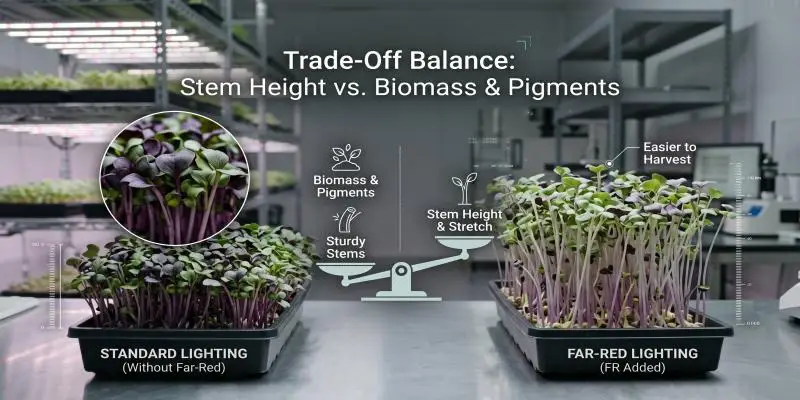
The measured side of the ledger is short and consistent enough to plan around.
Average effect of far-red addition across 207 independent studies pooled from 55 vegetable publications (Zhang et al., Plants 13:2508, 2024). The pool spans many crops, spectra, and FR fractions and is not a microgreen-specific forecast; the microgreen trials cited in this article are mixed on biomass. Chlorophyll and soluble protein are shown as reductions.
Biomass. Neutral in the 155 µmol·m⁻²·s⁻¹ blue-red trial across four species. Reduced in at least one species in the 32% FR white-LED trial. Increased dry weight in Ruby Streaks microgreens under enhanced white light, but that treatment raised total photon flux rather than adding FR to a fixed flux, so it is not evidence that FR raises yield.
A meta-analysis across 207 independent studies in vegetables found FR increased fresh weight by 25.27% and dry weight by 21.99% on average, alongside an 81.87% increase in plant height (Zhang et al., Plants, 2024). That average spans many crops, spectra, and FR fractions, and it should not be read as a microgreen yield forecast; the microgreen-specific trials above are the more relevant evidence, and they are mixed.
Pigments and phenolics. Reductions in total chlorophyll, carotenoids, and phenolics were reported for microgreens under supplemental FR in the greenhouse trial; reduced total phenolics and antioxidants in at least one species in the white-LED trial; and reduced glucosinolate and anthocyanin in Ruby Streaks microgreens. The meta-analysis likewise reports an average 11.88% reduction in chlorophyll and 11.66% reduction in soluble protein with FR addition. For a product sold on color and nutritional density, this is a real cost, and it is species- and cultivar-dependent.
Development rate. FR advanced leaf and flower emergence in Ruby Streaks. In a crop harvested at the first-true-leaf stage, an accelerated developmental clock can shift the harvest window earlier, which is a scheduling consequence as much as a quality one.
Three trade-offs are not established by the material reviewed here, and importing an answer from tomato or pepper would be a mistake.
Stem stiffness and lodging. No microgreen-specific measurement of stem diameter, stiffness, or lodging under FR finishing was found in these sources. The vegetable meta-analysis reports an average 12.91% increase in stem diameter with FR, but that is across crops and growth stages, and it does not settle whether a stretched microgreen hypocotyl is more or less likely to collapse at harvest or in the punnet.
Shelf life. No post-harvest storage data for FR-finished microgreens was found. Whether a longer, thinner stem holds up in the cooler is an open question for your own trial to answer.
Energy cost per tray. This is arithmetic, not a study result, and it depends on two things: the efficacy of the FR channel in your fixture, and whether FR photons displace PAR photons or add to them. If total photon flux is held constant and FR replaces red, the energy cost may be near zero and the biomass cost is the one that shows up. If FR is added on top, you pay for the extra photons and you also raise extended DLI, which may or may not translate into growth.
The decision framing follows from that. FR is worth adding when the harvest labor savings it produces exceed the measured quality cost, and both sides of that comparison have to be measured on your crop, in your facility, at your harvest criterion. A 9–18% height increase that moves a tray from below the cutter to above it may be worth a small phenolic reduction; a 30% height increase that costs biomass and color on a product sold on appearance probably is not.
Measuring Far-Red at the Canopy Instead of Trusting the Label
A fixture label rarely gives you what you need. Spectra shift with dimming, mounting distance, and reflector geometry; the FR fraction is often unstated; and when it is stated, the waveband may be 700–800 nm rather than 700–750 nm. The only number that governs the plant response is the one measured at canopy height in your own installation.
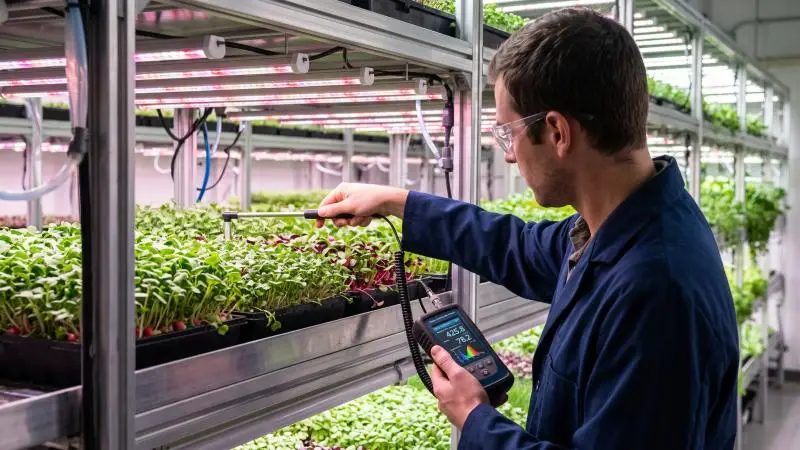
Three instrument options cover most needs:
- Spectroradiometer. Measures spectral photon flux density across the full range, from which you can calculate PAR, FR, extended PPFD, FR fraction, and a modeled PSS. This is the reference instrument and the one to borrow or rent for an initial characterization.
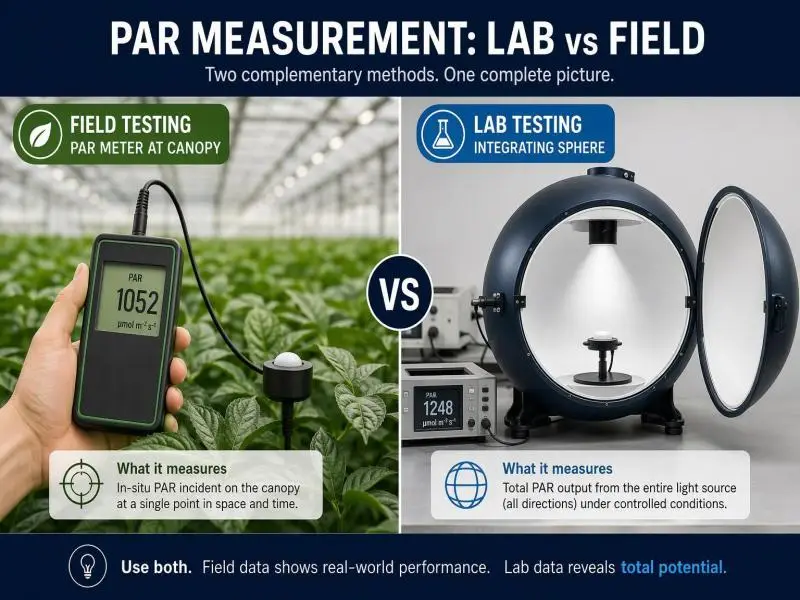
- PAR-FAR sensor. Reports the far-red to PAR ratio and the absolute PAR and FAR fluxes. It is the practical choice for routine checks under electric lights, and it gives you the FR fraction directly.
- R/FR sensor. Reports the red-to-far-red ratio and is recommended where comparison to historical sunlight data matters. Sensor spectral response affects agreement with a spectroradiometer: in a comparison under full sunlight and shade beneath a plant canopy, one commercial R/FR sensor matched the spectroradiometer closely while another diverged substantially in shade (Apogee Instruments). If you are comparing absolute ratios across instruments, verify the agreement rather than assuming it.
Where to measure matters as much as what to measure. Take readings at canopy height, not at the fixture. Sample a grid across the tray rather than a single center point, because edge-to-edge uniformity of the FR channel is rarely specified and may be worse than the PAR uniformity. Measure at the start and end of the FR window, since dimming or channel changes between those points change the delivered dose. Re-measure after any change to mounting height, dimming schedule, or fixture model.
One practical point is easy to overlook: canopy-level FR fraction rises as the canopy closes, because the growing leaves absorb PAR and scatter far-red. A recipe validated on an open tray at sowing may deliver a different ratio at harvest, when the canopy is dense. If your FR window runs late in the crop cycle, measure at the canopy you will actually harvest.
Designing a Bench-Scale Trial on Your Own Crop
A bench trial that answers the question for your facility does not need a research-grade growth chamber. It needs replication, a true control, a dose ladder, and pre-set stopping rules.
Design. Use multiple trays per treatment — three is a workable minimum, more if bench position effects are likely. Randomize or block tray positions across the bench so that light and temperature gradients do not align with treatment. Keep the base spectrum identical across all treatments and vary only the FR channel, so that any difference is attributable to FR and not to a change in PAR.
Treatments. Include a control on the base spectrum with no FR. Then run a dose ladder rather than a single FR level: three or four FR fractions spanning the range you are considering, for example roughly 5%, 10%, 15%, and 20% of total photon flux, all at the same total photon flux and the same application window. A ladder makes the response curve visible and shows whether a threshold exists below which nothing happens — the low-FR result in the blue-red trial, where 15.5 µmol·m⁻²·s⁻¹ changed nothing, is a reminder that a sub-threshold dose is wasted energy.
Stopping rules. Set a harvest criterion before the trial starts: a target stem length, or the minimum height at which your cutter or shears make a clean cut without dragging medium. Set a quality floor as well — a minimum acceptable fresh weight per tray, a color score, or a phenolic or anthocyanin threshold if you measure them — below which a treatment is rejected regardless of how much stretch it produced. Without a pre-set floor, the tallest treatment tends to win by default.
What to record. Spectral measurements at canopy height for every treatment, taken at the start and end of the FR window. Stem length and stem diameter at harvest, measured on a random sample of plants per tray rather than the tallest ones. Fresh weight per tray and dry weight on a subsample. A visual color score, ideally with a photographed reference standard. Any lodging observed at harvest or in the punnet. If you have the analytical capacity, total phenolics or anthocyanin on the treatments that pass the height and biomass screens.
What the trial establishes. It establishes what happens in your facility, with your species, your cultivar, your spectrum, and your harvest criterion. It does not establish a general recommendation, and it should not be reported as one. Its value is that it converts a vendor claim or a published result into a number you can put in a cost calculation.
FAQ
Does far-red reduce yield?
Not necessarily, and not uniformly. In the blue-red trial at 155 µmol·m⁻²·s⁻¹ FR, fresh and dry biomass were unchanged across four species. In the white-LED trial at 32% FR, biomass was reduced in at least one species. The difference in FR fraction and background spectrum is the likely explanation, but the trials do not isolate it, so treat biomass as a variable to measure rather than a fixed cost.
How much far-red is too much?
There is no single number, but two anchors are useful. The photosynthesis literature suggests far-red stops behaving like PAR above roughly 30% of total photon flux, and the same source suggests stem elongation will likely limit the useful fraction to below about 20% for most crops. The microgreen trial that reduced biomass used 32%. Start below 20% and let your dose ladder tell you where the cost appears.
Is end-of-day far-red enough?
It depends on the daytime spectrum. End-of-day FR is efficient because it produces a low PSS in a window without PAR, and it has been shown to increase light use efficiency. But in pepper, it did not match moderate-intensity daytime FR for plant height, and in the greenhouse microgreen trial, overnight FR — a longer dark-period exposure — did not promote stem length in arugula at all. If your daytime spectrum already leaves phytochrome active into the dark period, a short pulse may do less than you expect. Test it against a daytime or finishing-window treatment.
Do FR-finished microgreens hold up in the cooler?
This is unresolved. No post-harvest storage data for FR-finished microgreens was found in the sources reviewed. A longer, thinner stem may be more fragile, and the pigment reductions reported at high FR fractions may affect appearance over time, but neither has been measured here. Include a cooler hold in your trial if shelf life is a commercial constraint.
Is the far-red in a full-spectrum fixture sufficient?
Possibly, but verify it. Full-spectrum fixtures vary widely in FR content, and the fraction is often unstated or reported over a different waveband. Measure the FR fraction at canopy height with a PAR-FAR sensor or spectroradiometer before assuming the built-in FR is doing the work. If it is below the threshold your trial identifies, supplemental FR may be needed; if it is already at 20% or more, you may be paying a biomass and pigment cost you did not intend.
Does the response differ between hypocotyl and true stem?
Yes, in principle and probably in practice. Microgreens are typically harvested with cotyledons expanded and around the emergence of the first true leaf, so the harvest-relevant tissue is largely hypocotyl. The elongation response to FR is mediated through phytochrome in both tissues, but the hypocotyl is a seedling structure with different anatomy and carbon allocation than a true stem, and the studies reviewed here measured plant height or stem length without consistently separating the two. If your harvest criterion depends on a specific segment, measure that segment.
Conclusion: A Controllable Lever With a Measurable Cost
Far-red reliably triggers stem extension in microgreens through phytochrome and shade avoidance. That part is well established, and it is enough to justify treating FR as a controllable lever on harvest height rather than as a yield input.
Everything past that point is facility-specific. The size of the stretch depends on FR fraction, application window, background spectrum, species, and cultivar. The biomass and pigment cost appears at some FR fractions and not others, and the microgreen trials disagree on where that line sits. Stem stiffness, shelf life, and energy cost per tray are not settled by the published microgreen work at all.
The defensible path is therefore narrow and practical: run a short finishing window rather than continuous FR, keep the FR fraction below the level where your own trial shows a biomass or pigment cost, and use a small dose-response trial with a true control and a pre-set quality floor to find that level. The measurement and trial sections above are the next actions.
The number to record and repeat is the FR fraction at canopy height — measured, not read off a fixture label — because it is the parameter that best predicts the morphological response and the one most likely to change as your canopy closes, your fixtures dim, or your mounting height shifts. Fixture marketing will not give it to you. A PAR-FAR sensor and a notebook will.