
Introduction
A private label grow light warranty is a cost-allocation instrument before it is a marketing asset. The fixture carries your brand, so the grower with a dark canopy calls you — not the factory that built the driver or the board. The components, process data, and failure analysis sit with the contract manufacturer, and every dollar in that gap lands on the entity whose name is on the label.
This strategy closes that gap. The work runs in a sequence: decide which legal entity makes the promise and for how long, define what is covered and what remedy applies, map each obligation onto supplier terms so the factory’s duty tracks yours, write a claim procedure three parties can actually execute, assign every cost line, reserve against the residual exposure, draft exclusions tied to documented operating conditions, and check the whole document against statutory guarantees before it goes public.
The deliverable is two documents that agree line by line: a customer-facing warranty and a back-to-back supply schedule. A warranty that reads well but outruns the supplier’s obligation is a funded liability, not a differentiator. This article covers commercial strategy for B2B and consumer channels; it is not legal advice, and jurisdictional rules need local counsel.
Table of Contents
Start Your Private Label Grow Light Warranty Strategy With the Warrantor, Not the Warranty Period
The first decision is not three years versus five. It is which entity promises what, to whom, and from which date — because that determines who absorbs unreimbursed cost when a claim is valid to the grower but not recoverable from the factory.
Under the CPSA definition at 16 CFR 1110.3, a private labeler is the owner of a brand or trademark on the label of a consumer product where the manufacturer’s mark does not appear. The regulation’s test has three parts: the product is labeled with a brand belonging to someone other than the manufacturer, that person authorized or caused the labeling, and no manufacturer trademark appears on the label. Strip the factory’s mark from the housing, and the visible counterparty is your brand. That is the entity a grower, a distributor, or a regulator will pursue.
Three structures are workable, and each moves the cost of an unrecoverable claim:
- Brand entity as warrantor. Cleanest for the customer relationship and for marketing consistency. The brand carries the full exposure and recovers from the supplier only to the extent the supply agreement allows.
- Regional importer entity as warrantor. Useful where the importer of record already holds the customs and product-safety obligations in that market. It splits the promise across jurisdictions, which means two warranty documents and two reserve calculations.
- Distributor with assigned rights. The distributor warrants to the end user and holds assigned claims against the brand. This pushes the customer relationship one step away and makes the assignment language the critical clause.
Term start deserves the same scrutiny. A shipment-date term is simple to administer: the invoice or ship record is the evidence, and the grower cannot dispute it. It also starts the clock while the fixture sits in a warehouse or waits for a facility build-out, so a project with a long commissioning lag consumes warranty months before the first photon is emitted.
An installation-date term aligns coverage with service life but requires documented commissioning records, and those records are only as good as the installer’s discipline. A workable middle position is shipment date plus a defined maximum lag for documented projects — the clock starts at shipment, but a registered project can extend the start to a verified commissioning date within a stated window.
Transferability is the other lever. Established lighting brands commonly scope coverage to the first buyer at the first location. LEDVANCE’s US and Canada terms extend the warranty to the original end-user at the original location and bar transfer or assignment; Amerlux’s limited warranty is extended only to the original or first end-user purchaser at the original installed location and is non-transferable.
For a private label brand, the practical question is whether your channel resells into secondary markets. If it does, a non-transferable term will generate disputes at the first resale, and you should decide that deliberately rather than inherit it from a template.
Define Covered Components, Remedy and the Performance Guarantee
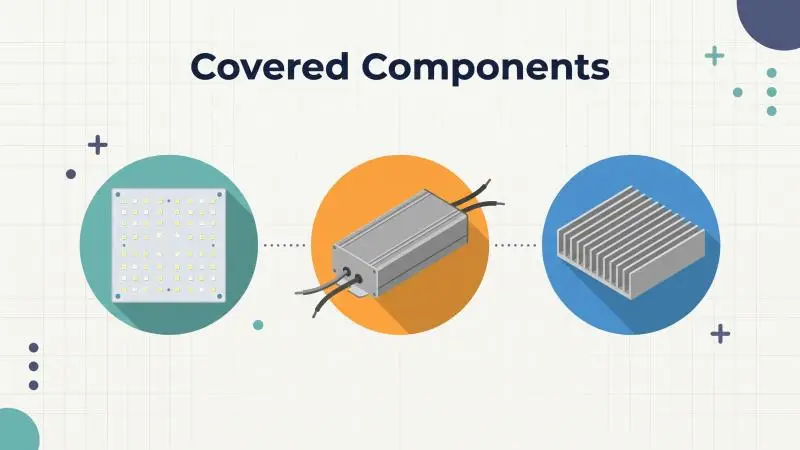
Three separate promises get blurred in most draft warranties: the parts list, the remedy ladder, and any guarantee about light output. Write them as separate clauses.
Components. Name what is covered: LED chips and boards, driver, thermal system (heat sink, fans, liquid cooling loop where applicable), controls and sensors, and firmware. Coverage can diverge at longer terms. A driver’s rated life depends on its operating temperature, and a chip’s output depends on drive current and junction temperature, so a five-year promise on the board and a three-year promise on the driver is a coherent structure — as long as the document says so.
The DLC Horticultural Lighting Technical Requirements V4.0 treats the luminaire as including light source, housing, heat sink, electrical components, optics, and any cooling fans or controls, and requires a manufacturer warranty of at least five years covering the complete luminaire for listed products. That is a program eligibility rule, not a legal minimum, but it is a useful benchmark for what the market treats as whole-fixture coverage.
Remedy. State repair-or-replace at the warrantor’s option, and say whether new, reconditioned, refurbished or remanufactured parts may be used — LEDVANCE and eldoLED both reserve that right explicitly. Decide whether the balance of the original term carries over or a replacement restarts the clock. Amerlux keeps the balance of the original period; LEDVANCE states that repair or replacement does not extend the warranty period. Carrying the balance is the more defensible position and the easier one to administer.
Performance. A lumen or photon-flux depreciation guarantee is a different product from a defect warranty, and it needs three things to be enforceable: a measurement method, a baseline, and a usage-hour cap. The DLC program illustrates the vocabulary.
It requires LM-80/TM-21 or LM-84/TM-28 projections sufficient for a Q90 of at least 36,000 hours in the 400–700 nm range, and its earlier testing guidance explains why the flux-maintenance point is set at a 10% reduction rather than the 30% loss human vision tolerates: reduced flux has an outsized effect on plant economics. A depreciation guarantee written without a test protocol, a stated ambient condition, and an hour cap is unenforceable in practice, because neither party can establish what the fixture was supposed to do at hour 20,000.
Coverage scope also varies by term length across the market. A B2B LED warranty comparison tabulates how 2-, 3-, 5-, and 10-year structures typically differ — proration appearing in later years, usage-hour limits becoming common at five years, driver coverage narrowing at ten — and offers buyer-volume guidance on which term suits which order size.
Treat that as a market heuristic from a sourcing platform, not a rule. The useful takeaway is structural: longer terms tend to migrate from full coverage toward prorated coverage and hour caps, so if you sell a long term, write the proration schedule and the cap into the document rather than discovering them at claim time.
Map the Promise Onto OEM/ODM Back-to-Back Terms
The brand’s promise and the factory’s obligation are two contracts. The work is making them track in duration, scope, and trigger, and knowing which structure you have chosen.
“Pass-through” is the phrase that appears in negotiations, and it is legally ambiguous. As the Global Supply Chain Law Blog’s analysis of warranty options down the supply chain sets out, several structures can accomplish the same economic goal, and the choice changes risk allocation. In a pass-through or back-to-back arrangement, the reseller obtains a warranty from the supplier and extends a matching warranty to the customer; the reseller remains exposed if its warranty is broader than the supplier’s, or if the supplier’s warranty becomes invalid or unenforceable.
An indemnity structure can encourage joint response to claims, but the supplier will want control over which claims the indemnity covers and how the reseller responds — and the reseller is still exposed if the indemnity lapses. Governing law and forum differences sharpen the problem: a dispute decided in one jurisdiction may reach a different result than the same facts decided in another.
| Criterion | Pass-through | Back-to-back | Indemnity |
|---|---|---|---|
| Who controls claim approval | Supplier, in practice | Brand approves to grower; supplier approves recovery | Supplier controls scope of covered claims |
| Who funds replacement freight | Often unresolved | Negotiated per cost line | Per indemnity terms |
| Supplier insolvency | Brand funds the full remedy | Brand funds the full remedy | Brand funds the full remedy; indemnity is a claim against an estate |
| How the grower’s remedy stays funded | Only while the supplier performs | Only while the supplier performs and the terms match | Only while the supplier is solvent and the indemnity is valid |
The table’s honest conclusion is that none of the three structures removes the brand from the customer relationship. What they change is how much of the cost comes back.
Four gaps to negotiate explicitly:
- Term. The supplier’s warranty period must equal or exceed the brand’s term plus the lag between the supplier’s shipment and the brand’s shipment to the grower. A three-year supplier term behind a three-year brand term leaves the last months of every unit uncovered.
- Scope. The supplier must cover the same components the brand covers, at the same terms. If the brand warrants the driver for the full term, the supply agreement cannot cap driver coverage at two years.
- Evidence standard. The supplier must accept the brand’s root-cause evidence or agree to a joint inspection. Otherwise every claim becomes a negotiation about whose test counts.
- Freight. The supplier must reimburse replacement freight, not just parts. A free driver that costs $60 to air-freight is a partial recovery.
Run the Claim: Evidence, Approval and Replacement Shipment

A claim procedure has to work for a grower with a dark room, a support desk with a queue, and a factory with an inspection bench. Write the sequence once and use it in both the customer warranty and the supply schedule.
- Report. The grower submits proof of purchase, serial number or date code, installation photos, and a fault description with the operating conditions at failure.
- Triage. The brand’s support desk checks eligibility — term, location, installation compliance — and issues a return authorization or an on-site inspection instruction.
- Return or inspect. The product comes back, or a technician inspects in place where freight cost or fixture size makes return impractical.
- Root cause. The brand assigns a cause, with the supplier involved where the cause implicates a supplied component.
- Remedy ships. Replacement or repair ships against the authorization.
LEDVANCE’s claim procedure is a concrete model. Claims are filed online or through customer service using a product claim record. Where the warrantor deems it necessary, the purchaser receives a return material authorization number that must appear on both the packing slip and the outside of the box, and failure to follow the procedure voids the warranty.
Advance replacements shipped before the return is received are charged at the then-current price plus shipping if the original is not returned or is found not covered. The warrantor reserves the right to examine all product and to be the sole judge of whether a product is defective and covered.
That last clause is the asymmetry to manage. The brand wants sole-judge authority over the grower; the factory wants the same authority over the brand. Both positions cannot be absolute in the same relationship without one party absorbing the difference. The practical resolution is a documented evidence standard — the brand’s determination stands against the grower, and the supplier’s recovery is governed by a defined inspection and joint-review process rather than by unilateral rejection.
The Foley OEM and supplier warranty analysis supplies the documentation discipline that makes such a process defensible. Identify root causes, implement containment, and establish clean points that mark when corrected product entered the stream. Involve the supplier in the root-cause investigation so blame is not assigned by default to whichever component is convenient — the article gives the example of a defect in one component causing a second component to wear out prematurely, where reinforcing the second component fixes the symptom without making it the cause.
Document conclusions and areas of disagreement as you go. The same analysis warns that claims must fall within the agreed warranty period and not be time-barred, which is a reason to timestamp every claim at intake.
Allocate Freight, Duties, Labor and Disposal Across Borders
This is where private label warranties quietly lose money. The parts cost is visible and negotiated; the surrounding cost lines are not.
- Outbound replacement freight, including expedited shipment when a commercial canopy is dark.
- Return freight for inspection, which someone pays even when the claim is denied.
- Import duties and VAT on replacement units, which are a customs question, not a warranty question.
- On-site labor for removal and reinstallation, plus any lift or scaffold time.
- Disposal of failed units, which may carry regulated-waste obligations depending on jurisdiction.
- Commissioning or reprogramming of controls after a swap.
Major lighting warranties commonly exclude labor and removal or installation costs. LEDVANCE states it is not responsible for labor or transportation costs for removal, installation of replacement components, return or installation, and its limitation clause excludes removal, commissioning, programming and reinstallation costs. Amerlux requires the customer to hire and pay an electrician to remove and reinstall covered components, with no labor covered after the first year.
Shipping responsibility varies by brand and is worth reading closely. eldoLED’s OEM warranty has the customer bear the cost of shipment to the warrantor, while the warrantor bears the cost of shipping the replacement to the end-user — conditioned on the warrantor having sole control over all aspects of the shipment, including shipping directly to the end-user. That condition matters: a brand that routes replacements through a distributor may fall outside the clause.
Tax treatment is often drafted separately from warranty scope. Fluxwerx’s terms place all taxes, including VAT, excise taxes and customs duties, on the customer and allow them to be invoiced separately. Whether a warranty replacement re-enters a country duty-free, and under what procedure, depends on the customs regime and the documentation filed — confirm the treatment with a customs broker rather than assuming a replacement is exempt.
Build a decision table with one row per cost line and one column each for brand, supplier and grower. A line with no owner is a line the brand pays by default.
| Cost line | Brand | Supplier | Grower |
|---|---|---|---|
| Replacement unit | ● | ||
| Outbound freight | ● | negotiate | |
| Return freight for inspection | negotiate | ● if claim denied | |
| Duty and VAT on replacement | Confirm with broker | ||
| Removal and reinstallation labor | decide deliberately | ● if excluded | |
| Disposal | ● unless stated | ||
| Recommissioning | ● unless stated |
Reserve Against Exposure Without Inventing a Failure Rate
A reserve is arithmetic, not a borrowed percentage. Build it from inputs the brand controls:
Illustrative arithmetic only. All inputs are hypothetical planning assumptions, not observed failure rates or market benchmarks. The reserve moves linearly with the claim rate, so the claim rate is the input that deserves the most scrutiny.
Annual unit volume × expected claim rate × cost per claim = annual warranty cost.
Cost per claim is the sum of unit cost, replacement freight, duty, and any labor allowance the brand has chosen to absorb. Divide annual warranty cost by annual revenue from the warranted products to get a reserve percentage.
A worked example, with every input illustrative and none of them a market claim:
- 4,000 units shipped per year
- 2% planning claim rate = 80 claims
- $180 per claim ($120 unit cost + $35 freight + $10 duty + $15 handling)
- Annual warranty cost = $14,400
- Revenue of $1.2 million gives a reserve of about 1.2%
Now run the sensitivity. Double the claim rate to 4%, and the annual cost becomes $28,800, or about 2.4% of revenue. Halve the per-claim cost, and the reserve falls proportionally. The point of the exercise is that the reserve moves linearly with the claim rate, so the claim rate is the input that deserves the most scrutiny — and the one most likely to be wrong in year one.
Keep two numbers separate. The reserve is an accounting accrual: money set aside whether or not the supplier reimburses anything. Supplier recovery is a contractual reimbursement that arrives later, if at all. Net exposure is the gap between them, and that gap is what the reserve has to cover. A brand that books the recovery as an offset before it is collected is under-reserving.
On inputs: the defensible sources are the brand’s own field data, supplier test data with its test conditions stated, and a conservative planning assumption that finance signs off on and documents. A failure rate from another product line, another supplier’s marketing material, or a competitor’s claim is not an input. If the brand has no field data yet, the planning rate should be explicitly labeled as an assumption with a review date, not presented as an estimate.
Set Exclusions and Environmental Limits That Hold Up
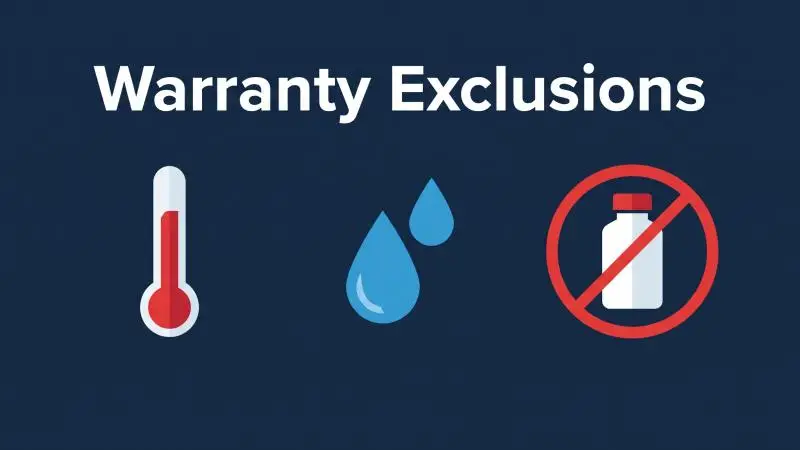
An exclusion that cannot be verified is an exclusion that will be argued. Tie each one to a documented operating condition the product was rated for.
- Ingress protection and washdown. State the IP rating and what cleaning practice it permits. Chemical cleaning agents are a common exclusion: eldoLED excludes failures from reactive cleaning agents and harsh chemicals.
- Ambient temperature ceiling. State the maximum rated ambient. The DLC requirements give the vocabulary — driver operating temperature is reported with the fixture operating in a 40 °C ambient, as defined by the thermal portions of the relevant safety standards, and testing is conducted at each driver’s worst-case input voltage. A warranty that states the rated ambient and the driver thermal basis gives the brand a defensible line when a fixture fails in an unconditioned space.
- Voltage and wiring. Require installation to the applicable electrical code. Amerlux voids coverage for fixtures not installed and operated in accordance with the current edition of the National Electric Code and the applicable UL standards.
- Unauthorized modification or repair, including removal of tamper labels. eldoLED excludes interference with the tamper-proof label indicating unauthorized opening.
- Non-approved drivers or controllers, and use with third-party products the brand has not evaluated.
- Cosmetic wear, normal wear and tear, and damage in transit or from improper storage.
- Power quality events — surges, dips and excessive switching — where the installation did not include specified protection.
Pair the exclusions with service commitments. A warranty and support checklist for custom LED lighting recommends enumerating exclusions and environmental limits alongside measurable service-level objectives such as first response time, diagnostic timeframe and mean time to repair, and tying credits to missed service levels. That is a supplier-side practitioner’s checklist, not a standard, but the pairing is sound: an exclusion list without a response commitment tells the grower what is not covered and nothing about what happens next.
One more benchmark worth knowing. The DLC program requires listed luminaires to carry at least a five-year warranty covering the complete luminaire, but it states that it does not set requirements for claim terms such as labor or recommissioning and does not verify or validate a manufacturer’s claim process. A five-year term is therefore not evidence that the surrounding terms are generous.
Check Statutory Obligations Before You Publish
A commercial warranty sits on top of statutory rights and cannot shrink them. Two regimes matter most for a brand selling into the US and Europe.
In the EU, Europe’s consumer guarantees guidance sets out a minimum two-year legal guarantee against faulty goods or goods that do not look or work as advertised, with some member states requiring longer. The seller is responsible, and in some countries so are the manufacturer or importer. Remedies are free of charge — repair, replacement, price reduction or full reimbursement — and most countries apply a hierarchy in which repair or replacement comes first, with price reduction or refund available where repair or replacement is impossible, disproportionately expensive, seriously inconvenient, or not completed within a reasonable time.
An additional commercial warranty may be included in the price or sold separately, but it does not replace the legal guarantee, and the seller must inform the consumer that it does not affect their right to the legal guarantee.
The same guidance carries a clause that turns marketing copy into a warranty term: the seller is legally bound by public statements about the product, especially in advertisements and on labels. A claim about spectrum, output or lifespan that appears in a brochure is a statement the buyer can rely on. Each member state implements the rules slightly differently, and B2B sales may fall outside consumer rules — which is why the same warranty document cannot simply be translated for every market.
In North America, the Magnuson-Moss Warranty Act and state law in the US, and provincial sale-of-goods rules in Canada, can limit disclaimer and limitation language. The “some states and jurisdictions do not allow the exclusion of incidental or consequential damages” carve-out in the LEDVANCE terms, and the corresponding language in the Amerlux document, exist for that reason: the limitation is drafted to yield where local law will not enforce it.
This section is orientation, not legal advice. Engage local counsel when any of the following is true: you sell to consumers in a jurisdiction with mandatory guarantee rules, you distribute across multiple states or countries, or your document contains any limitation of liability or disclaimer of implied warranties.
Conclusion
The build sequence is the strategy: warrantor and term, covered components and remedy, back-to-back supplier mapping, claim workflow, cost allocation, reserve model, exclusions, statutory check. Each step produces a clause, and each clause has a counterpart — or a deliberate gap — on the supply side.
The strategy is finished only when the customer-facing document and the supplier schedule agree line by line. A three-year promise backed by a two-year supplier term is a one-year liability. A labor exclusion that the sales team has been quietly overriding is a reserve that is wrong. A performance claim in a brochure that no test protocol supports is a warranty term nobody priced.
The next action is mechanical. Put the warranty document and the supply agreement side by side, and mark every clause where the brand’s promise exceeds the supplier’s obligation. Each mark is either a negotiation item, a reserve input, or a deliberate commercial decision to carry the risk. What it cannot be is unmarked.
FAQ
Should the warranty term start at shipment or at installation?
Shipment date is simpler to administer and harder for a grower to dispute, because the ship record is unambiguous. Installation date aligns coverage with actual service life but depends on commissioning records that may not exist or may be incomplete. A workable compromise is shipment date with a defined maximum lag: the clock starts at shipment, and a registered project with documented commissioning can extend the start within a stated window. Whatever you choose, state it in one sentence and apply it in the claim system.
Can I simply pass my supplier’s warranty through to my customers?
Pass-through is legally ambiguous, and the ambiguity is the risk. The brand remains exposed if its warranty is broader than the supplier’s, or if the supplier’s warranty becomes invalid or unenforceable — and governing law and forum differences between the two contracts can produce different outcomes on the same facts. Back-to-back and indemnity structures allocate the risk differently, but none of them removes the brand from the customer relationship. The brand is the party the grower calls regardless of what the supply agreement says.
Who pays for labor to remove and reinstall a failed fixture?
Major lighting warranties commonly exclude removal, installation, and commissioning labor. LEDVANCE excludes removal, commissioning, programming, and reinstallation costs; Amerlux requires the customer to hire and pay an electrician, with no labor covered after the first year. A private label brand can absorb labor as a differentiator, but that decision belongs in the reserve model, not in an unwritten sales promise. If you exclude it, say so plainly.
How do I set a warranty reserve without field failure data?
Use the input-driven model: annual volume × planning claim rate × cost per claim, divided by revenue. With no field data, the planning rate is a documented conservative assumption reviewed and signed off by finance, with a review date. It is not a figure borrowed from another product line, another supplier or a competitor’s marketing. Run the sensitivity so the finance team sees how the reserve moves if the claim rate doubles.
Does offering a longer warranty create legal risk?
A longer commercial warranty does not replace statutory guarantees, and it does not shrink them. In the EU, the legal guarantee is a minimum of two years, longer in some member states, and an additional commercial warranty must state that it does not affect the consumer’s legal rights. Public statements about the product can bind the seller, so a longer term paired with ambitious marketing copy increases exposure rather than reducing it. Have counsel review any document that disclaims warranties or limits liability before it is published.