Introduction
A light deprivation greenhouse is a photoperiod machine. Its blackout curtain determines when the crop perceives night, and everything else in the house—irrigation, humidity control, temperature setpoints—is scheduled around that dark window. Implementing a comprehensive light-deprivation greenhouse LED strategy introduces a second, independent system with its own clock, heat load, and failure modes. Once both are automated, they stop being two purchases and become one controlled system that has to be sequenced, interlocked, and audited.
That distinction matters because the two systems do different jobs. Photoperiod control is about the duration and timing of darkness. Supplemental lighting is about how much photosynthetic light the canopy receives inside the permitted light window. A controller that treats them as one undifferentiated “lights” output will eventually produce a state nobody designed: lamps burning against an open blackout, or a curtain closing onto fixtures that are still at full output.
This guide covers the integration work in the order an operator actually encounters it: what each system does, why pairing them is worth the complexity, how to size the LED load with arithmetic you can recompute from your own measurements, how to sequence and interlock the two, what sensor data the controller needs, how retrofit and new-build differ, and what commissioning and documentation a reviewer will expect.
Terms are defined on first use: PPFD (photosynthetic photon flux density, µmol·m⁻²·s⁻¹), DLI (daily light integral, mol·m⁻²·d⁻¹), photoperiod (the duration of light in a 24-hour cycle), and blackout curtain (a retractable screen that excludes incident light). The material draws on extension guidance for photoperiod management and DLI measurement, a USDA NRCS screen specification, published curtain performance data, and digital lighting-control standards. Where a recommendation is engineering judgment rather than a cited requirement, it is labeled as such.
Table of Contents
What a Light Deprivation Greenhouse LED Integration Achieves
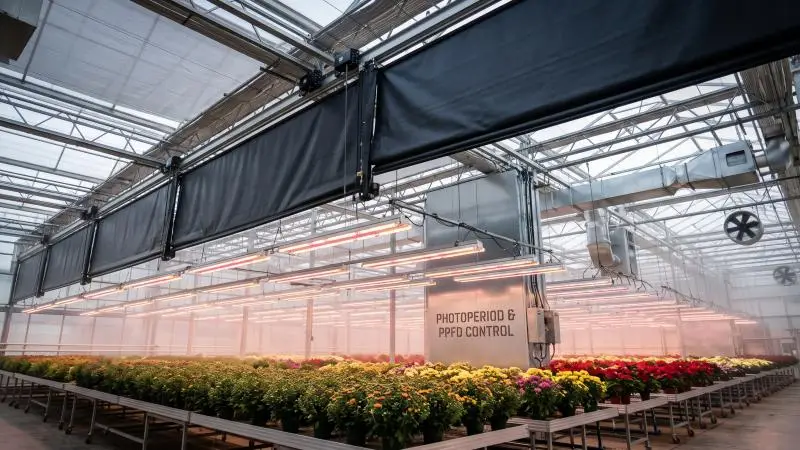
A light deprivation house uses a retractable blackout system — overhead screen, sidewall screens, and sealed edges — to exclude incident light and create a controlled dark period. The purpose is photoperiodic: many floriculture and other crops initiate flowering or shift development based on night length rather than day length. Purdue Extension puts the working thresholds at roughly 12 hours of night for a short day in most floriculture crops, and under about 10 hours of night for a long day in many long-day crops, while noting the values vary by species (Purdue HO-253-W).
Two consequences follow from that physiology. First, the dark period is the controlling variable, so the curtain’s job is not shading — it is guaranteeing that the plant registers an uninterrupted night. Second, the threshold for perception is low. UMass Extension notes that light at very low intensities — civil twilight — is sufficient to induce photoperiodic responses, and that an intensity of less than 2 foot-candles is enough to inhibit normal flower bud initiation in a short-day species such as poinsettia.
That is why photoperiod is estimated by adding twilight to daylight rather than by clock sunrise and sunset (UMass Extension). A pinhole leak at a seam is a photoperiod problem, not a cosmetic one.
LED supplemental light does something categorically different. It raises PPFD at the canopy and therefore DLI inside the light window. It does not shorten the night, extend the day, or substitute for the curtain. Purdue’s photoperiod publication is explicit that supplemental or photosynthetic lighting is a separate topic from day-extension and night-interruption lighting, and points readers to its DLI material instead.
So the house has two control domains. The curtain is a mechanical device: motor, cables, limit switches, edge seals, and position feedback. Its failure modes are mechanical and positional — a screen that stops short, a seal that gaps, a cable that slackens, a limit switch that drifts. The LED array is an electrical and optical load: drivers, circuits, dimming interfaces, thermal management, and optical output that changes with age and cleanliness. Its failure modes are electrical and photometric. Automation has to supervise both, and the two domains fail in ways that do not look alike on a status screen.
The Case for Pairing LEDs With a Blackout House
The argument for pairing is straightforward once the dark window is fixed. A blackout house already defines exactly when light may be delivered. Inside that window, natural sunlight in low-light months may not reach the crop’s DLI target, and supplemental light can close the gap on a schedule the curtain has already made predictable. The curtain, in other words, is not an obstacle to supplemental lighting — it is what makes the lighting schedule deterministic.
There is also a photometric benefit, with qualifications. Ontario’s review of light abatement curtains reports that fully deployed curtains can reduce light emissions by more than 99%, reduce nighttime heat loss by around 50%, and that a reflective interior surface returns light from supplemental fixtures to the crop (Ontario.ca). Svensson, a curtain manufacturer, describes light-pollution screens with a white lower surface and puts the resulting increase in in-greenhouse light intensity at three to five percent (Ludvig Svensson).
Those figures describe specific curtain models and configurations, not curtains in general. Transmission and energy-saving properties vary by model — the OMAFA best-management guide’s sample table of commercial light-abatement curtains shows light transmission ranging from 0.01% to 2% and energy savings from 45% to 70% across five models, which is a manufacturer-specification snapshot rather than a category average (OMAFA BMP-31).
Treat the three-to-five-percent reflection gain the same way: a property of a particular reflective lower surface, useful for judging whether a screen upgrade pays, not a number to enter into a DLI calculation without measurement.
The honest trade-off is climate. A closed curtain is a barrier between the crop zone and the attic, and it changes the environment under the screen. Ontario’s review documents air temperature stratification between cooler attic air above the curtain and warmer air below it when curtains are deployed. The same review reports that the temperature increase under LED lights plus light-abatement curtains was accompanied by higher relative humidity, whereas under HPS plus curtains relative humidity dropped — a difference the review attributes to the lighting type.
Svensson notes that multi-layer blackout screens used for abatement require more active management to relieve heat and humidity buildup under the screen. The practical reading: pairing LEDs with a blackout house is a climate decision as much as a lighting decision, and the dehumidification and ventilation strategy has to be designed for the closed-curtain, lamps-on state, not just for the open-curtain daytime state.
Sizing Supplemental LED Light: A DLI Method the Reader Can Recompute
Sizing supplemental light is arithmetic, and it is worth doing yourself rather than accepting a fixture count from a layout drawing. The method below follows the UNH Extension supplemental lighting run-time worksheet (UNH Extension).
Illustrative worked example of the DLI-deficit method, using the article’s stated placeholder inputs (transmission 0.60; outdoor December DLI 12 mol·m⁻²·d⁻¹; crop target 17 mol·m⁻²·d⁻¹; measured lamp PPFD 250 µmol·m⁻²·s⁻¹). These are arithmetic placeholders, not crop recommendations — substitute your own measured transmission, local outdoor DLI, and crop target. The 9.8 mol·m⁻²·d⁻¹ deficit is the quantity the run-time step divides by (250 × 0.0036).
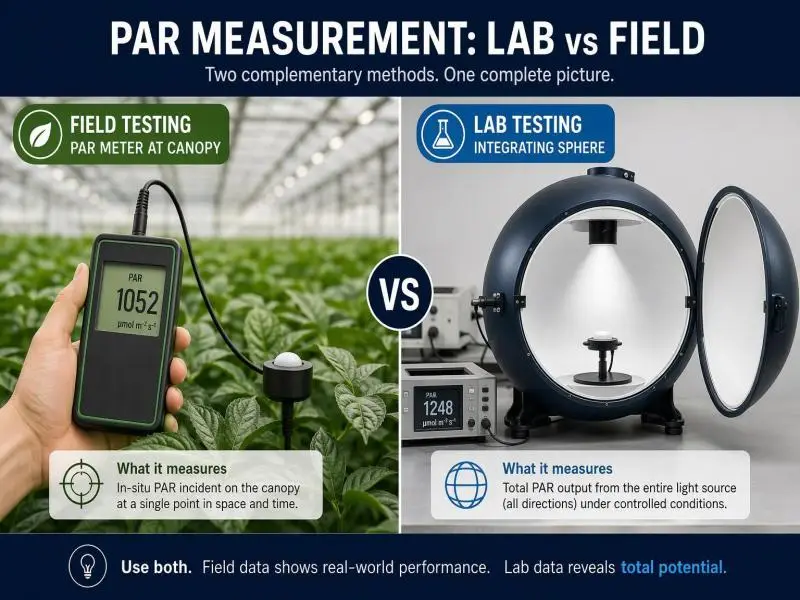
Step 1 — Measure greenhouse transmission. On a sunny day, read PPFD outside the structure and PPFD just above the crop inside, both in µmol·m⁻²·s⁻¹. Transmission is inside ÷ outside. This captures glazing, structure, dust, condensation, and shade in one number, which is more accurate than a manufacturer’s glazing transmission figure.
Step 2 — Take the outdoor DLI for the month. Use a published DLI map or your own weather-station record, in mol·m⁻²·d⁻¹. Virginia Tech’s extension material notes that Virginia, for example, averages roughly 40–45 mol·m⁻²·d⁻¹ in July and 15–20 in December, and that these are open-field values which a residential or obstructed site could fall well below (Virginia Tech SPES-720).
Step 3 — Compute DLI from sunlight inside. Multiply Step 2 by Step 1.
Step 4 — Set the crop’s target total DLI. Take this from a crop production guide or your extension service. It varies by species, stage, and production goal.
Step 5 — Subtract. Additional DLI needed = target total DLI − DLI from sunlight inside. If the result is zero or negative, the lamps are not needed for DLI in that month.
Step 6 — Measure lamp PPFD at canopy height, in the dark. Fixture type, power, age, cleanliness and reflector all affect output, so measure rather than trusting a nameplate.
Step 7 — Compute run hours. Hours = additional DLI ÷ (lamp PPFD × 0.0036). The constant converts µmol·m⁻²·s⁻¹ to mol·m⁻²·d⁻¹ over an hour: 1 µmol·m⁻²·s⁻¹ sustained for one hour delivers 0.0036 mol·m⁻².
A worked example with stated inputs:
| Step | Quantity | Value |
|---|---|---|
| 1 | Transmission (inside ÷ outside PPFD) | 0.60 |
| 2 | Outdoor DLI, December | 12 mol·m⁻²·d⁻¹ |
| 3 | DLI from sunlight inside | 12 × 0.60 = 7.2 mol·m⁻²·d⁻¹ |
| 4 | Crop target total DLI | 17 mol·m⁻²·d⁻¹ |
| 5 | Additional DLI needed | 17 − 7.2 = 9.8 mol·m⁻²·d⁻¹ |
| 6 | Measured lamp PPFD at canopy | 250 µmol·m⁻²·s⁻¹ |
| 7 | Run hours | 9.8 ÷ (250 × 0.0036) = 9.8 ÷ 0.9 ≈ 10.9 hours |
The result — about 11 hours of lamp operation — has to fit inside the light window the curtain permits. If the crop’s photoperiod allows only 12 hours of light, an 11-hour run leaves almost no margin for sunlight, and the design is telling you the installed PPFD is too low for that month or the target is unrealistic for that structure. That is the useful output of the calculation: not just a run time, but a check on whether the fixture density and the photoperiod are compatible.
Know the method’s boundaries. It treats DLI as additive, which is a reasonable planning approximation but not a physiological law. It uses one measurement point, so it does not represent a canopy average — a single reading under a fixture is not the same as the mean across a bay. It ignores lamp aging and dirt on lenses and reflectors, both of which reduce output over time. And it assumes the transmission measured on a sunny day holds for the month, which it will not exactly. Recompute per month, and treat the answer as a design target to be verified at commissioning, not a fixed schedule.
Sequencing the Curtain and the Lamps: Order of Operations and Interlocks
This is the section where most integration failures originate, because the correct sequence is not obvious from either subsystem’s manual. The following is engineering judgment for design review, not a cited standard.
The governing rule is that the system must never occupy an unintended state. Two states are unacceptable: lamps energized while the blackout is open during a dark window (light trespass, wasted energy, and a photoperiod violation), and the curtain closing onto fixtures that are still at high output without a defined transition (thermal stress on the screen and fixtures, and an uncontrolled temperature spike under the closing screen).
A defensible close sequence:
- Command lamps to ramp down to zero.
- Confirm zero output — by driver status feedback where available, or by a current-sensing relay on the lighting circuit.
- Command the curtain to close.
- Confirm full closure by position feedback, not by motor run time.
- Log the transition with a timestamp.
A defensible open sequence reverses it:
- Command the curtain to open.
- Confirm full open by position feedback.
- Ramp lamps up to the scheduled level.
- Log the transition.
The confirmation steps are the ones that get dropped in value-engineered designs, and they are the ones that matter. A controller that assumes the curtain closed because it sent the command has no way to detect a jammed screen, and a controller that assumes the lamps are off because it wrote a zero to a dimming channel has no way to detect a driver that failed at full output.
Fault states should alarm rather than default silently. At minimum:
- Curtain position disagrees with command — the screen reports open after a close command, or stops mid-travel.
- Lamp circuit energized while the curtain is open during a scheduled dark window — a direct photoperiod violation.
- Sensor failure or out-of-range reading — a quantum sensor reading zero at noon, or a value above clear-sky maximum, is a fault, not data.
- Communication loss between controller and fixture — a digital lighting bus that stops responding.
- Limit-switch fault — the end-of-travel device fails to register, so the motor keeps running or the position is unknown.
The maintenance vocabulary comes from the NRCS screen specification, whose operation and maintenance plan lists repair of screen tears, checking edge-seal tightness, adjusting support cables, adjusting limit switches, and lubricating bearings and rack-and-pinion drives (NRCS Code 374). Limit-switch adjustment is on that list for a reason: a drifting limit switch is exactly the failure that produces a position-disagreement alarm, and it is a scheduled maintenance item rather than an emergency.
On the lighting side, the vocabulary for “alarm” in a digital system comes from the DALI and D4i standards material. D4i extends the DALI protocol (IEC 62386 series) to carry luminaire data, energy data, and diagnostics data from the driver, and the DALI Alliance’s presentation lists fault detection, notifications, energy reporting, and asset management among the capabilities that digital addressable control provides and that proprietary analog 0–10V systems must supply separately (DALI Alliance / LEDucation 2023).
In practical terms, a D4i-capable fixture can report its own status and energy use to the controller, which is what makes a “lamp circuit energized” alarm possible without adding separate current sensors to every circuit.
Sensors, Zoning and the Data the Controller Acts On
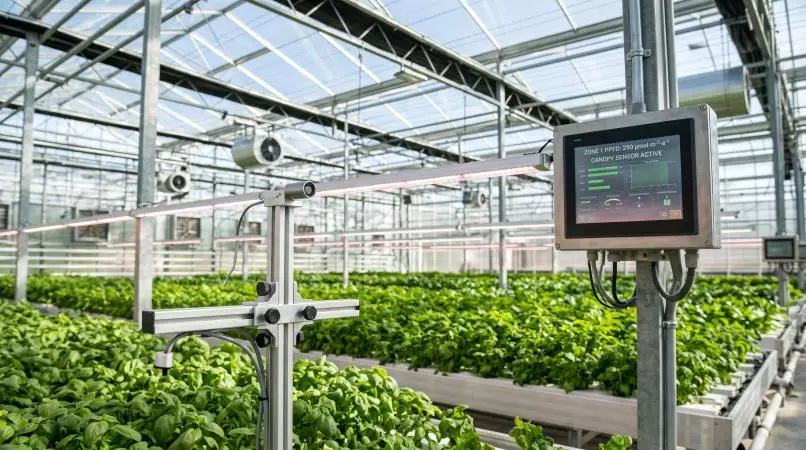
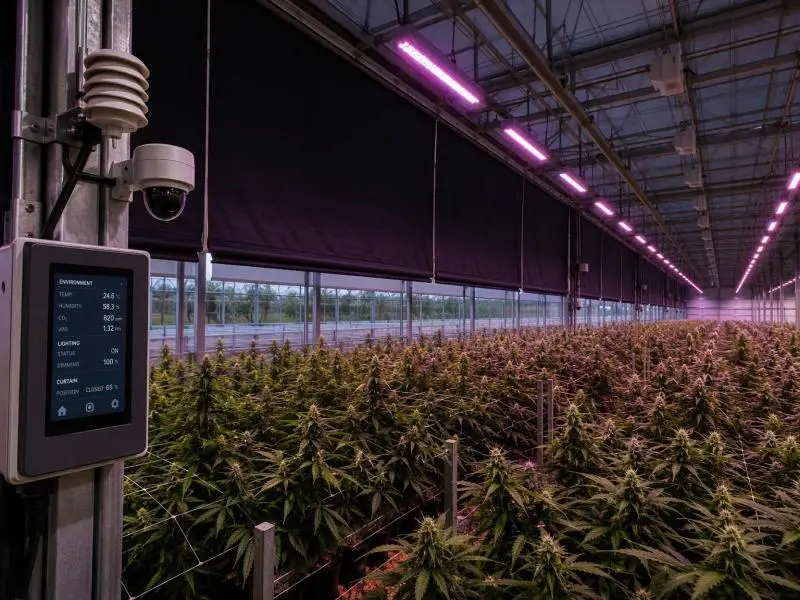
Automation is only as good as its inputs, and in a light-dep house the inputs are light sensors. Erik Runkle’s guidance on sensor practice is the most useful short reference here (GPN).
Sensor type. For crop light, use a quantum sensor measuring PAR in µmol·m⁻²·s⁻¹. For heat load from the sun — the input to shade-curtain and ventilation decisions — use a radiometer or pyranometer measuring shortwave radiation in W·m⁻². These are different instruments answering different questions, and substituting one for the other produces a controller that either mismanages shade or mismanages supplemental light.
Lux and foot-candle meters measure light as the human eye perceives it and are not appropriate for plant-light decisions; UNH Extension states this directly, and Purdue’s DLI publication makes the same point about photometric units being focused on people rather than photosynthesis (Purdue HO-238-W).
Placement. A quantum sensor for crop light belongs at or near canopy height, away from sidewalls and main aisles, not shaded by posts or overhead obstructions, and level. In a house with supplemental lighting, a second quantum sensor positioned above the lamps and below the curtain reads the sunlight actually available to the crop, which is the better input for deciding when lamps should run. That second sensor is what lets the controller distinguish “the crop is dark because it is night” from “the crop is dark because the curtain is closed.”
Maintenance. Sensors get dirty, get moved, and drift. Runkle’s guidance is to inspect regularly for level and cleanliness, clean per manufacturer instructions (typically a soft non-abrasive cloth with deionized water and mild detergent when needed), and designate a trained person responsible for maintenance and functional checks in each zone.
On drift, the numbers are worth knowing: quantum sensors manufactured before about 2015 are much more likely to drift, with error over time of 20% to 25% and potentially higher in demanding environments, so sensors more than ten years old should be recalibrated; newer high-quality sensors typically drift by less than 1% a year. Recalibration service typically costs roughly $75 to $100 per sensor.
That drift figure is not academic. The NYSERDA adaptive-lighting trial found that the existing PAR sensor on the control plot’s lighting controller was faulty and registering roughly double the true reading, which caused the control plot’s lights to run less often than intended — a sensor error that silently changed the crop’s light history and confounded the energy comparison until it was found (NYSERDA 21-19). A sensor fault is a control fault.
Zoning. A single sensor cannot represent a large multi-bay house. Control zones should follow curtain zones — because the curtain defines what light is available — and should be checked against light uniformity at canopy height. If one bay reads 20% below another under identical conditions, that is either a sensor problem or a uniformity problem, and both need resolving before the zone is trusted. The retrofit implications of zoning are covered in the next section.
Retrofit Versus New Build
The retrofit case is the common one, and it starts with a structure that was designed without LEDs in mind.
The NRCS specification is blunt about the physical conflict: electrical wiring, water pipes, fuel supply pipes, and light fixtures may have to be moved to provide an open area for screen movement, and the screen material should sit above heaters, circulating fans, heat supply pipes, fin or pipe radiation, and supplemental lighting fixtures. A house built for a blackout screen alone may have fixtures mounted where a screen now needs to travel, or a screen mounted where a fixture now needs clearance.
Svensson adds a fire-safety point specific to light-pollution screens: while most modern screens are flame-retardant, the screen should be installed far enough from the lights to avoid fire hazards. Clearance is not a nicety in a retrofit; it is a design constraint to verify before ordering fixtures.
Beyond clearance, a retrofit checklist:
- Structural capacity. Can the trusses and gutters carry the additional fixture weight plus the screen’s own load and cable tension?
- Electrical capacity. Are there spare circuits and panel capacity for the lighting load, and is the distribution arranged so that a single fault does not take out an entire zone?
- Controller inputs. Can the existing environmental computer accept new quantum-sensor inputs and a dimming or digital control channel, or does it need a gateway or a replacement?
- Screen condition. Is the existing screen still sealing at the edges, and are the limit switches and cables within adjustment range? A retrofit is the moment to fix a screen that has been drifting.
For a new build, the logic inverts: co-locate curtain motors, fixture circuits and sensor drops on a common control architecture from the start, and specify digital, addressable lighting control (DALI-2 and D4i) so diagnostics and energy reporting are available without adding hardware later. Svensson’s observation about screens applies directly to control infrastructure: a second screen is typically less expensive and causes fewer headaches when incorporated into the initial design than when retrofitted. The same is true of control wiring, sensor conduit, and spare capacity in the panel.
A practical test of whether an existing house is retrofit-ready: can you trace, on paper, a single control path from the environmental computer to the curtain motor, to the lighting circuit, to each sensor, and back to the computer as feedback? If any link in that loop is missing — no position feedback from the curtain, no status from the fixtures, no sensor above the lamps — the retrofit will need to add it, and the cost belongs in the comparison against a new build.
Commissioning Checklist Before Trusting an Automated Photoperiod Schedule
The schedule should not be trusted until the fault-injection tests pass. This checklist is a verification sequence, run before the automated photoperiod schedule is handed over.
Light exclusion. Confirm full curtain closure and edge-seal integrity. The NRCS blackout specification sets a design target of excluding at least 99% of incident light, with the seal between sidewall and overhead screen excluding all light — that is a reference point from that specification, not a universal code requirement. Verify it by inspection at seams, corners, and sidewall junctions, ideally at dusk when a leak is visible from inside.
Mechanical feedback. Verify limit switches and position feedback agree with actual curtain position at full open, full closed, and mid-travel. Adjust limit switches as needed per the NRCS O&M list.
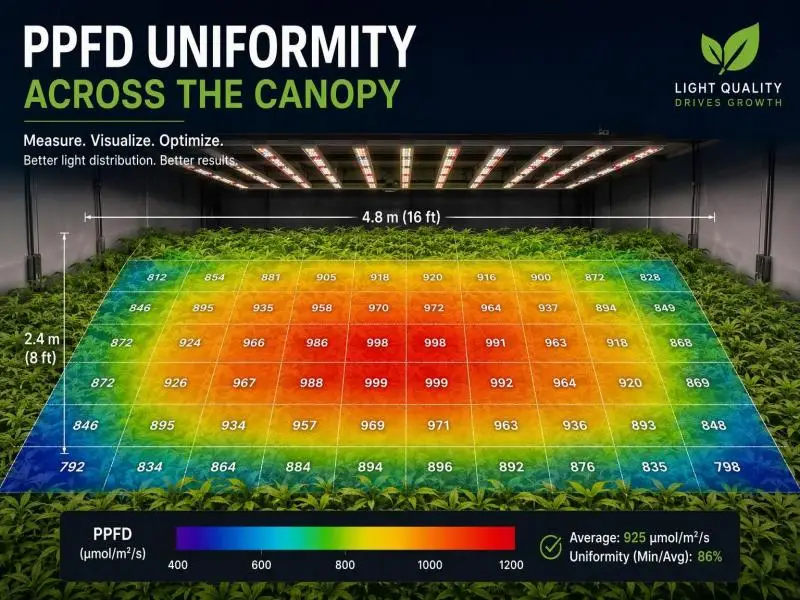
Lamp output. Measure PPFD at canopy height against the design value from the sizing calculation, in the dark, at several points across each zone. Record the readings.
Sensor verification. Confirm calibration status and placement for every quantum sensor and pyranometer: level, clean, unobstructed, at the intended height. Compare the above-lamp sensor against the canopy sensor under known conditions.
Fault injection. Test every fault state from the sequencing section and confirm each one alarms: force a position disagreement, simulate a lamp circuit energized during a dark window, disconnect a sensor, break communication to a fixture, and trip a limit switch. An alarm that does not annunciate is not an alarm.
Clock and calendar. Confirm the controller’s time zone, daylight-saving behavior, and the handling of the transition nights. A schedule that shifts by an hour twice a year is a photoperiod event, and it should be a planned one.
Full cycle. Run a complete simulated dark/light cycle with logging enabled, and review the log against the intended sequence. The commissioning record from this run becomes the baseline for the documentation set in the next section.
Documentation for Crop-Schedule Audits and Inspector Review
Documentation is what lets a reviewer reconstruct why the schedule is what it is. The set below is practical guidance for a crop-schedule audit or an inspector’s review; local authority having jurisdiction (AHJ) requirements govern and should be confirmed for the specific jurisdiction.
- As-built drawings showing curtain zones, fixture circuits, sensor locations, and control architecture.
- Commissioning record with measured PPFD at canopy height, the DLI calculation inputs and result, and the fault-test results.
- Operating schedule with its DLI target and the crop guide or extension source the target derives from.
- Sensor calibration and maintenance log — dates, readings before and after, and who performed the work.
- Curtain O&M records following the NRCS-style plan: edge-seal checks, cable tension, limit-switch adjustment, lubrication.
- Electrical documentation showing listed fixtures and compliant installation.
Where standards attach: the NRCS specification requires screen systems to meet the International Building Code (IBC) and National Fire Protection Association (NFPA) code, which is where structural and fire references attach for the screen itself. For the digital control layer, DALI-2 (IEC 62386 series), D4i, and ANSI C137.4 are the relevant interoperability standards, and ANSI C137.4-2021 specifies requirements for memory bank usage, energy reporting, diagnostic information, and auxiliary power supplies in digital lighting systems.
One more record is worth keeping even though no inspector will ask for it: the light-emission and neighbor-relations file. Svensson notes that municipalities in Canada and the United States are increasingly concerned about light emissions from greenhouses after nightfall, that active regulations are currently in place in only a few areas, and that dialogue between governing bodies and growers is ongoing. A record of curtain performance, closure discipline, and any complaints or responses is cheap to keep and useful if the local conversation turns into a by-law.
Where Equipment Selection and Supplier Support Fit
Equipment selection for a light-dep integration should be driven by measured performance and control compatibility, not by nameplate figures. Four criteria carry most of the decision.
Measured PPFD and uniformity at canopy height. Ask for photometric data and, where possible, measure a sample installation. Nameplate output at a nominal distance is not the same as canopy-level uniformity across a bay, and uniformity is what determines whether one zone setpoint serves the whole house.
Control interface compatibility. Determine what the house controller accepts: 0–10V analog dimming, DALI-2, or D4i. The distinction matters. The DALI Alliance material notes that a 0–10V system needs dedicated inputs for each control characteristic, whereas DALI digital addressing allows fixture groups to be configured in software and D4i carries luminaire data, energy monitoring, and diagnostics from the driver. If the controller is analog-only, a digital fixture is not automatically usable without a gateway; if the controller is digital, an analog-only fixture forfeits the diagnostics that make fault alarms possible.
Thermal design and clearance. Fixture heat interacts with the closed-curtain state described earlier, and physical clearance to the screen is a fire-safety and screen-wear issue. Ask for the fixture’s thermal data and confirm the mounting height against the screen’s travel.
Supplier documentation and support. Photometric files (IES/LDT), dimming protocol documentation, and commissioning support are the deliverables that make an integration auditable. A supplier who cannot provide them shifts the measurement burden onto the operator.
SLTMAKS, the publisher of this guide, manufactures full-spectrum LED grow lights and states that it holds warehouse stock in North America and Europe and offers OEM/ODM support; readers evaluating any supplier, including this one, should confirm current specifications, control interfaces, and certifications directly rather than relying on a general description. The evaluation criteria above apply equally to every vendor.
Conclusion
In an automated light-dep house, the curtain and the LED are one controlled system. The value comes from sequencing, interlocks, verified sensors and a documentation trail — not from either component alone, and not from the sum of two good purchases made independently.
The through-line of this guide: size the lighting with a DLI method you can recompute from your own canopy measurements; sequence and interlock the curtain and lamps so that no unintended state is reachable; alarm on fault states rather than defaulting silently; commission with fault injection before trusting the schedule; and document the result so a reviewer can reconstruct the reasoning.
Two pressures are tightening at once. Digital, addressable lighting control is becoming the norm for commercial installations, which raises the diagnostic and reporting baseline that operators are expected to meet. And light-abatement expectations are spreading — Svensson assesses that concerns over greenhouse light pollution will only increase, leading more municipalities to seek new regulations over time. Building the control and records architecture now reduces the cost of meeting both later.
The next action is concrete: run the commissioning checklist against the current house before the next crop cycle. If any fault state fails to alarm, that is the work to do first.
FAQ
Can LEDs run while the blackout curtain is closed?
Yes, and in a light-dep house that is often the point — the curtain defines the light window and the lamps supply DLI inside it. The caveat is climate: a closed curtain changes temperature and humidity under the screen, and published curtain data show temperature stratification between attic and crop zone and, under LED plus curtain configurations, higher relative humidity. Design the ventilation and dehumidification for the closed-curtain, lamps-on state.
How should curtain-close and lamp-off be ordered?
Ramp the lamps down, confirm zero output, then close the c
urtain and confirm full closure by position feedback. Reverse it to open: confirm full open, then ramp up. The confirmation steps are what distinguish a controlled sequence from a command that was merely sent. This is design reasoning, not a cited standard.
Which sensor measures plant light, and which measures heat load?
A quantum sensor measuring PAR in µmol·m⁻²·s⁻¹ measures plant light. A radiometer or pyranometer measuring shortwave radiation in W·m⁻² measures heat load and is the input for shade and ventilation decisions. Do not use lux or foot-candle meters for plant-light decisions.
How do I recompute run hours if canopy PPFD changes?
Re-measure lamp PPFD at canopy height in the dark and divide the additional DLI needed by (new PPFD × 0.0036). If the additional DLI is 9.8 mol·m⁻²·d⁻¹ and the measured PPFD is now 300 µmol·m⁻²·s⁻¹, the run time becomes 9.8 ÷ (300 × 0.0036) ≈ 9.1 hours. Recompute per month, since outdoor DLI changes seasonally.
Does a retrofit need a new controller?
Not necessarily, but it needs a controller that can accept the new inputs: quantum-sensor readings, curtain position feedback, and a dimming or digital control channel to the fixtures. If the existing environmental computer cannot take those inputs, a gateway or replacement is part of the retrofit cost and belongs in the comparison against a new build.
What records is an inspector likely to ask for?
As-built drawings, the commissioning record with measured PPFD and fault-test results, the operating schedule with its DLI target and source, sensor calibration logs, curtain O&M records, and electrical documentation showing listed fixtures and compliant installation. Local AHJ requirements govern — confirm the specific requirements for your jurisdiction.
How often do sensors and curtains need maintenance?
Quantum sensors near the crop should be inspected regularly for level and cleanliness, with a trained person responsible per zone; sensors more than about ten years old should be recalibrated, and newer high-quality units typically drift by less than 1% a year. Curtain maintenance follows the NRCS O&M list — edge seals, cable tension, limit switches, lubrication — on a scheduled basis rather than after a failure.