A record 4,137 product safety alerts were validated across the European Union in 2024, and electrical appliances and equipment accounted for 10% of them, behind only cosmetics and toys (European Commission / MPO, The EU Safety Gate Rapid Alert System in 2024, published 2025). Electric shock was the risk type in 7% of those alerts, up from 6% in 2023.
Because horticultural fixtures sit inside that heavily scrutinized electrical equipment category, securing valid LED grow light certifications is critical for facility compliance. The two largest markets for these products, the United States and the European Union, decide acceptance in completely different ways.
In the US, an Authority Having Jurisdiction (AHJ, the local official who enforces the electrical code) accepts a fixture that carries the registered mark of a laboratory OSHA recognizes. In the EU, the manufacturer declares conformity itself and affixes the CE mark, with no third-party certificate required for most luminaires. A supplier who treats those two systems as interchangeable will fail one of them.
This guide builds the evaluation framework market by market: what the US NRTL program actually requires, how Canada’s approval marks differ from US marks, what CE marking does and does not prove, which standards apply specifically to horticultural luminaires, and how to verify a listing before a purchase order rather than after an inspection notice.
United States: NRTL Approval and AHJ Acceptance
US workplace rules require NRTL approval for electrical conductors and equipment under 29 CFR 1910 Subpart S, specifically 1910.303 and 1910.307, alongside fire-protection equipment and other listed categories (OSHA, Types of products requiring NRTL approval, retrieved 2026). OSHA’s standards contain these testing and certification requirements for 39 product types, and the agency’s own product list groups equipment into categories with a note that approval “may be required only under specific circumstances or conditions of use” (OSHA, NRTL Program Frequently Asked Questions, retrieved 2026). Horticultural luminaires are not named as a category on that list; they fall under electrical equipment, which is why the standard question, not the product name, drives the requirement.
What “Approved” Means under OSHA/NEC
OSHA’s own definition of an approved product is equipment “accepted, certified, listed, labeled, or otherwise determined to be safe by a nationally recognized testing laboratory recognized pursuant to 1910.7” (OSHA, NRTL Program Frequently Asked Questions, retrieved 2026).
The same page sets out what OSHA means by properly certified, and it is a three-part test: the product bears the NRTL’s registered certification mark, the certification falls within the scope of a test standard for which OSHA recognized that laboratory, and the certification was issued from an OSHA-recognized site of that laboratory. A mark that satisfies only the first condition, a logo on a housing with no matching scope or issuing site, does not meet the test.
Two consequences follow for procurement. First, the NRTL program’s definition of approval is about the laboratory, not the product: OSHA states plainly that its recognition is not an equipment endorsement.
Second, OSHA does not require the NRTL acronym on the mark at all. “Some NRTLs have voluntarily included the acronym ‘NRTL’ with their regular certification marks, although OSHA does not require this practice,” the agency notes, adding that with or without the acronym, a registered certification mark designates conformance to the applicable product safety standard (OSHA, NRTL Program Frequently Asked Questions, retrieved 2026).
Buyers who screen for the letters “NRTL” are screening for a formatting choice, not a compliance fact.
The AHJ approves; the listing is evidence supporting it. OSHA’s FAQ notes that local governments generally may determine the nature and extent of their acceptance of NRTL certifications as part of local code enforcement, and that State Plans may run their own laboratory recognition programs whose approvals apply only within that state’s coverage area.
UL vs. ETL: Equivalent NRTL Listings When Scoped Correctly
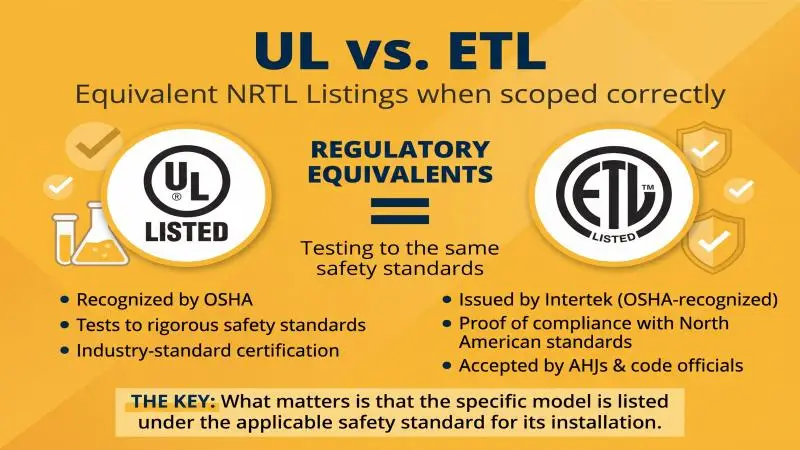
ETL and UL listings are both NRTL listings, and the difference between them is commercial rather than regulatory. Intertek, which issues the ETL mark, states that UL is one option among roughly twenty labs recognized by OSHA, and that because all NRTLs test to the same standards, a specification written as “must be UL” is outdated while a requirement to meet UL standards is satisfied by any NRTL listing to that standard (Intertek, Do I need the UL mark on my product?, retrieved 2026).
That is a vendor’s argument, made by a company that competes with UL, but it matches OSHA’s own position that laboratories recognized for the same test standard are considered equally capable of certifying under it.
Intertek’s own framing of the ETL Listed Mark is that it is proof of compliance to North American safety standards through independent testing and periodic follow-up inspections by an NRTL, and the company states that AHJs and code officials across the US and Canada accept the ETL Mark as proof of product compliance (Intertek, ETL Listed Mark FAQ, retrieved 2026).
Treat that acceptance claim as the vendor’s statement rather than regulator wording; the regulator’s position is the scope-and-site test above. What matters for a grow facility is that the specific model, with its model suffix, appears in the laboratory’s listing for the standard that applies to the installation.
Picking the Right Standard: UL 1598 vs. UL 8800 and Environment Ratings
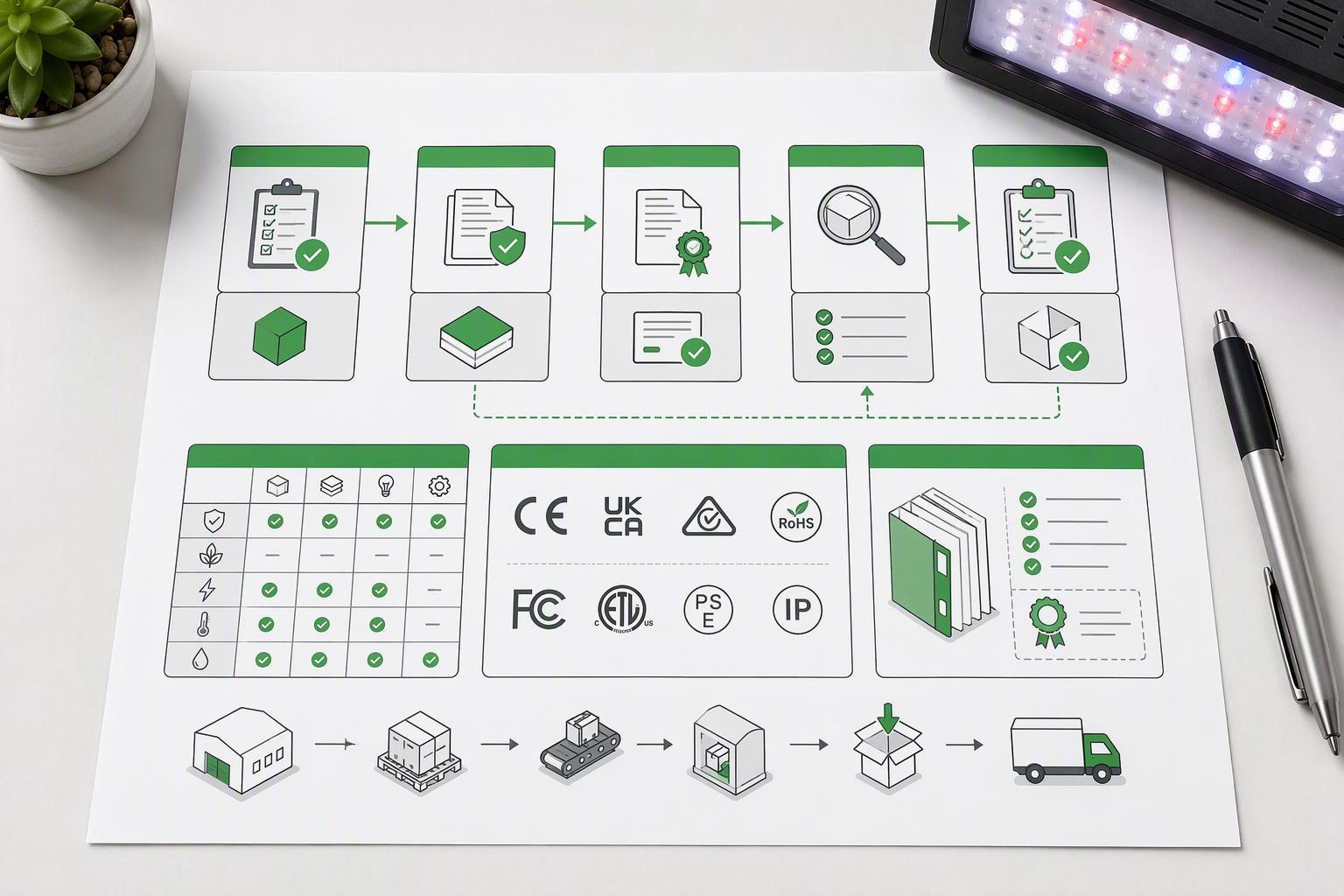
UL 8800, UL 1598 and UL 8750 all appear on OSHA’s list of appropriate test standards, listed respectively as “Horticultural Lighting Equipment and Systems,” “Luminaires,” and “LED Equipment for Use in Lighting Products,” with UL 1598C covering LED retrofit luminaire conversion kits (OSHA, Appropriate Test Standards, retrieved 2026). Which one applies depends on what the fixture is for, not on what the datasheet claims.
UL’s own scope summary for UL 8800 draws the line: UL 1598 addresses luminaires that are hardwired in a fixed location and designed for general illumination, while UL 8800 was developed specifically for horticultural lighting equipment, introduced in 2017 and published as Edition 1 in 2019, to address the safety issues of horticultural luminaires, components and grow systems (UL Solutions, UL 8800, Published Standard for Horticultural Lighting Equipment, 2024). UL 8800 also excludes broadband white light used for general illumination and lighting whose primary purpose applied to plantings is aesthetic or merely sustaining plant life.
The current edition of ANSI/CAN/UL 8800 is Edition 1, published 30 August 2019 and last revised 18 March 2025, with the revision adding requirements for “Horticultural Luminaires for Non-Residential Use Only” affecting clauses 5.5, Section 15A and 19.4.4 (UL Standards & Engagement, product record for ANSI/CAN/UL 8800, revision 18 March 2025). Cite the 2025 revision, not the 2019 publication date, when a supplier’s certificate is dated.
UL’s brief states that code officials, or AHJs, “will require UL 8800 for grow facilities.” That is a market expectation from the standard’s publisher, not an OSHA mandate; OSHA’s product-approval list does not name horticultural lighting, and its FAQ says recognition is not an endorsement and that local governments determine their own acceptance. The practical reading: an AHJ may well ask for UL 8800 because it is the standard written for the application, and a supplier who cannot produce a listing to it has no answer.
⚠️ Warning, A registered certification mark proves conformance only for the exact model, configuration and manufacturing site named in the listing. A mark on a datasheet that does not match the model number on the purchase order is not evidence of anything (OSHA, NRTL Program Frequently Asked Questions, retrieved 2026).
Canada: SCC Marks and CEC Compliance
Canada runs its own approval regime, and a US listing does not carry into it. The Canadian Electrical Code requires equipment to be approved for its purpose, which normally means certification by a body accredited by the Standards Council of Canada to an applicable Canadian standard, or an acceptable inspection or field-evaluation label (Standards Council of Canada, Recognized Canadian Electrical Product and Equipment Approval Marks, published 10 June 2025).
CSA, cUL and cETL are named examples of acceptable Canadian electrical certification marks, and a plain UL or ETL mark without a Canadian designation is not by itself Canadian approval.
Accepted Marks: CSA, cUL/cETL, cULus Distinctions
The “c” prefix is the whole point. A mark written cUL or cETL indicates certification to Canadian requirements; a bare UL or ETL mark indicates the US only; and cULus or cETLus indicates both markets under one listing. There is no CSA monopoly on Canadian approval, which matters when a specification is written around a single brand’s mark.
| Mark | Market covered | Issuing body type | Notes for procurement |
|---|---|---|---|
| CSA | Canada | SCC-accredited certification body | Named by the Standards Council of Canada as an acceptable Canadian mark |
| cUL | Canada | SCC-accredited body (UL) | Canadian designation required; a plain UL mark is US-only |
| cETL | Canada | SCC-accredited body (Intertek) | Canadian designation required; Intertek states the ETL mark is accepted in both countries |
| cULus / cETLus | US and Canada | NRTL plus SCC-accredited body | One listing covering both markets; the practical dual-market target |
| UL / ETL (no prefix) | US only | OSHA-recognized NRTL | Not Canadian approval on its own |
Caption: Accepted Canadian electrical approval marks versus US-only marks, per the Standards Council of Canada’s 2025 publication on recognized approval marks.
Field Evaluations under CSA SPE-1000: When and How
CSA SPE-1000 covers a one-time, product-specific field evaluation, also called a special inspection, of custom, modified or limited-quantity equipment against construction, marking, testing, code and luminaire requirements (Standards Council of Canada, Recognized Canadian Electrical Product and Equipment Approval Marks, published 10 June 2025).
Two limits belong in any procurement discussion. The evaluation carries no continuing factory surveillance, so it does not verify that later units match the evaluated one. And the field-evaluation label does not mean the product is CSA-certified; it records that one configuration was assessed for one installation.
That makes SPE-1000 a fit for a retrofit, a prototype array or a small custom run, and a poor fit for a fleet of identical fixtures bought over several years. A reported practice of capping field evaluations at a set number of units per model per year circulates in secondary summaries but could not be confirmed on CSA Group’s own material, so treat any such limit as something to confirm with the evaluation body rather than a fixed rule.
Labeling and Environment Ratings for Horticultural Installs
Canadian approval attaches to the product as marked, which means the label on the fixture in the grow room is the document that matters at inspection, not the certificate in a project folder. The environmental rating travels with that label: a fixture evaluated for a damp location and installed where condensate drips onto it is outside its approval regardless of which mark it carries. For Canadian grow rooms, check that the Canadian designation, the model number, and the environmental rating on the label match the specification and the installation instructions before the fixture is hung.
European Union: CE Marking Essentials
CE marking is a manufacturer’s declaration, not a third-party certificate, and the difference decides what documentation a buyer can demand. Under EU harmonisation legislation, the manufacturer carries out the conformity assessment, sets up the technical file, issues the EU declaration of conformity and affixes the CE marking (European Commission, CE marking, retrieved 2026). The same guidance states that a CE marking does not indicate that a product has been approved as safe by the EU or by another authority.
Applicable Directives: LVD, EMC, RoHS, Ecodesign
The LVD covers electrical equipment operating with an input or output voltage between 50 and 1,000 V for alternating current and 75 and 1,500 V for direct current, and has applied since 20 April 2016 (European Commission, Low Voltage Directive (LVD), retrieved 2026). A 240 V or 400 V three-phase grow light sits inside that scope; a low-voltage DC fixture below the threshold falls outside it and under general product safety rules instead.
| Directive | What it covers | Document the buyer should receive |
|---|---|---|
| LVD 2014/35/EU | Safety of equipment rated 50–1,000 V AC or 75–1,500 V DC | EU declaration of conformity citing the LVD and the harmonized standards applied |
| EMC Directive 2014/30/EU | Electromagnetic emissions and immunity | Declaration of conformity citing the EMC directive and standards |
| RoHS Directive 2011/65/EU | Restriction of hazardous substances | Declaration of conformity, plus substance documentation where requested |
| Ecodesign / energy labelling rules | Efficiency and information requirements for the product category | Product information sheet and compliance statement where the category is in scope |
Caption: EU directives relevant to LED grow lights and the document each one generates, per European Commission guidance current in 2026.
Harmonized Standards for LED Luminaires and Drivers
Only harmonized standard references published in the Official Journal give presumption of conformity with the LVD’s safety objectives, which is why the standard numbers on a declaration matter more than the certificate attached to it (European Commission, Low Voltage Directive (LVD), retrieved 2026).
For LED luminaires and their control gear, the common families are EN 60598 for luminaire safety, EN 61347 for control gear and driver safety, EN 55015 for emissions and EN 61547 for immunity, with IEC/EN 62471 for photobiological safety. A declaration that lists a standard withdrawn from the Official Journal is a declaration resting on nothing.
Documentation: EU Declaration of Conformity and Technical File
The Commission’s own explanation of conformity assessment is blunt about what does not count: “it is not acceptable for certificates to bear a CE marking,” and voluntary or other additional certificates are not a recognized means to prove compliance, so they have no value in checks by market surveillance authorities or customs (European Commission, Low Voltage Directive (LVD), retrieved 2026). Only notified bodies may issue certificates of compliance for harmonized products, and only within the area for which they are notified.
Historical enforcement shows what market surveillance finds when it looks. The EU’s coordinated luminaire inspection campaign in 2006 examined 226 luminaires across 15 participating states: 26 lacked CE marking, 127 had no declaration of conformity, a further 34 declarations were defective, and of 55 technical files supplied, 25 were judged incorrect (European Commission, LVD-ADCO cross-border market surveillance, luminaires, 2006 campaign).
A later campaign on LED and CFL lamps in 2013 inspected 123 lamps across 10 countries and found 86% non-compliant overall, with 57% failing technical requirements and 73% failing administrative ones (European Commission, LVD-ADCO cross-border market surveillance project 2013, LED lamps, 2013 campaign).
Both campaigns used targeted sampling of suspect products at national authorities, so they measure what inspectors found, not the share of the market that is non-compliant. They are dated, and no comparable luminaire-level campaign from 2024 or 2025 was available to cite here.
Pro Tip, Ask for the EU Declaration of Conformity and the technical file index, not a “CE certificate.” Certificates bearing a CE marking are not acceptable under the LVD, and a supplier who cannot produce a declaration naming the product, the directives and the harmonized standards has not completed conformity assessment (European Commission, Low Voltage Directive (LVD), retrieved 2026).
Horticultural Specifics for LED Grow Lights
Horticultural LED certifications split into two regimes that measure different things: safety certification, which makes a fixture acceptable to an inspector, and performance qualification, which makes it eligible for a rebate. A fixture can hold one without the other, and a buyer who conflates them will either overpay for a rebate-qualified product or buy a safe product that no utility program will fund.
Using the Right Listing for Grow Rooms (UL 8800, Damp/Wet, IP)
UL 8800 is the standard written for this application, and its scope clauses define what it covers. The current edition evaluates horticultural luminaires, hardware and horticultural systems intended for use in a plant growth environment, and it explicitly excludes lighting that provides broadband white light for general illumination or whose primary purpose applied to plantings is aesthetic or merely sustaining plant life (UL Standards & Engagement, product record for ANSI/CAN/UL 8800, revision 18 March 2025). A fixture sold as a grow light whose actual purpose is supplemental white light may not be certifiable to the standard at all.
Environment ratings are part of the listing, not a separate claim. Under UL 8800, horticultural lighting systems are evaluated for suitability in damp environments and in elevated ambient temperatures, and the applicable environmental rating is identified by product marking and installation instructions (UL Solutions, UL 8800, Published Standard for Horticultural Lighting Equipment, 2024).
The standard also addresses ingress protection, classifying the degree of protection against solid objects and water. No primary statement was found that UL 8800 imposes a single mandatory minimum IP code, so treat any specific IP number as a rating the fixture carries rather than a floor the standard sets.
System Scope: Drivers, Connectors, Controls within the Listing
A listing covers a system, not a component. When a horticultural system is employed, UL 8800 can assess lampholders, wire harnesses, plugs and connectors, LED packages, ballasts and LED drivers, lamps, and hardware and structures (UL Solutions, UL 8800, Published Standard for Horticultural Lighting Equipment, 2024). The consequence is directional: a stand-alone UL 8750-recognized driver does not make the assembled luminaire a listed horticultural luminaire. Swapping a driver, a connector, or a control module after listing takes the assembly outside the configuration that was evaluated unless the change is covered by the listing.
This is where retrofit and field-modification projects go wrong. The component certificate is real, the assembled fixture is not covered, and the mark on the housing no longer describes what is installed.
Photobiological Safety and Thermal Management Notes
Photobiological safety is assessed across the emitted range on an IEC 62471 basis, typically at a 20 cm measurement distance, and the result sets the risk group and the required cautionary markings (UL Solutions, UL 8800, Published Standard for Horticultural Lighting Equipment, 2024).
IEC 62471 sorts a lamp into the highest risk group reached by any applicable hazard, from Exempt (RG0) through RG3 (high risk), by how long exposure takes to reach the limit. The numeric limits behind those groups come from standard-technical literature rather than the paywalled IEC text, so treat specific exposure figures as reference values to confirm against the standard itself.
The assessment covers one luminaire, and the scope clause is explicit that increased exposure risk to facility personnel may be present depending on the number of luminaires and their placement and positioning, with responsibility for managing that risk at the facility level resting on the plant growth facility (UL Standards & Engagement, product record for ANSI/CAN/UL 8800, revision 18 March 2025). A certified fixture is not a facility-level exposure control.
Thermal ratings work the same way. A luminaire is marked for the maximum ambient temperature it was evaluated for, and installation ambient, including trapped heat near the canopy or ceiling, must not exceed the marked value. A fixture rated for 35 °C mounted in a canopy zone that reaches 45 °C is outside its listing regardless of its safety mark.
Performance qualification sits on top of safety certification. DLC’s Horticultural Technical Requirements V4.0 require a minimum photosynthetic photon efficacy of 2.5 µmol·J⁻¹, a power factor of at least 0.90, certification to ANSI/UL 8800 by an OSHA NRTL or SCC-recognized body, LM-79 testing only from ANSI/IES LM-79-19 or newer at ISO 17025 labs, and LM-80/TM-21 or LM-84/TM-28 data sufficient for a Q90 of at least 36,000 hours (DesignLights Consortium, Horticultural Technical Requirements V4.0, policy final 14 April 2025).
Applications opened 18 April 2025 and failing V3 products were delisted on 5 January 2026. DLC’s own quick facts state the Qualified Products List is required by nearly 700 utility and energy efficiency programs for rebate eligibility, while noting that listing does not guarantee an incentive because each program sets its own rules (DesignLights Consortium, DLC Quick Facts, retrieved 2026). DLC is a performance program, not a safety certification body.
Dual-Market Strategy and Buyer Checklist
One fixture can carry both a North American listing and CE marking, and specifying for both from the start costs less than certifying twice. The target configuration is a cULus or cETLus listing covering the US and Canada under one file, plus an EU declaration of conformity covering the LVD, EMC and RoHS directives, with the same model number traceable across all of them.
One Spec for Both: cULus/cETLus + CE
The two regimes are structurally different, and the specification has to reflect that. In the US, third-party NRTL certification is the mechanism for products requiring approval. Under the LVD, the new directive does not require notified bodies to assess whether products comply; the manufacturer alone determines this by carrying out conformity assessment procedures (European Commission, Low Voltage Directive (LVD), retrieved 2026). A single SKU can satisfy both, but the evidence for each is a different document.
| Requirement | United States | Canada | European Union |
|---|---|---|---|
| Conformity model | Third-party certification by an OSHA-recognized NRTL | Certification by an SCC-accredited body, or an accepted field evaluation | Manufacturer’s own conformity assessment and declaration |
| Mark on the product | Registered NRTL certification mark | Canadian designation (CSA, cUL, cETL) or field-evaluation label | CE marking |
| Governing standard | UL 8800 for horticultural luminaires; UL 1598 for general illumination | Canadian standard applicable to the product, per the CEC | Harmonized standards published in the OJ, such as EN 60598 and EN 61347 |
| Document to hold | Listing record naming the model and standard | Certification record or field-evaluation report | EU declaration of conformity and technical file index |
| Where to verify | NRTL’s own listing directory | SCC-accredited body’s records | Manufacturer’s declaration; notified body certificate only where one applies |
Caption: Dual-market compliance matrix for LED grow lights, US, Canada and EU, based on OSHA NRTL rules, Standards Council of Canada guidance published June 2025, and European Commission guidance current in 2026.
Verification Steps That Avoid Failed Inspections
Verification is a lookup, not a judgment call, and each market publishes where to do it. For an ETL listing, Intertek publishes the ETL Listed Mark Directory, searchable online, for products bearing the ETL or Warnock Hersey Listed Marks (Intertek, ETL Listed Mark Directory, retrieved 2026). UL maintains its own product database, and Canadian certification bodies publish their records in the same way.
Run the check in this order. Confirm the model number on the purchase order, including any suffix, appears in the laboratory’s listing record. Confirm the standard named in the listing is the one the installation requires, UL 8800 for a horticultural luminaire rather than UL 1598 for a general-illumination fixture. Confirm the environmental rating on the listing matches where the fixture will hang. For the EU, confirm the declaration of conformity names the product, the directives and the harmonized standards, and that those standards are current in the Official Journal. Any step that fails is a question for the supplier before the order, not after the inspection.
Procurement Language Referencing LED Grow Light Certifications
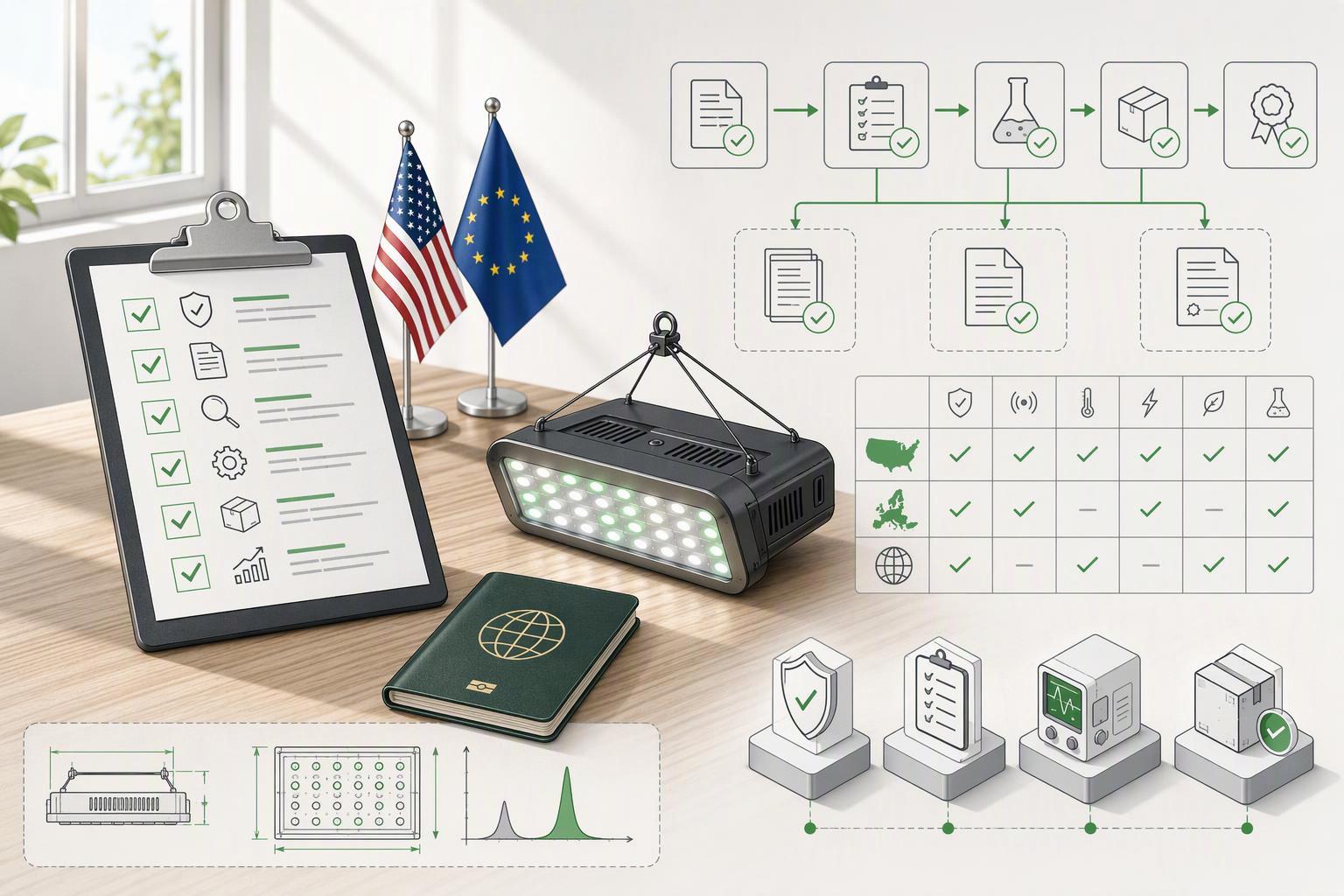
Specification wording decides whether a bid is compliant, and the common failure is writing a brand into a requirement. Because all NRTLs test to the same standards, a requirement to meet UL standards is satisfied by any NRTL listing to that standard, while a requirement written as “must be UL” excludes equivalent listings for no safety reason (Intertek, Do I need the UL mark on my product?, retrieved 2026). Write the standard, not the logo.
Useful clauses to carry into a purchase order: the fixture shall be listed by an OSHA-recognized NRTL to UL 8800 for horticultural luminaires, or to UL 1598 where the application is general illumination; the listing shall cover the exact model and configuration supplied, including drivers and connectors as assembled; the fixture shall carry a Canadian approval mark from an SCC-accredited body for Canadian installations; the supplier shall provide an EU declaration of conformity and technical file index for EU placements; and the supplier shall provide the listing record identifier so the buyer can verify it independently. Each clause maps to a document the buyer can check, which is the point.
Field Evaluations and Edge Cases
Field evaluation exists for equipment that cannot be factory-listed, and its limits are the reason it is a fallback rather than a strategy. NFPA 790 sets competency requirements for third-party field evaluation bodies, including qualified personnel, no conflict of interest such as ownership by manufacturers, suppliers or installers, and a prohibition on the body designing or performing the modifications needed to reach compliance, with records subject to audit (UL Solutions, Field Evaluations, New Standards NFPA 790 and 791, 2011). NFPA 791 is the recommended practice for evaluating unlabeled electrical equipment.
U.S. NFPA 790/791 Field Labels and AHJ Coordination
A field evaluation may begin at a factory or an interim site but must be completed at the final installation site, the report including corrective items goes to the AHJ, and the field label is applied only by the field evaluation body (UL Solutions, Field Evaluations, New Standards NFPA 790 and 791, 2011). The final-site rule is what makes the label meaningful: the evaluation describes the equipment as installed, in the environment where it operates.
AHJ coordination is the practical constraint. OSHA’s FAQ notes that local governments generally may determine the nature and extent of their acceptance of NRTL certifications as part of local code enforcement, and that State Plans may establish their own laboratory recognition programs whose approvals apply only within that coverage area (OSHA, NRTL Program Frequently Asked Questions, retrieved 2026). Bring the field evaluation body and the AHJ into the same conversation early, because a report the AHJ will not accept is an expense with no approval attached.
Canadian SPE-1000: Limits vs. Factory Certification
The Canadian field-evaluation path carries the same structural limits as the US one, stated in the approval framework itself. CSA SPE-1000 covers a one-time, product-specific field evaluation of custom, modified or limited-quantity equipment, with no continuing factory surveillance, and its label does not mean the product is CSA-certified (Standards Council of Canada, Recognized Canadian Electrical Product and Equipment Approval Marks, published 10 June 2025). No continuing surveillance means no mechanism verifies that unit 40 matches unit 1.
That chooses between the two paths a question of quantity and repetition. A factory certification covers a product family and survives repeat purchases; a field evaluation covers one configuration at one site and must be repeated for the next. A reported cap on the number of units a field evaluation may cover per model per year appears in secondary summaries but could not be confirmed on CSA Group’s own material, so confirm any such limit with the evaluation body rather than writing it into a specification.
Custom Fixtures, Retrofits, and Documentation Best Practices
Custom and retrofit work is where documentation discipline pays. Keep the field evaluation report, the corrective-item list and the label record together with the installation drawings, because the report describes the equipment as evaluated and any deviation from those drawings puts the installation outside it. For retrofits, note that UL 1598C covers LED retrofit luminaire conversion kits on OSHA’s list of appropriate test standards, which is the relevant listing for a kit that converts an existing luminaire rather than replacing it (OSHA, Appropriate Test Standards, retrieved 2026).
The recurring failure in custom work is component-level evidence presented as system-level approval. A recognized driver, a listed connector and a certified LED package do not add up to a listed luminaire, and a field evaluation is the mechanism that closes that gap. Budget for it as a per-site cost with a lead time, not as a one-time project expense.
Conclusion
Certification acceptance is decided by two different questions in the two largest markets. In the US, an AHJ accepts a fixture bearing the registered mark of an OSHA-recognized NRTL, provided the certification falls within a standard that laboratory is recognized for and was issued from a recognized site (OSHA, NRTL Program Frequently Asked Questions, retrieved 2026). In the EU, the manufacturer performs the conformity assessment and issues the declaration of conformity itself, and no third-party certificate is required for most luminaires (European Commission, CE marking, retrieved 2026). Canada sits closer to the US model, with its own accepted marks and a field-evaluation route for one-off equipment.
For a horticultural installation, the standard question resolves first. UL 8800 is the standard written for horticultural luminaires and grow systems, UL 1598 covers luminaires designed for general illumination, and the two are not substitutes (UL Solutions, UL 8800, Published Standard for Horticultural Lighting Equipment, 2024). Performance qualification is a separate layer: DLC’s V4.0 requirements set efficacy, power factor, safety certification and lifetime thresholds that determine rebate eligibility, not safety (DesignLights Consortium, Horticultural Technical Requirements V4.0).
The next step is a verification pass on the fixtures already specified. Pull the listing record for each model, check the standard and the environmental rating against the installation, and confirm the EU documentation names current harmonized standards. Where a custom or retrofit configuration has no listing, decide between a field evaluation and a factory certification before the order, not after the inspection.
Talk to an expert about evaluating your grow light specifications against US, Canadian and EU requirements, or compare options before your next procurement round.
FAQ
Do LED grow lights need UL 8800, or is any UL listing enough?
UL 8800 is the horticultural standard; UL 1598 is for general illumination.
How can I verify an ETL or UL certification before I buy?
Search the official listing directory (UL Product iQ / Intertek directory) and match the exact model.
Is a CE certificate enough for EU compliance?
No, the signed EU Declaration of Conformity is the document required.