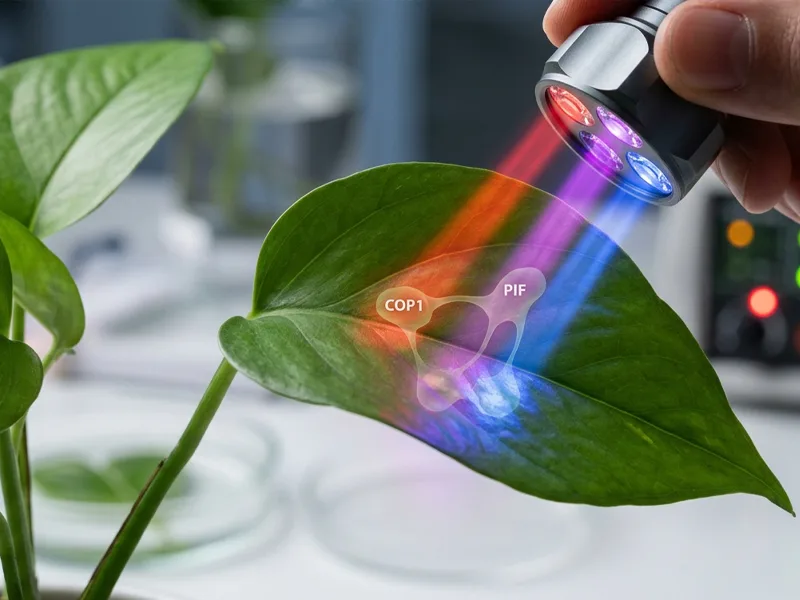
Understanding plant light acclimation spectrums is crucial because light acclimation for plants means holding the same daily light integral while the photoreceptor signal changes underneath it. A spectrum change is a signal change, not a scaling of the same response: plants deploy distinct photoreceptor classes, phytochromes for the red to far-red ratio, cryptochromes for blue and UV-A, phototropins for blue-driven stomatal opening, and UVR8 for UV-B, and these pathways converge on shared nodes such as COP1 and PIFs (photoreceptor review, PMC, 2019).
Acclimation is measurable rather than instantaneous, because chlorophyll content and the relative balance of the photosystems shift over time, so the same PPFD under a new spectral power distribution is still a new light environment (acclimation review, PMC, 2019).
That is why the metric currency for an HPS to LED transition is PPFD in µmol·m⁻²·s⁻¹, DLI in mol·m⁻²·d⁻¹, leaf temperature, VPD, and days of ramp. One number to carry from the start: leaves under LED run about 1.3 °C cooler than under HPS in typical indoor conditions, measured by direct energy balance (Nelson & Bugbee, PLOS ONE, 2015).
Introduction
Light acclimation for plants is the process of letting photoreceptors, photosystems, and leaf energy balance catch up to a new light environment, and it is why a spectrum change at constant PPFD still resets the crop. Plants deploy distinct photoreceptor classes, phytochromes for red and far-red, cryptochromes and phototropins for blue, and UVR8 for UV-B, integrated through shared signalling nodes, so a new spectrum is a signal change rather than a scaling of the same response (photoreceptor and signalling review, 2019). Acclimation is measurable: chlorophyll content and composition and the relative balance and size of the photosystems shift over time, which means “same PPFD, new SPD” is still a new light environment (acclimation review, 2019).
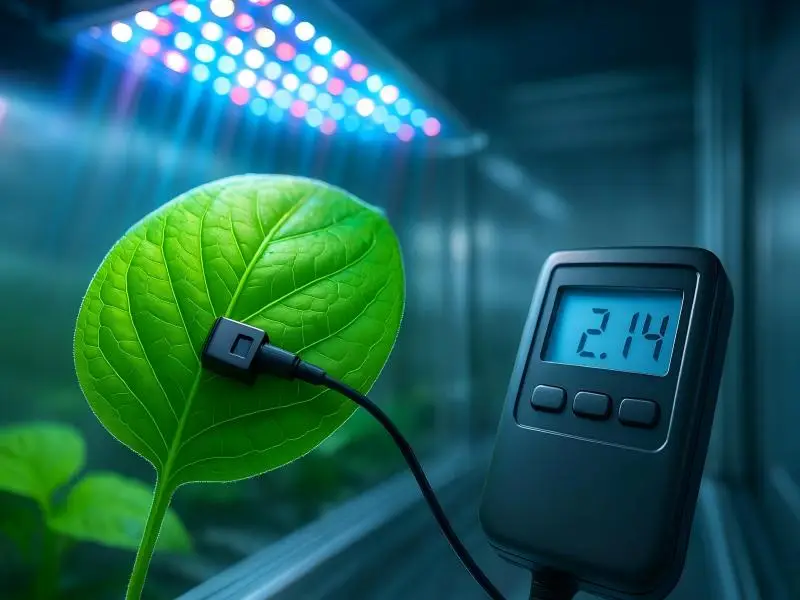
An HPS to LED transition changes more than the spectrum. Nelson and Bugbee measured the energy balance directly and found LED leaves running about 1.3 °C cooler than HPS leaves under typical indoor conditions, with leaves under all four radiation sources sitting within 2 °C of air when water is not limiting (Nelson & Bugbee, PLOS ONE, 2015). Cooler leaves pull less water, so the irrigation and VPD setpoints that suited HPS need re-checking alongside the spectrum.
This guide works in the units that decide the outcome: PPFD in µmol·m⁻²·s⁻¹, DLI in mol·m⁻²·d⁻¹, leaf temperature in °C, VPD in kPa, and days of ramp. It gives you a 14-day migration protocol with observation windows and rollback triggers, the PPFD and DLI calculation to set your starting point, and the stress checks that tell you whether to hold, step up, or back off.
Table of Contents
Photobiology Essentials of Plant Light Acclimation Spectrums
Light acclimation for plants is a signalling problem before it is an intensity problem. A spectrum change alters which photoreceptors fire, how strongly, and when, and the plant rebuilds its photosynthetic machinery in response. That is why an LED spectrum shift can stress a crop even when PPFD and DLI are held constant.
Photoreceptors and Signals
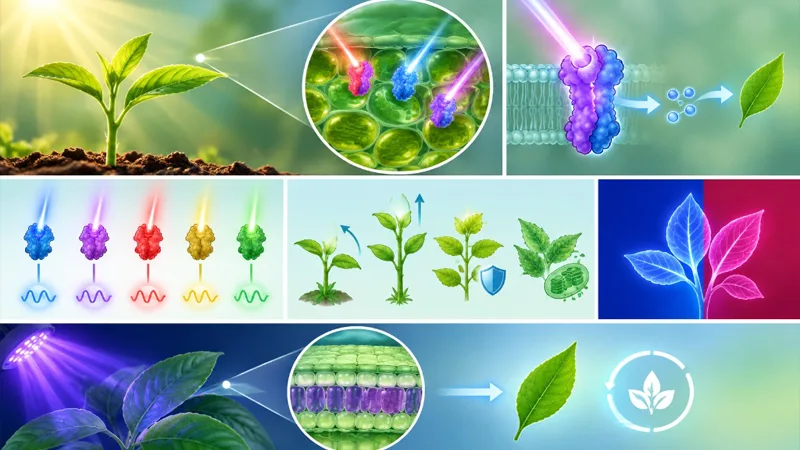
Plants read light through distinct photoreceptor classes, each tuned to a different waveband and each wired to a different response. Phytochromes sense red and far-red and track the red to far-red ratio, which tells a plant whether it is shaded and triggers shade-avoidance stretching. Cryptochromes respond to blue and UV-A and govern development and circadian timing. Phototropins, also blue-sensitive, drive phototropism, chloroplast movement and stomatal opening. UVR8 detects UV-B and initiates UV acclimation, including flavonol production. These inputs converge on integrators such as COP1 and the PIF transcription factors, which is why a single spectral change can move several traits at once rather than one.
Roles of Blue, Red, Far-Red
Blue governs morphology and stomatal behaviour, red drives photosynthetic electron transport, and far-red extends the phytochrome signal and shifts the red to far-red ratio. Changing the ratio between them changes plant architecture and leaf optics, not just the energy supply. For an operator, that means the useful question is not “how much blue is in this fixture” but “what ratio am I moving from, and what ratio am I moving to.”
UV as A Conditioning Signal
UV-B at controlled doses acts as a hardening signal: it triggers UVR8-mediated acclimation and secondary metabolite production. Treat it as a conditioning input with a dose ceiling, not as a yield lever.
Key Takeaway: Spectrum is a signal, not a scaling factor. Holding PPFD constant does not hold plant response constant, because chlorophyll content and photosystem balance shift over time as the plant re-acclimates to the new ratio.
Measure and Plan
Map PPFD and Calculate DLI
You cannot plan a spectrum change you have not measured. Start by mapping canopy PPFD on a grid of at least 9 points per fixture footprint, using a 9×9 or 16-point layout in large rooms, and hold the readings within ±10–15% of the average across the planted footprint (a minimum-to-average ratio of roughly 0.8 or better) (SLTMAKS, retrieved 2026-09-04). Remap after stretch, defoliation, fixture moves, or any meaningful dimming change, because each of those shifts the distribution.
Convert the map into DLI with the standard PPFD and DLI calculation: PPFD × photoperiod in seconds × 0.000001, or more simply PPFD × hours × 0.0036. A canopy averaging 700 µmol·m⁻²·s⁻¹ over 12 hours delivers about 30 mol·m⁻²·d⁻¹. Record both numbers per zone, not one room average, so you can see which racks are already running hot before you touch the spectrum.
Pro Tip: Treat the map as a living document. A grid that was uniform at flip can drift by 15% or more after a heavy defoliation, and a stale map is the most common reason a ramp overshoots.
Set Starting PPFD and Photoperiod
Set the first week’s target below your current canopy average, typically 60–70% of the mapped value, and keep photoperiod unchanged until the plants show a normal response. Changing intensity and day length in the same week removes your ability to tell which variable caused a problem.
Define Checkpoints and Rollback
Write the plan as checkpoint-based, not set-and-forget. Before each output increase, confirm three things: plant response is normal, with no interveinal bleaching, leaf cupping, or tip burn; the PPFD map still meets uniformity at the new setting; and climate is stable, with VPD within tolerance, RH controlled, and no condensation (SLTMAKS, retrieved 2026-09-04). If any checkpoint fails, hold the current setting for 3–5 days and re-measure before deciding whether to continue or roll back.
HPS to LED Protocol
An HPS to LED transition is a controlled ramp, not a switch-flip. The retrofit protocol used in commercial rooms runs on week-based observation windows rather than day-level ones, so each increment has time to show up in the canopy before you commit to the next one (SLTMAKS transition protocol, retrieved 2026-09-04). Treat the schedule below as a decision framework: every stage ends in a go/no-go checkpoint, and every checkpoint has a rollback trigger.
14-Day Ramp and Increments
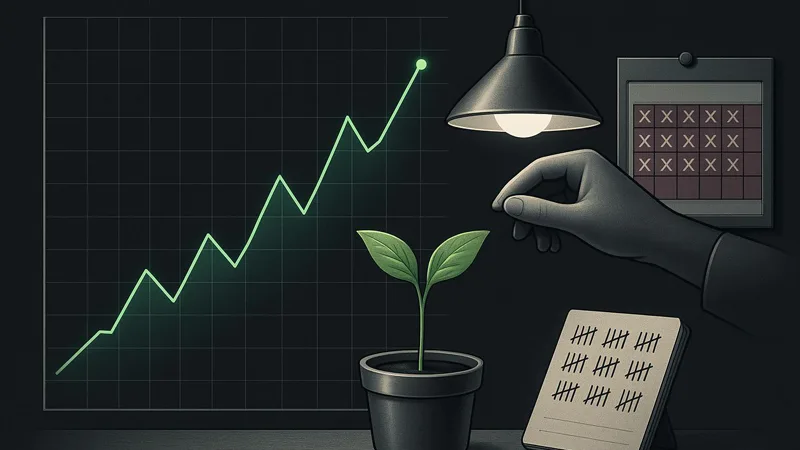
Micro-outcome: by day 14 you have a mapped room, a verified delivered PPFD/DLI figure, and at least two completed observation windows.
- Week 0, install and map. Record canopy PPFD and a leaf-temperature baseline before you change anything.
- Week 1, run at reduced output. Verify delivered PPFD and DLI against your target rather than trusting the dimmer setting.
- Weeks 2–3, raise output in small increments. Correct HVAC, RH and airflow at the same time to hold VPD.
- Then move conservatively through flower transition.
⚠️ Warning: Jumping to full LED output on an HPS-adapted canopy is a reported cause of photobleaching, along with leaf cupping, tip burn and interveinal bleaching (reported failure modes in commercial retrofits, retrieved 2026-09-04).
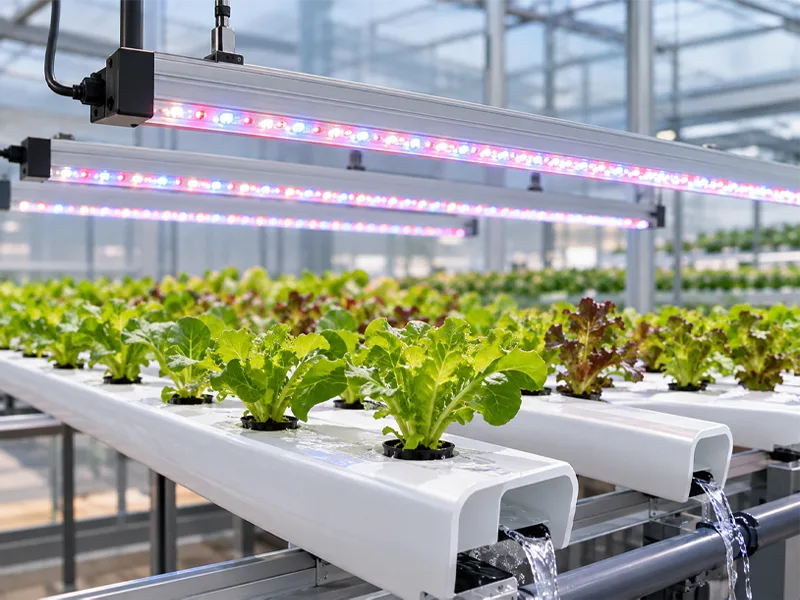
Fixtures with tunable output and spectrum support this kind of staged ramp, because levels can be stepped down or up instead of swapped in one move. SLTMAKS builds its commercial range around that capability. Confirm the delivered numbers with your own meter before advancing a stage.
Monitor Stress and Adjust
Checkpoint-based, not set-and-forget: the ramp only works if someone reads the room at each window. Watch for stretch when a new level is too low for the growth stage, or when the room still runs old HPS intensity and distance assumptions. Poor fixture layout shows up as uniformity drift, so measure across the canopy, not just under one fixture.
Tune Leaf Temp and VPD
LED canopies run cooler than HPS, and the gap is measurable. One controlled comparison measured the energy balance directly and found LED leaves sitting about 1.3 °C cooler than HPS under typical indoor conditions (PLOS ONE, 2015). In the near-worst-case water-stress and low-wind condition, peak leaf rise above air differed by 4 °C between the two, 12 °C under HPS against 8 °C under LED.
So keep your proven VPD targets but re-derive VPD from a measured leaf temperature, not air temperature alone. In flower, that commonly means raising HVAC air-temperature setpoints by roughly 7–8 °F, plus more dehumidification and airflow at and below the canopy (SLTMAKS, retrieved 2026-09-04). Watch the lights-off night setback: it is where the corrected setpoints most often drift back out of range.
LED to LED Shifts
An LED spectrum shift is usually cheaper and lower-risk than an HPS conversion, but the same rule applies: change one variable, then watch the crop before changing another. The decision variable is the observation window. A small recipe tweak can be judged in days; a large spectrum change needs a full crop cycle.
Small Recipe Tweaks
Treat a tweak as small when it moves one channel by a few percent and leaves total photon flux roughly unchanged. Typical examples: trimming blue by 5 to 10 percent during stretch, or nudging a red-to-white ratio to slow internode extension.
Run these one at a time, on one zone or bench, with the rest of the room untouched. Photograph the same plants from the same angle every two days. If leaf posture, color, or node spacing drifts outside your normal range within three to four days, revert the channel and hold for a week before trying again.
Larger Spectrum Changes
A larger change alters the ratio between broad bands, or swaps a fixture family entirely. Here the honest answer is that spectrum effects are real but crop-specific, and the published numbers are not interchangeable.
A controlled study in Frontiers in Horticulture held total PPFD at 100 ± 10 µmol·m⁻²·s⁻¹ over a 16-hour photoperiod for 30 days and delivered far-red as a relative photon-flux ratio of 3:0.5 white to far-red, not as an absolute figure. Under that ratio, lettuce height rose 56.4 percent and fresh weight 27.2 percent, while red light raised leaf number 34.5 percent, leaf area 56.5 percent, and dry weight 18.8 percent. Kale under white plus red plus far-red gained 54.7 percent in height, 17.3 percent in leaf number, 43.9 percent in leaf area, and 23.4 percent in fresh weight.
Read those as directional evidence for ratio-based design, not as a recipe to copy. Your cultivar, canopy density, and DLI differ. Give any ratio change a full crop cycle before you judge it, and log the ratio you ran alongside the harvest weight so the next cycle has a baseline to compare against.
Adding Far-Red or UV Safely
Far-red is the channel most often added badly, because it is usually added on top of an existing photon load rather than traded against it. Grow-light manufacturers typically cap far-red below 10 percent of total photon flux density, and the emitter vendor Ledestar reports that adding 10 to 20 µmol·m⁻²·s⁻¹ of 730 nm on top of a 400 µmol·m⁻²·s⁻¹ PAR base raises biomass by roughly 8 to 15 percent, crop- and environment-dependent. That is a vendor claim, not neutral research, so verify it on your own bench.
Add far-red in the smallest increment your controller supports, keep total DLI fixed by shortening photoperiod or trimming another channel, and hold for at least seven days. Watch internode length and leaf angle first; both respond before yield does. UV is a conditioning signal rather than a yield lever, so dose it in short daily windows and increase only after two clean weeks.
Environment Co-Controls
Spectrum is one input in the canopy energy balance, not the whole of it. If dehumidification, airflow or irrigation scheduling is already marginal, a spectrum change will expose that weakness, and no dimming curve will compensate for it. Treat the three controls below as the load-bearing part of the migration plan, and correct any mechanical constraint before the ramp starts rather than during it.
Leaf Temperature and VPD
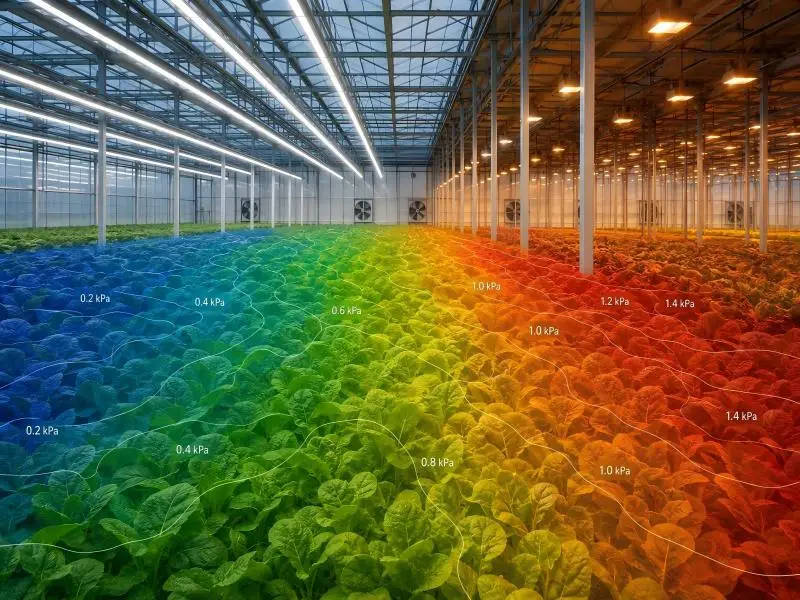
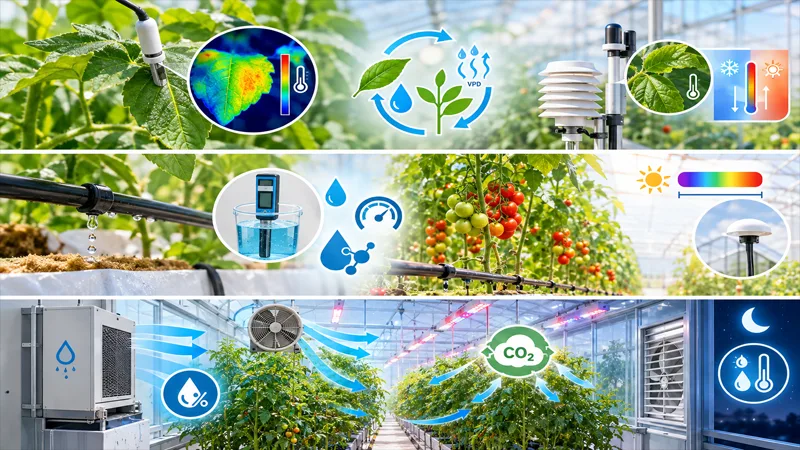
Air temperature is a poor proxy for what the leaf actually experiences. Nelson and Bugbee measured the energy balance directly and found that under non-water-stressed conditions, leaves under all four radiation sources sat within 2 °C of air temperature. Under a near-worst case of water stress combined with low wind, leaf rise above air reached 6, 8, 10 and 12 °C for field, LED, greenhouse and HPS respectively (Nelson & Bugbee, PLOS ONE, 2015). The practical consequence is that you should re-derive VPD from a measured leaf temperature rather than an air sensor alone, particularly in the first week after a spectrum change while stomatal behaviour is still adjusting.
Irrigation and EC Alignment
Radiation drives transpiration, so irrigation should follow the light sum rather than the clock. Grodan’s guidance on coupling irrigation to the radiation sum sets an EC target band of 3.0–3.5 mS on bright days, with drip EC at or above 3.0 mS for cluster tomatoes, and a water-to-radiation ratio of roughly 3.0 ml per joule. Keep irrigation running on a light setting until outside light falls to 250–200 W/m². Stopping early, at around 14:30 h with outside light still at 400–600 W/m², produced an uncontrolled substrate-EC rise in the observed trial.
Airflow, Dehumidification, CO2
A denser or differently shaped canopy changes the boundary layer at the leaf surface, which shifts both transpiration and the microclimate inside the crop. Increase dehumidification capacity and add airflow at and below the canopy before the ramp begins, then watch the lights-off night setback, when humidity climbs fastest. Confirm that existing racking and control zones can hold the setpoints you intend to run; where they cannot, fix the mechanical constraint first.
Conclusion
Light acclimation for plants is a checkpoint-based process, not a set-and-forget swap. The retrofit protocol used in commercial rooms spreads the change across week-based observation windows, and each window ends with a decision: hold, adjust, or stop. That is what makes the migration defensible to operations and procurement, because every increment has a documented reason and a documented result.
Keep the checklist short enough that a grower can actually run it:
- Map baseline PPFD and DLI at canopy level before touching a fixture.
- Change one variable per window: intensity, photoperiod, or spectrum.
- Verify leaf temperature and VPD after each change, not just photon delivery.
- Extend the timeline when readings drift; roll back when they breach the trigger you set in advance.
Pause when the canopy shows stress that does not resolve within one observation window, roll back when the deviation exceeds your pre-agreed threshold, and extend when the plants are responding but slower than the schedule assumed. The failure modes reported in commercial retrofits rarely come from the spectrum itself; they come from changing intensity, photoperiod, and spectrum at once, which leaves no way to identify the cause.
If you are weighing tunable-spectrum options for your next room, compare the SLTMAKS tunable-spectrum specifications or talk to a lighting specialist before you commit the capex.
FAQ
How long does light acclimation take after a spectrum change?
It depends on how big the change is. A small recipe tweak, like trimming blue by a few percent, can show a clear response in 3 to 7 days. A noticeable LED spectrum shift usually needs 1 to 2 weeks for chlorophyll content and photosystem balance to catch up. A full HPS to LED conversion is the longest case, so plan on 1 to 3 weeks of ramp before you reach target PPFD, and extend that for sensitive cultivars or a large jump in delivered intensity. The plant, not the calendar, sets the pace here.
Can plants still be stressed if PPFD and DLI stay the same?
Yes. A spectrum change is a signal change, not a scaling of the same response. Phytochromes read the red to far-red ratio, cryptochromes and phototropins read blue, and UVR8 reads UV-B, and those pathways converge on shared integrators such as COP1 and PIFs. When the ratio shifts, the plant rebuilds chlorophyll and rebalances its photosystems over time. So “same PPFD, new spectrum” is still a new light environment, and an LED spectrum shift can stress a crop even when your photon numbers look identical on paper.
Do leaves really run cooler under LED than HPS?
They do, and the gap is measurable. Direct energy-balance measurements found LED leaves running about 1.3 °C cooler than HPS leaves under typical indoor conditions (Nelson & Bugbee, PLOS ONE, 2015). Cooler leaves transpire less, so keep your proven VPD targets but re-derive VPD from a measured leaf temperature rather than an air sensor alone. In flower, that typically means raising HVAC air-temperature setpoints by roughly 7–8 °F and adding dehumidification and airflow at and below the canopy. Watch the lights-off setback, where these corrected setpoints most often drift back out of range.