A commercial LED grow light warranty is rarely one promise. It is a bundle of promises with different durations, different responsible parties, and different conditions that must all stay true for coverage to survive. Most procurement teams read only the headline number, three years or five years, and sign. Then a driver fails in year three, freight lands on their account, and the paperwork they need was never collected at commissioning.
Treat the grow light warranty as a validation exercise. What follows walks through what commercial policies actually cover, how component terms diverge, which conditions void coverage in practice, and how to run a grow light RMA process that keeps rooms producing while claims move.
Table of Contents
Coverage Essentials
Scope of Coverage
The standard commercial formulation across horticulture luminaire policies is coverage for defects in materials and workmanship. Grow Light Science’s commercial luminaire warranty warrants its LED luminaires, including the LED arrays and the LED drivers and integral control devices, against defects in materials and workmanship. PPF Tech’s LED product limited warranty frames its three-year term the same way, then extends an additional limited two years for products purchased on or after January 1, 2022.
Two things follow from that wording, and both matter at the decision stage.
First, a defect is a construction failure, not a performance shortfall. A driver that stops delivering current is a defect. A fixture that still runs but delivers 12% less light than it did at commissioning is generally not, unless the policy says otherwise.
Second, the scope definition determines who pays for what. If the policy defines the covered article as the luminaire, that usually pulls arrays, drivers, and integral controls into a single term. If it defines them separately, you can end up with three clocks running on the same physical unit, and grow light warranty coverage becomes three separate conversations with a vendor rather than one.
Before reading a single term length, confirm three things in writing: what the policy defines as the covered article, whether the term runs from invoice, shipment, delivery, or commissioning, and whether the remedy is repair, replacement, or credit. Those three answers change the value of the warranty more than the headline duration does.
Term Structure by Component
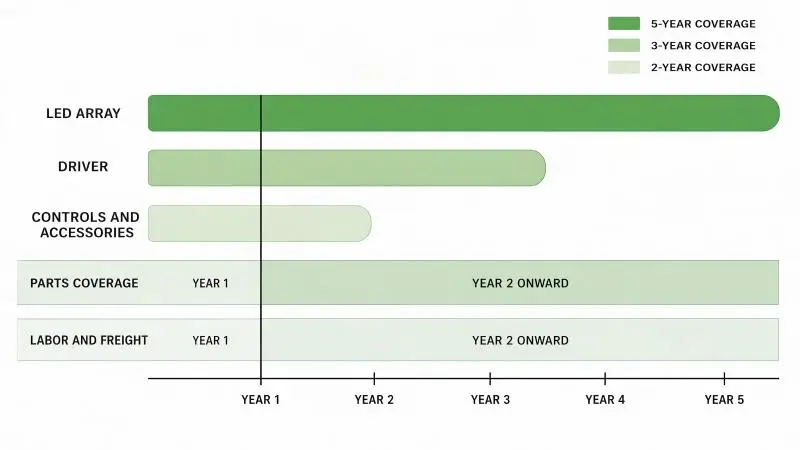
Component-level terms are where most commercial warranties diverge, and where buyers get surprised. Fluence’s published warranty information separates luminaires from controls, accessories, and connectivity products, which sit in their own shorter category. Philips’ horticulture warranty leaflet takes the same approach at component level, listing production modules at three years while strings and research modules carry one-year terms.
A pattern holds across the category:
| Component | Typical commercial term | Why it differs |
|---|---|---|
| LED array/light engine | Longest term; often the headline number | Lowest mechanical stress, best-understood degradation curve |
| Driver/power supply | Either folded into the luminaire term or backed by a separate OEM term | Highest-stress component; also the most commonly replaced |
| Integral controls, dimming, connectivity | Shortest term | Firmware, protocols, and interoperability change faster than hardware |
| Cables, hangers, connectors, accessories | Often excluded or one year | Treated as consumables rather than warranted assemblies |
The commercial consequence is straightforward. If a policy says five-year warranty and a controls module fails in year three, you may be outside coverage regardless of the headline figure. When you build a fixture schedule for a multi-site rollout, capture the warranty term for each line item, not for the fixture as a whole.
There is also a distinction worth capturing at purchase: coverage is not lifespan. A fixture rated to L90 at 50,000 hours is describing an output-depreciation expectation, not a period during which failures get repaired. The two numbers serve different purposes in your capital plan, and only one involves a claim. If you are modeling end-of-life economics rather than failure risk, replacing LED grow lights on L90 thresholds is the right framework to apply.
Performance Specs vs Warranty
This distinction causes more commercial friction than any other clause in the document. Photon output figures, PPF in μmol/s and efficacy in μmol/J, are warranted against defined test conditions: a specific drive current, a specific ambient temperature, and a specific measurement method. Step outside those conditions and the fixture may still be performing exactly as specified, just not as measured.
L70 and L90 are the depreciation metrics that sit alongside those specs. L90 means 90% of initial light output remains; L70 means 70% remains. The U.S. Department of Energy guidance on LED luminaire lifetime metrics states that reported lifetime figures are only meaningful when read together with the test conditions that produced them.
A defect warranty covers premature failure. It does not normally cover gradual light loss, unless the policy explicitly writes a maintenance threshold into the definition of a covered defect. Some do. Liron Lighting’s limited warranty policy states that LED chips will maintain at least 70% of initial lumen output during the warranty period, which converts depreciation into a claimable condition. Soraa’s warranty language separates lumen maintenance from defect-free materials and workmanship, warranting both but as distinct promises.
For a commercial operator, the practical question is close to binary. Does the policy define a covered defect solely as a failure, or does it also define an output threshold? If it is only failure, light-loss complaints are yours to absorb, and maintenance budgeting should reflect that. If there is a threshold, you need a PPFD mapping baseline from day one to prove the drift. Utility-program documentation matters too, since DLC-certified grow lights for commercial farms carry the QPL listing rebate administrators require at closeout.
Exclusions and Conditions
Installation and Environment
Exclusions are where most commercial claims die, and installation is the first category to check. This is also where most grow light warranty exclusions begin, and why they are so hard to argue after the fact. LEDCentral’s analysis of commercial LED warranty claims lists the recurring denial triggers it sees in practice: incorrect voltage, poor connections, inadequate ventilation, voltage spikes and surges, IP-rating mismatch for the location, and ambient temperature exceedance. None of these are manufacturing defects. All of them are treated as installation or operational failures.
The compliance layer sits on top of that. In North America, a horticultural luminaire needs a current safety listing to ANSI/UL 8800, the safety standard for horticultural lighting, issued by an OSHA-recognized testing laboratory. OSHA’s NRTL program description explains what that recognition means: a recognized laboratory certifies products to specific standards and periodically inspects production. The label itself, though, only covers the configuration that was tested.
That is the trap. UL’s guidance on listed luminaires versus recognized components draws the line clearly: a recognized component is incomplete by construction and does not constitute a listed end product. A driver bearing a recognized-component mark is not the same thing as a listed luminaire. And under NEC Article 110.3, equipment must be installed and used in accordance with its listing and labeling instructions.
⚠️ Warning: A fixture can carry an ETL or UL mark and still lose warranty coverage if it is installed outside the configuration its listing was evaluated for, whether that means the wrong mounting orientation, a location rating exceeded by the room’s wash-down practice, or an ambient temperature above the listed range. Verify the shipped model number against the listing record before the install crew hangs anything. Auditing an LED grow light factory is the fastest way to confirm that the certified configuration matches what actually ships.
Power Quality and Controls
Power quality is the second exclusion category, and it is the one most often invisible until it becomes expensive. PPF Tech names mechanical shock, unauthorized modification, improper storage or operating conditions, and lightning or surge damage among its exclusions. Those categories recur across commercial lighting policies almost verbatim.
In a cultivation facility, the exposure is real. Large motor loads from HVAC and dehumidification equipment switch on and off throughout the photoperiod cycle. Irrigation pumps, CO₂ injection systems, and rolling benches add switching events. Each of those events puts transient stress on the driver, which is the component most sensitive to it and the most frequently replaced.
Two defenses cost less than the claim you would otherwise lose: fit surge protection at the panel or fixture feed, and keep a power-quality record. A logged history of voltage events separates a claim that gets paid from one attributed to site power.
Controls introduce a separate failure mode. Dimming interfaces, protocol adapters, and network gateways are frequently listed under a shorter term than the luminaire, and third-party controllers may sit outside coverage entirely. Confirm that any control device you plan to connect is on the approved accessory list, then confirm in writing whether integration with a non-approved controller affects coverage for the fixture itself.
Authorized Purchase and Transfer
The last exclusion category is contractual rather than physical, and it catches multi-site operators during expansion and acquisition activity.
Coverage is commonly limited to units purchased through the manufacturer or an authorized dealer. Mars Hydro’s warranty policy restricts validity to purchases made on its official site, store, and authorized dealers or websites. Several policies also require registration within a fixed window: ILUMINAR Lighting’s warranty terms state that products must be registered within 30 days for full warranty coverage.
Transferability is the clause most often missed. The same warranty document extends coverage to the original purchaser and does not transfer. If a facility is sold, if fixtures move between legal entities, or if a third party brokers surplus units, coverage may stay with the party named on the original invoice rather than following the asset.
Three habits protect you here. Buy through the authorized channel and keep the authorization documented. Complete any registration requirement inside the stated window as a standard commissioning step. If a transfer is possible in your growth plan, negotiate transferability into the purchase agreement before signing rather than discovering the limitation during due diligence.
RMA Process and Downtime
Documentation and Start Date
Claim friction is nearly always a documentation problem, not a policy problem. NLight’s warranty documentation requirements are representative: proof of original purchase and delivery date, in the form of invoice copies, purchase contracts, or delivery receipts that also carry product identification.
Build the claim packet before you need it. For each site, retain the purchase order and invoice, the delivery receipt with serial numbers, the installation date, the fixture map by room and circuit, commissioning photographs, and maintenance records. Claims move faster when you can state which room, which circuit, and which serial number is affected.
Start date is the clause to settle in writing before the PO is issued. Policies commonly use purchase or delivery date; some tie commencement to commissioning. Ask the supplier directly whether the clock begins at invoice, shipment, delivery, or installation, and get the answer in the contract rather than in a sales email.
Pro Tip: Photograph and record every serial number at commissioning, linking each to its room and circuit, and store the record with the invoice. Claim windows can be short, and flagship grow light warranty terms commonly require notification within a defined number of days after you identify a defect. Retrieving serial numbers after the fact across a 40-fixture room costs more time than documenting them during install.
Claim Steps and Responsibilities
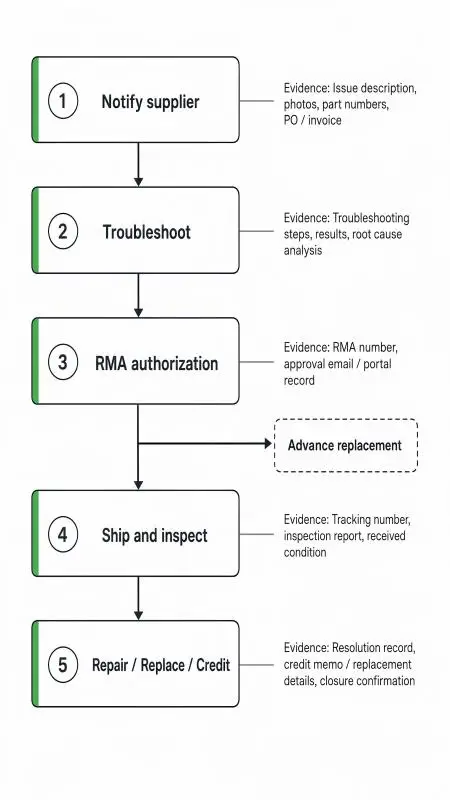
A workable LED grow light warranty claim process has five stages, and the handoff points between them are where delays accumulate.
- Notify the supplier. Submit the defect description, the quantity affected, the model and serial numbers, photographs, and proof of purchase. State the requested resolution: repair, replacement, or credit.
- Complete troubleshooting. Work through the supplier’s diagnostic steps and document the results. This is the stage where installation or power-quality causes are either ruled out by evidence or assumed by default.
- Obtain RMA authorization before shipping. Do not return anything without a written authorization number. Unauthorized returns are commonly refused or credited at a fraction of the claim.
- Ship and inspect. Record the tracking number, packaging condition, and received condition. If advance replacement is available for commercial accounts, confirm the terms, because it changes your downtime exposure entirely.
- Close out the disposition. Confirm whether the outcome is repair, replacement, or credit, and record the resolution against the asset in your maintenance system.
Before you accept a warranty, ask for the RMA terms in writing: how a failure is defined, the troubleshooting steps required, who pays shipping in each direction and in which year, the turnaround-time target, and whether replacements ship before returns are received. A grow light manufacturer checklist is a useful structure for that conversation, because it forces the answers into a comparable format across vendors.
Spares Strategy and Mitigation
The commercial reality is that a warranty is a financial remedy, not a production remedy. Freight and labor terms often shift after year one. Mars Hydro’s terms provide free components, repair service, and shipping within the first year, then free components with buyer-paid repair and shipping for years one through five. Alpha Omega Lighting’s warranty statement commits to freight for the first three years while declining to reimburse labor. Valoya’s LED grow light warranty policy states plainly that its warranty covers the supplied product only and does not extend to removal or reinstallation activities, labor costs, or unagreed shipping costs.
That last point deserves emphasis. Grow Light Science excludes labor and equipment needed to remove or reinstall parts with no time limit at all, which means a covered part can still cost you a lift, a crew, and a lost production window.
That gap is the real grow light spare parts problem for a multi-site operator, and it is solved before the first failure rather than after: complete spare fixtures for critical rooms, a repair-versus-replace decision tree defined in advance, cycle-time targets written into supplier or logistics agreements, and diagnostic records thorough enough that a vendor can confirm the failure without a second site visit. The Resource Innovation Institute lighting best-practices guide covers monitoring and maintenance scheduling in detail.
Vendor documentation quality then becomes a procurement criterion rather than a detail. SLTMAKS, for example, certifies its fixtures to ETL, CE, and RoHS and supplies IES and LDT photometric files with the listing documentation, supporting the compliant-installation record an inspector or an adjuster will ask for. The company’s wholesale LED grow lights program covers the other half of the same problem: defining what counts as a valid claim, stocking spare drivers, boards, and connectors for same-day swaps, and setting repair-versus-replace criteria with cycle-time targets. For a multi-site rollout, the certification package and the spares plan together decide whether the warranty ever converts into uptime.
Conclusion
What to Validate before You Sign
Three checks settle most of the risk before a purchase order exists. Confirm the covered article and the start-date trigger in writing. Map the term length to each component line item rather than to the fixture as a whole. Establish whether coverage applies to failures only or also to an output threshold.
Then reconcile the paperwork. The model number on the shipped unit must match the certified configuration referenced in the listing. The purchase must run through an authorized channel with registration completed inside the stated window. Any transferability requirement should be negotiated into the agreement rather than assumed.
What to Do after Commissioning
Protect eligibility from day one. Record serial numbers, room, and circuit for every fixture and store the record with the invoice. Photograph the installed condition. Establish a PPFD mapping baseline so any later output dispute has a reference point. Document your power-quality protection and keep the log.
Then build the mitigation layer. Stock complete spares for critical rooms. Set a written repair-versus-replace decision tree. Put cycle-time targets in the supplier agreement. The warranty protects the asset; the spares plan protects the harvest.
Key Takeaway: The warranty length in the headline is the least useful number in the document. The three numbers that decide whether coverage works are the covered article, the start-date trigger, and the year in which freight and labor responsibility shifts to you.
Before you commit to your next lighting order, confirm the warranty documentation and spare-part terms for the specific model you are specifying: the certification package, the RMA terms, and the spares list, in writing.
FAQ
Does a grow light warranty cover reduced light output, or only total failure?
It depends on how the policy defines a covered defect. Most warranties cover defects in materials and workmanship, which means a driver that stops working qualifies, while a fixture that still runs but produces noticeably less light usually does not. A few manufacturers write an explicit lumen-maintenance threshold into the policy, often 70% of initial output, which turns gradual depreciation into a claimable condition. Check whether your policy names an output threshold or only a failure, and if it names one, keep a PPFD baseline from commissioning so you can prove the drift.
Who pays for shipping and labor when a covered component fails?
Freight and labor terms often shift after the first year. Many policies provide free components, repair service, and shipping in year one, then keep components free while the buyer absorbs repair and freight costs for the remaining term. Labor for removing and reinstalling a fixture is frequently excluded entirely, with no time limit at all, so a “covered” part can still cost you a lift, a crew, and lost production time. Ask for the shipping and labor terms in writing, year by year, before you sign.
Can I transfer the warranty if I sell the facility or move fixtures to another entity?
Can I transfer the warranty if I sell the facility or move fixtures to another entity?
Usually not. Most commercial policies extend coverage only to the original purchaser and state that the warranty does not transfer. Some also require registration within a fixed window, such as 30 days from purchase, and limit validity to units bought through the manufacturer or an authorized dealer. If a sale, a move between legal entities, or a resale of surplus units is possible in your growth plan, negotiate transferability into the purchase agreement up front rather than discovering the limitation during due diligence.