Introduction
In cut-tulip forcing, stem length is a grade gate. Buyers pay on caliper, stem length, and first-internode strength, and short or uneven stems drop whole trays out of the premium bracket. Greenhouse supplemental lighting has historically been tuned for photosynthesis, but a quieter tool does a different job: far-red light aimed at morphology. Applied in the right window, it signals the tulip to elongate without asking it to fix more carbon.
This article explains how to use far-red supplemental light to reach target stem grades on a commercial forcing bench. The objective is extension that lands inside the right grade band while handling, caliper, and vase performance stay intact — not stems pushed as tall as possible, but stems steered to a predictable, harvestable target with the least energy. We will move through the mechanism, the crop-specific evidence, timing and intensity recipes, deployment and control wiring, then the energy and ROI picture so you can decide whether morphology-level far-red belongs in your forcing greenhouse.
Scope is the tulip forcing window: from when stems begin to extend under a natural photoperiod through to just before harvest. Everything below is grounded in how tulips actually respond, not generic shade-avoidance, with close attention to timing, dose, cultivar validation, and controls. If you already run photosynthetic PAR toplights, the central idea is that far-red can be layered underneath at very low intensity, largely decoupled from your growth-lighting energy bill.
Mechanism and Spectrum Basics
Far-red seems mysterious because it sits just outside the band most growers call “red.” The biology is well mapped, and three related ideas explain what you will see on the bench.
Phytochrome and Shade-Avoidance Response
Plants sense neighbors through the ratio of red to far-red light, not shadow alone. The gatekeepers are pigments called phytochromes, each in two reversible states: a red-absorbing form (Pr) and a far-red-absorbing form (Pfr).
Red drives the pigment toward Pfr, which signals open, sunny conditions and tends to restrain extension; far-red converts it back toward Pr, and a high share of Pr signals “I am shaded,” triggering the shade-avoidance response. That response is exactly what a shy tulip needs: accelerated stem and first-internode elongation toward what it believes is better light. By lowering the red:far-red ratio the plant perceives, you can steer it into a longer habit without touching temperature, fertilizer, or plant growth regulators.
Far-Red band (700–800 nm) and R: FR Balance
Far-red as a working term covers roughly 700–800 nm, with many fixtures peaking near 730 nm. It is largely invisible and carries little photosynthetic value on its own, yet it is the dominant signal input for phytochrome. The deciding quantity is the ratio of red to far-red — R: FR, dimensionless, best read as “open sun versus shade.”
Sunlight sits high in R: FR; below a canopy it drops. Lowering the R: FR a tulip sees, by adding far-red against a red background, moves phytochrome toward its inactive form and releases elongation. That is why far-red is generally delivered as a separate, independent channel, spoken of relative to the red it sits on, rather than baked into one fixed shade. For a working primer on this Pr-to-Pfr switching, the SLTMAKS guide to phytochromes and red-to-far-red control is a solid reference.
Blue Light and +DIF Interactions Affecting Elongation
Far-red does not act alone. Blue light, sensed by cryptochromes, pushes the opposite way — compact plants with sturdier stems. Drop blue too low in a far-red-rich bench and tulips stretch past useful stem into weakness; hold it at a measured level, and blue becomes the brake that keeps far-red-driven extension usable.
Temperature adds a parallel lever. DIF, the day-minus-night temperature difference, strongly shapes internode length: a positive +DIF (warm day, cool night) promotes elongation; negative DIF restrains it. Published work on the interaction shows far-red and +DIF can act synergistically to increase extension. At the same time, blue light can dampen that combined push — a 2025 Frontiers study on blue-light modulation of far-red and DIF found the elongation response was strongest under low blue and diminished as blue rose. So far-red, blue, and your night setpoint are one coordinated recipe, not three independent settings — push all three toward “elongate” at once and you overshoot.
Tulip-Specific Evidence
Generic photobiology is useful, but tulip forcing deserves better than analogy. A focused line of work on Tulipa gesneriana grown under a natural photoperiod with artificial night lighting collapses into a clear, implementable hierarchy.
Timing Hierarchy: Full-Night FR > EOD ≈ Night-Break; End-of-Night Ineffective
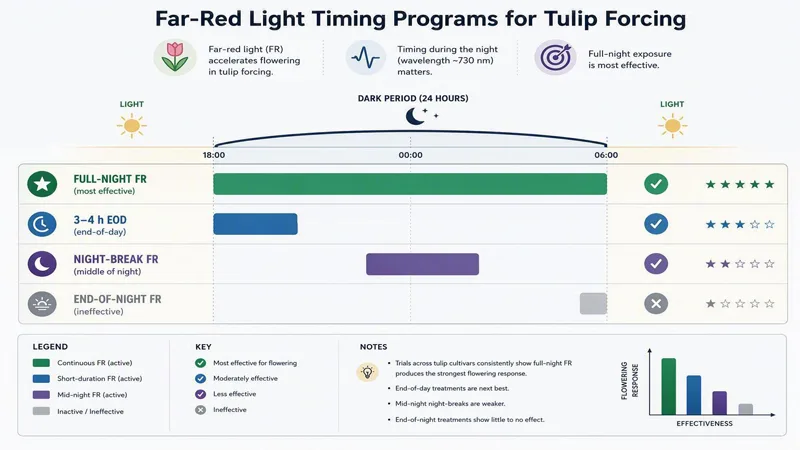
The most transportable finding is that when you deliver far-red matters more than anything else. In the JARQ spectral-sensitivity study of four tulip cultivars (Tulipa gesneriana ‘Leen van der Mark’, ‘Murasaki Suisho’, ‘Come Back’, and ‘Kikomachi’), far-red given continuously through the night produced the strongest stem and first-internode elongation; an end-of-day (EOD) dose of about four hours and a night-break dose of about four hours were both effective but consistently weaker; and a four-hour far-red treatment at the very end of the night had no measurable effect (Sumitomo et al., Spectral Sensitivity of the Extension Growth of Tulips, JARQ 46(1), 2012).
That end-of-night result is the single most important scheduling fact in the topic — it is the wrong place to spend energy. The responsive windows are the dark continuum and the stretch at the start of darkness, so an EOD or night-break dose is a serviceable compromise and a full-night run is the strongest lever available.
Effective Intensity: Start ~0.5–0.6 μmol·m⁻²·s⁻¹; Diminishing Returns above ~1
Tulips are strikingly sensitive to far-red, which helps your power budget. In that same JARQ study (2012), rising far-red photon flux increased extension growth up to a clear saturation point near 0.59 μmol·m⁻²·s⁻¹, and photon flux above that bought nothing more, essentially.
Where a photosynthetic bench runs hundreds of μmol·m⁻²·s⁻¹ across PAR, this morphological response saturates under one. The working start point is therefore roughly 0.5–0.6 μmol·m⁻²·s⁻¹ of far-red at canopy height, with meaningful diminishing returns above about 1 μmol·m⁻²·s⁻¹. Beyond that, you heat the bench and draw current without buying stem — the basis for the minimum-effective-dose approach in the ROI section.
Pro Tip: Start at ~0.5–0.6 μmol·m⁻²·s⁻¹ of far-red at the canopy and verify with a far-red-capable sensor. Going above ~1 μmol·m⁻²·s⁻¹ adds heat and cost while returning almost no extra stem.
Cultivar Variability and Validation per Class
Do not expect one recipe to fit every tulip. The JARQ work (2012) spanned four cultivars with real differences in response and dose, and elongation biology is genotype-sensitive, so the dose that saturates one cultivar can be wasteful for its neighbor. That variability is why this article leans on bench-scale trials and weekly stem-distribution checks rather than a single universal figure. Treat 0.5–0.6 μmol·m⁻²·s⁻¹ as a validated entry point, then refine per cultivar batch, and confirm at canopy height — not from the fixture chart — if you want a repeatable grade outcome.
Scheduling and Intensity Recipes
The evidence collapses into program choices. Full-night is strongest, EOD and night-break are acceptable, end-of-night is useless — and the recipes below follow that order.
Full-Night Program during Active Elongation Window
The most effective program is a full-night far-red run at a low, stable intensity across the entire dark period, and only while stems are actively elongating. In a forcing timeline, that means switching the morphology channel on once shoots have cleared the bulb-cooling phase and started to stretch, and off when trays reach target handle length and move to a hold/cool stage. Because the response saturates so low, running all night is not an energy extravagance; at 0.5 μmol·m⁻²·s⁻¹ the added load is a rounding error beside your PAR system. The infographic below compares the scheduling options at a glance.
Run full-night far-red in a dark house without a dawn confound. Because end-of-night far-red does nothing, you can leave the channel on through to lights-on without waste, but confirm the controller does not drop it off before dawn when you rely on a dark-period recipe. Uniformity matters at these ultra-low levels: a gap of only a few tenths of a μmol·m⁻²·s⁻¹ beneath saturation yields uneven stems because part of the bench responds and part does not.
EOD Alternative (3–4 h) for Energy Savings and Fine-Tuning
Where full-night running is impractical — a shared photoperiod controller, blackout schedule, or energy cap — the EOD alternative is the next-best program. A three-to-four-hour dose right after the photosynthetic day ends captures most of the elongation signal at a fraction of the duty cycle.
It also makes a good tuning tool for batches on the edge of the grade band: nudge the EOD window longer or shorter to move stem distribution without committing to overnight operation. Begin the EOD far-red the moment the main lights switch off, not an hour later — the competent window sits at the start of darkness, and delaying only pushes the dose toward unresponsive territory. Choose EOD when trading a little headroom for energy, and full-night when a lagging batch needs maximum length.
Guardrails: Maintain PAR DLI While Layering FR; Manage Blue to Restrain Stretch
Far-red is a signal, not a food source, so it must never compromise the crop’s photosynthetic diet. Keep the daily PAR light integral (DLI) where tulip forcing needs it and treat far-red as an overlay, never a replacement; far-red contributes little photosynthesis itself, so shifting PAR toward it would starve the bench while making it stretch — weak stems and scarce assimilates together.
Then manage blue to restrain stretch as you add far-red. Because blue favors compact, sturdy stems, a far-red program without enough blue can carry tulips past useful length into bending. The SLTMAKS guide to the far-red internodal response in a shade-avoidance crop makes that same blue-balance point explicit, and the tulip lesson is identical: hold a deliberate red-to-blue balance, verified at the canopy.
Deployment, Controls, and Compliance
A well-researched plan usually fails at getting the spectrum onto the bench cleanly. Fixture layout, control integration, and electrical compliance deserve the same rigor as the dose.
Fixture Placement, Uniformity, and Low PPFD Targeting
Morphology far-red is a low-photon, high-uniformity problem. Because the response saturates near 0.5–0.6 μmol·m⁻²·s⁻¹ and falls off sharply below it, the real enemy is bench-level non-uniformity, not weak peak output. Place far-red bars closer and more evenly than photosynthetic units — doubling spacing on a signal that saturates under one unit leaves cold zones where stems quietly lag.
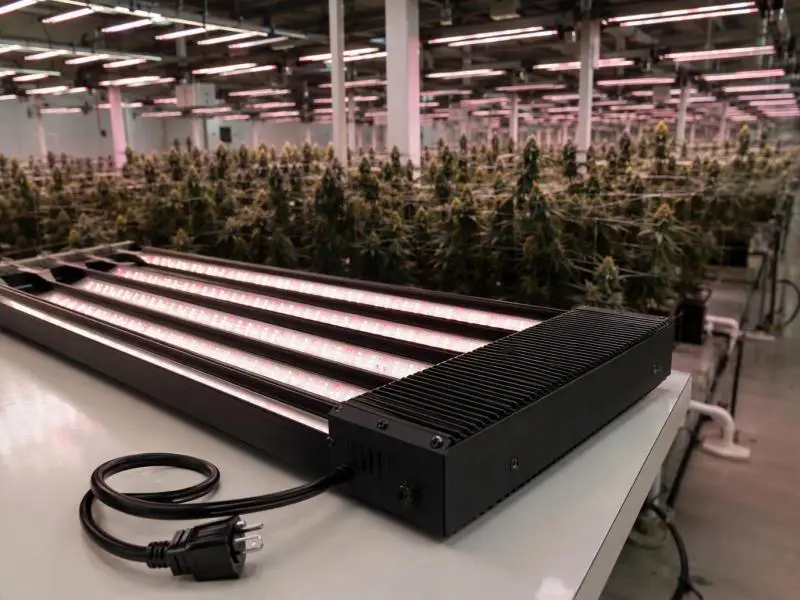
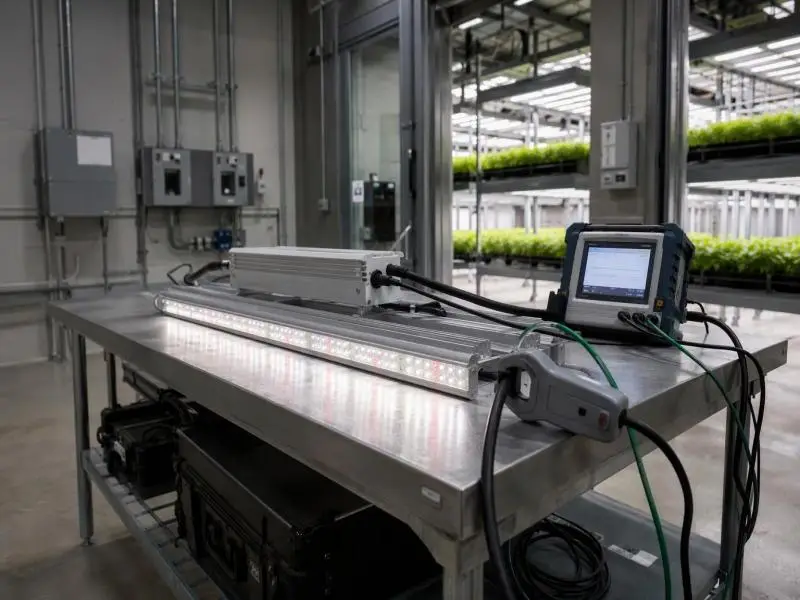
The schematic below shows a bench-level arrangement: evenly spaced far-red bars running transversely across the trays with a forgiving, wide coverage cone to keep the low-intensity field flat, plus a clean wiring path into a weather-rated box and a controller. Target a canopy field within roughly ±15 percent of recipe value across the whole bench, and verify with a spectroradiometer or far-red-capable quantum sensor at tray height rather than trusting distance charts.
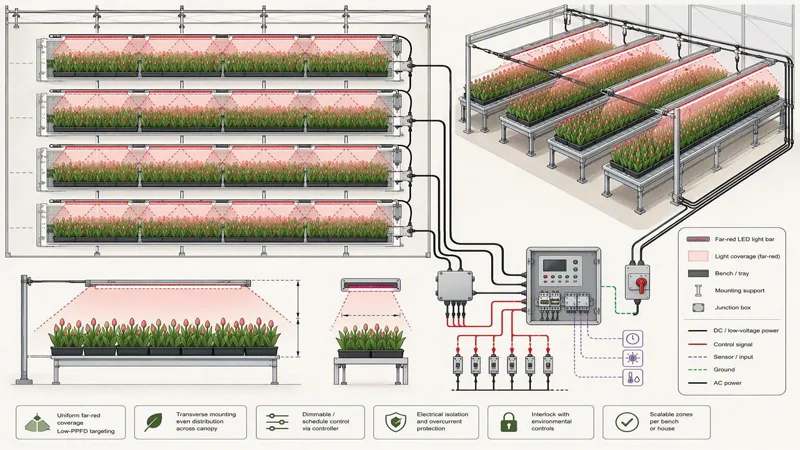
Because the intended dose sits below a single μmol·m⁻²·s⁻¹, the fixtures can run as a dedicated low-intensity morphology channel, mounted separately from the PAR grid. That keeps the two jobs independent: the growth light carries daily energy, and the far-red channel handles only signal work on its own schedule.
Integrating FR with Temperature Setpoints, DIF Strategy, and Photoperiod Controls
A far-red channel pays off only when it stays coordinated with the rest of the environment. Integrate it with your climate computer so temperature setpoints, DIF strategy, and photoperiod schedule move together. Because far-red and +DIF push in the same direction, a grower who deepens +DIF while also running far-red stacks two stretch drivers on one crop. Better to hold far-red steady as the primary lever and use temperature — a shift toward negative DIF — as the opposing control when a cultivar runs long.
Program the channel off the same clock as the photoperiod logic: in a full-night run it follows the dark period continuously; in an EOD run it opens the instant the main lights close. Use astronomical or photoperiod-based timing so the window tracks true daylength across the season, and log run hours and canopy dose per bench so a grade change traces back to the recipe rather than guesswork.
Safety and Certifications (ETL/UL, CE, RoHS) for Overnight Operation
Running fixtures overnight in a cooled, humid greenhouse puts electrical safety and materials compliance squarely on the procurement checklist. In North America, look for fixtures carrying a recognized laboratory listing such as ETL or UL — evidence that the unit was tested to an electrical safety standard rather than just advertised.
For European facilities, CE marks conformity with applicable EU directives, and RoHS confirms the unit restricts the hazardous substances the EU prohibits in electrical equipment. None of these is optional decoration; an inspector or authority having jurisdiction can reject a facility over an unlisted fixture, and overnight operation raises the stakes.
None of this requires a custom build. Compliance-ready far-red channels that pair with a greenhouse climate controller are available off the shelf; as one neutral example, SLTMAKS offers FR-capable channels documented to ETL, CE, and RoHS across its Samsung-diode range, so a forcing operation can add a morphology channel without a separate compliance project. The point is less the brand than verifying the certification paperwork before a unit ever hangs — because a certified fixture is what lets you run the program through the night and sleep through it.
Energy, HVAC, and ROI Modeling
Far-red looks exotic on paper and trivial on the meter, but it deserves proper financial modeling. The numbers split into added load, grade-driven return, and amortization.
Estimating Added Electrical Load at Morphology-Level FR
Because the saturating dose sits near 0.5–0.6 μmol·m⁻²·s⁻¹, the added load is small relative to a photosynthetic bench. Estimate it simply: multiply the fixture’s rated watts per linear meter of bench coverage by the dark-period hours you actually run it, giving a daily per-bench energy figure. An overnight full-night dose at these levels typically lands in the low single-digit percent of total lighting electrical load.
Still plan for one subtlety: every watt becomes heat, so factor the bars’ heat rejection into HVAC. The burden is modest at these power levels but not zero — and the saturation data removes any reason to over-drive the channel, keeping both increments minimal by design.
Grade-Uplift ROI Model: Premiums vs Electricity and Capex
The honest ROI case for far-red is grade uplift, not direct energy savings. Three variables do the work: (1) added electricity and HVAC from the channel, (2) one-time capex on fixtures and controls, and (3) the revenue from moving more of the crop into longer, higher-value stem grades. Model it with three scenarios that change only the share of the bench shifting up a grade:
| Input | Conservative | Moderate | Optimistic |
|---|---|---|---|
| Bench shifted up a grade | 15% | 30% | 45% |
| Price uplift per upgraded stem | low | mid | high |
| Added electrical + HVAC cost | modest | modest | modest |
| Payback (years) | longest | mid | shortest |
Run the arithmetic with your own packing-house grade spread, not a fixed premium, because stem-length premiums vary by contract and season. The result will almost always show the project is capex- and logistics-dominated — fixtures and controls cost more than the electricity ever will — so the decision rests on whether a reliable 15 to 45 percent of your bench clears the next grade, which only your trial data can confirm.
Utility Incentives, Amortization, and Minimum-Effective-Dose Approach
Three practices sharpen the financial picture. Because the added load is small, check for utility rebates or energy-efficiency incentives aimed at greenhouse lighting; even modest ones shorten payback on the capex side, which dominates here. Amortize fixtures over rated life — a three-year warranty is a conservative floor, with many LED units lasting longer — and weight daily energy by the hours you truly run, so an EOD 3–4 h program at half the duty cycle wins on opex if the grade holds.
Key Takeaway: The response saturates near 0.5–0.6 μmol·m⁻²·s⁻¹. Drive the channel to that effective minimum and no higher; over-driving to 1–2 units adds current, heat, and cooling cost while buying almost no stem, which silently erodes the ROI the saturation curve gives you for free.
Risks and Controls
Every environmental lever has a failure mode, and far-red is no exception. Risks concentrate in overshoot — stems too long, too weak, or too uneven — and the controls are measurement-based rather than speculative.
Over-Elongation, Bending/Lodging, and Stem Strength Monitoring
The defining risk is that far-red works better than you wanted. Push dose, duration, blue balance, or +DIF toward “elongate” too far at once, and tulips cross from premium stem into weak, leaning, or lodging material that fails handling and bends in the sleeve.
The safeguard is to monitor stem strength alongside length rather than harvesting by height alone. Caliper and first-internode firmness are what buyers grade, so a stem that reaches length by going thin is not an upgrade — it is a new defect. Set a ceiling on total stretch, keep a non-far-red control bench, measure stem diameter and first-internode firmness weekly, and if stems lengthen without holding caliper, pull blue up or back far-red off before the crop commits to weak architecture.
Bench-Scale Cultivar Trials and Weekly Stem Distribution Checks
Because response is cultivar-specific, validate per class before scaling to whole rooms. Run a small-block trial — a few trays per cultivar, far-red versus control, at identical temperature and light — to find each cultivar’s saturating dose and its behavior at target. Randomize blocks, change only the far-red variable, and hold PAR DLI, canopy temperature, and CO₂ constant so stretch is attributable to light and not confounded.
Then make weekly stem-distribution checks routine, counting stems into length classes rather than averaging — an average hides a bimodal bench where half grades up and half stays short. If the distribution widens, tighten uniformity; if the whole curve drifts long, ease the dose or raise blue. Distribution is the earliest, most sensitive signal a recipe needs adjusting before it hits the harvest rail.
Postharvest Elongation Management and Harvest Stage Adjustments
Tulip stems keep elongating after cutting, so the far-red decision is not over at harvest. Stems cut at a given length will gain more once hydrated and cool-stored, so an over-long harvest from a far-red bench can push final product past the buyer’s upper spec even if it looked right in situ. Pull the far-red channel off earlier and cut treated trays at a slightly shorter handle, confirming the postharvest gain lands the final stem inside grade rather than above it.
Conversely, a shy bench can receive one last elongation nudge before the harvest stage while the response window is open. The rhythm is to finish the far-red window a little before harvest, sample postharvest length across a few stems, and lock the harvest-stage target per cultivar, turning far-red into a predictable elongation control you schedule to a grade rather than a gamble one harvest from too long or too short.
Conclusion
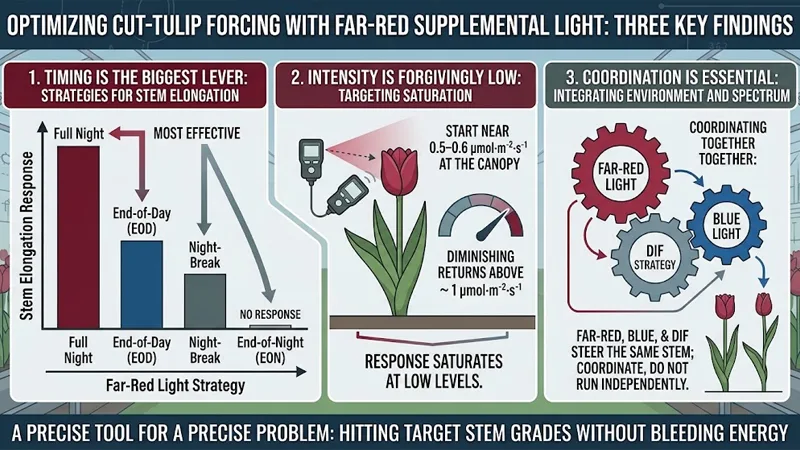
Far-red supplemental light is a precise tool for a precise problem: hitting target stem grades in cut-tulip forcing without bleeding energy. Three findings carry the practical payload. Timing is the biggest lever — full-night far-red beats EOD or night-break, which beat an end-of-night dose that does nothing. Intensity is forgivingly low: start near 0.5–0.6 μmol·m⁻²·s⁻¹ at the canopy, where the response saturates, and expect diminishing returns above roughly 1 μmol·m⁻²·s⁻¹. And environment matters as much as spectrum, because far-red, blue, and your DIF strategy steer the same stem, so they must be coordinated rather than run independently.
Key Takeaway: Timing is the biggest lever — full-night far-red out-performs EOD and night-break, and an end-of-night dose does nothing. Start low (~0.5–0.6 μmol·m⁻²·s⁻¹) and verify per cultivar with weekly distribution checks.
The path forward is disciplined: run bench-scale cultivar trials to lock each class’s dose, standardize control wiring and scheduling so far-red moves with temperature and photoperiod, then refine against weekly stem-distribution and caliper checks. Held to that discipline — low dose, correct timing, coordinated environment, verified per cultivar — far-red is the cleanest way to pull a lagging forcing bench up into the grade you are actually paid for. Start small, measure the distribution, and let the stems, not the fixture chart, tell you when you have the recipe right.
FAQ
Does far-red light really lengthen cut-tulip stems?
Yes. In the JARQ study of four tulip cultivars, far-red given as night lighting consistently increased stem and first-internode elongation. It works by shifting phytochrome toward its inactive form and triggering the shade-avoidance response, so the plant reaches toward what it reads as better light.
What far-red intensity do I need to lengthen stems without over-stretching?
Start around 0.5–0.6 µmol·m⁻²·s⁻¹ at the canopy. The JARQ study found the response reaches its saturation point near 0.59 µmol·m⁻²·s⁻¹, so pushing above roughly 1 µmol·m⁻²·s⁻¹ adds heat and current while buying almost no extra stem.
When is the best time to run far-red during tulip forcing?
Full-night far-red during active elongation is the strongest option, and a 3–4 hour end-of-day dose also works. What does not help is end-of-night far-red, which had no measurable effect. Time the program from when stems begin to extend until trays reach the target handle length.