
Running a professional grow is not the same as keeping a few houseplants alive. In commercial facilities, lighting is a production tool—one that affects crop quality, cycle time, labor efficiency, HVAC load, and ultimately profit.
This guide focuses on commercial LED grow lights designed for high-bay installations, characterized by high ceilings, wide coverage, demanding uniformity targets, and extended operating hours. We’ll keep it practical and easy to follow, while still using the real metrics that professional growers rely on when choosing lighting at scale.
Table of Contents
Why High-Bay Commercial LED Grow Lights Are the Go-To for Large Facilities

High-bay rooms demand engineered distribution, not “more watts.”
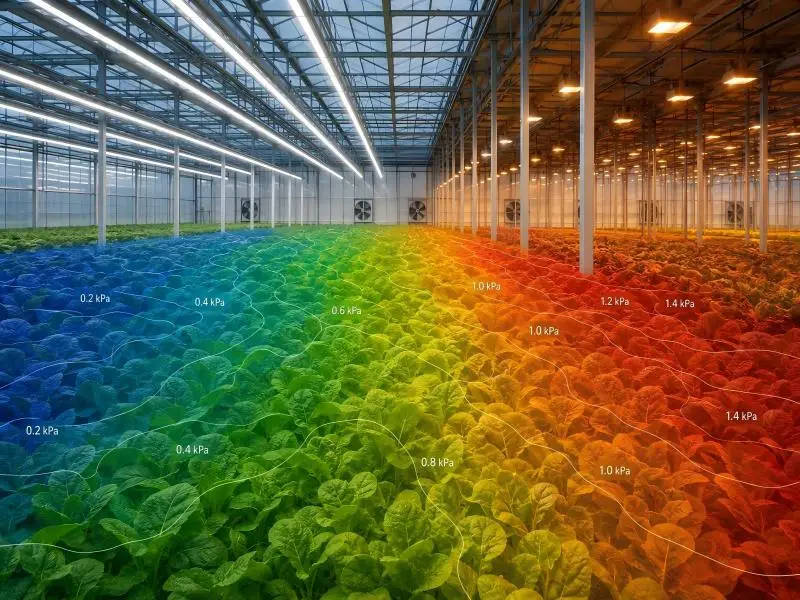
In high-ceiling facilities, the challenge isn’t only intensity—it’s controlled spread. High-bay commercial LED grow lights are designed to deliver more consistent PPFD across a wider footprint at higher mounting heights, so you can reduce edge falloff and minimize hot spots.
When you’re planning an entire room, uniform light distribution reduces plant-to-plant variability. That means fewer corrective actions (rotations, re-spacing, re-feeding) and smoother harvesting logistics across the bay.
Commercial environments require uptime-grade components.
Pro grows run long photoperiods day after day, often under warm and humid conditions. A fixture that looks powerful on paper can still underperform in the real world if thermal design and drivers aren’t built for industrial duty cycles.
This is why commercial buyers pay attention to safety and performance frameworks used across lighting industries, including standards and guidance from organizations like the Illuminating Engineering Society (IES) and published safety requirements designed specifically for horticultural environments, such as UL 8800.
The 5 Lighting Metrics That Matter Most in Commercial Growth
PPFD: what plants “receive” at the canopy level
PPFD (µmol/m²/s) measures the photon density hitting the canopy each second. It’s the core number growers look at for “how strong” the light is, but it only matters if it’s measured at the right height and across the full grow area.
A single center-point reading is not enough for commercial planning. You want a grid map so you can see the average, min/max spread, and whether edge rows will lag.
DLI: your daily “dose” for yield and cycle planning
DLI (mol/m²/day) is the total light delivered per day, and it connects lighting to outcomes like yield potential, flower density, and vegetative speed. DLI helps growers plan schedules and predict how changes to photoperiod or intensity will affect results.
For commercial operations, DLI is also the easiest way to translate lighting decisions into SOPs: stage-specific targets, dimming setpoints, and seasonal adjustments.
Efficacy (µmol/J): the efficiency number that impacts OPEX
Efficacy tells you how many usable photons you get per watt. In large facilities, small differences in µmol/J can become big differences in monthly electricity cost—especially when you add HVAC impacts.
But efficacy alone is not the full story. A fixture can be efficient and still perform poorly if the distribution is uneven or the spectrum doesn’t match your crop strategy.
Uniformity: the hidden lever for consistency and labor
Uniformity is about how evenly PPFD is spread across the canopy. Better uniformity usually means less plant-to-plant variability and fewer corrective actions—like moving trays, rotating plants, or compensating with extra nutrients.
In commercial grows, uniformity also reduces the risk of localized stress. That helps keep your crop more predictable and easier to manage under standardized protocols.
Thermal and environmental behavior: not just “LED heat.”
LEDs still generate heat—just less radiant heat than many legacy sources. The real commercial question is where that heat goes (into the room air, into the fixture body, and into the HVAC load profile).
High-bay fixture design matters here. Good heatsinks, quality drivers, and stable performance at higher ambient temperatures help prevent output sag and premature component failure.
Spectrum Strategy for Commercial LED Grow Lights
Full spectrum: the safe baseline for multi-crop operations
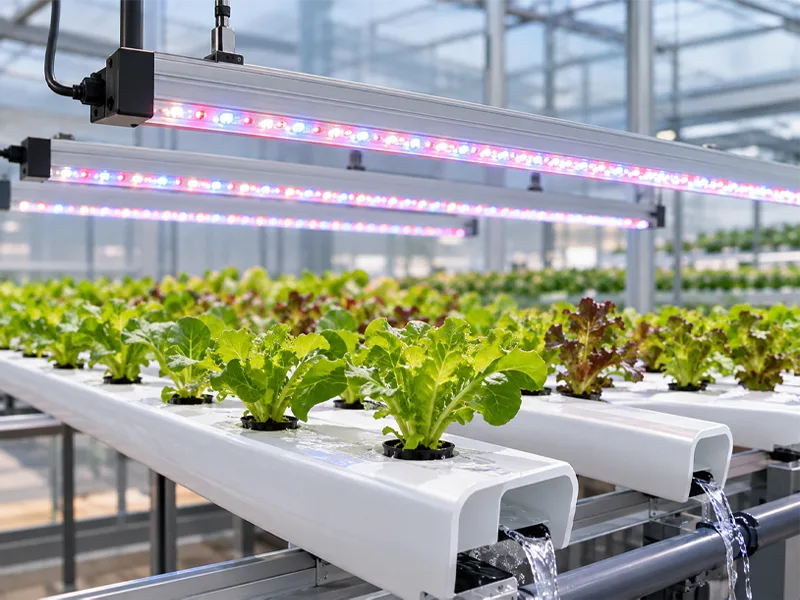
Most commercial growers choose “white + tuned” approaches because they’re easy to work with and flexible across crops. Full-spectrum commercial LED grow lights can support vegetative and flowering stages without forcing you into extreme spectral choices.
If your facility grows multiple varieties or crops, a balanced spectrum reduces re-optimization effort and keeps your lighting plan more scalable.
Red/blue emphasis: when it can make sense
Red and blue heavy recipes can deliver a strong photosynthetic response, but the operational tradeoffs can be real. Worker comfort, crop monitoring, and visual inspection can become harder under overly narrow spectra.
For commercial facilities, the question is rarely “does it grow plants?” and more “does it grow plants predictably, with good QC, at scale?”
Optional far-red and UV: use with a plan, not a trend
Far-red and UV can be useful tools, but they should be applied intentionally and measured carefully. In commercial settings, anything that increases stress risk, safety complexity, or SOP variability needs a clear payoff.
If you’re considering advanced spectrum channels, tie them to measurable goals: morphology targets, cycle-time reduction, or quality attributes you can validate consistently.
What Makes a High-Bay Fixture Truly “Commercial Grade”

Optics engineered for canopy uniformity
The lens and optic design determine whether your PPFD map looks like a clean, even field—or like a spotlight collection. In high-bay installations, optics are especially important because mounting height and beam control drive uniformity.
Commercial LED grow lights built for high-bay often use optics that reduce peak intensity while spreading photons efficiently across a wider area. That helps avoid light stress in the center while keeping edges productive.
Driver quality: where reliability is won or lost
A commercial grower can’t afford frequent driver failures. Drivers should support stable dimming, handle heat well, and maintain consistent output through long operating cycles.
Good commercial fixtures also protect the driver from humidity and contaminants. This is a major difference between “looks industrial” and “built for industrial horticulture.”
Thermal management that protects long-term output
Thermal design affects both reliability and performance stability. If a fixture runs too hot, you can see output drop, color shift, or shorter component life.
A well-designed high-bay unit uses heatsinking and airflow-friendly geometry to keep junction temperatures under control. In commercial operations, that means fewer surprises after months of continuous use.
Environmental protection: dust, humidity, and cleaning realities
Commercial grows are not clean rooms. Dust, organic particles, humidity swings, and cleaning schedules can all stress equipment.
When choosing high-bay commercial LED grow lights, look for sealing approaches and materials that match your room conditions. If your operation includes washdowns or high-humidity zones, environmental resistance becomes a core purchasing factor.
Layout Planning: Mounting Height, Spacing, and Real-World Coverage
Start with the target PPFD/DLI, then design the grid
A common mistake is to buy fixtures first and “make them fit.” Commercial planning works better in reverse: choose canopy targets, then design a layout to hit them uniformly.
Once your targets are clear, a lighting plan should specify mounting height, spacing, dimming ranges, and measurement points. This turns lighting into a repeatable system, not guesswork.
High-bay spacing is not “one number.”
Spacing depends on beam distribution, mounting height, reflectivity of walls and floor, and crop canopy density. Two fixtures with the same wattage can require different spacing if their optics and photon distribution differ.
For this reason, PPFD maps and layout simulations are extremely valuable. In commercial environments, they can prevent costly over-lighting or under-lighting across hundreds of square meters.
Commissioning: verify with measurements, not assumptions
Even the best plan should be verified after installation. Measure PPFD at canopy height across a grid, then tune dimming or layout if needed.
This step is what separates hobby-level installs from professional operations. Commissioning also creates documentation you can use for audits, troubleshooting, and future expansion.
Controls and Automation: Dimming, Scheduling, and Integration
Why dimming is a commercial advantage
Dimming lets you match light intensity to plant stage and avoid wasting electricity. It also helps you manage heat load, which can reduce HVAC strain during peak hours.
In commercial operations, dimming becomes a “control knob” for consistency. When your SOP says “run 70% output in early veg,” you’re building repeatability into production.
Photoperiod scheduling that supports production planning
High-bay systems are commonly paired with centralized scheduling so multiple rooms can run predictable cycles. This supports labor planning, harvest timing, and inventory commitments.
A stable lighting schedule also reduces plant stress. Consistency is a key ingredient in commercial-quality results.
Centralized control platforms and expansion readiness
If you plan to scale, choose systems that can integrate with facility controls and expand without redesign. Commercial grows evolve—new rooms, new cultivars, new SOPs—and your lighting infrastructure should keep up.
Even if you start with manual controls, selecting fixtures that support standardized control signals makes upgrades easier later.
Safety, Compliance, and Facility Requirements

Electrical and installation safety
Commercial facilities need lighting that supports safe installation, stable wiring practices, and predictable power behavior. High-bay fixtures should be selected with real facility constraints in mind: breaker sizing, cable runs, mounting hardware, and maintenance access.
Safety isn’t just compliance—it’s uptime protection. A safer installation is usually a more reliable one.
Worker comfort and visual inspection
Many commercial teams underestimate how spectrum affects day-to-day work. If staff can’t easily spot nutrient issues, pests, or mildew early, the risk cost can be far greater than small differences in fixture price.
Balanced, work-friendly lighting environments support better crop monitoring and faster decision-making.
Documentation for audits and operational control
Commercial growers often need documentation for internal QA, investors, or regulatory requirements (depending on region and crop). Having clear spec sheets, layout plans, and commissioning records strengthens operational control.
It also reduces friction when you replicate a successful room design across multiple sites.
Energy Economics: How Commercial LED Grow Lights Pay Back
Electricity cost is only one part of the ROI equation
Efficacy matters, but so does uniformity, reliability, and how well the light supports your production targets. A slightly higher-priced fixture can be cheaper long-term if it reduces labor, improves consistency, and lowers failure-related downtime.
In many facilities, lighting also interacts with HVAC costs. The “best” solution is often the one that optimizes the whole system, not one metric.
Rebates and qualified product programs
In some regions, commercial lighting rebates can meaningfully reduce upfront cost. Programs often require documentation and performance criteria, so it’s smart to plan for this early.
If rebates are available in your market, choose fixtures and documentation processes that make qualification easier—not harder.
Maintenance and lifetime planning
Commercial operations should plan maintenance like any other production asset. Driver replacement strategy, cleaning schedules, and spare parts planning reduce downtime risk.
A lighting system that is easy to service can be a real operational advantage when you’re running tight production windows.
High-Bay Applications: Where These Fixtures Perform Best
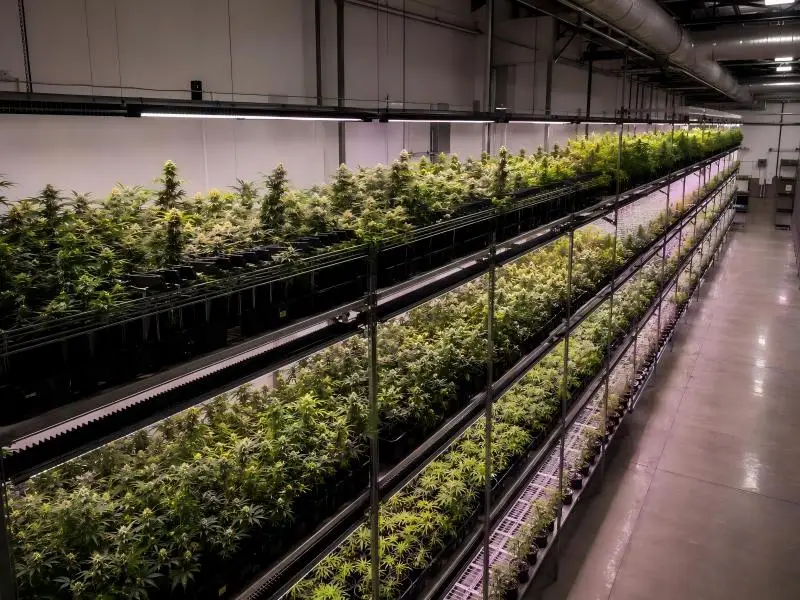
Vertical racks and multi-tier support areas
Even if your main production is multi-tier, high-bay commercial LED grow lights are often used for support spaces: propagation, staging, mother rooms, or overflow zones. High ceilings and flexible coverage are common in these areas.
High-bay fixtures also perform well where you need good uniformity over wide open floor plans.
Greenhouse supplemental lighting
In greenhouses, high-bay LED solutions can support seasonal consistency and reduce variability from weather. The goal is usually to stabilize DLI, not replace the sun.
Commercial LED grow lights designed for high-bay can also help target specific zones where natural light is weaker due to structural shading.
Large indoor flowering rooms
For large indoor rooms with high ceilings, high-bay systems are a natural match. They simplify installation, reduce fixture count in some layouts, and can provide strong uniformity when planned correctly.
The biggest win is often operational: fewer variables, cleaner coverage, and easier replication across rooms.
Why Pro Growers Choose SLTMAKS for Commercial LED Grow Lights
Engineering focused on real commercial constraints
At SLTMAKS, we approach commercial LED grow lights like production equipment, not decorative fixtures. That means we prioritize photon distribution, stable dimming performance, thermal control, and practical serviceability.
Professional growers need predictable results and smooth scaling. Our goal is to provide fixtures and support that make your facility easier to run—not harder.
High-bay solutions designed for consistent canopy performance
High-bay lighting succeeds when uniformity is treated as a design goal, not an afterthought. We build around coverage behavior so your PPFD map supports consistent crop development across the entire room.
That consistency helps standardize feeding, pruning, and harvest workflows. Over time, it becomes a competitive advantage.
Support for planning, commissioning, and expansion
Commercial lighting is not just a product choice—it’s a system choice. We support layout planning and commissioning workflows so you can verify performance and lock in repeatable SOPs.
If you’re expanding room-by-room, we can help keep designs consistent across phases. That reduces risk and makes scaling more predictable.
FAQ
How do I know if I need high-bay fixtures?
If your ceiling height is high enough that standard fixtures struggle to deliver uniform canopy PPFD, high-bay solutions are usually the better approach. They’re also ideal when you need wide, consistent coverage across large open rooms.
The best way to confirm is with a layout plan and PPFD mapping at canopy height. Decisions should be based on measured or simulated results, not wattage alone.
Is higher PPFD always better in commercial grows?
Not always. Plants can experience stress when intensity is too high, and the “best” level depends on crop type, cultivar, CO₂ strategy, temperature, and nutrients.
Commercial success comes from matching PPFD and DLI to a balanced system. That’s why dimming and stage-based targets are so valuable.
What should I ask for before making a purchase?
Ask for photometric data, PPFD maps, dimming specifications, and environmental suitability details. You should also confirm how the fixture behaves at higher ambient temperatures and what service strategy exists for drivers.
In commercial operations, the right questions prevent expensive rework. It’s far cheaper to plan than to retrofit.
Conclusion: Build Lighting Like a Production System
If you want a high-bay solution that matches your facility goals—PPFD, DLI, uniformity, controls, and long-term reliability—SLTMAKS is ready to support you from layout planning to commissioning and expansion.