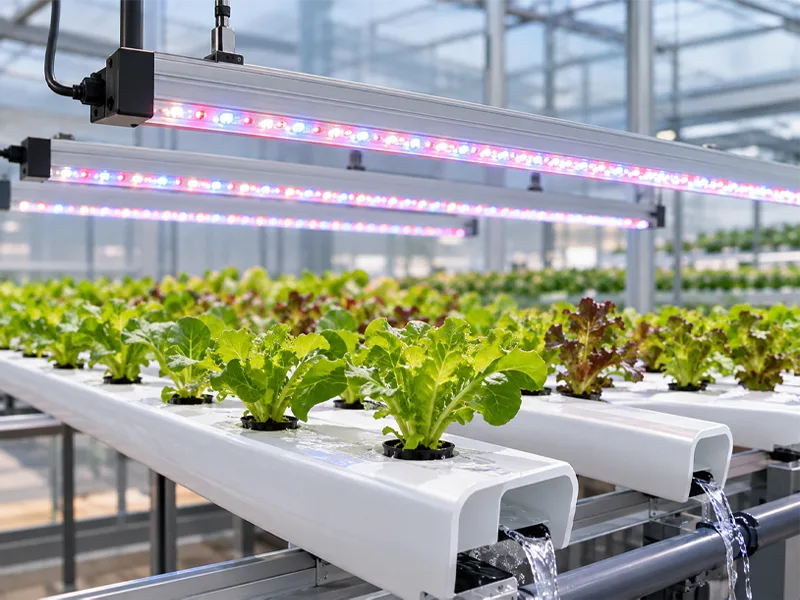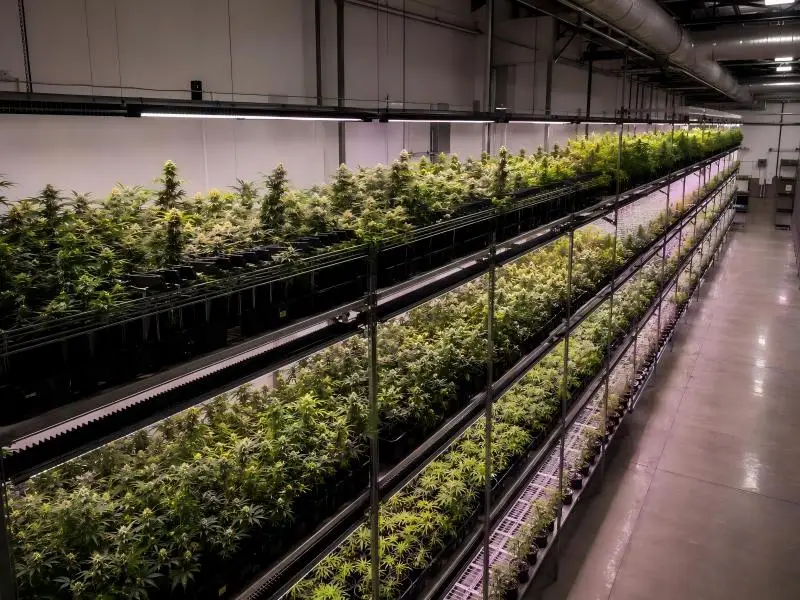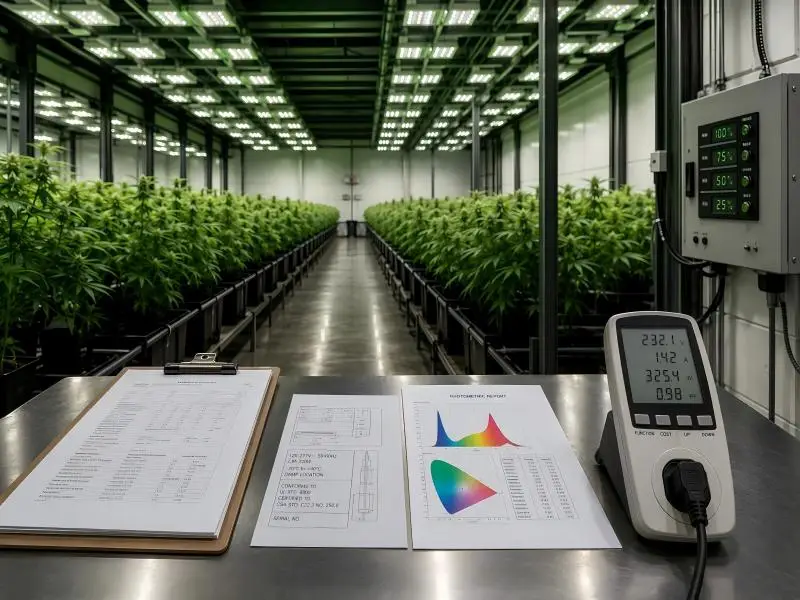
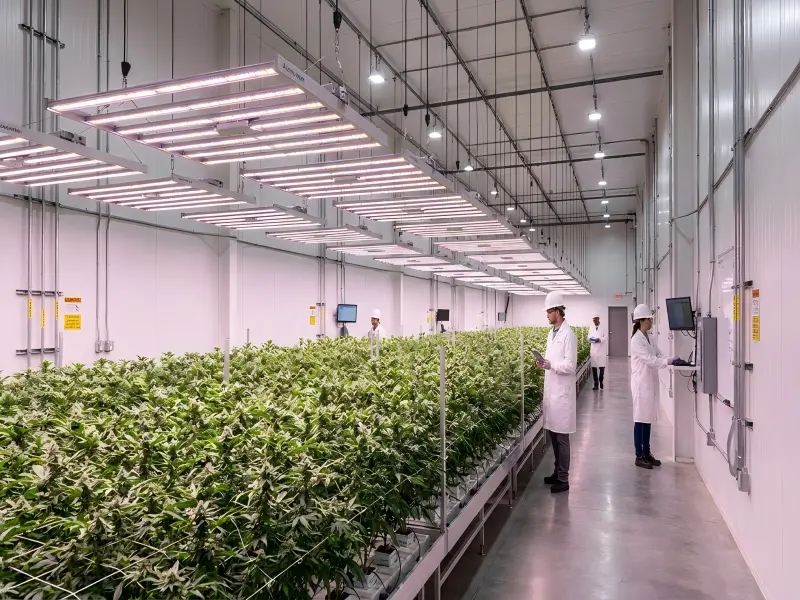
Commercial indoor cultivation facilities operate under harsh environmental conditions. Luminaires suspended above high-value crop canopies run continuously for 12 to 18 hours per day, surrounded by relative humidity levels exceeding 70%, automated liquid fertigation overspray, and elevated ambient temperatures. Under these conditions, lighting is not merely a photosynthetic driver—it is the single largest electrical load in the building.
For facility managers, cultivation directors, and electrical project engineers, choosing uncertified equipment instead of UL certified grow lights creates severe operational exposure. A single electrical fault or non-compliant lighting installation can trigger an immediate red tag from local inspectors, delay Occupancy Permits, void commercial property insurance coverage, or disqualify the facility from thousands of dollars in utility energy rebates.
Navigating compliance requires a clear understanding of international safety marks. This guide breaks down the technical differences between North American safety standards (ANSI/CAN/UL 8800 and UL 1598) and European CE directives, outlines how safety certifications protect your facility’s financial health, and provides a step-by-step verification framework for auditing vendor claims before procurement.
Table of Contents
The High-Stakes Reality of Electrical Safety in Commercial Indoor Cultivation
Unlike standard commercial office environments where lighting operates in dry, climate-controlled rooms, commercial grow environments subject electrical equipment to severe physical and chemical stressors:
- High relative humidity and washdowns: Daily transpiration and overhead irrigation create high moisture levels. Fixtures must withstand constant humidity and periodic pressure washdowns without water ingress causing short circuits.
- Corrosive environments: Airborne fertilizer salts, sulfur vapor treatments, and humidity corrode electrical connections, driver enclosures, and exposed wiring harnesses over time.
- Continuous high thermal load: High-power LED grow lights draw hundreds of watts per unit. Continuous operation generates significant thermal energy that must dissipate passively or actively without causing thermal runaway or degrading driver electronics.
⚠️ Warning: Installing uncertified grow lights in a commercial facility poses immediate electrical fire and shock risks. Beyond physical damage, operating non-listed fixtures violates National Electrical Code (NEC) mandates and almost always forfeits property and casualty insurance coverage in the event of a loss.
Comercial facility compliance risks
Risk Category Consequences &Details AHJ inspection failure Non-compliant equipment blokcs occupancy permits Insurance claim invalidation Uncertified ixtures void fire and casualty liability policies Utility rebate loss Disqualified from DLC QPL capex cash
Demystifying North American Safety Standards: UL 8800 vs. UL 1598
In North America, electrical equipment safety is verified by Nationally Recognized Testing Laboratories (NRTLs) accredited by OSHA, such as Underwriters Laboratories (UL), Intertek (ETL), and CSA Group. When evaluating UL certified grow lights, it is essential to distinguish between general lighting standards and horticulture-specific standards.
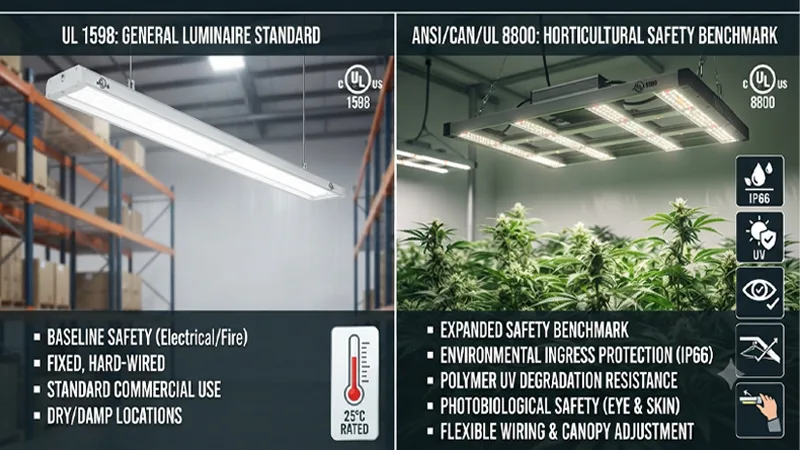
UL 1598: The Baseline Luminaire Standard
UL 1598 luminaire safety requirements apply to fixed, hard-wired lighting fixtures used in general commercial and industrial buildings. It evaluates basic construction, electrical shock protection, thermal performance at standard 25°C ambient temperatures, and mechanical enclosure grounding. While UL 1598 provides a solid baseline for structural and electrical safety, it was not written to address the specialized operational realities of plant growth environments.
ANSI/CAN/UL 8800: The Horticultural Safety Benchmark
Published in August 2019 as a harmonized standard for the United States and Canada, the ANSI/CAN/UL 8800 horticultural safety standard is the industry benchmark dedicated exclusively to horticultural lighting equipment and systems (Product Category CCN: IFAU).
UL 8800 expands upon UL 1598 by incorporating four specialized engineering evaluations tailored specifically to indoor farming:
- Photobiological eye & skin safety (IEC 62471/IEC TR62778
- Polymer UV degradation & anti-embrittlement (UL 746C f1 rating)
- Environmental ingress protection (IP54 to IP66 damp/wet location ratings)
- Flexible wiring, strain relief & canopy height adjustment protocols
1. Photobiological eye and skin safety
Commercial LED grow lights emit intense photon fluxes across spectra that include high-energy blue, deep red, far-red, and sometimes ultraviolet (UV) radiation. UL 8800 evaluates photobiological radiation hazards to the human eye and skin at a standardized 20 cm test distance in accordance with IEC 62471.
- Fixtures are categorized into Risk Groups: Risk Group 0 (Exempt), Risk Group 1 (Low Risk), and Risk Group 2 (Moderate Risk).
- Risk group 3 is strictly prohibited for commercial horticultural luminaires.
- Fixtures tested under UL 8800 must carry permanent risk-group labels and installation instructions that specify the required Personal Protective Equipment (PPE) for farm personnel.
2. UV material aging and resistance
Optical lenses, plastic baffles, wire insulation, and polymer gaskets exposed to sunlight in greenhouses or high-intensity artificial plant spectrums degrade over time. Under UL 8800, all exposed polymeric materials must meet UL 746C standards and carry an f1 outdoor/UV resistance rating, proving they will not yellow, become brittle, or experience dielectric breakdown under long-term light exposure.
3. Environmental ingress protection (IP)
UL 8800 requires fixtures to undergo rigorous water spray and dust exposure testing. Rather than relying solely on dry-location ratings, horticultural fixtures are evaluated for damp or wet location suitability under UL 1598 / CSA C22.2 No. 250.0. Fixtures built for high-humidity canopy environments should demonstrate IP65 and IP66 ingress protection ratings to ensure dust-tight construction and protection against liquid spray.
4. Specialized flexible wiring and mounting
Because commercial cultivators adjust light fixture height as crop canopies grow, UL 8800 outlines specific requirements for flexible supply cords, strain-relief fittings, and quick-connect plugs. Wiring methods must support positioning flexibility without risking conductor tension, wire chafing, or insulation failure.
Understanding CE Certification for European and Global Facilities
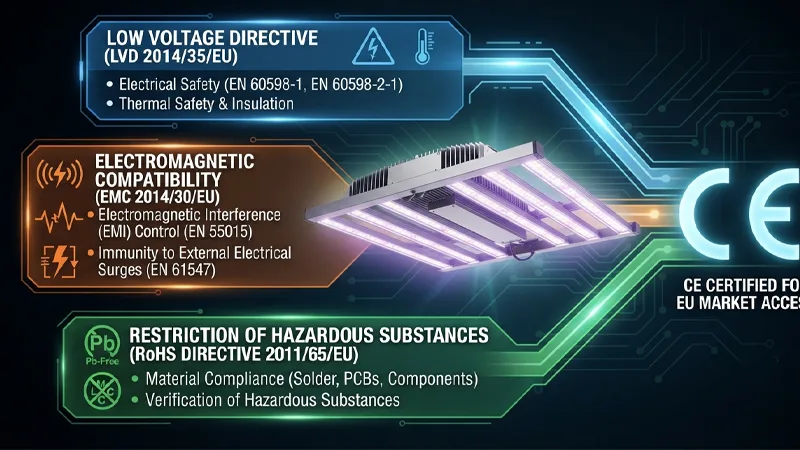
For commercial operations expanding into European or international markets, compliance revolves around the CE (Conformité Européenne) mark. Unlike UL or ETL listing, CE is not a single test standard—it is a mandatory conformity marking indicating that a product complies with all applicable European Union directives.
Key EU directives for commercial LED grow lights
| Directive | Description / Purpose |
| Low voltage directive (LVD 2014/35/EU) | Assesses electrical safety via EN 60598-1 |
| Electromagnetic compatibility (EMC 2014/30/EU) | Ensures fixture produces no harmful RF interference |
| RoHS directive (2011/65/EU) | Restricts hazardous substances (Pb, Hg) |
Core Directives for LED Grow Lights
To legally apply the CE mark to a commercial LED grow light, the manufacturer must ensure compliance across three primary areas:
- Low voltage directive (LVD 2014/35/EU): Evaluates electrical and thermal safety. Testing is conducted against harmonized standards EN 60598-1 (General Luminaire Requirements) and EN 60598-2-1 (Fixed General Purpose Luminaires).
- Electromagnetic compatibility (EMC 2014/30/EU): Ensures the luminaire does not emit electromagnetic interference (EMI) that disrupts nearby wireless equipment or sensors (EN 55015), and that it possesses immunity to external electrical surges (EN 61547).
- Restriction of hazardous substances (RoHS Directive 2011/65/EU): Verifies that components (solder, circuit boards, driver housings) do not contain restricted hazardous materials such as lead, mercury, or cadmium.
Third-Party NRTL Certification vs. CE Self-Declaration
A critical distinction for procurement teams is how compliance is verified:
- CE marking: In most cases, CE is a self-declaration process. The manufacturer compiles a Technical Construction File (TCF) backed by laboratory test reports and signs an EU Declaration of Conformity.
- NRTL listing (UL/ETL): North American listing requires independent third-party testing and ongoing factory audits. An accredited testing agency performs unannounced quarterly inspections of the manufacturer’s production facility to verify that off-the-line fixtures match tested samples.
Pro tip: In North America, local inspectors (AHJs) will not accept a CE mark as a substitute for an NRTL listing (UL, ETL, or CSA). If your facility is located in the US or Canada, your fixtures must carry a recognized NRTL mark.
How Safety Certification Impacts Insurance, AHJ Approval, and DLC Rebates
Securing certified grow lights is an operational imperative that impacts three critical financial pillars of a commercial farm:
Triple value of safety certification
| Value Proposition | Benefits & Details |
| Local AHJ sign-off | Passes electrical audit; secures CO permit |
| Insurance validity | Protects facility against claim denial after fire loss |
| DLC utility cash | Unlocks major capex energy rebates |
1. AHJ Approval and Building Code Compliance
Local electrical inspectors—known as the Authority Having Jurisdiction (AHJ)—enforce the National Electrical Code (NEC Article 410 for Luminaires and Article 411 for Low-Voltage Lighting). During pre-commissioning inspections, AHJs check every fixture for a valid NRTL mark. Uncertified fixtures are flagged immediately, resulting in failed inspections and costly delays in obtaining your Certificate of Occupancy (CO).
2. Commercial Insurance Validity
Commercial property and casualty insurance policies contain strict clauses regarding electrical equipment installation. Operating non-NRTL-listed electrical equipment in a commercial facility introduces unmitigated risk. In the event of an electrical fire or equipment failure, insurance adjusters inspect fixture compliance. Uncertified equipment can lead directly to denied insurance claims and total loss forfeiture.
3. Unlocking DLC Utility Rebates
Energy efficiency rebates offered by electric utilities can offset 20% to 50% of upfront fixture capital expenditure. To qualify for these incentives, fixtures must be listed on the DesignLights Consortium (DLC) Horticultural Qualified Products List (QPL).
According to the DLC Horticultural Technical Requirements, safety certification is a mandatory prerequisite. The DLC will not review efficacy or PPFD photometrics unless the manufacturer provides a complete safety test report confirming compliance with ANSI/CAN/UL 8800 or UL 1598 from an accredited testing laboratory.
Verification Framework: How to Audit Grow Light Safety Listings Before Buying
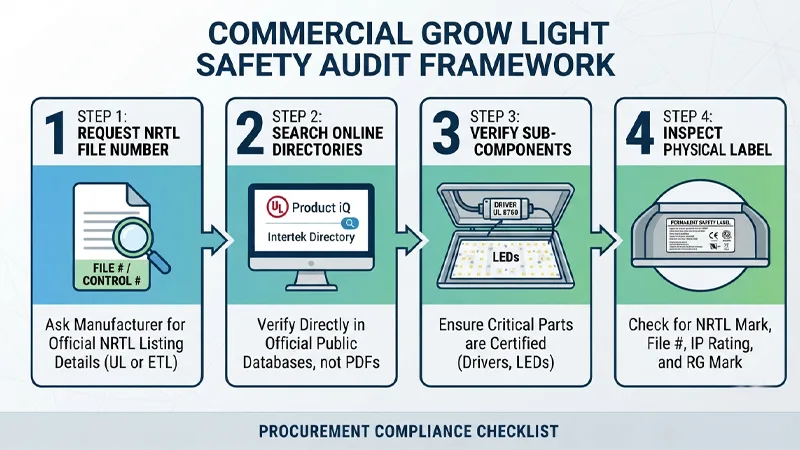
Due to the prevalence of counterfeit certification badges on commercial marketplaces, procurement officers must independently verify vendor compliance claims using this four-step audit framework:
NRTL compliance verification checklist
- Step 1: Request official NRTL file number and manufacturer name
- Step 2: Search online directory (UL product iQ or Intertek directory)
- Step 3: Verify sub-components (Samsung LEDs, drivers under UL 8750)
- Step 4: Audit physical fixture label for file number, IP rating & RG mark
Step 1: Request the NRTL File Number
Ask the manufacturer or distributor for their official NRTL listing details:
- UL listed: Request the UL File Number (typically starts with
Efollowed by 5–6 digits, e.g.,E123456). - ETL listed: Request the ETL Control Number (typically a 7-digit number, e.g.,
5001234).
Step 2: Query Online Certification Directories
Do not rely on digital certificates or static PDF sheets provided by sales representatives, as these can be forged or expired. Verify the number directly in official public databases:
- For UL listings: Log into UL Product iQ (
productiq.ulprospector.com) and search by File Number or Company Name. Check that the Category Control Number (CCN) readsIFAUfor Horticultural Luminaires orIFAMfor Fixed Luminaires. - For ETL listings: Access the Intertek Directory of Listed Products (
intertek.com/directories) and enter the Control Number to confirm active status and standard coverage (ANSI/UL 8800 or UL 1598).
Step 3: Audit Sub-Component Safety Listings
A compliant fixture relies on certified sub-components. Verify that the core driver electronics meet UL 8750 (Standard for Light Emitting Diode Equipment for Use in Lighting Products) and that internal wiring harnesses meet UL flame-retardant standards. High-tier industrial manufacturers transparently disclose driver model numbers (such as Inventronics or Mean Well) and diode component specifications (such as industry-standard Samsung LED packages).
Step 4: Inspect Physical Fixture Markings
When initial sample units arrive at your facility, conduct a physical label audit. Under UL 8800 and UL 1598, compliant fixtures must carry a permanent, tamper-evident label on the fixture housing containing:
- The registered NRTL mark (UL or ETL logo).
- The manufacturer’s official File Number or Control Number.
- Environmental location ratings (e.g.,
Suitable for Wet Locations). - Ingress Protection rating (e.g.,
IP65orIP66). - Photobiological safety Risk Group marking (e.g.,
Risk Group 1 - CAUTION: Optical Radiation).
Engineering Certified Safety into Commercial Operations with SLTMAKS
At SLTMAKS, product development is grounded in industrial reliability and compliance rigor. Designed specifically for multi-room commercial indoor farms, greenhouse operations, and vertical cultivation facilities, commercial-grade LED grow light fixtures are engineered to meet international safety and performance standards.
SLTMAKS Industrial safety advantages
| Feature | Description Benefits |
| Samsung LED diodes | High photon efficacy with proven thermal tolerance |
| Heavy-duty heat sinks | Advanced passive aluminum thermal dissipation; quiet operation |
| International certs | ETL listed, CE mark, RoHS, and backed by a 3-year warranty |
- Certified compliance: Built to conform with international safety requirements, including ETL, CE, and RoHS standards, facilitating straightforward AHJ inspections and DLC rebate application processes.
- Component engineering: Featuring high-efficiency Samsung LED diodes paired with robust aluminum heat sink assemblies, ensuring optimal thermal management without mechanical fan failure points.
- Durability for multi-cycle operations: Rated for continuous operation in high-humidity grow room conditions, supported by a comprehensive 3-year warranty and local warehouse distribution across North America and Europe.
FAQ
Is UL 8800 mandatory for commercial grow lights in North America?
While local electrical codes (NEC Article 410) require fixtures to be NRTL-listed (either to UL 1598 or UL 8800), ANSI/CAN/UL 8800 is strongly preferred by AHJ inspectors and utility rebate programs because it specifically evaluates photobiological safety, UV material aging, and damp/wet environment durability.
What is the practical difference between ETL Listed and UL Listed grow lights?
Both ETL (Intertek) and UL (Underwriters Laboratories) are OSHA-accredited Nationally Recognized Testing Laboratories in the United States. Testing a grow light against ANSI/UL 8800 or UL 1598 through either laboratory provides 100% equivalent legal compliance for AHJ electrical inspections, building codes, and insurance requirements.
Can I use CE-certified grow lights in a US commercial facility?
No. CE is a European conformity marking based on manufacturer self-declaration. Local electrical inspectors (AHJs) in the United States and Canada do not recognize the CE mark as proof of compliance and will require a recognized NRTL mark (such as UL, ETL, or CSA).
How does UL 8800 impact eligibility for DLC utility rebates?
The DesignLights Consortium (DLC) requires all horticultural luminaires submitted for QPL listing to submit proof of safety compliance from an accredited NRTL. Obtaining UL 8800 or UL 1598 safety certification is a mandatory first step before a fixture can qualify for DLC listing and unlock utility cash rebates.
Next Steps for Facility Planning
Selecting certified lighting equipment is a fundamental risk management decision for commercial indoor cultivation. By specifying fixtures tested to ANSI/CAN/UL 8800 and verifying NRTL file numbers before procurement, facility managers protect their capital investments, ensure worker safety, and streamline building code sign-offs.
- Audit existing equipment: Perform an audit of your current lighting inventory to confirm active NRTL file numbers and wet-location IP ratings.
- Evaluate specification sheets: Review engineering datasheets for driver listings (UL 8750), photobiological risk groups, and UV-resistant housing components before placing bulk orders.
- Consult engineering teams: Speak with our technical lighting specialists to review certified fixture layouts, DLC utility rebate eligibility, and custom commercial deployment support for your facility.