A foldable grow light is two products in one carton: an optical and electrical system that must be evaluated like any other horticultural luminaire, and a mechanical assembly of hinges, pivots, and cable runs that has no equivalent on a fixed fixture. Most wholesale sourcing failures happen when a buyer evaluates only the first and discovers the second after the pallets arrive.
This guide sets out the metrics that separate verified performance from catalog claims for wholesale foldable grow lights. It covers how to read efficacy and photon flux claims at the fixture level, which certification documents prove what, how to assess hinge and cable durability where no published test standard exists, how folded carton geometry drives freight and storage cost, and how to structure an RFQ, sample approval, and warranty terms so that bulk production matches what you approved.
The comparison is research-based, drawn from the DLC Horticultural Lighting Technical Requirements, UL 8800, OSHA’s NRTL program material, and carrier dimensional-weight conventions. It is a framework for evaluating suppliers, not a bench test of any specific product.
Table of Contents
Start With Your Own Requirements, Not the Supplier’s Catalog
Before you can score a supplier, you need the criteria your facility actually imposes. A foldable fixture adds a dimension that fixed fixtures do not: the folded and unfolded envelope must both fit your space, and the number of times the fixture will be folded determines how much hinge durability matters.
Start with the light requirement. Define target PPFD at canopy and the coverage area per fixture, then work back to mounting height and tier spacing. On multi-tier racks, tier spacing constrains the unfolded fixture height plus clearance for raising and lowering; on single-layer rooms, ceiling height and access determine whether a folding fixture’s reduced handling envelope is an advantage or irrelevant. Record the dimming and control protocol your facility already runs, the service voltage and available circuit capacity, and the ambient temperature range the fixture will see at its highest mounting position.
Then count fold cycles honestly. A fixture folded once for shipping and once for installation sees a handful of cycles over its life. A fixture folded routinely for canopy access, scouting, or maintenance may see several cycles per week per unit, which multiplies into thousands over a five-year term. That single number changes which hinge specification is acceptable and whether a supplier’s cycle rating is even relevant.
These answers convert the criteria in this guide into must-haves and nice-to-haves. A supplier cannot be fairly evaluated against requirements the buyer has not defined, and a low price on a fixture whose folded dimensions do not fit your rack is not a saving.
Reading Efficacy and PPF Claims: Fixture-Level vs. Component-Level Numbers
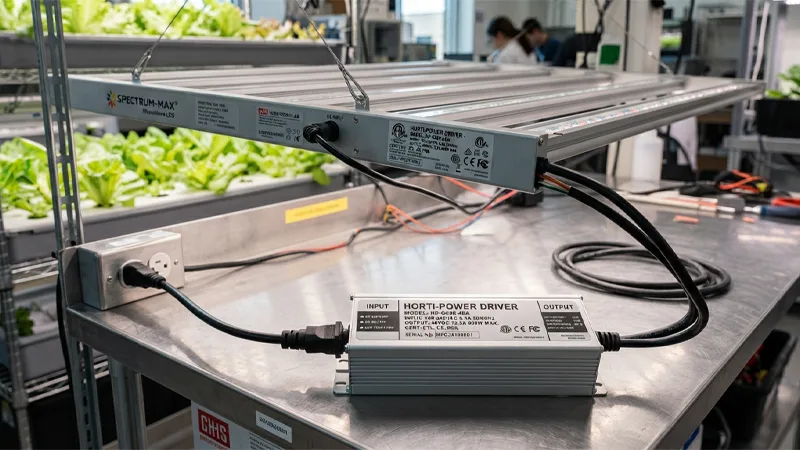
The first question to ask of any efficacy or PPF number is what was measured. LM-79 addresses test conditions and measurement methods for a complete luminaire: electrical input in volts, amperes, and watts, and total light output, from which efficacy is derived. It does not address LED drive current, in-situ operating temperature, lumen or color maintenance, or rated lifetime. LM-80 addresses LED package or device flux maintenance over time and does not by itself establish fixture performance. A supplier quoting an LED device’s efficiency is quoting a component, not the fixture you will hang.
Program eligibility floors, not typical product performance. Each threshold is measured per ANSI/IES LM-79 on complete fixtures. The V2.1 value is back-calculated from the DLC’s stated 21% increase to the V3.0 threshold and is therefore approximate; V3.0 and V4.0 values are as published.
The DLC’s treatment of DC-powered fixtures shows why the boundary matters in practice. A DC-powered fixture marketed with an AC-to-DC power source is listed at the power efficiency of that conversion at the load condition producing worst-case efficiency. The DLC’s own worked example is a 100 W light bar with a PPE of 3.0 µmol/J and a power supply showing 85% worst-case efficiency at 20% load: it is listed at 2.55 µmol/J and 118 W.
A DC-powered fixture not marketed with any AC-to-DC power source has its AC-derated values calculated on an assumed 87.5% conversion efficiency, a figure informed by the U.S. federal minimum efficiency standard for external power supplies above 250 W. Two fixtures with identical LED boards can therefore carry very different fixture-level efficacy depending on what power supply ships with them.
Expect some legitimate variation between a listed value and a test report. The DLC tolerance table allows −5% on photosynthetic photon efficacy, −3 percentage points on power factor, and +5 percentage points on total harmonic distortion current (THDi). These tolerances are intended to account for testing variation, rounding, and significant digits, and the DLC states that requirement values and tolerances are interpreted as exact requirements with no additional rounding beyond the absolute threshold. For the V4.0 minimum PPE of 2.5 µmol/J, any test value below 2.38 µmol/J is a failing value. A supplier whose quoted efficacy only clears the threshold because of the tolerance band is quoting at the edge, not with margin.
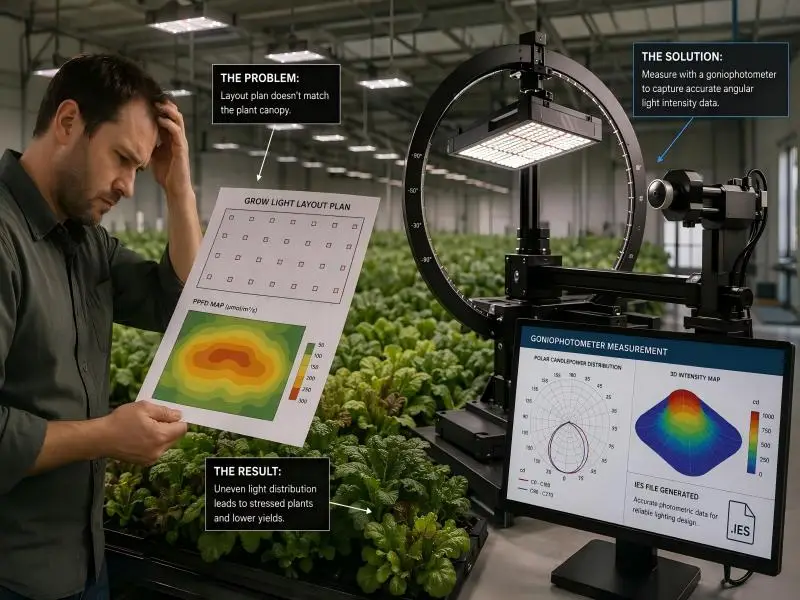
Request the full LM-79 report, not a summary line. Check that the catalog number matches the model you are buying, and read the test date, laboratory, ambient temperature, operating orientation, stabilization time, and any statement of deviation from standard conditions. The U.S. DOE’s guidance on evaluating LM-79 reports lists these among the items a complete report should contain, along with input current, voltage, and wattage, and a product description consistent with the cut sheet. A report that omits the catalog number or the operating orientation cannot be tied to the fixture in your quote.
Certifications: What Each Document Actually Proves
For U.S. deployment, the relevant safety standard is UL 8800, Standard for Safety for Horticultural Lighting Equipment, which is distinct from UL 1598 for general-illumination luminaires. UL 8800 was introduced in 2017 and covers luminaires and grow systems intended for plant growth, including, where a horticultural system is employed, lampholders, wire harnesses, plugs and connectors, LED packages, drivers, lamps, and hardware and structures.
Its requirements differ from UL 1598 in ways that matter for foldable fixtures: it addresses photobiological safety consistent with IEC 62471; it allows specialized wiring and connection methods for fixtures that are frequently raised, lowered, or repositioned; it evaluates suitability for damp and/or wet environments and elevated ambient temperatures; it covers ingress protection; and it addresses UV exposure of polymeric materials, which can become brittle and susceptible to breakage.
The mark must come from an OSHA-recognized Nationally Recognized Testing Laboratory (NRTL). OSHA’s recognition covers the specific product safety standards in the laboratory’s scope, and NRTL recognition includes adequate controls for identification of certified products and follow-up inspections of actual production. That follow-up inspection is the part buyers underuse: it means the certification is not a one-time event, and you can ask a supplier to document that production inspections are current.
The ETL Listed Mark is issued by an NRTL and, per Intertek, is accepted by Authorities Having Jurisdiction (AHJs) and code officials across the U.S. and Canada as proof of compliance to North American safety standards. UL and ETL are different marks from different organizations, but both function as NRTL certification; what you must confirm is the standard certified, which for horticultural luminaires is UL 8800.
For EU sales, separate three things that are often conflated. CE marking is a manufacturer’s declaration of conformity, not a third-party certificate. The energy label under Regulation (EU) 2019/2015 and the ecodesign rules under Regulation (EU) 2019/2020 are separate regulatory instruments.
Critically, Annex III of the ecodesign regulation exempts light sources with a photosynthetic efficacy above 1.2 µmol/J and/or with 25% or more of total radiation power across the 250–800 nm range falling within the 700–800 nm range, intended for use in horticulture. A horticultural fixture may therefore fall outside the standard lighting energy-label pathway, but the exemption has conditions and must be documented. Ask the supplier which regulatory pathway applies and for the technical documentation supporting that position rather than assuming a standard lighting label applies.
Finally, keep DLC listing in its own category. DLC listing is a qualification program against technical requirements, not a safety certification, and UL 8800 certification is a prerequisite for a horticultural QPL listing. A fixture can be DLC-listed only if it already holds the safety certification; the two documents answer different questions.
Hinge Durability, Cable Routing, and Frame Rigidity: Building a Test Protocol Where None Exists
No published standard test for fold-cycle durability of grow-light hinges was found in the material reviewed for this guide. That absence is itself the finding: the buyer must construct a protocol and require the supplier to test against it.
Begin by requesting the supplier’s own fold-cycle test data and the fixture’s rated fold cycles. Then convert your use into a cycle count: multiply fold cycles per week by 52 weeks by the years of service, and add the cycles for shipping and installation. A fixture folded only for shipping and installation may see a handful; two cycles per week over five years is about 520, and five per week is about 1,300. Set the RFQ cycle count at that total with a margin, and treat a supplier rating below it as disqualifying rather than a point to negotiate. If the supplier has no cycle rating at all, treat that as missing documentation rather than a neutral gap.
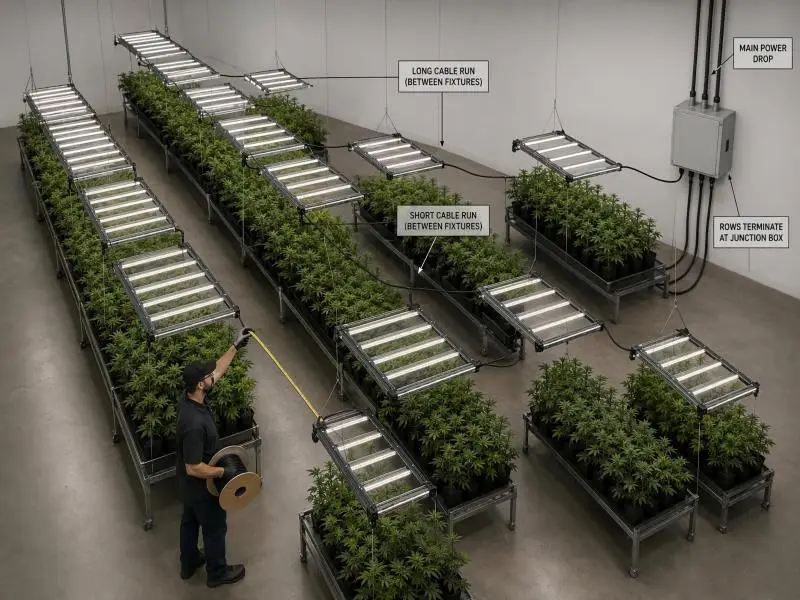
Inspect the hinge mechanically. Identify the hinge material, the pin and bushing design, and whether the hinge carries structural load or only aligns the panels. A hinge that bears load needs a larger pin and bearing surface than one that merely keeps two halves registered. On the cable side, look for a service loop at the hinge, strain relief on both sides of the pivot, and abrasion protection where the cable crosses the joint. A cable that runs straight through a folding joint without slack will flex at a single point and fail there first.
Check frame rigidity by unfolding the fixture and confirming it holds its shape without sag at mid-span. Sag changes the distance from fixture to canopy across the span, which shows up as PPFD non-uniformity long before anything fails electrically.
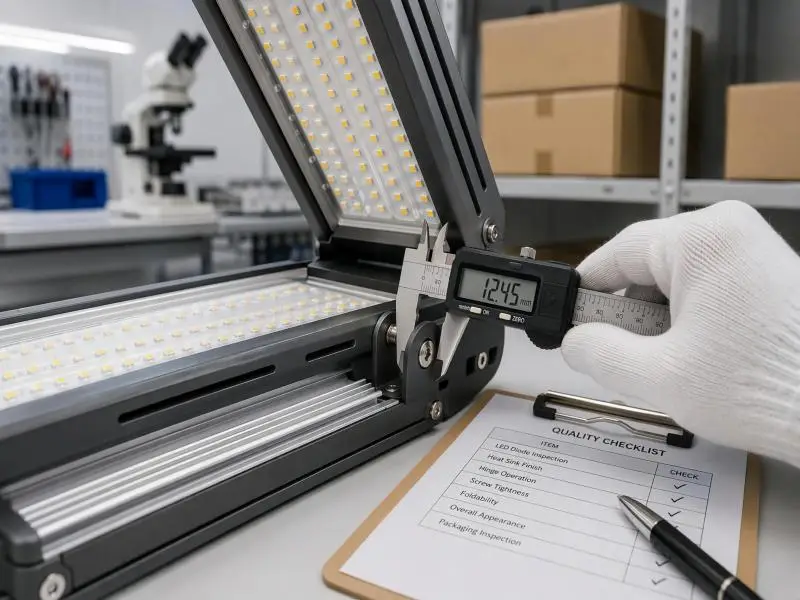
A practical incoming-inspection routine: take a sample unit, fold and unfold it to the cycle count you specified, then inspect conductor insulation at the pivot for cracking or chafing and re-measure output to confirm no optical or electrical degradation. Record the result against the unit’s serial number. This is a low-cost test that converts an unverifiable claim into a documented data point.
Freight and Storage: Folded Carton Size, Weight, and Dimensional Weight
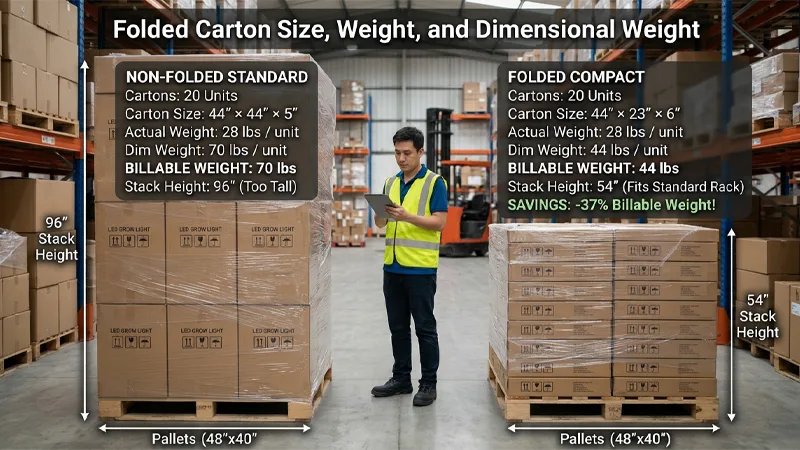
Carriers charge based on the greater of actual weight or dimensional weight. FedEx’s published method is to multiply length by width by height in inches, rounding each measurement to the nearest whole inch, then divide by 139 for U.S., Puerto Rico, and international shipments. The result is the billable weight if it exceeds actual weight.
For a foldable fixture, this is the commercial payoff of the folding design. A folded carton that reduces cubic size can lower billable weight even when the fixture’s actual weight is unchanged. The buyer’s job is to capture that benefit in the quote rather than assume it. Request carton dimensions, gross weight, and units per pallet for the folded configuration, and for any non-folded packaging configuration the supplier also offers. Then calculate dimensional weight yourself for a full pallet and for a container load, and compare it against the actual weight.
The same cubic-size logic governs warehouse slotting and container utilization. Compare the folded carton’s dimensions against your rack and pallet standards, not just against a competitor’s carton. A carton that is slightly smaller in volume but does not stack to your rack height can cost more in floor space than it saves in freight. Ask for the pallet footprint and stack height, and confirm the carton can be handled by your existing equipment.
Building a Standardized RFQ for Foldable Grow Lights
A standardized RFQ does two things: it forces the supplier to commit to verifiable data, and it gives you a like-for-like basis for comparing responses. The DLC’s own application requirements are a useful template for what a serious supplier should already have on hand: specification sheets showing the maximum ambient temperature rating, driver and fan specification sheets with lifetime-at-temperature information, and safety certificates.
Adapt this request list for foldable fixtures:
- Complete model number, including all performance-affecting options, with the same catalog number appearing on the test reports.
- Full LM-79 report for the fixture, and LM-80 and TM-21 data for each LED device type.
- Driver and fan specification sheets, including lifetime at the fixture’s maximum rated ambient temperature.
- Safety certificate with NRTL mark and certificate number, showing certification to UL 8800.
- DLC listing status and version, if applicable.
- Folded and unfolded dimensions, carton dimensions, gross weight, and units per pallet.
- Hinge specification with rated fold cycles and the supplier’s test data.
- Cable routing drawings showing service loops and strain relief at the hinge.
- IP rating and the test basis for it.
- Dimming protocol and control compatibility.
- Warranty terms, including what is covered.
- Spare-parts list with pricing and lead times.
Two items deserve emphasis. First, the model number must be complete: the DLC requires manufacturers to list full model numbers that include all performance-affecting and non-performance-affecting variations, and options affecting flux output, dimming capability, or spectral tuning may not be bracketed into a single model number. A quote that lists a base model with bracketed options is a quote you cannot tie to a test report. Second, the IP rating should come with its test basis. IEC 60529 classifies degrees of protection provided by enclosures, and a rating without a stated test basis is a claim, not a specification.
Keeping Bulk Production Matches the Approved Sample
The gap between an approved sample and bulk production is where sourcing programs lose money. Close it with documentation and a defined inspection routine.
Sign and retain a golden sample, and attach a serialized record of its measured performance: efficacy, PPF, power factor, THDi, folded dimensions, hinge cycle count, and the cable routing as built. The golden sample is the physical reference; the record is what makes it usable when the sample itself is in a warehouse and the question is whether a production unit matches it.
In the purchase order, separate critical-to-quality parameters from cosmetic ones. Critical-to-quality should include efficacy, PPF, power factor, THDi, folded dimensions, hinge cycle count, and cable routing. Cosmetic parameters, such as paint or label placement, can be handled with a broader acceptance band. Naming the measurement method for each parameter prevents a dispute about how a value was obtained.
Use the DLC tolerance table as a reference band for acceptable variation in efficacy, power factor, and THDi: −5% on efficacy, −3 percentage points on power factor, +5 percentage points on THDi. Be clear about what the band means. The DLC states the tolerances are intended to account for testing variation, rounding, and significant digits, and that values are interpreted as exact requirements. They are not a license for design changes between the sample and production. If a production unit’s efficacy sits at the bottom of the tolerance band while the sample sat at the top, that is a design or component change, not test variation.
Require a first-article inspection on the first production run, and periodic re-verification thereafter. Because NRTL certification includes follow-up inspections of actual production, you can also ask the supplier to document that those inspections are current; it is a second, independent check on production consistency.
Warranty and Spare-Parts Terms for Folding Hardware
No industry-standard warranty term for grow-light hinges was established in the material reviewed for this guide. Negotiate the terms rather than assume them.
Start with coverage scope. Does the warranty explicitly name hinges, pivot hardware, and cable assemblies at the hinge, or does it cover only LEDs and drivers? A warranty that covers the light engine but not the folding hardware leaves the most likely mechanical failure point uncovered.
The DLC requires a manufacturer-provided warranty of at least five years for luminaires, and for luminaires the warranty must cover the complete luminaire, which the DLC defines to include light source, housing, heat sink, electrical components, optics, and other components such as cooling fans or controls. That gives you a reference point for the fixture as a whole, but it does not by itself establish coverage for folding hardware, and the DLC does not verify or validate a manufacturer’s warranty claim terms or process.
Next, define what triggers a claim. Is coverage conditioned on a fold-cycle count, an installation method, or environmental conditions? A warranty that is voided by routine folding is not a warranty on a foldable fixture. Get the conditions in writing.
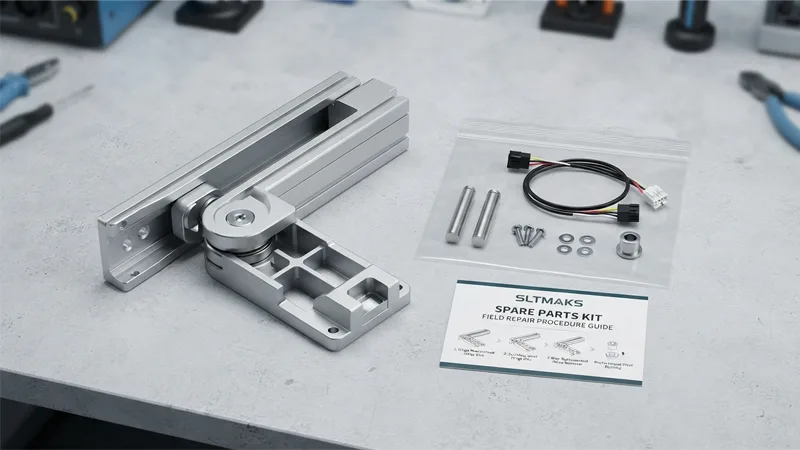
Then confirm parts availability. Ask whether spare hinges, cable assemblies, and hinge pins are orderable parts, at what price, and at what lead time. A fixture that requires a full replacement because a hinge pin is unavailable is a fixture with a hidden cost of ownership. Finally, ask whether the supplier will provide a repair procedure for hinge replacement in the field. If the answer is no, factor the labor and downtime into your total cost comparison.
Using the Criteria to Decide
Score suppliers against documented evidence, not against the quality of their presentation. Weight each criterion by its consequence in your facility: a fixture that fails a safety inspection costs more than one that is slightly less efficient, and a hinge that fails at month eighteen costs more than a small freight premium.
The must-have criteria are fixture-level LM-79 data tied to the quoted catalog number; NRTL safety certification to UL 8800; a documented hinge cycle rating with test data; and dimensional-weight data for the folded carton. Treat missing documentation as a failing score rather than a neutral one. A supplier that cannot produce an LM-79 report is not equivalent to one that can; it is unverified, and unverified should rank below verified.
The red flags are equally clear: efficacy quoted without a test report; a CE mark presented as third-party certification; no fold-cycle data; and no spare-parts list. Each of these is a gap you will have to close after the purchase order, when your leverage is lowest.
For comparison purposes, SLTMAKS publishes ETL, DLC, CE, RoHS, FCC, and UKCA certifications and offers OEM/ODM support, which you can use as a benchmark when building your own supplier shortlist. The point is not to substitute one supplier’s claims for your evaluation; it is to have a reference for what a complete documentation package looks like before you ask other suppliers to match it.
FAQ
Can a supplier’s PPF figure be trusted without an LM-79 report?
No. When sourcing wholesale foldable grow lights, always request the full LM-79 report from your wholesale foldable grow lights manufacturer. Check that the catalog number matches the specific model you are buying, along with the test date, laboratory, ambient temperature, operating orientation, and stabilization time. A PPF figure for wholesale foldable grow lights without an LM-79 report is merely a claim, not a measurement.
Are ETL and UL marks equivalent for AHJ acceptance?
Both are NRTL marks accepted by AHJs as proof of compliance to North American safety standards. When evaluating wholesale foldable grow lights, the critical question for commercial buyers purchasing wholesale foldable grow lights is not which mark, but which standard: for horticultural luminaires, confirm certification to UL 8800 to ensure your wholesale foldable grow lights meet local electrical codes.
Can a foldable fixture be DLC-listed?
Yes, in principle. DLC listing is a qualification program separate from safety certification, and UL 8800 certification is a prerequisite for a horticultural QPL listing. For commercial facilities deploying high-efficiency wholesale foldable grow lights, always verify both the safety certificate and the DLC listing status and version before committing to any large-scale order of wholesale foldable grow lights.
How do I estimate freight cost before ordering?
Request carton dimensions and gross weight, calculate dimensional weight as length × width × height in inches (each rounded to the nearest whole inch) divided by 139 for U.S., Puerto Rico, and international shipments, and compare it against actual weight. When shipping bulk volumes of wholesale foldable grow lights, logistics providers handling these commercial wholesale foldable grow lights will charge the greater of the two.
Is a five-year warranty standard?
The DLC requires a minimum five-year fixture warranty for listed products, and for commercial wholesale foldable grow lights, that warranty must cover the complete luminaire. When procuring reliable wholesale foldable grow lights, whether hinges and cable assemblies are covered must be confirmed directly in the supplier’s terms; the DLC does not verify or validate warranty terms for wholesale foldable grow lights.