Introduction
A grow light is a manufacturing product before it is a horticultural one. The fixture that arrives at your facility carries the accumulated decisions of a solder paste printer, a placement machine, a reflow profile, a torque driver, a burn-in rack, and whoever signed the final inspection sheet.
When those decisions are made by hand and recorded on paper, variation hides until harvest — a driver batch that runs hot, a board with a marginal joint, a fixture whose output sits three percent below its siblings. Transitioning to automated grow light assembly matters because it moves those decisions into a controlled, measured, recorded process, and because it makes the resulting data available to the buyer rather than to the factory alone.
The stakes are specific to controlled-environment agriculture. PPFD uniformity (photosynthetic photon flux density — the photon flux striking a given canopy area per second, in µmol·m⁻²·s⁻¹) depends on fixture-to-fixture consistency as much as on layout. Compliance depends on a listing that matches the exact model and manufacturing site you purchased. Total cost of ownership depends on driver and fan life, on rework and field-failure rates, and on how much of your maintenance budget goes to swapping fixtures instead of growing. None of these are marketing attributes; each is a measurable output of the assembly process.
This guide walks through the end-to-end automated assembly flow for horticultural LED fixtures, the digital-twin and manufacturing execution system (MES) layer that turns that flow into a record, and the verification steps a buyer can use to test whether a supplier’s automation claims hold. It is written for operators and procurement teams evaluating suppliers or standardizing specifications across multiple sites. Use it as an assessment framework: read each section against a candidate supplier’s documentation, and treat missing evidence as a question to resolve before award rather than as a disqualification on its own.
Table of Contents
The Core of automated grow light assembly
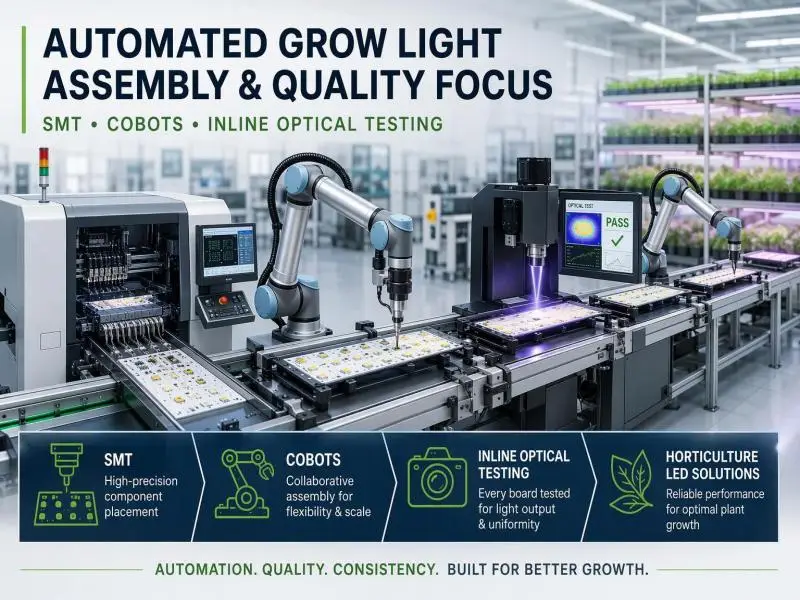
An automated horticultural fixture line is usually organized around three stages: board-level electronics, mechanical integration, and test. Each stage produces its own data, and the value of the line depends on whether that data is joined up. A line that inspects well but cannot link a test result to a serial number has automated the work without automating the evidence.
SMT with SPI/AOI
Surface-mount technology (SMT) assembly begins with solder paste printing, and paste printing is where a large share of defects originate. Solder paste inspection (SPI) measures deposited volume, area, and height against the stencil design before any component is placed. Because a paste defect is cheap to correct at that moment and expensive after reflow, SPI functions as an early gate rather than a final audit. Automated optical inspection (AOI) then verifies assembly — component presence, orientation, and solder joint appearance — at defined points in the flow.
The two inspections answer different questions and are not substitutes. SPI asks whether the paste deposit was correct; AOI asks whether the assembled board looks right at a given stage. For grow lights, the practical consequence is that SPI catches the class of defect that would otherwise produce a marginal joint surviving functional test and failing months later under thermal cycling — the failure mode that shows up as an intermittent driver or a dead string in the field. Each inspection generates an electronic record, which is what makes the data usable for audits and defect investigations later.
A buyer evaluating this stage should ask where SPI and AOI sit in the flow, what the inspection coverage is (full board or sampled), and whether the records are retained per serial number. Sampling plans are legitimate, but they change what a yield figure means: an inspection that covers a sample of the run supports a different claim than one that covers every board.
Cobot-Assisted Mechanical Assembly
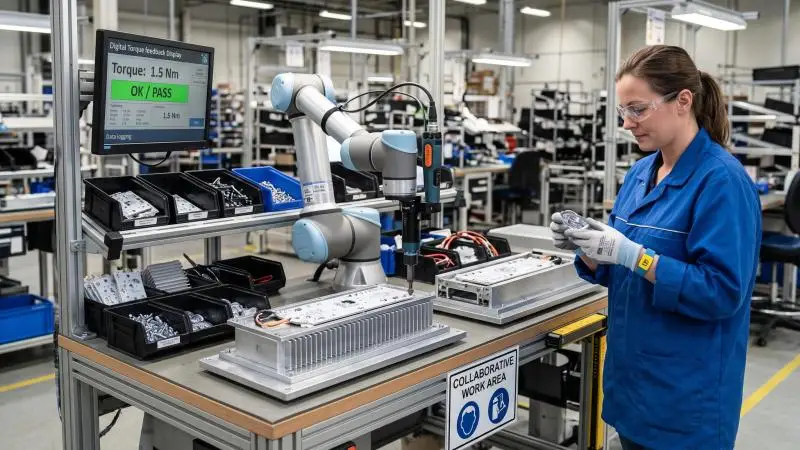
Collaborative robots (cobots) handle the repetitive mechanical steps — fastener driving, heatsink and board mating, connector seating, lens and optic placement — where human fatigue produces torque variation. The advantage is repeatability: a cobot applies the same torque to the same fastener in the same sequence on unit 1 and unit 10,000. That matters for thermal performance, because the contact between the LED board and the aluminum heatsink depends on consistent clamping force, and for optical performance. After all, optic seating affects beam shape.
Cobots are not a substitute for engineering the workstation. EU-OSHA notes that cobot deployment is a collaborative application — the whole system of human and robot interaction — and that alongside efficiency gains, the technology is associated with heightened work intensity and reduced autonomy for the people working with it.
A well-designed cell assigns the robot the repeatable motion and the operator the judgment call, with the safety assessment covering the application rather than the robot alone. For the buyer, the relevant question is not whether cobots are present but whether the mechanical steps that affect thermals and optics are torque-controlled and recorded.
Inline Electrical and Optical Testing
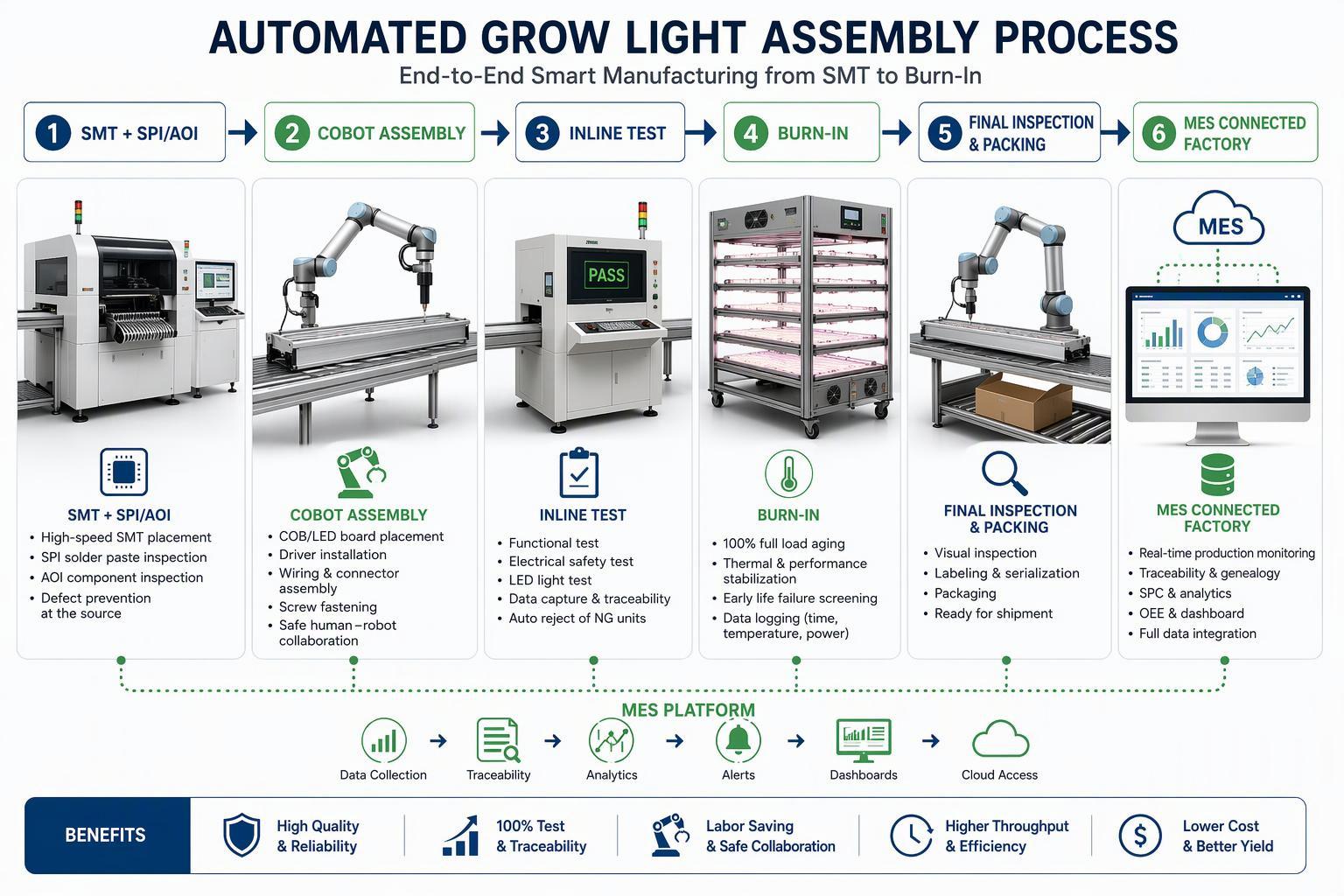
Inline test is where a grow light line differs most from a general luminaire line, because the product’s defining output is spectral and photobiological rather than visual. Electrical test verifies power factor, current harmonic distortion, driver function, and dimming response. Optical test verifies flux and spectrum. Both should happen on every unit or on a documented sample, and both should be tied to the unit’s serial number.
The reason to test inline rather than at final audit is containment. High-speed automated assembly has a characteristic risk: if something in the process is wrong, everything is wrong, and a tightly regulated process flow is what prevents a large batch of rejected product from being built in a short period. Inline test interrupts that accumulation. A drift in reflow profile, a bad reel of emitters, or a mis-set drive current is caught within the units that follow it rather than at the end of the month.
Burn-in belongs here as well. A burn-in or soak period before final optical measurement stabilizes output and surfaces early-life failures that would otherwise reach the grow room. The test sequence — electrical, burn-in, optical — should be documented, because the order determines what the measurement means.
Digital Twins, MES, and Compliance
Automation produces data; the digital layer determines whether that data becomes a usable record. Three components matter to a buyer: the twin models that describe the product and process, the traceability system that links a serial number to its build history, and the compliance alignment that connects production records to the listing on a qualified products list.
Product, Process, and Operational Twins
Digital twin is a broad term, and its meaning varies by context. In technical product development, the literature distinguishes definitions that range from a virtual representation of a product to a synchronized model of a running asset. IBM describes the operational form as a virtual model kept synchronized with its physical counterpart through a data pipeline that transmits sensor data in real time. For a grow light factory, the useful distinction is between three models:
- Product twin: the as-designed fixture — optical model, thermal model, bill of materials, and the performance the design intends to deliver.
- Process twin: the as-planned manufacturing flow — stencil designs, reflow profiles, torque specifications, test limits, and the expected yield at each gate.
- Operational twin: the as-built and as-run record — what actually happened to a specific unit, and how a fleet of units performs once installed.
The operational twin is the one that changes procurement. If a supplier can show that field performance data feeds back into the process model — that a drift in measured PPFD or a driver failure rate triggers a review of the corresponding process step — then the twin is doing work rather than serving as a diagram. If the twin exists only as a design model, it is an engineering asset, not a quality system.
Serialized Genealogy and Audit Readiness
Genealogy is the as-built record: which emitter reel, which driver batch, which board panel, which test result, and which operator or cell produced a given serial number. IPC-1782B, the standard for manufacturing and supply chain traceability of electronic products, establishes minimum requirements based on perceived risk and defines four levels of traceability for materials and processes. The standard is explicit that the appropriate level depends on the business model and end-use market — traceability is scaled to consequence, not applied uniformly.
For horticultural lighting, the consequence that justifies a high traceability level is straightforward. A fixture is a long-life capital asset installed in a controlled environment, often in a multi-site fleet, and a defect that appears across a batch is expensive to contain. Serialized genealogy lets a supplier scope a problem to the affected units instead of recalling a model year. It also lets a buyer verify a warranty claim against the actual build record rather than a purchase order date.
MES platforms support this through traceability and genealogy modules that create the as-built record, alongside quality execution modules that hold a failed unit, prevent further processing, and route the nonconformance for review. The containment capability is the practically important one: when a check fails, the system should stop the affected unit or lot automatically rather than relying on an operator’s memory.
This is where a supplier’s own quality infrastructure becomes relevant to the evaluation. SLTMAKS, for example, describes its production as combining SMT workshop capability with calibrated optical testing and serialized test data, and publishes certification information covering ETL, DLC, CE, and RoHS listings.
For a buyer, the educational point is not the brand name but the structure of the evidence: a serialized test record tied to a calibrated optical measurement is what allows a PPFD claim to be checked against a specific fixture rather than against a datasheet average. The same structure is what an auditor or a utility program reviewer will ask for.
UL/DLC Alignment in Production
Safety certification and performance qualification are separate tracks, and both depend on production discipline.
On safety, UL8800 is the standard for horticultural lighting equipment, introduced in 2017 and written specifically for luminaires and grow systems used for plant growth. It differs from the general luminaire standard, UL 1598, in ways that matter in a grow room: it addresses photobiological effects and eye and skin exposure consistent with IEC 62471; it permits wiring and connection methods suited to fixtures that are frequently raised and lowered, and it evaluates suitability for wet environments and elevated ambient temperatures, with ingress protection testing.
Certification must come from an OSHA-recognized Nationally Recognized Testing Laboratory (NRTL) or an SCC-recognized body. OSHA’s program requires NRTLs to maintain follow-up inspection of actual production, which is the link between the listing and the factory: the mark certifies the product as produced, not as designed.
On performance, the DesignLights Consortium (DLC) Horticultural Technical Requirements set the qualification baseline. Hort V4.0, released March 2025 and effective for applications from April 18, 2025, requires a photosynthetic photon efficacy (PPE) of at least 2.5 µmol·J⁻¹, with a −5% tolerance in both application and surveillance testing — meaning a report showing 2.38 µmol·J⁻¹ or higher is accepted, and anything below is disqualified at any point in the specified operating voltage range.
V4.0 also requires a power factor of at least 0.90, current total harmonic distortion no greater than 20%, photon flux maintenance of Q90 ≥ 36,000 hours, driver and fan life of at least 50,000 hours, a fixture warranty of at least five years, and safety certification to ANSI/UL 8800. Testing must be conducted at ISO 17025-accredited laboratories, with whole-fixture LM-79 testing at labs meeting DLC’s LM-79 requirements. V4.0 also removed lamps as an eligible category.
The production implication is that DLC alignment is not a paperwork exercise completed once. The efficacy threshold is verified under surveillance testing, and the −5% tolerance means a fixture that measures close to the line in the lab has little margin in production. A line with inline optical test and serialized records can demonstrate that shipped units hold the qualified performance; a line without them is relying on the qualification sample.
Quantified Impact and Buyer Verification
Automation claims are easy to make and hard to check. The sections below separate what the evidence supports from what requires site-specific confirmation, and close with a checklist a buyer can apply during supplier evaluation.
Worked example of how first-pass yield (FPY) is counted, using the standard definition: units passing all criteria on first attempt divided by units entering the process. Reworked units that later pass are excluded from the numerator but stay in the denominator, which is why FPY (92%) sits below final yield (98%). Figures are a teaching example, not a supplier result.
Reliability and First-Pass Yield Gains
First-pass yield (FPY) is the share of units that meet specification without rework, retest, or reprocessing. Definitions vary: some organizations use FPY for a single operation and first-time yield (FTY) for the end-to-end line result, while others treat the terms as synonyms. The distinction matters when comparing supplier figures, because a line-level FPY and a single-station FPY are not the same quantity.
FPY is also sensitive to test coverage. For inline tests, the measurement is only meaningful if the sample plan represents the full run and the coverage is stated; a high yield on a lightly tested line overstates performance. The operational value of FPY is capacity: a small gain frees substantial throughput when retest and rework queues disappear, and that headroom often beats buying another tester.
On reliability specifically, the honest position is that automation improves consistency and containment, and that the size of the reliability gain is supplier- and product-specific. Automated placement and inspection reduce the process drift that produces marginal joints; inline test and burn-in catch early failures before shipment; genealogy limits the blast radius when something does go wrong. Those are mechanisms, not guaranteed percentages. A buyer should ask for FPY defined at a stated level with stated test coverage, and for field failure data by batch — not for a headline number.
Energy, PPE, and PPFD Uniformity
Energy performance starts with PPE, and PPE is a ratio: photosynthetic photon flux over the 400–700 nm range divided by total electrical input watts, including ancillary loads such as controllers, sensors, and fans. Two consequences follow. First, PPE is not a fixed property of a fixture in service — it changes with spectral output and with dimming, and it should be evaluated at the expected operational power and spectrum rather than at full output only. Second, far-red light does not count toward PPE, so a spectrum rich in far-red can look less efficient on the metric while still serving a crop strategy.
The energy arithmetic is simple and worth doing before procurement. Average power per square meter of growing area equals PPFD divided by photon efficacy; total fixture watts equal PPF divided by photon efficacy. A fixture rated at 2.5 µmol·J⁻¹ delivering a given PPFD draws less power per square meter than one rated at 2.0, and the difference compounds across a facility’s lighting hours. That is the mechanism behind the total-cost-of-ownership case for higher-efficacy fixtures, and it is also why the DLC threshold increases matter commercially: each version raises the floor.
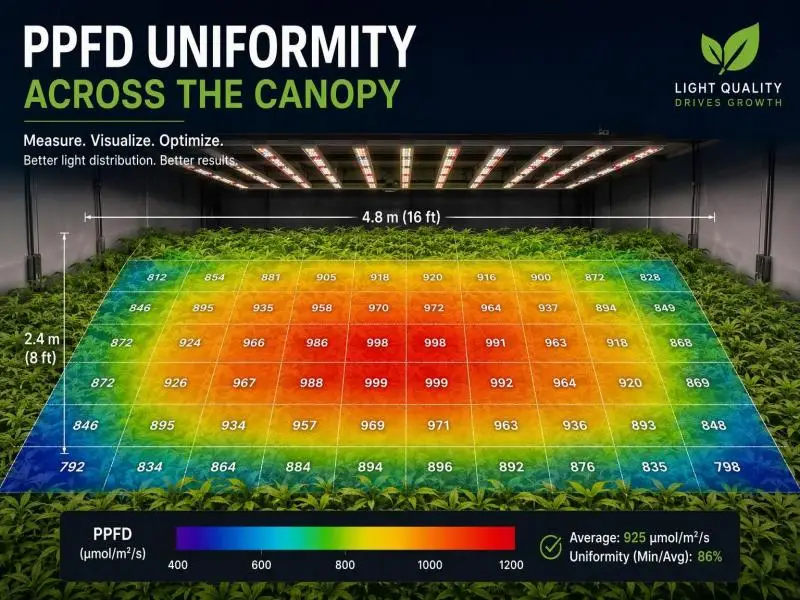
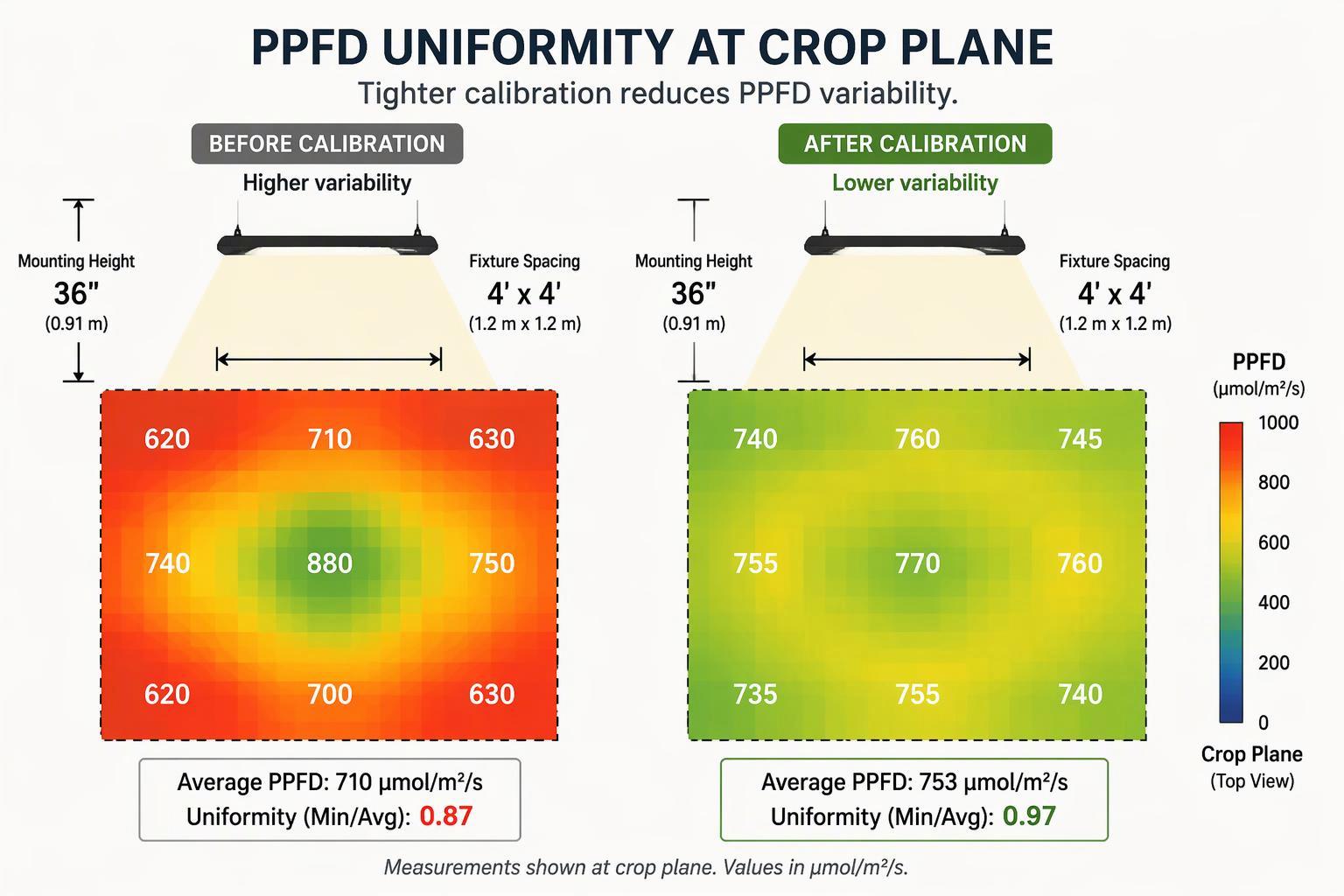
PPFD uniformity is a layout and fixture-consistency problem together. Resource Innovation Institute guidance notes that fixture spacing and mounting height contribute greatly to uniformity, that consistent spacing in both X and Y directions is necessary, and that continuous runs of linear fixtures can improve uniformity relative to grids of traditional HID fixtures. Industry guidance cited by RII suggests targeting at least 80% uniformity. Edge effects at bench boundaries and walkway placement are part of the calculation.
Tighter manufacturing calibration reduces the fixture-to-fixture component of that variability. If every unit ships at its measured output with a serialized optical record, the layout can be designed against a known distribution rather than a datasheet average, and a fixture that drifts can be identified and replaced individually. The heatmap above illustrates the variable a buyer is trying to control: PPFD at the crop plane, mapped across a grid, with mounting height and spacing noted, so that the pattern can be interpreted rather than read as a single average.
Verification Checklist and Acceptance Criteria
Use the following as a supplier evaluation and acceptance framework. Each item should be answerable with a document, a record, or a witnessed test — not a verbal assurance.
Process evidence
- SPI and AOI locations in the SMT flow, with inspection coverage stated (full or sampled).
- Torque-controlled and recorded mechanical assembly for board-to-heatsink and optic seating.
- Inline electrical and optical test sequence documented, including burn-in and its position relative to final optical measurement.
- FPY defined at a stated level (station or line) with test coverage stated.
Traceability and digital records
- Serialized genealogy covering emitter, driver, board, and test result, with the traceability level stated against a recognized framework such as IPC-1782B.
- Nonconformance containment logic: failed units held automatically, not by operator memory.
- Optical test records tied to a calibration schedule for the test equipment.
- Retention period for build and test records, and the buyer’s access to them.
Compliance
- Safety listing to ANSI/UL 8800 by an OSHA NRTL or SCC-recognized body, with the certificate naming the exact model, configuration, and manufacturing site on the purchase order.
- DLC Hort QPL listing current under the applicable version, with the model number matching the purchase order.
- LM-79 test report from an ISO 17025-accredited laboratory, to ANSI/IES LM-79-19 or newer.
- LM-80/TM-21 or LM-84/TM-28 data supporting Q90 ≥ 36,000 hours, and driver and fan life documentation supporting ≥ 50,000 hours.
- PPE at or above the applicable threshold, with margin above the −5% tolerance rather than at the line.
- Power factor ≥ 0.90 and THDi ≤ 20% documented at the reported input voltages.
Field verification
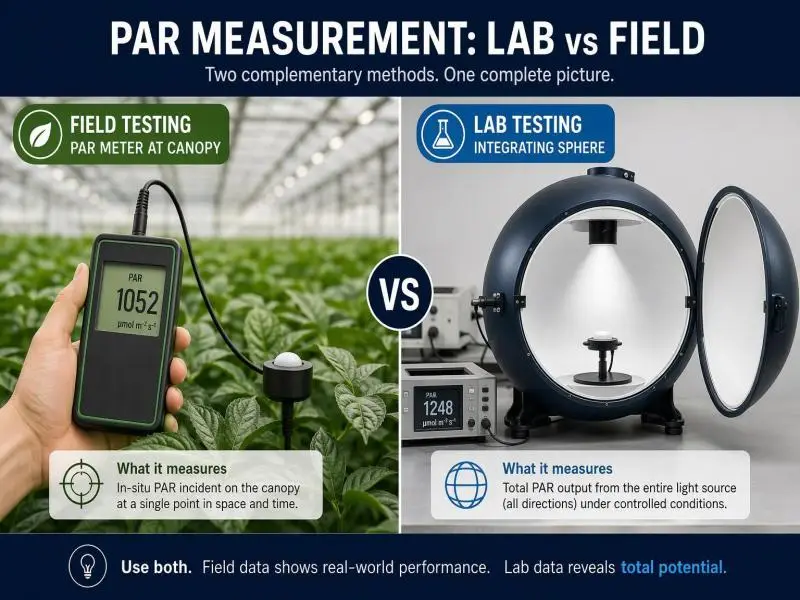
- Pre-shipment sample measured with a calibrated quantum sensor and compared against the specification, including measurement distance and distribution method.
- PPFD uniformity map for the intended layout, with mounting height and spacing stated, targeting at least 80% uniformity.
- A growing trial on a small number of fixtures before bulk award, comparing energy consumption and light measurements against the manufacturer’s specification.
- Warranty terms covering the complete luminaire, with the claim process tied to the serial number.
Conclusion
Automated assembly is not a single capability but a chain: inspection that catches defects early, mechanical assembly that holds thermal and optical tolerances, inline test that contains drift, and a digital record that lets a buyer verify what was built. A supplier can be strong at one link and weak at another, and the weak link determines the reliability of the fixture in your grow room.
The evaluation logic follows from that. Ask for process evidence rather than equipment lists. Ask for FPY at a defined level with stated test coverage. Ask for serialized optical records and the calibration behind them. Check that the safety listing names the exact model and site you are buying, and that the DLC listing is current under the applicable technical requirements version. Treat a missing document as a question to resolve, not as proof of a problem — but resolve it before award.
For multi-site standardization, the practical next steps are to write the checklist into the procurement specification, require the same evidence package from every candidate supplier, and verify a pre-shipment sample against the specification before the first bulk order. SLTMAKS publishes its certification and factory information for buyers running that comparison, which is a useful role for a manufacturer’s documentation: a starting point for verification, not a substitute for it. The fixtures that perform predictably across a fleet are the ones whose build records can be checked, unit by unit, long after the purchase order closes.
FAQ
Why is the automated assembly of LED grow lights important?
Automated assembly moves manufacturing decisions into a controlled, measured, and recorded process, ensuring fixture-to-fixture consistency. This is critical for maintaining PPFD uniformity, ensuring compliance, and lowering the total cost of ownership.
What is the difference between SPI and AOI inspections in manufacturing?
Solder Paste Inspection (SPI) measures the volume, area, and height of solder paste deposits before any components are placed, acting as an early gate to catch defects. Automated Optical Inspection (AOI) verifies component presence, orientation, and solder joint appearance later in the flow. The two inspections answer different questions and are not substitutes for one another.
What are the core performance requirements of DLC V4.0 for horticultural lighting?
The DLC requires a photosynthetic photon efficacy (PPE) of at least 2.5 µmol·J⁻¹, a power factor of at least 0.90, and a current total harmonic distortion no greater than 20%. Additionally, fixtures must have a photon flux maintenance (Q90) of ≥ 36,000 hours, driver and fan lifespans of at least 50,000 hours, a minimum five-year warranty, and safety certification to ANSI/UL 8800.