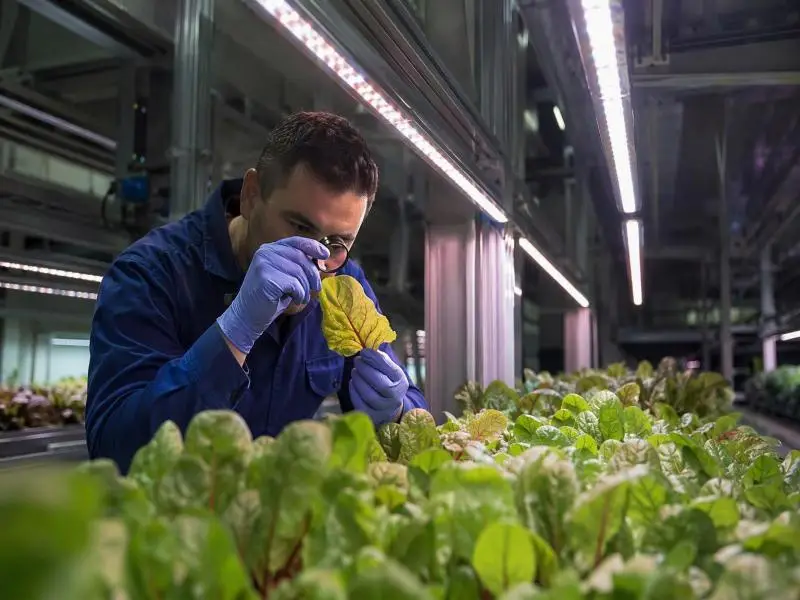
High CRI grow lights for plant health inspection are a human-vision specification layered on top of a growth specification, not a substitute for one. ANSI/IES RP-45-21 sets out the distinction directly: “The amount of light is characterized differently for plant versus human applications,” and “the appropriate spectral power distribution is different for plants and humans, and can vary between plant species” (IES product page for ANSI/IES RP-45-21, 2021). The same standard’s stated purpose is to help lighting professionals “translate their architectural lighting know-how into horticultural lighting practice.”
That framing matters because the metric most often quoted in grow-light marketing, CRI, was never built to describe plant response. CRI is a human metric: it measures how light and colour are perceived specifically by the human eye, and on the question of whether it matters for horticultural applications, the short answer from component supplier ILS is no (ILS on DesignSpark, 2024). The same source concedes the operational point that keeps the specification alive: it is easier for growers and workers to distinguish a plant’s true colour and condition under higher-CRI light.
This article treats inspection lighting as a procurement decision. It covers the CRI versus TM-30 comparison for horticultural lighting, the symptom cues a scout can actually see, the standards and compliance stack, specification targets, deployment procedures, and the energy and ROI arithmetic.
Color Fidelity Basics
CRI versus TM-30 for horticultural lighting is not a contest between a good metric and a better one; it is a comparison between a narrow fidelity average and a multi-part description of color rendition. CIE 13.3 defines CRI as the eight-sample average: the general color rendering index Ra is the arithmetic mean of eight special indices, Ra = (1/8) Σ Ri for i = 1 to 8, where each Ri = 100 − 4.6 ΔEi (CIE 13.3-1995, 1995).
CRI and Its Limits
The eight pastel samples behind that average are the first limitation. CIE 13.3 specifies 14 samples in total, but only samples 1 through 8 form Ra, and those eight “cover the hue circle, are moderate in saturation, and are approximately the same in lightness” (CIE 13.3-1995, 1995). NIST lists the same limitations: the Ra sample set “contains too few samples and have too low chromatic saturation,” and CRI “only evaluates color rendering, or color fidelity, and ignores other aspects of color quality, such as chromatic discrimination and observer preferences” (NIST, Color rendering of light sources, retrieved 2026).
Two consequences follow for a specification. First, a perfect Ra is possible at extreme CCTs because the reference illuminant is matched in CCT to the source under test, so the score can read 100 even where actual color rendering is degraded (NIST, retrieved 2026). Second, R9 sits outside the Ra average: R9 through R12 and R13 through R15 are excluded, so a quoted “CRI 90” says nothing directly about red rendering (CIE 13.3-1995, 1995).
The PNNL briefing delivered at LightFair makes the same point about the sample set: CRI was built on “8 pastel colors,” “does not include saturated colors, does not evenly represent all areas of color space,” and R9 exists because of a “distorted color space” (N. Miller, PNNL, TM-30 at LightFair 2017, 2017).
A rating also means little without its reference. CIE 13.3 requires the reference illuminant to be a Planckian radiator below 5000 K and a phase of daylight from 5000 K upward, and requires the rating to state it, as in Ra = 90(D65) (CIE 13.3-1995, 1995). A bare “CRI 90” on a datasheet omits that qualifier.
TM-30 (Rf, Rg) Essentials
TM-30 replaces the eight-sample average with a two-part description. The TM-30 tutorial’s definition of Rf and Rg is precise: Rf is the average color fidelity across 99 Color Evaluation Samples, and Rg is the relative gamut area calculated from 16 hue-angle bins, Rg = 100 × (test polygon area / reference polygon area) (DOE/PNNL TM-30 tutorial, 2022). Typical TM-30 ranges are Rf 70–100 and Rg 80–120 (DOE/PNNL TM-30 tutorial, Table 1, 2022).
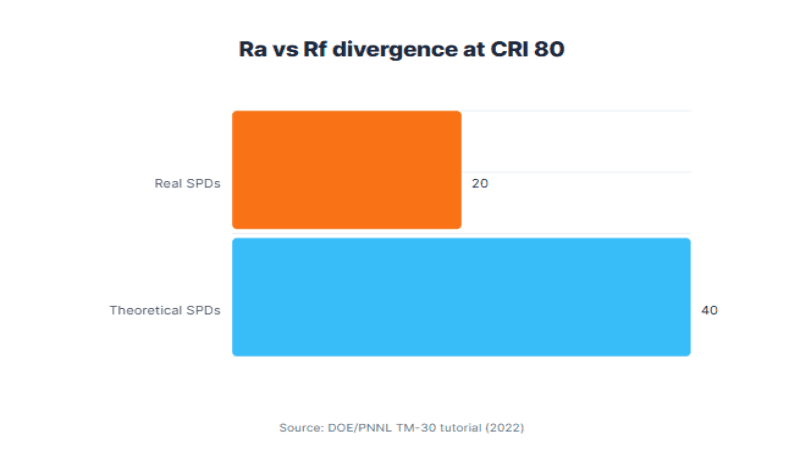
Rf and Ra are not interchangeable. For SPDs with a CRI of 80, the difference between Rf and CRI can exceed 20 points for light sources that exist today and 40 points for light sources that could be available in the future, despite a strong correlation (r² = 0.86 for theoretical sources, 0.85 for real ones) (DOE/PNNL TM-30 tutorial, 2022). The tutorial attributes the gap to the different color spaces (CIE UVW* versus CAM02-UCS) and sample counts (8 versus 99), and to a systematic bias: CRI values tend to be lower than Rf for sources that increase red chroma because of the nonuniformity of CIE UVW*.
Rg answers a question Rf cannot. What Rg above or below 100 means is directional: Rg = 100 means average chroma matches the reference, Rg > 100 means an average saturation increase, and Rg < 100 an average decrease, so a source can be high-fidelity yet under- or oversaturated (DOE/PNNL TM-30 tutorial, 2022). The PNNL LightFair briefing is blunter about relying on the average alone: as the PNNL LightFair briefing puts it, average fidelity is “mostly useless” as a predictor of perception because “it is unrelated to any perceptual attribute” (N. Miller, PNNL, TM-30 at LightFair 2017, 2017).
| Metric | What it measures | Sample base | What it misses |
|---|---|---|---|
| CRI (Ra) | Average color fidelity against a CCT-matched reference | 8 moderate-saturation samples | Saturated colors, R9 red rendering, direction of shifts |
| TM-30 Rf | Average color fidelity | 99 Color Evaluation Samples | Direction and distribution of shifts |
| TM-30 Rg | Relative gamut area, average chroma change | 16 hue-angle bins | Which hues gained or lost chroma |
Perception vs Growth Metrics
The two metric families answer different questions, and the counter-argument from component supplier ILS is worth stating plainly: CRI is a human metric that measures how light and colour are perceived specifically by the human eye, and it does not describe plant response (ILS on DesignSpark, 2024). That is not a reason to ignore it in a grow room. It is the reason to stop treating a CRI number as evidence about yield.
The standards bodies have not settled the replacement question either. CIE stopped short of recommending that Rf replace Ra for specifying color rendition and rating products, because color fidelity, no matter how accurately quantified, is not always related to perceived color quality, while the IES recommends that lighting professionals transition to IES Rf and that specifications built solely on average color fidelity be reevaluated case by case (DOE/PNNL TM-30 tutorial, 2022).
For an inspection specification, the practical reading is that TM-30 is the more recent and more settled instrument, and that a fidelity-only number is an incomplete basis for a purchase decision.
What High CRI Reveals
Grow light color rendering for nutrient deficiency detection matters because the diagnostic cues extension services teach are color cues. Purdue’s diagnostic chart organizes them by leaf age: on old leaves, nitrogen shows as yellow leaves, magnesium as interveinal chlorosis, potassium as chlorotic or necrotic margins, and phosphorus as purple color; on new leaves, iron shows as sharp interveinal chlorosis, sulfur as general yellowing, and manganese as dull interveinal chlorosis (K. Nemali, Purdue University, hosted since 2021).
The same chart defines the vocabulary a scout uses: chlorosis is yellow color on leaves, interveinal chlorosis is yellow color between veins, and necrosis is brown to dark brown dead tissue.
Early Nutrient Symptoms
Iowa State’s extension guide supplies the progression pattern that makes early detection possible. Nitrogen deficiency “causes pale, yellowish-green” plants, and because nitrogen is mobile, “symptoms begin on the older, lower leaves” and progress up the plant if the deficiency persists; potassium deficiency appears as “a yellowing and necrosis of the crop leaf margins, beginning on the lower leaves” (J. Sawyer, Iowa State University Extension, IPM 42, revised 2004).
Both patterns depend on distinguishing a pale yellow-green from a healthy green and a chlorotic margin from a necrotic one, which is a color-discrimination task performed under whatever light is overhead.
Purdue’s guide also lists the confounders that make a single symptom unreliable: pH issues, low substrate temperature, excess irrigation, diseases affecting roots, fertilizer injector issues, and interactions among elements all produce deficiency symptoms (K. Nemali, Purdue University, hosted since 2021). A scout comparing a suspect plant against a known-healthy reference under the same fixture is doing the comparison the diagnostic charts assume.
Pro Tip: Run the reference comparison under the same fixture and at the same time of day. A known-healthy plant or a calibrated color card placed beside the suspect canopy removes the fixture-to-fixture and hour-to-hour variation that makes a marginal color shift ambiguous.
Pest and Disease Cues
The 2026 review of multimodal stress detection frames the division of labor between the scout and the instrument. Human visual inspection detects visible symptoms such as wilting, chlorosis, necrosis, lesions, pests, and morphology best in context, while instruments detect earlier physiological signals; the defensible position is high-CRI visual inspection plus targeted instrumental measurement, not replacement of the scout (Frontiers in Plant Science, 2026).
Purdue’s chart shows the same overlap from the other direction, listing bacterial leaf spot, fungal leaf spot, viral mosaic, and tomato spotted wilt virus alongside the nutrient patterns, and noting that excess fertilizer (EC) can cause burnt symptoms along margins (K. Nemali, Purdue University, hosted since 2021).
Canopy Uniformity and Texture
Canopy-scale judgments depend on seeing texture and color variation across many plants at once, which is where a color-fidelity specification earns its place. The ILS counter-perspective concedes exactly this operational benefit: it is easier for growers and workers to distinguish a plant’s true colour and condition under light with better color rendering (ILS on DesignSpark, 2024). The same source is explicit that this is a worker-visibility benefit, not a plant-growth benefit, and the distinction should survive into the specification.
Standards and Compliance
Inspection lighting compliance under UL 8800 and IES RP-45 rests on two documents that do different jobs: RP-45 defines how horticultural light is characterized, and UL 8800 defines the safety requirements for the equipment that delivers it. RP-45’s stated purpose is to describe the differences between architectural and horticultural lighting design so that lighting professionals can translate their architectural lighting know-how into horticultural practice (IES product page for ANSI/IES RP-45-21, 2021).
IES TM-30 and RP-45
RP-45’s own framing separates plant-facing from human-facing characterization: “The amount of light is characterized differently for plant versus human applications,” and the appropriate spectral power distribution differs for plants and humans and can vary between plant species (IES product page for ANSI/IES RP-45-21, 2021). The document’s contents confirm the scope: chapters cover spectral regions from UV-C through infrared, photoperiod and daily light integral, light recipes, luminaire optics and photobiological risks, electrical considerations, controlled environments, and optical sensors.
RP-45-21 is still the current edition. The IES continuous maintenance register lists it under Continuous Maintenance as “Recommended Practice: Lighting Horticultural Facilities,” maintained by the Horticulture Committee (IES Continuous Maintenance Standards List, 2025-06-12). Under that process, proposed changes received by the IES Director of Standards by December 31 are given committee consideration by June 30 of the following year, so the document can be amended between editions.
UL 8800 and NEC Context
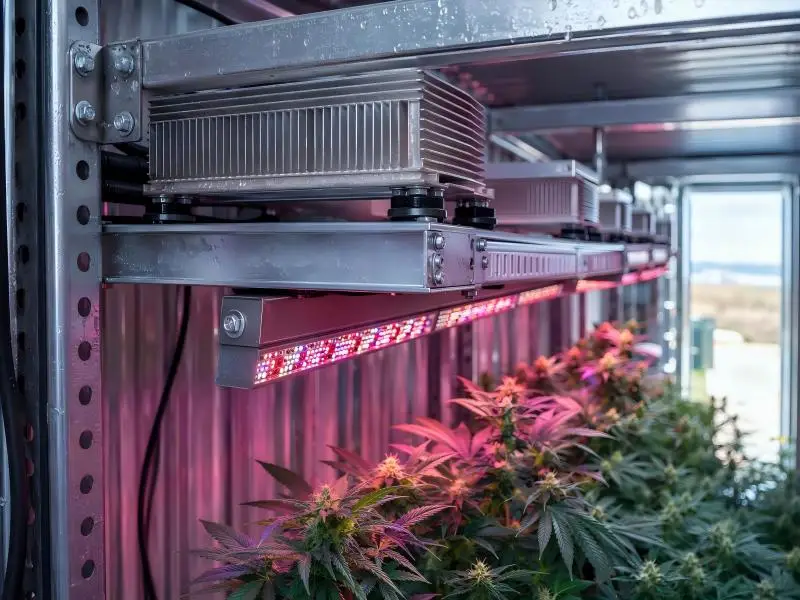
UL 8800’s scope is the safety of the equipment rather than the quality of its light. It “is intended to address the unique safety issues applicable to horticultural luminaires, lighting components and grow systems, and represents the first set of standardized requirements specifically designed for horticultural lighting equipment,” covering damp and wet locations, ingress protection, photobiological safety consistent with IEC 62471, and specialized wiring and connection methods that support luminaires designed to be raised, lowered, or repositioned (UL Solutions, UL 8800 published-standard brief, 2024 brief; standard Ed. 1 2019).
The first edition, with ANSI approval in 2025, is recorded as published August 30, 2019, designated ANSI/CAN/UL 8800:2019 Ed.1 with a revision dated 14 September 2023 (UL Standards & Engagement store record, Ed. 1 published 2019-08-30; ANSI approval 2025-03-18).
The NEC added Part XVI to Article 410 in the 2020 edition and retained it in 2023, with sections running from 410.170 General through 410.188 Hazardous (Classified) Locations, including 410.172 Listing and 410.184 GFCI Protection (2020 NEC significant-changes summary, 2020). The informational note at 410.170 describes the equipment’s purpose: “Lighting equipment identified for horticultural use is designed to provide a spectral characteristic needed for the growth of plants and can also provide supplemental general illumination within the growing environment.”
The DLC’s current horticultural requirements add the utility-program layer. Technical Requirements V4.0 took effect April 18, 2025, with V3.0 delisting January 5, 2026, and products must be safety certified by a safety certification organization relevant in the United States or Canada, with testing at an accredited laboratory to ANSI/IES LM-79-19, LM-80, and LM-84 (DesignLights Consortium, Horticultural Technical Requirements V4.0, effective 2025-04-18). DLC listing is a rebate-eligibility requirement, not a safety requirement; the safety requirement is the NRTL certification to UL 8800.
⚠️ Warning: A UL 8800 listing is not an installation authorization. The listing covers the conditions under which the equipment was evaluated, such as wet or damp location suitability, IP rating, photobiological risk group, ambient temperature, cord and plug configuration, and mounting; the installation method itself remains governed by the NEC and by the terms of the listing.
Documentation and Safety Checks
The documentation set that survives an AHJ review and a procurement review is the same set: the NRTL certification to ANSI/CAN/UL 8800, the LM-79-19 test report from an accredited laboratory, the IP and photobiological risk group markings, and the installation instructions that define the permitted mounting and wiring methods. The UL brief states the enforcement expectation directly: now that UL 8800 is a published safety standard, code officials, or Authorities Having Jurisdiction, will require UL 8800 for grow facilities (UL Solutions, UL 8800 published-standard brief, 2024 brief).
Specification Targets
The TM-30 Rf Rg inspection lighting specification problem is that no horticulture standard publishes inspection-task color-rendering values. What exists is a documented TM-30 specification framework, a published federal specification for a color-critical medical setting, and a body of industrial inspection-station guidance with no cited methodology. The three should be kept separate in a procurement document.
Recommended CRI/TM-30 Ranges
The TM-30 tutorial’s specification criteria provide the documented starting point. Its composite Color Fidelity specification at level F3 reads Rf ≥ 85, Rg ≥ 89, −12% ≤ Rcs,h1 ≤ 23%, and Rf,h1 ≥ 85 (DOE/PNNL TM-30 tutorial, 2022). A published federal specification shows what a color-critical institutional setting adopts: the U.S. DoD Unified Facilities Criteria for military medical facilities specifies Rf ≥ 80, 97 ≤ Rg ≤ 110, −9% ≤ Rcs,h1 ≤ 9%, and Rf,h1 ≥ 78 (DOE/PNNL TM-30 tutorial, 2022).
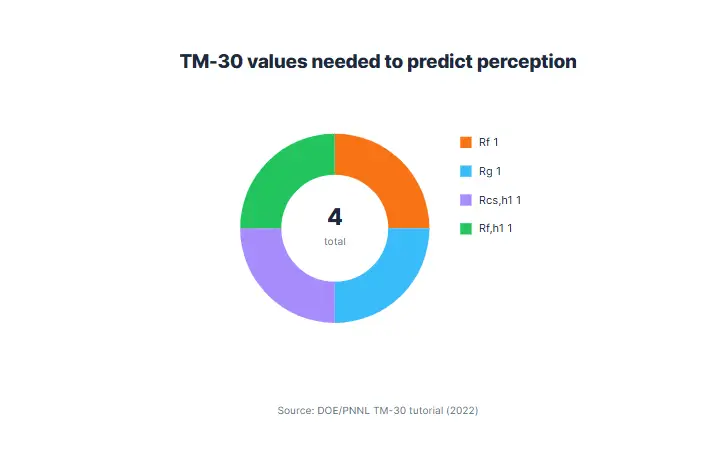
The four values TM-30 asks you to compare are Rf, Rg, Rcs,h1, and Rf,h1, because all four are needed to predict preference, vividness, and fidelity; the tutorial’s guidance is that at least Rf, Rg, and Rcs,h1 should be compared for a visual match (DOE/PNNL TM-30 tutorial, 2022). Higher is not automatically better: across all the measures included in TM-30, maximum values are not necessarily the best values, and for architectural interiors Rf values below 60 are not typically considered appropriate (DOE/PNNL TM-30 tutorial, 2022). That floor is stated for architectural interiors and should not be transferred to plant applications without a horticultural basis.
The CRI-based numbers circulating for inspection stations come from one industrial lighting supplier’s inspection guidance, which recommends CRI ≥ 90 (≥ 95 for color matching), R9 ≥ 50 (≥ 80 for demanding color work), CCT 4,000–5,000 K, flicker below 5% and ideally below 1%, uniformity about 1.5:1 max:min, and illuminance about 500–1,000 lux, against general area lighting at CRI ≥ 80 and 100–500 lux (hi-hyperlite inspection lighting guide, 2026). Treat these as market practice for industrial inspection stations, not as a horticultural standard: the source states no methodology and cites no standard clause.
| Parameter | General area lighting | Inspection baseline (vendor guidance) | Color-critical (vendor guidance) |
|---|---|---|---|
| CRI | ≥ 80 | ≥ 90 | ≥ 95 |
| R9 | Not specified | ≥ 50 | ≥ 80 |
| CCT | Not specified | 4,000–5,000 K | 4,000–5,000 K |
| Flicker | Not specified | < 5%, ideally < 1% | < 5%, ideally < 1% |
| Uniformity | Not specified | ~1.5:1 max:min | ~1.5:1 max:min |
| Illuminance | 100–500 lux | 500–1,000 lux | 500–1,000 lux |
SPD, CCT, Flicker, Uniformity
The spectral power distribution is the underlying variable, and RP-45 treats it as species-dependent: the appropriate SPD is different for plants and humans and can vary between plant species and even between cultivars within a species (IES product page for ANSI/IES RP-45-21, 2021). That is the reason an inspection specification should be written as a second, additive requirement on the luminaire rather than as a change to the production spectrum.
CCT and flicker belong in the same clause because they interact with the camera or eye doing the inspection. The vendor guidance places inspection CCT at 4,000–5,000 K and flicker below 5%, ideally below 1% (hi-hyperlite inspection lighting guide, 2026). Uniformity at roughly 1.5:1 max:min is the same source’s target, and it is the parameter that most directly affects whether a canopy-wide color comparison is meaningful.
Photometrics and Camera Setup
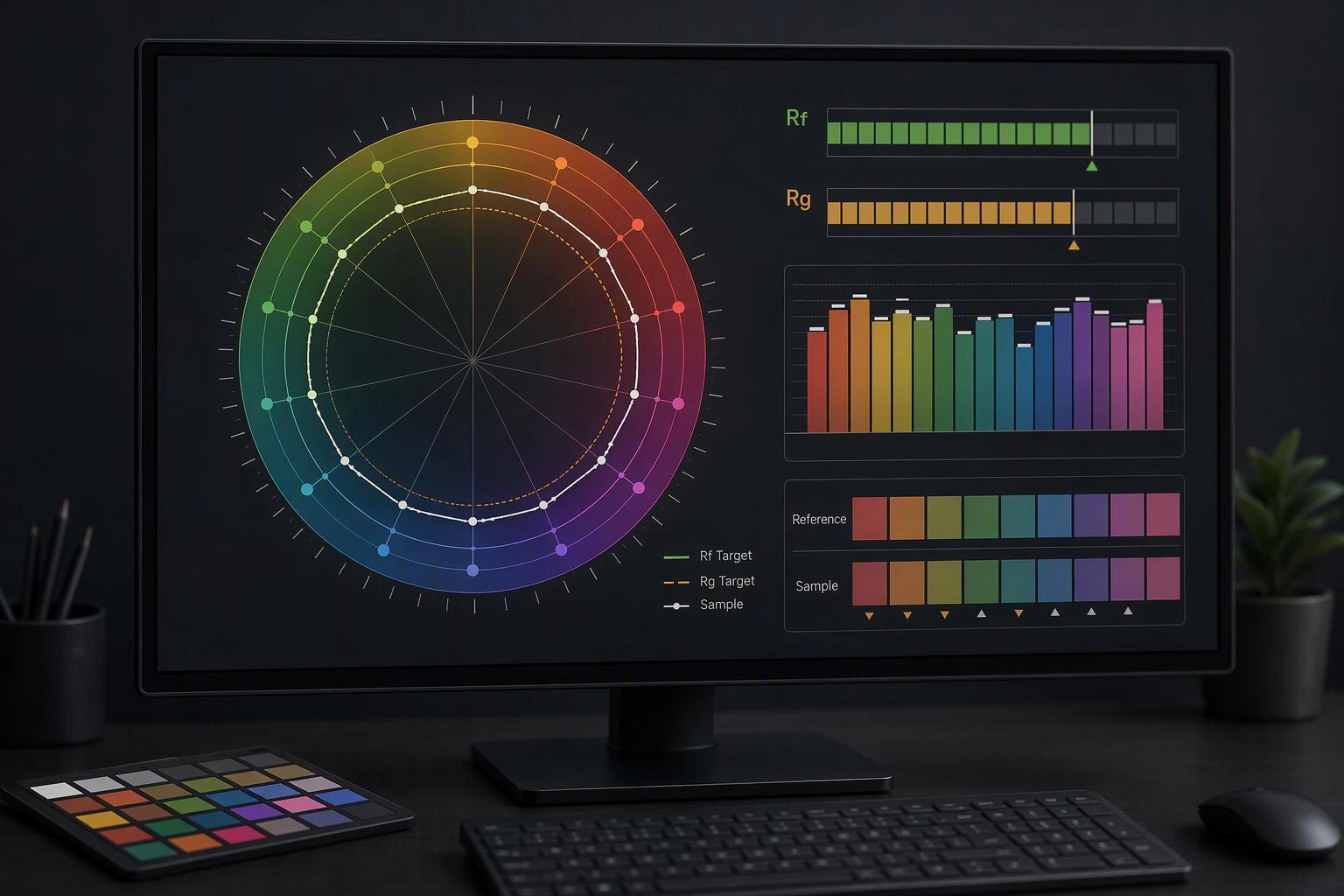
A TM-30 specification is only checkable against measured data. The tutorial’s own caution applies: some color samples may be rendered more similarly to the reference than others, and some hues can shift one way while others shift in the opposite direction, so two sources with the same Rf can differ in which colors are distorted (DOE/PNNL TM-30 tutorial, 2022). Request the full TM-30 report, including the Color Vector Graphic and the local measures, rather than a single Rf figure.
Deployment and SOPs
Deployment decisions turn on whether inspection light is a separate fixture layer or a mode of the production fixtures, and on whether the resulting procedure is written down. Both choices have to survive the same constraint: the production spectrum is set by the crop, and RP-45 notes it can vary between species and cultivars (IES product page for ANSI/IES RP-45-21, 2021).
Dedicated Inspection Lighting
A dedicated inspection fixture layer lets the production spectrum stay optimized for growth while the inspection spectrum is specified against TM-30. The trade-off is capex and a second set of photometric documentation. The UL 8800 scope matters here: horticultural lighting systems are typically designed to be frequently raised, lowered, or repositioned, and the standard allows specialized wiring and connection methods that support that positioning flexibility (UL Solutions, UL 8800 published-standard brief, 2024 brief).
Any added fixture layer inherits the same listing, IP, and photobiological requirements as the production luminaires.
Switchable Inspection Modes
A switchable mode on the production luminaire avoids the second fixture layer but requires the tunable spectrum to hold its TM-30 values at the inspection setting, not only at the production setting. The tutorial’s warning about averages applies directly: two sources with the same Rf can have samples shifting in opposite directions, so the inspection setting needs its own measured report (DOE/PNNL TM-30 tutorial, 2022). Where the production fixture is a fixed-spectrum unit, this option does not exist.
Controls, Training, and Logs
Controls, dimming, and logging are the operational integration layer, and the DLC requirements define what the submittal package should contain: safety certification by an OSHA NRTL or SCC-recognized body, plus accredited-laboratory testing to ANSI/IES LM-79-19, LM-80, and LM-84 (DesignLights Consortium, Horticultural Technical Requirements V4.0, effective 2025-04-18).
The training content follows from the diagnostic material: scouts need the leaf-age and symptom patterns from the extension charts, and they need the reference-comparison practice that makes a marginal color shift interpretable. The log should record the fixture setting, the inspection time, and the reference used, so that a later review can separate a real change from a lighting change.
Energy and ROI
The energy case for inspection lighting is a duty-cycle case, and the arithmetic is straightforward: every watt a luminaire draws becomes heat inside the conditioned space, so inspection hours add both lighting kWh and cooling load. The research base for this section is thinner than for the standards sections, and the numbers below are illustrative rather than sourced.
Duty-Cycle and Energy Math
A worked example makes the trade-off visible. If a dedicated inspection layer draws 20 W per fixture and runs 1 hour per day across 500 fixtures, that is 10 kWh per day, or roughly 3,650 kWh per year before any cooling penalty. At a commercial rate of $0.12 per kWh, the lighting energy alone is about $438 per year, and the cooling load adds a fraction of that again depending on the facility’s cooling efficiency. Substitute the reader’s own fixture wattage, fixture count, inspection hours, and electricity rate; the structure of the calculation is what transfers, not the figures.
The comparison that matters is against the cost of the alternative. The 2026 review of multimodal stress detection supports the position that instruments detect stress before visible symptoms appear, which is the mechanism by which earlier detection has value, but no source located for this article quantifies yield or quality loss from late pest or nutrient detection in controlled-environment agriculture (Frontiers in Plant Science, 2026). Without that figure, the ROI case has to be argued by mechanism and by avoided-risk scenarios rather than by a payback period.
HVAC and Control Strategies
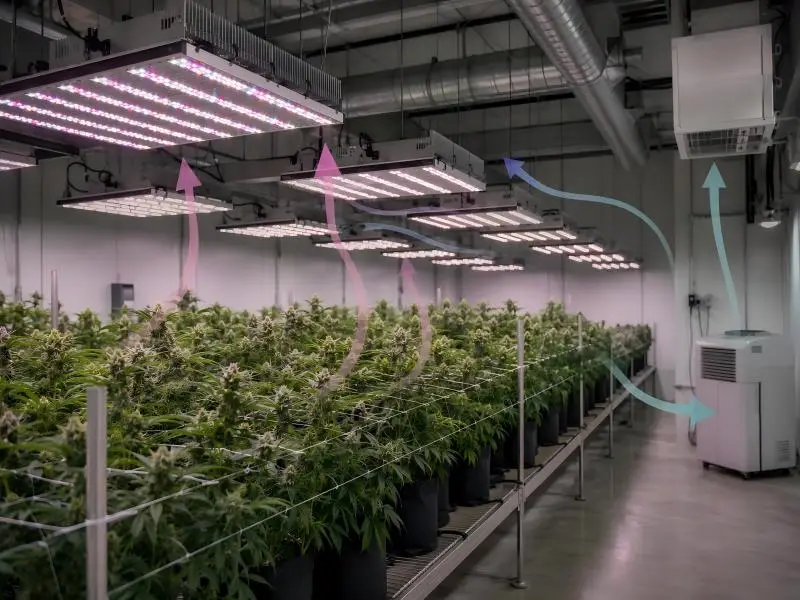
Because lighting watts become space heat, the HVAC delta is a function of the same duty cycle. A control strategy that ties the inspection mode to the scout’s presence, rather than running it on the production photoperiod, keeps both the lighting kWh and the cooling load proportional to actual inspection time. The DLC’s testing requirements give the procurement team a way to verify the dimming and control behavior it is paying for, since LM-79-19, LM-80, and LM-84 testing is required at an accredited laboratory (DesignLights Consortium, Horticultural Technical Requirements V4.0, effective 2025-04-18).
Risk Management and Validation
The risk case rests on the compliance stack rather than on an energy figure. The UL brief states that code officials will require UL 8800 for grow facilities, and that a failure to address the safety criteria in UL 8800 can compromise the safety of the grow facility and workers in the grow environment (UL Solutions, UL 8800 published-standard brief, 2024 brief). Validation should therefore cover three things: the NRTL certification and LM-79-19 report for each luminaire model, the measured TM-30 report at the inspection setting, and the installation instructions that define permitted mounting and wiring methods under the listing.
Conclusion
High CRI grow lights for plant health inspection are worth specifying when the inspection task is a color-discrimination task, and they should be specified in TM-30 terms rather than CRI terms. The evidence supports three conclusions. First, CRI is a human-vision metric with documented limits: eight moderate-saturation samples, an excluded R9, and a reference matched in CCT that permits a perfect score at extreme CCTs (NIST, retrieved 2026).
Second, TM-30 provides the multi-part description a specification needs, with Rf, Rg, Rcs,h1, and Rf,h1 compared together rather than reduced to a single number (DOE/PNNL TM-30 tutorial, 2022). Third, the compliance path is separate from the color path: UL 8800 governs the equipment and its installation, while RP-45 governs how horticultural light is characterized (UL Solutions, 2024 brief; IES, 2021).
The next step is to write the inspection lighting requirement as an additive clause on the existing production specification, with the TM-30 values stated at the inspection setting and the NRTL certification and LM-79-19 report named as submittals. Where the evidence stops: no horticulture standard publishes inspection-task color-rendering values, and no source located for this article quantifies the yield loss from late detection, so both the specification targets and the ROI case have to be built from the facility’s own measurements and risk tolerance rather than from a published benchmark.
FAQ
Does a high CRI rating help plants grow better?
No. CRI is a human-vision metric, not a plant-response metric, and it says nothing about photosynthesis, yield, or plant health. The component supplier ILS is direct on this point: CRI measures how light and colour are perceived by the human eye and does not describe plant response (ILS on DesignSpark, 2024). Growth decisions should be made on spectral power distribution, PPFD, daily light integral, photoperiod, coverage, efficacy, and heat load — and two fixtures can share a CRI value yet deliver very different spectra. Buy for the inspection task, not the yield.
What CRI or TM-30 values should I specify for an inspection station?
No horticulture standard publishes inspection-task color-rendering values, so the defensible approach is to borrow from a documented framework and state it as an additive requirement. The TM-30 tutorial’s composite Color Fidelity specification at level F3 reads Rf ≥ 85, Rg ≥ 89, −12% ≤ Rcs,h1 ≤ 23%, and Rf,h1 ≥ 85 (DOE/PNNL TM-30 tutorial, 2022). If a CRI number must appear in the document, industrial inspection-station guidance puts the baseline at CRI ≥ 90 and R9 ≥ 50, rising to CRI ≥ 95 and R9 ≥ 80 for color-critical work. That guidance comes with no cited methodology, so treat it as market practice rather than a standard.
Can I just inspect plants under my existing production grow light?
Sometimes, but it depends on the spectrum, not the fixture count. A red-and-blue “blurple” production spectrum can suppress the yellow, interveinal-chlorosis, and necrotic-margin cues that extension charts rely on, which makes nutrient and disease diagnosis unreliable. The ILS counter-perspective concedes the operational benefit directly: it is easier for growers and workers to distinguish a plant’s true colour and condition under light with better color rendering (ILS on DesignSpark, 2024). If the production fixture is fixed-spectrum, you need either a dedicated inspection layer or periodic inspection under daylight or neutral high-quality white light.