

Introduction
A damaged grow light does not arrive as a broken fixture. It arrives as a rescheduled install, a crew standing in a half-lit room, and an RMA that takes three weeks to clear.
When grow light packaging fails, the true cost shows up in three places. Dead-on-arrival (DOA) units consume the same receiving, handling, and reverse-logistics labor as working ones. A bent heat sink or a shattered diode cover on a long bar fixture can hold up a whole rack, because you cannot partially commission a tier. Once a claim is opened, the burden of proof shifts to the buyer, who must produce photographs, the original grow light packaging, and a delivery record to recover anything.
Standards-led packaging removes most of that guesswork. Instead of hoping a carton holds, you specify a validated pack-out: a test method matched to the shipping lane, an allowed shock and drop budget, printable acceptance criteria, and a unitization scheme that survives a trailer.
Table of Contents
Validation and Test Planning
Map Shipment Modes to Standards
Start with the route, not the box. Two standards do most of the work in this category, and they are not interchangeable.
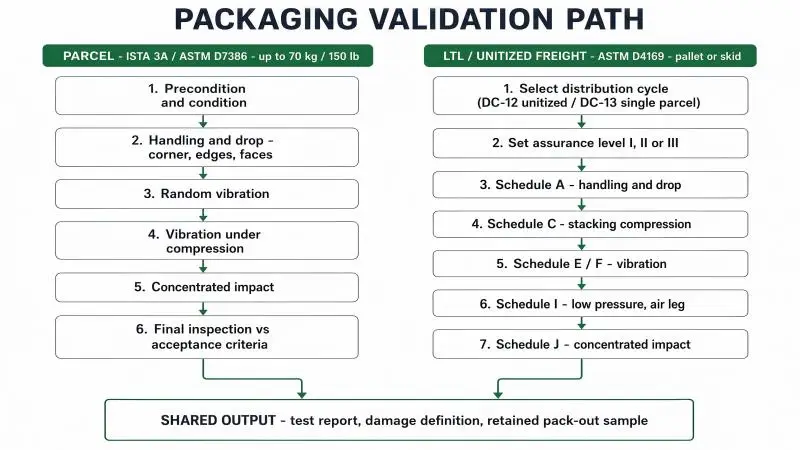
ISTA 3A applies to individually packaged products moving through a parcel delivery system, with a practical ceiling around 70 kg (150 lb). It reproduces parcel handling: preconditioning, atmospheric conditioning, a drop sequence on corners, edges, and faces, random vibration, vibration under compression, and concentrated impact. It is the right procedure when a single fixture ships to a dealer or a replacement unit goes direct to a site.
ASTM D4169 is a distribution-cycle framework. You pick the cycle that matches the actual route, then set an assurance level, then run the associated schedules. Typical schedules are A for handling and drop, C for stacking compression, E and F for vibration, I for low pressure on an air leg, and J for concentrated impact.
The distinction matters more than it appears. ASTM D4169 organizes test intensity around distribution cycles that represent a transport mode rather than a product category, so the DC-13 sequence for a single parcel runs handling, stacking, vibration, and impact schedules in a fixed order. Palletized fixtures belong instead to the unitized and less-than-truckload (LTL) cycles, where the pallet or skid configuration is part of the test article.
The practical decision rule is short. Parcel distribution goes to ISTA 3A. Palletized freight goes to ASTM D4169. A shipment that does both needs both, and the air leg adds the low-pressure schedule because reduced pressure changes how sealed enclosures behave.
Get the method wrong and everything downstream is wasted. A drop test run on a parcel cycle does not tell you whether a 1,800 mm pallet will survive a trailer ride.
Define Allowable G-Levels and Drop Heights
A validation plan is only useful if it states what the fixture is allowed to experience. That number comes from two inputs: the product’s fragility and the lane’s severity.
Fragility is set by the most delicate element in the assembly. For a bar or panel fixture, that is usually the diode board and its optical cover, sometimes the driver enclosure, rarely the aluminum extrusion itself. Ask your supplier for the fragile-component list in writing. If they cannot produce one, the packaging was designed by feel rather than by analysis.
Lane severity comes from the drop sequence you choose. In practice, the sequence follows the familiar shape of one weakest corner, three edges, and six faces, and drop height decreases as gross weight rises, so a 6 kg carton and a 32 kg carton do not share a test height. For palletized loads, drop severity drops further and stacking compression becomes the dominant hazard, which is why a palletized shipment is not validated by a parcel drop test.
ASTM D4169 gives you the same lever in a different form. The assurance level selects test intensity rather than a single fixed profile, with Level I the most severe, Level II the usual default, and Level III the least severe. Choose the level deliberately and write the reason beside it. “Level II because the first-order ships LTL through two break-bulk terminals” is a defensible statement. An unlabelled level is not.
Pro Tip: Request the test report’s sample count, not just its pass result. A validation claim built on one prototype carton tells you the design can survive once, which is not the same as saying a production lot will.
Set Pass/Fail and Documentation
This is where most packaging programs quietly fail. The laboratory does not decide what counts as damage; you do. The shipper defines damage before testing begins, and the samples should be real product in real production packaging, because a test on a mock-up proves nothing about the configuration you will actually ship.
Write acceptance criteria in three tiers so receiving staff can apply them without an engineer present:
- Pass — no structural failure of the carton, no deformation of the heat sink or frame, no cracked or chipped diode cover, no loose driver, all mounting hardware intact, and the fixture passes a functional check at first power-on.
- Conditional — cosmetic scuffs on the carton, minor abrasion on non-critical surfaces, or a bent bracket that can be replaced from a spare kit without returning the fixture.
- Fail — any of the pass criteria breached, or any deviation that requires the unit to leave the site.
Attach those criteria to the supply agreement rather than to an email. The acceptance criteria that belong in a supply agreement include the documentation set, the functional tests, the packaging and labeling requirements, change-control rules for key components, and inspection rights. First orders and any configuration change should also trigger third-party inspection, because a change in diode bin, driver vendor, or carton supplier can invalidate the original validation without anyone flagging it.
Pair the criteria with a documentation pack stored alongside the purchase order: the test report with method and date, the pack-out drawing, the retained sample location, and the change log. The same documentation checklist used in a factory audit applies here, and it is the difference between a supplier discussion and a supplier dispute.
Store the pack in a location named in the receiving procedure, not in someone’s inbox. When a claim or a site audit arrives eighteen months later, the pack has to still exist.
If you want, we can share the validation template and pack-out specification sheet we use as the starting point for commercial orders, so your team can adapt it before the next purchase order.
Outer Cartons and Edge Protection
Board Grade, ECT/Mullen, and Double-Wall
Two measurements describe a corrugated carton, and buyers routinely specify the wrong one.
Edge Crush Test (ECT) measures how much force the board edge resists before crushing. It correlates with stacking strength, which is what a palletized load actually experiences as cartons press on each other and on the bottom layer. Mullen burst measures the board’s resistance to puncture. It matters when the risk is a forklift tine, a protruding fastener, or rough manual handling.
For a palletized shipment, ECT is the specification that governs, because stacking performance is the failure you are buying insurance against. A common baseline for heavier or optics-sensitive lighting is double-wall, five-ply corrugated, with procurement reference points around 200 psi burst or ECT-32 appearing in published packaging guidance. Those are starting points rather than universal answers, since fixture weight, carton dimensions, load height, and route severity all move the requirement. Board quality is also a manufactured property, and flute caliper tolerances and drop-sample validation for lighting cartons should be verified on incoming lots rather than assumed from a supplier datasheet.
One rule outlives all the grade debates: use new, undamaged board. Recycled or previously wet board loses a substantial share of its compression strength, and a carton that collapses in the bottom layer of a trailer will cost more in claims than a full production run of correct board.
Form Factors: Bars, Long Luminaires, and Drivers
Grow lights resist standard packaging because of geometry. A six-bar or ten-bar fixture is a long, thin, heavy beam with delicate optics on one face and a rigid frame on the other. Handled badly, it behaves like a bridge: support only the ends and the middle deflects, and drop it on a corner and the whole frame takes a bending load.
Three design responses work in practice, and most good pack-outs use two of them together:
- Support the span. Add a mid-span foam cradle or a corrugated tray with ribs under the center of long bars. A shelf supported only at its ends will bow under its own weight during a rough ride.
- Protect the optical face. Orient the fixture so the diode board does not sit against a hard surface, and use an insert that contacts the frame perimeter rather than the diode face. Shattered diode covers are almost always the result of face-on impact against a carton wall.
- Separate the driver. Where the driver is a separate module, ship it in its own compartment with its own cushioning. A half-kilo driver moving freely inside a carton becomes a hammer against the bar it was strapped to.
Foldable and modular chassis design helps here for a different reason. Reducing the packaged envelope lowers freight cost and lets you control the orientation of the optical face, which is otherwise awkward on a three-meter bar. The trade-off is a hinge or joint that now has its own shipping requirement, since joints need to be locked and supported so they do not take the load.
Heavy, optics-sensitive fixtures are the reason packaging engineering sits inside a grow light supply chain rather than beside it. Carton and insert design is upstream of the fixture’s durability in the field, because damage that is visible on arrival gets caught, while damage that is latent does not.
Concentrated Impact and Corner/Edge Guards
Most transit damage is not a uniform crush. It is a concentrated impact on one corner or edge, applied by a forklift, a dock plate, or another pallet. Both ISTA 3A and ASTM D4169 include a concentrated impact element precisely because that hazard dominates real handling.
Corner protection addresses this directly. Full-height corner boards on the pallet protect the load as a unit. Inside the carton, the equivalent is a reinforced corner pocket or a molded corner block, so the first few millimeters of any impact is absorbed by something sacrificial rather than by the fixture frame. Edge guards along the long face of a bar fixture work the same way and protect the carton seam, which is the structural weak point of any box.
The failure mode to describe to a supplier is simple: put the load on a corner and see whether the fixture frame or the packaging takes the energy. If the answer is the frame, the pack-out is not finished.
Inserts, Immobilization, and Environmental Controls
Cushioning Selection with D1596 Curves
Cushioning is an engineering problem, and the test that characterizes it is ASTM D1596, which measures how a cushioning material performs under repeated impact. The output is a cushion curve: for a given material, thickness, and density, the curve shows how much shock is transmitted at a given static loading.
That curve gives you two failure boundaries, and good inserts avoid both:
- Too little support. The material compresses fully during a drop, then the fixture hits the carton wall through the bottomed-out foam. This is the most common cause of a cracked diode cover on a pack-out that looked well padded.
- Too stiff a material. The foam barely deforms, so it transmits nearly the full impact. A dense foam chosen to be safe is often the least protective choice at low drop heights.
Select thickness and density against the fixture’s mass resting on each cushion, not against intuition. Custom-molded polyethylene and expanded polypropylene foams and engineered molded pulp consistently outperform loose fill because they hold position and deliver predictable attenuation. Loose fill settles, and settled fill has no curve at all.
Record the specification on the pack-out drawing: material type, density, thickness, and insert geometry. A drawing with a material callout is auditable. “Foam insert” is not.
Moisture Management: Bags, Desiccants, Indicators
Electronics hate container humidity, and ocean freight is the worst case. A loaded container moves through temperature swings that drive condensation on cool surfaces, and a fixture that spent five weeks at sea can arrive with moisture inside the driver enclosure or on the terminations. Moisture, temperature cycling, and dust rank among the documented causes of equipment damage in transit, and corrosion on connectors is often invisible until the fixture fails months later.
A workable scheme has three parts. Use a barrier or anti-static bag for electronic subassemblies. Add desiccant sized to the enclosed volume and the expected transit duration, not one sachet per carton as a ritual. Then verify with humidity indicator cards on the pallet or inside the master carton, so the receiving team can see whether the condition held. The indicator is the audit trail, and without it you cannot distinguish a supplier packaging error from a rough lane.
For wooden packaging, destination phytosanitary rules apply, and wood moving into regulated markets must be ISPM 15 compliant and marked accordingly.
ESD Packaging for Drivers and Control Modules
Electrostatic discharge (ESD) is the quiet failure mode. A driver or control board damaged by static during packing or handling may pass the arrival functional check and fail in week three. Static charge appears alongside impact, vibration, and moisture in the standard list of transit damage causes, and it does not leave visible evidence.
Controls that are proportionate and auditable:
- Boards and modules packed in ESD-safe bags or wrapped in dissipative material, sealed and taped rather than left open.
- Packing and unpacking performed at an ESD-protected workstation, with wrist straps and grounded mats, rather than at a bench in a dry room.
- Incoming screening for high-risk parts, so a driver that arrives pre-damaged is caught at goods-in rather than at commissioning.
- Handling instructions printed on the insert, because the installer opening the box on site is the last person in the chain.
Programs that ship sensitive fixtures often pair this with LED grow light warranty coverage terms, because a claim for a failed driver is far easier to settle when the shipping and handling record is intact from supplier to site.
A worked example helps here, so it is worth describing one supplier’s documented approach rather than a generic list. SLTMAKS specifies custom-molded EPE foam with double-corrugated export cartons for its commercial fixtures, and states that validated packaging costs more up front and less in claims because foam, edge protection, and moisture protection add cost to the bill of materials but reduce the damage-claim rate. Its flat-pack, palletized designs carry documented pack-out specifications alongside certifications such as UL 8800, cETLus, CE, RoHS, and IEC 62471 photobiological reporting, so the packaging claim sits next to the compliance claim instead of replacing it. Treat that as a template for the documentation you should be asking every supplier to produce, whichever brand you buy.
Palletization, Stacking, and Traceability
Unitization: Stretch Wrap, Straps, Corner Boards
A pallet is a single shipping unit, and it should be built so it arrives as one. Uncontrolled unitization is the fastest route to load shift, which looks like carton damage but starts as a stacking decision.
The standard build holds up well:
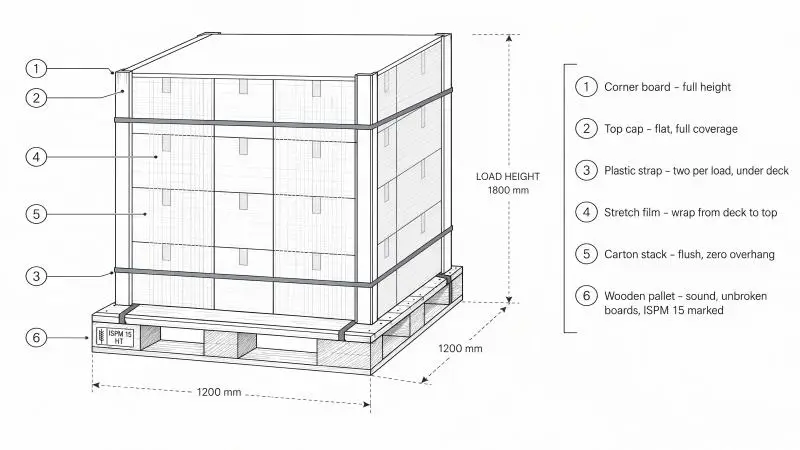
- Corner boards at full height on all four corners, so strapping pressure and any external impact are distributed over the board edge rather than the box corner.
- A flat top cap over the entire stack, which keeps the top layer from being crushed by the strap and gives the load a stable bearing surface if another pallet sits on it.
- Two or more plastic straps tensioned under the pallet deck, positioned so they hold the corner boards and the stack together without cutting into the cartons.
- Stretch film applied from the deck to the top cap in overlapping passes, which keeps the unit weather-tight and stops individual cartons from walking.
Carriers repeat the same instruction in their own freight guidance: keep the stack square, avoid overhang, band or wrap tightly, use corner boards, and maintain a flat and stable top deck. Their guidance also flags packaging choices that lead to denied claims, which is worth reading before you assume a rejected claim was the carrier’s fault.
The pallet itself is part of the specification. Reject pallets with broken deck boards, protruding nails, or a bowed bottom deck, and standardize on one footprint. Mixed pallet sizes in a single shipment are a stacking accident waiting for a dock plate. Wholesale purchasing is where this control is easiest to hold, since palletization, corner protection, and carton specification can be written into the order rather than negotiated after the fact.
Stack Patterns, Compression, and No-Overhang
Stack height is where protection and freight cost fight each other, and the honest answer is that fragility should win.
Compression is the load the bottom layer carries. It grows with stack height, carton weight, and the number of pallets the carrier stacks in a trailer or warehouse, and it is tested as a stacking compression schedule in ASTM D4169. Long, thin bar fixtures are poor compression members, so a tall column of long-bar cartons will bow and the bottom carton will eventually take the load across its weakest face.
Practical rules that hold up across facilities:
- Zero overhang. Every carton sits within the pallet footprint. Overhang is the most common cause of corner damage, because the load’s most vulnerable points become the points that hit first.
- Heavy items low. Where a pallet mixes fixture sizes, place the densest cartons at the bottom and the lightest on top.
- Cap the stack below trailer clearance, not at the arithmetic maximum. A stable load using 80% of the available cube beats a maxed-out load that shifts.
- Keep one stack pattern per SKU. Alternating the interlock pattern between shipments makes damage hard to attribute and training harder still.
Carton dimensions also feed into billed freight weight, so the volumetric penalty on long-bar fixtures is real. Reducing the packaged envelope is a legitimate goal, provided you re-validate the load after the change rather than assuming a smaller carton is automatically fine.
Labeling, Barcodes, and Receiving Checklists
Labels do two jobs: they direct handling, and they make a claim winnable.
On the carton, use the orientation and handling marks that dock staff actually read, including this side up, fragile, keep dry, and the handling symbol for electronic equipment. Add a barcode or QR label carrying the SKU, the purchase order number, the pack-out revision, and the batch. If the pack-out drawing has ever changed, the revision code on the label is how you find out which units were packed to which specification, months later.
On the pallet, carry a pallet license plate label that links to the carton list, plus a contents summary visible without unwrapping. Receiving teams should not have to open a load to know what is in it.
The receiving checklist is the operational payoff, and a short repeatable sequence is enough: photograph the pallet before unwrapping, including the label and any visible damage; note damage on the delivery receipt and, for LTL, in the driver’s presence; photograph the outer carton and the inner packaging before removing the fixture; retain the packaging material until the claim is resolved rather than recycling it; and record arrival condition separately from the first power-on result, because latent failures matter later.
That sequence produces what a freight claim needs, which is the documentation set that supports a freight damage claim: shipment identifiers such as the bill of lading or PRO number, delivery date and time, a written damage description, photographs or video, the original packaging, and proof of value. Report promptly, because notification windows are short by design and several brands specify a reporting deadline measured in hours rather than weeks.
Warning: Do not let a receiving team dispose of packaging before a claim is settled. Once the carton is in the baler, a concealed-damage claim usually becomes an argument you cannot win.
Sustainability and EU PPWR Readiness
Mono-Material Designs and Right-Sizing
The EU Packaging and Packaging Waste Regulation, Regulation (EU) 2025/40, entered into force on 12 February 2025 and applies from 12 August 2026. For lighting equipment, the outer packaging used to ship fixtures is generally treated as transport or grouped packaging, which puts it squarely inside the rules.
The headline constraint is space. Grouped, transport, and e-commerce packaging are capped at a maximum empty space ratio of 50%, and the Commission’s definition of that empty space ratio is the difference between the packaging volume and the sales packaging volume it contains. The obligation in Article 24 of Regulation 2025/40 applies from 1 January 2030, or three years after the implementing act that defines the calculation method enters into force, whichever is later. The Commission is to adopt that act by 12 February 2028, and reusable packaging inside a reuse system is exempt from the 50% cap.
Right-sizing is therefore both a compliance action and a damage-risk action, and the two mostly point the same way. A carton that fits the fixture with enough room for the correct insert geometry beats a carton with a large void filled with loose material. Where they diverge is at the extreme: a carton sized so tightly that the insert cannot deform has no cushion left to work with.
Mono-material thinking helps twice. Corrugated-only constructions with paper corner boards and paper tape separate more cleanly at end of life than mixed foam-and-film assemblies, and they simplify the design-for-recycling assessment the regulation requires.
Recycled Content and Documentation
The recyclability requirement is expressed as performance grades: A at 95% or above, B at 80% or above, and C at 70% or above, assessed against design-for-recycling criteria. Those obligations begin on 1 January 2030, or 24 months after the relevant delegated acts, if later. Recycled-content minimums for plastic packaging also start from 1 January 2030, including a 35% target for plastic packaging outside the contact-sensitive categories.
Compliance runs on paperwork as much as on design, so build the documentation now: a packaging bill of materials listing every component, its material, its weight, and whether it is recycled or virgin; recyclate declarations from your packaging supplier with the grade and source; the design-for-recycling assessment for each pack-out revision, kept with the pack-out drawing; and traceability from the pallet label back to the pack-out revision that produced it.
Because the implementing act on the empty-space calculation is still pending, treat any “fully PPWR compliant” claim as provisional. A supplier can reasonably say which design decisions anticipate the requirement. They cannot certify a calculation method that does not yet exist. The minimisation rules behind EU 2025/40 are the part you can act on today.
Trade-Offs: Protection vs Material Reduction
Material reduction has a floor, and it is set by the cushion curve, not by a volume target.
Strip out foam thickness to reduce packaging volume, and the insert stops attenuating shock, so the fixture takes the impact directly. That outcome is worse than non-compliance by a wide margin: a damaged fixture costs several times any packaging saving, and it also generates the return freight, the replacement unit, and the site delay. The regulation acknowledges the tension by permitting the space necessary for protection, which is why the empty-space cap sits at 50% rather than near zero.
A defensible sequence for most operators looks like this. First, remove genuine waste: oversized cartons, double-cartoning that adds nothing, film used where a paper alternative performs identically. Second, switch to mono-material where the change does not alter cushioning performance. Third, re-run the validation after any material change, because a thinner insert invalidates the earlier test. Fourth, document the trade-off in the pack-out record so the next person who asks for a material reduction can see what was already evaluated.
Warning: Never reduce cushioning without re-validating. A pack-out that fails a drop test after a material change will give back more in claims than it saved in board.
Conclusion
Reliable grow light packaging is a specification, not a preference. The operators who get it right treat it as an engineering deliverable that sits next to the photometric data and the certification file, and they standardize it across every facility rather than letting each site improvise.
The actions worth specifying across sites:
- Fix the validation method per lane. ISTA 3A for parcel shipments up to 70 kg, an ASTM D4169 unitized or LTL cycle for palletized freight, with the assurance level chosen deliberately and the reason recorded.
- Write acceptance criteria in three tiers — pass, conditional, fail — and attach them to the supply agreement along with the documentation set, packaging and labeling requirements, change-control rules, and inspection rights.
- Specify the carton by ECT, not by feel, and require new double-wall board with a defined grade for palletized loads.
- Require a cushioning specification on the pack-out drawing, with material, density, thickness, and insert geometry, so the design is auditable rather than described.
- Control moisture and static explicitly, with barrier or ESD bags, correctly sized desiccant, humidity indicators, and handling instructions visible at the point of unpacking.
- Standardize one unitization build, with corner boards, top cap, two or more straps, stretch film, zero overhang, and one pallet footprint.
- Run the receiving checklist on every load, retain packaging until claims clear, and keep the pack-out revision code on the pallet label.
- Document packaging materials against PPWR now, and re-validate the pack-out whenever a material or dimension changes.
The workflow that makes this scale is unglamorous: define allowable damage, test the real configuration, publish pass and fail, standardize the build, and keep the records. Once those five steps exist as documents, packaging stops being a per-shipment gamble and becomes one more line item you can audit, quote, and improve.
If it would help, send over the packaging specification and one recent pack-out drawing. We can review them against this framework and flag the gaps before the next order ships.
FAQ
Should I use ISTA 3A or ASTM D4169 to validate grow light packaging?
Should I use ISTA 3A or ASTM D4169 to validate grow light packaging?
Use ISTA 3A for any single fixture shipped through a parcel network up to 70 kg (150 lb), because ISTA 3A is the most relevant protocol for standard LED fixture export cartons moving by air or ground. Switch to ASTM D4169 when the fixture travels palletized or through mixed modes, since it lets you build a distribution cycle with separate drop, compression, vibration, and low-pressure schedules. A shipment that does both needs both tests. Running a parcel drop sequence on a 1,800 mm pallet tells you nothing about how it survives a trailer ride.
What drop height should a commercial grow light carton survive?
What drop height should a commercial grow light carton survive?
Drop height is not a universal number — it falls as gross weight rises, so a 6 kg carton and a 32 kg carton are tested at different heights. Set the sequence from the fragility of the most delicate element (usually the diode board and its optical cover) and the severity of the lane. Under ASTM D4169, the assurance level chooses the intensity, with Level II the usual default among the assurance levels that select test intensity rather than a fixed profile. Write the chosen height and the reason beside it in the test report so the decision is auditable.
How does the EU PPWR space rule affect grow light packaging?
How does the EU PPWR space rule affect grow light packaging?
Regulation (EU) 2025/40 caps space at a maximum 50% space ratio for grouped, transport, and e-commerce packaging, and the obligation in Article 24 of Regulation 2025/40 applies from 1 January 2030, or three years after the implementing act that defines the calculation method enters into force, whichever is later. Space is the difference between the packaging volume and the sales packaging volume it contains. Right-sizing toward that cap also cuts shipping damage — provided you never thin out cushioning below the level the drop test validated.