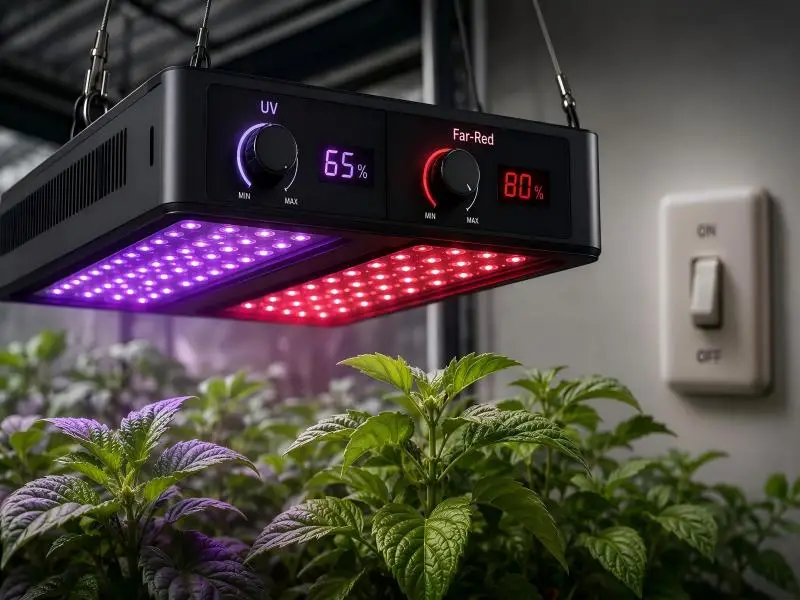
A grow light that switches UV and far-red on or off is not a controlled fixture. It is a fixture with two extra presets. The specification that increasingly separates a serious ODM platform from fixed-spectrum hardware is independent channel control: separately driven UV and IR LED groups, each with its own dimming level, schedule, and limits, addressable through the control protocol the room already runs. UV and far-red are the two bands where dose, timing, and ratio change plant response, so a binary switch turns a photobiology decision into a coin flip.
The argument below is an evaluation argument, not a product claim. It defines the term, separates it from weaker configurations, maps where the published evidence is strong and where it is thin, and then sets out the control-layer and reporting criteria a buyer can hold a supplier to. It draws on published photobiology, horticultural lighting program requirements, and photobiological safety standards. It is not built on first-hand testing of any particular fixture, and nothing here should be read as a claim that a specific product has been measured against these criteria.
Table of Contents
What “UV IR Channel Control” Actually Means in a Fixture Specification
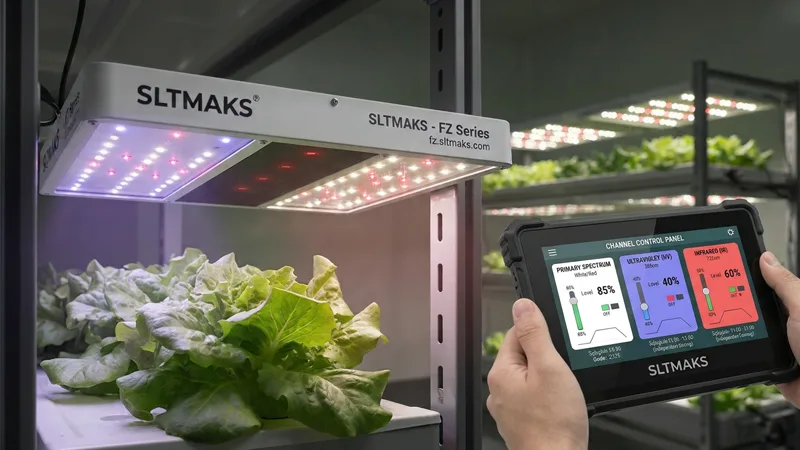
In a fixture specification, “UV IR channel control” means that the ultraviolet-emitting group and the infrared-emitting group are each a separately driven LED group with its own driver output and its own control address, so each can be set to an independent output level on an independent schedule. Four configurations get conflated in marketing material, and only the last is what the term should mean.
- Fixed spectrum. One spectral power distribution, no spectral adjustment. Dimming, if present, scales the whole output.
- Whole-fixture dimming only. A single control level moves every emitter together. The spectral ratios are locked by the design.
- Switchable UV/IR bands. The bands can be turned on or off, or toggled between a small number of factory presets. The operator chooses presence, not dose.
- Independently addressable UV and IR channels. Each band has its own dimming level, its own schedule, and its own configured limits, and the control system can address each one separately.
The distinction is architectural, not cosmetic. A separately driven group requires a driver output dedicated to that group; independent addressing requires a control interface that can carry a setpoint to that output alone. A 0–10V analog link, for example, is a single low-voltage signal that varies output across whatever is wired to it, and as a control method it offers no addressing: every driver on the link responds identically to the controller’s command. A digital bus such as DALI provides addressing, which is why the choice of protocol is part of the channel-control question rather than an afterthought.
The phrase also says nothing yet about wavelength band, maximum irradiance or dimming floor. Those are separate specification lines. “Independent UV and IR channel control” tells you the fixture can be steered; it does not tell you where it can be steered to, how hard it can push, or how far down it can go.
The Wavelength Labels are Ambiguous, and the Ambiguity Is a Purchasing Risk
“UV” and “IR” are category words. They are not specifications, and the gap between the category and the emitter is a purchasing risk.
UV radiation is conventionally divided into UV-C (100–280 nm), UV-B (280–320 nm), and UV-A (320–400 nm). In sunlight, the ozone layer absorbs UV-C entirely, while UV-A and UV-B reach the surface. A supplier’s “UV channel” may therefore be a UV-A emitter, a UV-A/UV-B mix, or a violet emitter sitting near the visible boundary. Each carries a different photobiological profile and a different safety assessment.
On the infrared side, the relevant horticultural band is far-red, and the reporting conventions treat it separately from the photosynthetic range: the DLC’s horticultural technical requirements define photosynthetic photon flux over 400–700 nm, report far-red photon flux over 700–800 nm, and offer an optional extended metric over 280–800 nm. An “IR channel” that emits at 850 nm is not a far-red channel in any horticulturally meaningful sense, and a channel described only as “IR” leaves the buyer unable to tell the difference.
The standards themselves encode the distinction. IEC 62471-6, which covers ultraviolet lamp products including UV LED products, applies where more than half of the radiant power emitted between 180 nm and 3,000 nm falls in the 180–400 nm region; if more than half falls outside that region, the base IEC 62471 applies instead. Which standard a UV-emitting fixture is assessed against therefore depends on the spectral composition of the product, not on what the channel is called on the datasheet.
A channel-control specification is only meaningful when each channel’s peak wavelength, bandwidth, and maximum output are stated. Without those three lines, “UV channel” and “IR channel” are labels on a box.
Why Independent Dimming Beats On/Off Selection
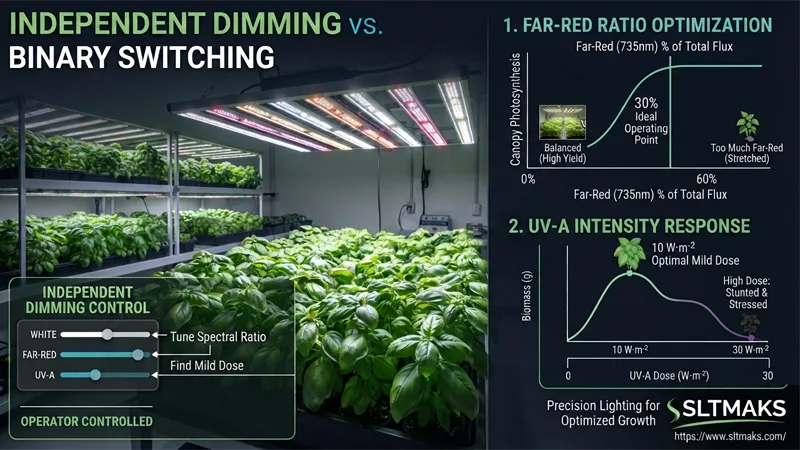
The value of channel control is dose and ratio, not presence or absence. Published plant responses to UV and to far-red are reported to depend on intensity, spectral peak, exposure time, species, and variety. A binary switch fixes one arbitrary dose chosen by the designer and removes the operator’s ability to tune it.
The far-red case shows why ratio matters. Zhen and Bugbee measured canopy net photosynthesis across 14 species and found that far-red photons (700–750 nm, peaking at 735 nm) were as effective as traditional 400–700 nm photons when applied at up to roughly 30% of total photon flux; far-red alone was not effective, and additional far-red beyond about 30% of the total did not produce further increases. The proposed explanation is that the response saturates once the excitation balance between the photosystems is restored. That is a dimming problem, not a switching problem: the useful operating point is a fraction of total flux, and the fraction moves whenever the main spectrum or the canopy changes.
The UV case shows why intensity matters. In a 14-day trial on sweet basil under red/blue/green LED background light, Kang and colleagues applied supplemental UV-A at 0, 10, 20, and 30 W·m⁻² (peaking at 385 nm). Biomass at 14 days was highest under the mild 10 W·m⁻² treatment and lowest under 30 W·m⁻². The maximum quantum efficiency of photosystem II stayed roughly constant at 0 and 10 W·m⁻² but fell 8.6% at 20 W·m⁻² and 17% at 30 W·m⁻² relative to the untreated control. A mild dose and a high dose of the same band produced opposite growth outcomes in the same crop.
Independent dimming is what lets an operator hold a target ratio as the main spectrum or canopy changes, and what lets an operator find the mild end of a band’s response curve rather than the designer’s single guess.
What the Photobiology Does and Does Not Support
A defensible channel-control rationale has to distinguish what the literature reasonably establishes from what it does not.
Reasonably established, within stated conditions. UV-A acts as an abiotic stressor associated with secondary metabolite accumulation, and the same literature reports tradeoffs against growth and yield, with effects varying by intensity, peak, exposure time, species, and cultivar. The basil trial above is a concrete instance: a mild dose was associated with the highest biomass, a high dose with the lowest. UV-B perception interacts with far-red signalling — UV-B has been reported to block the signal transduction triggered by low red-to-far-red conditions — and the interaction with temperature is documented, with elevated temperature reported to compensate for UV-B-mediated growth inhibition in sunflower and maize. Far-red contributes to canopy photosynthesis when combined with shorter wavelengths, and acts morphogenetically through phytochrome.
The limits. Many results come from controlled chambers or single cultivars, several are short-duration, and the outcome depends on the background spectrum. The far-red enhancement itself is not universal: a study in tomatoes grown under sunlight with supplemental red/blue LED light found the enhancement negligible, and the same body of work notes that the effect depends on the background spectrum and on the light under which leaves developed.
On the UV side, a 2024 cannabis trial testing five UV treatments across three UV-A: UV-B ratios found that none of the treatments altered the cannabinoid profile, although one low-intensity UV-A treatment was associated with higher linalool, limonene and myrcene. A separate trial summarized in a 2024 review found total foliar THC unaffected by UV exposure, with higher THC concentrations in sugar leaves under a combined UV-A plus UV-B treatment.
The honest conclusion is that the case for channel control rests on the ability to reproduce a chosen dose and ratio, not on a promise of a specific outcome. A supplier who claims a guaranteed cannabinoid or terpene result from a UV channel is claiming more than the published record supports.
What the Control Layer Has to Do: Protocols, Drivers, and Failure Modes
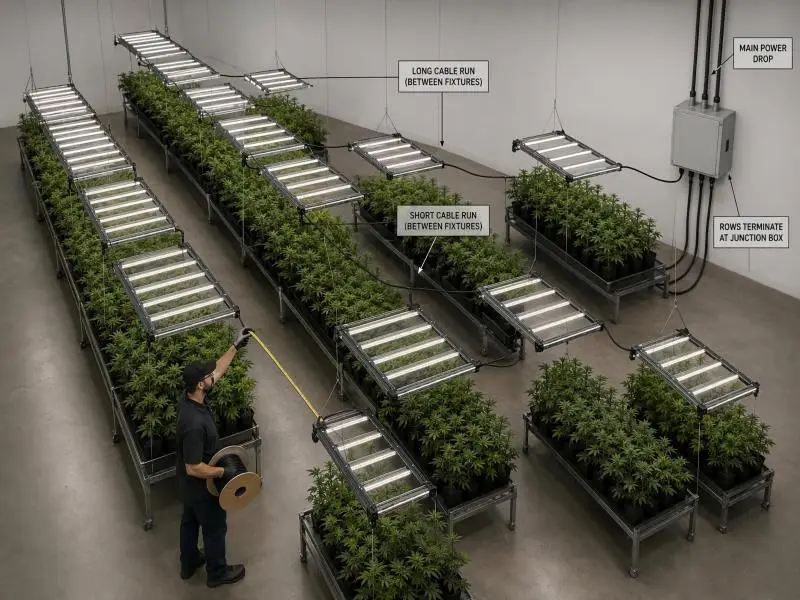
Independent channel control needs two things: separately controllable driver outputs, and a control interface that can address them. The interface must carry per-channel setpoints, not one global level. Whether that interface is analog, a digital bus or a proprietary controller matters less than whether it can hold four independent values — main, UV, far-red, and any additional group — and report them back.
The failure modes that matter in a production room are rarely about diodes:
- Schedule loss on power cycle. A fixture that returns to a default state after an outage silently changes the dose the crop receives.
- A dimming floor that will not reach the low end. If the UV channel cannot be driven below a minimum output, the mild-dose operating point may be unreachable. Dimming range is a reported characteristic in horticultural program requirements precisely because the minimum matters as much as the maximum.
- Step changes instead of ramps. A channel that jumps between levels cannot reproduce a gradual schedule, and abrupt transitions are hard to attribute when a crop response appears.
- No interlock when a UV channel is live. UV-emitting products carry photobiological risk-group obligations. IEC 62471-6 addresses adjustable UV luminaires, interlock safeguards on removable baffles, and labelling requirements, so the control layer is also a compliance surface, not only a cultivation tool.
- No logging. Without a record of what actually ran, a trial cannot be reproduced, and a crop response cannot be attributed to a setpoint.
The safety dimension deserves its own line in the specification. Under ANSI/CAN/UL 8800, the primary North American safety standard for horticultural lighting, acceptable photobiological risk groups assessed to IEC 62471 are Risk Group 0, 1, and 2; Risk Group 3 is not permitted. A UV channel that can be driven to high output changes the assessment, and the interlock and labelling provisions exist because the fixture can be reconfigured in the field.
How to Report Efficacy When UV and IR Channels Are Live
A single efficacy number cannot describe a multi-channel fixture, because the measurement boundary excludes what the UV and far-red channels do. Photosynthetic photon efficacy is defined over 400–700 nm. Far-red flux is reported separately over 700–800 nm, and the extended-range metric over 280–800 nm is optional. A headline PPE figure therefore does not describe what the UV and far-red channels contribute, and two fixtures with the same headline number can behave very differently once those channels are live.
Illustrative arithmetic only — not measured product data. A fixture whose main channel delivers 1,680 µmol·s⁻¹ at 600 W (2.8 µmol·J⁻¹) gains a 30 W UV-A channel emitting 60 µmol·s⁻¹ entirely below 400 nm. Under the conventional PPE definition (400–700 nm numerator, total input power denominator), PPF is unchanged while input rises to 630 W, so reported PPE falls to about 2.67 µmol·J⁻¹. Assumes no change to main-channel output and no far-red contribution.
The arithmetic is transparent. A fixture’s efficacy depends on which channels are at which level, because each channel has its own wall-plug watts and its own photon output. The same hardware yields different numbers at different setpoints. A fixture run with the UV channel at 10% and the far-red channel at 20% is a different efficiency proposition from the same fixture run with both at maximum, and neither number is wrong — they describe different operating states.
Horticultural program requirements already anticipate this. The DLC’s V4.0 technical requirements for spectrally tunable products with customizable spectra require full LM-79 spectral testing for each setting representing the maximum power of each individually controllable channel, with all other individually controllable channels set to their minimum designed output. Applicants must also provide user-facing documentation describing the control protocol and input parameters, sufficient to understand the product’s capabilities across end-use applications rather than a set of presets for one customer.
That is exactly the reporting a buyer should request. The specification should state efficacy at named channel settings — for example, all channels at maximum, main channels at maximum with UV and far-red at minimum, and the specific ratios the supplier expects a grower to run — not one best-case figure with no stated operating condition.
What to Test Before You Accept the Fixture
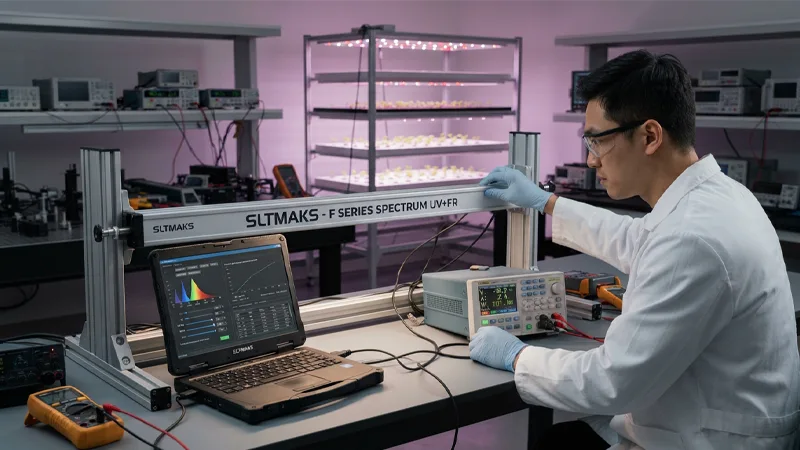
The following checks test the control layer rather than the diodes. A fixture can pass a photometric report and fail every one of them.
- Confirm each channel’s measured peak wavelength and maximum output against the datasheet. Ask for the measurement to be identified by method and facility, not just a number on a cut sheet.
- Verify the dimming floor and the resolution of the low end. Drive the UV channel to its minimum and measure the output. If the mild-dose operating point is unreachable, the channel cannot reproduce the conditions the literature describes.
- Cut and restore power. Confirm the schedule and setpoints persist, and confirm what state the fixture returns to.
- Run a ramp and watch for step artifacts. Log the commanded values against the measured output if the fixture supports it.
- Confirm the UV interlock and labelling. Check the risk-group classification, the interlock on removable baffles where applicable, and the labels against the applicable photobiological standard.
- Pull the logs. Confirm the fixture records what it actually ran, at what level, and for how long.
None of these checks requires a spectroradiometer in the grow room. Most require a controller, a power switch, and a specification to compare against.
The Strongest Counterargument: Most Operations Do Not Need This Yet
The strongest case against the thesis is straightforward. For many crops and many rooms, a well-chosen fixed spectrum with whole-fixture dimming delivers the yield. Adding UV and far-red channels adds cost, driver complexity, a safety obligation, and a new failure surface, for a benefit that is cultivar-specific and not yet reliably quantified. Where the crop and the goal are settled, that argument has real force, and nothing in the published record justifies running UV in every room.
The answer is about scope, not about denying the objection. The claim is not that every operation must run UV and far-red. It is that where a grower does choose to run them, a binary switch cannot deliver a defined dose, and an ODM platform that cannot address the channels independently forecloses the experiment before it starts. A fixture with a UV on/off switch can answer “does UV do anything here?” It cannot answer “what dose, at what ratio, on what schedule?” — and the literature suggests those are the variables that matter.
The honest weak point is the outcome evidence. It is uneven, cultivar-dependent, and sometimes contradictory, as the cannabis UV trials above show. That is an argument for controllability, not for a particular recipe. A platform that can hold a defined dose is what makes the recipe testable; the recipe itself still has to be earned crop by crop.
What This Means for ODM Procurement
Translating the argument into procurement, an ODM partner should be able to deliver the following, in writing:
- Per-channel wavelength and maximum output on the datasheet, with peak wavelength and bandwidth stated for each channel.
- Efficacy reported at named channel settings, including the all-maximum condition and the individually-controllable-channel-at-maximum condition described in horticultural program requirements.
- A documented control protocol with per-channel addressing, including which control method is used and whether it can carry independent setpoints.
- Stated dimming floor and ramp behaviour, including the minimum output of each channel and whether transitions are ramped or stepped.
- Schedule persistence across power loss, with the return state defined.
- UV interlock and labelling to the applicable photobiological standard, with the risk-group classification stated.
- Access to logs, so the operator can confirm what actually ran.
A supplier’s own capabilities legitimately enter the conversation as evaluation criteria: spectrum customization, driver and firmware engineering, certification coverage, and delivery logistics all affect whether a channel-control specification can be met and supported in the field. They are criteria for judging the partner, not proof of performance. The proof is the documentation and the acceptance test.
As channel control becomes a standard expectation, the ODM question shifts from “what spectrum do you ship” to “what can your control layer let me run, and can you document it.” That is a harder question to answer with a datasheet alone, which is precisely why it is a useful one.
Doesn’t A Fixed Spectrum with Good Dimming Cover This?
It covers total intensity but not spectral ratio. A fixed spectrum locks the UV-to-PAR and far-red-to-PAR ratios at whatever the designer chose, so the operator can only scale the whole recipe up or down. If the target is a far-red fraction of total photon flux, or a UV-A dose at a specific intensity, whole-fixture dimming moves both the numerator and the denominator together and cannot hold the ratio constant.
If the Outcome Evidence Is Uneven, Why Specify the Capability Now?
Because controllability is a precondition for generating and reproducing a recipe. The capability is justified by the ability to test and repeat, not by a guaranteed result. A fixture without independent channels cannot be used to run the dose-response trial at all, so the operation that waits for better evidence before specifying the capability has no way to contribute to that evidence from its own rooms.
What If We Already Bought Switchable Fixtures?
Switchable hardware still supports presence/absence comparisons, and those comparisons have value. What it cannot do is hold a target ratio as other channels change, which is the operating mode the far-red and UV literature points to. The transition is therefore about the next specification cycle rather than about replacing working hardware immediately. Run the presence/absence trials on what is installed, and write independent channel control into the next procurement.
FAQ
What is UV IR channel control in modern grow light specifications?
UV IR channel control refers to an architectural design where ultraviolet and infrared LED groups are independently driven, separately addressable, and equipped with individual dimming levels and schedules. Unlike whole-fixture dimming or simple binary switches, UV IR channel control allows growers to precisely steer specific spectral bands instead of locking them into fixed presets.
Why is UV IR channel control superior to basic on/off switches or fixed spectra?
Basic on/off switches only control presence or absence, turning plant responses into a coin flip. UV IR channel control enables accurate dose and ratio management, which is essential because plant responses depend heavily on intensity and timing. With UV IR channel control, operators can fine-tune specific bands to avoid harmful over-dosages and maintain target ratios as environmental conditions change.
How does UV IR channel control impact fixture efficacy and performance reporting?
Because each channel operates with its own power and photon output, a single headline efficacy figure cannot accurately describe a multi-channel fixture. When evaluating UV IR channel control, buyers must request efficacy data reported at specific, named channel settings (such as all-maximum conditions or individually controllable channel maximums) rather than relying on a single best-case metric.
What key factors should be tested during acceptance testing for UV IR channel control?
When testing fixtures with UV IR channel control, operators should verify per-channel peak wavelengths, maximum outputs, dimming floors, schedule persistence across power losses, and the absence of step artifacts. Additionally, verifying safety interlocks and logging capabilities ensures that the UV IR channel control system complies with photobiological standards and reliably records operational data.
Why is UV IR channel control essential for ODM procurement and custom lighting platforms?
ODM procurement requires verified documentation to ensure hardware performs as specified in commercial grow rooms. Integrating UV IR channel control shifts the evaluation standard from generic spectrum shipping to advanced control layers, requiring suppliers to deliver written per-channel maximums, documented control protocols, schedule persistence, and rigorous safety compliance.