Author: The Senior Agricultural Lighting Engineering Team at SLTMAKS
Reading Time: Approx. 15-20 minutes
Target Audience: Commercial Greenhouse Operators, Master Growers, Agricultural Investors, and CEA (Controlled Environment Agriculture) Facility Managers.
Introduction: The Summer Survival Challenge for Modern Greenhouses
As global climate patterns shift dramatically, commercial agriculture faces an unprecedented set of challenges. Extreme weather events, particularly prolonged and intense summer heatwaves, are no longer anomalies; they are the new normal. For commercial indoor farming solutions and large-scale greenhouse operators, the summer months have historically been a period of anxiety, reduced yields, or even complete facility shutdowns. The primary culprit? An inescapable battle against thermal accumulation.
In a controlled environment, maintaining the delicate balance of light, temperature, and humidity is paramount. However, traditional supplemental lighting systems, such as High-Pressure Sodium (HPS) fixtures, have long acted as a double-edged sword. While they provide the necessary photons for photosynthesis, they simultaneously emit massive amounts of radiant heat. When a summer heatwave strikes, operating HPS lights is akin to turning on a fleet of space heaters inside a glass box that is already baking under the summer sun. The result is a skyrocketing thermal load that overwhelms commercial greenhouse cooling systems, leading to devastating heat stress in crops and astronomical energy bills.
To maintain profitability and year-round production consistency, the agricultural industry must pivot. The definitive solution to decoupling light provision from heat generation lies in advanced horticultural lighting technology. Specifically, Low-Heat-Radiation LED Grow Lights have emerged as the cornerstone of modern greenhouse climate control.
In this comprehensive guide, we will explore the profound impact of extreme summer temperatures on plant physiology, decode the thermal physics of different lighting technologies, and clearly demonstrate how partnering with a professional LED plant light manufacturer like SLTMAKS to implement Low-Heat-Radiation LED Grow Lights can ensure your greenhouse not only survives but thrives during the harshest summer heatwaves.
Table of Contents
The Deep Threat of Extreme Summer Heatwaves on Commercial Greenhouses
To truly understand the value of low-heat lighting, we must first examine the physiological destruction that excessive heat wreaks upon commercial crops. Heat stress is a severe abiotic stress factor that disrupts nearly every fundamental process within a plant.
1. The Breakdown of Photosynthesis and Plant Metabolism
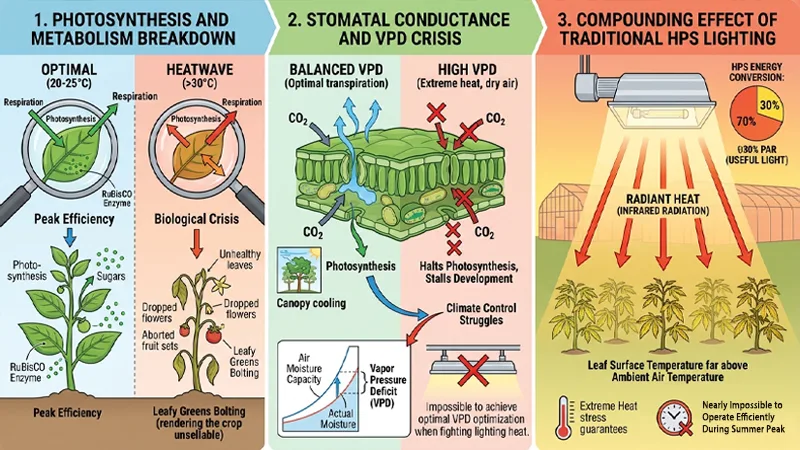
At an optimal temperature range (typically between 20°C and 25°C for many commercial crops like tomatoes and cannabis), photosynthesis operates at peak efficiency. The enzyme RuBisCO efficiently binds carbon dioxide to produce sugars. However, as ambient and canopy temperatures soar during a heatwave, a biological crisis occurs.
When temperatures exceed the optimal threshold, the plant’s metabolic rates shift. Respiration (the process of burning sugars for energy) begins to outpace photosynthesis (the process of creating sugars). The plant is literally burning more energy than it can produce, leading to stunted growth, dropped flowers, aborted fruit sets, and severe yield reductions. For leafy greens, heat stress triggers premature bolting (going to seed), rendering the crop unsellable.
2. Stomatal Conductance and the VPD Crisis
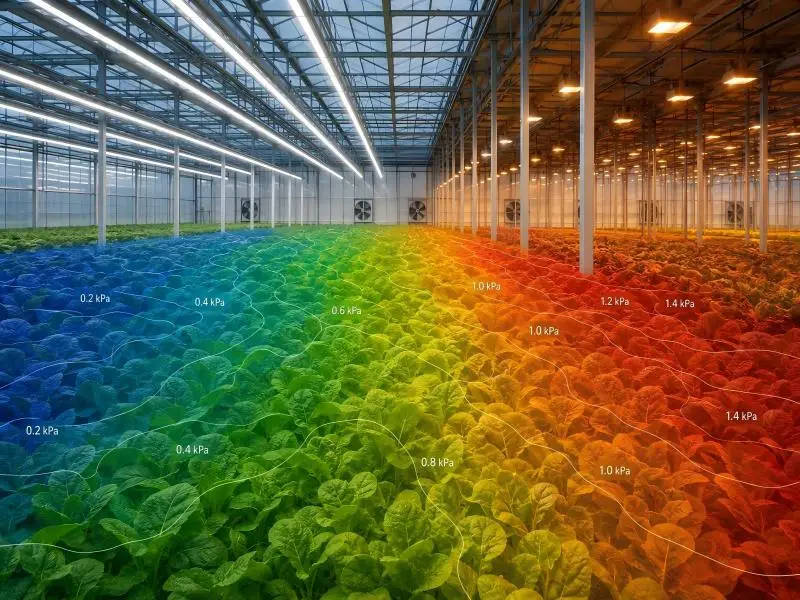
Plants cool themselves through transpiration—releasing water vapor through tiny pores on their leaves called stomata. This process is entirely dependent on the Vapor Pressure Deficit (VPD), which is the difference between the amount of moisture in the air and how much moisture the air can hold when it is saturated.
During extreme summer heat, the air’s capacity to hold water expands exponentially. If greenhouse climate control systems cannot keep up, the VPD becomes too high. The air becomes exceedingly dry relative to the leaf temperature. To prevent fatal dehydration, the plant’s survival mechanism kicks in: it closes its stomata. While this saves water, it completely halts the intake of CO2, instantly stopping photosynthesis and stalling crop development. Achieving optimal VPD optimization is impossible when your lighting system is actively fighting your cooling system.
3. The Compounding Effect of Traditional HPS Lighting
High-Pressure Sodium (HPS) lamps convert only about 30% of the electrical energy they consume into Photosynthetically Active Radiation (PAR). The remaining 70% is converted into heat. Worse, a significant portion of this heat is Infrared (IR) radiation. When you operate HPS lights during the summer, you are actively bombarding your plant canopy with radiant heat, raising the leaf surface temperature far above the ambient air temperature. This compounding effect guarantees heat stress, making it nearly impossible for traditional commercial greenhouses to operate efficiently during the peak of summer.
Decoding Thermal Management: HPS vs. LED Heat Output
To solve the summer heat crisis, commercial growers must understand the fundamental physics of how different lighting technologies manage heat. The debate of LED vs. HPS heat output is not just about the total amount of heat generated, but how that heat is distributed within the growing environment.
1. Convective Heat vs. Radiant Heat: The Crucial Difference
All electrical appliances, including grow lights, generate heat. The law of conservation of energy dictates that electricity not turned into light must become heat. However, the delivery mechanism of that heat changes everything.
- HPS radiant heat: An HPS bulb burns at incredibly high temperatures. It emits a massive amount of radiant heat (infrared radiation) directed straight down, along with the light. Radiant heat does not heat the air directly; it heats the objects it touches. In a greenhouse, those objects are your precious crop leaves. This direct thermal bombardment raises canopy temperatures drastically, causing immediate localized heat stress.
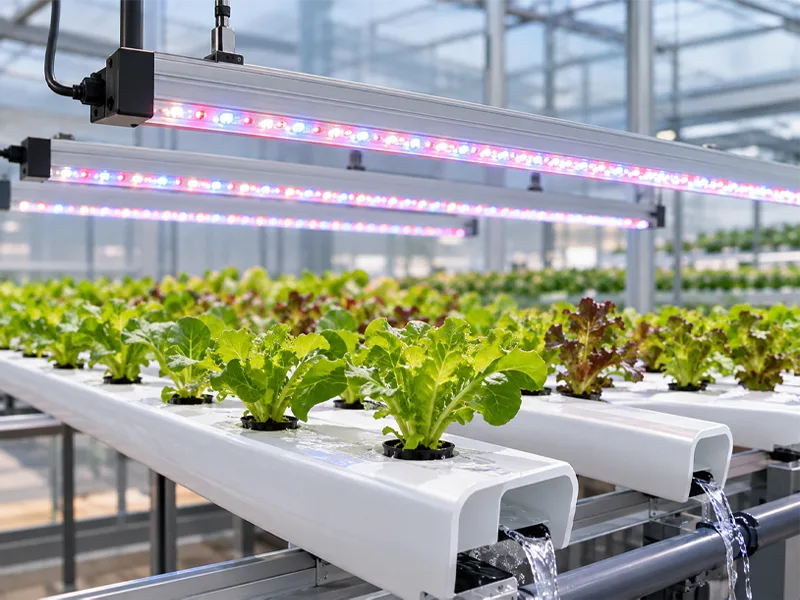
- LED convective heat: Low-heat-radiation LED grow lights operate on a fundamentally different principle. LEDs do not emit infrared heat downward onto the plants. Instead, the heat generated by the LEDs is conductive and convective. It is transferred to the circuit board and then to the aluminum heat sinks on the back of the fixture. This heat rises upwards, safely away from the plant canopy, where it can be easily extracted by roof vents or HVAC return ducts.
2. The Power of High Photosynthetic Photon Efficacy (PPE)
The definition of an energy-efficient grow light is heavily tied to its Photosynthetic Photon Efficacy (PPE), measured in micromoles per joule (µmol/J). A standard HPS fixture might achieve a PPE of 1.7 to 1.9 µmol/J. In stark contrast, professional-grade Low-Heat-Radiation LED Grow Lights engineered by SLTMAKS can achieve PPE ratings of 2.8 to 3.2 µmol/J or higher.
This higher efficacy means that a significantly larger percentage of every watt of electricity is converted into usable light rather than waste heat. By utilizing high-PPE LEDs, growers can provide the same—or even higher—light intensities to their crops while simultaneously slashing the total thermal energy introduced into the greenhouse.
How Low-Heat-Radiation LEDs Optimize Greenhouse Environments
Transitioning to wholesale grow lights equipped with low-heat LED technology offers a multi-faceted approach to dominating summer production. It transforms the greenhouse from a reactive environment (constantly fighting the weather) into a proactive, finely tuned manufacturing floor for plants.
1. Decoupling Light from Temperature Control
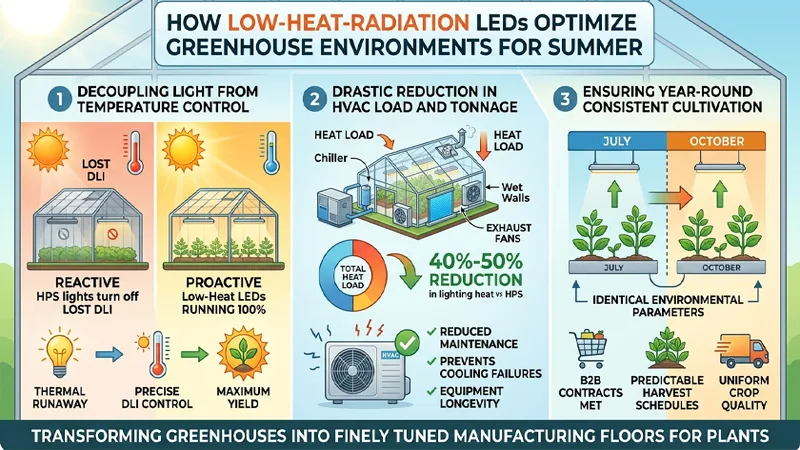
The most profound advantage of Low-Heat-Radiation LED Grow Lights is the decoupling of your lighting strategy from your temperature strategy. In the past, growers frequently had to turn off their HPS lights during summer days to prevent the greenhouse from overheating, sacrificing crucial Daily Light Integral (DLI) targets.
With low-heat LEDs, you achieve precise DLI control in summer. If it is a cloudy, intensely hot summer afternoon, you can run your LED lights at 100% capacity to ensure your crops get the photons they need for maximum yield, without triggering a thermal runaway event in the facility.
2. Drastic Reduction in HVAC Load and Tonnage
Commercial greenhouse cooling relies heavily on chillers, wet walls, exhaust fans, and robust HVAC systems. Sizing an HVAC system for a greenhouse requires calculating the total heat load, which includes solar gain, equipment heat, and lighting heat.
Because Low-Heat-Radiation LED Grow Lights emit practically zero downward radiant heat and have superior electrical efficiency, the total heat load contributed by the lighting system drops by 40% to 50% compared to HPS. This massive reduction in thermal load means your existing cooling systems do not have to work nearly as hard, preventing equipment strain, reducing maintenance, and preventing catastrophic cooling failures during peak heatwaves.
3. Ensuring Year-Round Consistent Cultivation
For B2B agriculture, consistency is currency. Supermarket chains and wholesale distributors demand reliable, year-round supply contracts. You cannot afford to tell your buyers that your summer yields will be 30% lower due to the heat. Low-heat LED solutions allow commercial operators to maintain identical environmental parameters in July as they do in October. This consistency guarantees predictable harvest schedules, uniform crop quality, and robust revenue streams regardless of the extreme weather outside.
Economic Analysis: The ROI of Upgrading to Low-Heat LEDs
For facility managers and investors, adopting new technology is ultimately a financial decision. While the Capital Expenditure (CAPEX) for commercial LED grow lights is higher than purchasing legacy HPS fixtures, the Return on Investment (ROI) is rapid, driven by compounding operational savings (OPEX).
1. Slashing Summer Cooling Costs
The most immediate financial impact of installing Low-Heat-Radiation LED Grow Lights is seen in the summer utility bills. Let’s consider the math: if an HPS fixture requires 1000 watts to run, and your cooling system requires roughly 300 to 400 watts of cooling energy to remove the heat generated by that single fixture, your true energy cost is 1300 to 1400 watts per light.
By switching to a 600-watt high-efficiency LED fixture that provides the same light output, you not only save 400 watts on lighting electricity, but you also drastically reduce the associated cooling requirement. The HVAC system runs less frequently and draws less power. Commercial facilities routinely report a 30% to 40% total reduction in summer electrical costs strictly from this dual-layered energy saving.
2. Maximizing Yield and Revenue
Energy savings are only half of the commercial LED grow lights ROI equation. By eliminating heat stress and maintaining optimal VPD and canopy temperatures, crop yields increase. Furthermore, the tailored light spectra of advanced LEDs enhance secondary metabolite production (such as terpenes in cannabis or Brix levels in tomatoes), leading to a higher quality, more valuable end product. Preventing just one catastrophic summer crop loss due to overheating can often pay for the entire LED retrofit.
3. Capitalizing on Grow Light Energy Rebates
Governments and local utility companies worldwide are aggressively incentivizing the transition to energy-efficient agricultural practices. Because Low-Heat-Radiation LED Grow Lights significantly reduce strain on the municipal power grid during peak summer usage hours, many utility providers offer substantial grow light energy rebates. These B2B agriculture lighting solutions rebates can offset the initial purchase price of the LED fixtures by 20% to 50%, accelerating the ROI timeline to as little as 12 to 24 months.
Buyer’s Guide: Key Specs for Summer Greenhouse LEDs
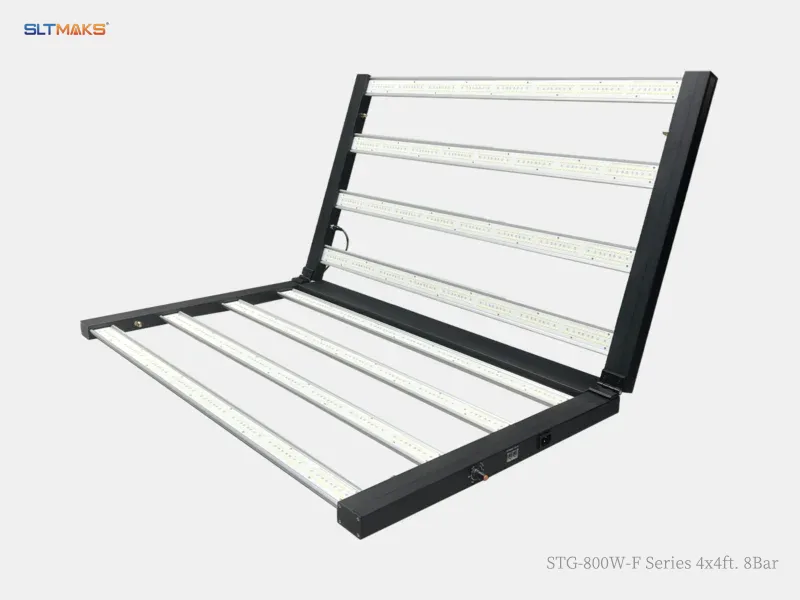
Not all LEDs are created equal. When sourcing commercial indoor farming solutions to combat summer heatwaves, purchasing managers must look beyond marketing claims and focus on rigorous engineering specifications. Here is what to demand from a professional LED plant light manufacturer:
- 1. Superior thermal management design: How the fixture handles its own internal heat is critical to its lifespan and its impact on your greenhouse. Look for heavy-duty, cold-forged or extruded aluminum heat sinks. Passive cooling (no internal fans) is generally preferred in commercial environments as it eliminates moving parts that can fail in humid, dusty conditions. SLTMAKS engineers our fixtures with state-of-the-art thermodynamics to ensure rapid heat dissipation away from the diode array.
- 2. High PPE (Photosynthetic Photon Efficacy): Demand third-party certified testing reports verifying the PPE. A minimum of 2.6 µmol/J should be the baseline for commercial B2B operations, with 2.8 to 3.0+ µmol/J being ideal for maximizing energy-efficient grow lights performance and minimizing heat.
- 3. IP65 or IP67 ingress protection rating: Summer greenhouses utilize heavy evaporative cooling, high-pressure fogging systems, and frequent washdowns. Your fixtures must be resilient. IP65 LED grow lights (or IP67) ensure that the critical electronic components and drivers are completely sealed against dust intrusion and protected from low-pressure water jets and high humidity.
- 4. Seamless dimming and smart control compatibility: During the summer, natural sunlight intensity fluctuates. Your supplemental lighting should be smart enough to adapt. Look for fixtures that offer 0-10V dimming capabilities and integrate seamlessly with master greenhouse climate control systems (like Priva, Argus, or TrolMaster). This allows you to set precise DLI targets; the LEDs will automatically dim down when the sun is brightest, further cutting heat output and electricity costs.
SLTMAKS Real-World Case Study: Defeating the 40°C Heatwave
Data-driven results are the true test of any B2B agriculture lighting solution.
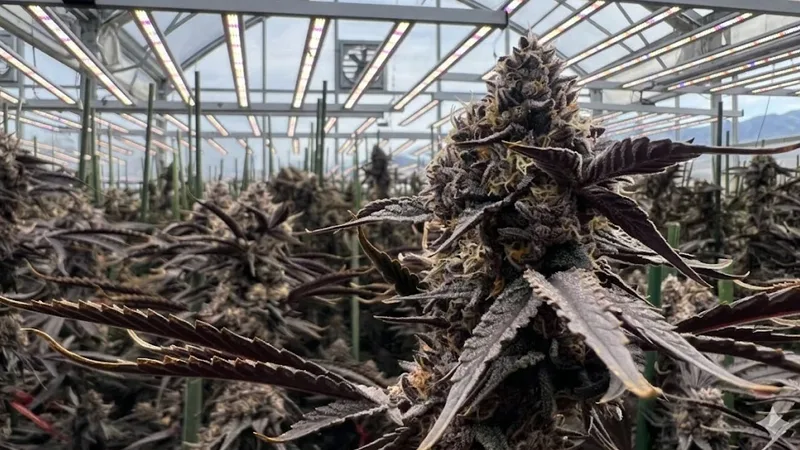
Client: A 5-Hectare Commercial Tomato Greenhouse Facility (Southern California). The Challenge: The facility historically relied on 1000W DE HPS fixtures. During the summer of 2024, a prolonged heatwave pushed ambient outside temperatures past 40°C (104°F) for several weeks. The existing wet-wall and exhaust fan cooling system was completely overwhelmed. The facility had to turn off its HPS lights during the day, resulting in a severe DLI deficit, massive flower drop, and a 28% reduction in total summer yield.
The SLTMAKS solution: In early 2025, the facility partnered with SLTMAKS to retrofit one 2-hectare bay with our flagship Low-Heat-Radiation LED Grow Lights (Model: SLT-Pro-800W), featuring an efficacy of 2.9 µmol/J and passive aluminum fin thermal management. The adjacent bay remained on HPS as a control.
The results (summer 2025 heatwave):
- Canopy temperature: The LED bay maintained a stable canopy temperature 4.5°C lower than the HPS bay during peak afternoon heat.
- HVAC energy savings: The exhaust fans and cooling pumps in the LED bay ran 35% less frequently than in the HPS bay, representing massive OPEX savings.
- Yield retention: Because the SLTMAKS LEDs could remain on during the day without overheating the crops, the plants met their DLI targets. The LED bay saw a 0% loss in flower sets and actually yielded 14% more Grade-A tomatoes compared to the facility’s 5-year summer average.
- ROI: Factoring in a substantial utility rebate from the local power company, the facility achieved full ROI on the SLTMAKS retrofit in just 16 months.
Conclusion & Call to Action
The era of hoping for a mild summer is over. Extreme weather and severe heatwaves are a permanent variable in the commercial agriculture equation. Continuing to rely on outdated, high-heat HPS lighting is a liability that jeopardizes your crop, inflates your operating costs, and restricts your business growth.
Upgrading to Low-Heat-Radiation LED Grow Lights is no longer just an “eco-friendly” option; it is a fundamental requirement for the survival and profitability of modern commercial greenhouses. By drastically reducing HVAC loads, eliminating radiant heat stress on your canopy, and ensuring consistent year-round production, low-heat LEDs provide an insurmountable competitive advantage.
Ready to climate-proof your cultivation facility for the next heatwave? Do not wait for the summer heat to decimate your yields. Partner with a professional LED plant light manufacturer you can trust. Contact the expert lighting engineering team at SLTMAKS today.
We provide free, comprehensive facility audits, custom 3D light mapping, and detailed ROI & Energy Rebate analysis tailored specifically to your B2B agricultural operation.
Click Here to Schedule Your Free Consultation with SLTMAKS Today
FAQ
Do LED grow lights create any heat at all for summer greenhouses?
Yes, all electrical devices produce heat. However, Low-Heat-Radiation LED Grow Lights produce significantly less total heat than HPS fixtures, and more importantly, they emit convective heat upward away from the plants, rather than radiating infrared heat directly down onto the plant canopy. This makes climate control vastly easier.
Can I completely turn off my greenhouse cooling system if I switch to LEDs?
No. Greenhouses will always require cooling, especially due to solar gain (the heat from the sun penetrating the glass or plastic). However, switching to low-heat LEDs will drastically reduce the thermal load, meaning your existing HVAC system will work much more efficiently, run less often, and cost significantly less to operate.
Are commercial LED grow lights robust enough to handle the humidity of a summer greenhouse?
Absolutely, provided you choose the right manufacturer. At SLTMAKS, our commercial fixtures are built to IP65 or IP67 standards, meaning they are fully sealed and protected against heavy moisture, dust, and water sprays commonly found in commercial greenhouse environments.
How do I know if my facility qualifies for grow light energy rebates?
Rebate programs vary by region and utility provider. As a professional B2B lighting partner, SLTMAKS assists our clients in navigating the rebate process. We provide the necessary DLC (DesignLights Consortium) certifications and efficacy data that utility companies require to approve your financial incentives.