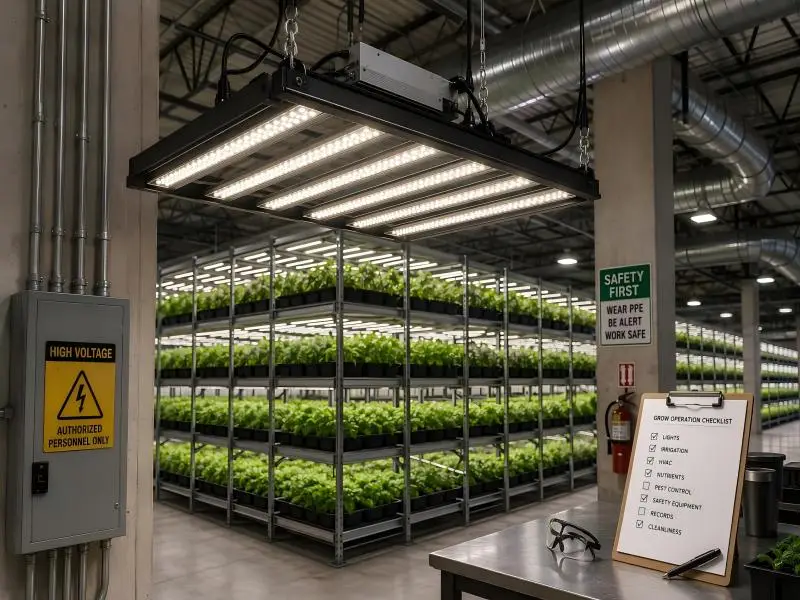
Specifying high-bay LED grow lights in a commercial warehouse is never only a lighting decision. The moment you select them, you have also committed to an electrical distribution design, a safety certification scope, a heat load your mechanical engineer must handle, and a procurement line item that will be audited by a utility rebate reviewer. Treating those as separate workstreams is how projects end up with a fixture schedule that meets its PPFD target but fails inspection, or a room that grows well in January and molds in July.
This guide covers sole-source and supplemental high-bay horticultural LED lighting in commercial warehouse cultivation across North America and Europe. It is written for the operator, facility engineer, or procurement lead who already knows LEDs work and now needs a defensible design sequence: crop target → fixture count and layout → uniformity check → HVAC interaction → certification package → total cost of ownership → commissioning record → multi-site specification control. Each section can be read alone, but the chain only closes if you carry the outputs forward.
A note on terms, defined here once. PPF (photosynthetic photon flux) is a fixture’s total output in µmol/s over 400–700 nm. PPE (photosynthetic photon flux efficacy) is that output divided by total electrical input, in µmol/J. PPFD is the intensity arriving at a surface, in µmol/m²/s. DLI is the daily accumulated dose, in mol/m²/day. PF (power factor) and THDi (total harmonic current distortion) are power-quality metrics your electrical engineer will care about. AHJ is the authority having jurisdiction — the inspector or code official. NRTL is a nationally recognized testing laboratory under OSHA. QPL is the DesignLights Consortium’s Qualified Products List.
Refreshed November 2026. Verify the QPL version in force before any award; the program’s revision cycle is described in the multi-site section below.
Table of Contents
What Makes High-Bay LED Grow Lights Different from General-Illumination High Bays
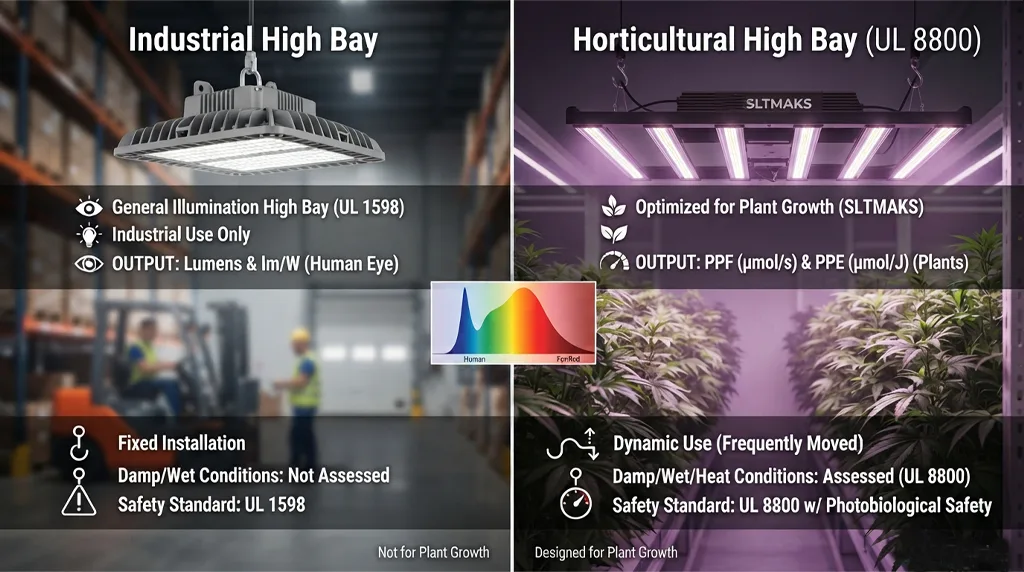
An industrial high bay you would hang over a loading dock and a horticultural high bay can share a housing shape and nothing else. The DLC’s Horticultural Technical Requirements V4.0 defines an eligible product as a complete LED light fixture or module — an electromagnetic radiation-generating device analogous to a luminaire as defined by ANSI/IES LS-1-22. That definition does the sorting work for you.
Output is specified in photons, not lumens. A horticultural fixture is characterized by PPF in µmol/s and PPE in µmol/J. Lumens and lm/W describe light weighted to human vision; they tell you almost nothing about how much photosynthetically usable radiation reaches a canopy. A fixture datasheet that leads with lumen output is a datasheet written for a different buyer.
Far-red is reported but not counted. V4.0 requires reporting of far-red photon flux maintenance (PFMFR, 700–800 nm) but sets no threshold across that range — it is a reported value only. Critically, PPE is calculated over 400–700 nm only. A fixture with heavy far-red output can influence plant morphology while its PPE figure ignores those photons entirely. When you compare two fixtures on PPE, you are comparing their 400–700 nm performance per watt, not their total photon output.
The fixture must survive being moved. UL 8800, the horticultural safety standard, explicitly allows specialized wiring and connection methods because horticultural luminaires are designed to be frequently raised, lowered, or repositioned — unlike fixed general-illumination luminaires. It also evaluates suitability in damp and/or wet environments and at elevated ambient temperatures, applies ingress protection (IP) testing, and addresses UV degradation of polymeric materials. A general-illumination high bay certified to UL 1598 has not been assessed against those conditions.
Photobiological safety is assessed. UL 8800’s photobiological requirements are consistent with IEC 62471 and require the manufacturer to document precautions for eye and skin exposure. In a warehouse where staff work beneath high-output fixtures, that documentation is part of the safety file, not a marketing appendix.
Retrofit kits and light engines are out. V4.0 explicitly excludes products that are light engines or identified as retrofit kits intended to replace light sources or other structures within an existing fixture, products incorporating non-LED light sources (including LED-hybrid fixtures), and lamps of any type. The lamp qualification pathway was removed entirely in V4.0. If you plan to relamp an existing industrial high bay, that path does not lead to a QPL listing — and in most utility programs, it does not lead to a rebate either.
How to Translate a Target PPFD and DLI into Fixture Count and Layout
The arithmetic from crop target to fixture count is short, and every step has an assumption you should write down.
Daily light integral delivered at constant PPFD across three photoperiods, calculated as PPFD × hours × 0.0036. The same DLI can be reached with lower intensity over a longer photoperiod or higher intensity over a shorter one. Photoperiod is a design variable, not a free input: it interacts with photoperiodic flowering responses and with the HVAC schedule. RII’s crop-category DLI guidance (greens 12–17 mol/m²/day; tomatoes, peppers and cucumbers 20–30) is situational guidance, not a requirement, and varies with cultivar, CO₂ and temperature.
Step one: fix the daily dose. DLI (mol/m²/day) = PPFD (µmol/m²/s) × photoperiod (seconds) ÷ 1,000,000. Runkle’s lighting basics handout gives the same relationship as a lookup table, reproduced here for the photoperiods most warehouse operations run:
| Photoperiod | 150 µmol/m²/s | 200 | 250 | 300 | 400 | 500 |
|---|---|---|---|---|---|---|
| 12 h | 6.5 | 8.6 | 10.8 | 13.0 | 17.3 | 21.6 |
| 16 h | 8.6 | 11.5 | 14.4 | 17.3 | 23.0 | 28.8 |
| 20 h | 10.8 | 14.4 | 18.0 | 21.6 | 28.8 | 36.0 |
Values in mol/m²/day. The trade-off is visible: you can reach a given DLI with lower intensity over a longer photoperiod, or higher intensity over a shorter one. Photoperiod is not free — it interacts with photoperiodic flowering responses and with your HVAC schedule — but it is a design variable, not a fixed input.
Step two: pick a starting intensity, scoped correctly. Runkle’s application table gives typical intensities of 150–250 µmol/m²/s for most sole-source crops, higher for cannabis, and 60–100 µmol/m²/s for ornamentals; supplemental greenhouse applications run 60–100 for ornamentals and 100–250 for vegetables. Those are starting ranges for the crop categories the table describes, not universal targets. Your cultivar, growth stage, and market specification set the actual number.
Step three: convert intensity to total photon demand. Total PPF required over the canopy = target PPFD × canopy area. A 500 m² canopy at 600 µmol/m²/s needs 300,000 µmol/s of delivered photon flux.
Step four: divide by delivered PPF, not nameplate PPF. This is where most first-pass layouts go wrong. A fixture rated at 3,000 µmol/s at the test condition does not deliver 3,000 µmol/s to every square meter beneath it at your mounting height and spacing. The delivered figure comes from a layout model or the fixture’s photometric file, evaluated at your planned mounting height and center-to-center spacing.
Carrying the 500 m² example forward: if that model shows each fixture delivering 2,400 µmol/s to the canopy at the planned height and spacing — an illustrative figure taken from a layout model, not a datasheet value — the count is 300,000 ÷ 2,400 ≈ 125 fixtures. Step five’s maintenance factor applies on top of that (at 0.9, roughly 139), and the result then rounds up to a spacing grid that divides the room evenly, because a count that does not tile the canopy leaves gaps at the walls. RII’s lighting guide is blunt about the difference: manufacturer plans offer estimated PPFD targets and uniformity, and the performance of fixtures in a testing lab may not match operational performance once installed.
Step five: apply a maintenance factor. Photon flux maintenance is a real, quantified decline. V4.0 requires Q90 ≥ 36,000 hours for the 400–700 nm range — meaning output is projected to remain at or above 90% of initial for that period. Design to a depreciated value, not to day-one output, and add margin for spill onto walkways and walls. RII notes that spill light is light delivered by grow fixtures that lands on walls and walkways instead of plants; it is a capital cost with no yield return.
Step six: check the count against the room. Fixture count divided by canopy area gives you a power density in W/ft² or W/m². Compare it to your electrical panel capacity and to your HVAC load calculation before you commit. A layout that meets its PPFD target but exceeds the available circuit capacity is not a design.
How to Read a PPFD Uniformity Map and Decide What Uniformity Is Acceptable
A manufacturer’s layout map is a grid of calculated PPFD values at a stated mounting height and spacing, summarized with average, minimum, and maximum. RII reproduces an example: a room schedule with light spacing, section spacing, mounting height, total PPF, power density, average room PPFD, and a cell count showing what percentage of the plant area falls within 10% and within 5% of the target intensity. That last pair of numbers is often more informative than the headline average.
Know which uniformity metric you are reading. Uniformity is commonly expressed as minimum divided by average, or minimum divided by maximum. The two produce very different numbers from the same grid. A map reporting min/average of 0.85 and a map reporting min/max of 0.70 might describe similar rooms. Before you accept a uniformity figure in a bid comparison, ask which ratio it is and over what grid density it was calculated. RII notes that some manufacturers model PPFD on 6-inch grids; coarser grids will report better-looking minimums because they miss the dark spots between fixtures.
Uniformity is a cost driver, and the acceptable value is a business decision. RII frames the trade-off directly: higher uniformity can require more fixtures, while lower uniformity can save capital and operating dollars as long as the canopy is getting what it needs. The variables that should move your answer:
- Crop value per square meter. A high-value crop justifies tighter uniformity because a weak corner is expensive.
- Canopy homogeneity. A uniform crop canopy at a fixed height tolerates more variation than a multi-tier or mixed-stage room.
- Whether the crop can be moved. If plants rotate through positions, a low-intensity corner becomes a temporary condition rather than a permanent penalty.
- Whether the schedule can absorb it. A dimming and control system that trims the bright zones can recover some of the difference.
Measure at the right plane. RII advises ensuring elevation measurements are modeled at the intended finished canopy height, and also at media height for shorter crops like lettuce. A map calculated at floor level describes a room nobody is growing in.
Treat the map as a model, not a measurement. RII’s warning is worth repeating in every bid review: lab-measured performance may not match installed performance. The map tells you what the software predicts given the photometric file and the geometry. The commissioning section below tells you how to find out what the room actually does.
How to Model the HVAC and Dehumidification Load Change When Retrofitting from HPS to LED
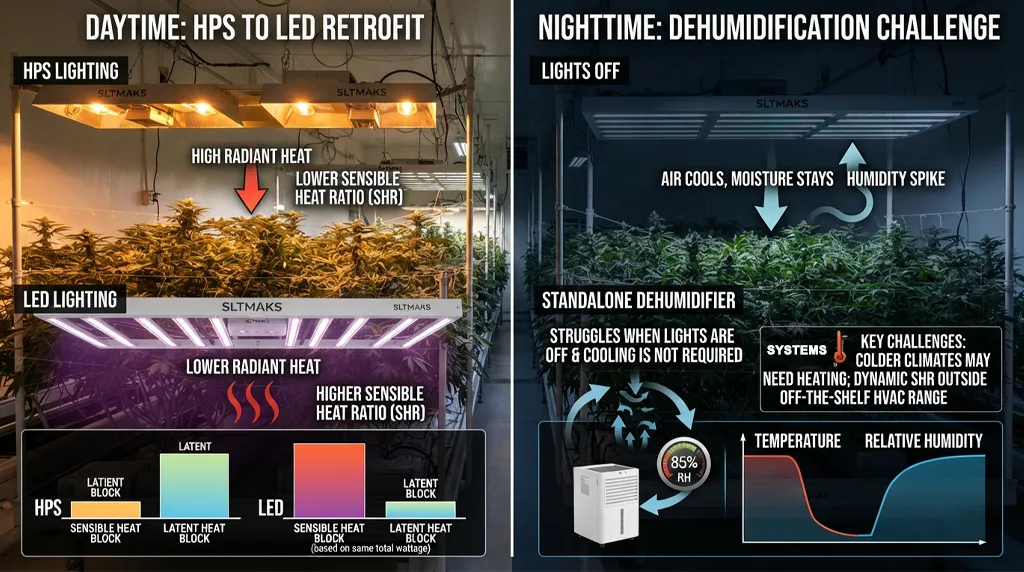
Every watt that enters a luminaire leaves the room as heat eventually. What changes between HID and LED is the split between radiant and convective heat, and that split changes what your mechanical system has to do.
The radiant fraction drops. RII’s lighting guide, citing Lopez and Runkle, shows LED luminaires emitting less radiant heat (expressed in Btu per hour) than HID luminaires of comparable output. Signify’s horticulture guidance makes the same point from the plant side: using the same amount of energy, LED modules deliver more light and less radiant heat, which calls for new growth strategies for high-wire crops. Two consequences follow, both identified by RII:
- Colder climates may need more heating capacity to hold the same greenhouse or warehouse temperature, because the radiant contribution that used to warm the canopy is gone.
- Increasing lighting density can offset the loss. RII suggests considering higher lighting density when retrofitting to LED so the facility does not need to substantially change HVAC systems or add heating capacity. More fixtures means more total electrical input, which means more total heat — just delivered differently.
The latent side is the one that catches operators. RII’s HVAC guide describes the mechanism: relative humidity in cultivation spaces often spikes after lighting systems turn off, because the air begins to cool soon after the lights go out, but the quantity of water in that air does not reduce at the same rate the temperature drops. You get a cooler space holding the same moisture, and RH rises. Standalone dehumidifiers struggle in exactly this window, when lights are off, and cooling is not required.
Sensible Heat Ratio is the design variable. SHR is the ratio of sensible heat load to total heat load (sensible plus latent). RII gives example values: for some CEA crops that need more dehumidification, latent load can be half the total (SHR ≈ 0.5); for crops like lettuce, latent is a smaller share (SHR ≈ 0.8); at night, SHR can be as high as 1. The caution that matters for procurement: typical commercial HVAC systems are manufactured to satisfy static SHR values of 0.7 to 0.9, and are usually not equipped to handle the dynamic ranges CEA facilities experience. A space targeting 80 °F and 60% RH lands near SHR 0.5 — outside what off-the-shelf commercial equipment was built for.
This is a method to run with your mechanical engineer, not a rule of thumb to apply yourself. The inputs are your fixture schedule’s actual wattage and radiant/convective characteristics, your target temperature and humidity setpoints by photoperiod stage, your climate, and your envelope. The output is an equipment selection and a sequence of operation that can follow the lights.
Which Certifications and Documentation an Inspector or AHJ Will Expect
Certification is where a lighting specification becomes an electrical permit. The requirements differ by jurisdiction, so treat North America and Europe as separate workstreams.
North America: safety first. The applicable standard is ANSI/UL 8800 (ANSI/CAN/UL 8800 in Canada). Products must be certified to it by an OSHA-recognized NRTL in the United States or an SCC-recognized body in Canada. UL’s brief on the standard is explicit that code officials — AHJs — will require UL 8800 for grow facilities. What UL 8800 adds over UL 1598, per UL’s own comparison:
- Scope specific to luminaires and grow systems intended for active plant development, not general illumination.
- Photobiological safety requirements consistent with IEC 62471, with documented precautions for eye and skin exposure.
- Wiring and connection methods that support frequent raising, lowering, and repositioning.
- Evaluation for damp and/or wet environments and elevated ambient temperatures.
- IP testing to classify protection against solid objects and water.
- Requirements addressing UV exposure of polymeric materials.
The documentation package. The DLC’s safety certification policy spells out what a reviewer expects: a compliance certificate from the approved safety organization bearing the manufacturer’s name — commonly a Certificate of Compliance or Authorization to Mark, varying by body (Intertek issues an Authorization to Mark; UL a Certificate of Compliance or Notice of Authorization; CSA a Certificate of Compliance; DEKRA a Certificate). The manufacturer digitally signs an agreement that the documentation covers all models listed. If the safety documentation is later updated such that a listed model is no longer covered, the manufacturer must submit the revision or risk delisting.
The QPL listing and its thresholds. For rebate eligibility, the fixture should appear on the DLC Horticultural QPL. V4.0, effective April 18, 2025, sets the thresholds a reviewer will check:
| Parameter | V4.0 requirement |
|---|---|
| PPE | ≥ 2.5 µmol/J |
| Power factor | ≥ 0.90 at any reported input voltage, full output |
| THDi | ≤ 20% at any reported input voltage, full output |
| Photon flux maintenance (400–700 nm) | Q90 ≥ 36,000 h |
| Driver lifetime | ≥ 50,000 h |
| Fan lifetime | ≥ 50,000 h at or above the fixture’s highest rated ambient |
| Fixture warranty | ≥ 5 years, covering the complete luminaire |
The PPE floor is an 8.7% increase over V3.0 and sits more than 45% above the most efficacious non-LED option, the 1000 W double-ended HPS luminaire. The DLC projected it would delist roughly 11% of the least efficacious V3-listed products.
The V3.0 delist date is a live procurement risk. The DLC’s program page lists Hort V3.0 with a delist date of January 6, 2026. As of this refresh, that date has passed; any specification still citing a V3.0-only listing is citing a listing that no longer exists. Confirm the current status of every model number on the QPL before award.
Europe: CE marking is a declaration, not a certificate. CE marking is the manufacturer’s declaration that the product meets the applicable EU directives, supported by an EU declaration of conformity and technical documentation. It is not issued by a third party. RoHS is among the material requirements a horticultural luminaire must satisfy. If you are procuring in Europe, ask for the declaration of conformity and the technical file reference, not a certificate — and note that private “CE certificates” are not legally recognized.
How to Compare Fixtures on a Total Cost of Ownership Basis
A fixture comparison on capex per unit is close to meaningless across different wattages and efficacies. Normalize on two numbers: cost per installed µmol/s of delivered PPF, and cost per year of operation at your actual schedule.
Arithmetic from PPE = PPF ÷ input power, holding delivered photon output fixed at 1,000 µmol/s. Assumes all electrical input becomes heat within the conditioned space and that no ducting or liquid cooling removes heat from the room; dehumidification load is separate and driven by evapotranspiration, not by lighting equipment directly. Higher efficacy lowers input watts for the same photon output, which lowers both energy cost and the sensible heat the mechanical system must handle.
Line items to carry:
- Capex per fixture and per installed µmol/s. Use delivered PPF at your mounting height, not nameplate. A cheaper fixture that needs more units to hit the target is not cheaper.
- Energy. Input wattage × operating hours × your tariff. Use the fixture’s reported input wattage at full output, and model your actual dimming schedule if you run one.
- HVAC energy interaction, in both directions. In cooling-dominated rooms, LEDs’ lower radiant fraction can reduce sensible cooling load — but the same watts still enter the space. In heating-dominated rooms, you may add heating capacity. Model both against your climate.
- Driver and fan replacement at rated life. V4.0 requires driver and fan life ≥ 50,000 hours. At 16 hours per day, 50,000 hours is roughly 8.5 years; at 20 hours, about 6.8 years. Put the replacement cost in the year it lands.
- Spare fixture inventory. A small spares pool avoids a dark position while a warranty claim is processed.
- Dimming and controls. The control protocol determines whether you can run stage recipes or only on/off cycles. V4.0 requires dimming capability to be reported (or required, depending on product attributes) and lists acceptable control types, including 0–10 V under IEC 60929 Annex E and ANSI C137.1. Verify the driver’s minimum output — some fixtures cut out below a threshold and give you a step instead of a ramp.
- Rebate eligibility is tied to QPL status at the time your program requires. Utility programs commonly require DLC listing at the time of incentive reservation, purchase, installation, or inspection; rules vary by program. A delisting between award and inspection can turn an expected rebate into a shortfall.
The framing that should anchor the comparison. The DLC’s own V4.0 document states that lighting is the largest operational expense in controlled environment agriculture, and that there are significant opportunities to increase energy efficiency and cost savings with the right lights. That is the case for spending engineering time on this decision rather than treating it as a commodity purchase.
Keep sourced inputs separate from your own numbers. The 2.5 µmol/J PPE floor, the 50,000-hour driver and fan life, and the five-year warranty minimum are program requirements you can cite. Your tariff, your labor rate, your maintenance schedule, and your discount rate are yours. Mixing them in a single spreadsheet is fine; presenting them in a bid comparison as if they came from the same source is not.
How to Verify Installed Performance at Canopy Height After Commissioning
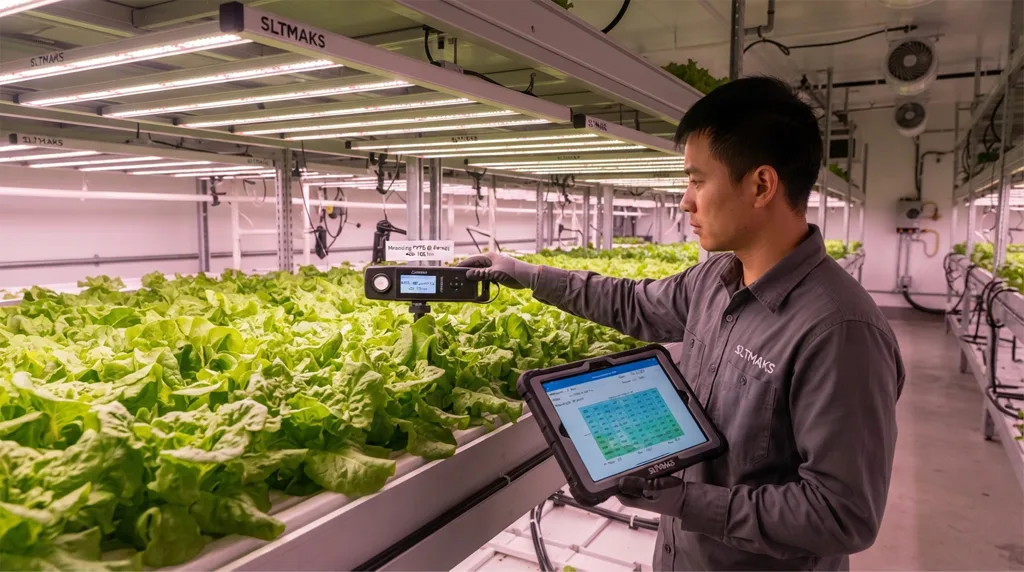
Commissioning is the step that converts a design into a record. It is also the step most often skipped, which is why so many rooms are discovered to be underlit a full crop cycle after handover.
Define the measurement plane. Measure at the intended finished canopy height, not the floor. For short crops like lettuce, RII advises also measuring at media height. A floor-level measurement in a room with raised benches describes a surface no plant occupies.
Set the grid. RII notes some manufacturers model PPFD on 6-inch grids. Match your measurement grid to the model’s grid density, or finer, so the comparison is meaningful. Record the coordinates of each measurement point so the map can be reproduced.
Use the right instrument and state. A quantum meter reading PPFD in µmol/m²/s over 400–700 nm, calibrated, held level at the measurement plane. Record the time of day, the dimming state, and the fixture output setting. A measurement taken at 80% dimming is not comparable to a design map calculated at full output.
Record in a format that compares to the design map. The record should carry: date, technician, instrument model and calibration date, mounting height as installed, center-to-center spacing as installed, dimming state, and the grid of measured values with average, minimum, and maximum. RII’s guidance on final reports asks for average PPE and PPFD of each cultivation space, verification that fixtures are running at the temperature the project team forecasted, and an acknowledgment that measurements may carry a ±5–10% error band. Visual maps of spaces as lit help operations and maintenance staff troubleshoot later.
Handle the gap honestly. If measured PPFD is below the model, check the inputs before assuming the fixture is at fault: mounting height as installed versus as modeled, spacing as installed versus as specified, dimming state, input voltage, and whether the shipped model number matches the one modeled. If the gap persists, document it and take it to the manufacturer with the photometric file and the measurement record. Do not adjust the design target to match the measurement.
Tie the record to the schedule and the paperwork. The commissioning record belongs with the fixture schedule, the safety certificates, and the QPL listing printout for each model number. If a rebate or warranty claim is later questioned, that package is your evidence.
How to Keep Specifications Consistent Across Multiple Sites and Procurement Cycles
A single-site specification can be a cut sheet and a purchase order. A multi-site specification has to survive buildings, phases, bid cycles, and program revisions. The failure mode is a substitution that looks equivalent on a bid form and is not equivalent in the room.
Specify full model numbers. V4.0 requires manufacturers to list full model numbers that clearly demonstrate all qualified product options offered — including all performance-affecting and non-performance-affecting variations, with no option omitted that is available to customers. Options that do not affect performance may be bracketed in a single model number (for example, exterior paint or mounting options). Voltage variants may be submitted as a single model number with the worst-case performance reported, for example “ABC 300 [120V-277V, 347V-480V] WH.” The DLC reserves the right to check web listings and marketing materials, and misrepresentation of model numbers may result in delisting.
For your specification, this means you can write a model number that covers a voltage range, but you should state which variant you are installing and confirm the safety certificate covers it.
Lock the fixture schedule with revision control. Every revision gets a number, a date, and a reason. Substitutions require a written equivalence package: the proposed model number, its QPL listing, its safety certificate, its photometric file, and a layout re-run at your mounting height and spacing. A substitution that is not re-modeled is not equivalent.
Record the QPL version in force at each award date. The DLC operates a preset revision cycle: 24-month major revisions focused on efficacy and structural updates, and 12-month minor revisions focused on administrative and process improvements. That cycle is predictable, which means you can plan for it. Write the specification to reference the QPL version in force at the award date, and require the contractor to confirm the listing is still active at the inspection date. If a major revision lands between award and installation, you have a defined re-qualification event rather than a surprise.
Write a change-control rule that survives the cycle. The rule should say: no substitution without a re-run layout, a current QPL listing, a safety certificate covering the shipped configuration, and written approval from the owner’s representative. It should also say what happens if a listed model is delisted mid-project — typically, the contractor proposes an equivalent listed model and the owner re-runs the layout before accepting. Put the rule in the specification, not in a side letter.
Where the Design Sequence Breaks: Common Failure Points
Five failure points account for most of the problems this sequence is designed to prevent. Each is addressed in the section noted.
- Designing to nameplate PPF instead of delivered PPFD. The fixture’s test-condition output is not what reaches your canopy at your mounting height and spacing. See the fixture-count section.
- Accepting a uniformity number without knowing which metric it is. Min/average and min/max are different numbers from the same grid, and grid density changes the answer. See the uniformity section.
- Retrofitting to LED without re-running the heat and latent load. The radiant fraction drops, the latent spike at lights-off remains, and the SHR range may fall outside what commercial HVAC was built for. See the HVAC section.
- Specifying a fixture whose QPL listing lapses before inspection. The V3.0 delist date has passed; the revision cycle is predictable. See the certification and multi-site sections.
- Commissioning without a measurement record. Without a grid measurement at canopy height, you have no baseline for troubleshooting, no evidence for a rebate or warranty claim, and no way to know whether the room matches the model. See the commissioning section.
Further Reading and Source Documents
Keep these on hand through design, procurement, and commissioning. Links point to the primary documents where available.
- DLC Horticultural Technical Requirements V4.0 — the qualification framework, thresholds, and model-number rules.
- DLC Horticultural Lighting program page — current version status, delist dates, and the revision cycle.
- DLC Safety Certification Requirements — the documentation package an applicant must submit.
- DLC Horticultural QPL — verify each model number before award.
- RII CEA Lighting Best Practices Guide — layout, uniformity, spill light, and manufacturer plan review.
- RII CEA HVAC Best Practices Guide — SHR ranges, latent load, and the lights-off humidity spike.
- DOE SSL horticulture energy-savings study — market context and energy-savings potential.
- DOE fact sheet: Understanding LM-79 Reports — what a photometric report should contain and how to read it.
- DOE SSL fact sheet: Lifetime and Reliability — lumen maintenance, L70/Q90, and the limits of lifetime projections.
- UL Solutions brief on UL 8800 — what the horticultural safety standard adds over UL 1598.
- Runkle, The Basics of Plant Lighting — PPFD, DLI, and application intensity ranges by crop category.
- European Commission guidance on CE marking — the declaration-of-conformity route for EU procurement.
Refreshed November 2026. Check the QPL version in force before any award, and confirm the listing status of every model number at the inspection date.
FAQ
Can a general-illumination high bay be converted into high-bay LED grow lights?
Not through a relamp or retrofit kit that will qualify for the QPL. V4.0 excludes light engines, retrofit kits intended to replace light sources within an existing fixture, and lamps of any type. A general-illumination high bay certified to UL 1598 has also not been evaluated against UL 8800’s horticultural requirements — repositioning-friendly wiring, damp/wet and elevated-temperature suitability, IP testing, photobiological safety, and UV exposure of polymers. See the fixture-difference section.
What PPE figure should I require when selecting high-bay LED grow lights?
The V4.0 listing floor is 2.5 µmol/J. Treat it as a filter, not a differentiator — many listed products clear it. Compare shortlisted fixtures on their photometric files at your mounting height and spacing, and on delivered PPF per dollar of installed cost. See the TCO section.
Does far-red count toward efficacy for commercial high-bay LED grow lights?
No. PPE is calculated over 400–700 nm only. Far-red photon flux maintenance (700–800 nm) is a reported value under V4.0 with no threshold. A fixture with substantial far-red output can affect plant morphology while its PPE figure excludes those photons. See the fixture-difference section.
How much uniformity is enough when designing layouts with high-bay LED grow lights?
There is no universal number. Uniformity is a cost driver: higher uniformity generally requires more fixtures, while lower uniformity can save capital and operating costs if the canopy still receives its target. The acceptable value depends on crop value, canopy homogeneity, whether the crop can be moved, and whether the schedule can absorb the variation. Specify which metric (min/average or min/max) and at what grid density. See the uniformity section.
Is a DLC listing legally required for commercial high-bay LED grow lights?
No. The DLC QPL is a voluntary qualification program, not an electrical code. The legally required element is safety certification to ANSI/UL 8800 by an OSHA NRTL or SCC-recognized body. The QPL listing is what utility rebate programs typically require, and it is what a procurement reviewer will check. See the certification section.