
Investing in high-quality full-spectrum LED grow lights is the most effective way to ensure your indoor plants receive the precise light energy they need to thrive year-round. Indoor plants are more than just décor – they are living systems that depend on light for every aspect of growth, color, and health. But in modern homes and apartments, natural sunlight is often inconsistent or simply not available in the right place. This is where full-spectrum LED grow lights for indoor plants come in. They recreate the balanced, photosynthetically active light your plants would receive outdoors, but in a controllable, energy-efficient way.
In this guide, we’ll walk you through what “full spectrum” really means, why it matters, and how to choose and use the right LED grow lights for your indoor garden. You’ll also see how SLTMAKS designs full-spectrum fixtures that deliver natural sunlight indoors – while staying friendly to your energy bill.
Table of Contents
Why Indoor Plants Need Full-Spectrum Light

Plants See Light Differently Than We Do
Humans judge light by brightness and color temperature, but plants “see” light through photosynthesis. They respond mainly to wavelengths in the Photosynthetically Active Radiation (PAR) range, from 400 to 700 nm. Within this band, blue, green, and red light all contribute to photosynthesis and plant morphology in different ways.
Because of this, a lamp that looks bright and white to our eyes may still be inefficient for plant growth if it doesn’t deliver enough usable photons in the PAR range.
What Makes Full-Spectrum LED Grow Lights Different
Full-spectrum LED grow lights for indoor plants are designed to mimic the spectral distribution of natural sunlight, not just emit a single color such as pure red or pure blue. University extension services and horticulture experts consistently recommend full-spectrum or “white” light as the most balanced option for long-term indoor plant health, especially for mixed collections of foliage and flowering plants.
With a well-engineered spectrum, your plants receive:
- Enough blue light for compact growth and strong leaves.
- Enough red light to support flowering and fruiting.
- Green and mid-range wavelengths that improve canopy penetration and overall photosynthesis efficiency.
What “Full Spectrum” Really Means
Beyond “Blurple”: Natural White Light
Early LED grow lights often used only red and blue diodes, resulting in a purple glow, commonly referred to as “blurple.” While effective for photosynthesis, these lights can be visually harsh, making it difficult to assess plant health. Newer full-spectrum LED grow lights for indoor plants combine multiple diode types to produce a natural-looking white light that’s pleasant for humans and productive for plants.
Extension resources from the University of Maine highlight that full-spectrum (white) light remains the best all-around choice for most indoor gardeners, offering balanced growth and more natural colors.
For a deeper dive, you can refer to:
- University of Maine Extension – Growing Houseplants Under Artificial Lights
- Kansas State University – Grow Lights for Home and Garden
Color Temperature (CCT) and CRI
When shopping for full-spectrum LEDs, two specifications matter for both plants and aesthetics:
- CCT (Correlated Color Temperature): Measured in Kelvins (K). A CCT around 5000–6500K closely resembles daylight and is commonly recommended for indoor gardening.
- CRI (Color Rendering Index): Indicates how accurately colors appear under the light compared to sunlight. Full-spectrum fixtures with a CRI above 85 let your plants’ true colors show and make it easier to identify nutrient deficiencies or pests.
The University of Vermont Extension recommends full-spectrum grow lights with high CRI values to provide a near-natural sunlight experience indoors. See their guidance here:
PAR, PPF, and PPFD in Simple Terms
To move beyond watt labels and marketing claims, it helps to know three basic metrics:
- PAR (Photosynthetically Active Radiation): The wavelength range (400–700 nm) that plants use for photosynthesis – not a unit by itself.
- PPF (Photosynthetic Photon Flux): Total number of PAR photons a light emits per second (µmol/s).
- PPFD (Photosynthetic Photon Flux Density): Number of PAR photons hitting each square meter of your plant canopy every second (µmol/m²/s).
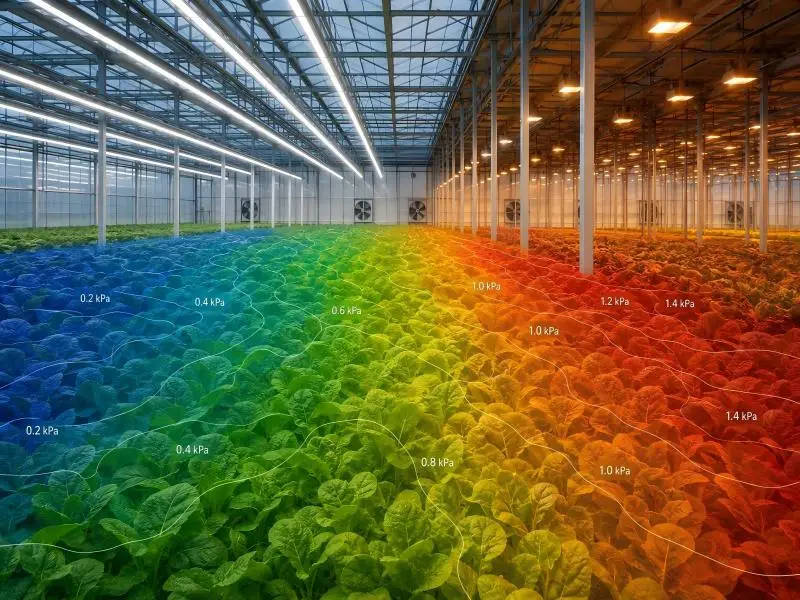
Think of PPFD as “how much usable light your plants actually receive.” Quality manufacturers of full spectrum led grow lights for indoor plants provide PPFD maps so you can see light distribution across your grow area.
Science-Backed Benefits of Full-Spectrum LEDs
Proven by Universities and Space Agencies
LED plant lighting is not just a trend; it is backed by decades of research. NASA and other institutions have tested LEDs extensively for controlled-environment agriculture and space missions, showing that carefully tuned spectra can support robust plant growth while using significantly less energy.
To explore this research, you can review:
- NASA – Research Boosts LED Lamps for Home and Garden
- NASA – Growing Plants in Space
- ScienceDirect – Significant Reduction in Energy for Plant-Growth Lighting
Balanced Blue and Red for Healthy Growth
Research shows that red and blue light are both crucial for photosynthesis. Red light supports vegetative growth and flowering, while blue light controls leaf thickness, chlorophyll content, and compact plant form.
Full spectrum LEDs incorporate:
- Enough blue to avoid leggy, stretched plants.
- Ample red to promote flowering and biomass.
- Additional green and far-red to fine-tune plant responses and improve canopy penetration.
Scientific articles such as “Effects of LED Red and Blue Light Component on Growth” (Horticulturae, 2022) provide detailed evidence on how different red: blue ratios affect crop development.
Energy Efficiency and Low Heat
Compared with traditional HID or fluorescent lighting, high-quality full-spectrum LEDs:
- Deliver more usable photons per watt of power input (higher efficacy).
- Produce less radiant heat near the plant canopy, reducing the risk of leaf burn.
- Have longer lifespans, lowering replacement and maintenance costs.
For home growers, this means you can run full- spectrum LED grow lights for indoor plants closer to foliage, for longer hours, with less worry about overheating your growing area.
Choosing Full-Spectrum LED Grow Lights for Indoor Plants
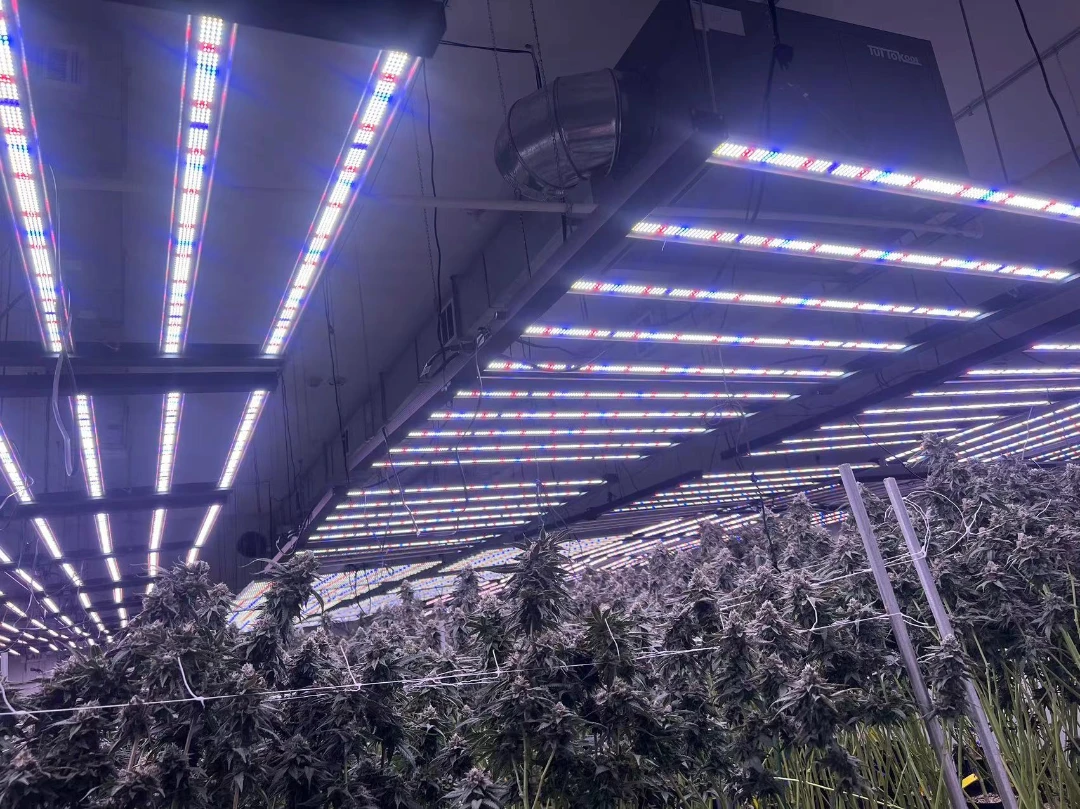
Define Your Grow Space and Plant Types
Start by measuring your grow space and listing your plants:
- A small shelf with herbs and succulents.
- A 60 × 60 cm (2 × 2 ft) tent with leafy greens.
- A 120 × 60 cm (2 × 4 ft) rack with houseplants and small fruiting crops.
Different plants have different light needs. University of Minnesota Extension, for example, suggests matching plant species to your available light levels and providing additional artificial light for medium- and high-light plants when necessary.
参考阅读:
- University of Minnesota Extension – Lighting for Indoor Plants and Starting Seeds
- Iowa State University – Sources of Supplemental Light for Indoor Plants
Key Technical Specs to Look At
When evaluating full-spectrum LED grow lights for indoor plants, pay attention to:
- Power draw (Watts): Real power consumption, not just “equivalent”.
- PPFD at different distances: Look for PPFD maps over your intended grow area, not just a single center value.
- Efficacy (µmol/J): Higher values mean more light per watt.
- Spectrum chart: Check that the fixture provides a smooth, full spectrum with strong output in the blue and red regions and additional mid-range wavelengths.
- Dimming and control: Adjustable output lets you fine-tune intensity for seedlings, mature plants, and different seasons.
- Form factor: Bars, boards, panels, or strips to fit your specific space.
Safety, Reliability, and Certifications
Quality full-spectrum LED grow lights should also offer:
- Stable drivers and thermal management to protect LEDs and maintain consistent output over time.
- Over-temperature and short-circuit protection for safe long-term indoor use.
- Certifications (such as CE, RoHS, UL/ETL, where applicable) to meet regional safety standards.
Choosing a reputable manufacturer like SLTMAKS ensures you’re not only getting the right spectrum but also long-term reliability and support.
How to Use Full-Spectrum LED Grow Lights Indoors
Hanging Height and Coverage
The optimal hanging height for full spectrum led grow lights for indoor plants depends on:
- The fixture’s power and optics.
- Your plants’ light requirements.
- The growth stage (seedling vs mature plant).
As a general starting point for many SLTMAKS full-spectrum fixtures:
- Seedlings & young plants: 30–45 cm (12–18″) above the canopy with lower intensity or dimming.
- Established foliage plants: 30–60 cm (12–24″) above the canopy at moderate intensity.
- Light-hungry flowering or fruiting plants: 25–40 cm (10–16″) above the canopy with higher intensity and careful monitoring.
Always observe your plants: pale leaves and stretching can indicate too little light; leaf curling or bleaching may suggest too much light or heat.
Daily Light Duration (Photoperiod)
Most indoor plants respond not just to light intensity but also to the number of hours of light per day. University extension guides often recommend:
- 12–14 hours for many foliage houseplants.
- 14–16 hours for herbs and leafy greens.
- Up to 18 hours for some high-light vegetables and seedlings.
Using plug-in timers or smart controllers makes it easy to maintain consistent photoperiods and schedule automatic on/off cycles.
Positioning Plants for Even PPFD
For best results:
- Place plants under the central, brightest zone of your PPFD map.
- Rotate pots every few days for balanced growth.
- Use reflective surfaces (tents, mylar, or white walls) to reduce light loss at the sides.
- Adjust fixture height gradually as plants grow taller to keep PPFD in the optimal range.
With SLTMAKS fixtures, we design bar-style and board-style layouts to minimize hot spots and dark corners, helping you achieve more uniform coverage across your entire shelf or tent.
Example Setups Using Full-Spectrum LED Grow Lights
Windowsill Upgrade: Houseplants and Small Herbs
Goal: Keep a mixed collection of pothos, philodendrons, and a few herb pots thriving through winter.
Recommended approach:
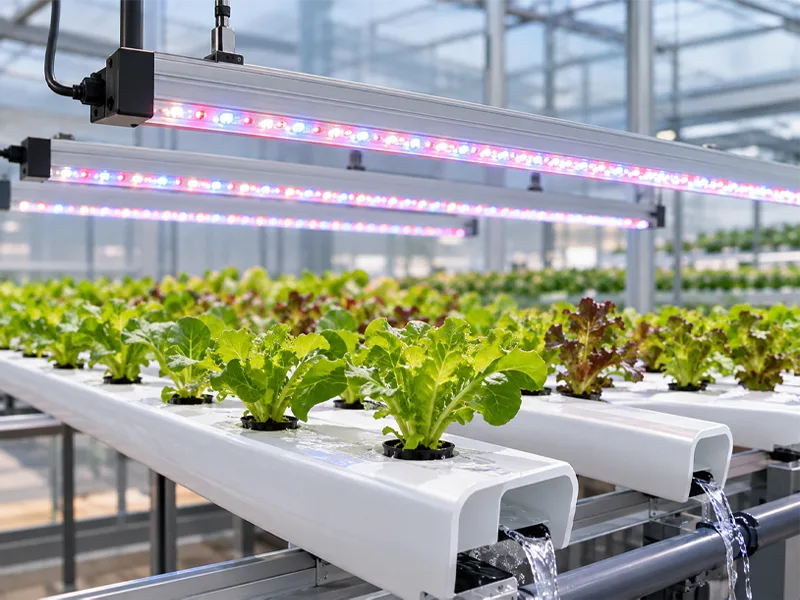
- Use a compact full-spectrum LED grow light for indoor plants mounted above the windowsill.
- Aim for a moderate PPFD (100–250 µmol/m²/s) across the foliage.
- Run the light 10–14 hours per day to supplement weak winter sun.
Result: Your leafy plants maintain compact growth, richer greens, and fewer dropped leaves than under natural window light alone.
Grow Shelf for Seedlings and Microgreens
Goal: Start vegetables, flowers, and microgreens indoors before transplanting outdoors.
Recommended approach:
- Install slim full-spectrum LED bars under each shelf tier.
- Place trays 15–30 cm (6–12″) below the lights.
- Provide 14–16 hours of light per day to produce short, sturdy seedlings.
By combining full-spectrum LEDs with proper watering and nutrients, you reduce spindly, stretched seedlings and improve transplant survival rates, as supported by many extension guides on seed starting under lights.
2×4 ft Grow Tent: Leafy Greens and Fruiting Plants
Goal: Grow lettuce, peppers, and compact tomatoes in a 60 × 120 cm (2 × 4 ft) tent year-round.
Recommended approach:
- Use a high-output SLTMAKS full-spectrum fixture sized specifically for 2×4 ft coverage.
- Maintain PPFD between 250–500 µmol/m²/s for leafy greens and up to 600–800 µmol/m²/s for fruiting crops.
- Use dimming and adjustable hanging height to manage intensity as plants mature.
In this scenario, full spectrum led grow lights for indoor plants let you simulate long summer days in any season, unlocking consistent yields even in apartments or urban homes.
Why Choose SLTMAKS Full-Spectrum LED Grow Lights
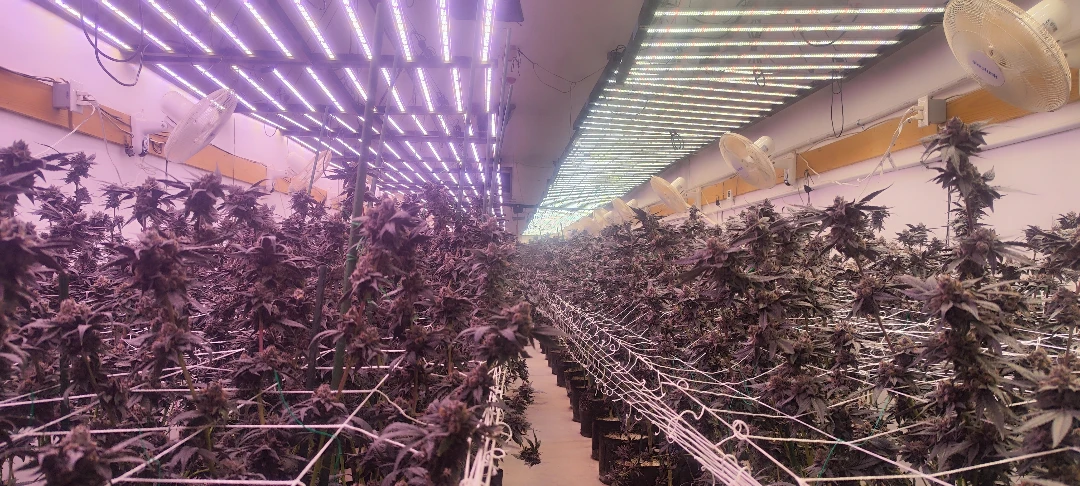
Engineered Spectrum Inspired by Plant Science
At SLTMAKS, we don’t guess our spectra. We design full-spectrum LED grow lights for indoor plants based on:
- Scientific findings on red/blue ratios and the importance of green and far-red light for plant morphology and canopy penetration.
- Insights from controlled-environment agriculture, NASA’s space research, and university horticulture programs.
The result is a balanced spectrum that supports seedlings, foliage plants, and flowering crops – all under one natural-looking light.
High Efficiency and Long Service Life
Our fixtures are designed for:
- High photon efficacy, converting more watts into usable PAR light.
- Optimized thermal paths, keeping LEDs cool and stable to extend lifespan.
- Robust drivers and components, suitable for continuous operation under real-world conditions.
For growers, this means lower electricity costs, less heat management, and fewer lamp replacements – especially important if you run multiple fixtures or grow year-round.
Flexible Solutions for Home Growers and Professionals
Whether you’re an indoor plant enthusiast or a commercial grower, SLTMAKS offers:
- Compact lights for desks, windowsills, and plant corners.
- Bar and board systems for shelves, grow tents, and vertical farms.
- Custom solutions tailored to specific crops and installations.
Our technical team can help you interpret PPFD charts, match fixtures to your grow area, and optimize hanging heights and scheduling to get the most from your full-spectrum LED grow lights for indoor plants.
FAQ
Are Full-Spectrum LED Grow Lights Safe for People and Pets?
Yes. Full-spectrum LEDs designed for indoor use are safe when installed and operated correctly. They produce minimal UV and less heat than many traditional lights. However, avoid staring directly at bright LEDs at close range, and ensure fixtures are mounted securely out of reach of small children and pets.
Can I Use Regular LED Bulbs Instead of Grow Lights?
Some high-quality, high-CRI daylight LED bulbs can support modest plant growth, especially for low-light houseplants. However, dedicated full-spectrum LED grow lights for indoor plants are engineered for higher PPFD, better spectral balance, and more uniform coverage. Extension resources, such as those from Kansas State University and Iowa State University, emphasize the benefits of fixtures specifically marketed and tested as grow lights for better performance.
How Do I Know If My Plants Are Getting Enough Light?
Look for these signs:
Healthy light levels: Compact growth, rich leaf color, and new leaves emerging regularly.
Too little light: Stretching, pale foliage, slow growth, leaves leaning strongly toward the light source.
Too much light: Bleached leaves, brown tips, or crispy patches, especially on upper leaves closest to the light.
If you want precise measurements, consider a PAR or PPFD meter to confirm that your full-spectrum LED grow lights for indoor plants deliver the recommended µmol/m²/s for your specific plant species.
Do I Need Different Spectra for Veg and Bloom?
Advanced commercial growers sometimes adjust the spectrum by adding more red or far-red for flowering. However, for most home and small-scale growers, a well-balanced full-spectrum is sufficient for both vegetative and flowering stages. With SLTMAKS fixtures, you can focus more on managing light intensity and photoperiod rather than constantly changing lamps.
Bring Natural Sunlight Indoors with SLTMAKS
Full-spectrum LED technology has transformed indoor gardening. You no longer need south-facing windows or bulky, hot HID lamps to maintain lush foliage and abundant harvests. With carefully designed full-spectrum LED grow lights for indoor plants, you can:
Recreate the quality and quantity of sunlight in any room.
Support healthy, compact growth for a wide range of species.
Enjoy beautiful, natural-looking light that showcases your plants instead of washing them in purple.
At SLTMAKS, we bring together years of LED grow light R&D, rigorous testing, and real grower feedback to deliver fixtures you can trust. Whether you’re lighting a single shelf or building a full indoor garden, our full-spectrum LED grow lights are here to help you create natural sunlight indoors – on your terms.
If you’re ready to design your indoor lighting setup or upgrade from older fixtures, reach out to the SLTMAKS team. Let’s build a lighting solution that keeps your plants thriving, season after season.