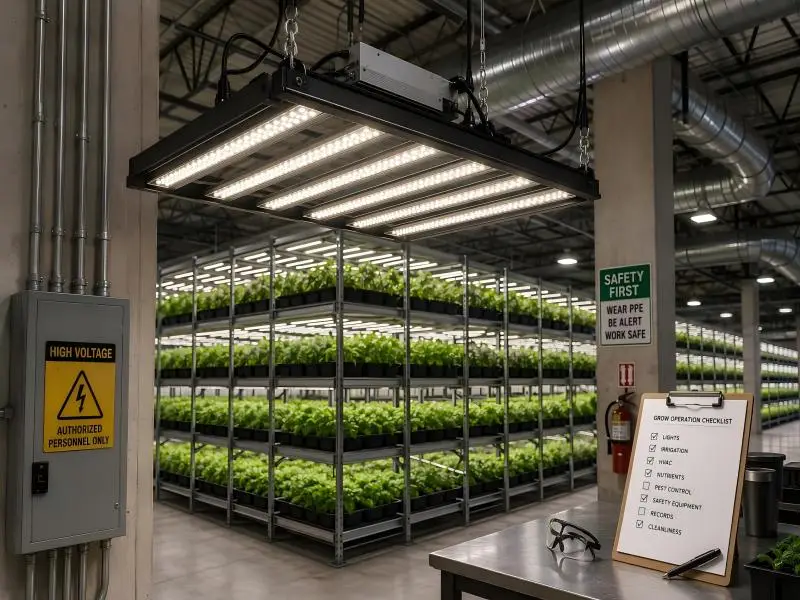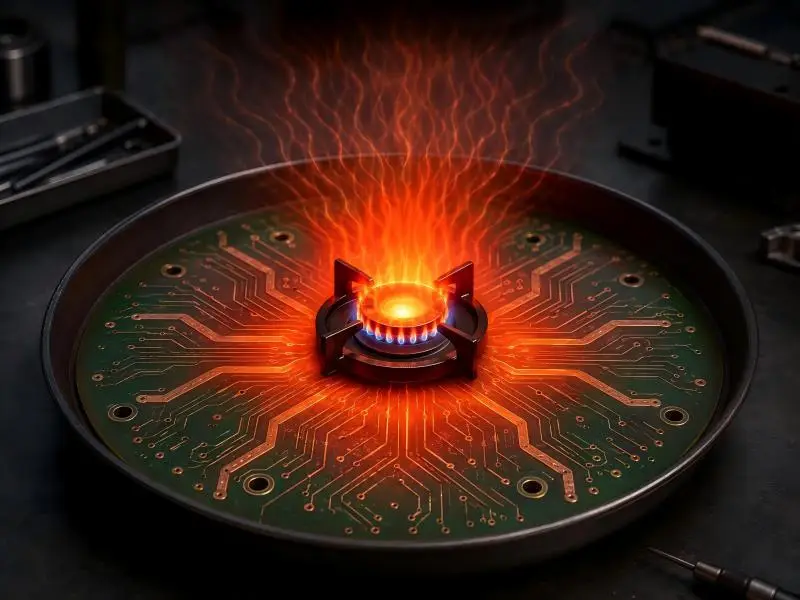
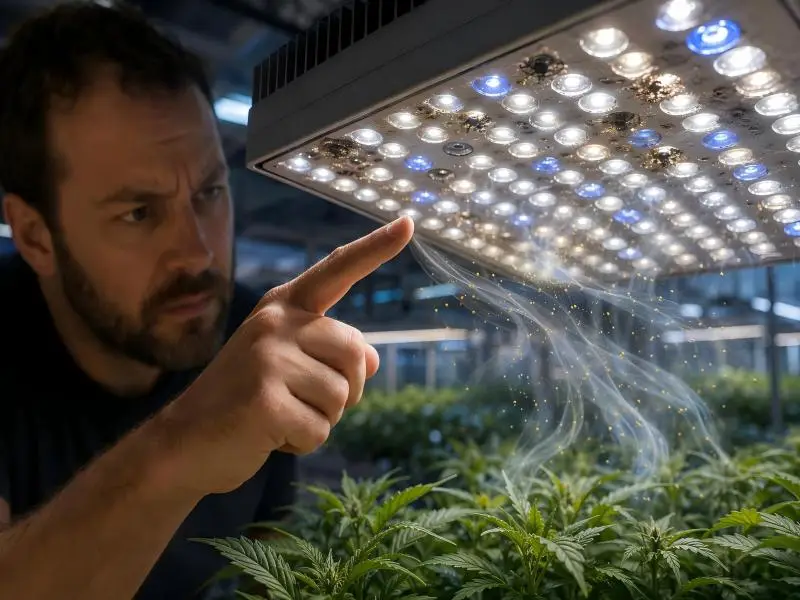
A fixture rated for damp locations comes back from a grow room with a row of blackened diodes. The room was humid, so the failure gets filed as a moisture problem — but moisture is rarely what attacks the LED. The real culprit is LED diode sulfuration, a chemical reaction driven by sulfur-bearing gases while humidity and heat act as accelerants once the gas diffuses through the encapsulant.
Inside a white LED, the lead frame and bond pads are typically plated with silver, chosen for its reflectivity and electrical performance. Sulfur-bearing gases — hydrogen sulfide (H2S) above all — diffuse through the silicone encapsulant and convert that silver into silver sulfide, which is dark and non-conductive. The diode dims, shifts color, or opens entirely. Humidity and heat do not cause the corrosion on their own; they raise the rate at which it proceeds.
That distinction changes what prevention looks like. A manufacturer cannot simply seal a grow light against water and call the problem solved. It has to control which materials sit near the diode, choose a package robust enough for the environment, protect the assembly appropriately, and then prove the result with the right test. This article walks through those defense layers in order, then gives procurement teams a checklist for verifying anti-sulfur claims before a purchase order is signed.
Table of Contents
Why Humidity Accelerates LED Diode Sulfuration
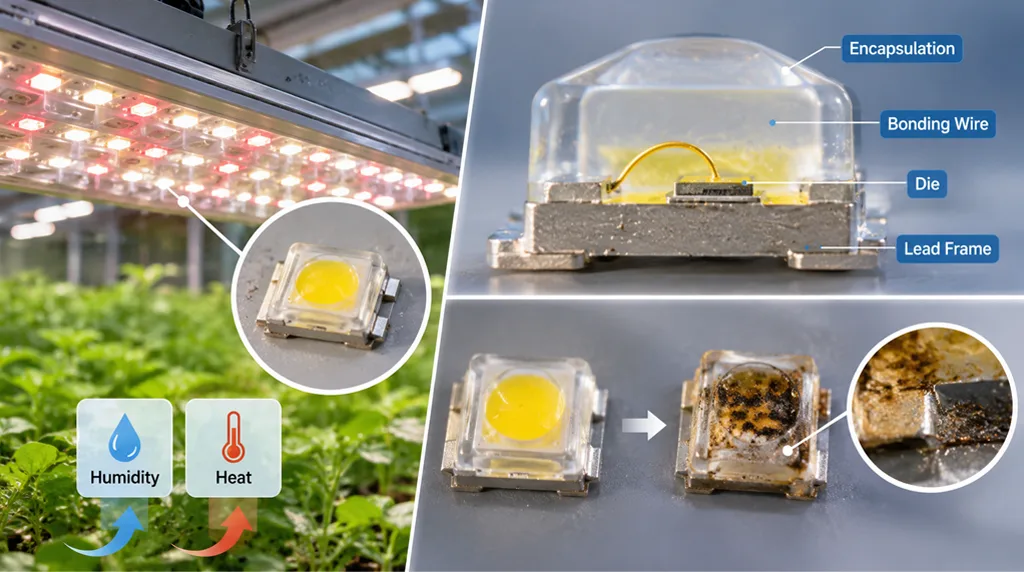
Start with the package. A typical surface-mount LED consists of a metal lead frame, a chip bonded or soldered to it, a bonding wire providing the second electrical contact, and an encapsulation — usually silicone or epoxy — cast over the die and wire. Each material choice affects how easily corrosive gases reach the metal underneath.
Corrosive gases penetrate through the encapsulation. How fast depends on the encapsulant and on the specific LED design: epoxy is typically less permeable than silicone, and silicones themselves vary widely in permeability. Once H2S reaches the lead frame, it reacts with the silver plating. The silver layer transforms into silver sulfide, which shows up as brown or black discoloration on a clear-cast package. Because silver sulfide is not electrically conductive and occupies more volume than the silver it replaces, the reaction can mechanically separate the bond wire from the contact pad — an open circuit, not just a dimmer light.
Humidity’s role is best understood as acceleration. The ams OSRAM application note on corrosive materials identifies concentration level and temperature as the main influencing factors, while noting that heat, humidity, and light can each accelerate a corrosive process. Luminus states the same relationship more directly: increased humidity levels or heat enhance the reaction and increase the formation rate and amount of metal-sulfur intermetallics.
For a grow-room operator, the practical consequence is that a humid room is a higher-risk room even when nobody has introduced sulfur deliberately. Moisture raises the reaction rate, and heat from the fixture itself raises it further. The corrosion still needs a sulfur source — which is the subject of the next section.
Where the Sulfur Actually Comes From
Sulfur is not exotic. It is present at low levels in ordinary air, and it outgasses from a long list of common materials. The ams OSRAM note separates its list into confirmed cases and theoretical sources, and the distinction is worth preserving.
Actual cases known to the manufacturer include O-rings, gaskets, organic rubber, foam pads, rubber sealing, elastomer vulcanized with sulfur, and anti-vibration pads. Theoretical sources include thermal conductive pads, contaminated PCB material, solder resist, stop-off lacquer, paper and paperboard, and industrial environments with high sulfur or sulfide concentration. Luminus adds cardboard, drywall, foam, rubber sealant, thermal conductive pads, anti-vibration pads, and notes that sulfur appears in some oils and lubricants, rubber gaskets, hoses, belts, grommets and connectors. Nichia’s list of sulfur-containing items includes cardboard, rubber products such as rubber bands, rubber-based adhesives, and detergents.
Map those categories onto a grow-light fixture and its supply chain and the exposure paths become concrete: the cardboard carton the fixture ships in, rubber hangers or grommets used in mounting, sealing foam and gaskets around drivers and connectors, thermal pads between the PCB and the heat sink, and rubber-based adhesives used anywhere in assembly. None of this means any particular product contains sulfur-bearing compounds. It means these are the material categories a designer has to screen, and the reason a bill of materials is part of the corrosion story.
The other half of the mechanism is geometry. Sulfur outgassed inside an enclosure does not disperse into the room; it concentrates in the micro-climate around the LED. The ams OSRAM note describes exactly this: a micro-climate containing sulfur compounds drives the chemical reaction between diffused gases and the silver lead frame plating. A small amount of outgassing material in a confined space can therefore matter more than a larger amount in open air.
The Manufacturer’s Defense Layers
Prevention is a chain, and each link has limits. Manufacturers work outward from the die: package-level material choices, assembly-level controls, and enclosure-level design. No single layer is sufficient on its own.
Package level. LED makers offer silver-alloy systems and protective layers over silver, and the IEC test standard explicitly covers silver or silver alloy protected with another layer — which tells you that protection over the plating is a recognized design option. Manufacturers also grade LEDs by corrosion robustness. ams OSRAM, for example, classifies automotive LEDs into robustness classes based on hydrogen sulfide and flowing mixed gas tests drawn from AEC-Q102, with visible and electrical inspection after each test. The caveat is explicit in the same note: robustness toward corrosion is limited and depends on the concentration of the harmful materials. A more robust grade buys margin, not immunity.
Assembly level. The most direct control is eliminating sulfur-bearing materials near the LED. Luminus recommends sulfur detectors in the manufacturing environment and training personnel to identify and eliminate common sulfur sources such as cardboard and solvents. This is a process discipline as much as a material specification: storage, kitting, reflow, and final assembly all create opportunities for a sulfur-releasing material to sit close to a package. Nichia’s storage guidance points the same way — keep LEDs in a hermetically sealed container or nitrogen-filled desiccator after opening the aluminum bag, and never store them alongside parts or materials that can produce corrosive gas.
Enclosure level. The luminaire design determines what the LED is actually exposed to in service. That includes which internal materials are permitted, how much ventilation the LED-to-lens interface receives, and whether the fixture traps outgassed compounds around the package. Luminus recommends leaving room between the LED and the lens, avoiding a completely air-tight seal around the LED, and designing lens holders that allow air circulation.
Conformal Coating, Potting, or a Different Package
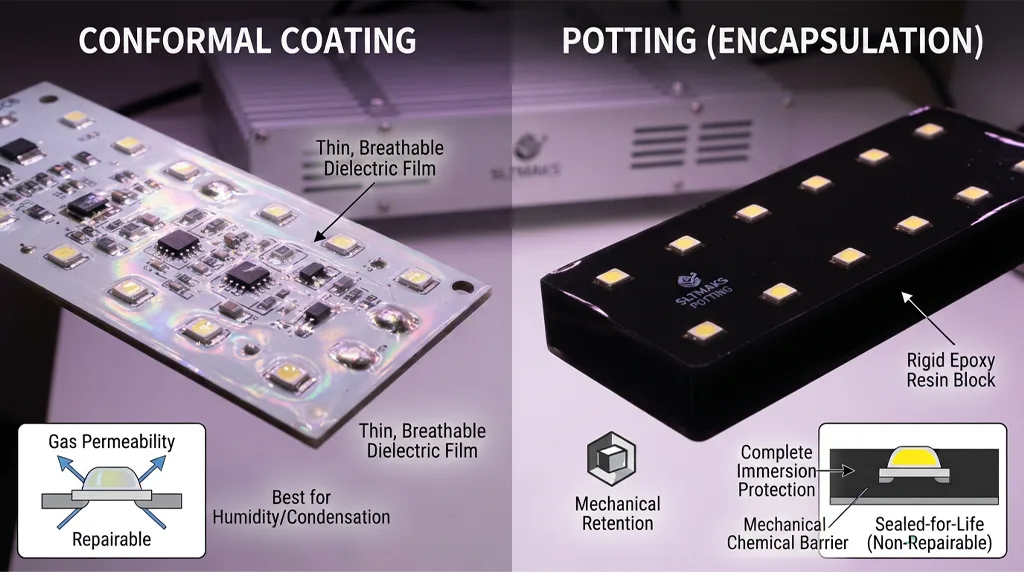
When a design needs an extra barrier, the choice between conformal coating and potting should follow the dominant failure mode and the service model, not a general sense of which is stronger.
Conformal coating is a thin dielectric film that follows component contours and can usually be removed locally for rework. It controls surface leakage and dendritic growth on fine-pitch features under humidity cycling. Potting fills a housing with resin so the board is embedded as a solid block; it is the stronger barrier when the board may see splashing, immersion, or pressure-driven liquid ingress, and the assembly becomes effectively non-maintainable.
For a grow light, that maps roughly as follows: humidity and condensation with a serviceable fixture point toward coating; washdown, immersion risk, or a sealed-for-life unit point toward potting. Where wide thermal cycling dominates, low-modulus silicone systems limit the stress transferred to solder joints, while rigid epoxy suits sealed-for-life units where mechanical retention and chemical barrier matter most.
Coating chemistry matters as much as the coating decision. The ams OSRAM chemical compatibility work tested specific coatings on specific LED packages and found acrylic and acrylated urethane coatings browning or losing conformity under heat, blue radiation or thermal cycling, while silicone potting could affect the radiation pattern if it ripples over the lens.
Those results are tied to the coatings and packages tested and may vary with thickness and process — the same note cautions that results can vary significantly with applied coating thickness and that pre-treatment such as plasma cleaning may alter coating reliability. The broader principle from that work is that a coating or sealant around an LED should not be fully air-tight: sufficient gas exchange should be allowed for VOC escape while still maintaining insulation from corrosive gas.
A coating is a barrier, not an absolute seal. It slows the arrival of corrosive species and protects surfaces; it does not change the chemistry of the materials underneath it.
Can a Sealed Fixture Make Sulfuration Worse?
Reason from the mechanism rather than from field anecdotes. If sulfur-bearing materials are trapped inside a sealed or poorly ventilated enclosure, outgassed H2S accumulates in the micro-climate around the LEDs, and heat accelerates the reaction. Sealing the fixture does not remove the sulfur source; it concentrates what that source releases.
This is a design caution, not a measured finding about any particular fixture. The implication is that sealing must be paired with low-sulfur internal materials, not used as a substitute for them. A gasket that keeps water out can also keep sulfur in, and a rubber gasket is itself on the list of confirmed sulfur sources. Enclosure design and material selection have to be evaluated together.
What the Test Reports Actually Show
Procurement teams eventually receive a test report, and the value of that report depends entirely on what the test covers. Two methods come up most often in anti-sulfur claims.
IEC 60747-5-13 is the accelerated hydrogen sulfide corrosion test for LED packages. Its stated object is to assess the effects of tarnishing of silver and silver alloys used for LED packages due to hydrogen sulfide, and in particular to give information on tarnishing effects on the luminous or radiant flux maintenance of LED packages, plus information on electrical performance due to corrosion of silver and silver alloys. It applies to parts made of silver or silver alloy, silver or silver alloy protected with another layer, and other metals covered with silver or silver alloy.
The scope is as important as the method. Testing other degradations that could affect flux maintenance or electrical performance — degradation of copper or silicone parts, for example — is explicitly not the object of the test. The standard also states that it might not be suitable as a general corrosion test and might not predict the behavior of flux and electrical characteristics and connections in industrial atmospheres. And it applies to LED packages for lighting applications only if referenced by an IEC SC 34A document. A passing result therefore speaks to silver tarnishing in a defined accelerated condition; it does not certify the luminaire against every corrosive agent in a grow room.
The Flower of Sulfur (FoS) test, defined by ASTM B809, was initially approved in 1990 as a method for porosity in metallic coatings by humid sulfur vapor, developed to test porosity of metallic coatings on silver, copper, and copper-alloy substrates. The traditional setup uses a desiccator as the control volume, a potassium nitrate solution as the humidity source, granular sulfur as the sulfur source, and an oven to control ambient temperature. With the shift to lead-free electronics, variants of the original test have been developed; CALCE reports that the test has been used to successfully demonstrate silver corrosion weaknesses that escaped mixed-flowing-gas tests.
That last point is the practical takeaway for a buyer: different accelerated methods probe different weaknesses, and a clean result from one method does not automatically transfer to another. What a passing report establishes is that a defined sample passed defined criteria under defined conditions. It does not establish that the delivered luminaire, with its gaskets, thermal pads, coatings and driver, will behave the same way in a specific grow room.
A Procurement Checklist for Anti-Sulfur Claims
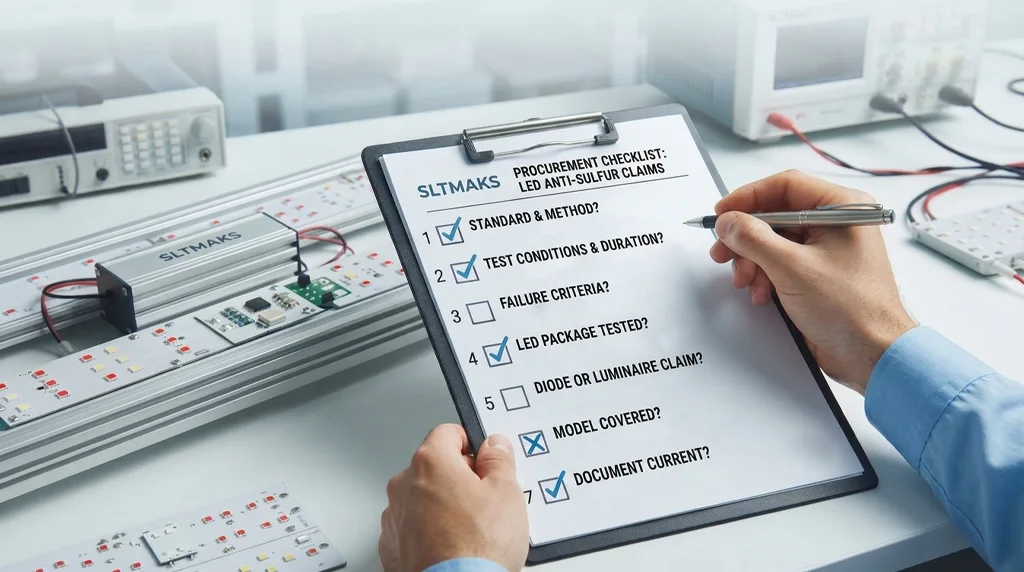
Anti-sulfur claims are only as useful as the documentation behind them. These are the questions to put to a supplier, framed as verification rather than as a guarantee of what any supplier provides.
- Which standard and method? Ask for the specific test referenced — IEC 60747-5-13, ASTM B809, AEC-Q102 C12, or another method — rather than a general statement that the product is “anti-sulfur.”
- What were the test conditions and duration? Concentration, temperature, humidity, and exposure time determine how much the result means. A result without conditions cannot be compared to another supplier’s.
- What were the failure criteria? Flux maintenance, electrical parameters such as forward voltage, and visual inspection of the lead frame and encapsulant are different endpoints. Ask which were measured and what limits applied.
- Which LED package and configuration was tested? The exact package, encapsulant, plating system, and any coating matter. A result for one package does not describe another.
- Does the claim cover the diode or the delivered luminaire? A diode-level report does not address the gaskets, thermal pads, adhesives, and coatings in the finished fixture.
- Does the report cover the model being purchased? Certificate and report scope is a recurring procurement trap in LED lighting. A small change — a different LED package, adhesive, gasket or enclosure — can place the supplied product outside the original report’s scope, and a report for one model does not automatically cover another. Match model number, construction and component options against the document.
- Is the document current? Check issue date, revision, and validity against the product being shipped.
A supplier may answer some of these questions with a full report and others with a summary. The point of asking is to learn which parts of the chain are documented and which are being taken on trust.
Conclusion
Return to the blackened diodes. The fixture was rated for a humid room, and the room was humid — but the failure was a materials-and-environment problem. Sulfur reached the silver inside the package, humidity and heat raised the rate, and the diode darkened or opened. Moisture was the accelerant, not the attacker.
Prevention follows the same chain in reverse. Package choice sets the baseline robustness, with the explicit limit that robustness is finite and concentration-dependent. Sulfur-free assembly and storage keep the source away from the diode. Enclosure design decides whether outgassed compounds disperse or concentrate, and whether a coating or potting barrier is appropriate for the service model. Each link can be verified through documentation, and each link has a scope that the documentation should match.
The practical conclusion is a purchasing one. Specify anti-sulfur requirements at the quotation stage — the standard, the conditions, the failure criteria, and the exact configuration covered — rather than diagnosing blackened diodes after installation. A requirement written into the specification is a design input; a failure analysis after the fact is a cost.
FAQ
Does a humid room without obvious sulfur sources still pose a risk of LED diode sulfuration?
Yes, potentially. Sulfur is present at low levels in ordinary air, and it outgasses from common materials including cardboard, rubber products and some adhesives. Humidity and heat raise the chemical reaction rate, so a humid room accelerates LED diode sulfuration whenever sulfur is present. The appropriate response is to screen the materials inside and around the fixture, not only the room air.
Is conformal coating alone enough to prevent LED diode sulfuration in a grow room?
Not by itself. Coating is a barrier that slows corrosive species and protects surfaces, but it is not an absolute seal, and its performance depends on chemistry, thickness, and process. Coating also does nothing about internal sulfur sources inside the enclosure, and some coating chemistries have shown browning or loss of conformity under heat, blue radiation, or thermal cycling in package-level compatibility testing. Preventing LED diode sulfuration requires a multi-layer defense chain that also includes low-sulfur materials and an appropriate package.
What does a passing H2S test report prove regarding LED diode sulfuration?
That a defined sample passed defined criteria under defined accelerated conditions. For IEC 60747-5-13, that means evaluating silver tarnishing effects on flux maintenance and electrical performance caused by LED diode sulfuration; the standard explicitly excludes other degradations such as copper or silicone and may not predict behavior in industrial atmospheres generally. It does not certify the finished luminaire or every configuration derived from it.
Does sealing a fixture protect the LEDs or concentrate the hazard?
It can do either, depending on what is inside. Sealing keeps external contaminants out, but if sulfur-bearing materials are trapped inside, outgassing accumulates in the micro-climate around the LEDs, and heat accelerates the reaction. Sealing should be paired with low-sulfur internal materials and evaluated as part of the enclosure design, not treated as a substitute for material control.