A grow light order placed in September for a November commissioning rarely arrives late because the factory was slow. It arrives late because the clock the buyer assumed had started — the one that begins when the purchase order is signed — was not the clock the factory was running. Specification questions, sample approval, driver allocation, and a compressed freight market each consumed days that were never in the plan.
Grow light manufacturing lead times are not a single number. They are a chain of stages, each governed by a different party: some by the factory, some by upstream component suppliers, some by the freight market, and several by you. The buyer’s real leverage sits in the stages you control — specification freeze, RFQ quality, capacity reservation, and pre-approved alternates — not in pressing the production floor for a shorter build.
This guide maps the chain stage by stage, explains which stages stretch during peak season and why, and turns the map into a backward calendar and an RFQ structure you can apply to your own install dates. The planning figures below come from supplier and sourcing guides and are ranges, not commitments. Peak-season congestion windows and component allocation conditions shift from year to year, so re-confirm the current position with your supplier each season.
Table of Contents
What Grow Light Manufacturing Lead Times Actually Measure
Two suppliers can both quote “30 days” and mean two different things. One is counting from deposit receipt; another from specification freeze; a third from the day materials land at the factory. Until every quote is restated on a common basis, the numbers are not comparable, and the cheapest-looking date may simply be the one with the latest start.
Lead Time Versus Cycle Time in Lighting Production
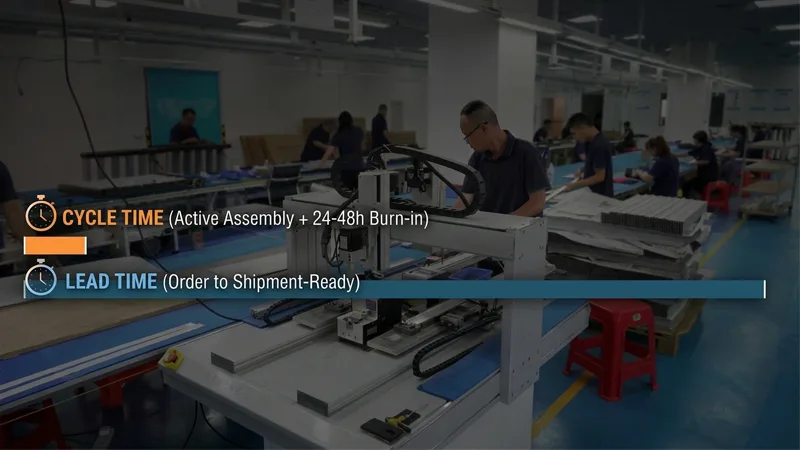
Cycle time is the factory’s internal measure: the active processing time for one unit. In LED production, it covers surface-mount (SMT) assembly, manual soldering, final assembly, and the mandatory burn-in cycle — typically 24 to 48 hours of stress testing to stabilize the semiconductors before photometric QC. Measured that way, a fixture’s cycle time is remarkably short: minutes of machine and manual work per unit, plus the burn-in dwell.
Lead time is your measure: the full elapsed clock from order commitment to shipment readiness. It includes everything cycle time excludes — quotation, sampling, component procurement, production scheduling queues, inspection, and packing. A factory can be world-class at cycle time and still deliver late, because procurement or pre-shipment inspection sits outside the measure it optimizes. When a supplier talks about how fast their line runs, you are hearing about cycle time. Ask instead what happens between deposit and shipment-ready, and who owns each of those days.
Why Suppliers Quote Different Starting Points
The common starting points, and the commercial logic behind each:
- RFQ receipt. Makes the number look shortest and puts every subsequent delay on the buyer’s specification and approval. Common in early sales conversations.
- Quotation or proforma invoice. Starts the clock before money changes hands; rarely the basis a factory actually schedules against.
- Deposit receipt. A common contractual basis, because it is the point at which the factory commits capacity and releases material orders. In practice, though, most factories actually start the production clock at written sample approval, so the quote should state which basis it uses.
- Specification freeze. Used by factories that have been burned by mid-production spec changes; protects them from rework, but can leave weeks of pre-freeze work uncounted.
- Material arrival. Used when component supply is the binding constraint; honest, but it hides how long procurement will take.
The normalization method is simple: ask each supplier to restate their quote twice — as days from deposit to shipment-ready, and as days from specification freeze to shipment-ready. The first is the number you can contract against. The second tells you how much of the schedule you control. If a supplier cannot produce both, that is itself useful information about how they schedule.
The Stage-by-Stage Chain from Specification Freeze to Delivery
The table below is a planning reference, drawn from published sourcing guides on custom LED fixture orders. The ranges are typical, not guaranteed; custom work — new tooling, bespoke spectra, non-standard housings — sits at the top of each range, and standard repeat orders can run below the bottom.
| Stage | Typical days | Whose clock |
|---|---|---|
| Specification freeze and quotation | 7–14 | Buyer and factory together |
| Sample build and approval | 15–22 | Factory builds, buyer signs |
| Material procurement | 10–20 | Factory, constrained upstream |
| Production and aging | 15–20 | Factory |
| Inspection and packing | 3–4 | Factory |
| Freight to site | 25–40 | Forwarder and carrier |
Summed at the midpoint, that chain runs roughly 75 to 120 days from enquiry to site for a custom fixture on an existing platform. The factory’s own portion — materials, production, testing, packing — is typically 30 to 45 days of that total. The rest is sampling and freight, which is why buyers who focus only on the production quote miss most of the calendar.
Specification Freeze and Quotation
The 7–14 day band is where you and the factory converge on a locked specification and a priced quote. An incomplete specification is the most common cause of a quote that later “changes”: the supplier fills gaps with cheaper defaults, and the correction surfaces at sample approval or, worse, at pre-shipment inspection.
The freeze date is the single most useful anchor in the whole schedule. It is the last point at which you can change the product without restarting procurement, and it is the date against which every later stage should be counted. Put it in writing, with the specification sheet attached and versioned.
Sampling and Approval
Sampling runs 15–22 days for a custom fixture, and it is slower than production because it is inserted into the schedule rather than scheduled. A sample has to clear engineering confirmation, a hand build or pilot run, assembly, a power and photometric check, photography for the buyer, and international courier.
Distinguish a hand-built prototype from a production-representative sample built on the actual line with production-intent components and tooling. The second is the one that tells you what mass production will look like, and the one worth approving in writing. Note also that the industry convention “25–35 days after sample approval” is a contract term with a requirement embedded in it: the approval has to be in writing. Sample approval is a buyer-controlled gate. Delay there is your delay, not the factory’s, and it will not appear in any supplier’s lead-time figure.
Material Procurement and Component Allocation
Procurement runs 10–20 days in normal conditions and is the stage most exposed to peak season. LED chips and driver ICs are sold on allocation models: contracted high-volume buyers get priority, spot buyers take what remains, and during tight supply the gap between the two can run three to five weeks. Custom correlated color temperature (CCT) or high-CRI chips are smaller production runs and are deprioritized first when allocation tightens.
Driver unavailability is the leading cause of LED fixture order delays in the sourcing data — estimated at 35–40% of all delays — with outsourced surface finishing (powder coating queues at factories without in-house lines) second at roughly 25%. Together, those two account for about 60% of production timeline overruns. If your fixture uses a name-brand driver, verify at order placement that the factory is buying through an authorized distributor, not drawing on broker stock.
Production, Aging, and Inspection
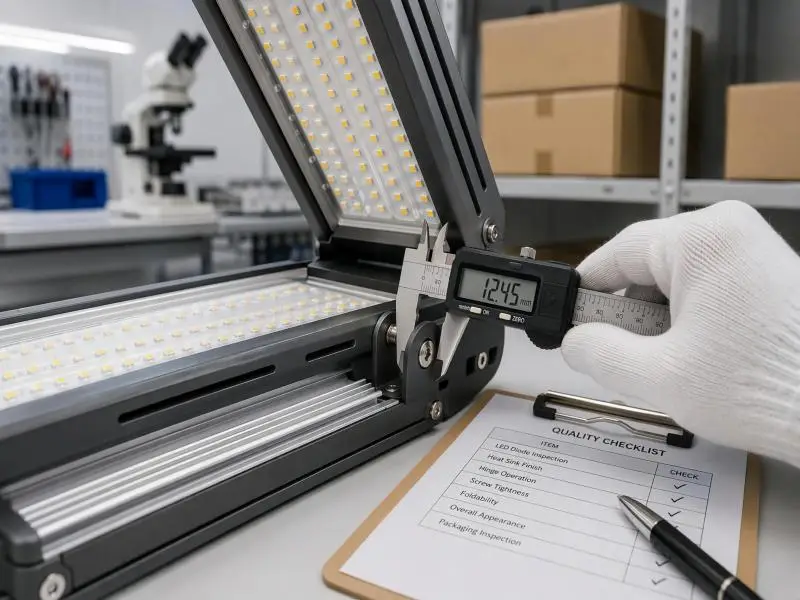
Production and aging run 15–20 days, followed by 3–4 days of inspection and packing. Aging and inspection are the days you should not compress. Burn-in is what catches early-life failures before a fixture reaches a canopy; pre-shipment inspection is what catches the substitution, the mis-binned emitter, or the driver that does not match the purchase order.
A pre-shipment inspection gate protects you in a specific way: it converts quality from an aspiration into a pass/fail decision made while the goods are still at the factory, before balance payment and before the container is sealed. Commission it when production is complete and at least 80% packed, and hold the balance payment until it passes.
Freight and Delivery
Ocean transit runs 25–40 days door to door depending on route. Published port-to-port transit times give a starting point: Shanghai to Los Angeles 14–16 days direct, 18–22 with transshipment; Shenzhen to Los Angeles 15–17 direct; Shanghai to New York 25–28 via Panama; Shanghai to Rotterdam 24–28 via Suez. Add inland legs, port handling, customs clearance, and the gap between vessel arrival and available appointment.
Air freight is a rescue lever, not a shipping strategy. Light fixtures are volumetric cargo — chargeable weight is driven by volume, not by the scale — and loose air freight often runs 10–30% of the goods value. During peak season, port congestion and blank sailings extend the tail of this stage: carriers pull sailings to match demand, and cargo rolls to the next available vessel.
Why Lead Times Stretch During Peak Season
Peak-season delay is not one mechanism but several running at once, and they hit different stages. Knowing which one threatens your order tells you where to put buffer and which lever to pull.
Lead time from order confirmation to ex-works in calendar days, by production model, for general LED lighting factories. Peak figures refer to the September–November window. The source covers LED lighting factories generally, not grow-light lines specifically, and the ranges are planning figures rather than measured averages.
Capacity Crunch and the Domestic-Export Collision
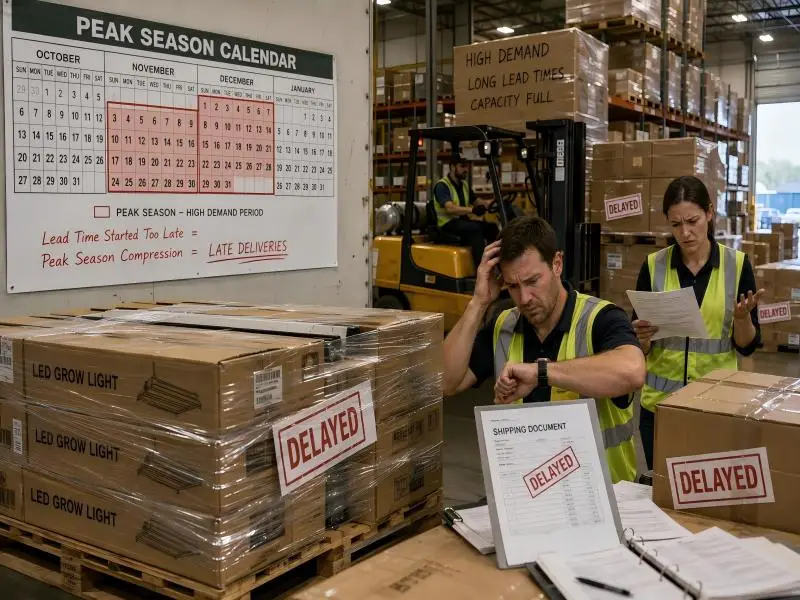
September through November is China’s domestic retail peak, anchored by Singles’ Day on November 11 and followed by the Christmas export rush. Factories serving both domestic and export markets report capacity loads of 130–160% of normal, with export orders competing against domestic orders for the same production lines. In that window, sourcing guides report component prices rising 8–18% and lead times stretching 30–50%.
One sourcing guide puts the practical consequence bluntly: if your order is not confirmed by August 15, expect to pay premiums or wait until December. Treat that as a planning marker rather than a rule — it will shift with the year’s demand pattern — but the direction is consistent. A peak-season order placed in September is competing for capacity that was largely committed in July.
Component Allocation and Driver Supply
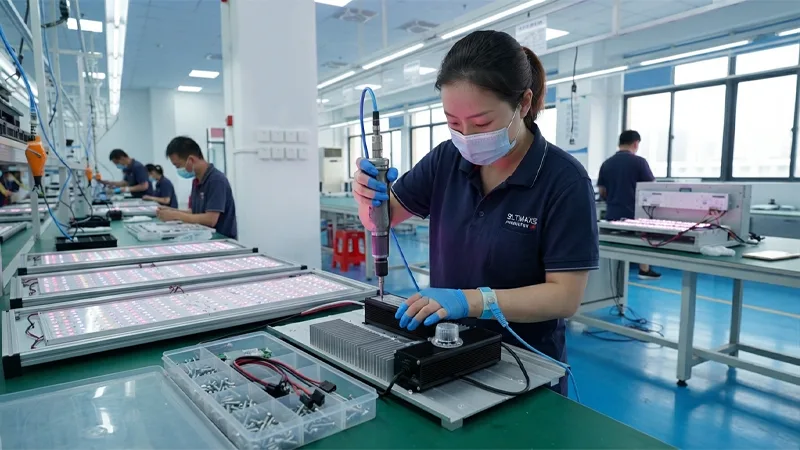
Underneath the factory crunch sits the semiconductor market. LED driver ICs share fabrication capacity with automotive and consumer electronics chips, and during global shortage events driver lead times have spiked to 8–12 weeks. As of mid-2026 the driver supply chain has normalized but remains vulnerable to regional fab allocation shifts. LED chip manufacturing is concentrated among a handful of fabs that operate allocation models, so the contracted-versus-spot gap can reopen quickly.
Supply conditions vary year to year. Confirm current driver lead times with your supplier rather than assuming a past shortage persists — and equally, do not assume that a normalized market means your specific driver model is on the shelf. Build-to-order variants, including higher IP-rated and dimming-protocol-specific drivers, sit on multi-week cycles even in calm markets.
Holiday Shutdowns and the Recovery Tail
The Chinese holiday calendar sets hard boundaries around production slots. The 2026 dates, with the shutdown and recovery pattern reported by sourcing guides:
| Holiday | 2026 dates | Factory shutdown | Recovery | Planning order-by |
|---|---|---|---|---|
| Chinese New Year | Jan 29, 2026 | Jan 15 – Feb 12 (4 weeks) | Feb 12–26 at 40–70% capacity | Dec 1, 2025 |
| Qingming | Apr 4–5 | 2 days | Immediate | Minimal impact |
| Labor Day | May 1–5 | 3 days | Immediate | Budget 3–4 lost days |
| Dragon Boat | Jun 19 | 3 days | Immediate | 2–3 lost days |
| Mid-Autumn | Sep 25 | 3 days | Overlaps Golden Week prep | Part of Sep–Oct congestion |
| Golden Week | Oct 1–7 | 7 days | Oct 8–15 at 60–80% capacity | Aug 15, 2026 |
The Chinese New Year tail matters more than the shutdown itself. A four-week closure followed by two weeks at 40–70% capacity means the effective loss is closer to six weeks, and orders queued behind the restart wait through the ramp. The reported guidance is not to plan a critical shipment within 45 days of Chinese New Year, and one sourcing guide puts the CNY premium at 25–35 days on top of normal lead time. These are planning figures, not guarantees; confirm your factory’s specific shutdown and restart dates each year, because they follow the lunar calendar and the government’s announced schedule.
What Buyers Control Versus What Suppliers Control
The most common scheduling error is spending effort on stages the buyer cannot move. Pressing a factory on fab allocation or ocean transit produces reassurance, not dates. The productive split is between stages you control and stages you can only buffer.
Buyer-Controlled Levers
- Freeze the specification early. Every week of specification ambiguity pushes the freeze date, and the freeze date anchors everything downstream. A locked, versioned specification sheet at RFQ stage removes the most common cause of a quote that later changes.
- Send a complete RFQ. A vague RFQ gets either an inflated price or a quote built on the supplier’s cheapest defaults. Both cost you time later, at sample approval or inspection. The RFQ section below lists what completeness looks like.
- Reserve capacity ahead of peak. Capacity reservation agreements — committing volume or paying a reservation fee for a production slot — are the lever that moves you out of the spot queue. Sourcing guides recommend planning orders two to three months ahead of peak season or negotiating reservation terms explicitly.
- Approve alternates in advance. A pre-approved alternate driver or LED package converts a multi-week allocation wait into a same-week substitution. This is the highest-leverage preparation most buyers skip.
- Structure payment and penalty terms. Milestone payments tied to inspection and a late-delivery penalty tied to a specific shipment-ready date align the supplier’s incentives with your install date. A supplier facing a defined penalty prioritizes your order over one with no consequence for delay.
Each lever maps to a stage: specification freeze shortens the quotation stage, RFQ completeness shortens sampling and inspection, capacity reservation shortens the production queue, and alternate approval shortens procurement.
Supplier-Controlled and Upstream-Constrained Stages
Some stages you cannot compress, and pretending otherwise wastes negotiating capital:
- Fab allocation. LED chip and driver IC supply is set upstream of your factory. Your supplier is a customer of the fab, not its manager.
- Ocean transit. Vessel schedules, port congestion, and blank sailings are market conditions. Booking earlier helps; demanding a faster vessel does not.
- Holiday shutdowns. The factory closes when the calendar says so, and the recovery ramp is not negotiable.
The right response to these stages is buffer, not pressure. Add days to the schedule for the stages you cannot move, and hold your supplier to the stages they can. A supplier who promises to “push” the fab is telling you what you want to hear; a supplier who tells you the allocation position and offers a pre-approved alternate is giving you something you can plan against.
Building a Backward Calendar for a Target In-Hand Date
A forward schedule built from a supplier’s quoted lead time is a guess. A backward schedule built from your install date is a plan. The method is the same for any order; only the inputs change.
Working Backward from the Install Date
Start with the date the fixtures must be on site and working, then subtract each stage in reverse order. Using the midpoint of the ranges above for a custom fixture:
- Install date. Your fixed point.
- Minus freight (25–40 days). Use the port-to-port transit for your route plus inland legs, customs, and appointment lag. For a US West Coast delivery from Shenzhen, 15–17 days port-to-port direct becomes roughly 25–30 days door to door once clearance and inland transport are added.
- Minus inspection and packing (3–4 days).
- Minus production and aging (15–20 days).
- Minus material procurement (10–20 days).
- Minus sampling and approval (15–22 days).
- Minus specification freeze and quotation (7–14 days).
The result is the order-by date. Then apply peak-season stretch to the stages that stretch: add 10–15 days to a peak-season order (September–November) per one sourcing guide, and add 25–35 days if the order falls around Chinese New Year. Keep the units consistent — calendar days throughout, with working-day assumptions stated if your supplier quotes in working days.
Worked at the midpoint for a custom order with a US West Coast destination and a peak-season window: 30 (freight) + 4 (inspection) + 18 (production) + 15 (procurement) + 18 (sampling) + 10 (spec freeze) = 95 days, plus 12 days of peak-season stretch = 107 days before the install date. That is the number to plan against, and it is usually three to six weeks earlier than the date in a project plan built from a quoted lead time.
Setting the Order-By Date and Buffer
Buffer is not a single number added at the end. It belongs at the stages where risk actually sits, and buffer in the wrong place does not protect the date.
- Buffer for supplier-controlled stages. If component allocation is the live risk, buffer belongs in procurement, not production. Extra production days do not help when the line is waiting for drivers.
- Buffer for freight. Ocean transit deserves its own buffer, sized to the season. Peak-season port congestion and blank sailings can add one to two weeks; booking two to three weeks ahead for long-haul routes is the reported guidance.
- Buffer for approval gates. Your own sample approval and specification sign-off are the gates most likely to slip, because they compete with everything else on your desk. Set internal deadlines ahead of the supplier’s.
A practical split: hold buffer in the two stages you cannot control (procurement and freight) and hold your own approval gates to a hard internal date. If the backward calculation lands the order-by date in the past, the honest options are a later install, a standard product instead of a custom one, or air freight priced into the budget from the start.
Writing an RFQ That Produces Comparable Delivery Dates

An RFQ’s job is to make quotes comparable on delivery, not just price. Two quotes at different Incoterms, different lead-time bases, and different certification status are not a comparison; they are three unrelated numbers.
Specification and Quantity Details
The specification sheet is what prevents a supplier from filling gaps with cheaper defaults. For a grow light, the minimum set:
- Wattage and input voltage.
- Output — PPF (photosynthetic photon flux) in µmol/s and efficacy in µmol/J — with tolerance. Verify against an LM-79 test report, not a catalog claim.
- Spectrum and CCT with tolerance (for example, 4000K ±200K), plus the red: blue ratio or spectral bands your crop plan requires.
- Driver brand and model — not just “Mean Well” but the specific model, because dimming protocol, IP rating, and surge immunity differ across the range.
- LED package brand and series, with binning and SDCM (color consistency) requirements.
- Thermal requirements — housing material, heat sink specification, ambient operating temperature.
- IP rating and, for horticultural environments, the damp/wet suitability the fixture must meet.
- The horticultural safety standard the fixture must be listed to. In North America, that is UL 8800, the published safety standard for horticultural lighting equipment, which addresses photobiological hazards to eyes and skin, wet environments, elevated ambient temperatures, and ingress protection. A general-purpose luminaire listing under UL 1598 does not cover the same scope.
- Quantity per SKU with tolerance. The industry convention for LED production is ±5%, charged pro rata; state it explicitly so over- or under-production is not a surprise.
Incoterms and Lead-Time Basis
Quotes at different Incoterms are not comparable. An EXW quote looks cheapest until you add inland transport, export clearance, port handling, freight, insurance, and brokerage; a CIF quote bundles some of that but not the destination-side costs. For first orders, FOB is the usual recommendation: the supplier handles export clearance and delivery to the port, and you control freight and insurance through your own forwarder. Normalize every quote to the same Incoterm before comparing.
The RFQ should also force the lead-time basis into the open. Ask each supplier:
- What date does your quoted lead time start from — deposit, specification freeze, or material arrival?
- Can you quote days from deposit to shipment-ready, and days from specification freeze to shipment-ready?
- Can you quote in stages — materials complete, production complete, ship date, arrival date?
- What is your definition of shipment-ready?
- What is the current lead time for the specified driver model and LED package, and are they contracted or spot purchases?
Certification Status and Its Own Clock
A new certification test runs on the laboratory’s backlog, not the factory’s schedule, and it is routinely omitted from delivery promises. Published timelines for the relevant marks:
| Mark | Market | Typical timeline |
|---|---|---|
| ETL (Intertek) | US / Canada | 4–8 weeks |
| UL | US / Canada | 8–12 weeks |
| FCC Part 15/18 | US | 2–4 weeks |
| DLC Standard / Premium | US / Canada (rebates) | 2–5 weeks |
| CE (LVD) | EU | 4–8 weeks |
| RoHS | EU | 1–2 weeks |
ETL and UL are both Nationally Recognized Testing Laboratory (NRTL) listings, and because all NRTLs test to the same standards, an ETL listing satisfies a requirement to meet UL standards. The difference is commercial and scheduling, not regulatory — and ETL’s shorter timeline is one reason it is common on grow lights. If your fixture needs a new listing rather than an existing one, add the laboratory’s queue to your backward calendar; sourcing guides report certification queues costing three to six weeks when left out of schedules. Confirm with the supplier whether the listing is existing and current, or new — and ask for the certificate, not a claim.
Qualifying Alternate Drivers and LED Packages Without Requalifying the Fixture
Dual sourcing is the answer to component allocation, but only if the alternate is approved before the shortage. The core principle is that an alternate must be tested in the finished luminaire, not on the datasheet alone. The same board and driver can behave differently with a different emitter, and a source that works briefly on a bench can operate differently in the finished housing.
The Approved-Alternate List
Build an approved vendor list and approved part numbers with locked revisions: for each critical component — LED package, driver, connector, optic — name the approved manufacturer, the specific part number, and the revision. Record the approval date and the evidence behind it.
Keep one approved golden sample of the finished fixture as the comparison benchmark. When a substitution is proposed, the question is not whether the alternate’s datasheet matches; it is whether a fixture built with the alternate matches the golden sample on the parameters you care about. The golden sample is what makes that question answerable.
Testing the Alternate in the Finished Fixture
Qualify the alternate in the assembled luminaire, under the operating conditions it will see:
- Photometric output. Measure PPF and spectrum at the intended growing-plane geometry with a quantum sensor, and compare against the golden sample. A different emitter bin can shift output and spectrum even when the part number family is the same.
- Thermal behavior under continuous operation. Run the fixture for an extended period and check that heat leaves the board through the intended path. An alternate with different thermal resistance can change junction temperatures and lumen depreciation.
- Dimming compatibility. Verify the alternate driver against your control protocol — 0-10V, DALI, or PWM — across the full dimming range. A substitute that meets wattage and output voltage but loses dimming protocol or surge protection is the dominant failure mode in a constrained driver market.
- Aging. Run the burn-in cycle on the alternate build. Early-life failures that appear in the first 48 hours are exactly what aging is for.
Change Control and Documentation
Record each approved substitution, so repeat orders do not drift: the approved part number and revision, the test evidence, the date, and the approver. Hold the documentation with the purchase order and specification sheet so that a substitution during production is a pre-approved swap rather than an uncontrolled change.
The lead-time benefit is direct. A pre-approved alternate converts a three-to-five-week allocation wait into a same-week substitution, and it does so without reopening the fixture qualification. The cost is the testing time up front — which is far less than the wait it prevents.
FAQ
Where Does the Lead-Time Clock Actually Start in Grow Light Manufacturing Lead Times?
It depends on the supplier’s convention. Common starting points are RFQ receipt, quotation, deposit receipt, specification freeze, and material arrival. When evaluating grow light manufacturing lead times, the buyer’s job is to force a common basis: ask each supplier to restate their quote as days from deposit to shipment-ready and days from specification freeze to shipment-ready, then compare on those two numbers.
How Much Does Peak Season Add to a Grow Light Order’s Manufacturing Lead Times?
Sourcing guides report peak-season orders (September–November) adding 10–15 days, and Chinese New Year adding 25–35 days, with guidance not to plan a critical shipment within 45 days of CNY. When calculating peak-season grow light manufacturing lead times, these are planning figures from sourcing guides, not guarantees, and they vary by order type and component availability. Confirm the current position with your supplier for your specific order window.
Can Air Freight Rescue a Late Grow Light Manufacturing Lead Times Schedule?
It can buy time, at a cost. Light fixtures are volumetric cargo, so chargeable weight is driven by volume rather than scale, and loose air freight often runs 10–30% of the goods value. When managing emergency grow light manufacturing lead times, treat air freight as a contingency priced into the budget from the start, not a shipping strategy—and note that air freight moves the freight stage only; it does nothing for a production or allocation delay.
How Do We Avoid a Component Shortage Stalling Grow Light Manufacturing Lead Times?
The levers are pre-approved alternates and capacity reservation. An approved-alternate list with tested substitutes lets production swap a constrained part without reopening fixture qualification, effectively safeguarding your overall grow light manufacturing lead times. On repeat orders, key-material reservation—where the factory holds or reserves emitters, boards, connectors, and drivers against an agreed forecast—can shorten the procurement stage. Both need to be set up before the shortage, not during it.
What Should a Delivery-Date Commitment Look Like in the PO for Grow Light Manufacturing Lead Times?
Four elements secure your target grow light manufacturing lead times: a specific shipment-ready date (not “approximately 30 days”); a written definition of shipment-ready (goods packed, inspected, and available for container loading at the factory); a late-delivery penalty tied to that date (industry standard is 0.5–1% of the delayed goods’ value per week, capped at 5–10% of order value); and a QC clause with consequences (AQL levels, inspection party, and rework or cancellation rights if inspection fails). A supplier who resists a reasonable penalty is signaling something about their confidence in the date.
Further Reading and Sources
The planning figures in this guide are drawn from the following source categories. They are ranges from supplier and sourcing guides, not commitments, and should be refreshed for your own order window.
- Lead-time stages and production data: Kingseng, Chinese LED factory lead times and LED order lead time from China; Light OEM, custom LED lighting lead time.
- Lead time versus cycle time: Fanxstar, lead time vs. cycle time in lighting production.
- RFQ and PO structure: Kingseng, LED lighting B2B RFQ process.
- Component sourcing and alternates: VST Lighting, LED component sourcing guide and managing LED component supply for mass production; Source by Spec, LED driver supply tightness.
- Freight transit times: Freight Academy, sea freight transit times; C.H. Robinson, ocean market update.
- Certification timelines: Kingseng, global LED lighting certification comparison; UL Solutions, UL 8800 brief; DesignLights Consortium, horticultural lighting.
- Capacity and peak-season planning: Alibaba.com seller blog, OEM manufacturing capacity assessment.
This guide reflects conditions as of November 2026. Peak-season congestion windows, component allocation, and freight rates shift year to year; re-confirm current lead times, driver availability, and holiday shutdown dates with your supplier before committing to an order-by date.