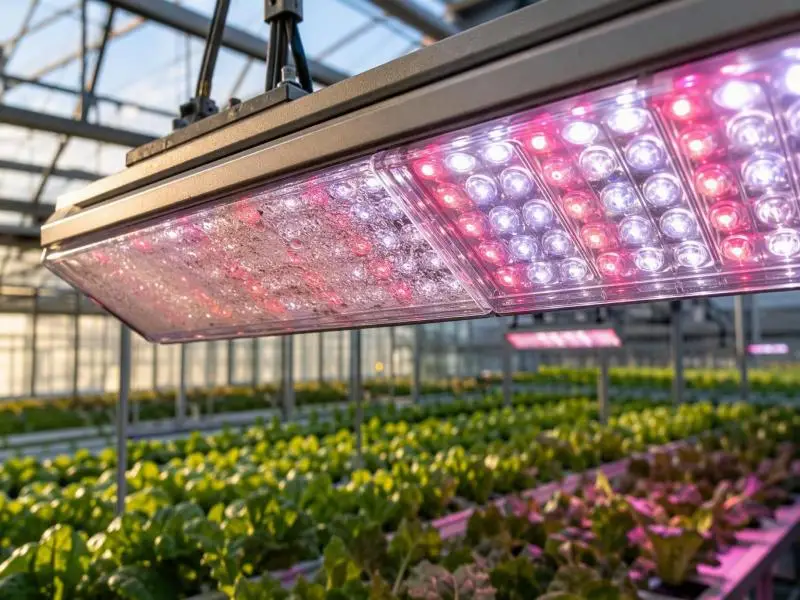
A single-cover greenhouse can lose nearly 40% of its light during winter to dust and condensation, and an inflated double-film house can lose more, according to a 2025 study of greenhouse roof cleaning. The lens on a supplemental LED fixture sits in that same air: wet, dusty, and often dosed with sulfur. Whatever the cover loses, the fixture’s secondary optics face a comparable assault from the inside of the canopy.
Greenhouse LED lens transmission is therefore not a purchase attribute you settle once. It is a value that decays along several distinct paths, and only some of them are yours to control. Fouling, cleaning damage, and the choice of polymer are operator decisions. UV-driven yellowing and hydrolysis of the bulk material are decided the day the lens is specified. The work below follows that split: identify which loss you are looking at, choose a material your cleaning regime will not destroy, record a baseline at commissioning, protect the lens in service, and put enforceable numbers into the next purchase order.
One caution applies throughout. Transmission figures quoted for a material are measured under stated conditions on a stated specimen. They are not predictions for the specific lens in your house, and they are not a warranty of remaining output after three seasons of sulfur. Treat them as a starting point for specification, not as an installed-performance claim.
Table of Contents
Map the Loss Paths Before You Clean Anything
Every percentage point of transmission a lens loses reaches the canopy as fewer photons. Before scheduling a cleaning cycle, separate the mechanisms, because they respond to different interventions and only some are reversible.
Fresnel reflection. At each boundary between air and lens material, a fraction of light reflects toward the LED instead of passing through. For a standard BK7 glass substrate, roughly 4% of visible light is lost per uncoated surface, and an anti-reflection coating can reduce that to below 0.5%, according to Edmund Optics’ coating presentation. A lens has two surfaces, so an uncoated optic can shed close to 8% before any dirt arrives. This loss is fixed at manufacture; you cannot clean it away, and it is one reason coated optics command a premium.
Absorption and Yellowing in the Polymer
UV exposure breaks chemical bonds in the lens material and produces species that absorb visible light. The NIST weathering study on aromatic engineering thermoplastics documents this yellowing and gloss loss as a function of UV dose, temperature, and wavelength, and a separate polycarbonate aging study traces the yellowing to oxidation products formed after UV absorption. This path is decided at specification: once a polymer is installed, its UV stability is what it is.
Surface Fouling and Biofilm
Dust, mineral film, algae, and biofilm sit on the outer lens face and block or scatter light before it enters the optic. This is the operator-controlled path, and it is the one a cleaning program addresses.
Haze from Scratching or Chemical Attack
Fine scratches and etched surfaces do not necessarily reduce the total light passing through a lens, but they scatter it. That distinction matters because of how transmission is measured. Under ASTM D1003, regular luminous transmittance is obtained with a clear specimen placed some distance from the entrance port of the integrating sphere, while total hemispherical luminous transmittance is measured with the specimen at the entrance port. The total hemispherical value will be greater than the regular value depending on the sample’s optical properties. A hazy lens can therefore pass a naive transmission check while sending a large share of its light off-axis, away from the canopy.
The practical consequence: when a fixture looks dim, do not assume dirt. A fouled lens recovers with cleaning; a yellowed or scratched one does not. Knowing which path you are on determines whether the next step is a cloth or a purchase order.
Choose the Lens Material Your Greenhouse Can Actually Keep Clean
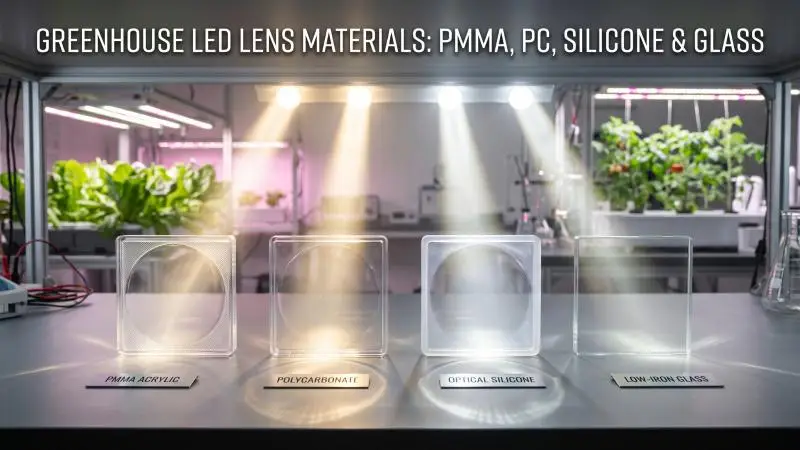
There is no single best lens material, only a best match between material, chemical exposure, and cleaning practice. The comparison below draws on a study of optical silicone degradation that reviews secondary optics for LEDs, on material property data for PMMA, and on a commercial comparison of PMMA and polycarbonate.
| Material | Transmission and optical character | Strengths | Weak points to plan around |
|---|---|---|---|
| PMMA (acrylic) | Up to about 90% in the visible; up to 75% in the 300–400 nm range | Low cost, easy molding, high UV transmittance, good scratch resistance | Yellows under prolonged UV exposure; higher water absorption than PC |
| Polycarbonate (PC) | Lower than PMMA; the Formerra comparison cites 87–89% for PC against 90–92% for PMMA | Harder, higher refractive index, lower water absorption, higher softening temperature (130 °C per the silicone study) | Attacked by many solvents; prone to stress cracking and crazing |
| Silicone | Optical-grade plates | Stable against UV at 360 nm and blue light at 450 nm in the cited study | Severely degraded by 100 °C salt bath exposure, with transmission falling as exposure time rose |
| Glass | Highest transmission of the group; low-iron glass around 91–93% in the visible per a materials comparison table | Best chemical resistance, no polymer yellowing mechanism | Higher cost and weight; breakage risk in service |
Visible-band transmission ranges for clear grades as reported by the cited sources; thickness and grade differ between materials, so the bars compare typical ranges rather than a controlled side-by-side test. PMMA and PC figures come from a commercial comparison; glass comes from a materials table for low-iron glass.
The silicone result deserves care in reading. The study found silicone plates stable under UV and blue light, but the 100 °C salt bath produced the most severe degradation of any condition tested, with both light transmission and relative radiant power deteriorating as exposure time increased. That is an accelerated test, not a greenhouse exposure, but it tells you that hot saline contact is the condition to keep away from a silicone optic.
The recommendation here is judgment, not a rule: match the lens material to the chemicals and fumigants actually used on site, then confirm compatibility against the supplier’s data for those specific agents. A house that never fumigates and cleans with a mild detergent faces a different material decision than one running sulfur burners between cycles.
Anti-reflection coating is a separate durability decision. Fraunhofer IOF describes two routes. Hard AR coatings deposited by plasma-ion assisted deposition offer high scratch resistance and environmental stability, typically rated from −40 °C to +60 °C on PMMA and −40 °C to +85 °C on PC. Nanostructured AR surfaces give excellent broadband antireflection across a wide range of incidence angles and suit curved or microstructured lenses such as Fresnel designs, but they are mechanically sensitive and recommended for protected surfaces inside optical devices only. On an exposed greenhouse lens, that sensitivity is a real constraint.
Record A Commissioning Baseline You Can Compare Against Later
Without a recorded starting point, “the lens has dimmed” is an opinion, and a disputed warranty claim has nothing to rest on. The baseline does not need to be elaborate; it needs to be repeatable.
At first light, capture four things:
- A transmission or haze reading on a sample lens or a witness coupon of the same material, following ASTM D1003 procedures. Record the specimen position at the sphere port, because that position determines whether you are reading regular or total hemispherical transmittance.
- Fixture-level output as PPFD (photosynthetic photon flux density, the photon flux reaching a surface) or PPF (photosynthetic photon flux, the total emitted by the fixture) at fixed, marked measurement points.
- A dated photo log of lens condition, taken from the same angle each time.
- The cleaning products and fumigants in use at the time of the reading.
The geometry rule is the one operators most often break. Because regular and total hemispherical transmittance differ with specimen placement, a later reading taken with the coupon in a different position is not comparable to the baseline, even on the same instrument. Fix the position in the written record.
Fixture-level readings carry their own confound: they combine lens loss with LED and driver depreciation. That is fine for tracking total delivered light, but it cannot tell you how much of a decline belongs to the lens. Keep both the coupon reading and the fixture reading, and use the coupon when the question is specifically about the optic.
Keep the whole exercise cheap enough that it actually happens. A single witness coupon per fixture type, measured once at commissioning and stored with the maintenance log, is enough to answer the question that matters later.
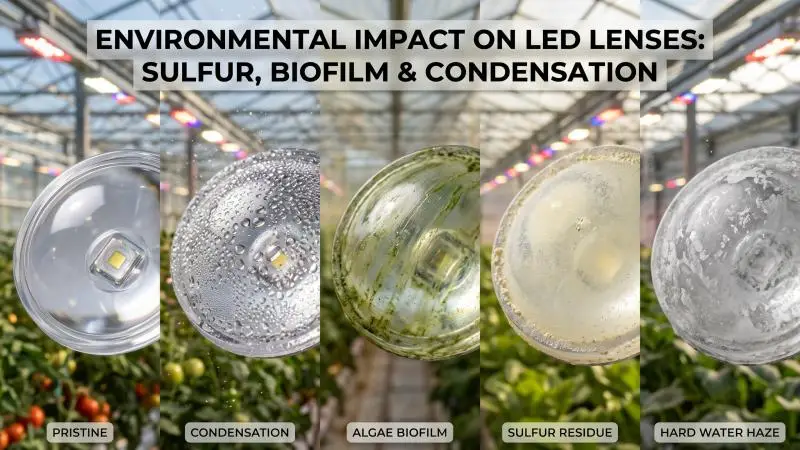
Recognize What Sulfur, Hard Water, Algae and Condensation Do to A Lens
Greenhouse air is a chemical environment, and the lens sits in it. The compatibility charts rate materials against specific agents at stated temperatures, and the ratings are worth reading closely because several common greenhouse exposures land in the severe category.
PMMA compatibility ratings from the ISM chart at 20 °C and 50 °C, plotted on the chart’s A–D scale (A = excellent, B = good/minor effect, C = fair/moderate effect, D = severe, not recommended for any use). Ratings reflect ambient-temperature chart data and are not a prediction of multi-season greenhouse service.
Sulfur Burners and Sulfur Dioxide
On the PMMA compatibility chart, wet sulfur dioxide gas is rated D, severe effect, not recommended for any use, at 20 °C; dry sulfur dioxide gas is rated B at 20 °C and D at 50 °C. Sulfur salts are rated B, good, with only minor effect. Liquid sulfur dioxide is D at both temperatures. On the polycarbonate chart, sulfur dioxide is listed as N/A, but the polycarbonate resistance datasheet marks sulfur dioxide and sulfur dioxide gas with an X, and its introduction warns that chemical exposure can produce effects from fading and whitening through stress cracking and crazing, sometimes not visible to the unaided eye. Fumigation cycles are a genuine chemical exposure, not just an odor.
Hard Water and Alkaline Cleaners
The PMMA chart rates 1% and 10% sodium hydroxide A at both 20 °C and 50 °C, but 25% sodium hydroxide A at 20 °C with no data at 50 °C, and 50% sodium hydroxide A at 20 °C and D at 50 °C. The pattern is the point: dilute alkali at room temperature is tolerable, and hot concentrated alkali is where cleaning goes wrong. A grower who mixes a strong caustic wash and applies it warm has moved outside the rated envelope.
Algae, Dust and Biofilm
The greenhouse cleaning study notes that dust accumulation on greenhouse surfaces promotes algae growth, compromising light transparency, and treats dust and condensation as independent contributors to transmission loss. The same mechanisms settle on a fixture lens under the canopy.
Solvent Cleaners
On the polycarbonate chart, acetone, ketones, chlorinated solvents, ammonia and sodium hydroxide are all rated severe. The PMMA chart rates chlorinated solvents and chlorinated hydrocarbons D at both temperatures. A solvent chosen because it cuts grease quickly can be the most damaging thing applied to a lens.
One boundary applies to all of these ratings. The ISM charts state that data is based on ambient or room temperature, roughly 18 °C to 23 °C, and the CP Lab Safety chart states its ratings apply to a 48-hour exposure period with no knowledge of effects beyond it. A rating is not a prediction of multi-season service, and it does not cover elevated-temperature contact. Use the charts to eliminate clearly incompatible agents, then confirm the surviving choices with the lens supplier against your actual exposure.
Build A Cleaning and Inspection Routine That Does Not Scratch the Lens
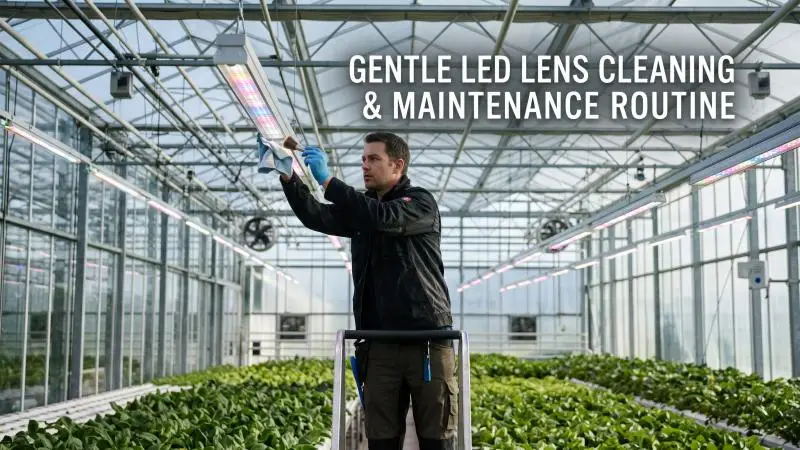
The cleaning procedure is short. The discipline is in the order and in what you refuse to do.
- Isolate power. De-energize the fixture before any contact with the lens.
- Remove loose material dry. Brush or vacuum dust and grit first, so it is lifted off rather than dragged across the surface.
- Use a soft, non-abrasive cloth and a cleaner confirmed compatible with the specific lens polymer. A cleaner approved for PMMA is not automatically approved for PC, and vice versa.
- Avoid tap water. It leaves a mineral film that itself reduces transmission.
- Never rub protruding diodes. Physical pressure on an exposed emitter is a failure mode, not a cleaning technique.
- Dry fully before re-energizing.
The failure mode to watch for is cleaning that removes fouling but adds fine scratches. Haze from scratching is irreversible, and as the ASTM D1003 geometry discussion shows, it can hide inside a total transmission number while scattering light away from the canopy. A lens that reads acceptably but looks dull in raking light is telling you the cleaning method is costing more than it returns.
Set inspection frequency from the environment rather than a fixed calendar. A grow-light cleaning guide suggests monthly attention in dusty or high-traffic areas and quarterly or annual cleaning in cleaner environments, with the trigger being visible buildup or reduced brightness. That is a reasonable starting frame; adjust it to what your own inspections find.
Inspect the whole fixture, not just the lens face. Seals and gaskets are exposed to the same cleaning chemicals and fumigants, and elastomer compatibility varies widely by compound. The ISM elastomer chart, for example, rates EPDM A against sulfur dioxide while nitrile is rated D, and rates EPDM D against ketones. A gasket that degrades before the lens does admits moisture, and moisture ingress damages drivers and connectors long before the LEDs themselves fail. Record any moisture found inside a housing during cleaning, because repeated small amounts usually indicate a failing seal rather than a one-time event.
Write Greenhouse LED Lens Transmission, Aging and Ingress Requirements into the Purchase Contract
The preceding sections describe what to do with the fixtures you have. The next purchase is where you stop repeating the problem. Four requirements belong in the contract, each with a named test and a stated condition.
Initial Transmission or Haze, with the Method and Geometry Named
Specify the value, the standard (ASTM D1003 is the relevant method for haze and luminous transmittance of transparent plastics), and whether the figure is regular or total hemispherical transmittance. Without the geometry, the number is not reproducible.
An Aging Protocol with the Light Source Spectrum Stated
The NIST weathering work found that degradation rates increase exponentially as wavelength decreases over the 306–355 nm range, with a different function for each material studied, and that because the test source’s spectral power distribution was unlike natural sunlight, there was no a priori way to calculate a correlation factor between chamber exposure and outdoor life. The paper concludes that service-life prediction of dissimilar materials is best done with sources whose spectrum is close to sunlight, such as properly filtered xenon arc. A supplier’s aging claim is only as good as the spectrum behind it. IEC 60068-2-5:2018 specifies simulated solar radiation testing at ground level and includes a weathering test method, which gives you a citable protocol to require.
An Ingress Rating Appropriate to the House, Verified on the Datasheet
IEC 60529 is the standard behind the IP code, and its dust and water tests have defined pass criteria. IP54 to IP65 is the usual band for greenhouse and vertical-farm conditions, according to a grow-light IP rating guide, which also makes the necessary caveat: an IP rating says nothing about chemical resistance, UV stability, or impact resistance. Require the actual code on the datasheet, not the word “waterproof.”
Chemical Compatibility Declared Against Your Actual Fumigants and Cleaners
List the agents you use, with concentration and application temperature, and require the supplier to confirm compatibility for each. This is the requirement that most directly protects the lens you just spent the article learning to keep clean.
The acceptance threshold is your decision, not a published number. No standard dictates how much transmission loss justifies rejecting a lens, because the right figure depends on your baseline, your crop’s light requirement, and the cost of replacement. Set the number from your own commissioning data, state the test that proves it, and write both into the contract so that acceptance is a measurement rather than an argument.
Verify the Result and Decide When to Replace
Verification is the baseline procedure run again. Re-measure the witness coupon at the same sphere port position, re-read fixture output at the same marked points, and compare against the commissioning record. Then classify what you find.
A fouled lens is recoverable: clean it and re-measure. A yellowed or scratched lens is not. If cleaning no longer moves the coupon reading, the loss is in the material, and the question shifts from maintenance to replacement.
Set the replacement trigger as a condition you defined in advance. Three workable triggers:
- Loss beyond the threshold written into your purchase contract.
- Haze that cleaning no longer reduces.
- Visible crazing that compromises the seal.
The third deserves emphasis. Crazing is not only an optical problem; on a polycarbonate lens it can progress to mechanical failure, and the polycarbonate resistance datasheet warns that such conditions can lead to catastrophic mechanical and electrical failures. A crazed lens that still transmits acceptably is still a lens to replace.
Assess replacement economics at fixture level. A lens approaching the end of its transmission life is usually accompanied by LED and driver depreciation, and the DLC horticultural requirements set a useful reference point for what a fixture is expected to deliver over time: Q90 photon flux maintenance of at least 36,000 hours and a driver lifetime of at least 50,000 hours for listed products. If your fixture is already well into that service life, a lens replacement buys less than a fixture replacement. Compare the cost of the optic against the delivered light you recover, not against the lens price alone.
FAQ
Which material should I choose if I run sulfur burners?
Neither PMMA nor polycarbonate comes out of the compatibility charts well against wet sulfur dioxide, which is rated severe on PMMA and marked incompatible on the polycarbonate datasheet. Glass has no polymer yellowing mechanism and the best chemical resistance of the group, at higher cost and weight. If fumigation is routine, the practical route is to confirm the specific exposure with the lens supplier and consider shielding the optic or selecting glass rather than assuming a polymer will hold.
Is an anti-reflection coating worth specifying?
It recovers real light: uncoated surfaces lose roughly 4% each, and coating can bring that below 0.5%. The question is durability. Hard AR coatings carry stated temperature ranges on PMMA and PC; nanostructured AR is mechanically sensitive and recommended for protected surfaces only. On an exposed lens that gets brushed and washed, specify the hard coating and confirm its rating, not the nanostructure.
How do I test without a spectrophotometer?
Use the fixture itself as the instrument. Mark fixed measurement points, record PPFD at each with a quantum sensor at commissioning, and repeat at the same points and distance. This confounds lens loss with LED depreciation, so pair it with a visual and photographic record of the lens. For a defensible transmission number, send a witness coupon to a lab for ASTM D1003 testing; that is a one-time cost per fixture type.
What if a lens is already crazed?
Replace it. Crazing indicates chemical attack that has progressed beyond the surface, and on polycarbonate it can lead to mechanical failure. Cleaning will not reverse it, and continued service risks the seal and the electronics behind it. Record the chemical exposure that preceded it so the replacement specification accounts for it.