An end-of-day far-red treatment utilizes a short pulse of EOD far-red light delivered at subjective dusk, and it is worth testing when time-to-flower, stem elongation, canopy uniformity, or lighting energy use is a constraint you can already measure. The mechanism is well characterized: an EOD far-red light pulse given at subjective dusk triggers a circadian clock-gated response that leaves a minimal pool of active Pfr during the dark period, mimicking a continuous low-R: FR photoperiod.
What separates a reproducible result from a wasted trial is verification. Canopy R:FR ratio measurement is a useful first check across similar spectra, but it is not a reliable predictor by itself once LED spectral power distributions differ.
This guide is for growers, cultivation managers, and facility engineers deciding whether an independent far-red channel earns its place in the room. It covers how EOD far-red flowering responses differ by crop class, the parameter ranges and far-red light protocol for controlled environment cultivation you can trial, and the operational controls, uniformity mapping, and documentation that make a deployment auditable.
Introduction
An end-of-day far-red treatment is worth testing when a crop’s time-to-flower, canopy uniformity, or lighting energy bill is a bottleneck you can actually measure. Growers running tight schedules in controlled-environment agriculture benefit most: a short far-red pulse at subjective dusk can shift phytochrome photoequilibrium and nudge flowering timing without adding meaningful heat load. The question is not whether far-red works in the abstract, but whether your crop, spectrum, and dose produce a reproducible result.
Track four outcomes from day one: time-to-flower, stem elongation, canopy uniformity, and energy use per cycle. Each tells you something different about whether the treatment earns its place in your recipe.
Verification at the canopy separates a repeatable protocol from a lucky first run. An EOD-FR pulse given at subjective dusk is a circadian clock-gated response that leaves a minimal pool of active Pfr during the dark period, so it depends on dose, timing, and the R: FR your plants actually see rather than the ratio a fixture spec sheet claims (Physiological and Genetic Characterization of End-of-Day Far-Red, 2010).
R: FR is dimensionless and best read as open sun versus shade, which makes it a useful first check across similar spectra but not a reliable predictor by itself when LED SPDs differ (SLTMAKS, Phytochromes LED Control: Red and Far-red, 2026).
Key Takeaway: Test an end-of-day far-red treatment only if you can measure time-to-flower, elongation, uniformity, and energy at the canopy. Dose, timing, and verified R:FR determine whether results reproduce.
Table of Contents
How EOD far-red light influences flowering
Timing, not total dose, is what makes an end-of-day far-red treatment work. The mechanism is phytochrome photoequilibrium: the plant measures night length by how much active phytochrome survives into darkness, and a dusk pulse removes it before the clock starts counting. That is why the same far-red light phytochrome photoequilibrium produces different flowering responses depending on when it is delivered.
Phytochrome photoequilibrium and the dusk signal
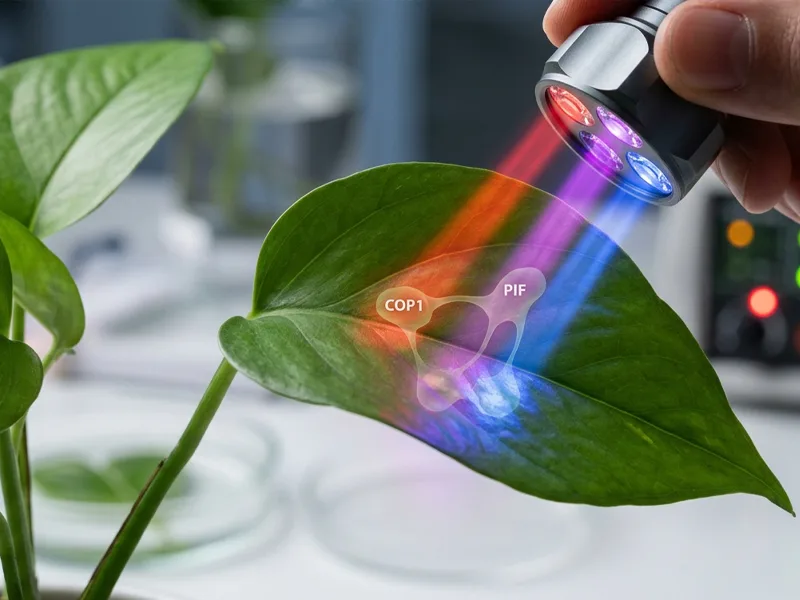
Phytochrome exists as interconvertible Pr (inactive, red-absorbing) and Pfr (active, far-red-absorbing) forms. Red light shifts the pool toward Pfr; far-red shifts it back toward Pr. Because the two absorption spectra overlap, any real light source drives a photoequilibrium rather than a one-way switch, so the ratio of red to far-red at the canopy sets where that equilibrium settles (PMC12182589, 2025-06-21).
Once the lights go out, the remaining Pfr does not persist indefinitely. Dark reversion, the slower thermal relaxation of Pfr back to Pr, proceeds without light and is typically described by multiple kinetic phases running from minutes to hours, with rate depending on phytochrome type, species, temperature, and cell context (PMC3268501, 2011-08-29). The plant’s night-length measurement therefore depends on how much Pfr is still present when darkness begins.
Why end-of-day timing outperforms midnight pulses
An EOD-FR pulse empties residual Pfr at dusk, so the night starts with little active phytochrome and the perceived dark period lengthens even though clock dark time is unchanged. A midnight or light-break pulse does the opposite: it re-accumulates Pfr mid-night, splitting or resetting the night-length measurement (PMC2938140, 2010-07-28).
For a short-day crop, that difference is the whole intervention. The dusk pulse extends the signal the plant already reads as night; the midnight pulse interrupts it and can push the plant back toward a long-day interpretation. This is the practical reason to treat timing and dose as separate variables rather than scaling one number up or down.
Pro Tip: Treat timing and dose as separate variables. Fix the EOD window first, then tune intensity and duration inside it. Increasing far-red dose at the wrong hour does not substitute for moving the window.
Indoor vs. greenhouse: baseline spectra and solar far-red
Indoor rooms start from a known baseline. Broad-spectrum LEDs deliver little far-red, so canopy R: FR sits high and the dusk transition is abrupt. Adding an EOD-FR window is a deliberate, repeatable change, and the same schedule can be locked per room.
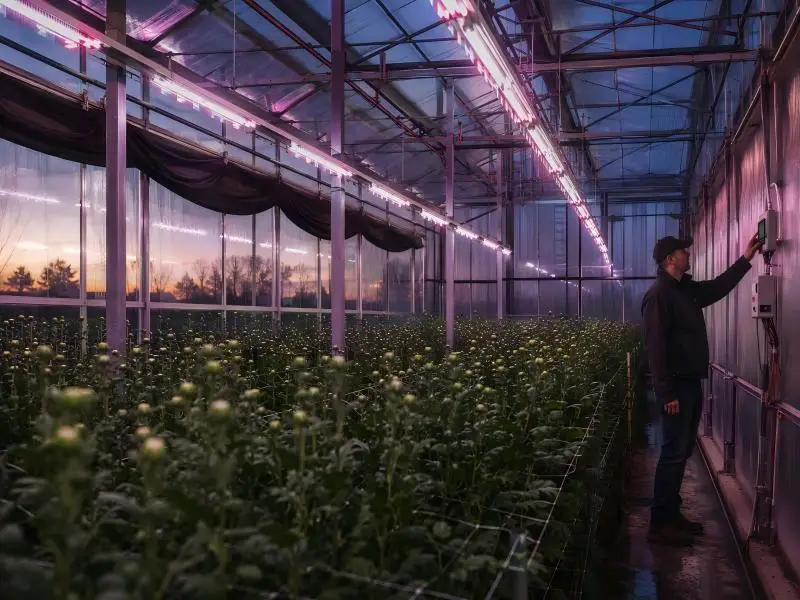
Greenhouses begin with solar far-red already in the spectrum, and that contribution shifts with season, cloud cover, and glazing. A fixed EOD-FR dose that reads correctly in March may overshoot in June, when natural far-red at dusk is already high. Greenhouse operators should therefore treat the EOD window as a seasonal variable and re-check canopy R: FR ratio measurement after any change to glazing, shading or supplemental lighting.
Evidence by crop class
Crop class, not fixture choice, decides whether EOD far-red flowering gains are real. Model crops respond most consistently; short-day crops split by dose and timing; cannabis mostly changes shape rather than schedule. The table below grades what the published record actually supports.
| Crop class | Treatment | Measured outcome | Source |
|---|---|---|---|
| Tomato (day-neutral model) | 15 min EOD-FR at 17 µmol·m⁻²·s⁻¹, 730 nm, after 16 h light | EOD phytochrome photostationary state shifted to 0.88/0.1 | Frontiers in Plant Science |
| Tulip (stem-length model) | Continuous FR extension | Elongation saturates near 0.59 µmol·m⁻²·s⁻¹, diminishing above ~1 | SLTMAKS |
| Cannabis | FR added to the dark period | +9% plant height, +17% petiole length | Nature Scientific Reports |
| Cannabis | 4 h FR in a 12 h photoperiod | Reduced flower biomass, delayed flowering | SLTMAKS |
Model crops: tomato photoequilibrium and tulip extension
The clearest published EOD far-red flowering evidence comes from model crops rather than commercial long-day ornamentals, and the distinction matters when you plan a trial. A dusk FR signal lowers the active phytochrome fraction and reads to the plant as “the day is ending.” The tomato work used a 15-minute EOD-FR pulse at 17 ± 0.4 µmol·m⁻²·s⁻¹ (730 nm) after a 16-hour photoperiod, dropping the end-of-day phytochrome photostationary state to 0.88/0.1, a decisive dusk signal rather than a light-supplementation effect (Frontiers in Plant Science).
Tulip stem extension, a related low-R: FR response, saturates near 0.59 µmol·m⁻²·s⁻¹, so pushing intensity past roughly 1 µmol·m⁻²·s⁻¹ buys little (SLTMAKS). Treat intensity as a threshold to clear, not a dial to maximize. If your crop is a long-day ornamental, run the same measurement on your own benches before you assume the tomato result transfers.
Short-day crops: mixed responses and dose/timing dependencies
Short-day crops do not inherit the model-crop result. FR during a 12 h dark period delayed flowering, and 4 h of FR inside a 12 h photoperiod reduced flower biomass and delayed flowering across genotypes, while 2 h of FR in a 10L/14D cycle showed no detrimental effect (Nature Scientific Reports). The pattern is dose- and window-dependent: short EOD pulses and multi-hour additions are not the same treatment. Verify on your own cultivar before committing a room.
Cannabis and day-neutral notes: morphology effects over initiation timing
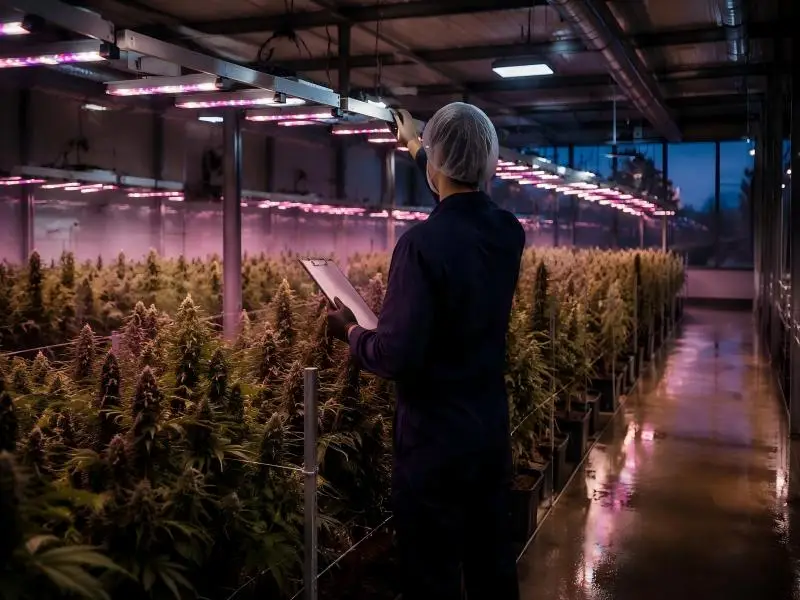
In cannabis, far-red reliably drives shade-avoidance morphology, taller plants with longer internodes and petioles, while flowering-time effects are weak, absent, or negative depending on dose and timing; floral induction is reported to be controlled mainly by photoperiod rather than light quality (Nature Scientific Reports). One genotype, Northern Lights, gained roughly 70% total THC yield under 10 h full spectrum plus 2 h FR, but that is a single-genotype result, not a schedule (SLTMAKS).
⚠️ Warning: Do not generalize cannabis morphology results to flowering timing. Height and petiole gains are consistent; initiation-timing gains are not, and a 4 h FR addition can cost flower biomass.
The practical read: trial EOD far-red for flowering acceleration on model crops first, treat short-day production as a dose-and-window experiment, and treat cannabis as a morphology and yield experiment with its own verification.
Protocols and parameters you can trial
A workable end-of-day far-red treatment starts with three numbers you control directly: intensity at the canopy, window length, and the resulting dose per treatment. Get those into a log before you touch anything else, because the useful question is not “did we add far-red” but “what exactly did we add, and did the crop respond.”
The dusk signal is a transition cue, not a cumulative light sum, so a long far-red tail mostly overlaps into the dark period where the phytochrome response you are trying to trigger has already been set. Practical commissioning guidance for EOD-FR windows therefore favors short windows and treats multi-hour far-red additions as high-risk rather than as a shortcut to a stronger signal. The exact ceiling is a trial question for your room, not a published constant, which is why the brackets below are written as ranges to test rather than setpoints to copy.
Starting ranges: intensity, duration, and per-treatment dose
Treat these as trial brackets. Your cultivar, canopy density, and existing spectrum determine where the useful range sits.
- Intensity: add far-red as a supplement to the existing photoperiod, sized so the canopy-level FR addition is a defined fraction of total PPFD rather than a fixed wattage. Record the fraction, not just the fixture setting.
- Duration: begin at the short end, tens of minutes rather than hours, and extend only after you have a flowering-time or morphology result to justify it.
- Dose per treatment: multiply canopy FR PPFD by window seconds to get mol·m⁻² per event. This single number makes trials comparable across rooms and seasons.
- Schedule position: run the window at the end of the photoperiod, immediately before lights-off, so the far-red transition is the last spectral event the canopy sees.
Pro Tip: Log dose per zone, not per room. A single room-level number hides the uniformity problem you will find in the next subsection.
Targeting canopy R: FR and verifying with spectroradiometry
Canopy R:FR ratio measurement is the check that tells you whether the protocol actually reached the plants. Measure at canopy height, not at fixture height, and measure at several points across the bed rather than at one representative spot.
Use a spectroradiometer to capture the red and far-red bands under the full operating spectrum, with the EOD window both on and off. The difference between those two readings is your delivered far-red addition. Fixture datasheets and IES photometric files describe what the luminaire emits in isolation; they do not describe what arrives at a leaf under a closed canopy, so the measurement is the only number that counts. Run this check whenever you change fixture height, canopy density, or the crop mix in a zone.
Greenhouse vs. indoor: scripting EOD windows and seasonal tweaks
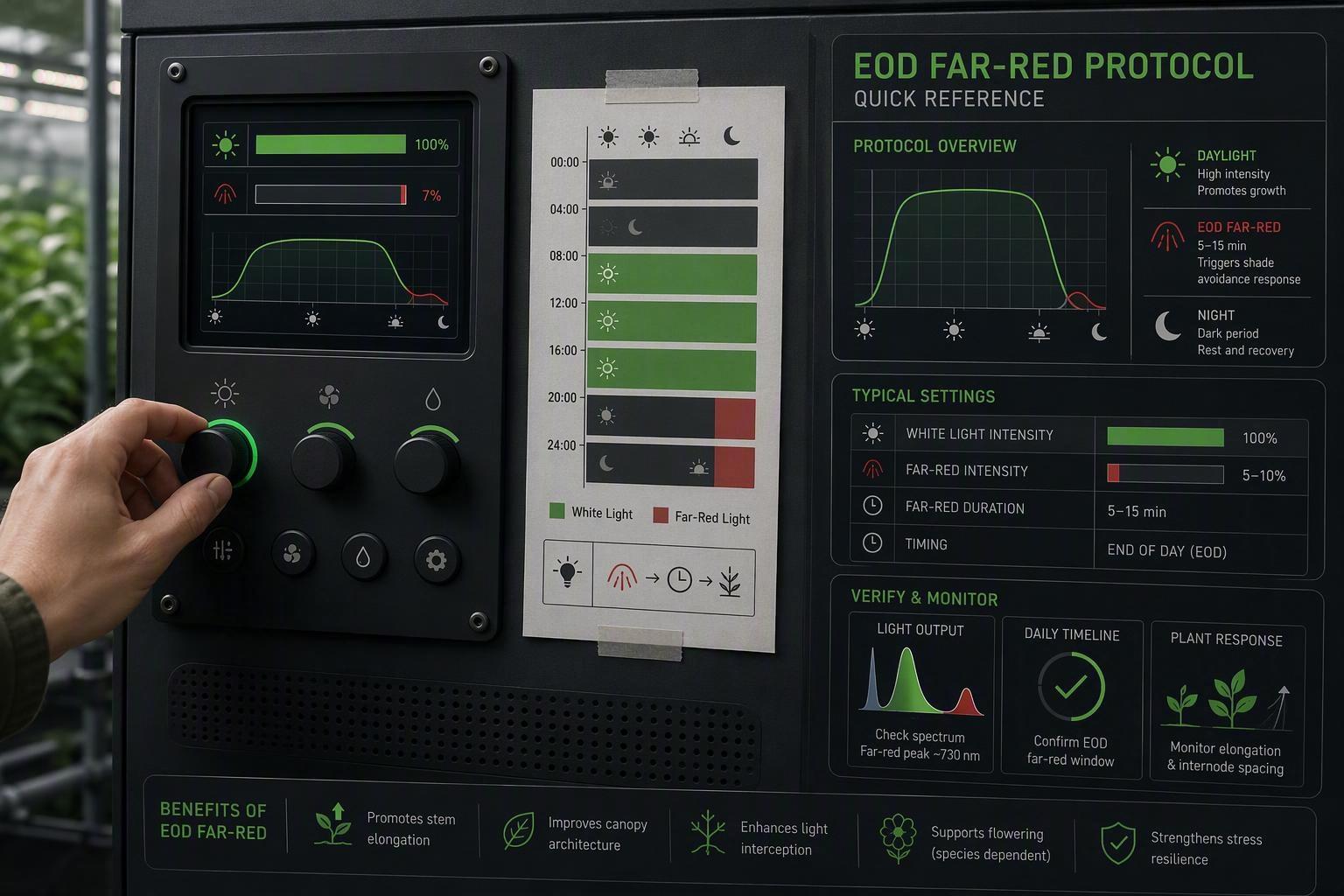
Indoor rooms let you script the window as a fixed offset from lights-off, which keeps dose constant year-round. Greenhouses do not: solar far-red already arrives at dusk, and its contribution shifts with season, cloud cover, and glazing. In a greenhouse, treat the EOD window as a supplement to a moving baseline, and re-measure canopy R: FR after seasonal transitions rather than assuming the setpoint still holds.
Operational deployment at scale
Running an end-of-day far-red window in one grow room is straightforward. Running it across a facility without disturbing existing climate control, lighting schedules or uptime is a controls problem, and that is where most deployments stall. The three areas below cover what tends to break first: channel independence, canopy uniformity, and heat load.
Controls and failsafes: independent FR channels, scripts, and alarms
Treat far-red as its own controllable channel rather than a fixed fraction of the white or red output. Independent control is what lets you open an EOD window at dusk, close it, and keep far-red at zero for the rest of the photoperiod, which matters because the dusk signal is the point of the treatment.
Continuous far-red through the dark period does not reproduce the same effect, since the perceived dark period lengthens even though clock dark time is unchanged (Frontiers in Plant Science, retrieved 2026-06-11). A far-red light protocol for controlled environment cultivation therefore needs a schedule that can be scripted per room, not a global dimmer curve.
Practical failsafes to build in:
- A hard cap on continuous far-red fraction, enforced in the controller rather than in the operator’s head.
- An alarm if the FR channel is still on past the scheduled window close.
- Logging of every window open, close, and intensity setpoint, timestamped, so a crop response can be traced back to what the fixture actually did.
SLTMAKS fixtures are stated to offer tunable red/far-red channels that support per-room EOD-FR windows, capping of continuous FR fractions, and locked schedules, which is the kind of control surface this section assumes.
Uniformity mapping: grid-based R: FR checks and correction workflow
A canopy R: FR ratio measurement taken at one point tells you almost nothing about a room. Map it instead: divide the canopy into a grid, take a reading at each node with a spectroradiometer, and record the ratio alongside the position. The output is a uniformity map, and the workflow that follows is short. Flag nodes outside your target band, check whether the deviation tracks a fixture row or a room edge, then adjust hanging height, spacing or channel output before the next cycle.
IES photometric files are stated to be available from SLTMAKS to support layout validation and uniformity checks before fixtures are hung, which is cheaper than correcting after commissioning.
Key Takeaway: Independent FR channels, a hard cap on continuous far-red, and timestamped logging turn an EOD-FR trial into something you can audit and repeat. Uniformity is verified on a grid, never from a single sensor reading.
HVAC and energy: small heat load, cycle-time impacts, scheduling
Far-red adds a modest heat load relative to the main photoperiod, but it lands in a window where your HVAC may already be ramping down for the dark period, so check the overlap rather than assuming it is negligible. Schedule the EOD window so it closes before the cooling setpoint changes, and confirm the added load against your existing capacity before scaling to every bay. Where cycle time shortens, labor and irrigation schedules shift with it, so plan the change by zone rather than facility-wide.
ROI, documentation, and compliance
Where ROI arises: cycle-time, throughput, labor planning
An end-of-day far-red treatment earns its place in a capital plan through three measurable channels: shorter cycles, higher throughput per bay, and steadier labor demand. Cycle time is the first lever. When a crop finishes earlier, the same bench space turns over more times per year, and each additional turn carries its own revenue without a matching increase in fixed cost. Throughput follows directly: more turns per bay per year at the same labor hours per turn means lower labor cost per unit harvested.
The 2025 Scientific Reports cannabis trial is instructive here, and it is worth reading carefully before you promise a number to finance. The study reported morphology-driven changes under far-red supplementation rather than a clean shift in initiation timing. That distinction matters for ROI modeling: if the effect is expressed through plant architecture and canopy fill rather than a shorter flowering window, the return shows up in grams per square meter and in the number of pruning or trellising passes, not in the calendar.
Labor planning is where this becomes concrete. A more compact, more uniform canopy is faster to scout, faster to defoliate, and easier to schedule against a fixed crew. Build the business case on those two or three line items you can actually measure in your own rooms, and treat any cycle-day claim as a hypothesis to test rather than a planning assumption.
Safety and audits: ETL/CE/RoHS, commissioning records, spectra logs
Procurement and the authority having jurisdiction will ask for the same three things: a listing mark, a commissioning record, and evidence that the installed spectrum matches what you specified. Confirm the fixture’s ETL, CE, or RoHS documentation before you sign, and keep the certificates in the project file rather than in a vendor email thread. Commissioning records should capture the as-built layout, the measured output at canopy height, and the date of measurement.
Spectra logs close the loop: a dated record of the red to far-red ratio at canopy level, taken at the same grid points over time, is what turns a specification into an auditable fact. Note that published product pages do not state a numeric dimming protocol or a numeric R: FR target, so write your own acceptance criteria into the commissioning scope instead of borrowing a figure from a datasheet.
Rollout playbook: pilot, verify, then scale by bay/zone
Sequence the deployment so that each stage produces evidence for the next.
- Pilot one zone. Run the end-of-day window in a single bay or room, with a control zone matched for cultivar, substrate, and planting date.
- Verify before you expand. Measure canopy R: FR at fixed grid points, log the spectra, and record cycle days, yield per square meter, and labor hours per turn against the control.
- Scale by bay or zone. Add capacity only where the verified delta holds, and re-verify after each addition, because uniformity problems compound as rooms multiply.
Key Takeaway: Pilot, verify, scale. Each stage should produce a record that justifies the next.
If you are planning a first installation or need the commissioning documentation package for an audit, start a pilot and verification conversation with our team.
FAQ
Does end-of-day far-red actually make plants flower earlier?
It depends on the crop, and that is the honest answer most guides skip. Far-red light reliably shortens time-to-flower in many long-day plants, where it’s most effective when photoperiodic lighting includes both red and far-red rather than far-red alone, according to Michigan State University’s guide to far-red radiation. Tomato is the clearest controlled-environment example: a 15-minute EOD-FR pulse at 17 µmol·m⁻²·s⁻¹ after a 16-hour photoperiod advanced flowering and fruit maturity compared with no far-red (PMC6448094, 2019). Day-neutral crops show no consistent flowering effect, and in short-day crops far-red alone is not a reliable flowering trigger. Treat “accelerated flowering” as a crop-specific hypothesis, not a guaranteed outcome.
How long should an end-of-day far-red treatment run?
Start short. Research and commercial practice converge on roughly 10 to 30 minutes immediately before or at lights-off, and a canopy-level study on tomato found a 15-minute pulse was enough to set a decisive dusk signal. Longer windows are not automatically stronger: the dusk cue is a transition signal rather than a cumulative light sum, so multi-hour far-red additions risk overlapping into the dark period where the phytochrome response has already been set. Fix the window first, then tune intensity inside it, and extend duration only after you have a flowering or morphology result that justifies it.
Does far-red light help or hurt flowering in cannabis?
It mostly changes shape, not schedule. Far-red reliably drives shade-avoidance traits in cannabis, with one trial reporting about 9% greater plant height and 17% longer petioles (Nature Scientific Reports, 2025), while flowering-time effects range from weak to negative depending on dose and genotype. That same study found a 4-hour far-red addition inside a 12-hour photoperiod reduced flower biomass and delayed flowering, so duration and placement carry real risk. Build a cannabis program around canopy architecture and verified yield per square meter rather than an assumed shorter cycle, and always confirm the response on your own cultivar before scaling it to a room.