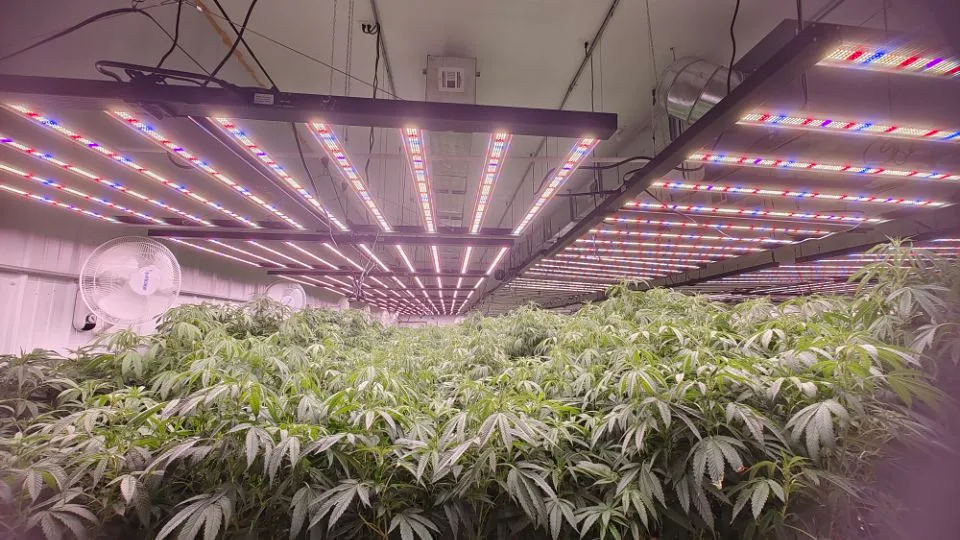
A full spectrum LED grow light is one of the simplest ways to give plants consistent, “sun-like” indoor lighting without the heat and energy waste of older technologies. But buying a fixture is the easy part—getting great growth comes from understanding three ideas: spectrum (light quality), PPFD (light intensity), and hanging distance (delivery to the canopy).
This guide explains those concepts in plain English, then turns them into practical setup steps you can use for seedlings, leafy greens, herbs, houseplants, and fruiting crops. Along the way, you’ll see how professional growers think in terms of PPFD and DLI, not watts, so your results become repeatable instead of guesswork. Yard and Garden
Table of Contents
What “full spectrum” really means for plant lighting

PAR is the plant-useful part of light
Plants mainly use light in the PAR region—traditionally described as 400–700 nm—because those wavelengths drive photosynthesis efficiently. That’s why horticulture lighting talks about “PAR photons” and not the brightness you see with your eyes. NASA Earthdata
A key point is that PAR is a measurement range, not a promise of “perfect” light. Two fixtures can both output PAR but still perform differently depending on spectrum shape, intensity, and uniformity across your canopy. ies.org
“Full spectrum” is a marketing term, so look for the spectrum shape
In consumer markets, “full spectrum” isn’t a single regulated formula. In practice, a full spectrum LED grow light usually means a white LED base (often described by CCT like 3000K/4000K/5000K) sometimes blended with deep red, and occasionally far-red. This creates a broad spectral distribution that supports both photosynthesis and normal plant morphology.
What you want to see is a spectrum chart (SPD) and a PPFD map at defined mounting heights. Those two documents tell you far more than “full spectrum” printed on a box. Yard and Garden
Why growers like white-light fixtures for real work
White-light-based grow fixtures make it easier to see plant color, nutrient issues, pests, and overall canopy health. That matters in commercial environments because better visibility supports faster decisions and fewer losses, even before you talk about photons.
If a supplier can provide third-party or lab-style measurements, that’s an extra signal of professionalism. For example, PPFD and DLI are standard concepts used in university extension lighting guidance and professional horticulture training. AgriCollege
The numbers that matter: PPF, PPFD, and photon efficacy
PPFD is “how much usable light hits the leaves”
PPFD (Photosynthetic Photon Flux Density) measures the number of PAR photons landing on a surface each second, expressed as µmol·m⁻²·s⁻¹. In simple terms, PPFD tells you how intense the plant light is at canopy level—which is why it’s the most useful single metric for hanging height and dimming decisions. Yard and Garden
Lux and lumens can be misleading for plant lighting because they are based on human vision sensitivity. That’s why extension educators emphasize PPFD when discussing indoor plant lighting performance. Yard and Garden
PPF is what the fixture emits, PPFD is what the plant receives
PPF is total photons a fixture outputs per second (µmol/s), while PPFD is those photons distributed over area at the canopy. A high-PPF fixture can still deliver poor results if optics, height, or footprint uniformity are wrong.
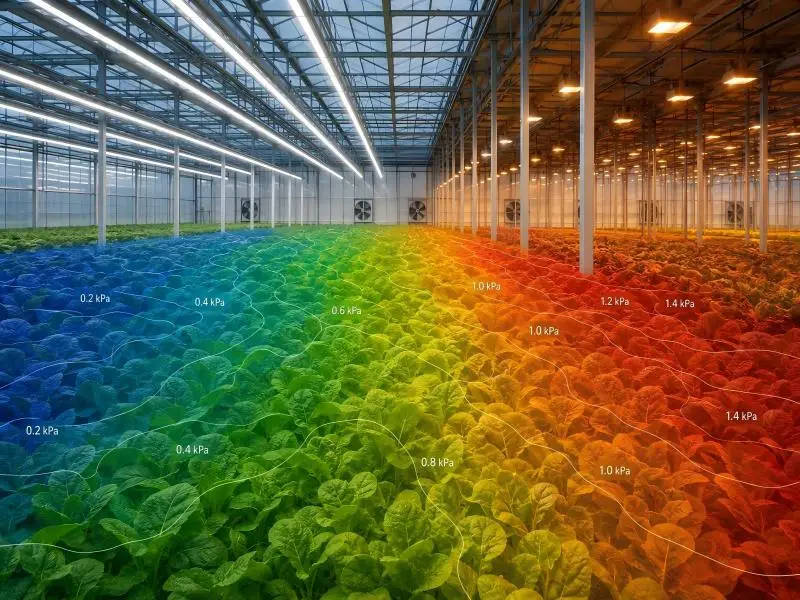
That’s why a reputable supplier should show PPFD maps at multiple hanging heights. Maps reveal hotspots, weak corners, and how well your canopy will match the light distribution. Yard and Garden
Photon efficacy (PPE) helps you compare energy efficiency honestly
A common buying mistake is comparing “watts” like it’s a brightness number. Watts are only power input, and two fixtures with the same wattage can deliver very different photon output and distribution.
Instead, compare photon efficacy (PPE)—how many PAR photons you get per watt. High efficacy usually means lower electricity cost for the same PPFD at canopy, especially important for long photoperiod crops. Wikipedia
PPFD targets by growth stage (practical ranges you can start with)
Seedlings and clones: gentle intensity, close control
Seedlings typically need lower PPFD than mature plants because their leaves are thin and their root systems are still developing. A safe starting range for many seedlings is roughly 100–250 µmol·m⁻²·s⁻¹, then you increase as they build leaf area and stem strength.
The goal is compact, sturdy growth—not maximum photons on day one. You can keep the canopy stable by using a dimmer and maintaining a consistent distance as the plants grow upward. AgriCollege
Leafy greens and herbs: steady PPFD with good uniformity
Leafy greens and herbs generally respond well to moderate-to-high PPFD with long photoperiods. Many controlled-environment growers target something like 200–400 µmol·m⁻²·s⁻¹ for a balanced mix of growth rate and quality, then tune photoperiod to hit the DLI they want.
Uniformity matters more than people expect. If the center is 400 and corners are 150, you won’t get consistent harvest timing or quality across the tray. AgriCollege
Fruiting crops: higher PPFD, tighter environment management
Fruiting crops usually need more total light per day to maintain yield and strong flowering/fruit set. Instead of obsessing over a single PPFD number, you’ll get better results by thinking in DLI, then choosing a PPFD + photoperiod combination that achieves it.
University and industry references commonly show fruiting vegetables needing higher DLI than foliage crops under controlled environments. That’s why fruiting setups often pair higher PPFD with stronger airflow, better temperature control, and sometimes CO₂ supplementation. AgriCollege
Houseplants: match the plant’s natural light habit
Houseplants vary widely, so “one PPFD fits all” doesn’t work. Many foliage houseplants prefer lower daily light totals, while sun-loving ornamentals want more.
The easiest way to win here is to pick a moderate PPFD, then adjust by observing leaf response over 1–2 weeks. Houseplants are forgiving if you avoid extremes and keep the photoperiod consistent. AgriCollege
DLI: the “light per day” number that makes results repeatable

What DLI is and why it matters
DLI (Daily Light Integral) is the total number of PAR photons delivered per square meter per day, expressed as mol·m⁻²·day⁻¹. It combines both intensity and time, which is why two setups with different PPFD can still produce similar growth if their DLI matches. Apogee Instruments
This matters because plants react to the daily total, not just the midday peak. DLI thinking also helps you optimize electricity cost by selecting a reasonable PPFD and then choosing photoperiod strategically. Virginia Tech Publications
The simple DLI formula you can use
A common conversion is:
DLI ≈ PPFD × 0.0036 × hours of light
This relationship (PPFD integrated over time) is widely used in extension guidance for practical greenhouse and indoor calculations. Wikipedia
Example: If your canopy PPFD averages 300 µmol·m⁻²·s⁻¹ for 16 hours, DLI ≈ 300 × 0.0036 × 16 = 17.3 mol·m⁻²·day⁻¹. That’s a strong daily total for many greens and a solid baseline for higher-light crops depending on species and goals. Virginia Tech Publications
DLI targets: low, medium, high (useful for planning)
One helpful reference point is that crops can be grouped by DLI needs, with shade/foliage plants generally lower and fruiting or cut-flower crops higher. Michigan State University floriculture resources provide suggested DLI target ranges by crop type, which many growers use as a starting framework. AgriCollege
Treat these as starting targets, not rigid rules. Temperature, CO₂, cultivar, and your quality goals all influence the ideal DLI, so you’ll refine over time using plant response and measured PPFD. Wiley Online Library
Hanging distance: how to set height without guessing
Distance changes PPFD fast (but LEDs aren’t a single point source)
Basic light physics says intensity drops with distance, often described by the inverse-square concept for point sources. NASA educational materials show the core idea: as distance increases, brightness drops sharply. NASA
Real LED grow lights are arrays, not a single bulb, so the drop is usually less extreme close to the fixture. Even so, hanging height still strongly controls canopy PPFD and uniformity, which is why “set it and forget it” often leads to bleaching or stretching. NASA
A practical starting distance range
If you don’t have a quantum sensor yet, start conservative and use the plant as feedback. For many modern full spectrum LED grow light panels and bar fixtures, these starting points work well:
- Seedlings / propagation: roughly 45–75 cm above canopy, then dim to hit gentle PPFD.
- Vegetative leafy growth: roughly 30–60 cm above canopy, then adjust based on response.
- Higher-light fruiting phases: often 25–50 cm, usually with careful PPFD checking and strong airflow.
These are starting ranges, not guarantees. The correct height depends on fixture design, optics, wattage, and how wide your canopy is relative to the fixture footprint. Yard and Garden
Use dimming as a tool, not an afterthought
Dimming is the easiest way to control PPFD without constantly moving the fixture. It also helps you maintain uniformity because you can keep the light at a height that covers the area well, then tune intensity to your stage.
If you’re running shelves or vertical racks, dimming becomes even more important because fixed ceiling heights force you to manage intensity precisely to avoid leaf stress. AgriCollege
The best method: measure PPFD where plants actually are
Professional growers measure PPFD at multiple points across the canopy (center, mid, corners) and then calculate DLI based on photoperiod. This is exactly the kind of measurement workflow described in extension and horticulture education materials. Yard and Garden
If you only measure the center, you’ll overestimate your whole grow area. A simple grid measurement gives you the truth, and that truth translates directly into predictable harvest timing and quality. AgriCollege
Coverage and uniformity: the hidden performance multiplier
Footprint is about the weakest areas, not the brightest spot
Many buyers shop by the maximum PPFD number. That’s risky because the hottest center point is not where problems happen—problems happen at the edges where plants stretch and mature slower.
A better approach is to look at minimum and average PPFD across your target footprint. A fixture with slightly lower peak PPFD but better uniformity often produces more consistent yield across the entire canopy. Yard and Garden
Overlap beats “one light per area” thinking
Uniformity improves when multiple fixtures overlap footprints slightly. This is why commercial rooms often use bar-style layouts or multiple smaller fixtures rather than one massive panel.
When overlap is done well, you can run a lower peak PPFD while raising the corners and edges. The result is a smoother canopy microclimate and more predictable crop timing. AgriCollege
Reflective surfaces help, but don’t substitute for good design
Reflective walls and clean surfaces can recover some light that would otherwise be lost. However, they can’t fix a fundamentally poor PPFD map or an undersized fixture.
If your corners are too low, you need either better coverage, a different mounting height, or more fixtures. Treat reflectivity as optimization, not a rescue plan. Yard and Garden
Spectrum + plant shape: why full spectrum often looks “more natural”

Blue light influences compact growth and leaf thickness
In broad terms, more blue content tends to encourage tighter internodes and thicker leaves in many species. That’s one reason white-light-based full spectrum fixtures can produce sturdier, more “daylight-like” plant structure compared to very narrow red/blue combinations.
The key is balance. Too much blue at high PPFD can slow stretch (good) but also increase stress risk if temperature and humidity aren’t managed well. AgriCollege
Red light drives photosynthesis efficiently, but it’s not the whole story
Red photons are highly effective for photosynthesis, which is why red is always present in grow lighting. But plants are not solar panels—spectrum influences morphology, pigmentation, and canopy development, not just raw photosynthetic rate.
That’s why many professional indoor setups prefer a broad spectrum foundation and then fine-tune with small additions (like deep red or far-red) only when there’s a clear purpose. NASA Earthdata
Far-red and “extended PAR” are advanced tools
Some research and commercial practice consider wavelengths beyond 700 nm (often discussed as extended PAR or ePAR) because far-red can influence plant signaling and canopy responses. Instrument manufacturers and researchers discuss this evolving area and the proposed extension toward 750 nm in some contexts. ICT International
For most growers, you don’t need to chase far-red immediately. Start with strong, uniform PAR PPFD, hit your DLI target, and only then explore spectrum tweaks once your environment and nutrient program are stable. AgriCollege
Heat, airflow, and humidity under LED grow lights
LEDs reduce radiant heat, but leaves can still overheat
LEDs generally emit less infrared than HID lamps, so air temperature alone may not reflect leaf temperature. That can be good—less burn risk—but it can also mislead growers into underestimating airflow needs.
If leaf surfaces stagnate, transpiration becomes unstable and you can see curled edges, slowed growth, or disease pressure. Strong, consistent airflow keeps leaf temperature and humidity more stable. AgriCollege
Higher PPFD usually means higher environmental demands
As PPFD rises, plants can photosynthesize faster, but only if they can move water and nutrients efficiently. That means humidity, temperature, root oxygen, and nutrient balance become more important as you increase light.
So when you upgrade to a higher-performance full spectrum LED grow light, plan to upgrade your environment management too. Light is the engine, but airflow and root health are the fuel system. Wiley Online Library
CO₂: only helpful when light and climate are already strong
CO₂ enrichment can increase growth rate, but it’s not magic. If PPFD is low or temperature and humidity are unstable, CO₂ won’t deliver the expected return.
For most small grows, you’ll get more benefit by improving PPFD uniformity, dialing in DLI, and stabilizing climate than by focusing on CO₂ early. Wiley Online Library
How to choose a full spectrum LED grow light for your space
Ask for PPFD maps, not just a wattage number
When evaluating a supplier, request PPFD maps at real mounting heights and a clear recommended coverage area. A good map shows measurement points, height, and average/min values so you can plan your canopy properly.
If a seller cannot provide PPFD distribution data, you’re buying blind. Since PPFD is central in extension education for indoor lighting, lack of PPFD information is a real red flag. Yard and Garden
Look for a driver and thermal design built for long runs
Indoor farming often means long daily runtimes. Reliable drivers, stable dimming behavior, and solid thermal management are what separate hobby-grade fixtures from commercial-capable ones.
A strong warranty, clear after-sales support, and documented QC standards matter just as much as the diode brand. For B2B buyers, consistency is profit. AgriCollege
Certifications, safety, and real-world service
For commercial projects, safety compliance and supply stability are not optional. Ask what certifications are available for your market, and confirm the supplier can support replacement parts and warranty claims efficiently.
At SLTMAKS, we recommend choosing fixtures the same way you choose any production equipment: verify data, verify build quality, and verify support. That approach reduces risk and makes scaling much easier. AgriCollege
Setup examples: turning theory into a working plan

Example 1: Herbs and leafy greens in a small tent
Start by selecting a DLI target appropriate for leafy crops, then choose a PPFD that fits your photoperiod and energy plan. If you aim for a long photoperiod (like 16–18 hours), you can often use a moderate PPFD while still reaching a strong DLI. AgriCollege
Mount the fixture at a height that gives good edge coverage, then use dimming to hit your target PPFD at canopy level. Re-check PPFD after 3–5 days because canopy height and leaf density change the light capture pattern. Yard and Garden
Example 2: Fruiting vegetables in a controlled room
Fruiting plants usually need higher daily light totals, so plan DLI first and build backwards. If your room height is limited, multiple fixtures with overlap often deliver better uniformity than one powerful hotspot. AgriCollege
Because PPFD will likely be higher, prioritize airflow and stable temperature/humidity. Your light upgrade should come with a climate upgrade, otherwise leaf stress may limit the gains you expected from higher photons. AgriCollege
Example 3: Vertical racks for propagation
Propagation racks are all about repeatability. Set a fixed height that covers the tray evenly, then use dimming to maintain stable PPFD as plant height changes.
Track DLI over time so you can compare batches, refine schedules, and reduce losses. This measurement-first approach is consistent with how greenhouse and indoor crop specialists recommend managing light for predictable outcomes. Virginia Tech Publications
Troubleshooting: what your plants are telling you about PPFD and distance
Too much light: bleaching, leaf curl, stalled growth
If new growth becomes pale or bleached, or leaf edges curl upward while growth slows, your canopy PPFD may be too high for the current stage or environment. Raise the light or dim it, and make sure airflow is strong enough to keep leaf temperature stable.
Also check that you didn’t increase PPFD without adjusting irrigation and nutrient supply. Higher light increases demand, and the plant will show stress if the root zone can’t keep up. AgriCollege
Too little light: stretching and weak structure
Stretching, thin stems, and large gaps between nodes often indicate insufficient PPFD or poor edge coverage. This is common when a fixture is hung too high or when the footprint is too small for the area.
Lower the fixture gradually, or add overlap with additional lighting to raise corner PPFD. Then confirm your new average PPFD and DLI so you’re not guessing. Yard and Garden
Uneven canopy: different plants mature at different speeds
When the center grows fast but corners lag, it’s usually a PPFD uniformity issue. A PPFD grid measurement will reveal the problem quickly, and the solution is usually height adjustment, fixture repositioning, or more overlap.
Uniformity is one of the biggest “silent” drivers of commercial profitability because it affects labor scheduling, harvest timing, and quality consistency. Yard and Garden
FAQ about full spectrum LED grow lights
Is a full spectrum LED grow light better than red/blue lights?
For most real-world growing, broad spectrum fixtures are easier to manage because they provide balanced morphology and better visibility. Narrow red/blue can work, but it often requires more careful tuning and may be less comfortable for workers.
If you want the most flexible “one fixture for many crops” option, full spectrum is usually the safer choice. AgriCollege
Can I use a lux meter instead of measuring PPFD?
A lux meter can help with rough consistency checks, but it measures human-visible brightness, not plant-usable photons. That’s why horticulture education materials emphasize PPFD as the correct unit for indoor plant lighting decisions. Yard and Garden
If you can, use a quantum sensor or request PPFD maps from the supplier. Even a simple PPFD grid measured at canopy height is a major upgrade from guessing with lux. AgriCollege
How often should I adjust hanging distance?
Adjust when plant stage changes, when you change photoperiod, or when the canopy grows significantly closer to the fixture. Many growers also re-check after pruning or training because canopy shape changes light distribution.
A good habit is to measure PPFD weekly during fast growth periods. That keeps your DLI stable and prevents gradual drift into stress or stretching. AgriCollege
Final takeaway: measure, plan, and then scale
A full spectrum LED grow light can deliver professional results when you stop thinking in “watts” and start thinking in PPFD, DLI, and canopy uniformity. Spectrum matters, but delivery matters more—because the best spectrum in the world doesn’t help if the plant canopy isn’t receiving the right photon intensity consistently.
If you want a setup that’s easy to dial in and easy to scale, build your plan like this: choose a crop-appropriate DLI, select a practical photoperiod, set a starting height for coverage, and then use PPFD measurement + dimming to lock it in. That workflow is the shortest path to repeatable growth and predictable harvests. Virginia Tech Publications